orchestrata_ultimate.kernel.pipeline
Reference › orchestrata_ultimate › kernel › pipeline
The product-level flow of the kernel: how a human intent enters the system, travels through the volk agents and comes back. PipelineRunner boots the built-in volks, registers each with the postman, and drives conversations by creating CXP packets and routing them. The monolithic deployment in cli_main, the REPL in pipeline_cli and agents.kernel_handler all import it. The curated kernel page describes the pipeline; note that the class docstring and the volk table below name 11 built-in volks.
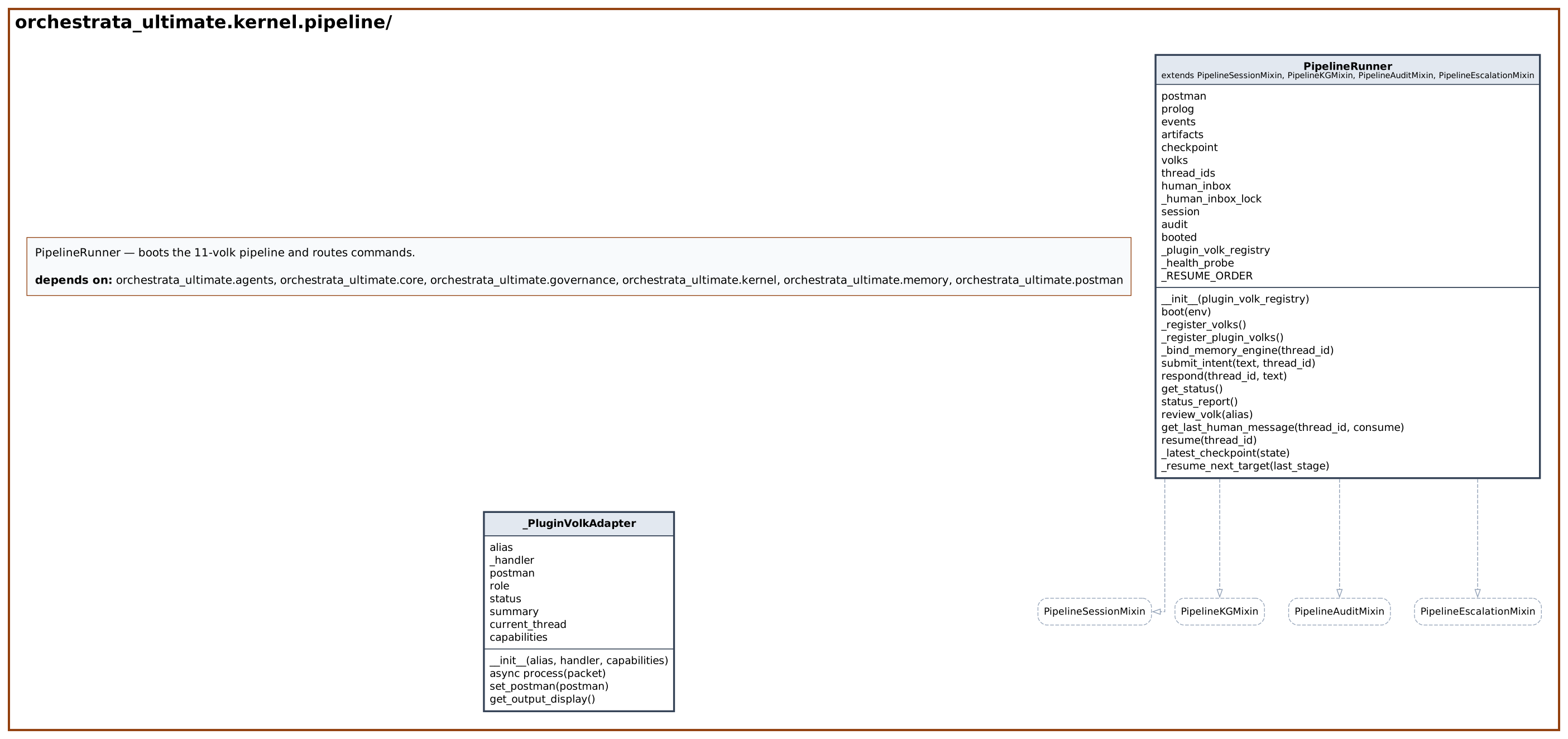
PipelineRunner is composed of four mixins: session, knowledge graph, audit and escalation. Its constructor creates the collaborators: a Postman (see the postman package), a PrologGate (see prolog_gate), a PipelineEventBus and PipelineCheckpoint sharing the postman's Redis client, an artifact store, and a bounded human_inbox deque (256 entries by default) that holds replies addressed to the human.
bootvalidates configuration, loads the Prolog rules (the boot line reports permissive mode if loading fails), creates the workspace directory, starts session and audit services, calls_register_volksand_register_plugin_volks, syncs volk and component nodes to the knowledge graph and emits a boot event._register_volksinstantiates the volks under the aliasesU:Cx,U:PM,U:Ux,U:Ar,U:Cd,J:Junior,U:Qa,U:BA,U:Cp,U:DoandU:SD, registers eachprocessmethod with the postman, registers aHUMANhandler, and hands each volk the postman, runtime writer, context injector and optional health probe._PluginVolkAdapterwraps plugin-registered handlers, sync or async, to look like a volk.submit_intentbegins a session, builds aCXPPacketfromHUMANtoU:Cxwith subjectintent, and asks the Prolog gate whetherHUMANmaysubmit_intent; if not, it returns None. Otherwise it emits an intent event, binds a memory engine to the thread on a best-effort basis, syncs the intent to the graph, calls the postman'sroute_sync, and files a reply for the human in the inbox or routes an escalation reply on to the next volk. A clarification reply also asserts an open question in Prolog.respondfinds the volk that last spoke on the thread, retracts the open question and routes aresponsepacket to it with the prior human answers.resumereloads checkpointed stage outputs and re-dispatches from the stage after the last completed one.get_status,status_report,review_volkandget_last_human_messagesupport the CLIs.
At a glance
Class diagram
Dependency diagram
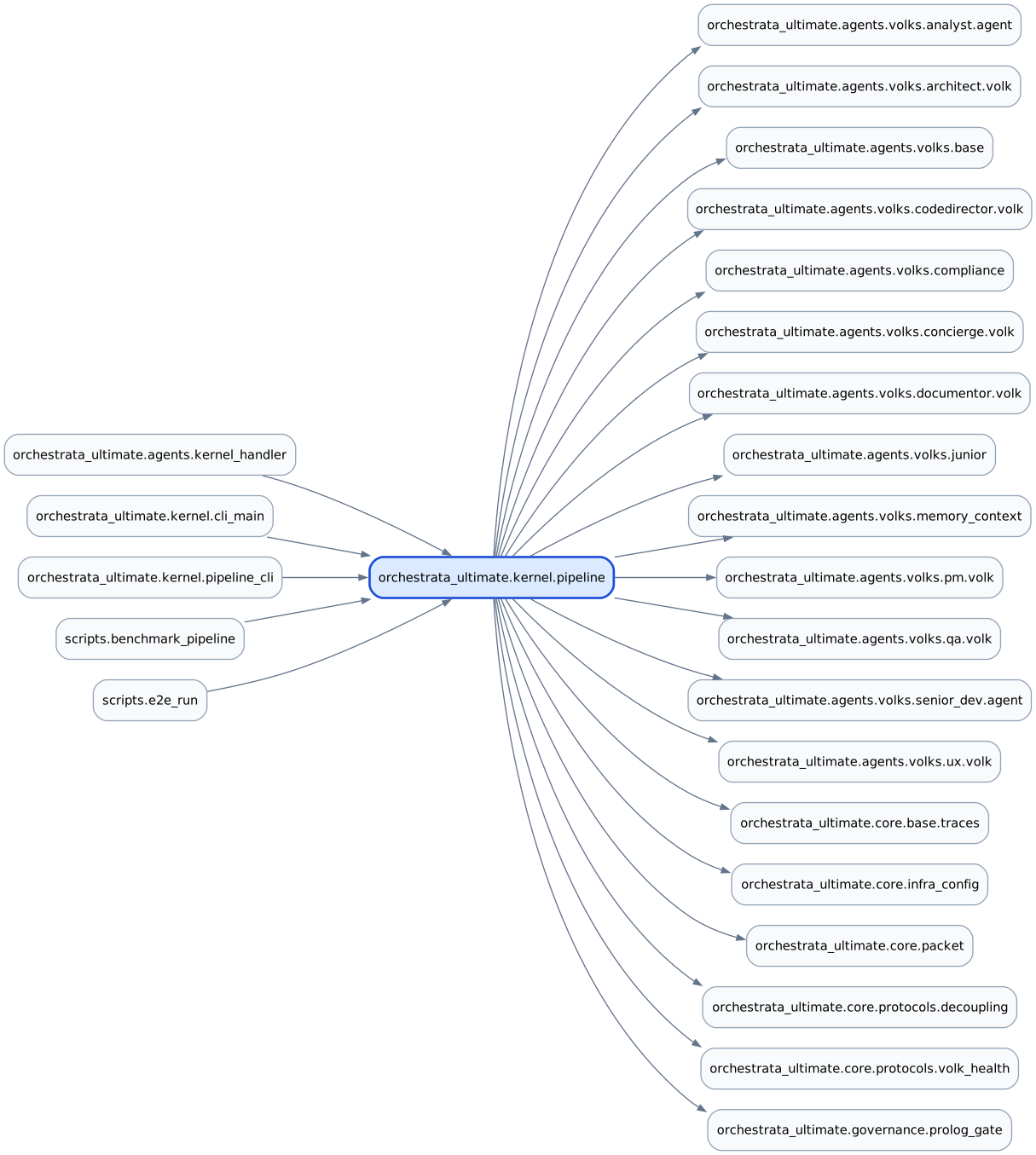
Truncated at 25 nodes: showing 19 of 29 imports and 5 of 5 importers.
API
Classes
_PluginVolkAdapter
Line 58
Presents a plugin-registered Volk handler with the full volk interface the kernel expects.
| Method | Signature | Summary |
|---|---|---|
__init__ |
__init__(alias: str, handler: Callable[[CXPPacket], CXPPacket | None | Awaitable[CXPPacket | None]], capabilities: tuple[str, ...] = ()) -> None |
|
process |
async process(packet: CXPPacket) -> CXPPacket | None |
|
set_postman |
set_postman(postman: object) -> None |
|
get_output_display |
get_output_display() -> str |
PipelineRunner
Bases: PipelineSessionMixin, PipelineKGMixin, PipelineAuditMixin, PipelineEscalationMixin · Line 106
Production pipeline runner for multi-volk orchestration.
| Method | Signature | Summary |
|---|---|---|
__init__ |
__init__(plugin_volk_registry: PluginVolkRegistryProtocol | None = None, *, health_probe: VolkHealthProbe | None = None, human_inbox_max: int = 256) -> None |
Args: plugin_volk_registry: Optional plugin VolkRegistry whose registered Volks are projected onto the live dispatch at boot, so packets addressed to their aliases reach the plugin handlers… |
boot |
boot(env: Mapping[str, str] | None = None) -> bool |
Boot the kernel — load Prolog, register volks, connect services. |
_register_volks |
_register_volks() -> None |
Instantiate all volks and register them with Postman. |
_register_plugin_volks |
_register_plugin_volks() -> None |
Project plugin-registered Volks onto the live dispatch. |
_bind_memory_engine |
_bind_memory_engine(thread_id: str) -> bool |
Best-effort: bind a memory engine for this thread so volks recall prior context (mirrors the orchestrator path). |
submit_intent |
submit_intent(text: str, thread_id: str | None = None) -> str | None |
Submit an intent — returns thread_id. |
respond |
respond(thread_id: str, text: str) -> None |
Human responds to a volk on a thread. |
get_status |
get_status() -> list[str] |
Return status lines for all registered volks. |
status_report |
status_report() -> list[dict[str, object]] |
Structured live status for every registered volk. |
review_volk |
review_volk(alias: str) -> str |
Get a volk's output for human review. |
get_last_human_message |
get_last_human_message(thread_id: str | None = None, consume: bool = False) -> CXPPacket | None |
Get the most recent message addressed to the human. |
resume |
resume(thread_id: str) -> str | None |
Resume a previously-checkpointed pipeline thread. |
_latest_checkpoint |
_latest_checkpoint(state: dict[str, dict]) -> tuple[str, dict] |
Return the (stage, output) of the furthest-along completed stage. |
_resume_next_target |
_resume_next_target(last_stage: str) -> str | None |
Return the stage that follows last_stage in the pipeline order. |
Source
# mypy: ignore-errors
"""PipelineRunner — boots the 11-volk pipeline and routes commands.
Static-boot pipeline engine for the out-of-process agent runtime and
monolithic boot; the gateway's live path runs
``orchestrator.pipeline_runner``. Composes session, knowledge-graph, and
escalation mixins, and routes CXP packets through the production
``Postman`` (sync router). Used by
``orchestrata_ultimate.kernel.pipeline_cli``.
"""
import inspect
import logging
import os
import threading
from collections import deque
from collections.abc import Awaitable, Callable, Mapping
from orchestrata_ultimate.agents.volks.analyst.agent import AnalystAgent
from orchestrata_ultimate.agents.volks.architect.volk import ArchitectVolk
from orchestrata_ultimate.agents.volks.base import BaseAgent
from orchestrata_ultimate.agents.volks.codedirector.volk import CodeDirectorVolk
from orchestrata_ultimate.agents.volks.compliance import ComplianceVolk
from orchestrata_ultimate.agents.volks.concierge.volk import ConciergeVolk
from orchestrata_ultimate.agents.volks.documentor.volk import DocumentorVolk
from orchestrata_ultimate.agents.volks.junior import JuniorVolk
from orchestrata_ultimate.agents.volks.pm.volk import PMVolk
from orchestrata_ultimate.agents.volks.qa.volk import QaVolk
from orchestrata_ultimate.agents.volks.senior_dev.agent import SeniorDevAgent
from orchestrata_ultimate.agents.volks.ux.volk import UXVolk
from orchestrata_ultimate.core.base.traces import traces
from orchestrata_ultimate.core.infra_config import WORKSPACE_DIR, validate
from orchestrata_ultimate.core.packet import CXPPacket, WorkStatus
from orchestrata_ultimate.core.protocols.decoupling import PluginVolkRegistryProtocol
from orchestrata_ultimate.core.protocols.volk_health import VolkHealthProbe
from orchestrata_ultimate.governance.prolog_gate import PrologGate
from orchestrata_ultimate.kernel.pipeline_artifacts import ArtifactStore
from orchestrata_ultimate.kernel.pipeline_audit import PipelineAuditMixin
from orchestrata_ultimate.kernel.pipeline_checkpoint import PipelineCheckpoint
from orchestrata_ultimate.kernel.pipeline_escalation import PipelineEscalationMixin
from orchestrata_ultimate.kernel.pipeline_events import PipelineEventBus
from orchestrata_ultimate.kernel.pipeline_kg import PipelineKGMixin
from orchestrata_ultimate.kernel.pipeline_session import PipelineSessionMixin
from orchestrata_ultimate.memory.memory_context import (
register_memory,
unregister_memory,
)
from orchestrata_ultimate.postman.postman import Postman
# The volk roster mixes built-in BaseAgent subclasses with plugin-projected
# adapters (_PluginVolkAdapter, below) — both share the same process/
# set_postman/status/summary/role/current_thread/get_output_display surface,
# so this union (not `object`) types `self.volks` precisely enough for that
# shared surface to resolve without per-access `getattr`/`hasattr` guards.
type _Volk = BaseAgent | _PluginVolkAdapter
class _PluginVolkAdapter:
"""Presents a plugin-registered Volk handler with the full volk interface the
kernel expects.
Beyond ``process``/``set_postman``, it exposes the ``status``/``summary``/
``role``/``current_thread``/``get_output_display`` surface that the roster and
status paths (``get_status``, ``status_report`` → the CXP GetStatus RPC,
``review_volk_output``) read — so a registered plugin volk never crashes those
with a missing attribute. The plugin handler may be a sync or async callable
taking a ``CXPPacket``; ``process`` awaits it when needed so the Postman
dispatch treats it like any built-in volk.
"""
def __init__(
self,
alias: str,
handler: Callable[[CXPPacket], CXPPacket | None | Awaitable[CXPPacket | None]],
capabilities: tuple[str, ...] = (),
) -> None:
self.alias = alias
self._handler = handler
self.postman: object = None
# Roster/status surface — plugin volks are stateless request handlers, so
# they report a stable idle status rather than tracking per-thread work.
self.role = "Plugin"
self.status = WorkStatus.PENDING
self.summary = "Plugin volk"
self.current_thread: str | None = None
# Declared capabilities let a plugin volk participate in capability-routed
# hops (PipelineEscalationMixin.resolve_capability discovers them).
self.capabilities = capabilities
@traces(spec="015", story="US-015-002", reqs=["REQ-015-021", "REQ-015-022"])
async def process(self, packet: CXPPacket) -> CXPPacket | None:
result = self._handler(packet)
if inspect.isawaitable(result):
return await result
return result
@traces(spec="015", story="US-015-002", reqs=["REQ-015-018"])
def set_postman(self, postman: object) -> None:
self.postman = postman
@traces(spec="000", story="US-006", reqs=["REQ-000-051"])
def get_output_display(self) -> str:
return f"Plugin volk {self.alias} (no captured output)."
class PipelineRunner(
PipelineSessionMixin, PipelineKGMixin, PipelineAuditMixin, PipelineEscalationMixin
):
# Mixin order matters for the type checker: PipelineAuditMixin's concrete
# _audit_fire must precede PipelineEscalationMixin, whose TYPE_CHECKING
# _EscalationHost declares the same method as a bodyless stub — with the
# stub first in the MRO, pyright reports the class as abstract.
"""Production pipeline runner for multi-volk orchestration."""
@traces(
spec="001",
story="US-001",
reqs=["REQ-001-018", "REQ-001-015", "REQ-001-US-002-030"],
)
def __init__(
self,
plugin_volk_registry: PluginVolkRegistryProtocol | None = None,
*,
health_probe: VolkHealthProbe | None = None,
human_inbox_max: int = 256,
) -> None:
"""
Args:
plugin_volk_registry: Optional plugin ``VolkRegistry`` whose
registered Volks are projected onto the live dispatch at boot,
so packets addressed to their aliases reach the plugin handlers
exactly like the built-in volks. When omitted, only the 11
built-in volks are dispatchable.
health_probe: Optional ``VolkHealthProbe`` (e.g. ``VolkRegistry``)
consulted by :meth:`status_report` to enrich each volk row with
heartbeat health (REQ-001-018). When omitted, ``status_report``
is byte-identical to its pre-heartbeat shape.
human_inbox_max: Cap on ``human_inbox``'s size (D-H4,
plans/kernel-dispatch-reply-hardening.md §3.2). A tunable, not
an infra endpoint (RUL-003 inverse) — mirrors ReplyRouter's
own drop-oldest 256. Steady-state size stays near zero once
``get_last_human_message(consume=True)`` claims each matched
reply (D-H3); this cap only bounds unclaimed residue (e.g.
session-mixin terminals like ``qa_complete``).
"""
self.postman = Postman()
self.prolog = PrologGate()
self.events = PipelineEventBus(self.postman._redis)
self._init_context_injector()
# Queryable IN-MEMORY artifact collection, fed from stage-completion
# hooks in the session/escalation mixins. The kernel engine serves
# many projects from one long-lived process, so there is no single
# sanctioned base dir for the store's JSONL layer here — durability
# comes from PipelineKGMixin's graph sync and the on-demand
# ``write_to_disk``; per-project durable stores are the orchestrator
# engine's job (PipelineRunner(project_dir=...)).
self.artifacts = ArtifactStore()
# Per-stage output checkpoint store enabling resume (small state →
# Redis, large blobs → disk + pointer). Reuses the postman's Redis.
self.checkpoint = PipelineCheckpoint(redis_client=self.postman._redis)
self.volks: dict[str, _Volk] = {}
self.thread_ids: set = set()
# Bounded deque (D-H4): append/reversed/[-1]/remove are all
# deque-native, so every existing human_inbox usage form is
# unchanged; only the drop-oldest cap and consume-on-match
# (get_last_human_message) are new.
self.human_inbox: deque[CXPPacket] = deque(maxlen=human_inbox_max)
# Guards every human_inbox read-scan and mutation. deque iteration
# RAISES RuntimeError on concurrent append, and deque.remove RAISES
# IndexError when the deque mutates during its __eq__-dispatching
# scan (CXPPacket.__eq__ is Python-level, so the scan yields) — both
# reachable when a background round's consume races another round's
# append (reviewer findings 1-2, 2026-08-05). One lock over the
# three append sites and the snapshot+match+remove makes the
# claim-check atomic; sections are tiny and never await.
self._human_inbox_lock = threading.Lock()
self.session = None
self.audit = None
self.booted = False
self._plugin_volk_registry = plugin_volk_registry
self._health_probe = health_probe
@traces(spec="000", story="US-002", reqs=["REQ-000-009"])
@traces(spec="001", story="US-008", reqs=["REQ-001-US-008-020"])
def boot(self, env: Mapping[str, str] | None = None) -> bool:
"""Boot the kernel — load Prolog, register volks, connect services.
Args:
env: Injection seam for both the SPEC-001 US-008 audit-logger's
enable/disable check and session-manager init (defaults to
``os.environ``; tests pass an explicit mapping instead of
monkeypatching the process environment — see
``_init_audit_logger`` / ``_init_session_manager``).
Returns:
True when boot completes successfully.
"""
print("[Kernel] Booting...")
warnings = validate()
for w in warnings:
print(f" [Config] WARNING: {w}")
prolog_ok = self.prolog.load_rules()
os.makedirs(WORKSPACE_DIR, exist_ok=True)
print(f" [Workspace] {WORKSPACE_DIR}")
self._init_session_manager(env)
self._init_audit_logger(env)
self._start_audit_background()
self._register_volks()
self._register_plugin_volks()
print(f" [Volks] Registered: {', '.join(self.volks.keys())}")
print(f" [Prolog] {'Loaded' if prolog_ok else 'FAILED — permissive mode'}")
print("[Kernel] Ready.")
print()
self.booted = True
# Publish the standing roster into the KG so the semantic layer is
# queryable with live Volk nodes (best-effort; no-op without the graph).
synced = self.sync_volks_to_kg()
if synced:
print(f" [KG Volks] {synced} volk nodes synced")
components_synced = self.sync_components_to_kg()
if components_synced:
print(f" [KG Components] {components_synced} component nodes synced")
self.events.emit_boot(list(self.volks.keys()))
return True
def _register_volks(self) -> None:
"""Instantiate all volks and register them with Postman."""
cx = ConciergeVolk()
pm = PMVolk()
ux = UXVolk()
ar = ArchitectVolk()
vz = CodeDirectorVolk()
jr = JuniorVolk()
# QaVolk's mixins (agents/volks/qa/_*.py) use the "mixin self-type"
# trick: they inherit `_QaHost` (a package-local Protocol declaring
# `_call_llm` as abstract) only under TYPE_CHECKING, purely so pyright
# can resolve `self.<attr>` accesses inside the mixins. At runtime the
# mixins inherit plain `object`, so QaVolk (which also inherits the
# concrete `BaseAgent._call_llm`) is genuinely instantiable — proven
# by every QaVolk() call across tests/agents/volks/qa/. Pyright's
# static MRO still resolves `_call_llm` to the abstract Protocol stub
# ahead of BaseAgent's concrete override, a documented false positive
# of that typing-only trick (out of scope here: agents/volks/qa/*.py).
qa = QaVolk() # pyright: ignore[reportAbstractUsage]
ba = AnalystAgent()
cp = ComplianceVolk()
do = DocumentorVolk()
sd = SeniorDevAgent()
self.volks = {
"U:Cx": cx,
"U:PM": pm,
"U:Ux": ux,
"U:Ar": ar,
"U:Cd": vz,
"J:Junior": jr,
"U:Qa": qa,
"U:BA": ba,
"U:Cp": cp,
"U:Do": do,
"U:SD": sd,
}
for alias, volk in self.volks.items():
self.postman.register(alias, volk.process)
self.postman.register("HUMAN", self._human_handler)
for volk in self.volks.values():
volk.set_postman(self.postman)
# set_runtime_writer/set_context_injector are BaseAgent-only hooks
# (_PluginVolkAdapter is a deliberately thinner surface — plugin
# volks don't participate in KG runtime-signal writing or the
# validator context-injection loop), so narrow with isinstance
# rather than hasattr (which doesn't narrow union membership).
if isinstance(volk, BaseAgent):
volk.set_runtime_writer(getattr(self, "_runtime_writer", None))
volk.set_context_injector(getattr(self, "context_injector", None))
# G5 (plans/volk-comms-heartbeat-design.md §4.1 decision 7):
# mirrors orchestrator/pipeline_runner.py:786 -- bind the
# injected health probe into every rostered volk so its tool
# calls (message_volk health pre-check, get_volk_status) can
# query peer health, exactly like the orchestrator's live
# path already does. Only when a probe was actually injected
# (self._health_probe is Optional) -- previously the kernel
# path never bound a registry into its volks at all.
if self._health_probe is not None:
volk.set_volk_registry(self._health_probe)
@traces(
spec="015",
story="US-015-002",
reqs=["REQ-015-017", "REQ-015-021"],
)
def _register_plugin_volks(self) -> None:
"""Project plugin-registered Volks onto the live dispatch.
Iterates the injected plugin ``VolkRegistry`` and registers each Volk's
handler with the same ``Postman`` map the built-in volks use, wrapped so
it presents the volk interface (``process``/``set_postman``). After this,
a CXP packet addressed to a plugin Volk's alias is dispatched to the
plugin handler — the SPEC-015 registration becomes operational, not just
recorded.
"""
registry = self._plugin_volk_registry
if registry is None:
return
for alias in registry.list_volks():
rv = registry.get_volk(alias)
if rv is None:
continue
adapter = _PluginVolkAdapter(
alias, rv.handler, capabilities=tuple(getattr(rv, "capabilities", ()))
)
adapter.set_postman(self.postman)
self.volks[alias] = adapter
self.postman.register(alias, adapter.process)
def _bind_memory_engine(self, thread_id: str) -> bool:
"""Best-effort: bind a memory engine for this thread so volks recall
prior context (mirrors the orchestrator path). Returns False and no-ops
when memory or its backing store is unavailable — the kernel pipeline
never breaks on it.
The orchestrator path is async and calls ``MemoryEngine.initialize`` in
the runner's event loop; the kernel path is synchronous, so this helper
bridges the async initialization using the same thread-pool pattern
``postman.sync_router`` uses for async handlers.
"""
try:
from orchestrata_ultimate.agents.volks.memory_context import _run_async_sync
from orchestrata_ultimate.memory.memory_engine import MemoryEngine
engine = MemoryEngine()
_run_async_sync(engine.initialize({}))
register_memory(thread_id, engine)
return True
except Exception as exc:
logging.getLogger(__name__).debug(
"memory engine unavailable for kernel thread %s: %s", thread_id, exc
)
return False
@traces(
spec="000",
story="US-004",
reqs=[
"REQ-000-033",
"REQ-000-035",
"REQ-000-036",
"REQ-000-037",
"REQ-000-041",
],
)
def submit_intent(self, text: str, thread_id: str | None = None) -> str | None:
"""Submit an intent — returns thread_id.
Args:
text: Human intent text.
thread_id: Optional caller-supplied conversation id. When provided
(e.g. the gateway dispatching a UI intent over gRPC) it is
honoured so the volk's reply correlates to the caller's
conversation and follow-up ``respond(thread_id, ...)`` resolves
the same thread. When omitted a fresh id is minted.
Returns:
The thread ID for the new conversation, or None if blocked.
"""
if self.session:
try:
self.session.begin(purpose=text)
print(" [Session] Started", flush=True)
except Exception as exc:
print(f" [Session] Begin failed: {exc}", flush=True)
packet = CXPPacket(
from_agent="HUMAN",
to_agent="U:Cx",
subject="intent",
payload={"text": text},
# CXPPacket.thread_id is `str = ""` (falsy-checked, not Optional);
# `or ""` preserves the existing "mint a fresh id when omitted"
# behaviour (`"" or uuid4()` == `None or uuid4()` at runtime).
thread_id=thread_id or "",
)
thread_id = packet.thread_id
allowed, reason = self.prolog.may_execute("HUMAN", "submit_intent")
print(f" [Prolog] may_execute(HUMAN, submit_intent): {reason}")
if not allowed:
print(f" [BLOCKED] {reason}")
return None
self.events.emit_intent(thread_id, text)
# Bind a memory engine for this thread so volks recall prior context on
# the kernel path too (mirrors the orchestrator path). Best-effort/no-op
# when Redis/graph is unavailable. Round-scoped: released in the
# `finally` below (P-H2, plans/kernel-dispatch-reply-hardening.md D-H2)
# so this round's bind is always balanced — under the refcounted
# registry (P-H1, memory/memory_context.py) an unreleased bind here
# would leak a permanent +1 count on the thread, and a same-thread
# concurrent round's own binding must survive this round finishing
# first.
memory_bound = self._bind_memory_engine(thread_id)
try:
# Record the intent + its pipeline run in the semantic graph so the
# provenance chain (intent → run → volk → artifact) is queryable. The
# run's EXECUTED_BY / artifact GENERATED_BY edges are added as stages
# produce artifacts (sync_artifacts_to_kg). Best-effort — never blocks.
self.sync_intent_to_kg(thread_id, text)
response = self.postman.route_sync(packet)
self.thread_ids.add(thread_id)
if response and response.to_agent == "HUMAN":
# F8 fix: the very first hop can itself be a clarification
# request (e.g. ConciergeVolk asking a follow-up question)
# before any escalation routing ever runs — mark the open
# question here too, same as _route_escalation does for every
# later hop, so may_complete's no_open_questions gate sees it.
if response.subject == "clarification":
try:
self.prolog.assert_open_question(
response.from_agent, f"task_{thread_id}"
)
except Exception as exc:
print(f" [Prolog] assert_open_question failed: {exc}")
with self._human_inbox_lock:
self.human_inbox.append(response)
if (
response
and response.to_agent in self.volks
and response.to_agent != "HUMAN"
):
self._route_escalation(response)
return thread_id
finally:
if memory_bound:
unregister_memory(thread_id)
@traces(
spec="000",
story="US-004",
reqs=["REQ-000-039", "REQ-000-040"],
)
def respond(self, thread_id: str, text: str) -> None:
"""Human responds to a volk on a thread.
Args:
thread_id: The active thread identifier.
text: The human's response text.
"""
if thread_id not in self.thread_ids:
print(f" [Error] Thread {thread_id} not found")
return
thread_packets = self.postman.get_thread_packets(thread_id)
target = "U:Cx"
if thread_packets:
last_packet = thread_packets[-1]
target = last_packet.from_agent
if target == "HUMAN":
for p in reversed(thread_packets):
if p.from_agent != "HUMAN":
target = p.from_agent
break
prior_answers = [
p.payload.get("text", "")
for p in thread_packets
if p.from_agent == "HUMAN" and p.subject == "response"
]
# F8 fix: the human answering resolves whatever open question
# `target` raised (assert_open_question, set when `target` sent a
# "clarification" packet — see submit_intent/_route_escalation).
# Without this, an open question could be asserted but never
# retracted, permanently denying may_complete for this task —
# the mirror-image bug of the self-fulfilling one this fix removes.
try:
self.prolog.retract_open_question(target, f"task_{thread_id}")
except Exception as exc:
print(f" [Prolog] retract_open_question failed: {exc}")
packet = CXPPacket(
from_agent="HUMAN",
to_agent=target,
thread_id=thread_id,
subject="response",
payload={"text": text, "prior_answers": prior_answers},
)
response = self.postman.route_sync(packet)
if response:
if response.to_agent == "HUMAN":
with self._human_inbox_lock:
self.human_inbox.append(response)
elif response.to_agent in self.volks:
self._route_escalation(response)
@traces(spec="000", story="US-002", reqs=["REQ-000-023"])
def get_status(self) -> list[str]:
"""Return status lines for all registered volks.
Returns:
List of status strings, one per volk.
"""
return [
f"[{volk.status.value.upper()}] {alias}: {volk.summary}"
for alias, volk in self.volks.items()
]
@traces(spec="000", story="US-002", reqs=["REQ-000-023"])
@traces(spec="001", story="US-001", reqs=["REQ-001-018", "REQ-001-015"])
def status_report(self) -> list[dict[str, object]]:
"""Structured live status for every registered volk.
The machine-readable counterpart to :meth:`get_status` — this is what the
orchestrator/gateway query to know each volk's status at any point in
time (``busy`` is derived from the volk holding a ``current_thread``).
When a health probe is wired in (``self._health_probe``, REQ-001-015),
each row is additionally enriched with heartbeat health — ``healthy``,
``heartbeat_age_s``, ``last_heartbeat`` (REQ-001-018). A failure
enriching any one row is swallowed so it never breaks the report
(REQ-001-017); that row simply omits the three health keys. With no
probe injected, rows are byte-identical to the pre-heartbeat shape.
"""
report: list[dict[str, object]] = []
for alias, volk in self.volks.items():
current_thread = getattr(volk, "current_thread", None)
entry: dict[str, object] = {
"alias": alias,
"role": getattr(volk, "role", ""),
"status": volk.status.value,
"summary": volk.summary,
"current_thread": current_thread,
"busy": current_thread is not None,
}
if self._health_probe is not None:
try:
health = self._health_probe.get_volk_health(alias)
entry["healthy"] = (
health.is_healthy if health is not None else False
)
entry["heartbeat_age_s"] = (
health.heartbeat_age_seconds if health is not None else None
)
entry["last_heartbeat"] = (
health.last_heartbeat.isoformat()
if health is not None and health.last_heartbeat is not None
else None
)
except Exception:
# REQ-001-017: a probe failure for one volk must never
# break the roster report for the rest.
logging.getLogger(__name__).warning(
f"Health probe failed for volk {alias!r}; omitting "
"heartbeat health from its status_report row",
exc_info=True,
)
report.append(entry)
return report
@traces(spec="000", story="US-006", reqs=["REQ-000-051", "REQ-000-052"])
def review_volk(self, alias: str) -> str:
"""Get a volk's output for human review.
Args:
alias: The volk alias to review.
Returns:
Display string of the volk's output, or error message.
"""
if alias not in self.volks:
return f"Unknown volk: {alias}"
# self.volks holds both BaseAgent volks and plugin adapters; only the
# former expose get_output_display, so guard rather than assume.
display = getattr(self.volks[alias], "get_output_display", None)
if not callable(display):
return f"Volk {alias} has no reviewable output."
return str(display())
@traces(spec="001", reqs=["REQ-001-US-002-033", "REQ-001-US-002-039"])
def get_last_human_message(
self, thread_id: str | None = None, consume: bool = False
) -> CXPPacket | None:
"""Get the most recent message addressed to the human.
Args:
thread_id: When given, scan the inbox in reverse and return the
newest packet whose ``thread_id`` matches; None if no packet
matches. When omitted, behavior is unchanged: the last
packet in the inbox (or None if empty).
consume: When True and a packet matches, remove it from
``human_inbox`` (D-H3, claim-check pattern,
plans/kernel-dispatch-reply-hardening.md §3.2) so a later
round on the same thread can never re-match — and re-emit as
its own terminal — a reply an earlier round already claimed.
Default False keeps every other caller (peeks) byte-identical
(REQ-000-039/040).
Returns:
The matching CXPPacket, or None.
"""
# The whole scan+match+remove runs under _human_inbox_lock, shared
# with every append site: deque iteration raises RuntimeError on a
# concurrent append, and deque.remove raises IndexError when the
# deque mutates during its Python-__eq__ scan, so an unlocked
# "snapshot" is not a fix — it is the crash site. Under the lock the
# claim-check is atomic: a matched packet is still present when
# removed, and two rounds can never claim the same reply.
with self._human_inbox_lock:
if thread_id is None:
match = self.human_inbox[-1] if self.human_inbox else None
else:
match = None
for packet in reversed(self.human_inbox):
if packet.thread_id == thread_id:
match = packet
break
if match is not None and consume:
self.human_inbox.remove(match)
return match
@traces(spec="003", story="FR-024", reqs=["REQ-003-FR24-003"])
def resume(self, thread_id: str) -> str | None:
"""Resume a previously-checkpointed pipeline thread.
LLM stages are not replayable, so resume reuses the outputs already
checkpointed for completed stages and re-dispatches from the stage that
follows the last completed one — injecting the prior outputs as the
escalation payload so the downstream volk receives the real upstream
work instead of re-running it.
Args:
thread_id: The thread to resume.
Returns:
The thread id when a resume was dispatched, or None when there is
nothing to resume (no checkpointed stages).
"""
state = self.checkpoint.resume_state(thread_id)
if not state:
print(f" [Resume] No checkpoint for thread {thread_id}", flush=True)
return None
self.thread_ids.add(thread_id)
last_stage, last_output = self._latest_checkpoint(state)
next_target = self._resume_next_target(last_stage)
print(
f" [Resume] thread={thread_id} reusing {len(state)} stage(s); "
f"last={last_stage} → {next_target}",
flush=True,
)
self.events.emit_intent(thread_id, f"resume after {last_stage}")
if next_target is None or next_target not in self.volks:
# Nothing left to run downstream — the pipeline was already complete.
return thread_id
payload = dict(last_output)
payload["resumed_from"] = last_stage
packet = CXPPacket(
from_agent=last_stage,
to_agent=next_target,
thread_id=thread_id,
subject=payload.get("subject", "implement"),
payload=payload,
)
self._route_escalation(packet)
return thread_id
# Choreographed stage order used only to pick the next stage on resume.
_RESUME_ORDER = ["U:Cx", "U:BA", "U:PM", "U:Ar", "U:Cd", "U:Qa", "U:Cp"]
@traces(spec="003", story="FR-024", reqs=["REQ-003-FR24-003"])
def _latest_checkpoint(self, state: dict[str, dict]) -> tuple[str, dict]:
"""Return the (stage, output) of the furthest-along completed stage."""
ordered = [s for s in self._RESUME_ORDER if s in state]
last_stage = ordered[-1] if ordered else next(iter(state))
return last_stage, state[last_stage]
@traces(spec="003", story="FR-024", reqs=["REQ-003-FR24-003"])
def _resume_next_target(self, last_stage: str) -> str | None:
"""Return the stage that follows *last_stage* in the pipeline order."""
if last_stage not in self._RESUME_ORDER:
return None
idx = self._RESUME_ORDER.index(last_stage)
if idx + 1 >= len(self._RESUME_ORDER):
return None
return self._RESUME_ORDER[idx + 1]