orchestrata_ultimate.agents.volks.architect.volk
Reference › orchestrata_ultimate › agents › volks › architect › volk
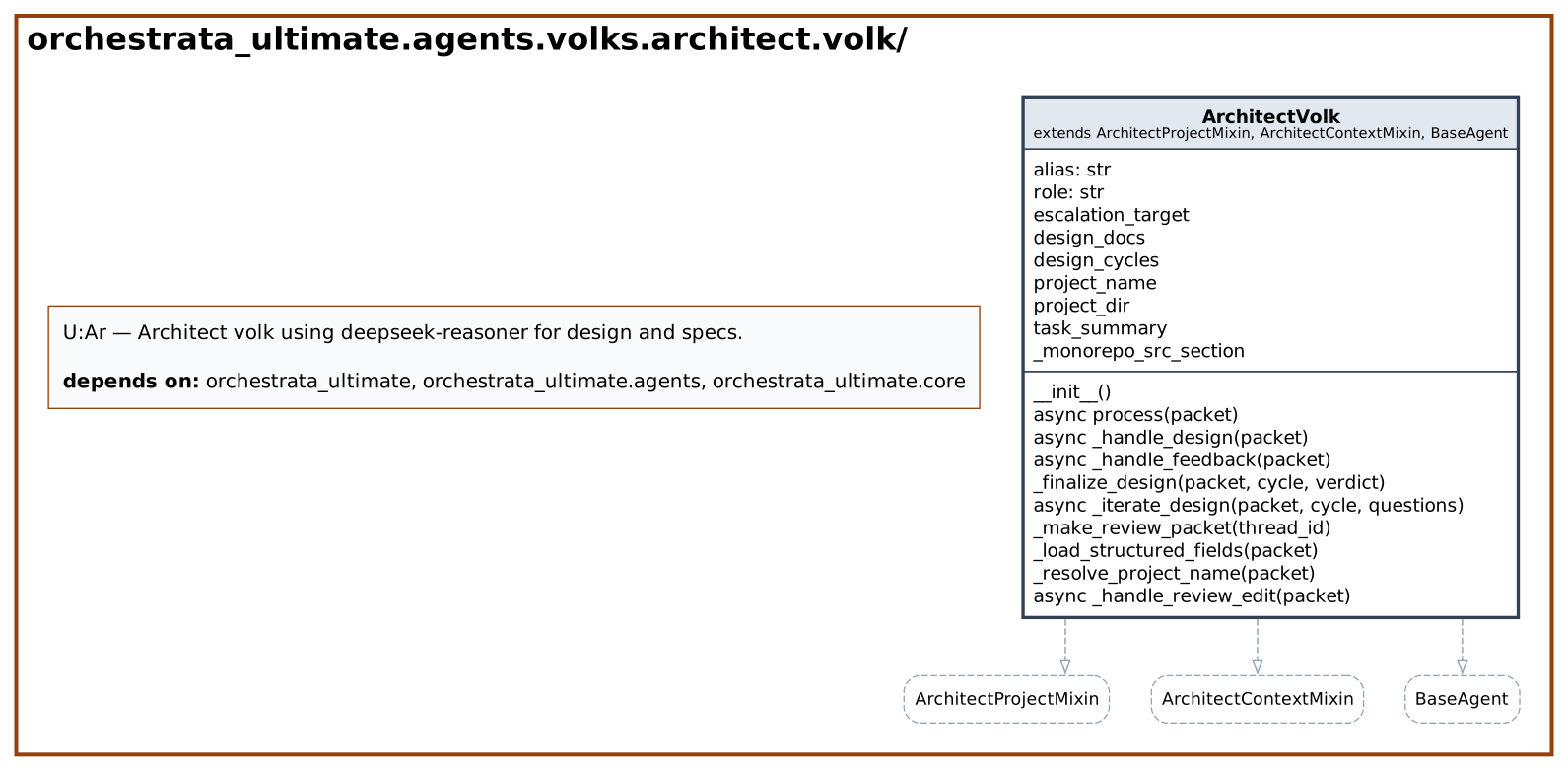
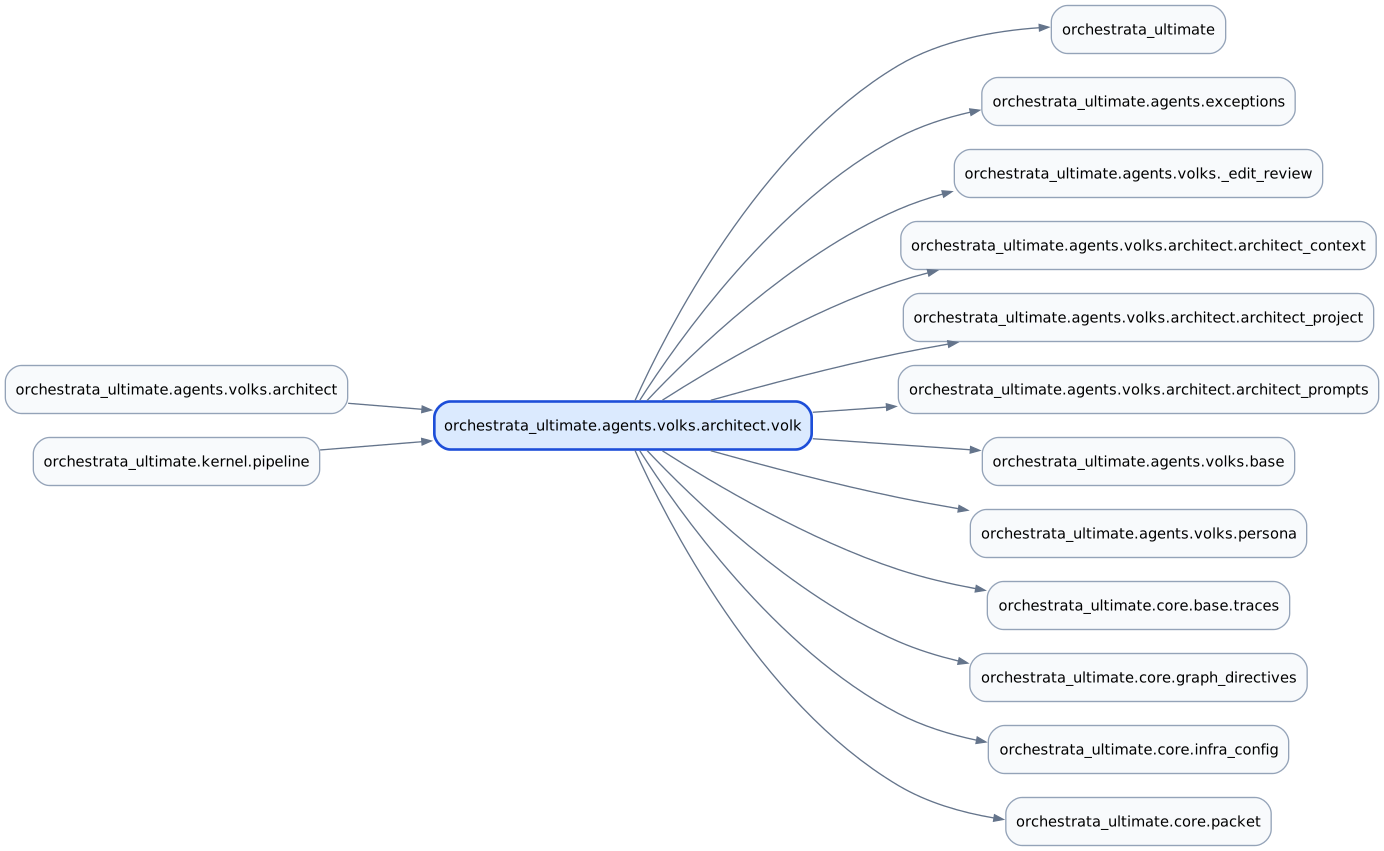
ArchitectVolk (alias U:Ar, role Architect) is the principal designer of the pipeline (specifications 030 and 000). It extends BaseAgent (base) together with two mixins, ArchitectContextMixin (architect_context) and ArchitectProjectMixin (architect_project), and takes its prompt from architect_prompts. It is imported by the package __init__ and the kernel pipeline.
What it receives: an implement packet from the Project Manager (volk) or a ux_complete packet from the UX volk (volk); feedback packets from the Junior volk during design review; and review_edit packets from other volks. What it produces: the design documents (architecture, requirements, file tree, API spec, class diagram) in an implement packet addressed to the CodeDirector (U:Cd), plus design_review packets for J:Junior along the way.
_handle_design loads the structured fields from the Analyst (_load_structured_fields), resolves the project name and directory, builds the prompt from the specification and optional UX sections (_build_spec_section, _build_ux_section) and existing monorepo API sources, initialises the project (_init_project), calls the model through the tool loop with a budget of 16 turns, and parses the sections. When ORCHESTRATA_SKELETON_FLOW is 1 it first validates the Mermaid class diagram with the real skeleton parser (_validate_class_diagram). If every core section comes back blank it retries once, and a second blank result raises TaskExecutionError rather than sending an empty design to the Junior. Otherwise it writes the design documents and sends a review packet (_make_review_packet) to the Junior. _handle_feedback reads the verdict: when the Junior says READY, or the cycle count reaches MAX_DESIGN_CYCLES, _finalize_design writes the docs, commits them to git and escalates to U:Cd; otherwise _iterate_design answers the Junior's questions and loops.
_handle_review_edit is a deterministic floor with no LLM call. It parses the edit fragment with the helpers in _edit_review and returns BLOCK for a relative import, or for direct driver construction outside a factory module, and APPROVE otherwise, in a review_edit_result packet.
At a glance
Class diagram
Dependency diagram
API
Classes
ArchitectVolk (pydantic)
Bases: ArchitectProjectMixin, ArchitectContextMixin, BaseAgent · Decorators: traces(spec='000', story='US-000', reqs=['REQ-000-105']), traces(spec='030', story='US-007', reqs=['REQ-030-045']) · Line 151
Architect volk — designs architecture using deepseek-reasoner.
| Attribute | Type | Default |
|---|---|---|
alias |
str |
Field(default='U:Ar') |
role |
str |
'Architect' |
| Method | Signature | Summary |
|---|---|---|
__init__ |
__init__() |
|
process |
async process(packet: CXPPacket) -> CXPPacket | None |
Route incoming CXP packets to the appropriate handler. |
_handle_design |
async _handle_design(packet: CXPPacket) -> CXPPacket |
Create initial architecture from requirements. |
_handle_feedback |
async _handle_feedback(packet: CXPPacket) -> CXPPacket |
Handle design feedback from J:Junior. |
_finalize_design |
_finalize_design(packet: CXPPacket, cycle: int, verdict: str) -> CXPPacket |
Finalize and escalate approved design to U:Cd. |
_iterate_design |
async _iterate_design(packet: CXPPacket, cycle: int, questions: list) -> CXPPacket |
Update design in response to junior's questions. |
_make_review_packet |
_make_review_packet(thread_id: str) -> CXPPacket |
Build a design_review CXP packet for J:Junior. |
_load_structured_fields |
_load_structured_fields(packet: CXPPacket) -> None |
Extract structured BA fields from packet payload. |
_resolve_project_name |
_resolve_project_name(packet: CXPPacket) -> None |
Set project_name and project_dir from packet or task summary. |
_handle_review_edit |
async _handle_review_edit(packet: CXPPacket) -> CXPPacket |
SPEC-050 P3.1 fail-closed FLOOR for architectural compliance. |
Functions
| Function | Signature | Summary |
|---|---|---|
_esc traces |
_esc(s: str) -> str |
Escape braces so str.format() does not misinterpret content. |
_repo_root |
_repo_root() -> Path |
Return the repository root (the directory containing scripts/). |
_extract_mermaid_block |
_extract_mermaid_block(text: str) -> str | None |
Extract the first fenced mermaid classDiagram block. |
_validate_class_diagram |
_validate_class_diagram(response_text: str) -> None |
Validate a Mermaid contract with the real gen-skeleton parser. |
_extract_edit_fields |
_extract_edit_fields(payload: dict) -> tuple[str, str, str] |
Extract (file_path, old_code, new_code) from a review_edit payload. |
_build_spec_section traces |
_build_spec_section(original_intent: str) -> str |
Build the ORIGINAL_SPEC section string for the design prompt. |
_build_ux_section traces |
_build_ux_section(ux_design: str) -> str |
Build the UX DESIGN section string for the design prompt. |
Source
# mypy: ignore-errors
"""U:Ar — Architect volk using deepseek-reasoner for design and specs."""
import logging
import os
import subprocess
import sys
import tempfile
from pathlib import Path
from pydantic import Field
from orchestrata_ultimate.agents.exceptions import TaskExecutionError
from orchestrata_ultimate.agents.volks._edit_review import (
extract_edit_fields,
has_direct_driver_construction,
has_relative_import,
parse_fragment,
regex_has_direct_driver_construction,
regex_has_relative_import,
)
from orchestrata_ultimate.agents.volks.architect.architect_context import (
ArchitectContextMixin,
)
from orchestrata_ultimate.agents.volks.architect.architect_project import (
ArchitectProjectMixin,
)
from orchestrata_ultimate.agents.volks.architect.architect_prompts import (
ARCHITECT_UPDATE_TEMPLATE,
MAX_DESIGN_CYCLES,
get_architect_prompt_template,
)
from orchestrata_ultimate.agents.volks.base import BaseAgent
from orchestrata_ultimate.core.base.traces import traces
from orchestrata_ultimate.core.graph_directives import extract_graph_context
from orchestrata_ultimate.core.infra_config import PROJECT_WORKSPACE_ROOT
from orchestrata_ultimate.core.packet import CXPPacket, WorkStatus
_logger = logging.getLogger(__name__)
@traces(spec="030", story="US-002", reqs=["REQ-030-017"])
def _esc(s: str) -> str:
"""Escape braces so str.format() does not misinterpret content.
Args:
s: String that may contain literal curly braces.
Returns:
String with {{ and }} replacing { and }.
"""
return s.replace("{", "{{").replace("}", "}}")
def _repo_root() -> Path:
"""Return the repository root (the directory containing ``scripts/``).
``get_project_root()`` stops at the package's bundled ``prolog/``
directory, which is not the repo root, so this helper derives it from
the installed ``orchestrata_ultimate`` package location instead.
"""
import orchestrata_ultimate
return Path(orchestrata_ultimate.__file__).resolve().parent.parent.parent
def _extract_mermaid_block(text: str) -> str | None:
"""Extract the first fenced `````mermaid classDiagram````` block.
Args:
text: The Architect response text.
Returns:
The diagram source inside the fence, or ``None`` if absent.
"""
markers = ("```mermaid classDiagram", "```mermaid\nclassDiagram")
for marker in markers:
start = text.find(marker)
if start != -1:
after = start + len(marker)
end = text.find("```", after)
if end == -1:
return None
return text[after:end].strip()
return None
def _validate_class_diagram(response_text: str) -> None:
"""Validate a Mermaid contract with the real gen-skeleton parser.
When ``ORCHESTRATA_SKELETON_FLOW=1`` is set, U:Ar's CLASS_DIAGRAM block
must be parseable by ``scripts/serialize_codebase_ast.py gen-skeleton``.
A malformed contract is logged as a WARNING and the pipeline falls back
to the freehand design path — it never crashes the run.
Args:
response_text: The raw LLM response containing the CLASS_DIAGRAM section.
"""
block = _extract_mermaid_block(response_text)
if block is None:
_logger.warning(
"SKELETON_FLOW: no fenced mermaid classDiagram block found; "
"falling back to freehand design path"
)
return
try:
repo_root = _repo_root()
except Exception as exc: # pragma: no cover - defensive
_logger.warning("SKELETON_FLOW: cannot locate repo root: %s", exc)
return
script_path = repo_root / "scripts" / "serialize_codebase_ast.py"
with tempfile.TemporaryDirectory() as tmpdir:
diagram_path = Path(tmpdir) / "contract.mmd"
output_path = Path(tmpdir) / "skeleton.py"
diagram_path.write_text(block, encoding="utf-8")
try:
result = subprocess.run(
[
sys.executable,
str(script_path),
"gen-skeleton",
"--no-smoke",
"--output",
str(output_path),
str(diagram_path),
],
cwd=str(repo_root),
capture_output=True,
text=True,
timeout=30,
)
except Exception as exc: # pragma: no cover - defensive
_logger.warning(
"SKELETON_FLOW: contract validation subprocess failed: %s",
exc,
)
return
if result.returncode != 0:
detail = (result.stderr.strip() or result.stdout.strip())[:500]
_logger.warning(
"SKELETON_FLOW: contract failed gen-skeleton validation: %s",
detail,
)
@traces(spec="000", story="US-000", reqs=["REQ-000-105"])
@traces(spec="030", story="US-007", reqs=["REQ-030-045"])
class ArchitectVolk(ArchitectProjectMixin, ArchitectContextMixin, BaseAgent):
"""Architect volk — designs architecture using deepseek-reasoner."""
alias: str = Field(default="U:Ar")
role: str = "Architect"
def __init__(self):
super().__init__()
self.escalation_target = "U:Cd"
self.design_docs = {
"architecture": "",
"requirements": "",
"file_tree": "",
"api_spec": "",
"class_diagram": "",
}
self.design_cycles = 0
self.project_name = ""
self.project_dir = ""
self.task_summary = ""
self._monorepo_src_section = ""
@traces(
spec="030",
story="US-001",
reqs=["REQ-030-001", "REQ-030-002"],
)
async def process(self, packet: CXPPacket) -> CXPPacket | None:
"""Route incoming CXP packets to the appropriate handler.
Args:
packet: Incoming CXP packet to process.
Returns:
Response CXP packet, or None if the subject is unhandled.
"""
self._graph_context = extract_graph_context(packet.payload)
if packet.subject in ("implement", "scope_validated", "ux_complete"):
return await self._handle_design(packet)
elif packet.subject == "design_feedback":
return await self._handle_feedback(packet)
elif packet.subject == "review_edit":
return await self._handle_review_edit(packet)
return None
@traces(
spec="030",
story="US-001",
reqs=[
"REQ-030-003",
"REQ-030-004",
"REQ-030-005",
"REQ-030-007",
"REQ-030-009",
],
)
async def _handle_design(self, packet: CXPPacket) -> CXPPacket:
"""Create initial architecture from requirements."""
self.status = WorkStatus.IN_PROGRESS
self.current_thread = packet.thread_id
requirements = packet.payload.get("requirements", "")
# Retained (not just a local var) so _iterate_design can re-ground
# later design-update calls in the ORIGINAL BA requirements text --
# dogfood run-2 F3 defect 3: without this, _iterate_design only had
# its OWN prior (possibly blank) parsed requirements section to work
# from.
self._requirements = requirements
self.task_summary = packet.payload.get("task_summary", "")
self._original_intent = packet.payload.get("original_intent", "")
self._ux_design = packet.payload.get("ux_design", "")
self._scope_data = packet.payload.get("scope_data", {})
self._load_structured_fields(packet)
self._resolve_project_name(packet)
self.summary = "Designing architecture"
print(
f" [U:Ar] Designing architecture for: {self.task_summary}",
flush=True,
)
print(f" [U:Ar] Project dir: {self.project_dir}", flush=True)
self._init_project()
original_spec_section = _build_spec_section(self._original_intent)
full_monorepo_context = await self._build_full_monorepo_context(requirements)
prompt = get_architect_prompt_template().format(
task_summary=self.task_summary,
requirements=requirements + _build_ux_section(self._ux_design),
original_spec_section=original_spec_section,
monorepo_src_section=full_monorepo_context,
)
from orchestrata_ultimate.agents.volks.persona import ( # noqa: PLC0415
compose_persona,
)
# W4.3a: route the primary design-generation call through the
# tool-calling loop (SPEC-103) with U:Ar's registered tools
# (read_file/search_code/ast_query/list_dir --
# tool_registry.AGENT_TOOLS["U:Ar"]) so the Architect can inspect the
# real codebase while designing instead of reasoning from the prompt
# text alone. This replaces the direct ``call_reasoner`` call (still
# used by ``_iterate_design`` below), which has no tool support.
#
# ``call_reasoner`` hardcodes its own system prompt and puts the
# whole persona-composed prompt in the user turn (see the removed
# comment this replaces); ``_call_llm_with_tools`` takes system_prompt
# and user_message explicitly, so that same split is reproduced here.
# It also takes no ``graph_context=`` kwarg -- unlike ``call_reasoner``
# /``call_llm``, the tool loop only forwards temperature/model to
# ``call_with_tools`` -- so the graph context is folded directly into
# the user turn, matching the injection ``call_llm`` performs
# internally (``graph_context + "\n\n---\n\n" + user_message``).
user_message = compose_persona(prompt)
if self._graph_context:
user_message = self._graph_context + "\n\n---\n\n" + user_message
# Dogfood run-4/F13: grounded design work against a real codebase
# routinely burns 6-9 exploration turns before the model is ready to
# compose, so the default ``max_turns=10`` budget was found too tight
# -- the finalization call would fire mid-exploration and return a
# truncated mid-thought fragment instead of a real design. Only the
# primary design-generation call gets the larger budget; the retry
# path in ``_iterate_design`` below is unaffected.
response = await self._call_llm_with_tools(
"You are a deep reasoning architect. Think step by step.",
user_message,
max_turns=16,
temperature=1.0,
)
self.output_artifacts.append(f"=== INITIAL ARCHITECTURE ===\n{response}")
if os.environ.get("ORCHESTRATA_SKELETON_FLOW", "") == "1":
_validate_class_diagram(response)
self._parse_design(response)
if self._core_sections_blank():
# Dogfood run-2 F3 defect 2: a blank response was previously
# written straight to design/ and shipped to J:Junior for review
# (Junior's own review found "Architecture, Requirements, File
# Tree, and API Specification sections ... are all blank"). Retry
# ONCE through the same tool-loop path before failing loud --
# mirrors the fail-loud doctrine already applied to J:Junior
# codegen failures (CodeDirectorVolk._handle_junior_complete).
_logger.warning(
"U:Ar: initial design response had all core sections blank "
"-- retrying once"
)
response = await self._call_llm_with_tools(
"You are a deep reasoning architect. Think step by step.",
user_message,
temperature=1.0,
)
self.output_artifacts.append(
f"=== INITIAL ARCHITECTURE (retry) ===\n{response}"
)
self._parse_design(response)
if self._core_sections_blank():
raise TaskExecutionError(
"U:Ar: design response had all core sections "
"(architecture/requirements/file_tree/api_spec) blank "
"after retry -- refusing to send a blank design to "
"J:Junior for review",
task_id=packet.thread_id,
)
self._write_design_docs()
self.design_cycles = 1
print(
" [U:Ar] Initial design complete. Sending to J:Junior for review...",
flush=True,
)
return self._make_review_packet(packet.thread_id)
@traces(
spec="030",
story="US-002",
reqs=["REQ-030-010", "REQ-030-011", "REQ-030-012", "REQ-030-013"],
)
async def _handle_feedback(self, packet: CXPPacket) -> CXPPacket:
"""Handle design feedback from J:Junior."""
verdict = packet.payload.get("verdict", "")
questions = packet.payload.get("questions", [])
cycle = packet.payload.get("design_cycle", self.design_cycles)
if verdict == "READY" or cycle >= MAX_DESIGN_CYCLES:
return self._finalize_design(packet, cycle, verdict)
return await self._iterate_design(packet, cycle, questions)
@traces(
spec="030",
story="US-002",
reqs=["REQ-030-014", "REQ-030-015", "REQ-030-016"],
)
def _finalize_design(
self, packet: CXPPacket, cycle: int, verdict: str
) -> CXPPacket:
"""Finalize and escalate approved design to U:Cd."""
if cycle >= MAX_DESIGN_CYCLES and verdict != "READY":
print(
f" [U:Ar] Max design cycles ({MAX_DESIGN_CYCLES}) reached -- proceeding",
flush=True,
)
else:
print(f" [U:Ar] Junior is READY after {cycle} cycle(s)", flush=True)
self.summary = f"Design complete ({cycle} cycles)"
self._write_design_docs()
self._git_commit(f"Design finalized after {cycle} review cycle(s)")
return CXPPacket(
from_agent="U:Ar",
to_agent="U:Cd",
thread_id=packet.thread_id,
subject="implement",
payload={
"architecture": self.design_docs["architecture"],
"requirements": self.design_docs["requirements"],
"file_tree": self.design_docs["file_tree"],
"api_spec": self.design_docs["api_spec"],
"class_diagram": self.design_docs["class_diagram"],
"original_intent": self._original_intent,
"project_dir": self.project_dir,
"task_summary": self.task_summary,
"structured_requirements": self._structured_requirements,
"user_stories": self._user_stories,
# Forward monorepo API sources to U:Cd so J:Aider sees real constructors
"monorepo_src_section": self._monorepo_src_section,
"nfrs": self._nfrs,
"spec_metadata": self._spec_metadata,
# Capability-routed hop: the Architect needs *implementation*
# next. The kernel resolves this to whichever volk provides it
# (U:Cd by default), so ``to_agent`` above is the fallback, not a
# hardcoded destination. See PipelineEscalationMixin.
"needs_capability": "implementation",
},
work_status=WorkStatus.IN_PROGRESS,
)
@traces(
spec="030",
story="US-002",
reqs=["REQ-030-018", "REQ-030-019"],
)
async def _iterate_design(
self, packet: CXPPacket, cycle: int, questions: list
) -> CXPPacket:
"""Update design in response to junior's questions.
Args:
packet: The incoming feedback packet.
cycle: Current design cycle number.
questions: List of blocking questions from J:Junior.
Returns:
Updated design packet addressed back to J:Junior.
"""
self.design_cycles = cycle + 1
self.summary = (
f"Updating design (cycle {self.design_cycles})"
f" -- {len(questions)} questions"
)
print(
f" [U:Ar] Updating design for {len(questions)} questions "
f"(cycle {self.design_cycles})...",
flush=True,
)
questions_text = "\n".join(f"{i + 1}. {q}" for i, q in enumerate(questions))
prompt = ARCHITECT_UPDATE_TEMPLATE.format(
task_summary=self.task_summary,
requirements=_esc(getattr(self, "_requirements", "")),
architecture=_esc(self.design_docs["architecture"]),
requirements_doc=_esc(self.design_docs["requirements"]),
file_tree=_esc(self.design_docs["file_tree"]),
api_spec=_esc(self.design_docs["api_spec"]),
class_diagram=_esc(self.design_docs["class_diagram"]),
questions=questions_text,
monorepo_src_section=_esc(getattr(self, "_monorepo_src_section", "")),
)
from orchestrata_ultimate.agents.volks.persona import ( # noqa: PLC0415
compose_persona,
)
# Dogfood run-2 F3 defect 3: plain ``call_reasoner`` has no tool
# support and, when the prior design was blank/truncated, nothing
# left to ground it in the real task -- on run 2 it hallucinated an
# unrelated ("books API") design in response to "your design is
# blank" questions. Mirrors the W4.3a routing in _handle_design
# above: ``_call_llm_with_tools`` takes system_prompt/user_message
# explicitly (unlike ``call_reasoner``, which hardcodes its own
# system prompt and puts everything in the user turn) and takes no
# ``graph_context=`` kwarg, so the graph context is folded directly
# into the user turn here too, matching ``call_reasoner``'s internal
# injection (``graph_context + "\n\n---\n\n" + user_message``). The
# template above also now carries the ORIGINAL task_summary + BA
# requirements text (not just this volk's own prior, possibly blank,
# parsed design) so the iteration stays grounded even when the prior
# design was empty.
user_message = compose_persona(prompt)
if self._graph_context:
user_message = self._graph_context + "\n\n---\n\n" + user_message
response = await self._call_llm_with_tools(
"You are a deep reasoning architect. Think step by step.",
user_message,
temperature=1.0,
)
self.output_artifacts.append(
f"=== DESIGN UPDATE (cycle {self.design_cycles}) ===\n{response}"
)
self._parse_design(response)
self._write_design_docs()
return self._make_review_packet(packet.thread_id)
@traces(
spec="030",
story="US-003",
reqs=["REQ-030-020", "REQ-030-021"],
)
def _make_review_packet(self, thread_id: str) -> CXPPacket:
"""Build a design_review CXP packet for J:Junior.
Args:
thread_id: Thread ID to attach to the packet.
Returns:
CXP packet ready to send to J:Junior.
"""
return CXPPacket(
from_agent="U:Ar",
to_agent="J:Junior",
thread_id=thread_id,
subject="design_review",
payload={
"architecture": self.design_docs["architecture"],
"requirements": self.design_docs["requirements"],
"file_tree": self.design_docs["file_tree"],
"api_spec": self.design_docs["api_spec"],
"class_diagram": self.design_docs["class_diagram"],
"design_cycle": self.design_cycles,
"project_dir": self.project_dir,
"task_summary": self.task_summary,
},
work_status=WorkStatus.IN_PROGRESS,
)
# --- Private helpers: prompt-section assembly ---
@traces(
spec="030",
story="US-004",
reqs=["REQ-030-025", "REQ-030-026"],
)
def _load_structured_fields(self, packet: CXPPacket) -> None:
"""Extract structured BA fields from packet payload.
Args:
packet: CXP packet whose payload contains BA analysis output.
"""
impact_report = packet.payload.get("parameters", {}).get("_impact_report", {})
if impact_report:
print(
f" [U:Ar] Impact analysis: {impact_report.get('classification')} - "
f"{impact_report.get('severity')} severity, "
f"{len(impact_report.get('affected_files', []))} affected files",
flush=True,
)
self._structured_requirements = packet.payload.get(
"structured_requirements", []
)
self._user_stories = packet.payload.get("user_stories", [])
self._nfrs = packet.payload.get("nfrs", [])
self._spec_metadata = packet.payload.get("spec_metadata", {})
self._analyst_output = packet.payload.get("analyst_output", "")
@traces(
spec="030",
story="US-004",
reqs=["REQ-030-027", "REQ-030-028"],
)
def _resolve_project_name(self, packet: CXPPacket) -> None:
"""Set project_name and project_dir from packet or task summary.
Args:
packet: CXP packet that may carry a concierge-supplied project name.
"""
concierge_name = packet.payload.get("project_name")
if concierge_name:
self.project_name = self._slugify(concierge_name)
else:
self.project_name = self._slugify(self.task_summary)
self.project_dir = os.path.join(PROJECT_WORKSPACE_ROOT, self.project_name)
@traces(spec="050", story="US-001", reqs=["REQ-050-FR1-001"])
async def _handle_review_edit(self, packet: CXPPacket) -> CXPPacket:
"""SPEC-050 P3.1 fail-closed FLOOR for architectural compliance.
Deterministic, no LLM call — not a correctness review. Approves
unless the new code violates one of two hard architecture rules
(see CLAUDE.md § Key Rules / scripts/architecture_checker.py):
- absolute-imports-only: no ``from .`` / ``from ..`` relative
imports.
- no direct driver construction outside a factory module: no
``GraphDatabase.driver(``/``redis.Redis(`` calls unless the
target file path itself looks like a factory module.
Checks run against the parsed AST when ``new_code`` parses (via
``_edit_review.parse_fragment``, which tolerates indented
fragments) so a docstring/comment merely mentioning ``from .foo``
or ``GraphDatabase.driver(`` never triggers a false BLOCK; the
regex fallback only fires for genuinely unparseable fragments.
"""
file_path, _old_code, new_code = _extract_edit_fields(packet.payload)
verdict = "APPROVE"
reason = "No architecture violations detected."
new_tree, _parse_error = parse_fragment(new_code)
if new_tree is not None:
relative_import = has_relative_import(new_tree)
direct_driver = has_direct_driver_construction(new_tree)
else:
relative_import = regex_has_relative_import(new_code)
direct_driver = regex_has_direct_driver_construction(new_code)
if relative_import:
verdict = "BLOCK"
reason = "Edit introduces a relative import (absolute imports only)."
elif direct_driver and "factory" not in file_path.lower():
verdict = "BLOCK"
reason = "Edit constructs a driver directly outside a factory module."
return CXPPacket(
from_agent=self.alias,
to_agent=packet.from_agent,
thread_id=packet.thread_id,
subject="review_edit_result",
payload={
"verdict": verdict,
"reason": reason,
"content": reason,
"file_path": file_path,
},
work_status=WorkStatus.RESOLVED,
)
def _extract_edit_fields(payload: dict) -> tuple[str, str, str]:
"""Extract (file_path, old_code, new_code) from a review_edit payload.
Thin re-export of the shared helper (see
``orchestrata_ultimate.agents.volks._edit_review.extract_edit_fields``)
kept under this name for backward compatibility with existing call
sites/tests in this module.
"""
return extract_edit_fields(payload)
@traces(spec="030", story="US-001", reqs=["REQ-030-006"])
def _build_spec_section(original_intent: str) -> str:
"""Build the ORIGINAL_SPEC section string for the design prompt.
Args:
original_intent: The original intent text to include in the prompt.
Returns:
Formatted spec section with brace-escaped content, or empty string.
"""
if not original_intent:
return ""
escaped = original_intent.replace("{", "{{").replace("}", "}}")
return "\n\nORIGINAL_SPEC (from human -- use these exact signatures):\n" + escaped
@traces(spec="030", story="US-001", reqs=["REQ-030-006"])
def _build_ux_section(ux_design: str) -> str:
"""Build the UX DESIGN section string for the design prompt.
Args:
ux_design: The UX design text to incorporate.
Returns:
Formatted UX section with brace-escaped content, or empty string.
"""
if not ux_design:
return ""
escaped = ux_design.replace("{", "{{").replace("}", "}}")
print(" [U:Ar] Incorporating UX design into architecture", flush=True)
return (
"\n\nUX DESIGN (from U:Ux -- incorporate these workflows, "
"components, wireframes, and design tokens into the "
"architecture):\n" + escaped
)