orchestrata_ultimate.agents.kernel_handler
Reference › orchestrata_ultimate › agents › kernel_handler
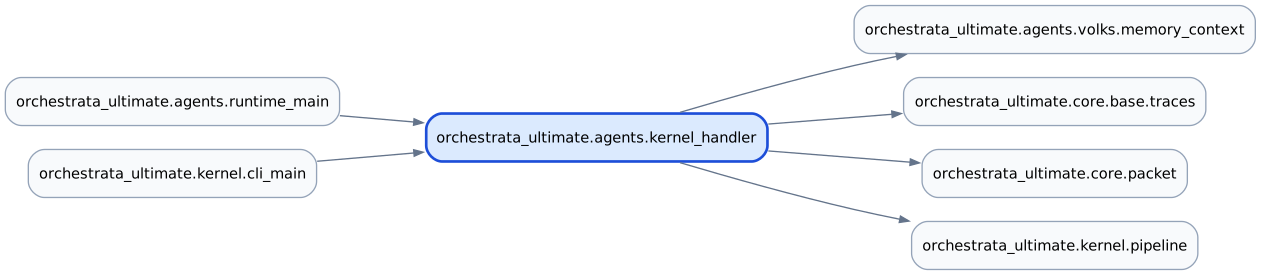
kernel_handler builds the packet handler that connects live CXP gRPC traffic to the volk engine. build_kernel_packet_handler returns a _KernelPacketHandler bound to a booted kernel PipelineRunner (booted over all the volks when none is passed), an optional memory engine and an optional intent broker. runtime_main uses it, as does the kernel CLI; it binds run memory through memory_context.
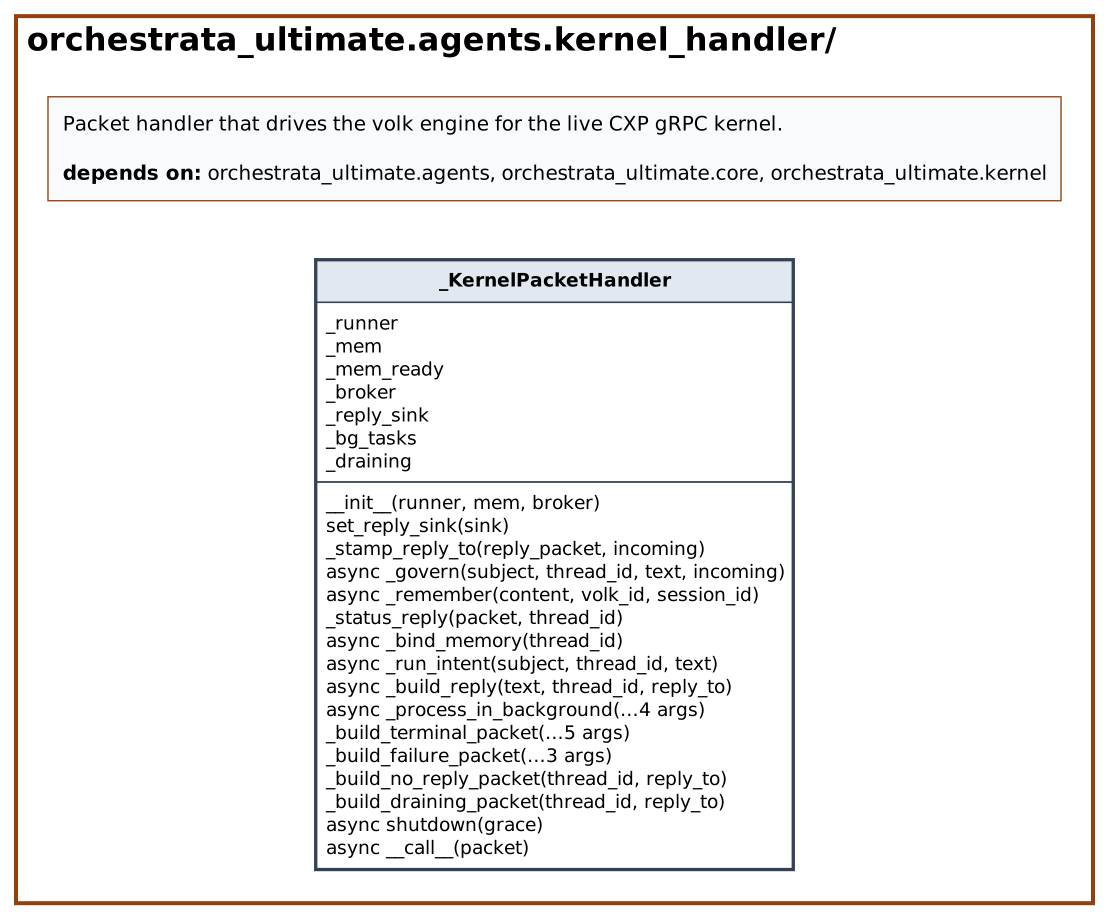
The handler is an async callable taking a packet dictionary. A packet with subject status is answered at once by _status_reply without running the pipeline. Every other packet first passes the governance gate _govern, which returns a rejection reply when the intent is denied. For chat subjects, when a reply sink has been set with set_reply_sink, the handler acknowledges immediately with accepted true and runs the round in the background (_process_in_background), which publishes exactly one terminal packet through the sink. _run_intent runs the blocking engine off the gRPC loop, _bind_memory binds the memory engine to the thread, _remember stores the turn best-effort, and _build_reply reads the engine's last human-inbox message. Terminal packets are built by _build_terminal_packet and its variants for failure, no reply and draining; _stamp_reply_to copies the sender's reply target onto the reply. shutdown drains in-flight rounds; after it begins, new chat packets are rejected synchronously with a draining receipt.
At a glance
| Source | src/orchestrata_ultimate/agents/kernel_handler.py |
| Lines of code | 814 |
| Classes | 1 |
| Functions | 1 |
| Imports (internal) | orchestrata_ultimate.agents.volks.memory_context, orchestrata_ultimate.core.base.traces, orchestrata_ultimate.core.packet, orchestrata_ultimate.kernel.pipeline |
| Imported by | orchestrata_ultimate.agents.runtime_main, orchestrata_ultimate.kernel.cli_main |
| Tests that import it | tests/agents/test_kernel_handler.py, tests/agents/test_kernel_handler_ack_only.py, tests/agents/test_kernel_handler_governance.py, tests/agents/test_kernel_handler_memory.py, tests/agents/test_runtime_main.py, tests/gateway/handlers/test_cxp_kernel_dispatch.py, tests/gateway/handlers/test_orchestrator_kernel_dispatch.py, tests/gateway/test_kernel_reply_consumer.py, tests/gateway/test_kernel_reprobe.py, tests/gateway/test_reply_consumer_addressing.py, tests/gateway/test_server_coverage_wave.py, tests/generated_agents/test_kernel_handler_generated.py, tests/kernel/test_cli_main_kernel_boot.py |
Class diagram
Dependency diagram
API
Classes
_KernelPacketHandler
Line 71
Async-callable packet_handler bound to one booted PipelineRunner (+ optional memory engine).
| Method | Signature | Summary |
|---|---|---|
__init__ |
__init__(runner: PipelineRunner, mem: Any | None, broker: Any | None = None) -> None |
|
set_reply_sink |
set_reply_sink(sink: Callable[[dict[str, Any]], None]) -> None |
Wire the reply-publication sink (D2). |
_stamp_reply_to staticmethod |
_stamp_reply_to(reply_packet: dict[str, Any], incoming: dict[str, Any]) -> dict[str, Any] |
Stamp reply_packet's metadata.reply_to from incoming's (P-B2/P-B7, D6) -- the ONE mechanism every reply-packet producer in this handler funnels through (_govern's denial… |
_govern |
async _govern(subject: str, thread_id: str, text: str, incoming: dict[str, Any] | None = None) -> dict[str, Any] | None |
Governance gate. |
_remember |
async _remember(content: str, volk_id: str, session_id: str) -> None |
Persist one conversation turn to long-term memory (best-effort). |
_status_reply |
_status_reply(packet: dict[str, Any], thread_id: str) -> dict[str, Any] |
Live volk status — answered without running the pipeline, so the orchestrator/gateway can poll every volk's status at any time. |
_bind_memory |
async _bind_memory(thread_id: str) -> bool |
Bind the memory engine for this conversation so volks can recall relevant prior turns while the pipeline runs (best-effort; only for a continuing thread, which is exactly when stored history exists). |
_run_intent |
async _run_intent(subject: str, thread_id: str, text: str) -> tuple[str, bool] |
Run submit_intent/respond off the gRPC loop (blocking-sync engine calls); return the (possibly new) thread_id and whether a reply was produced. |
_build_reply |
async _build_reply(text: str, thread_id: str, reply_to: str = '') -> tuple[str, dict[str, Any], str, dict[str, Any]] |
Read the engine's last human-inbox message (if any) and persist this turn (human intent + volk reply) to long-term memory under the conversation thread, when an engine is wired. |
_process_in_background |
async _process_in_background(subject: str, thread_id: str, text: str, reply_to: str = '') -> None |
Run the volk round off the ack path (D1) and publish EXACTLY ONE terminal packet through the sink on every exit path (D-H5, F5 fix — amends the parent design's D3): the genuine reply on success, the… |
_build_terminal_packet |
_build_terminal_packet(thread_id: str, subject: str, delivery_status: DeliveryStatus, payload: dict[str, Any], reply_to: str = '') -> dict[str, Any] |
Shared terminal-packet core (D-H5): the one dict shape every background-round terminal (failure, no-reply) is built from — _build_failure_packet and _build_no_reply_packet are thin wrappers… |
_build_failure_packet |
_build_failure_packet(thread_id: str, error: str, reply_to: str = '') -> dict[str, Any] |
Build the honest terminal FAILURE packet for a background round that raised (D3, closes G2). |
_build_no_reply_packet |
_build_no_reply_packet(thread_id: str, reply_to: str = '') -> dict[str, Any] |
Build the honest terminal NO-REPLY packet (D-H5, amends the parent design's D3): a background round that completed without producing a human-directed reply — governance blocked the submit_intent… |
_build_draining_packet |
_build_draining_packet(thread_id: str, reply_to: str = '') -> dict[str, Any] |
Build the SYNCHRONOUS KERNEL_DRAINING rejection terminal for a chat-subject packet that arrives after :meth:shutdown began draining (D-H11, F-3 hardening -- amends the parent design at… |
shutdown |
async shutdown(grace: float | None = None) -> None |
Graceful drain (D-H6, F5 fix): give every in-flight background round up to grace seconds to finish normally -- sinking its genuine reply or intent_no_reply terminal exactly as it would outside… |
__call__ |
async __call__(packet: dict[str, Any]) -> dict[str, Any] |
Functions
| Function | Signature | Summary |
|---|---|---|
build_kernel_packet_handler traces |
build_kernel_packet_handler(kernel: PipelineRunner | None = None, memory_engine: Any | None = None, intent_broker: Any | None = None) -> _KernelPacketHandler |
Return an async packet_handler(packet_dict) -> reply_dict that drives the volk engine. |
Source
"""Packet handler that drives the volk engine for the live CXP gRPC kernel.
``agents/runtime_main.py`` starts a :class:`CXPServer` for the out-of-process
kernel (the ``agent-runtime`` service). This module builds the ``packet_handler``
that the server invokes for each received packet: it boots a
:class:`~orchestrata_ultimate.kernel.pipeline.PipelineRunner` (all 9 volks on a
real ``Postman``) **once**, then routes each incoming packet's intent/response
text through the engine and returns the volk's reply.
Reply transport note: the unary ``send_packet`` gRPC RPC returns only an ack
(``CXPReceipt``). The ``reply_packet`` produced here is enqueued by the servicer
onto the streaming channel and pumped to the gateway's UI subscribers by
``WebSocketGateway._consume_kernel_replies``; the handler's return value also
carries the reply for direct callers/tests.
Ack-only mode (P-A3, ``plans/kernel-dispatch-reply-design.md`` D1/D2/D3;
hardened by P-H4, ``plans/kernel-dispatch-reply-hardening.md`` D-H5): once
``set_reply_sink`` has been called (production wiring happens at boot --
packet P-A4, NOT this module), chat subjects (``intent``/``response``) are
acknowledged immediately and the volk round runs in the background,
publishing EXACTLY ONE terminal packet through the sink instead of the
receipt: the genuine reply, the ``intent_no_reply`` terminal when the round
completed but produced nothing human-directed, an honest ``intent_failed``
failure packet on exception, or (P-H5, D-H6) the same failure packet when
:meth:`_KernelPacketHandler.shutdown` cancels a round still in flight past
its drain grace period. Without a sink, this handler is unchanged: fully
synchronous, reply inline in the receipt.
Once :meth:`_KernelPacketHandler.shutdown` begins draining (P-H10,
``plans/kernel-dispatch-reply-hardening.md`` §11.2 D-H11), a fresh
chat-subject packet is never backgrounded at all: it gets a synchronous
``intent_draining``/``KERNEL_DRAINING`` rejection receipt instead, returned
the same way a synchronous governance denial already is, so the servicer's
existing plumbing enqueues it onto the still-open reply stream.
"""
from __future__ import annotations
import asyncio
import logging
import os
import uuid
from collections.abc import Awaitable, Callable
from datetime import UTC, datetime
from typing import TYPE_CHECKING, Any
from orchestrata_ultimate.agents.volks.memory_context import (
register_memory,
unregister_memory,
)
from orchestrata_ultimate.core.base.traces import traces
from orchestrata_ultimate.core.packet import DeliveryStatus, PacketType
if TYPE_CHECKING:
# Type-only: a module-level runtime import here is an upward layer
# violation (agents layer 3 -> kernel layer 4); the runtime import is
# function-scoped at the construction site (accepted pattern, see
# architecture-standards.md).
from orchestrata_ultimate.kernel.pipeline import PipelineRunner
logger = logging.getLogger(__name__)
KernelPacketHandler = Callable[[dict[str, Any]], Awaitable[dict[str, Any]]]
# Chat subjects eligible for the ack-only background path (D1) once a reply
# sink is wired. "status" always stays synchronous (answered without running
# the pipeline); every other subject keeps today's fully synchronous round.
_CHAT_SUBJECTS = frozenset({"intent", "response"})
class _KernelPacketHandler:
"""Async-callable ``packet_handler`` bound to one booted ``PipelineRunner``
(+ optional memory engine).
Extracted from :func:`build_kernel_packet_handler` so each piece of the
per-packet logic (status report, memory binding, intent dispatch, reply
assembly) is its own small method instead of one large closure.
"""
def __init__(
self, runner: PipelineRunner, mem: Any | None, broker: Any | None = None
) -> None:
self._runner = runner
self._mem = mem
self._mem_ready = False
# SPEC-003 Option A: the broker is the GOVERNED FRONT DOOR. When wired,
# each new work intent is classified + validated (Prolog governance,
# fail-closed) before the PipelineRunner executes it. The broker's own
# route/dispatch is unused here — execution stays with the pipeline.
self._broker = broker
# P-A3 (plans/kernel-dispatch-reply-design.md D1/D2): unset by default,
# which keeps __call__ fully synchronous (byte-for-byte with the
# pre-P-A3 behavior). set_reply_sink activates the ack-only background
# path for chat subjects.
self._reply_sink: Callable[[dict[str, Any]], None] | None = None
# Strong refs to in-flight background rounds so they aren't
# garbage-collected mid-flight; discarded via the done callback.
self._bg_tasks: set[asyncio.Task[None]] = set()
# D-H11 (F-3 hardening, plans/kernel-dispatch-reply-hardening.md
# §11.2): flipped True as shutdown()'s FIRST action, before the
# background-task snapshot, so accept-reject (__call__) and the
# drain snapshot (shutdown) can never interleave a stray spawn.
# __call__ and shutdown both run on the kernel's single event loop
# (never concurrent OS threads, and neither awaits between reading
# and branching on this flag), so plain attribute read/write
# visibility is sufficient -- no lock is needed here.
self._draining: bool = False
def set_reply_sink(self, sink: Callable[[dict[str, Any]], None]) -> None:
"""Wire the reply-publication sink (D2).
Production wiring passes ``server.servicer.enqueue_reply`` at boot
(packet P-A4, not this module). Once set, ``__call__`` acks chat
subjects (``intent``/``response``) immediately and runs the volk
round in the background, publishing its terminal packet through this
sink instead of the (now-empty) receipt.
"""
self._reply_sink = sink
@staticmethod
def _stamp_reply_to(
reply_packet: dict[str, Any], incoming: dict[str, Any]
) -> dict[str, Any]:
"""Stamp *reply_packet*'s ``metadata.reply_to`` from *incoming*'s
(P-B2/P-B7, D6) -- the ONE mechanism every reply-packet producer in
this handler funnels through (``_govern``'s denial, ``_status_reply``,
``_build_reply``, ``_build_failure_packet``). A no-op -- no
``metadata`` key invented -- when *incoming* carries no non-empty
``metadata.reply_to``, so unstamped/legacy callers get byte-identical
output to before this helper existed.
"""
reply_to = (incoming.get("metadata") or {}).get("reply_to", "")
if reply_to:
reply_packet["metadata"] = {"reply_to": reply_to}
return reply_packet
async def _govern(
self,
subject: str,
thread_id: str,
text: str,
incoming: dict[str, Any] | None = None,
) -> dict[str, Any] | None:
"""Governance gate. Returns a rejection reply dict when the intent is
DENIED (caller must not run the pipeline), or ``None`` to proceed.
Only new work intents are gated — never ``status`` polls or in-thread
``response`` follow-ups (which the concierge already owns). A gate
*error* (infra/classification failure, not a policy denial) logs and
proceeds: governance must not reduce availability on its own fault.
*incoming* (P-B7, D6) is the raw inbound packet; when it carries
``metadata.reply_to``, the denial reply is stamped with it via
:meth:`_stamp_reply_to` so a DENIED intent still routes back to the
exact consumer that sent it. Optional (defaults to ``None``, treated
as unstamped) so direct unit calls need not construct one.
"""
broker = self._broker
if broker is None or subject in ("status", "response") or not text:
return None
evaluator = getattr(broker, "evaluator", None)
if evaluator is None:
return None
try:
intent = evaluator.evaluate(text).intent
validation = await broker.validate_only(intent)
if getattr(validation.outcome, "value", "") == "allowed":
return None
reason = getattr(validation, "reason", "") or "governance policy: denied"
logger.info("intent DENIED by governance: %s (%s)", text[:80], reason)
denial = {
# Real id, same contract as _build_terminal_packet: consumers
# key dedup/claim-checks on message_id (H-B probe finding).
"message_id": str(uuid.uuid4()),
"from_agent": "SYSTEM",
"to_agent": "HUMAN",
"thread_id": thread_id or "",
"subject": "intent_denied",
"payload": {"reason": reason, "intent_id": intent.id},
}
self._stamp_reply_to(denial, incoming or {})
return {
"success": True,
"thread_id": thread_id or "",
"reply": reason,
"reply_payload": {"reason": reason, "intent_id": intent.id},
"reply_subject": "intent_denied",
"reply_packet": denial,
}
except Exception:
logger.exception("governance gate error (non-fatal); allowing intent")
return None
async def _remember(self, content: str, volk_id: str, session_id: str) -> None:
"""Persist one conversation turn to long-term memory (best-effort)."""
if self._mem is None or not content or not session_id:
return
try:
if not self._mem_ready:
await self._mem.initialize({})
self._mem_ready = True
await self._mem.store(content, volk_id=volk_id, session_id=session_id)
except Exception: # auxiliary — never break the orchestration reply
logger.exception("kernel packet_handler: memory store failed (non-fatal)")
def _status_reply(self, packet: dict[str, Any], thread_id: str) -> dict[str, Any]:
"""Live volk status — answered without running the pipeline, so the
orchestrator/gateway can poll every volk's status at any time. The
report is emitted as a reply_packet so the gRPC servicer enqueues it
onto the streaming channel (the unary receipt is ack-only); in-process
callers can also read reply_payload directly.
*packet*'s ``metadata.reply_to`` (P-B7, D6), when present, is stamped
onto ``status_reply`` via :meth:`_stamp_reply_to` so the poll's reply
routes back to the exact consumer that asked.
"""
report = self._runner.status_report()
status_reply = {
# Real id for the same reason as every other reply this module
# emits: message_id is the consumer's dedup/claim-check key.
"message_id": str(uuid.uuid4()),
"from_agent": "SYSTEM",
"to_agent": packet.get("from_agent") or "HUMAN",
"thread_id": thread_id or "",
"subject": "status_report",
"payload": {"volks": report},
}
self._stamp_reply_to(status_reply, packet)
return {
"success": True,
"thread_id": thread_id or "",
"reply": "",
"reply_payload": {"volks": report},
"reply_subject": "status_report",
"reply_packet": status_reply,
}
async def _bind_memory(self, thread_id: str) -> bool:
"""Bind the memory engine for this conversation so volks can recall
relevant prior turns while the pipeline runs (best-effort; only for a
continuing thread, which is exactly when stored history exists).
"""
if self._mem is None or not thread_id:
return False
try:
await self._mem.initialize({})
except Exception:
logger.debug("memory initialize failed (non-fatal)", exc_info=True)
register_memory(thread_id, self._mem)
return True
async def _run_intent(
self, subject: str, thread_id: str, text: str
) -> tuple[str, bool]:
"""Run submit_intent/respond off the gRPC loop (blocking-sync engine
calls); return the (possibly new) thread_id and whether a reply was
produced.
"""
if subject == "response" and thread_id:
await asyncio.to_thread(self._runner.respond, thread_id, text)
return thread_id, True
# Honour the caller's thread_id so the volk reply correlates to the
# gateway/UI conversation (and a later respond() resolves it).
new_tid = await asyncio.to_thread(
self._runner.submit_intent, text, thread_id or None
)
if new_tid is not None:
return new_tid, True
return thread_id, False
@traces(
spec="001",
story="US-002",
reqs=["REQ-001-US-002-001", "REQ-001-US-002-033", "REQ-001-US-002-039"],
)
async def _build_reply(
self, text: str, thread_id: str, reply_to: str = ""
) -> tuple[str, dict[str, Any], str, dict[str, Any]]:
"""Read the engine's last human-inbox message (if any) and persist this
turn (human intent + volk reply) to long-term memory under the
conversation thread, when an engine is wired.
The lookup is filtered to *thread_id* (G6, P-A1's
``get_last_human_message(thread_id=...)``), so a reply from an older,
unrelated conversation still sitting in the shared human-inbox can
never be mis-attributed to this round. It also consumes the match
(P-H3, D-H3, ``consume=True``) -- a claim-check: once THIS round has
matched and returned a reply, that inbox entry is gone, so a LATER
round on the same thread that produces nothing of its own can never
re-match it and re-emit it as its own terminal (REQ-001-US-002-033/039).
*reply_to* (P-B2, D6) is the inbound packet's ``metadata.reply_to`` --
when non-empty it is stamped onto the built ``reply_packet`` (via the
shared :meth:`_stamp_reply_to`) so ``ReplyRouter._pick_key`` routes
the terminal reply to the exact consumer that sent the request.
Empty (the unstamped/legacy default) leaves ``reply_packet`` with no
``metadata`` key at all -- byte-identical to the pre-P-B2 dict.
"""
reply_text, reply_payload, reply_subject = "", {}, ""
reply_packet: dict[str, Any] = {}
reply = self._runner.get_last_human_message(thread_id=thread_id, consume=True)
if reply is not None and isinstance(reply.payload, dict):
reply_payload = reply.payload
reply_text = reply.payload.get("text", "")
reply_subject = reply.subject
# A _dict_to_proto-compatible reply packet that the servicer
# enqueues onto the streaming channel for the gateway.
reply_packet = {
"message_id": getattr(reply, "message_id", "") or "",
"from_agent": reply.from_agent,
"to_agent": reply.to_agent,
"thread_id": reply.thread_id or thread_id,
"subject": reply.subject,
"payload": reply_payload,
}
self._stamp_reply_to(reply_packet, {"metadata": {"reply_to": reply_to}})
await self._remember(text, "HUMAN", thread_id)
if reply is not None and reply_text:
await self._remember(reply_text, reply.from_agent, thread_id)
return reply_text, reply_payload, reply_subject, reply_packet
@traces(
spec="001",
story="US-002",
reqs=[
"REQ-001-US-002-001",
"REQ-001-US-002-019",
"REQ-001-US-002-031",
"REQ-001-US-002-032",
"REQ-001-US-002-033",
"REQ-001-US-002-035",
"REQ-001-US-002-038",
"REQ-001-US-002-039",
],
)
async def _process_in_background(
self, subject: str, thread_id: str, text: str, reply_to: str = ""
) -> None:
"""Run the volk round off the ack path (D1) and publish EXACTLY ONE
terminal packet through the sink on every exit path (D-H5, F5 fix —
amends the parent design's D3): the genuine reply on success, the
new ``intent_no_reply`` terminal when the round completed but
produced nothing human-directed, or an honest ``intent_failed``
packet on exception.
Before this fix, a ``produced=False`` round (governance-blocked
``submit_intent``, or a ``respond`` that matched no inbox entry) sank
NOTHING — indistinguishable from packet loss to a sender who was
already told (via the ack) that a background round was running. Once
the ack promises a reply-or-terminal, silence is a hole, not a
feature (REQ-001-US-002-035/038, REQ-002-US-001-026).
*reply_to* (P-B2, D6) is the inbound packet's stamped consumer id,
forwarded unchanged to ``_build_reply``, ``_build_no_reply_packet``,
and ``_build_failure_packet`` so whichever terminal packet this round
produces carries the same addressing.
"""
sink = self._reply_sink
if sink is None: # defensive — only ever scheduled when a sink is set
return
memory_bound = False
try:
memory_bound = await self._bind_memory(thread_id)
thread_id, produced = await self._run_intent(subject, thread_id, text)
reply_packet: dict[str, Any] = {}
if produced:
_, _, _, reply_packet = await self._build_reply(
text, thread_id, reply_to
)
if reply_packet:
sink(reply_packet)
else:
sink(self._build_no_reply_packet(thread_id, reply_to))
except asyncio.CancelledError:
# D-H6 (F5 fix): shutdown() cancels stragglers past the drain
# grace period. CancelledError is a BaseException -- it never
# matches the `except Exception` arm below, so without this arm
# a cancelled round sank nothing (the RUL-020 violation this
# closes). Sink an honest failure terminal, THEN re-raise so the
# cancellation still propagates (never swallow it).
logger.warning(
"kernel packet_handler background round cancelled (shutdown)"
)
sink(
self._build_failure_packet(thread_id, "kernel shutting down", reply_to)
)
raise
except Exception as exc: # the verified ProviderError propagation path
logger.exception("kernel packet_handler background round failed")
sink(self._build_failure_packet(thread_id, str(exc), reply_to))
finally:
if memory_bound:
unregister_memory(thread_id)
@traces(
spec="001",
story="US-002",
reqs=[
"REQ-001-US-002-033",
"REQ-001-US-002-035",
"REQ-001-US-002-037",
"REQ-001-US-002-038",
"REQ-001-US-002-039",
],
)
@traces(
spec="032",
story="US-032-G243",
reqs=["REQ-032-053", "REQ-032-054"],
)
def _build_terminal_packet(
self,
thread_id: str,
subject: str,
delivery_status: DeliveryStatus,
payload: dict[str, Any],
reply_to: str = "",
) -> dict[str, Any]:
"""Shared terminal-packet core (D-H5): the one dict shape every
background-round terminal (failure, no-reply) is built from —
``_build_failure_packet`` and ``_build_no_reply_packet`` are thin
wrappers over this.
Always sent from the KERNEL's own identity — never a volk alias — so
a terminal packet can never be mistaken for a fabricated
conversational reply (SPEC-032 G243); machine-flagged the same way
``_build_unavailable_reply`` (``gateway/handlers/cxp.py``) already
flags an unreachable assistant — *payload*'s ``assistant_status``
(when present) is mirrored onto the packet's TOP LEVEL too (backlog
[403]): the gateway's ``cxp.py::_record_event`` only reads
``packet["assistant_status"]``, never ``packet["payload"][...]``, so
without this mirror a kernel terminal's status was invisible to that
top-level-only surfacing even though the payload carried it all
along. ``packet_type`` follows *delivery_status*: ``FAILED`` rounds
are ``PacketType.ERROR``, everything else (the round completed,
there's simply no reply) is ``PacketType.NOTIFICATION``.
*reply_to* (P-B2, D6): stamped onto the packet's ``metadata`` (via
the shared :meth:`_stamp_reply_to`) when non-empty, so the terminal
routes back to the exact consumer that sent the request instead of
the ``to_agent``/default fallback.
"""
packet: dict[str, Any] = {
# A real id, not "": terminal packets are consumer-visible CXP
# packets — an empty message_id defeats client-side dedup/
# distinctness checks (caught live by the H-B acceptance probe,
# 2026-08-05: two rounds' terminals were indistinguishable).
"message_id": str(uuid.uuid4()),
"from_agent": "KERNEL",
"to_agent": "HUMAN",
"thread_id": thread_id or "",
"subject": subject,
"packet_type": (
PacketType.ERROR
if delivery_status == DeliveryStatus.FAILED
else PacketType.NOTIFICATION
),
"delivery_status": delivery_status,
"timestamp": datetime.now(UTC).isoformat(),
"payload": payload,
}
# Backlog [403]: mirror payload.assistant_status onto the TOP LEVEL,
# the same dual placement `_build_unavailable_reply` already uses —
# see the docstring note above for why the top-level copy matters.
if "assistant_status" in payload:
packet["assistant_status"] = payload["assistant_status"]
self._stamp_reply_to(packet, {"metadata": {"reply_to": reply_to}})
return packet
@traces(
spec="001",
story="US-002",
reqs=[
"REQ-001-US-002-001",
"REQ-001-US-002-035",
"REQ-001-US-002-038",
"REQ-001-US-002-039",
],
)
def _build_failure_packet(
self, thread_id: str, error: str, reply_to: str = ""
) -> dict[str, Any]:
"""Build the honest terminal FAILURE packet for a background round
that raised (D3, closes G2). Thin wrapper over
:meth:`_build_terminal_packet` (D-H5 extraction).
"""
return self._build_terminal_packet(
thread_id,
"intent_failed",
DeliveryStatus.FAILED,
{
"text": (
"[automated notice] the assistant failed to process this "
"request."
),
"error": error,
"failure": True,
"assistant_status": "failed",
},
reply_to,
)
@traces(
spec="001",
story="US-002",
reqs=[
"REQ-001-US-002-033",
"REQ-001-US-002-037",
"REQ-001-US-002-038",
"REQ-001-US-002-039",
],
)
@traces(
spec="032",
story="US-032-G243",
reqs=["REQ-032-053", "REQ-032-054"],
)
def _build_no_reply_packet(
self, thread_id: str, reply_to: str = ""
) -> dict[str, Any]:
"""Build the honest terminal NO-REPLY packet (D-H5, amends the
parent design's D3): a background round that completed without
producing a human-directed reply — governance blocked the
``submit_intent`` (``produced=False``), or the round's outcome never
landed a matching packet in the human inbox — must still tell the
sender something happened; the ack already promised a background
round, so silence would be indistinguishable from loss.
Thin wrapper over :meth:`_build_terminal_packet` (D-H5 extraction).
Explicitly non-failure: the round COMPLETED, there is simply no
reply (``delivery_status=DELIVERED``, ``assistant_status="no_reply"``,
``failure=False``) — G243-honest (SPEC-032): machine-detectable,
never conversational, never a volk alias.
"""
return self._build_terminal_packet(
thread_id,
"intent_no_reply",
DeliveryStatus.DELIVERED,
{
"text": (
"[automated notice] the assistant completed processing "
"without a reply."
),
"failure": False,
"assistant_status": "no_reply",
},
reply_to,
)
@traces(
spec="001",
story="US-002",
reqs=[
"REQ-001-US-002-030",
"REQ-001-US-002-035",
"REQ-001-US-002-038",
"REQ-001-US-002-039",
],
)
@traces(
spec="002",
story="US-001",
reqs=["REQ-002-US-001-026"],
)
def _build_draining_packet(
self, thread_id: str, reply_to: str = ""
) -> dict[str, Any]:
"""Build the SYNCHRONOUS ``KERNEL_DRAINING`` rejection terminal for a
chat-subject packet that arrives after :meth:`shutdown` began
draining (D-H11, F-3 hardening -- amends the parent design at
``plans/kernel-dispatch-reply-hardening.md`` §11.2).
Unlike every other terminal this module builds, this one is never
handed to the reply sink: it is returned directly from ``__call__``
as the packet_handler result's ``reply_packet``, which the
servicer's existing ``send_packet``/``receive_packet`` plumbing
enqueues onto the still-open reply stream -- exactly the mechanism a
synchronous governance denial already uses (see ``_govern``). Thin
wrapper over :meth:`_build_terminal_packet` (D-H5 extraction).
Explicit failure (``delivery_status=FAILED``, ``assistant_status=
"draining"``, ``payload.error_code="KERNEL_DRAINING"``): the request
was never accepted, so the caller's one clear move is to retry
against the restarted kernel. *thread_id*/*reply_to* are the
ORIGINAL values from the rejected packet (never minted), stamped
through the shared :meth:`_stamp_reply_to` exactly like every other
terminal here.
"""
return self._build_terminal_packet(
thread_id,
"intent_draining",
DeliveryStatus.FAILED,
{
"text": (
"[automated notice] the kernel is shutting down and "
"cannot accept new requests; retry after it restarts."
),
"error": "kernel is draining (shutdown in progress)",
"error_code": "KERNEL_DRAINING",
"failure": True,
"assistant_status": "draining",
},
reply_to,
)
@traces(
spec="001",
story="US-002",
reqs=["REQ-001-US-002-035", "REQ-001-US-002-038", "REQ-001-US-002-039"],
)
async def shutdown(self, grace: float | None = None) -> None:
"""Graceful drain (D-H6, F5 fix): give every in-flight background
round up to *grace* seconds to finish normally -- sinking its
genuine reply or ``intent_no_reply`` terminal exactly as it would
outside shutdown -- then cancel any stragglers, which trips the
``except asyncio.CancelledError`` arm in
:meth:`_process_in_background`: an honest ``intent_failed`` "kernel
shutting down" terminal is sunk before the cancellation propagates.
Call this BEFORE stopping the transport (D-H7 wiring, not this
module) so still-connected consumers can receive the final
terminals. A no-op when nothing is in flight.
*grace* defaults to ``KERNEL_BG_DRAIN_GRACE_S`` (env, default
``"30"`` -- a tunable with a permitted literal default, RUL-003's
inverse: this is not an infra endpoint), resolved at call time (not
import time) so tests and deploy tooling can override it without a
code change. 30s covers the measured 11.5-21.1s round and sits
inside systemd's stop window. An unparseable value (empty string,
garbage) falls back to 30.0 with a warning instead of raising --
a misconfigured env must not turn a graceful shutdown into a crash
(F-1 hardening).
Cancelled stragglers get a bounded 5s window to react to
cancellation and sink their failure terminal; any still pending
after that are abandoned with a warning rather than blocking
shutdown indefinitely (F-5 hardening).
FIRST action (D-H11, F-3 hardening): flip ``_draining`` True before
touching ``_bg_tasks`` at all, so a packet accepted by ``__call__``
right up to the instant the snapshot below is taken either lands in
the snapshot (and gets drained/cancelled normally) or is rejected
with a synchronous ``KERNEL_DRAINING`` receipt at the accept seam --
never both silently missed.
"""
self._draining = True
if grace is None:
raw = (os.environ.get("KERNEL_BG_DRAIN_GRACE_S", "30") or "30").strip()
try:
grace = float(raw)
except ValueError:
logger.warning(
"invalid KERNEL_BG_DRAIN_GRACE_S=%r; falling back to 30.0s",
raw,
)
grace = 30.0
tasks = set(self._bg_tasks)
if not tasks:
return
_, pending = await asyncio.wait(tasks, timeout=grace)
if pending:
for task in pending:
task.cancel()
_, still_pending = await asyncio.wait(pending, timeout=5.0)
if still_pending:
logger.warning(
"%d background round(s) did not react to cancellation "
"within 5.0s during shutdown; abandoning them",
len(still_pending),
)
async def __call__(self, packet: dict[str, Any]) -> dict[str, Any]:
payload = packet.get("payload")
text = payload.get("text", "") if isinstance(payload, dict) else ""
subject = packet.get("subject", "")
thread_id = packet.get("thread_id", "") or ""
# P-B2: the sender-stamped consumer id (D6, ReplyRouter._pick_key's
# first-precedence key). Propagated onto the terminal reply/failure
# packet below so a multi-gateway deployment's reply routes back to
# the exact consumer that sent this packet, not just "HUMAN". Absent
# for unstamped/legacy callers -- reply_to stays "" and the terminal
# packets carry no metadata key, byte-identical to pre-P-B2 output.
metadata = packet.get("metadata")
reply_to = (
str(metadata["reply_to"])
if isinstance(metadata, dict) and metadata.get("reply_to")
else ""
)
memory_bound = False
try:
if subject == "status":
return self._status_reply(packet, thread_id)
denial = await self._govern(subject, thread_id, text, packet)
if denial is not None:
return denial
if self._reply_sink is not None and subject in _CHAT_SUBJECTS:
if self._draining:
# D-H11 (F-3 hardening): this is the single accept seam
# where a packet would enqueue background work. shutdown()
# has already begun draining -- its task snapshot was (or
# is about to be) taken and will never await a round
# spawned after that point, stranding its terminal behind
# a transport that's about to close. Do NOT spawn: return
# a synchronous rejection receipt instead, addressed with
# the ORIGINAL thread_id/reply_to so the still-open reply
# stream delivers it (same mechanism as a governance
# denial, see _govern). Non-spawning subjects (status,
# a denied/synchronous round) never reach this branch and
# pass through unchanged while draining.
draining_packet = self._build_draining_packet(thread_id, reply_to)
return {
"success": True,
"thread_id": thread_id or "",
"reply": "",
"reply_payload": draining_packet["payload"],
"reply_subject": draining_packet["subject"],
"reply_packet": draining_packet,
"accepted": False,
}
# D1: ack immediately, run the round in the background, and
# let _process_in_background publish the terminal packet
# through the sink (D2/D3) instead of returning it inline.
thread_id = thread_id or str(uuid.uuid4())
task = asyncio.create_task(
self._process_in_background(subject, thread_id, text, reply_to)
)
self._bg_tasks.add(task)
task.add_done_callback(self._bg_tasks.discard)
return {
"success": True,
"thread_id": thread_id,
"reply": "",
"reply_payload": {},
"reply_subject": "",
"reply_packet": {},
"accepted": True,
}
memory_bound = await self._bind_memory(thread_id)
thread_id, produced = await self._run_intent(subject, thread_id, text)
reply_text: str = ""
reply_payload: dict[str, Any] = {}
reply_subject: str = ""
reply_packet: dict[str, Any] = {}
if produced:
reply_text, reply_payload, reply_subject, reply_packet = (
await self._build_reply(text, thread_id, reply_to)
)
return {
"success": True,
"thread_id": thread_id or "",
"reply": reply_text,
"reply_payload": reply_payload,
"reply_subject": reply_subject,
"reply_packet": reply_packet,
}
except Exception as exc: # surface engine errors as a failed receipt
logger.exception("kernel packet_handler failed")
return {"success": False, "error": str(exc)}
finally:
if memory_bound:
unregister_memory(thread_id)
@traces(spec="001", story="US-002", reqs=["REQ-001-US-002-012"])
def build_kernel_packet_handler(
kernel: PipelineRunner | None = None,
memory_engine: Any | None = None,
intent_broker: Any | None = None,
) -> _KernelPacketHandler:
# Return type is the concrete class (not the bare-callable
# KernelPacketHandler alias): boot sites need the full surface —
# set_reply_sink (P-A4 wiring) — and no external caller imports the
# alias, so narrowing to Callable only forced cast(Any) at both sites.
"""Return an async ``packet_handler(packet_dict) -> reply_dict`` that drives
the volk engine.
The engine (a booted ``PipelineRunner`` with all 9 volks) is constructed
once. Pass *kernel* to reuse an already-booted runner (tests); otherwise a
fresh one is booted here.
The returned dict carries ``success`` (the handler ran without raising),
``thread_id`` (empty if the intent was blocked/not accepted), ``reply`` /
``reply_payload`` / ``reply_subject`` (the volk's reply, empty if none).
When *memory_engine* (a :class:`~orchestrata_ultimate.memory.memory_engine.
MemoryEngine`) is supplied, each accepted conversation turn — the human
intent and the volk's reply — is persisted to long-term memory under the
conversation's ``thread_id`` (``session_id``). This is where the kernel
*uses* the memory engine: intents and replies become recallable rather than
only living in the transient human-inbox. The async handler runs on one
long-lived loop, so the engine is initialized once there and reused (no
per-call ``asyncio.run`` and no cross-loop client reuse). Memory writes are
auxiliary: a memory failure is logged and never breaks the orchestration
reply.
Limitation (single-flow): the reply is read from the engine's shared
human-inbox; concurrent independent conversations through one kernel can
interleave. Per-thread reply tracking is a later increment.
"""
if kernel is None:
from orchestrata_ultimate.kernel.pipeline import PipelineRunner
kernel = PipelineRunner()
kernel.boot()
return _KernelPacketHandler(kernel, memory_engine, intent_broker)