Orchestrata Ultimate / Overview
Orchestrata, explained
This page explains orchestrata as one system: what it is for, the parts it is made of, how a request travels through it, where its data lives, where it runs, the tools that surround it, and the refactor it is in the middle of. Read it top to bottom once; after that, the project hub and the table of contents take you to the detail.
How this page was built (2026-10-23). Code facts come from the deployed AST
toolkit (/opt/orchestrata-tools) run against the worktree
wt-MAP-PRECOMMIT at 8a2cb42ad; no .py file was read by hand. Decisions
come from docs/adr/ in the worktree orchestrata-wt-unshipped-scope at
478d9a0ef (and ADR-0103 from branch architecture/domain-model). Runtime
facts come from read-only commands run on 2026-10-23 (incus list,
systemctl --user, /opt/*/VERSION) and from the measured wiki pages it
links. Where a fact was not measured, the text says so.
1. What orchestrata is, and who it is for
Orchestrata is a governance and agentic workflow engine for the three things a software organization produces: code, architecture and communications (starting context). A person states an intent in plain language. The system classifies it, authorizes it against written policy, and routes it through a team of specialist agents called volks, each of which plays a real occupation: intake, business analysis, product management, UX, architecture, code direction, implementation, quality assurance, compliance and documentation. Every stage is a real LLM-backed agent doing real work, and every transition is checked by a Prolog policy engine before it happens.
Three choices make it different from a generic agent framework:
- Governance is a logic program, not a code path. Policy lives in Prolog
rule files (
constitutional.pl,governance.pl,intent_policy.pland 26 more). The runtime asksmay_execute/2before acting, and a denial carries a reason. The same rule engine also drives the static gates that judge the codebase itself. - Specs are authoritative. Every feature starts as a numbered spec under
specs/, its requirements get ids, and code declares which ids it implements with@traces. The traceability matrix (RTM) is built from those claims and graded by evidence (section 9). - Everything runs on real infrastructure. No mocks, fakes or skipped tests; a test runs against a real Redis, a real graph cluster and a real kernel, in an isolated test fleet built for that purpose (section 6).
Who it is for. Orchestrata is built and owned by Mohamed, its sole author.
The human states intents, rules on decisions and reviews outcomes; the volks
do the work, and the volks' work is real writing in the workspace: specs,
code, tests and docs, with session.close committing and tagging
(ADR-0124 context). The project's
own framing is that it gives an engineer "a tireless, verifiable, multi-agent
team" rather than replacing the engineer.
Size. The generated code reference
(revision 8a2cb42ad) counts 902 modules and 242,957 lines in
orchestrata_ultimate, 182 modules in scripts/, and 1,790 modules in the
eight component packages under packages/. The source repository is
gitlab.com/MSamy/orchestrata-ultimate-architecture.
2. The core concepts
A newcomer meets about a dozen ideas in the first hour. Each has a glossary entry; here is how they fit together.
Intent. A natural-language request from a person ("build me a task API").
The gateway parses it into an action, a target and a work type; if it cannot
classify the text into any actionable work type it asks the person to clarify
instead of starting work (gateway/handlers/orchestrator.py,
OrchestratorHandler.handle_intent).
Volk. One agent role. At 8a2cb42ad, PipelineRunner._register_volks
(kernel/pipeline.py) registers eleven volks with the Postman under these
aliases: U:Cx concierge, U:BA analyst, U:PM product manager, U:Ux UX,
U:Ar architect, U:Cd code director, J:Junior junior developer, U:SD
senior developer, U:Qa QA, U:Cp compliance and U:Do documentor. No volk
receives work straight from a person: every intent is addressed to the
concierge first. The volks page has
each role's prompt suite and handoff contract.
Kernel. The agent runtime: one process started as
python -m orchestrata_ultimate.agents.runtime_main, serving CXP on
CXP_GRPC_PORT (50053). It boots a PipelineRunner with the volks on a real
Postman and runs every intent it receives. The project treats the kernel as
required infrastructure: a test-suite run that does not start and verify
the kernel is invalid, because kernel-dependent paths otherwise no-op or fall
back and the suite goes green without testing the core
(docs/kernel-is-required.md; AGENTS.md Hard Rule 7).
Gateway. The single runtime ingress: a WebSocket JSON-RPC 2.0 server
(WebSocketGateway, gateway/server.py, SPEC-014) on GATEWAY_PORT 8765 with
an HTTP surface on 8766 for health, readiness and metrics. It authenticates
each connection, dispatches about 80 RPC methods (gateway.*, orchestrator.*,
tui.*, session.*, governance.*, knowledge.*, volk.* and more, counted
in ADR-0099), fans events out over pub/sub, and writes an audit trail. Clients
never read Redis directly.
CXP and cxpt. CXP, the Cross-agent eXchange Protocol (SPEC-004), is the
packet format every hop speaks: a flat packet with eleven core fields (below).
cxpt is its transport: the native direct transport that replaced grpc.aio on
2026-08-07, because gRPC's native threads outlived stop() and hung
free-threaded interpreter exit
(gRPC retirement). Function
and log names still say "gRPC" in places; the profiles set
CXP_TRANSPORT=cxpt.
Postman. The message router (postman/, alias U:PS): queues, topics,
subscriptions, receipts and replay. Volks register their process callables
with it, and the pipeline routes packets through postman.route_sync.
Governance. The policy layer (governance/ plus the rule files in
src/orchestrata_ultimate/prolog/). SWI-Prolog runs embedded in the kernel
through a patched free-threaded janus-swi; rules are consulted from .pl
files and only ground facts are asserted
(free-threaded Prolog).
Session. A unit of tracked work: the session package, the session CLI
that keeps a per-project context.json, the gateway's session.* methods, and
Session nodes in the knowledge graph.
The two graphs. orchkg is the operational knowledge graph: code
structure, specs and requirements, traces, sessions, audit, conversations.
memgraph is the semantic / RAG graph: embedded chunks of code, docs and
specs. They are two databases on one Memgraph-fork cluster called
orchgraph, and they must never be confused (section 5).
Spec, requirement, @traces, RTM. A spec defines requirement ids; code and
tests cite them with @traces(spec=..., story=..., reqs=[...]); the RTM joins
the two and grades the evidence (section 9).
ADR, ruling, brief. One-way-door decisions are ADRs in docs/adr/
(105 files at 478d9a0ef); standing user rulings are RUL-001 to RUL-041
in the wiki's rulings canon; a brief is the written task a
worker model builds from (section 8).
Components. The ten packages the monolith is being split into under
packages/ (contracts, governance, knowledge_graph, kernel, session, volks,
gateway, tools, integration, plugin). The split has not cut over yet (section 10).
The packet every hop carries
The CXP packet is the one data structure that crosses every boundary in the
request path. Its class docstring calls it a "flat 11-field structure"
(core/packet/packet.py, CXPPacket, SPEC-004 US-001); the kernel's
MessageDispatcher.dispatch(packet, recipient) (kernel/dispatcher.py) is the
seam that delivers it to a volk definition.
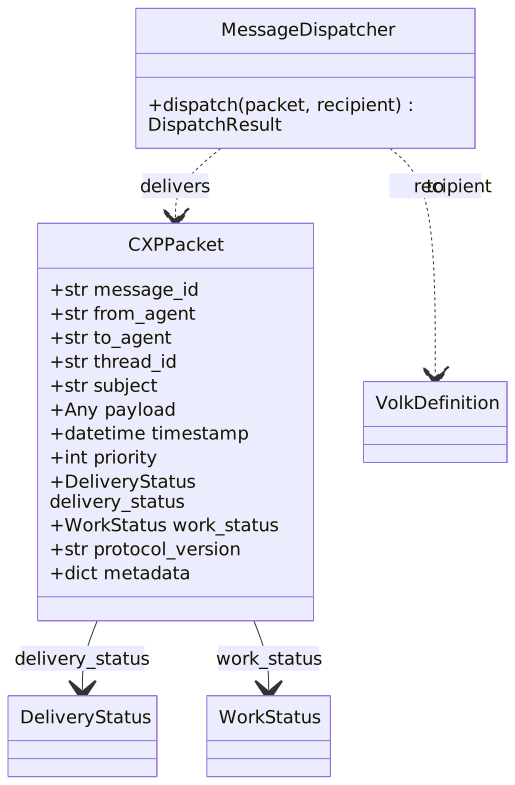
The constructor also takes from_instance, to_instance, packet_type,
ttl_seconds (default 3600), expires_at, correlation_id, reply_to and
tags; metadata.reply_to is how a gateway stamps its reply-consumer id so the
kernel can address the answer back to it.
3. The architecture: layers and packages
Six layers, one rule
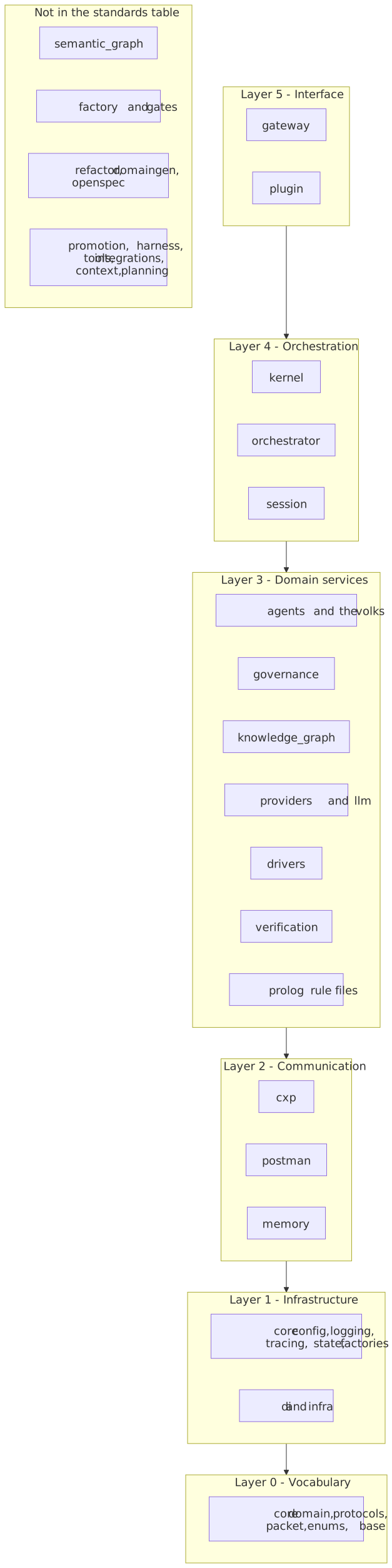
The code is organized as a modular monolith with six layers and a single rule:
imports go down only. A module may import from its own layer or a lower
one, never a higher one, and same-layer concrete imports between domain
services go through Layer-0 protocols injected by the DI container. The table
below is from architecture-standards.md, which mirrors LAYER_ASSIGNMENTS
in scripts/architecture_checker.py:
| Layer | Name | Packages | May import from |
|---|---|---|---|
| 0 | Vocabulary | core.domain, core.protocols, core.packet, core.enums, core.interfaces, core.base, top-level types, models, interfaces, exceptions |
Layer 0 only |
| 1 | Infrastructure | core.config, core.logging, core.tracing, core.state, core.adapters, core.traceability, the Redis and graph client factories, di, infra |
Layers 0–1 |
| 2 | Communication | cxp, postman, memory |
Layers 0–2 |
| 3 | Domain services | agents, governance, knowledge_graph, providers, verification, llm, drivers, prolog |
Layers 0–3 |
| 4 | Orchestration | kernel, orchestrator, session |
Layers 0–4 |
| 5 | Interface | gateway, plugin, __main__ |
Layers 0–5 |
The other top-level packages (semantic_graph, factory, gates,
refactor, domaingen, openspec, promotion, harness, tools,
integrations, context, planning) do not appear in that table; their layer
was not measured for this page.
The packages, by what they are for
The tree under src/orchestrata_ultimate/ has 30 packages
(docs/CODEBASE_MAP.md), plus two sibling roots, src/orchestrata_ast (the
AST analyzer the graph sync uses) and src/orchestrata_tools. Grouped by
purpose (adapted from the starting context):
| Role | Packages | In one sentence |
|---|---|---|
| Runtime spine | kernel, gateway, orchestrator, postman, agents, cxp |
The processes and protocol that carry an intent from a client to the volks and back. |
| Policy and proof | governance, gates, verification, factory |
Prolog policy at runtime, Prolog gates over the codebase, the verification agent, and SPEC-033's governed build factory. |
| Knowledge | knowledge_graph, semantic_graph, memory, context |
The operational KG, the RAG graph, dual-layer agent memory and context assembly. |
| Models and drivers | providers, llm, drivers |
The provider abstraction over LLM backends, the async client the volks call, and the code-generation drivers. |
| Code intelligence | refactor, domaingen, openspec |
The codemod and rename engines, ontology-driven domain generation, and the OpenSpec format. |
| Operations | session, promotion, harness, plugin, tools, integrations, infra |
Session tracking, deployment ("what promote has to mean"), the volk test harness, the plugin SDK, the tool registry and external integrations. |
| Foundations | core, di, planning |
Shared vocabulary and infrastructure, the DI container, long-horizon planning support. |
Every package has a generated page under the
code reference and most have
a curated narrative under modules/; the hub
has the one-line-per-package table that links both.
The runtime components
Five long-running pieces, and the stores under them. The diagram is the component view; section 4 walks the same path as a sequence.

The volks' retrieval from the semantic graph is only partly wired: chunk text is used, vector search is not, and retrieval is not scoped by project or module (RAG context-injection investigation).
If the kernel is unreachable at gateway start, the gateway retries a bounded
number of times and then falls back to an in-process PipelineKernelClient
(WebSocketGateway._init_kernel). It records the outcome as a mode, grpc,
in-process or unavailable, which gateway.info reports, so "connected to
the real kernel" and "quietly running the fallback" can be told apart. In the
fallback, chat (cxp.send) reports an explicit assistant-unavailable notice
instead of a fabricated reply.
Below the monolith, the same code is being re-cut into ten component packages with a drawn dependency DAG (component DAG). That work, and why it has not cut over, is section 10.
4. The request lifecycle
What happens when a person types an intent. The path below is the
orchestrator.intent method, traced through the code at 8a2cb42ad with the
AST toolkit.
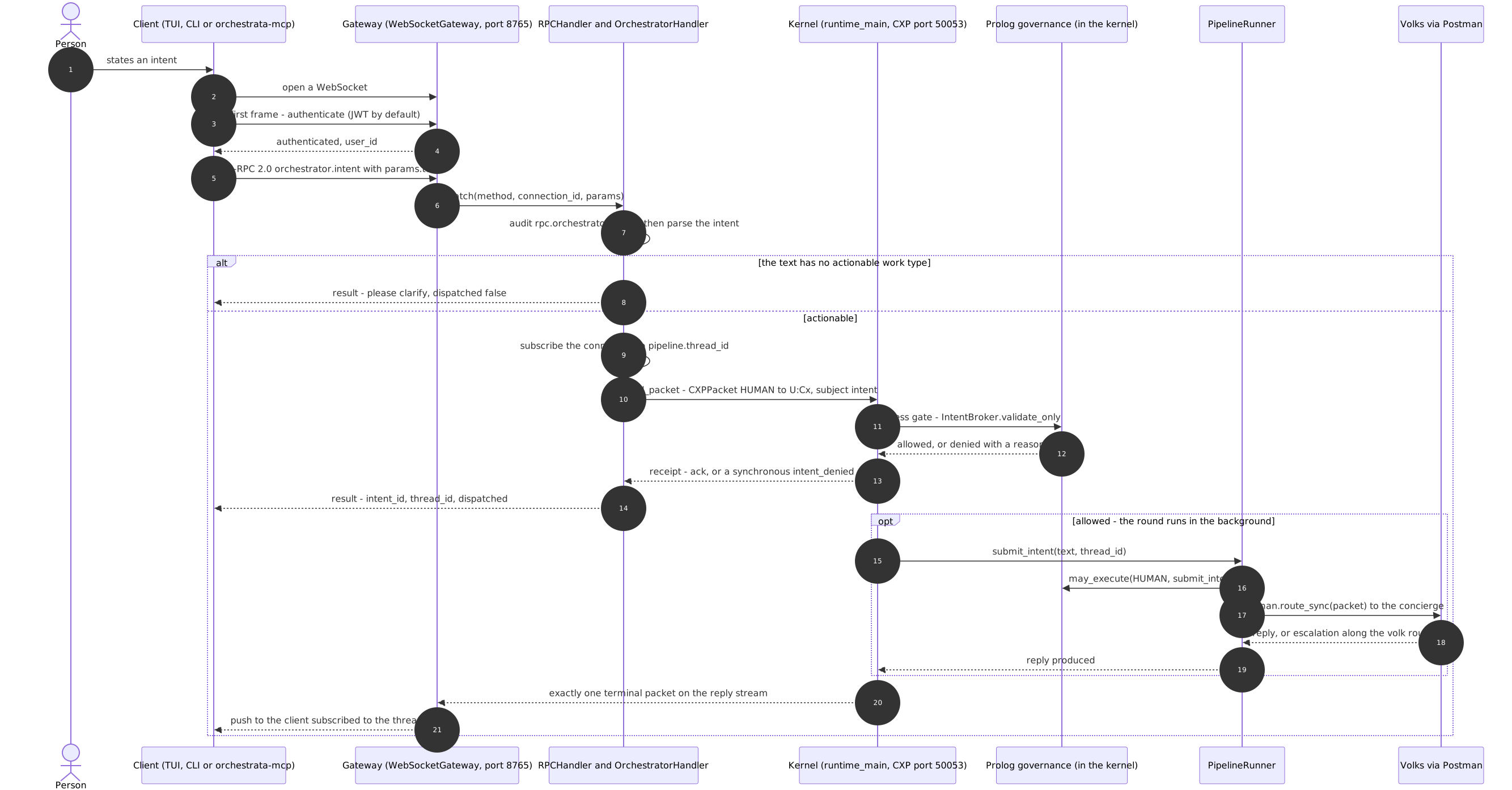
Step by step, with the code that does it:
- Connect.
WebSocketGateway._handle_connection(REQ-014-168) gives the connection a UUID and a correlation id, then waits for authentication before it registers the connection or reads anything else. - Authenticate.
gateway/auth_handler.py::authenticate(REQ-014-089) reads the first frame within a timeout. It accepts either a JSON-RPCauth.authenticatecall or an internal AUTH frame, and validates it in the modeGATEWAY_AUTH_MODEselects:jwt(the default),staticorhmac(SPEC-014 FR-005..007). JWTs are HS256, signed withJWT_SECRET, and expire afterTOKEN_EXPIRY_SECONDS(default 3600) (gateway/config.py,GatewayConfig). An insecure secret fails closed withInsecureJWTSecretError(SPEC-099). The CLI mints short-lived JWTs itself (kernel/cli_client.py);orchestrata-mcpauthenticates withGATEWAY_TOKENfrom the deployed environment (ADR-0099). - Route the frame. Every inbound frame passes
_handle_message, which refreshes the connection's heartbeat first (REQ-014-109), then sends JSON-RPC frames to_handle_jsonrpcand anything else to the legacy message processor. Malformed JSON gets a JSON-RPC parse error. - Dispatch.
RPCHandler.dispatch(REQ-014-178) looks the method up in its method table (unknown methods get -32601), writes anrpc.<method>audit event, and calls the handler. Since ADR-0099 the table is declarative (gateway/method_table.py,MethodSpec), and every method is approval-gated for MCP unless it is marked read-only. - Parse and gate at the edge.
OrchestratorHandler.handle_intentparses the text. If the shared evaluator finds no actionable work type it returnsneeds_disambiguationand starts nothing. - Send to the kernel. It subscribes the caller to
pipeline.<thread_id>before dispatch, so the first stage events are not lost, then sends aCXPPacketfromHUMANtoU:Cxwith subjectintent, stamped with this gateway's reply-consumer id. The kernel client was built bycreate_cxp_clientat gateway start (_connect_grpc_kernel_once), verified with a bounded health check, not just a connect. - Govern at the kernel.
agents/kernel_handler.py,_KernelPacketHandler.__call__, runs_governon every new intent:IntentBroker.validate_onlymust returnallowed. A denial becomes anintent_deniedpacket with the reason. A gate error (as opposed to a denial) is logged and the intent proceeds; the docstring's reason is that "governance must not reduce availability on its own fault". - Acknowledge, then work. For the chat subjects
intentandresponsethe kernel acknowledges at once and runs the volk round in the background (the ack-only design of the dispatch-reply hardening). The gateway returns the JSON-RPC result to the client:intent_id,thread_id,dispatched,pipeline_topic, plus a task record. - Run the pipeline.
PipelineRunner.submit_intentbegins a session if one is attached, asks Prologmay_execute(HUMAN, submit_intent)(a block returns no thread), emits the intent event, binds a memory engine to the thread, records the intent's provenance in the operational KG (kernel/pipeline_kg.py,sync_intent_to_kg, which MERGEs anIntentand thePipelineRunit triggered, anchored to aThreadand theProjecthub), and routes the packet through the Postman to the concierge. The concierge either answers the person (for example with a clarification question) or the reply is routed on to the next volk. - Reply. The background round publishes exactly one terminal packet:
the reply,
intent_no_replyif the round produced nothing for the person, orintent_failedon an exception or shutdown. The gateway's reply consumer (_consume_kernel_replies) pushes it to the subscribed client.
Other entry points. The TUI uses tui.intent, which runs the full agent
pipeline through the TUI handler (gateway/handlers/ultimatetui.py, SPEC-050)
rather than the path above. orchestrata-mcp exposes the same methods as MCP
tools (for example orchestrator_intent and tui_intent) and forwards each
call over the WebSocket, so it passes the same auth, scope guard and audit as
the TUI (ADR-0099). On 2026-10-22 the MCP path answered gateway_ping with
"GATEWAY_TOKEN is not set" (runtime services),
and on 2026-10-23 the prod host's gateway and kernel units were inactive and
disabled (systemctl --user is-active, is-enabled); the test fleet's pair
was running (section 6).
A third governance seam, off by default. MessageDispatcher in
kernel/dispatcher.py takes policy_audit_mode=False: when switched on it
evaluates routing and plan fidelity against policy and records the verdict
without acting on it (shadow mode). It is not enforcement.
5. Data and knowledge
Four kinds of state, each with its own home.
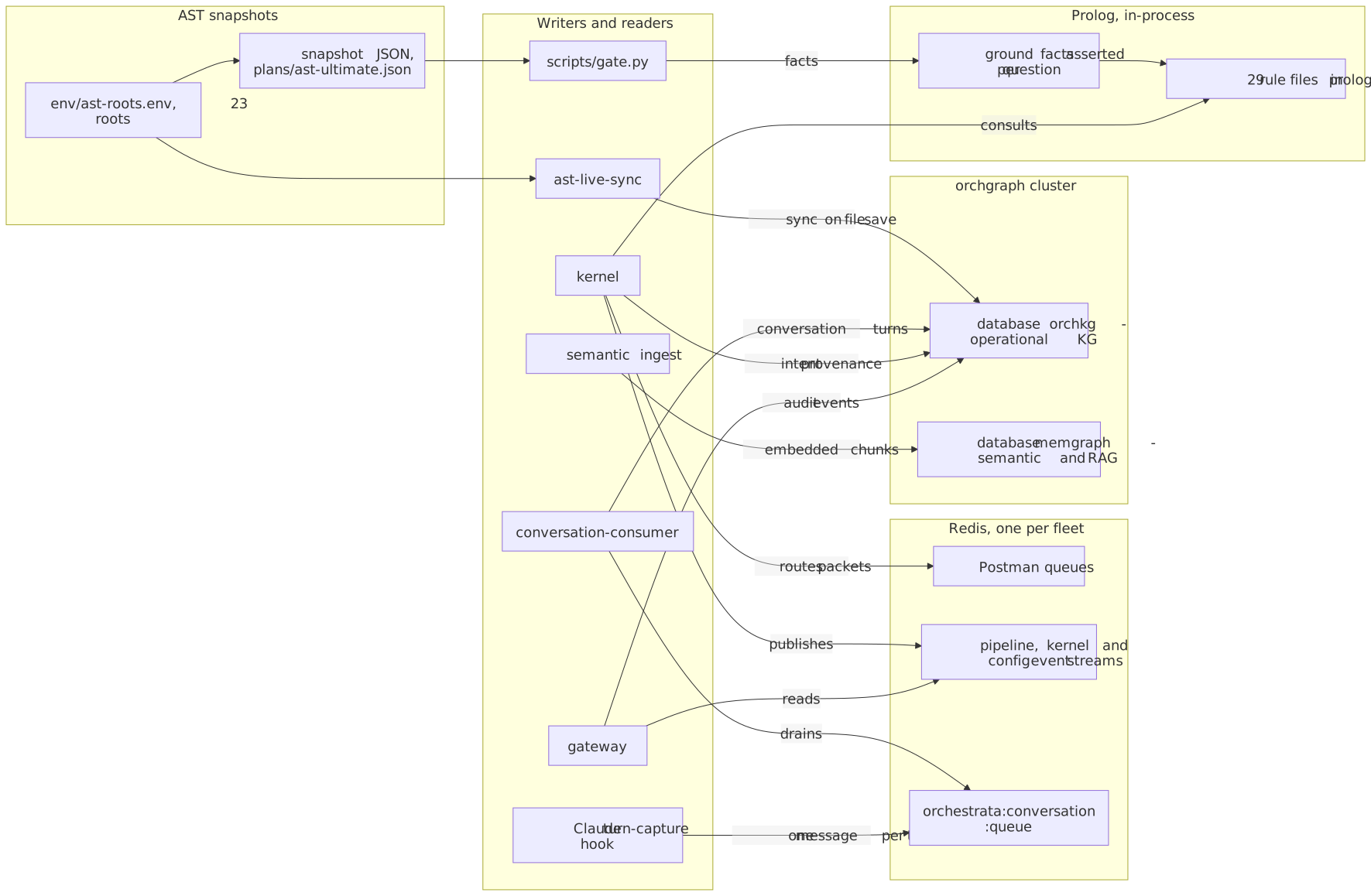
Redis: hot state and the message bus
Each fleet has its own Redis: redis-queue at 10.53.1.10:6379 in prod,
10.53.2.11 in test and 10.53.3.21 in dev (env/*.env). It carries the
Postman's queues, the event streams the gateway pumps to clients (pipeline,
kernel and config events; the _pump_*_once functions in gateway/server.py),
the ring buffers the gateway replays from, the hot layer of the
MemoryEngine, and the SPEC-021 conversation queue
orchestrata:conversation:queue, which a Claude hook fills with one message per
turn and orchestrata-conversation-consumer drains into orchkg. Turns are not
lost while the consumer is off; they wait in the list
(runtime services §6). Test
Redis keys are namespaced by test id, and a gate enforces it.
orchgraph: the cluster and its two databases
orchgraph is a Memgraph fork run as a Raft HA cluster in the prod Incus
project default: three coordinators, orchgraph-coord-1..3 at
10.53.1.160/.109/.198, and two data instances, orchgraph-data-1..2 at
10.53.1.128/.123 (measured with incus list, 2026-10-23). Clients route
through neo4j://10.53.1.160:7691; there is no Bolt auth (ratified in the
KG migration).
Since the 2026-07-26 cut-over from Neo4j the cluster holds two isolated
databases:
orchkg, the operational knowledge graph. Code structure (Module, Class, Function, Method), the spec tier (Spec, Requirement, RequirementItem andTRACES_TO), sessions, CXP packets, gateway audit, conversations and the component DAG. On 2026-10-20 it held 71 Spec, 639 Requirement and 5,786 RequirementItem nodes and 15,366TRACES_TOedges from this project's code (component DAG). Every node must have a path to the rootProjectnode (the root-connectivity invariant). ADR-0126 (Proposed) records that the KG had lost modules (4,195 present against about 5,220 in the snapshot) because every checkout synced into one project id, and proposes one project per synced branch (orchestrata-ultimate@components, for example).memgraph, the semantic / RAG graph. Embedded chunks of code, docs and specs with a vector index, written by the semantic ingest and the wiki indexer, read for context injection (semantic graph).
Two operational facts matter on day one. Reads through the routing URI were
measured to diverge after a write, so verification after a prod write uses
direct per-instance Bolt reads (main and replica must agree)
(component DAG). And
orchgraph-backup snapshots every database daily at 03:00 and keeps 14 runs;
it is the only backup of orchkg, and between 2026-07-26 and 2026-10-05 it
produced no snapshot (runtime services §9).
The test and dev fleets each run a single memgraph node (10.53.2.10,
10.53.3.20) holding both databases, and test adds a disposable HA pair
(memgraph-ha-main/replica, ADR-0058).
Prolog: the governance rules
The rules live in src/orchestrata_ultimate/prolog/: 29 .pl files at
8a2cb42ad, among them constitutional.pl, governance.pl, intent_policy.pl,
pam_rules.pl, policy_layers.pl, routing.pl, explain.pl (proof trees and
why-not answers), gate_rules.pl and rtm_constraints.pl. SWI-Prolog runs
only embedded: in the kernel, in test and tool processes, through the vendored
free-threaded janus-swi; the kernel maps libswipl.so.9.3.8 (ADR-0110). Prolog
is a stateless reasoning view and the graph is the sole fact store (ADR-0005):
callers assert ground facts and consult rules, and nothing is learned by the
engine itself (the Prolog layer does not learn).
ADR-0110 (Accepted 2026-10-19) retired the idle Prolog containers from every
fleet, since nothing connected to them. Measured 2026-10-23: the three prod
prolog-node-* containers are gone, but prolog at 10.53.2.12 (test) and
10.53.3.22 (dev) are still running, so that ADR is not yet executed for test
and dev.
AST snapshots: the code as data
The AST toolkit serializes the source tree into a JSON snapshot (default warm
cache plans/ast-ultimate.json) over the roots declared in
env/ast-roots.env, which lists 23 roots including the eight
packages/*/src trees (ADR-0126). The snapshot feeds three things: the
toolkit's own symbols, refs and source queries (the project's rule is to
query code, never read .py files by hand); the Prolog gate layer
(scripts/gate.py turns the snapshot into facts and evaluates codebase policy
as inference); and the orchkg code-intelligence subgraph, kept current on
every file save by orchestrata-ast-live-sync (SLO under 5 s, measured
1.31–1.68 s when built). A resident AST daemon per worktree publishes the
snapshot from its warm cache (ADR-0097); on 2026-10-23 five
orchestrata-ast-daemon@ units were running, one per active worktree.
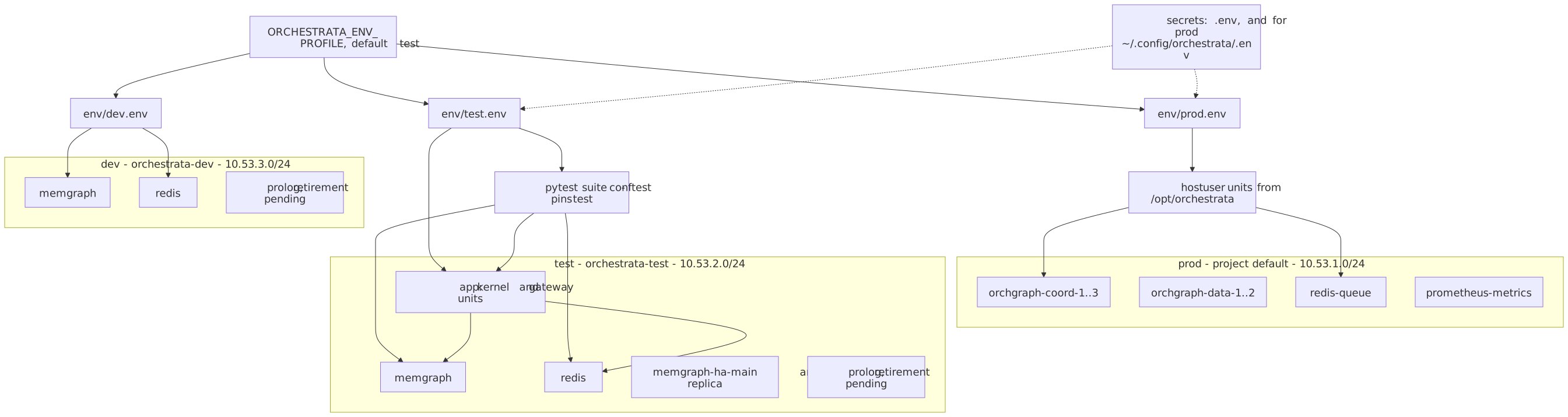
6. The environments
Three physically isolated fleets, each its own Incus project on its own bridge, separated by Incus network ACLs. Terraform (OpenTofu) owns every fleet and every container address is pinned (ADR-0077, ADR-0080). The hourly drift check that ADR-0077 added has had its timer stopped and disabled since 2026-10-22, when its last run reported drift (runtime services §10).
| Fleet | Incus project | Subnet | What runs there (measured 2026-10-23) |
|---|---|---|---|
| prod | default |
10.53.1.0/24 | orchgraph-coord-1..3, orchgraph-data-1..2, redis-queue (.10), prometheus-metrics (.40) |
| test | orchestrata-test |
10.53.2.0/24 | app (.13, Arch Linux) running the kernel and gateway units; memgraph (.10); redis (.11); prolog (.12); memgraph-ha-main/replica (.20/.21); rh-coord-1..3 and rh-data-1 (.30–.33) |
| dev | orchestrata-dev |
10.53.3.0/24 | memgraph (.20), redis (.21), prolog (.22) |
Where the application itself runs differs per fleet:
- Prod application services are systemd user units on the host, running
from the pinned checkout
/opt/orchestrata(ADR-0062, RUL-027). On 2026-10-23/opt/orchestrata/VERSIONread commit4ac0db570. The ten units and why each exists are on the runtime services page; ADR-0123 (Proposed) makes that page the register of host services and proposes that kernel and gateway become on-demand units. On 2026-10-23 the kernel and gateway units were inactive and disabled; the conversation consumer and the backup, retention and history-mining timers were active. - Test runs the kernel and gateway inside the
appcontainer at10.53.2.13(orchestrata-kernel.serviceandorchestrata-gateway.service, both active on 2026-10-23), so the suite talks to test services and never to the prod host's (isolated test fleet). The commit installed in that container was not measured for this page. - Dev holds infrastructure only, for developer scratch.
How the runtime profile is chosen
Endpoints live in committed, secret-free profiles env/dev.env,
env/test.env and env/prod.env. ORCHESTRATA_ENV_PROFILE selects one
(default test), and it is layered over a gitignored .env that holds secrets
only (AGENTS.md). Prod's secrets live in ~/.config/orchestrata/.env
(ADR-0066), and the prod units load .env plus env/prod.env. The test suite
does not choose: tests/conftest.py hard-pins env/test.env and refuses to
run if any resolved endpoint is on the prod subnet (override only with
ORCHESTRATA_ALLOW_PROD_INFRA=1). Required endpoint keys raise when unset;
there is no literal fallback, not even localhost (RUL-003).
| Key | prod | test | dev |
|---|---|---|---|
REDIS_HOST |
10.53.1.10 | 10.53.2.11 | 10.53.3.21 |
KG_URI |
neo4j://10.53.1.160:7691 (routing) |
bolt://10.53.2.10:7687 |
bolt://10.53.3.20:7687 |
KG_DATABASE |
orchkg |
orchkg |
orchkg |
CXP_GRPC_HOST / port |
localhost / 50053 | 10.53.2.13 / 50053 | localhost / 50053 |
GATEWAY_HOST |
127.0.0.1 (ADR-0065) | 127.0.0.1, with ORCHESTRATA_GATEWAY_PROBE_HOST=10.53.2.13 for the readiness probe |
not set in the profile |
What is changing. ADR-0124 (Proposed; items 1, 2 and 10 ruled) moves orchestrata's services off the host into a test container and a prod container built from one OpenMandriva image, over always-on memgraph and Redis, with the workspace mounted read-write so the volks can do their work. Its item 10 is "cutover first": the components cut-over (section 10) lands before either container is built. ADR-0111 forbids test runs from creating containers.
7. The tooling around it
Orchestrata is developed with a ring of separately deployed tools. Each lives
under /opt, at a pinned release, and is deployed by its own launcher rather
than run from a checkout.
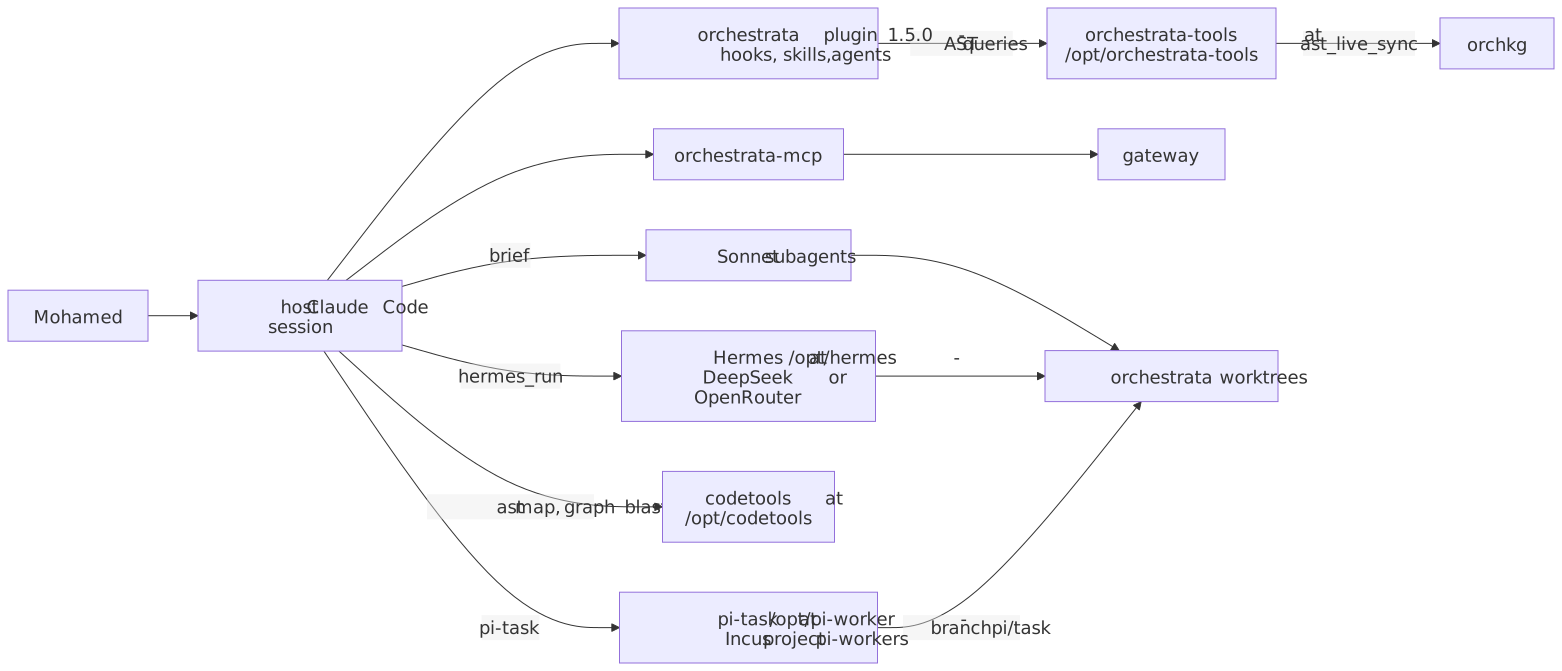
orchestrata-tools (/opt/orchestrata-tools). The developer daemons and
binaries, deployed code with the served checkout as a runtime parameter
(ADR-0067). Its bin/ holds ast, ast-daemon, ast_live_sync,
codemod-daemon, observe_pytest, pytest-live, ship and
swarm_supervisor; its VERSION read commit 7309a3488, deployed
2026-10-22T19:55:40-04:00. This is where the AST toolkit runs from. The name
also belongs to two other things, so keep them apart: the component package
orchestrata-tools (packages/tools, import name orchestrata_tools,
ADR-0107) and the source root src/orchestrata_tools.
codetools (/opt/codetools). A separate project
(codetools, repo ~/workspace/orchestrata.codetools)
that provides code tooling as a CLI, an MCP server (ast_query,
ast_snapshot, graph_blast, gate_run, the deploy_* verbs and more) and a
Claude plugin. codetools ast map regenerates docs/CODEBASE_MAP.md. Host-side
orchestrata scripts are moving into it (ADR-0117 for the rename engine,
ADR-0118 for tier-1 scripts).
Hermes (/opt/hermes). The Nous Research Hermes agent, deployed at a
pinned commit and used as a non-Claude worker through the hermes MCP server
(hermes_run, hermes_runs, hermes_status). It runs DeepSeek or OpenRouter
models and reports answered_by, fell_back and cost_usd per run; it keeps a
persistent curated memory across runs (ADR-0121).
pi-worker (/opt/pi-worker). pi-task runs a Pi worker on one task in a
fresh Incus container and returns the result only if a judge in a second fresh
container finds the brief's checks hold; an accepted result arrives as a branch
pi/<task> and is never merged automatically (pi-harness).
The Claude Code plugin. The orchestrata plugin, version 1.5.0
(~/.claude/plugins/cache/orchestrata/orchestrata/1.5.0), is installed by
deploy/install-claude-config.sh as part of a deploy. It carries 65 of the
119 hook commands registered on the host, 10 skills (agent-messaging,
canvas, decision, kimi-webbridge, notify, observe-work,
orchestrata-provision, session, shell-guards, test-isolation), 7 agent
definitions (auditor, builder, lint-fixer, refactorer, reviewer,
test-writer, wirer) and 14 commands. Hooks are registered at the user level
only and scope themselves to the repo in the current directory (ADR-0070,
RUL-035). The Claude configuration section documents every
hook, skill and command. The orchestrata MCP server itself is
/opt/orchestrata/.venv/bin/orchestrata-mcp.
8. How work flows
Since 2026-10-22 the division of labour is a ruling (ADR-0125, RUL-041): the host Claude session writes no orchestrata code. It measures, writes briefs, runs checks and improves the workflow; worker models write the code: Sonnet subagents, and Qwen or DeepSeek through Hermes and pi-task. Each dispatch is measured, and a workflow change counts as an improvement only if the measurements improve.

- Briefs. A brief lives in
plans/briefs/and must carry the literal labelsGOAL:,FILES:,CONSTRAINTS:,DONE WHEN:andVERIFY:, plus aDESIGN_WAIVER:line for builder-type agents (plans/briefs/TEMPLATE-sonnet-agent.md). Brief defects are logged inplans/briefs/IMPROVEMENT-LOG.md. See briefs and the dispatch ledger. - The loop. Measure before theorizing; write a contract; refute the design; build red-first; verify by execution, never by reading a report; run the battery and fix everything; document. The rules behind it are not style: most exist because something broke silently (starting context). See workflow and workflow improvements.
- Gates. A gate is a mechanical check with a command and no discretion:
the battery in
scripts/gates.py, the suite preflight, the session hooks and the Prolog gate layerscripts/gate.py, whose verdict can be invalid when its fact base is stale (gates). Defects found and fixed are logged in bug fixes and the bug-fix log. - Deployment.
deploy/ship.shanswers "is this finished?" (gate, push, deploy, verify, promote);deploy/deploy.shanswers "is the running system this commit?". The prod gate is one correctness run of the promoted commit (ADR-0087). See deployment, ship and deploy, deployment sequence, deployment inventory and runtime services. - Tests. Real infrastructure, no doubles, no
pytest-xdist, the kernel required, and runs observed live rather than read from an exit code. The batched runner isscripts/run_tests.py. See tests, the test reference, test reports, the green ledger and durations. - Definition of Done. Every spec packet ships with
@traces, a regenerated RTM, documentation, a wiki update and at least 90% coverage (ADR-0069, RUL-034).
9. Specs, requirements and the RTM

Specs. specs/ has 79 tracked entries (specs index):
71 numbered spec directories from 000-orchestrata-cli to
114-governance-rule-learning (counted with ls on 2026-10-23), plus
SPEC_INVENTORY.md, SPEC_STANDARD.md, SPEC_REVIEW_CHECKLIST.md, the
codegen/ and spec-review/ folders and three HTML prototypes. A spec
directory holds spec.md, a checklists/requirements.md that defines the
numbered requirement ids, and often compliance audits and addenda.
SPEC_STANDARD.md fixes the template: metadata, overview, at least three user
scenarios and so on. Specs are authoritative: design and contract questions
are settled from the spec first (RUL-013).
Each spec has its own page at /projects/orchestrata-ultimate/specs/<spec-dir>.
Requirement ids. docs/req-id-grammar.md (ratified 2026-08-02) is the
grammar: spec-scoped forms such as REQ-001-001 and the canonical story form
REQ-022-US-001-001, subsystem tags such as REQ-GATE-001, and cluster forms.
scripts/check_req_format.py enforces it as the pre-commit hook
req-id-format.
@traces. Code claims a requirement with a decorator from
core/base/traces.py. The gateway's connection handler, for instance, carries
@traces(spec="014", story="US-011", reqs=["REQ-014-168"]). The scanner
harvests these claims, the RTM files under rtm/ and docs/ are generated
from them, and scripts/sync_traces_to_graph.py writes them into orchkg as
TRACES_TO edges to RequirementItem nodes.
The RTM, graded. A decorator is a claim, not proof. The legacy matrix in
docs/rtm.md reported "Coverage 100.0%" while listing 3,087 orphans, and the
decorator-claim model was measured at 55% ± 5% accurate on 2026-07-09
(docstring of scripts/generate_rtm_evidence.py). The evidence-graded RTM
replaces it: each requirement is graded by the strongest evidence that exists,
TESTED (a citing test ran green), FAILING (a citing test ran red),
CITED, DECLARED (only @traces claims it) or UNLINKED. The
specs index counts 7,347
requirement ids, 3,150 of them (42.9%) cited by at least one src/ decorator
and 269 (3.7%) by a test decorator. The RTM page
explains generation and totals.
10. The components cut-over
What is being done. The monolith src/orchestrata_ultimate is being re-cut
into component packages under packages/, each with its own import name, its
own tests and a drawn dependency DAG
(component DAG): contracts,
governance, knowledge_graph (orchestrata_kg), kernel, session,
volks, gateway, tools, the composed release integration (import name
orchestrata) and plugin (a packaging track). The source of the lift is the
frozen monolith at e57782ea4.
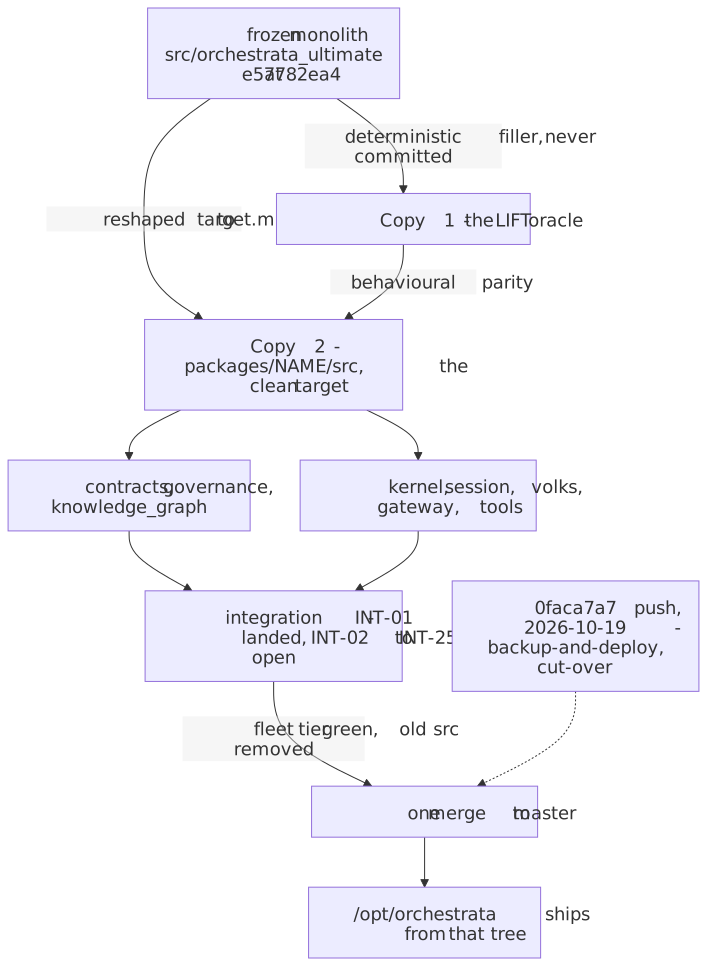
ADR-0103 (Accepted, probationary, 2026-10-15) sets the method. A
byte-faithful LIFT of frozen code is a deterministic script's output, not an
LLM task (25 of 34 wave-1 files were reproduced byte-identically from the brief
alone), and shipping it would carry frozen's debt into the new packages. So
there are two copies: the oracle, regenerated on demand and never
committed, and the clean target in packages/<c>/src/, which is the
deliverable and must pass behavioural parity against the oracle and conform to
the target design. The ADR stays probationary until a five-criterion POC passes.
The file exists only on branch architecture/domain-model (commit
b3ea29a31); it is not in docs/adr/ of the master-line worktrees read for
this page.
ADR-0113 (Accepted, 2026-10-19) defines the cut-over and corrects the
record. The 2026-10-19 push of the in-progress tree to origin/master
(0faca7a7), which prod deployed, is a backup-and-deploy, not the
cut-over. The cut-over is the future event where integration passes the fleet
tier, the old src/orchestrata_ultimate/* is removed, one merge lands on
master and /opt/orchestrata ships from that tree. It also orders integration
level 1 to be built now.
INT-01 to INT-25 are the integration increments
(packages/integration/increments/README.md). INT-01 is the spec delta
(SPEC-125) and release scaffold, and it has landed. INT-02 to INT-24 lift the
entry points into the release package: the CLI client and watch stream, the
monolithic kernel.cli_main in five parts, the pipeline CLI and KG server,
the gateway token minter, the test runner and service starter in five parts
each, and the session pipeline CLI. INT-25 is a net-new composition of the
session console script. Ruling gate E-1 was cleared on 2026-10-20
(ADR-0115); gates N4 (INT-11) and N-I1 (INT-04) are listed as standing.
Measured 2026-10-23: packages/integration holds three Python files at
4ac0db570, so INT-02 to INT-25 have not landed on master. Related decisions:
ADR-0107 (tools becomes a package), ADR-0108 (the AST toolkit stays host-side
behind a contracts protocol), ADR-0112 (tools reaches Redis and embeddings
through contracts protocols), ADR-0114 (orchkg sees the component packages)
and ADR-0124 item 10 (cut-over before containers).
Open questions, stated as found.
- The role of
packages/. On 2026-10-22 the question was raised whetherpackages/is the single edited source (the reading of ADR-0103 and ADR-0113, and of Python packaging practice) or a versioned deployment copy ofsrc/. It has not been ruled. - ADR-0103's POC. Whether the five-criterion POC gate has passed or failed was not measured for this page.
- Which branch the KG describes. Until ADR-0126 is ruled and implemented, syncs from different checkouts write into one project id.
- Unpinned components. INT-01's release pins still read
<PENDING volks design>fororchestrata-volksand<PENDING tools release id>forcodetools.
The open decisions page tracks what awaits a ruling.
11. Where to go next
Pick the path that matches why you are here.
- New to orchestrata. Starting context, then the volks, then the architecture and its full-size diagram. Keep the glossary open.
- About to change code. The code reference for the module you touch, its curated page under the module docs index, the component DAG, then workflow, briefs and gates.
- Operating it. Runtime services, deployment, isolated test fleet, runbooks and running the test suite.
- Checking a requirement. Specs and the RTM.
- Understanding a decision. Decisions, open decisions, the rulings canon and plans.
- Catching up on history. Sessions, tasks and research.