Orchestrata Ultimate / Architecture
Orchestrata-Ultimate Architecture
Orchestrata is a single Python package, orchestrata_ultimate, ported from the
former 26-package orchestrata monorepo and organized as a modular monolith. It
runs on free-threaded Python 3.14 with uv. The same code is now being re-cut
into ten component packages under packages/, which has not cut over
(component DAG). This page is
the architecture in one place; Orchestrata, explained
walks a request through it, and the architecture diagram
is the full-size picture.
Sources, all read on 2026-10-23: architecture-standards.md and
docs/CODEBASE_MAP.md in the worktree wt-MAP-PRECOMMIT (8a2cb42ad), the
generated code reference, the
component DAG and the
runtime services page.
The six layers
The single rule is down only: a module may import orchestrata_ultimate
code from its own layer or a lower one, never a higher one. Same-layer concrete
imports between Layer-3 domain services are not allowed; they talk through
Layer-0 protocols injected by the DI container or through Layer 4. The table
mirrors LAYER_ASSIGNMENTS in scripts/architecture_checker.py, the source of
truth, which validates import rules, module boundaries and layering;
scripts/architecture_static_check.py is its static import-graph complement.
| Layer | Name | Packages | May import from |
|---|---|---|---|
| 0 | Vocabulary | core.domain, core.protocols, core.packet, core.enums, core.interfaces, core.base, types, models, interfaces, exceptions |
Layer 0 only (stdlib and pydantic in practice) |
| 1 | Infrastructure | core.config, core.logging, core.tracing, core.monitoring, core.patterns, core.state, core.threading, core.adapters, core.traceability, core.traceability_utils, core.redis_factory, core.neo4j_factory, core.infra_config, core.graph_directives, di, infra |
Layers 0–1 |
| 2 | Communication | cxp, postman, memory |
Layers 0–2 |
| 3 | Domain services | agents, governance, knowledge_graph, providers, verification, llm, drivers, prolog |
Layers 0–3, peers only through protocols |
| 4 | Orchestration | kernel, orchestrator, session |
Layers 0–4 |
| 5 | Interface | gateway, plugin, __main__ |
Layers 0–5 |

Module counts are from the code reference at 8a2cb42ad; core (92 modules)
spans Layers 0 and 1.
The packages
src/orchestrata_ultimate/ holds 30 packages (docs/CODEBASE_MAP.md). Twelve
are not in the layer table above: context (11 modules), domaingen (7),
factory (74), gates (5), harness (20), integrations (4), openspec (7),
planning (2), promotion (23), refactor (50), semantic_graph (20) and
tools (20). Their layer was not measured for this page. Two sibling roots sit
beside the package: src/orchestrata_ast (7 modules, the AST analyzer used by
the graph sync) and src/orchestrata_tools (60 modules). The
hub's code reference table
gives each package a one-line description and links its reference and curated
pages.
Two packages are easy to conflate. knowledge_graph talks to the
operational KG, the orchkg database: sessions, audit, code intelligence,
specs, requirements and traces. semantic_graph talks to the semantic /
RAG database, memgraph: embeddings, chunks and GraphRAG
(semantic graph). Both
databases live on the same orchgraph cluster.
The runtime pieces
| Piece | Package | Process | What it owns |
|---|---|---|---|
| Kernel | kernel, started by agents/runtime_main.py |
python -m orchestrata_ultimate.agents.runtime_main, CXP on CXP_GRPC_PORT 50053 over cxpt |
The pipeline runner, dispatch, routing, audit and the embedded Prolog. Required for every authoritative test run. |
| Gateway | gateway |
python -m orchestrata_ultimate.gateway.cli serve, WebSocket 8765, HTTP 8766 |
The single runtime ingress: JSON-RPC 2.0, auth, pub/sub, ring buffers, audit. |
| Orchestrator | orchestrator |
in the kernel and, as a fallback, in the gateway | U:Ox: intent classification, the intent broker, policy evaluation, escalation; PipelineKernelClient is the gateway's in-process fallback. |
| Postman | postman |
in the kernel (a standalone postman/cli.py entry point also exists) |
Message routing and delivery: queues, topics, subscriptions, receipts, replay. |
| Agents | agents |
in the kernel | The volk runtime: eleven volks registered by PipelineRunner._register_volks at 8a2cb42ad. |
Underneath: Redis (one per fleet) for queues, event streams, ring buffers,
hot memory and the conversation queue; the orchgraph Memgraph-fork HA
cluster with its orchkg and memgraph databases; and SWI-Prolog, embedded
in the kernel through the free-threaded janus-swi fork, with no Prolog service
of its own (ADR-0110). On the prod host the kernel and gateway are systemd user
units run from /opt/orchestrata; in the test fleet they run in the app
container. See runtime services
for every unit.
The component DAG (packages refactor)
ADR-0112, ADR-0113, ADR-0114 and ADR-0115 rule the ten components and their 30
dependency edges (component DAG).
plugin is a packaging track, not a lifted component, and integration (import
name orchestrata) is the composed release. Arrows point from a component to
what it depends on.
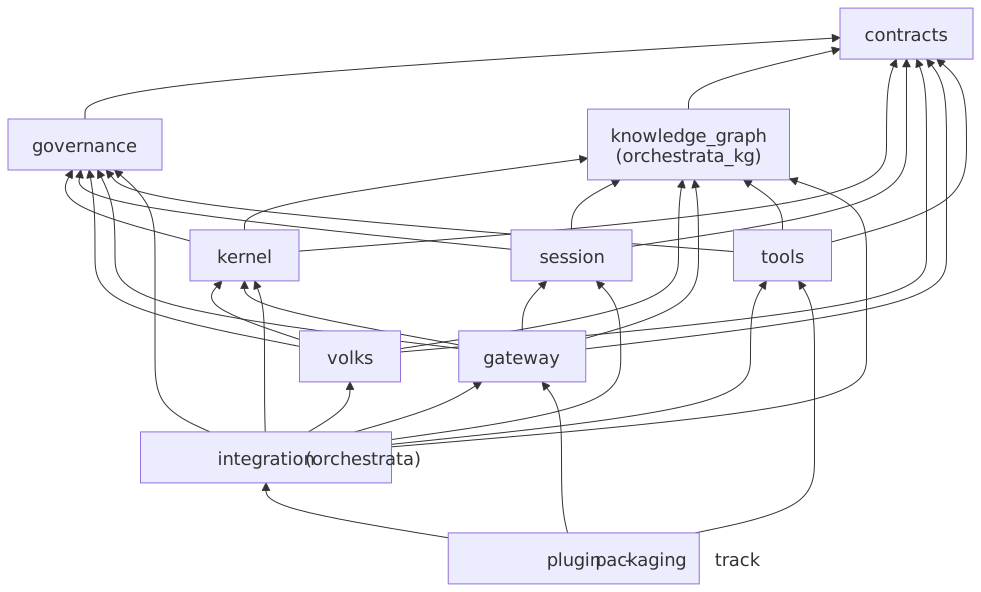
tools deliberately has no edge to kernel: it reaches Redis and embeddings
through contracts protocols (ADR-0112). The cut-over, its INT increments and
its open questions are in Orchestrata, explained §10.
AST statistics
At 8a2cb42ad the code reference counts 902 modules and 242,957 lines in
orchestrata_ultimate, 1,790 modules in the eight lifted component packages,
and 3,508 classes and 6,162 functions across everything it covers
(code reference). The table
below is the earlier measurement from plans/ast-ultimate.json, kept for
comparison.
Earlier measurement (2026-07-22, plans/ast-ultimate.json)
| Metric | Value |
|---|---|
| Classes | 1,153 |
| Functions | 1,034 |
| Methods | 4,730 |
| Lines of code | 164,427 |
| Packages | 24 |
Package dependency graph (2026-07-22)
Edge labels are import counts. The heaviest edges confirm the layering: agents → core (82), cxp → core (34), gateway → core (32) — plus session → core (62), kernel → core (54), orchestrator → core (53), verification → core (46).
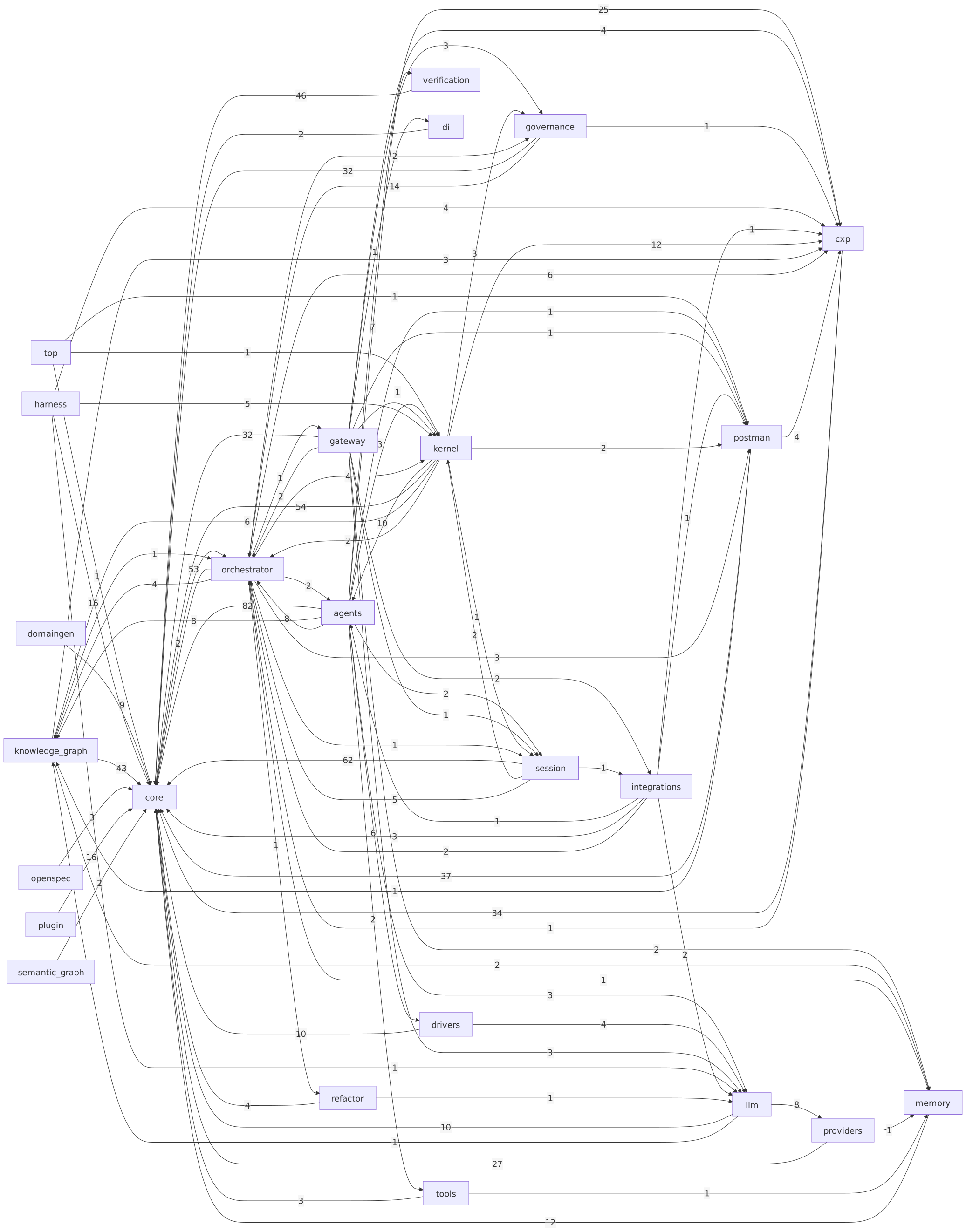
Source diagrams: docs/diagrams/architecture-packages.mmd in the repo.
Persistence layer (D12) — as of 2026-07-08
All Neo4j/Redis client construction goes through core/neo4j_factory.py and
core/redis_factory.py (see ADR-010 on the decisions page);
a blocking architecture_checker rule prevents regressions. Memgraph connections
use the NO_AUTH sentinel (ADR-011).
Since the 2026-07-26 cut-over the graph those clients reach is the orchgraph
cluster (KG_ENGINE=memgraph, KG_DATABASE=orchkg in all three env/*.env
profiles), while the factory module keeps its Neo4j-era name. The Bolt
protocol is shared, which is why the prod routing URI is
neo4j://10.53.1.160:7691 (KG migration).