Orchestrata Ultimate / Architecture / Architecture diagram
Architecture Diagram
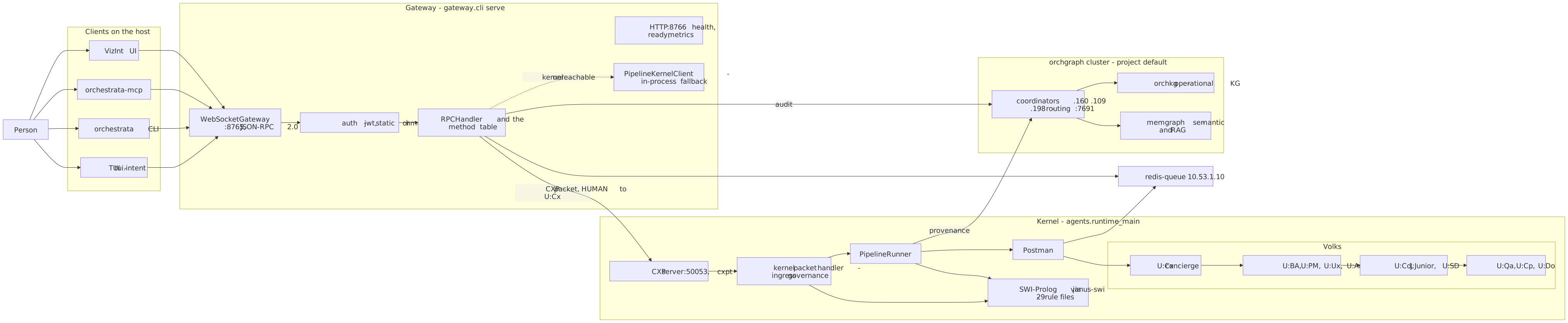
The full-size system diagram, as of 2026-10-23. It traces a request from a
person, in through the gateway, into the kernel and across the volks, against
the stores underneath, and it shows where each piece runs in prod. Code facts
are from the AST toolkit at 8a2cb42ad; runtime facts are from incus list
and systemctl --user on 2026-10-23. The narrative version is
Orchestrata, explained.
How to read it
- Clients never talk to volks directly. Every client enters through
WebSocketGateway(gateway/server.py), which authenticates the first frame, dispatches JSON-RPC 2.0 throughRPCHandlerand writes anrpc.<method>audit event per call.orchestrata-mcpis a WebSocket client of the same gateway (ADR-0099); the TUI callstui.intent; the CLI is a thin client over the gateway (kernel/cli_client.py). - The kernel is
orchestrata_ultimate.agents.runtime_main: a CXP server onCXP_GRPC_PORT(50053) over the cxpt transport, which replaced gRPC on 2026-08-07 (gRPC retirement). Its packet handler gates every new intent through the intent broker before thePipelineRunnerruns it, and it is required infrastructure for every authoritative test run. If it is unreachable when the gateway starts, the gateway falls back to the in-processPipelineKernelClientand reports the mode throughgateway.info. - The volks. Every intent is addressed to the concierge,
U:Cx, first; the route onward depends on the work type. The grouping in the diagram is for reading only; the eleven aliases are thosePipelineRunner._register_volksregisters with the Postman at8a2cb42ad. See the volks. - Governance is SWI-Prolog embedded in the kernel through the free-threaded
janus-swifork, consulting the rule files insrc/orchestrata_ultimate/prolog/.PipelineRunner.submit_intentasksmay_execute(HUMAN, submit_intent)before routing. There is no Prolog server (ADR-0110). - The two graphs, kept apart. Both are databases on the orchgraph cluster
(coordinators
orchgraph-coord-1..3, dataorchgraph-data-1..2):orchkgis the operational KG (code intelligence, specs and traces, sessions, audit, conversations) andmemgraphis the semantic / RAG graph. Neo4j was retired as the operational KG on 2026-07-26. - Redis carries the Postman's queues, the event streams and ring buffers the gateway pushes from, hot agent memory and the conversation queue.
- Where it runs. In prod the gateway and kernel are host user units run from
/opt/orchestrata(inactive and disabled on 2026-10-23), over the orchgraph cluster andredis-queuein Incus projectdefault. In test the same pair runs inside theappcontainer at10.53.2.13, over the test fleet's singlememgraphandredis. See Orchestrata, explained §6 and runtime services.
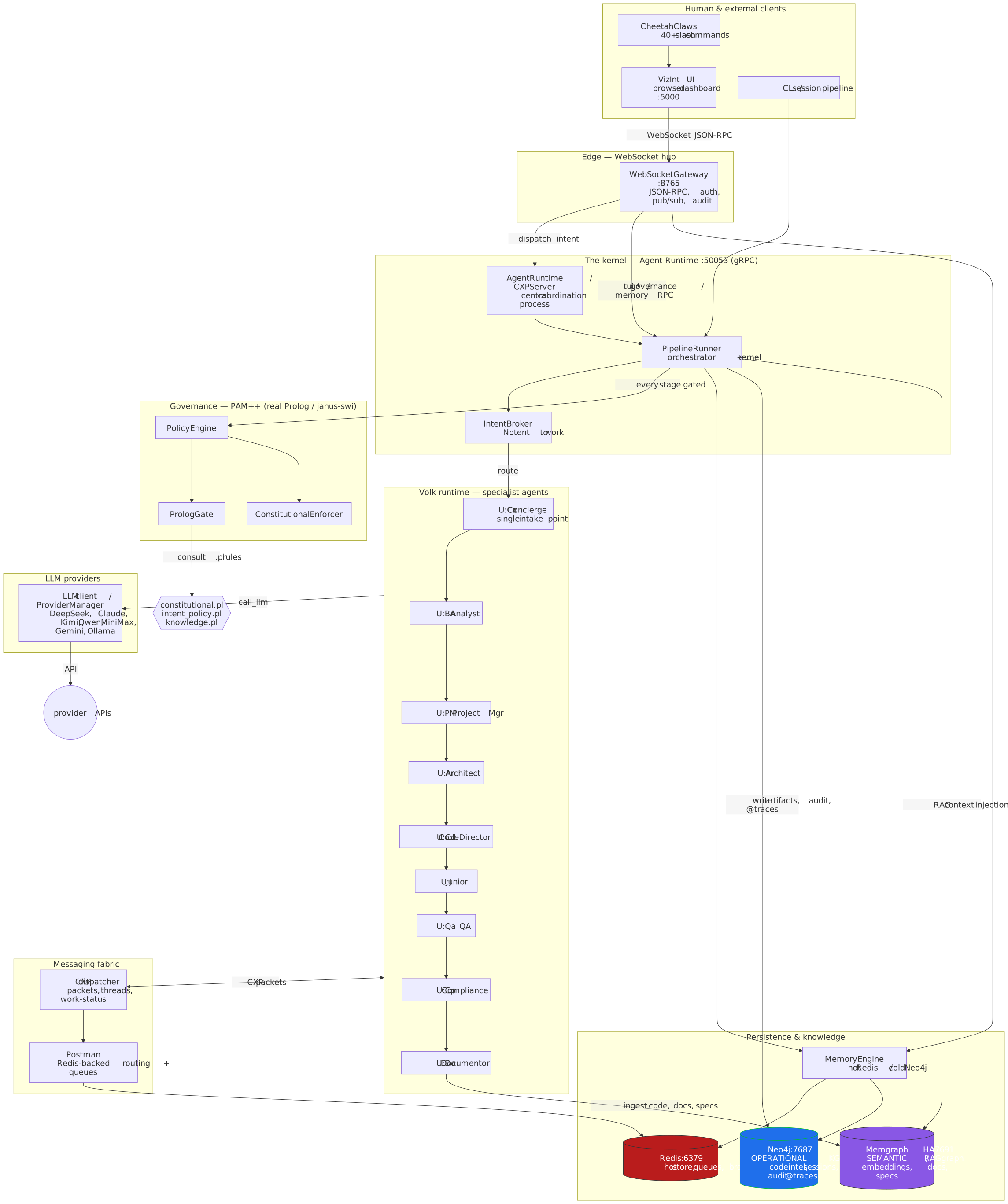
Earlier diagram
The diagram that stood here until 2026-10-23 predates the orchgraph cut-over and the gRPC retirement: it shows Neo4j as the operational KG and a gRPC kernel. It is kept for history: open the earlier diagram.