Home / Glossary
Glossary
The shared vocabulary for orchestrata-ultimate and this wiki. Four parts:
orchestrata terms for newcomers (start
here; each term links to its page), the longer
project vocabulary, the
operational KG schema
(the orchkg database), and the
semantic/wiki graph schema
(the memgraph database). Authoritative sources:
knowledge_graph/canonical_schema.py (SPEC-106 FR-001) for the operational KG,
graph-indexer/memgraph_client.py for the wiki graph. The whole system is
explained in Orchestrata, explained.
Orchestrata terms for newcomers
Alphabetical. Facts are as of 2026-10-23 and cite their source.
- ADR (architecture decision record) — an append-only record of a one-way-door decision, in the repo's
docs/adr/NNNN-title.md(105 files at478d9a0ef), with status Proposed, Accepted or Superseded. Never edited once accepted; superseded instead. See Decisions and Open decisions. - AST snapshot — the JSON serialization of the source tree that the AST toolkit queries (default warm cache
plans/ast-ultimate.json, roots declared inenv/ast-roots.env). It also feeds the Prolog gate layer and theorchkgcode-intelligence sync. See Overview §5. - AST toolkit —
serialize_codebase_ast.pyand its daemon, deployed under/opt/orchestrata-tools; the only sanctioned way to read Python structure and source in this project. See Overview §7. - Brief — the written task a worker model builds from, kept in
plans/briefs/. It must carry the labelsGOAL:,FILES:,CONSTRAINTS:,DONE WHEN:andVERIFY:(plus aDESIGN_WAIVER:line for builder agents), perplans/briefs/TEMPLATE-sonnet-agent.md. See Briefs and the dispatch ledger. - codetools — a separate code-tooling project (
~/workspace/orchestrata.codetools, deployed at/opt/codetools) offered as a CLI, an MCP server and a Claude plugin;codetools ast mapwrites the codebase maps. Host-side orchestrata scripts are moving into it (ADR-0117, ADR-0118). See codetools. - Components — the ten packages the monolith is being re-cut into under
packages/: contracts, governance, knowledge_graph, kernel, session, volks, gateway, tools, integration (import nameorchestrata) and plugin. The cut-over has not happened (ADR-0113). See Component DAG. - CXP (Cross-agent eXchange Protocol) — the packet format every hop speaks (SPEC-004):
CXPPacket, a flat packet with eleven core fields (message_id,from_agent,to_agent,thread_id,subject,payload,timestamp,priority,delivery_status,work_status,protocol_version). See cxp. - cxpt — the native direct transport that carries CXP between gateway and kernel. It replaced the
grpc.aiotransport on 2026-08-07;CXP_TRANSPORT=cxptin the profiles, and some names still say "gRPC". See gRPC retirement. - Definition of Done — every spec packet ships with
@traces, a regenerated RTM, documentation, a wiki update and at least 90% coverage (ADR-0069). See RUL-034. - Factory — the
factorypackage: SPEC-033's governed autonomous build factory (assumption ledgers, semantic anchors, red-first evidence, mutation testing, a DAG scheduler and merge queue). ADRs 0001 to 0033 are its decision register. See factory. - Fleet — one of the three isolated Incus environments: prod (project
default, 10.53.1.0/24), test (orchestrata-test, 10.53.2.0/24) and dev (orchestrata-dev, 10.53.3.0/24). See Isolated test fleet and Overview §6. - Gate — a mechanical check with a command, a failure behaviour and no discretion: the battery in
scripts/gates.py, the suite preflight, the session hooks and the Prolog gate layerscripts/gate.py. See Gates. - Gateway — the single runtime ingress:
WebSocketGateway, WebSocket JSON-RPC 2.0 onGATEWAY_PORT8765 with HTTP on 8766, JWT auth by default (JWT_SECRET,TOKEN_EXPIRY_SECONDSdefault 3600), about 80 RPC methods (SPEC-014). See gateway. - Governance — the policy layer: the
governancepackage plus the Prolog rule files insrc/orchestrata_ultimate/prolog/, consulted in-process before work runs (may_execute/2). Denials carry a reason;explain.plgives proof trees. See governance and Governed action classification. - Hermes — the Nous Research Hermes agent, deployed at
/opt/hermesat a pinned commit and used as a non-Claude worker (DeepSeek or OpenRouter models) through thehermesMCP server; it reportsanswered_by,fell_backandcost_usdper run (ADR-0121). See Overview §7. - Intent — a natural-language request from a person. The gateway parses it and either asks for clarification or sends it to the concierge volk as a CXP packet with subject
intent; the kernel gates it through the intent broker and runs it in thePipelineRunner. See Overview §4 and orchestrator. - INT-01..25 — the increments of the integration package, the composed release; INT-01 (spec delta and release scaffold) has landed, INT-02 to INT-25 have not (2026-10-23). See Overview §10.
- kg — Mohamed's alias for the operational knowledge graph,
orchkgon the prod orchgraph cluster (ADR-0126 provenance). See orchkg. - Kernel — the agent runtime process,
python -m orchestrata_ultimate.agents.runtime_main, serving CXP onCXP_GRPC_PORT50053 over cxpt; it runs thePipelineRunner, the Postman, the volks and embedded Prolog. Required for every authoritative test run. See kernel. - memgraph (database) — the semantic / RAG database on the orchgraph cluster: embedded chunks of code, docs and specs. Not to be confused with orchkg. See Semantic graph.
- orchestrata-mcp — the
orchestrataMCP server (/opt/orchestrata/.venv/bin/orchestrata-mcp), a WebSocket JSON-RPC client of the running gateway; every method is approval-gated unless marked read-only (ADR-0099). See gateway. - orchestrata-tools — two things share the name. (1) The deployed developer tools at
/opt/orchestrata-tools(ast,ast-daemon,ast_live_sync,codemod-daemon,observe_pytest,pytest-live,ship,swarm_supervisor; ADR-0067). (2) The component packagepackages/tools, import nameorchestrata_tools(ADR-0107). See Overview §7 and the tools component reference. - orchgraph — the Memgraph-fork Raft HA cluster in prod (project
default): coordinatorsorchgraph-coord-1..3(10.53.1.160/.109/.198, routing:7691) and data instancesorchgraph-data-1..2(10.53.1.128/.123). It hosts bothorchkgandmemgraph. See KG migration to orchgraph. - orchkg — the operational knowledge graph database on orchgraph since 2026-07-26: code structure, specs, requirements and
TRACES_TO, sessions, CXP packets, gateway audit, conversations, the component DAG. See KG migration to orchgraph and knowledge_graph. - pi-worker / pi-task —
pi-taskat/opt/pi-worker: one task, one fresh Incus container (projectpi-workers), a judge in a second container, and an accepted result returned as a branchpi/<task>, never merged automatically. See pi-harness. - Postman — the message router (
postman, aliasU:PS): queues, topics, subscriptions, receipts, replay. Volks register with it and the pipeline routes packets through it. See postman. - Profile —
ORCHESTRATA_ENV_PROFILE(defaulttest) selectsenv/dev.env,env/test.envorenv/prod.env, endpoint-only files layered over a secrets-only.env; the test suite is hard-pinned to test. See Overview §6. - Prolog KB — the Prolog knowledge bases: the governance rule files (29
.plfiles insrc/orchestrata_ultimate/prolog/at8a2cb42ad) plus the ground facts callers assert for each question, and the code-intelligence knowledge base thecode_intel,trace_intelandhistory_inteltools query. Prolog is a stateless reasoning view; the graph is the sole fact store (ADR-0005). See The Prolog layer does not learn and the Prolog atlas. - RTM (requirements traceability matrix) — the join of requirement ids to the code and tests that cite them, graded by evidence:
TESTED,FAILING,CITED,DECLAREDorUNLINKED(scripts/generate_rtm_evidence.py). See RTM. - RUL (ruling) — a standing user ruling,
RUL-001toRUL-041, each tied to an enforcement mechanism. See the rulings canon. - Session — a unit of tracked work: the
sessionpackage, thesessionCLI and its per-projectcontext.json, the gateway'ssession.*methods andSessionnodes in orchkg. See session and Sessions. - Spec — an authoritative requirement document,
specs/NNN-name/spec.mdwithchecklists/requirements.md; 79 tracked entries inspecs/, 71 of them numbered spec directories. See Specs. - Volk — one agent role. Eleven are registered at
8a2cb42ad:U:Cxconcierge,U:BAanalyst,U:PM,U:Ux,U:Ararchitect,U:Cdcode director,J:Junior,U:SDsenior developer,U:Qa,U:Cpcompliance,U:Dodocumentor. Every intent goes to the concierge first. See The volks. - Worker model — the model that writes orchestrata code under ADR-0125: Sonnet subagents, or Qwen and DeepSeek through Hermes and pi-task; the host Claude writes briefs, checks and workflow only. See RUL-041.
Project vocabulary
- orchestrata-ultimate — the single-package port (~122K LOC) of the
26-package
orchestratamonorepo. Python 3.14 free-threaded,uv-managed, absolute imports only. The port itself is complete; work is now maintenance, tooling, and capability build-out. - Volk — an agent role in the multi-agent system (from German "folk").
Eleven exist: analyst (U:BA), architect (U:Ar), codedirector (U:Cd),
compliance (U:Cp), concierge (U:Cx), documentor (U:Do), junior (J:Junior),
pm (U:PM), qa (U:Qa), senior_dev, ux (U:Ux). Each has a system prompt,
tools, and handoff rules;
BaseAgentis the shared base class. - Kernel — the Agent Runtime coordination engine (
kernel/,agents/runtime_main.py, CXP over the cxpt transport onCXP_GRPC_PORT/50053; gRPC was retired 2026-08-07). REQUIRED infra for every test-suite run — a run that skips it is invalid/false-green. - CXP (Cross-agent eXchange Protocol) — the typed packet protocol agents
use to talk to each other (
cxp/): packets, headers, routing, priorities, delivery guarantees; the cxpt direct transport between processes, with WebSocket and HTTP dispatch paths inkernel/dispatcher.py. - Postman (U:PS) — the message routing/delivery engine (
postman/): queues, topics, subscriptions, receipts, replay, circuit breakers. - Orchestrator (U:Ox) — the governance/policy management engine
(
orchestrator/): intent parsing/classification/routing, the PipelineRunner, fact stores, impact analysis. - Intent — a parsed user request routed to a pipeline: classified, validated (Prolog), secured, then executed as a PipelineRun.
- Pipeline / PipelineRunner — the staged execution of an intent across volks (e.g. review work type: QA → Cp), with retry classification, checkpoints, escalation-as-data, and KG absorption.
- Gateway — the WebSocket surface (SPEC-014,
gateway/): RPC dispatch, pub/sub, auth, ring buffers, the PolicyGate, and the UI (VizInt) bridge. - Governance / PAM — the Prolog-backed policy layer (
governance/,prolog/*.pl):may_execute/2, constitutional articles, ethical checks, escalation, safe mode. Strict mode (ORCHESTRATA_GOVERNANCE_STRICT, default fail-closed) turns evaluation errors into denies. - Prolog engine (janus, free-threaded) — SWI-Prolog embedded via a
PATCHED janus-swi (
scripts/_janus_patched) that runs with the GIL genuinely off on 3.14t. Never revert to stock janus/grpcio. Rules live in.plfiles (consulted); only GROUND facts are assertz'd. - Harness — the scenario-driven volk evaluation system (
harness/): YAML scenarios, evaluators (syntax/lint/file/llm-judge/trace), Incus isolation, healing, history. - Spec / SPEC-NNN — the authoritative requirement documents
(
specs/000..106). Specs override tests and opinions: design/contract questions are resolved from specs first. - Requirement / RequirementItem — a spec's user-story-level requirement
and its checklist items (the
REQ-NNN-...ids). Code claims coverage via@traces; the graph links code to RequirementItem viaTRACES_TO. - @traces — the decorator (
core/base/traces.py)@traces(spec=..., story=..., reqs=[...])that declares which requirements a class/function/method implements. Harvested bycore/tracing/scanner.py; synced to the KG byscripts/sync_traces_to_graph.py(formerlysync_traces_to_neo4j.py). - RTM (Requirements Traceability Matrix) — the spec↔code↔test coverage
matrix. The honest form is the evidence-graded RTM
(
scripts/generate_rtm_evidence.py: TESTED / FAILING / CITED / DECLARED / UNLINKED, per its docstring at8a2cb42ad); the legacydocs/rtm.md"100% coverage" is fiction slated for retirement. - Runtime attribution — deriving (code → requirement) evidence from
which code actually executes under a requirement's citing tests
(per-test coverage contexts,
COVERAGE_CORE=ctracemandatory). Plan:plans/bdd-runtime-tracing-plan.md. - Context pack (SPEC-106) — the deterministic, budgeted context brief built for agent tasks: frame (entity linking on name/qualified_name) → selector (per-TaskType template expansion over the KG) → packer (budgeted markdown with provenance). Surfaced by ContextInjector.
- AST toolkit —
scripts/serialize_codebase_ast.py: the house tool for structure questions and refactors (symbols/refs/rename/check-deps/ standards/gen-*). Used instead of grep/sed for structure. - Session CLI — per-project work tracking (
context.json) viasession begin/work/artifact/choice/achievement/handoff/end. Never hand-editcontext.json. - Knowledge wiki — this wiki: durable cross-agent knowledge, indexed
into the Memgraph graph (
wiki-kimi index) and embedded for RAG (wiki-rag-ingest/wiki-rag-query, codestral-embed-2505 + cohere/rerank-4-pro with RRF fusion). - Incus fleet — the container infrastructure (NOT docker/localhost),
three isolated projects. Prod (
default,10.53.1.x, measured 2026-10-23):redis-queue.10, the orchgraph cluster (coordinators .160/.109/.198, data .128/.123, routing .160:7691),prometheus-metrics.40. The Neo4j nodes were deleted 2026-07-26 and the prod Prolog containers retired by ADR-0110. Test is10.53.2.x, dev10.53.3.x. Terraform-managed (ADR-0077). - The two graphs — #1 source of confusion:
orchkgis the OPERATIONAL KG (sessions, audit, code intelligence, specs, traces);memgraphis the SHARED SEMANTIC/RAG graph (wiki pages + code chunks + architecture twin). Since 2026-07-26 both are databases on the same orchgraph cluster, isolated by database name. Never conflate them. - Ruling 2 (canonical ids) — code-node identity is
{project}:{qualified_name}(e.g.orchestrata-ultimate:knowledge_graph.search.SearchEngine); spec-tier ids are{project}:{natural id}. Entity linking joins onname/qualified_namePROPERTIES, never by parsing id strings. - Test standards — no mocks/stubs/fakes/monkeypatch/skips/xdist; real infra; function-scope fixtures; test_id-scoped data; live-observer runs only; kernel required. Enforced by audit_test_purity, test-review (T-rules), isolation audit, and PreToolUse hooks.
Governance & action classification (SPEC-034)
Terms for how the governance layer decides whether an action is allowed. Full treatment: Governed Action Classification.
- Action atom — the single Prolog term the constitution reasons about (e.g.
delete_data). Today it is just the rawactionstring a caller passed (governance/prolog_client.py:186), not derived from the real operation. - Reduction function — the (currently missing) function that turns a real
operation (tool call / CXP packet / intent) into the atom/descriptor the gate
reads. Its absence is why the constitution can't fire on real actions. SPEC-034
target:
reduce_to_action(REQ-034-020). - Classification — deciding what kind of thing an action is (security threat? involves PII? destructive?). The article checks are only as good as it.
- Blocklist vs allowlist — a blocklist names bad things and permits everything unlisted (its weakness); an allowlist names good things and denies the rest. The constitution's risk categories are blocklists of atom names, so a threat under a new name escapes.
- Property-derived classification — classifying by the attributes an
action/resource has (
env=prod,reversibility=irreversible) not by name on a list (ADR-0034). - Lexical — "of words/surface text." A lexical detector matches words or
string patterns (keywords, regexes) rather than reasoning over structure or
meaning.
intent_security.py's injection regexes are lexical: cheap, high-recall, easily fooled by rewording. Contrast structural (parsed shape) and semantic (meaning). Detectors are tiered by measured precision because lexical ones are noisy (ADR-0029). - Toothless / decorative — a rule that cannot fail any input, so it looks
like a control but enforces nothing (Articles VIII–X are bare
true). Worse than no rule: it creates false confidence. - PEP / PDP — Policy Enforcement Point / Policy Decision Point. The PDP is the one place that decides (the Prolog gate); a PEP intercepts an operation, asks the PDP, and enforces the answer, holding no policy of its own.
- ABAC — Attribute-Based Access Control: authorization by matching attributes of actor/action/resource/context, not by role (RBAC) or a global flag. Fits the prod-vs-test distinction (a resource attribute).
- Standing policy grant — a human-ratified pattern rule that auto-authorizes a whole scoped class forever (e.g. "delete any test fixture in env=test"). Widening its selector is a loosening (human-only).
- Consent grant — a human authorization bound to one specific resource, single-use, with expiry and provenance (e.g. "delete THIS prod row, once").
- Tightening vs loosening — a change adding denials is a tightening (quorum-eligible); one adding acceptances is a loosening (human-only, ADR-0009).
- Fail-open vs fail-closed — on error/misconfig a fail-closed gate denies
(safe), a fail-open gate allows (dangerous).
governance_strict(default true) makes the main engine fail-closed; some sites fail open (prolog_gate.py:96,ethical.py:112). - Audit-only / shadow mode — the gate runs and records a verdict but does not
act on it (
kernel/dispatcher.py:310, default off). Not enforcement. - Atom supply — asserting the ground Prolog facts the rules read
(
involves_pii(X),human_consent_given(...)). Facts come from outside the rulebase (ADR-0005); today almost nothing supplies the constitution's. - Constitution-tier — artifacts whose changes need human ratification,
never autonomous quorum (ADR-0013):
constitutional.pl, the SPEC-034 authorization model.
Operational knowledge graph (orchkg on orchgraph)
The orchkg database on the orchgraph cluster (prod routing
neo4j://10.53.1.160:7691), which replaced the Neo4j instance at
10.53.1.11:7687 on 2026-07-26.
Canonical schema: knowledge_graph/canonical_schema.py. Identity rule:
{project}:{natural id} for project-scoped tiers; global natural ids for
truly global things. ~48 labels in the live graph; the canonical core:
Node labels — code structure tier
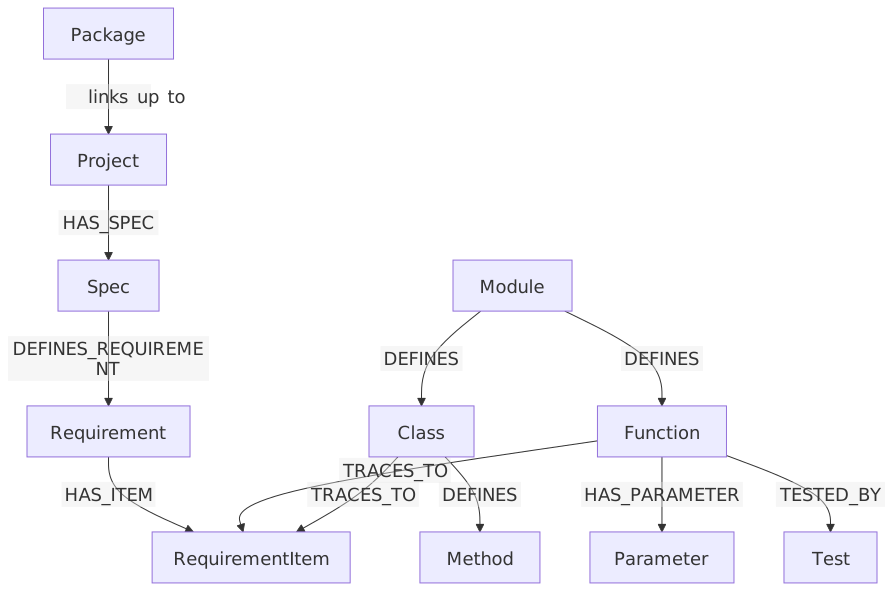
- Project / Portfolio — the project hub node (keyed by slug) and its grouping. Every project-scoped node links up to its Project.
- Package / Directory / File — filesystem structure. File/Directory are being migrated to project-qualified ids (multi-project invariant).
- Module — one Python module (id
{project}:module:{dotted.path}); DEFINES its classes/functions. - Class / Function / Method — code symbols with
name,qualified_name,projectproperties (the join keys for entity linking and trace sync). Method = function bound to a class. - Parameter — a function/method parameter (HAS_PARAMETER from its owner).
- Predicate / Rule — Prolog predicates and rules from the governance
layer's
.plcorpus. - UnresolvedCall / UnresolvedClass — call/inheritance targets the AST sync could not resolve to a known symbol (kept explicit, not dropped).
Node labels — spec/traceability tier
- Spec — one SPEC-NNN document (id
{project}:{NNN}, natural_id kept). - Requirement — a user-story-level requirement inside a spec
(id
{project}:{spec}::{req};spec_idproperty links up). - RequirementItem — one checklist item (id
{project}:{REQ-tag}, bare tag kept inreq_tag). The canonical target of TRACES_TO — code never traces to Requirement directly. - UserStory / Scenario — story-level grouping and harness scenarios.
- Test / TestRun / TestResult — test entities and execution outcomes.
Node labels — runtime/operational tier
- Session / SessionStart / SessionEnd — engineering sessions (the session CLI's counterpart) and lifecycle events.
- Volk — an agent role (keyed by alias, e.g.
U:Qa). - Intent — a parsed user intent; PipelineRun — one pipeline execution of it; Task / Action — units of work within.
- Message — a CXP packet (inter-agent message); GatewayEvent / AuditEntry — gateway audit log entries; Event — generic runtime events; ToolCall — one tool invocation by an agent.
- PolicyDecision / Violation / Escalation / Resolution / Timeout — governance outcomes: a policy verdict, a rule violation, an escalation to a human/higher authority, a conflict resolution, a timeout event.
- Conversation / ConversationTurn — SPEC-021 captured conversations (Claude/kimi/IRC producers) and their turns.
- Decision / Artifact / Change / Component — an architecture/process decision record, a produced artifact, a code change event, a named system component.
- Fact / Memory — Prolog-derived session facts and SPEC-010 agent memory entries.
Node labels — architecture ontology tier (ontology phase 1-2)
- Architecture / Pattern / DesignModule / DesignClass — the as-designed architecture: the root architecture description, applied design patterns, and design-level modules/classes (vs the as-built Class/Function tier).
- ApiContract / DataEntity — declared API surfaces and domain data entities.
- QualityAttribute / WAFPillar / Constraint — quality attributes (with measurable scenarios), well-architected-framework pillars, and hard constraints the design must satisfy.
- CapacityModel / CostModel / CostLineItem / Environment — capacity and cost modeling artifacts and deployment environments.
- ArchitectureDecision — an ADR (ingested from this wiki's decisions.md); immutable once ratified (ADR-integrity gate).
Relationship types (edges)
- DEFINES — structural ownership: Module DEFINES Class/Function; Class DEFINES its methods. The backbone of code containment.
- CONTAINS — filesystem containment (Directory CONTAINS File etc.).
- HAS_PARAMETER — Function/Method → Parameter.
- CALLS / IMPORTS / INHERITS / IMPLEMENTS — code intelligence: call graph (lives on Function/Method), module imports, class inheritance, interface implementation.
- TRACES_TO — code symbol → RequirementItem: "this code implements that
requirement". Written by
sync_traces_to_graph.pyfrom@traces; gaining aprovenanceproperty (static|runtime|both) per the BDD plan. - TESTED_BY — code symbol → the test that exercises it (selector ranking signal).
- HAS_SPEC / DEFINES_REQUIREMENT / HAS_ITEM — Project → Spec → Requirement → RequirementItem: the spec corpus hierarchy.
- REQUIRES — requirement-level dependency.
- CHANGED_IN / NEXT_VERSION — temporal versioning: symbol → Change, version chains.
- MENTIONS / IN_THREAD / TRIGGERED_BY / RESULTED_IN / FAILED — runtime signal wiring: a signal (event/conversation) mentions code, belongs to a thread/session, was triggered by an event, resulted in a decision/resolution; TestRun/Event FAILED some node.
- HAS_CONVERSATION / HAS_TURN — Session → Conversation → turns.
- Architecture-tier edges: HAS_ARCHITECTURE / HAS_COMPONENT / EXPOSES (component → ApiContract), DATA_FLOWS_TO, DEPENDS_ON, PERSISTS_TO, RUNS_ON (→ Environment), HAS_SCENARIO / SATISFIES / HAS_QUALITY_ATTRIBUTE / MEASURED_ON (quality attributes), ADDRESSES_PILLAR / MUST_FOLLOW / CONSTRAINS (pillars & constraints), MODELED_BY / INFORMS / HAS_LINE_ITEM / METERS (capacity & cost), DECIDES / CHOSE / REJECTED / JUSTIFIED_BY / WEIGHS / SUPERSEDES / SELECTS / FORCED_BY (ADR reasoning: what a decision decided, the option chosen/rejected, its justification, trade-off weighing, supersession), APPLIES / USES_PATTERN (pattern application), THREATENS / AFFECTS / MITIGATED_BY (risk wiring), HAS_SLO.
Operational KG — core schema (code structure + spec/traceability tiers)
Semantic / wiki graph (Memgraph HA, routing 10.53.1.160)
One shared Raft-HA cluster serving BOTH the knowledge-wiki graph index and
orchestrata's semantic/RAG layer; within the memgraph database, isolation
is by label, and the operational KG is a separate database, orchkg.
Wiki-index labels (written by wiki-kimi index)
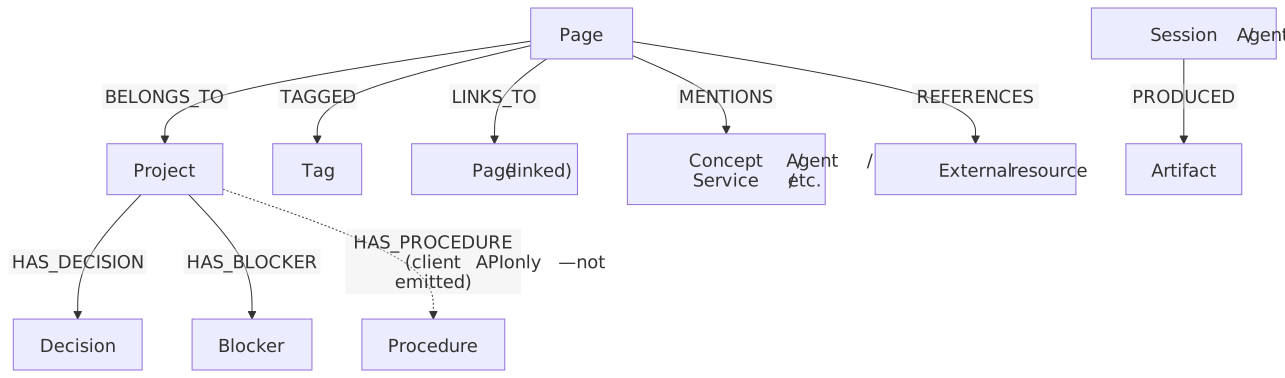
- Page — one wiki page (path, title, description).
- Project / Concept / Agent / Service / Procedure / Decision / Blocker / Session / Tag — typed entities extracted from pages: active projects, domain concepts, the agents (claude/kimi/deepseek), infrastructure services, step-by-step procedures, decision records, active blockers, work sessions, and controlled-vocabulary tags.
- Runbook / Tool / Milestone / Reference — operational runbooks (one per
##heading inrunbooks.md), CLI tools extracted fromreference/pages, release milestones, and external-URL reference nodes. - Chunk — the wiki RAG retrieval unit written by
ingest_chunks.py(384-dim embedding,chunk_embeddingvector index). This is the wiki's ACTIVE chunk label — distinct from orchestrata'sSemanticChunkfamily below.
Wiki-index edges
- BELONGS_TO — page → its project. TAGGED — page → Tag.
- LINKS_TO — page → page (markdown links). MENTIONS — page → entity it names. REFERENCES — page → external resource.
- HAS_DECISION / HAS_BLOCKER — project → its decision/blocker records.
HAS_PROCEDURE — client API (
link_project_procedure) exists but is not emitted by the current indexer walk. PRODUCED — session/agent → artifact. - HAS_RUNBOOK / HAS_MILESTONE — project → its runbooks / release milestones.
- DEPENDS_ON — Decision → entity named in its text; Service → Service
(links between
infrastructure/pages). RELATED_TO — Concept↔Concept, Procedure↔Procedure. USES — Agent → Service. DERIVED_FROM — Chunk → its source Page.
Wiki-index schema (Memgraph)
Semantic-RAG labels (written by orchestrata ingest + wiki RAG)
- SemanticChunk (+ legacy
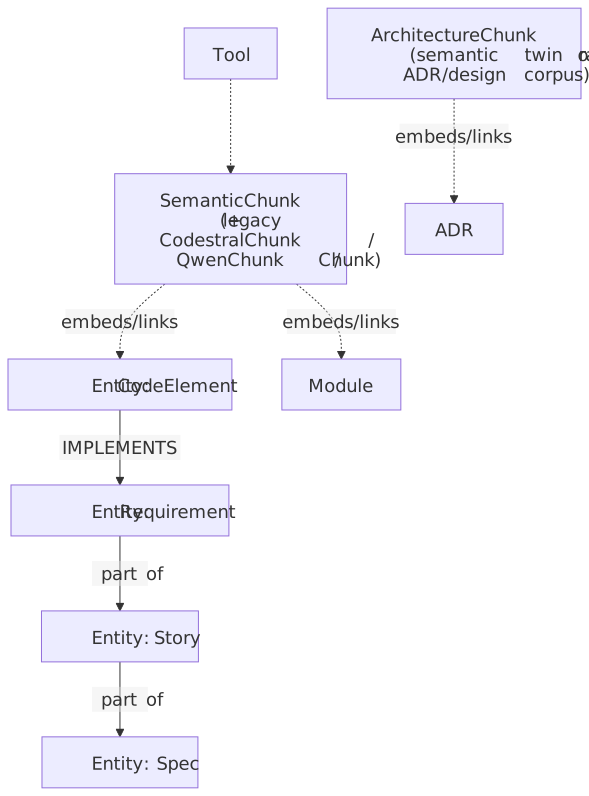
CodestralChunk/QwenChunk/Chunk— a known label-split debt) — an embedded chunk of source code or wiki text with its vector; the retrieval unit for GraphRAG. - ArchitectureChunk — the semantic twin of the ratified architecture ontology corpus (ADR/design docs) for architecture retrieval (ruling 4).
- Entity (Spec/Requirement/Story/CodeElement flavors) — the enhancement layer linking chunks to structured entities, with IMPLEMENTS edges.
- Module / ADR / Tool — coarse code-module nodes, ADR mirrors, and a small number of tool nodes.
Semantic-RAG schema (Memgraph)
Neither graph models the volk tool registry; the live registry is
tools.registryToolRegistry.metadata()/names()(SPEC-072).