orchestrata_ultimate.tools.base
Reference › orchestrata_ultimate › tools › base
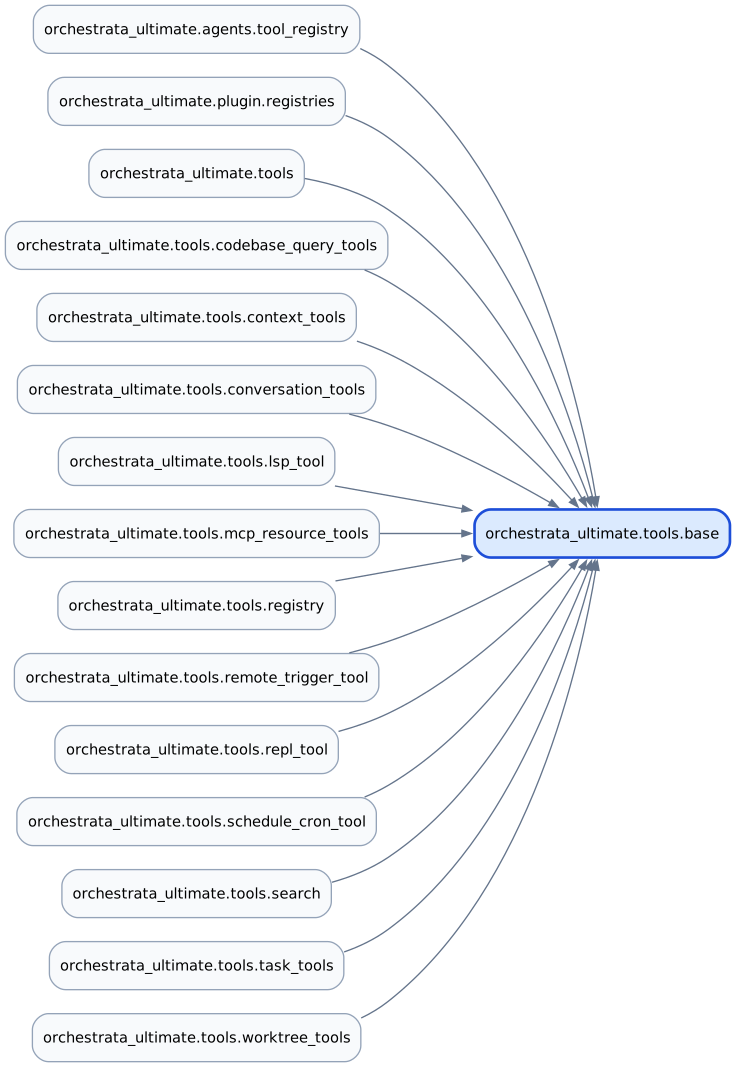
This module defines what a tool is in orchestrata: the contract every first-class tool implements (SPEC-062). Nearly every other module in the tools package imports it, as do agents.tool_registry and plugin.registries. tests/tools/test_base.py covers it.
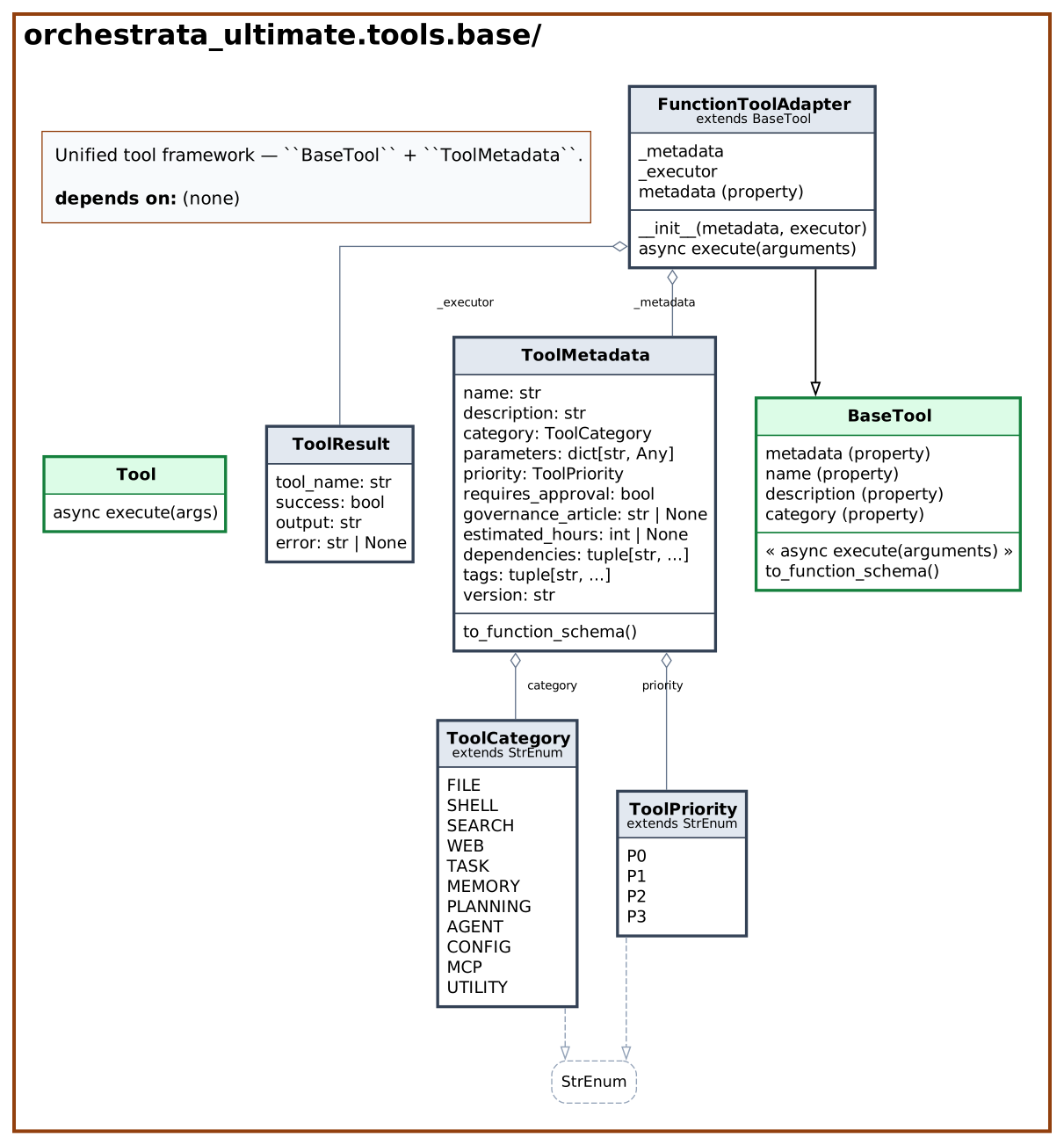
ToolResultis the uniform outcome of one execution: tool name, success flag, output text and an optional error string.Toolis a runtime-checkable protocol with one asyncexecutemethod, a thin structural interface.ToolCategory(file, shell, search, web, task, memory, planning, agent, config, mcp, utility) andToolPriority(P0 to P3) are string enums that classify a tool.ToolMetadatais a frozen description: name, description, category, JSON-Schema parameters, priority, arequires_approvalflag, governance article, estimated hours, dependencies, tags and version.to_function_schemarenders it as an OpenAI or DeepSeek style function-calling definition, which is how a tool is described to an LLM.BaseToolis the abstract base. A subclass supplies themetadataproperty and an asyncexecute;name,description,categoryandto_function_schemaderive from the metadata.FunctionToolAdapterwraps a plain asyncexecutor(name, args)function and aToolMetadataas aBaseTool, so existing function tools join the framework unchanged.
The registry that indexes these objects is in registry.
At a glance
| Source | src/orchestrata_ultimate/tools/base.py |
| Lines of code | 196 |
| Classes | 7 |
| Functions | 0 |
| Imports (internal) | none |
| Imported by | orchestrata_ultimate.agents.tool_registry, orchestrata_ultimate.plugin.registries, orchestrata_ultimate.tools, orchestrata_ultimate.tools.codebase_query_tools, orchestrata_ultimate.tools.context_tools, orchestrata_ultimate.tools.conversation_tools, orchestrata_ultimate.tools.lsp_tool, orchestrata_ultimate.tools.mcp_resource_tools, orchestrata_ultimate.tools.registry, orchestrata_ultimate.tools.remote_trigger_tool, orchestrata_ultimate.tools.repl_tool, orchestrata_ultimate.tools.schedule_cron_tool, orchestrata_ultimate.tools.search, orchestrata_ultimate.tools.task_tools, orchestrata_ultimate.tools.worktree_tools |
| Tests that import it | tests/agents/test_tool_registry.py, tests/plugin/test_tool_registry_adapter.py, tests/tools/test_base.py, tests/tools/test_codebase_query_tools.py, tests/tools/test_conversation_tools.py, tests/tools/test_lsp_tool.py, tests/tools/test_mcp_resource_tools.py, tests/tools/test_registry.py, tests/tools/test_remote_trigger_tool.py, tests/tools/test_repl_tool.py, tests/tools/test_schedule_cron_tool.py, tests/tools/test_search.py, tests/tools/test_task_tools.py, tests/tools/test_worktree_tools.py |
Class diagram
Dependency diagram
API
Classes
ToolResult (dataclass)
Decorators: dataclass · Line 29
Result of a single tool execution.
| Attribute | Type | Default |
|---|---|---|
tool_name |
str |
|
success |
bool |
|
output |
str |
|
error |
str | None |
None |
Tool (protocol)
Bases: Protocol · Decorators: runtime_checkable · Line 47
Thin structural interface for a single callable tool.
| Method | Signature | Summary |
|---|---|---|
execute |
async execute(args: Any) -> ToolResult |
Run the tool with its typed arguments and return a ToolResult. |
ToolCategory (enum)
Bases: StrEnum · Line 72
Tool category taxonomy (SPEC-062 Tool Definition Schema).
| Member | Value |
|---|---|
FILE |
'file' |
SHELL |
'shell' |
SEARCH |
'search' |
WEB |
'web' |
TASK |
'task' |
MEMORY |
'memory' |
PLANNING |
'planning' |
AGENT |
'agent' |
CONFIG |
'config' |
MCP |
'mcp' |
UTILITY |
'utility' |
ToolPriority (enum)
Bases: StrEnum · Line 88
Roadmap priority band for a tool (SPEC-062).
| Member | Value |
|---|---|
P0 |
'P0' |
P1 |
'P1' |
P2 |
'P2' |
P3 |
'P3' |
ToolMetadata (dataclass)
Decorators: dataclass(frozen=True) · Line 101
Describes a tool: identity, category, LLM parameter schema, governance.
| Attribute | Type | Default |
|---|---|---|
name |
str |
|
description |
str |
|
category |
ToolCategory |
|
parameters |
dict[str, Any] |
field(default_factory=dict) |
priority |
ToolPriority |
ToolPriority.P2 |
requires_approval |
bool |
False |
governance_article |
str | None |
None |
estimated_hours |
int | None |
None |
dependencies |
tuple[str, ...] |
() |
tags |
tuple[str, ...] |
() |
version |
str |
'1.0.0' |
| Method | Signature | Summary |
|---|---|---|
to_function_schema |
to_function_schema() -> dict[str, Any] |
Render as an OpenAI/DeepSeek function-calling tool definition. |
BaseTool (abstract)
Bases: ABC · Line 136
Abstract base every registrable tool implements.
| Method | Signature | Summary |
|---|---|---|
metadata property, abstract |
metadata() -> ToolMetadata |
The tool's metadata (identity, category, parameter schema). |
execute abstract |
async execute(arguments: dict[str, Any]) -> ToolResult |
Run the tool with the given arguments. |
name property |
name() -> str |
|
description property |
description() -> str |
|
category property |
category() -> ToolCategory |
|
to_function_schema |
to_function_schema() -> dict[str, Any] |
Render this tool as an LLM function-calling definition. |
FunctionToolAdapter
Bases: BaseTool · Line 174
Wrap a plain async executor(name, args) -> ToolResult as a BaseTool.
| Method | Signature | Summary |
|---|---|---|
__init__ |
__init__(metadata: ToolMetadata, executor: Callable[[str, dict[str, Any]], Awaitable[ToolResult]]) -> None |
|
metadata property |
metadata() -> ToolMetadata |
|
execute |
async execute(arguments: dict[str, Any]) -> ToolResult |
Source
"""Unified tool framework — ``BaseTool`` + ``ToolMetadata``.

The canonical contract every first-class tool implements so it can be
registered, discovered, described to an LLM (OpenAI/DeepSeek function schema),
and dispatched uniformly through :class:`~orchestrata_ultimate.tools.registry.ToolRegistry`.

Before this module the codebase had no tool abstraction: tools were ad-hoc
module-level function-call dicts collected in ``agents/tool_registry.py`` and
dispatched by a hardcoded ``if/elif`` chain. This module introduces the shared
base the greenfield tool suite (SPEC-063…072) builds on, and the metadata index
that makes tool search (SPEC-072) possible.

Spec: SPEC-062 (CheetahClaws Tools Gap) — Tool Definition Schema + category
taxonomy; enables SPEC-072 (ToolSearchTool).
"""

from __future__ import annotations

from abc import ABC, abstractmethod
from collections.abc import Awaitable, Callable
from dataclasses import dataclass, field
from enum import StrEnum
from typing import Any, Protocol, runtime_checkable

# ── Result ───────────────────────────────────────────────────────────


@dataclass
class ToolResult:
    """Result of a single tool execution.

    Canonical home for the result type (previously defined in
    ``agents/tool_registry.py``, which now re-imports it) so both the legacy
    executor and the unified registry speak one type.
    """

    tool_name: str
    success: bool
    output: str
    error: str | None = None


# ── Thin structural interface ─────────────────────────────────────────


@runtime_checkable
class Tool(Protocol):
    """Thin structural interface for a single callable tool.

    Composition-over-inheritance boundary (see
    ``plans/build-factory-architecture.md``): a concrete tool implements this
    Protocol — the ONE ABC/Protocol boundary — and COMPOSES its behaviour
    (executor, validator, tracer, registry lookups, ...) via constructor DI
    rather than a deep inheritance chain. ``gen-skeleton``'s ``<<Tool>>``
    emitter targets exactly this Protocol (``ReplTool ..|> Tool`` ->
    ``class ReplTool(Tool):``).

    Distinct from :class:`BaseTool`, the pre-existing ABC below: tools that
    need its shared ``name``/``description``/``category`` properties may
    still subclass ``BaseTool`` directly; new composition-first tools target
    ``Tool``.
    """

    async def execute(self, args: Any) -> ToolResult:
        """Run the tool with its typed arguments and return a ToolResult."""
        ...


# ── Taxonomy ─────────────────────────────────────────────────────────


class ToolCategory(StrEnum):
    """Tool category taxonomy (SPEC-062 Tool Definition Schema)."""

    FILE = "file"
    SHELL = "shell"
    SEARCH = "search"
    WEB = "web"
    TASK = "task"
    MEMORY = "memory"
    PLANNING = "planning"
    AGENT = "agent"
    CONFIG = "config"
    MCP = "mcp"
    UTILITY = "utility"


class ToolPriority(StrEnum):
    """Roadmap priority band for a tool (SPEC-062)."""

    P0 = "P0"
    P1 = "P1"
    P2 = "P2"
    P3 = "P3"


# ── Metadata ─────────────────────────────────────────────────────────


@dataclass(frozen=True)
class ToolMetadata:
    """Describes a tool: identity, category, LLM parameter schema, governance.

    Mirrors the SPEC-062 Tool Definition Schema. ``parameters`` is a JSON Schema
    object (the same shape the OpenAI/DeepSeek function-calling API expects).
    """

    name: str
    description: str
    category: ToolCategory
    parameters: dict[str, Any] = field(default_factory=dict)
    priority: ToolPriority = ToolPriority.P2
    requires_approval: bool = False
    governance_article: str | None = None
    estimated_hours: int | None = None
    dependencies: tuple[str, ...] = ()
    tags: tuple[str, ...] = ()
    version: str = "1.0.0"

    def to_function_schema(self) -> dict[str, Any]:
        """Render as an OpenAI/DeepSeek function-calling tool definition."""
        return {
            "type": "function",
            "function": {
                "name": self.name,
                "description": self.description,
                "parameters": self.parameters
                or {"type": "object", "properties": {}, "required": []},
            },
        }


# ── Base tool ────────────────────────────────────────────────────────


class BaseTool(ABC):
    """Abstract base every registrable tool implements.

    A tool exposes immutable :class:`ToolMetadata` and an async ``execute`` that
    takes a JSON-decoded ``arguments`` mapping (the LLM's tool-call arguments)
    and returns a :class:`ToolResult`. Uniform ``(arguments) -> ToolResult``
    dispatch is what lets the registry route any tool without special-casing.
    """

    @property
    @abstractmethod
    def metadata(self) -> ToolMetadata:
        """The tool's metadata (identity, category, parameter schema)."""

    @abstractmethod
    async def execute(self, arguments: dict[str, Any]) -> ToolResult:
        """Run the tool with the given arguments."""

    @property
    def name(self) -> str:
        return self.metadata.name

    @property
    def description(self) -> str:
        return self.metadata.description

    @property
    def category(self) -> ToolCategory:
        return self.metadata.category

    def to_function_schema(self) -> dict[str, Any]:
        """Render this tool as an LLM function-calling definition."""
        return self.metadata.to_function_schema()


# ── Adapter for the legacy function-tools ────────────────────────────


class FunctionToolAdapter(BaseTool):
    """Wrap a plain async ``executor(name, args) -> ToolResult`` as a BaseTool.

    Bridges the pre-existing function-tools (``agents/tool_registry.py``'s
    ``ToolExecutor``) into the unified registry without rewriting them, so the
    live tools become discoverable/searchable while the invocation path is
    unchanged. The executor is any callable with the legacy executor signature.
    """

    def __init__(
        self,
        metadata: ToolMetadata,
        executor: Callable[[str, dict[str, Any]], Awaitable[ToolResult]],
    ) -> None:
        self._metadata = metadata
        self._executor = executor

    @property
    def metadata(self) -> ToolMetadata:
        return self._metadata

    async def execute(self, arguments: dict[str, Any]) -> ToolResult:
        return await self._executor(self._metadata.name, arguments)