orchestrata_ultimate.tools.remote_trigger_tool
Reference › orchestrata_ultimate › tools › remote_trigger_tool
RemoteTriggerTool (SPEC-067) sends an outbound HTTP request, such as a webhook or REST call, with pluggable authentication, bounded retry with exponential backoff, timeout handling and response validation. It uses httpx. It is a BaseTool, registered by agents.tool_registry and register_remote_trigger_tool, and exported from the package __init__. tests/tools/test_remote_trigger_tool.py covers it.
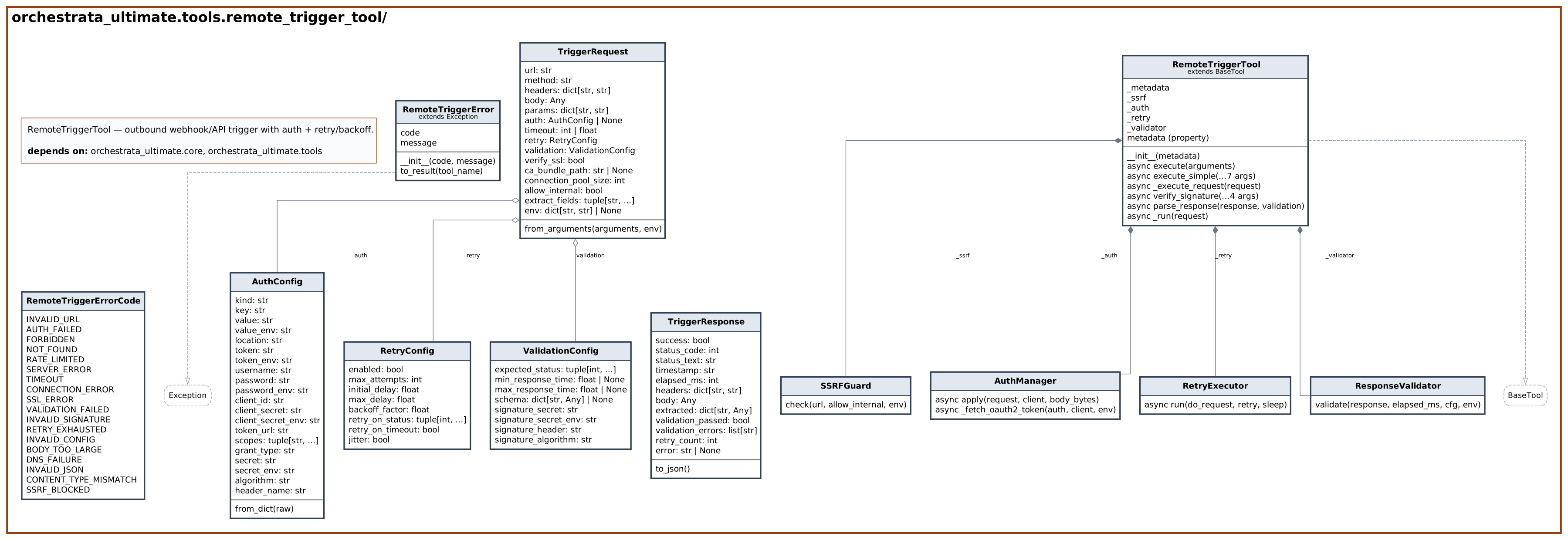
The pieces are small classes composed by the tool:
- Configuration dataclasses:
AuthConfig,RetryConfig,ValidationConfig,TriggerRequestandTriggerResponse. SSRFGuardblocks loopback, private, link-local and reserved targets and known metadata endpoints, by resolving the host once. It does not defend against DNS rebinding and has no allowlist. Per-requestallow_internalor the environment variableREMOTE_TRIGGER_ALLOW_PRIVATElifts the block.AuthManagerapplies API key (header or query), bearer, basic, OAuth2 client credentials (one token fetch per request, no caching) and HMAC signing. Secret values can be given as literals or as environment variable names resolved by_resolve_secret.RetryExecutorretries on configured status codes and optionally on timeouts, honoursRetry-After, and returns the response and the retry count; it returns no response when every attempt timed out.ResponseValidatorchecks a JSON Schema subset: type, required, properties and items.
One httpx client is built per call and reused across that call's attempts. Failures are reported as RemoteTriggerError with a RemoteTriggerErrorCode, and become failed ToolResult values.
At a glance
| Source | src/orchestrata_ultimate/tools/remote_trigger_tool.py |
| Lines of code | 1284 |
| Classes | 12 |
| Functions | 18 |
| Imports (internal) | orchestrata_ultimate.core.base.traces, orchestrata_ultimate.tools.base, orchestrata_ultimate.tools.registry |
| Imported by | orchestrata_ultimate.agents.tool_registry, orchestrata_ultimate.tools |
| Tests that import it | tests/tools/test_remote_trigger_tool.py |
Class diagram
Dependency diagram

API
Constants
| Name | Type | Value |
|---|---|---|
_DEFAULT_RETRY_STATUSES |
tuple[int, ...] |
(429, 500, 502, 503, 504) |
_SCHEMA_TYPE_MAP |
dict[str, Any] |
{'object': dict, 'array': list, 'string': str, 'integer': int, 'number': (int, … |
_PARAMETERS |
dict[str, Any] |
{'type': 'object', 'properties': {'url': {'type': 'string', 'description': 'Tar… |
Classes
RemoteTriggerErrorCode
Decorators: traces(spec='067', story='US-067-001', reqs=['REQ-067-023']) · Line 110
String error codes for the RemoteTriggerTool pipeline (spec.md ERR-00N).
RemoteTriggerError
Bases: Exception · Decorators: traces(spec='067', story='US-067-001', reqs=['REQ-067-023']) · Line 134
Raised for any spec.md ERR-00N condition; renders as a failed ToolResult.
| Method | Signature | Summary |
|---|---|---|
__init__ |
__init__(code: str, message: str) -> None |
|
to_result |
to_result(tool_name: str) -> ToolResult |
AuthConfig (dataclass)
Decorators: traces(spec='067', story='US-067-002', reqs=['REQ-067-002', 'REQ-067-003']), dataclass(slots=True, frozen=True) · Line 157
Resolved authentication configuration (spec.md AuthConfig, all variants).
| Attribute | Type | Default |
|---|---|---|
kind |
str |
|
key |
str |
'' |
value |
str |
'' |
value_env |
str |
'' |
location |
str |
'header' |
token |
str |
'' |
token_env |
str |
'' |
username |
str |
'' |
password |
str |
'' |
password_env |
str |
'' |
client_id |
str |
'' |
client_secret |
str |
'' |
client_secret_env |
str |
'' |
token_url |
str |
'' |
scopes |
tuple[str, ...] |
() |
grant_type |
str |
'client_credentials' |
secret |
str |
'' |
secret_env |
str |
'' |
algorithm |
str |
'sha256' |
header_name |
str |
'X-Signature' |
| Method | Signature | Summary |
|---|---|---|
from_dict classmethod |
from_dict(raw: dict[str, Any]) -> AuthConfig |
RetryConfig (dataclass)
Decorators: traces(spec='067', story='US-067-003', reqs=['REQ-067-008', 'REQ-067-009']), dataclass(slots=True, frozen=True) · Line 221
Retry behaviour (spec.md RetryConfig).
| Attribute | Type | Default |
|---|---|---|
enabled |
bool |
True |
max_attempts |
int |
3 |
initial_delay |
float |
1.0 |
max_delay |
float |
60.0 |
backoff_factor |
float |
2.0 |
retry_on_status |
tuple[int, ...] |
_DEFAULT_RETRY_STATUSES |
retry_on_timeout |
bool |
True |
jitter |
bool |
False |
ValidationConfig (dataclass)
Decorators: traces(spec='067', story='US-067-004', reqs=['REQ-067-011', 'REQ-067-012', 'REQ-067-013', 'REQ-067-014']), dataclass(slots=True, frozen=True) · Line 240
Response validation rules (spec.md ValidationConfig).
| Attribute | Type | Default |
|---|---|---|
expected_status |
tuple[int, ...] |
() |
min_response_time |
float | None |
None |
max_response_time |
float | None |
None |
schema |
dict[str, Any] | None |
None |
signature_secret |
str |
'' |
signature_secret_env |
str |
'' |
signature_header |
str |
'X-Signature' |
signature_algorithm |
str |
'sha256' |
TriggerRequest (dataclass)
Decorators: traces(spec='067', story='US-067-001', reqs=['REQ-067-001', 'REQ-067-007']), dataclass(slots=True, frozen=True) · Line 258
A validated remote-trigger request (spec.md TriggerRequest).
| Attribute | Type | Default |
|---|---|---|
url |
str |
|
method |
str |
'POST' |
headers |
dict[str, str] |
field(default_factory=dict) |
body |
Any |
None |
params |
dict[str, str] |
field(default_factory=dict) |
auth |
AuthConfig | None |
None |
timeout |
int | float |
30 |
retry |
RetryConfig |
field(default_factory=RetryConfig) |
validation |
ValidationConfig |
field(default_factory=ValidationConfig) |
verify_ssl |
bool |
True |
ca_bundle_path |
str | None |
None |
connection_pool_size |
int |
10 |
allow_internal |
bool |
False |
extract_fields |
tuple[str, ...] |
() |
env |
dict[str, str] | None |
None |
| Method | Signature | Summary |
|---|---|---|
from_arguments classmethod |
from_arguments(arguments: dict[str, Any], env: Mapping[str, str] | None = None) -> TriggerRequest |
Build a :class:TriggerRequest from raw tool-call arguments. |
TriggerResponse (dataclass)
Decorators: traces(spec='067', story='US-067-001', reqs=['REQ-067-001', 'REQ-067-018']), dataclass(slots=True) · Line 386
Result of a trigger execution (spec.md TriggerResponse).
| Attribute | Type | Default |
|---|---|---|
success |
bool |
|
status_code |
int |
|
status_text |
str |
'' |
timestamp |
str |
'' |
elapsed_ms |
int |
0 |
headers |
dict[str, str] |
field(default_factory=dict) |
body |
Any |
None |
extracted |
dict[str, Any] |
field(default_factory=dict) |
validation_passed |
bool |
True |
validation_errors |
list[str] |
field(default_factory=list) |
retry_count |
int |
0 |
error |
str | None |
None |
| Method | Signature | Summary |
|---|---|---|
to_json |
to_json() -> str |
SSRFGuard
Decorators: traces(spec='067', story='US-067-005', reqs=['REQ-067-020']) · Line 658
Blocks outbound requests to loopback/private/link-local/metadata targets.
| Method | Signature | Summary |
|---|---|---|
check |
check(url: str, allow_internal: bool, env: Mapping[str, str] | None = None) -> None |
AuthManager
Decorators: traces(spec='067', story='US-067-002', reqs=['REQ-067-002', 'REQ-067-003', 'REQ-067-004', 'REQ-067-005', 'REQ-067-006']) · Line 703
Applies the configured :class:AuthConfig as request headers/params.
| Method | Signature | Summary |
|---|---|---|
apply |
async apply(request: TriggerRequest, client: httpx.AsyncClient, body_bytes: bytes) -> tuple[dict[str, str], dict[str, str]] |
Return (extra_headers, extra_params) for request's auth. |
_fetch_oauth2_token |
async _fetch_oauth2_token(auth: AuthConfig, client: httpx.AsyncClient, env: Mapping[str, str] | None) -> str |
RetryExecutor
Decorators: traces(spec='067', story='US-067-003', reqs=['REQ-067-008', 'REQ-067-009', 'REQ-067-010']) · Line 823
Bounded exponential-backoff retry over an async request callable.
| Method | Signature | Summary |
|---|---|---|
run |
async run(do_request: Callable[[], Awaitable[httpx.Response]], retry: RetryConfig, sleep: Callable[[float], Awaitable[None]]) -> tuple[httpx.Response | None, int] |
Returns (response_or_None, retry_count). |
ResponseValidator
Decorators: traces(spec='067', story='US-067-004', reqs=['REQ-067-011', 'REQ-067-012', 'REQ-067-013', 'REQ-067-014']) · Line 874
Validates a response against a :class:ValidationConfig (FR-005).
| Method | Signature | Summary |
|---|---|---|
validate |
validate(response: httpx.Response, elapsed_ms: int, cfg: ValidationConfig, env: Mapping[str, str] | None) -> tuple[bool, list[str]] |
RemoteTriggerTool
Bases: BaseTool · Decorators: traces(spec='067', story='US-067-001', reqs=['REQ-067-001', 'REQ-067-007', 'REQ-067-015', 'REQ-067-016', 'REQ-067-017',… · Line 1037
The registrable BaseTool (Command) callers/LLMs invoke.
| Method | Signature | Summary |
|---|---|---|
__init__ |
__init__(metadata: ToolMetadata | None = None) -> None |
|
metadata property |
metadata() -> ToolMetadata |
|
execute |
async execute(arguments: dict[str, Any]) -> ToolResult |
Run a trigger from raw tool-call arguments (FR-001). |
execute_simple |
async execute_simple(url: str, method: str = 'POST', headers: dict[str, str] | None = None, body: Any = None, auth: dict[str, Any] | None = None, timeout: int = 30, env: Mapping[str, str] | None = None) -> ToolResult |
Simplified interface for basic triggers (spec.md API Contract). |
_execute_request |
async _execute_request(request: TriggerRequest) -> ToolResult |
|
verify_signature |
async verify_signature(payload: bytes, signature: str, secret: str, algorithm: str = 'sha256') -> bool |
Verify a webhook HMAC signature (spec.md API Contract, FR-011). |
parse_response |
async parse_response(response: httpx.Response, validation: ValidationConfig | None = None) -> dict[str, Any] |
Parse (and optionally validate) an httpx.Response (FR-009). |
_run |
async _run(request: TriggerRequest) -> TriggerResponse |
Execute request end-to-end: SSRF guard -> auth -> retry -> validate. |
Functions
| Function | Signature | Summary |
|---|---|---|
_resolve_secret traces |
_resolve_secret(literal: str, env_name: str, env: Mapping[str, str] | None, field_label: str) -> str |
Resolve a secret from a literal value or an *_env variable name. |
_encode_body traces |
_encode_body(body: Any) -> bytes |
Render a request body to bytes (for HMAC signing). |
_hmac_digest traces |
_hmac_digest(secret: str, payload: bytes, algorithm: str) -> str |
|
_verify_hmac traces |
_verify_hmac(payload: bytes, signature: str, secret: str, algorithm: str) -> bool |
Constant-time HMAC comparison; tolerates a "sha256=<hex>" prefix. |
_sanitize_url traces |
_sanitize_url(url: str) -> str |
Strip query string (may carry an API key) before logging a URL. |
_sanitize_headers traces |
_sanitize_headers(headers: dict[str, str], sensitive: frozenset[str] = _DEFAULT_SENSITIVE_HEADERS) -> dict[str, str] |
|
_now_iso |
_now_iso() -> str |
|
_status_error_message traces |
_status_error_message(status: int, url: str, retry_count: int, retry_cfg: RetryConfig) -> str |
Map a non-2xx status to a spec.md ERR-00N message. |
_parse_body traces |
_parse_body(response: httpx.Response) -> Any |
Parse JSON responses; fall back to raw text (FR-009). |
_extract_fields traces |
_extract_fields(body: Any, fields: tuple[str, ...]) -> dict[str, Any] |
Pull dotted-path fields out of a JSON object body (FR-009). |
_type_matches traces |
_type_matches(instance: Any, expected_type: Any) -> bool |
|
_validate_schema traces |
_validate_schema(instance: Any, schema: dict[str, Any], path: str = '$') -> list[str] |
Validate instance against a JSON-Schema subset: type/required/properties/items. |
_is_blocked_address traces |
_is_blocked_address(ip_str: str) -> bool |
True if ip_str is loopback/private/link-local/reserved (or unparsable). |
_allow_private_from_env traces |
_allow_private_from_env(env: Mapping[str, str] | None) -> bool |
|
_parse_retry_after traces |
_parse_retry_after(value: str | None) -> float | None |
|
_compute_delay traces |
_compute_delay(attempt: int, retry: RetryConfig, retry_after: float | None) -> float |
|
_build_metadata |
_build_metadata() -> ToolMetadata |
|
register_remote_trigger_tool traces |
register_remote_trigger_tool(registry: ToolRegistry) -> RemoteTriggerTool |
Build a :class:RemoteTriggerTool and register it into registry. |
Source
"""RemoteTriggerTool — outbound webhook/API trigger with auth + retry/backoff.
Spec: SPEC-067 (RemoteTriggerTool). A :class:`~orchestrata_ultimate.tools.base.BaseTool`
that sends an HTTP request (webhook or REST call) with pluggable authentication,
bounded exponential-backoff retry, timeout handling, and response validation —
built on ``httpx`` (already declared in ``pyproject.toml``; no new dependency).
**MVP scope / forks from spec.md** (reported to the orchestrator, not silently
guessed):
* **No pydantic models.** spec.md's API Contracts sketch ``TriggerRequest`` /
``RemoteTriggerConfig`` as pydantic ``BaseModel``\\s; this module uses plain
``@dataclass``\\es instead, matching the prevailing style of the other
SPEC-06x tools (``tools/search.py``, ``tools/worktree_tools.py``) rather than
introducing a second modelling convention.
* **OAuth2** implements a single client-credentials token fetch per request
(no token caching/refresh-lifecycle — spec.md's "Manages OAuth2 token
refresh lifecycle" is a multi-call optimization, out of MVP scope).
* **JSON Schema validation** (FR-005) is a lightweight subset: ``type``,
``required``, ``properties``, ``items`` — not full JSON Schema draft-07
(no ``format``/``pattern``/``enum``/``$ref``; no external ``jsonschema``
dependency is declared in ``pyproject.toml``, and adding one is out of
scope for this brief).
* **SSRF protection** (Security Requirements) resolves the target hostname
once via :func:`socket.getaddrinfo` and blocks loopback/private/link-local/
reserved addresses and known metadata endpoints — mirroring the existing
``agents.tool_registry._is_blocked_address``/``_web_tools_allow_private``
pattern for ``web_fetch``. It does **not** implement DNS-rebinding
protection (re-resolving between check and connect) or an allowlist;
``allow_internal=True`` (per-request) or the ``REMOTE_TRIGGER_ALLOW_PRIVATE``
env var (read at call time, never hardcoded — REQ project rule) are the
sanctioned escape hatches, used by this module's own tests to target a real
local HTTP server.
* **Connection pooling** (FR-007) is scoped to the lifetime of a single
``execute``/``execute_simple`` call: one ``httpx.AsyncClient`` (with
``httpx.Limits``) is built per call and its pool is reused across that
call's own retry attempts. A cross-call persistent client is deferred —
the stateless ``BaseTool.execute(arguments) -> ToolResult`` contract has no
lifecycle hook (no ``close()``/``aclose()`` on the Protocol) to tear one
down safely.
* **Query parameters** (``params``) and **field extraction**
(``extract_fields``) are MVP additions beyond spec.md's literal
``TriggerRequest`` JSON Schema (needed to support ``api_key`` auth placed
"in": "query", and FR-009's "extract specific fields from responses").
* ``execute_simple``'s ``auth`` parameter is typed ``dict[str, Any] | None``
(the same raw shape ``TriggerRequest.from_arguments`` parses), not spec.md's
``AuthConfig`` object — :class:`AuthConfig` is this module's internal,
already-resolved representation, not a caller-facing constructor.
Architecture: :class:`RemoteTriggerTool` (the registrable ``BaseTool``)
composes :class:`SSRFGuard`, :class:`AuthManager`, :class:`RetryExecutor`, and
:class:`ResponseValidator` — each a focused, independently testable unit.
"""
from __future__ import annotations
import base64
import hashlib
import hmac
import ipaddress
import itertools
import json
import logging
import os
import random
import socket
import time
import urllib.parse
from collections.abc import Awaitable, Callable, Mapping
from dataclasses import dataclass, field
from datetime import UTC, datetime
from typing import Any
import httpx
from orchestrata_ultimate.core.base.traces import traces
from orchestrata_ultimate.tools.base import (
BaseTool,
ToolCategory,
ToolMetadata,
ToolPriority,
ToolResult,
)
from orchestrata_ultimate.tools.registry import ToolRegistry
logger = logging.getLogger(__name__)
# ── constants ────────────────────────────────────────────────────────────
_ALLOWED_METHODS = frozenset(
{"GET", "POST", "PUT", "PATCH", "DELETE", "HEAD", "OPTIONS"}
)
_ALLOWED_AUTH_KINDS = frozenset({"api_key", "bearer", "basic", "oauth2", "hmac"})
_ALLOWED_HMAC_ALGORITHMS = frozenset({"sha256", "sha512", "sha1"})
_DEFAULT_RETRY_STATUSES: tuple[int, ...] = (429, 500, 502, 503, 504)
_DEFAULT_SENSITIVE_HEADERS = frozenset({"authorization", "x-api-key"})
_BLOCKED_HOSTNAMES = frozenset(
{"metadata.google.internal", "metadata", "metadata.internal"}
)
# The fixed IANA link-local address every cloud provider (AWS/GCP/Azure/
# DigitalOcean) uses for its metadata service — an SSRF blocklist constant,
# not deployment infra (link-local is skip-listed by the HARDCODED_IP gate).
_METADATA_IPS = frozenset({"169.254.169.254"})
# ── error codes / exception ─────────────────────────────────────────────
@traces(spec="067", story="US-067-001", reqs=["REQ-067-023"])
class RemoteTriggerErrorCode:
"""String error codes for the RemoteTriggerTool pipeline (spec.md ERR-00N)."""
INVALID_URL = "invalid_url"
AUTH_FAILED = "auth_failed"
FORBIDDEN = "forbidden"
NOT_FOUND = "not_found"
RATE_LIMITED = "rate_limited"
SERVER_ERROR = "server_error"
TIMEOUT = "timeout"
CONNECTION_ERROR = "connection_error"
SSL_ERROR = "ssl_error"
VALIDATION_FAILED = "validation_failed"
INVALID_SIGNATURE = "invalid_signature"
RETRY_EXHAUSTED = "retry_exhausted"
INVALID_CONFIG = "invalid_config"
BODY_TOO_LARGE = "body_too_large"
DNS_FAILURE = "dns_failure"
INVALID_JSON = "invalid_json"
CONTENT_TYPE_MISMATCH = "content_type_mismatch"
SSRF_BLOCKED = "ssrf_blocked"
@traces(spec="067", story="US-067-001", reqs=["REQ-067-023"])
class RemoteTriggerError(Exception):
"""Raised for any spec.md ERR-00N condition; renders as a failed ToolResult."""
def __init__(self, code: str, message: str) -> None:
super().__init__(message)
self.code = code
self.message = message
@traces(spec="067", reqs=["REQ-067-023"])
def to_result(self, tool_name: str) -> ToolResult:
return ToolResult(
tool_name=tool_name,
success=False,
output="",
error=f"{self.code}: {self.message}",
)
# ── auth / retry / validation config ────────────────────────────────────
@traces(spec="067", story="US-067-002", reqs=["REQ-067-002", "REQ-067-003"])
@dataclass(slots=True, frozen=True)
class AuthConfig:
"""Resolved authentication configuration (spec.md AuthConfig, all variants).
A single flat dataclass discriminated by ``kind`` rather than 5 separate
types (spec.md's ``oneOf`` union) — simpler to build from a raw tool-call
``arguments["auth"]`` dict and to pattern-match on in :class:`AuthManager`.
"""
kind: str
key: str = ""
value: str = ""
value_env: str = ""
location: str = "header"
token: str = ""
token_env: str = ""
username: str = ""
password: str = ""
password_env: str = ""
client_id: str = ""
client_secret: str = ""
client_secret_env: str = ""
token_url: str = ""
scopes: tuple[str, ...] = ()
grant_type: str = "client_credentials"
secret: str = ""
secret_env: str = ""
algorithm: str = "sha256"
header_name: str = "X-Signature"
@classmethod
@traces(spec="067", story="US-067-002", reqs=["REQ-067-002", "REQ-067-003"])
def from_dict(cls, raw: dict[str, Any]) -> AuthConfig:
kind = str(raw.get("type", "")).lower()
if kind not in _ALLOWED_AUTH_KINDS:
raise RemoteTriggerError(
RemoteTriggerErrorCode.INVALID_CONFIG,
f"Unknown auth type: {raw.get('type')!r}",
)
return cls(
kind=kind,
key=str(raw.get("key", "")),
value=str(raw.get("value", "")),
value_env=str(raw.get("value_env", "")),
location=str(raw.get("in", "header")),
token=str(raw.get("token", "")),
token_env=str(raw.get("token_env", "")),
username=str(raw.get("username", "")),
password=str(raw.get("password", "")),
password_env=str(raw.get("password_env", "")),
client_id=str(raw.get("client_id", "")),
client_secret=str(raw.get("client_secret", "")),
client_secret_env=str(raw.get("client_secret_env", "")),
token_url=str(raw.get("token_url", "")),
scopes=tuple(raw.get("scopes", ()) or ()),
grant_type=str(raw.get("grant_type", "client_credentials")),
secret=str(raw.get("secret", "")),
secret_env=str(raw.get("secret_env", "")),
algorithm=str(raw.get("algorithm", "sha256")),
header_name=str(raw.get("header_name", "X-Signature")),
)
@traces(spec="067", story="US-067-003", reqs=["REQ-067-008", "REQ-067-009"])
@dataclass(slots=True, frozen=True)
class RetryConfig:
"""Retry behaviour (spec.md RetryConfig)."""
enabled: bool = True
max_attempts: int = 3
initial_delay: float = 1.0
max_delay: float = 60.0
backoff_factor: float = 2.0
retry_on_status: tuple[int, ...] = _DEFAULT_RETRY_STATUSES
retry_on_timeout: bool = True
jitter: bool = False
@traces(
spec="067",
story="US-067-004",
reqs=["REQ-067-011", "REQ-067-012", "REQ-067-013", "REQ-067-014"],
)
@dataclass(slots=True, frozen=True)
class ValidationConfig:
"""Response validation rules (spec.md ValidationConfig)."""
expected_status: tuple[int, ...] = ()
min_response_time: float | None = None
max_response_time: float | None = None
schema: dict[str, Any] | None = None
signature_secret: str = ""
signature_secret_env: str = ""
signature_header: str = "X-Signature"
signature_algorithm: str = "sha256"
# ── request / response ──────────────────────────────────────────────────
@traces(spec="067", story="US-067-001", reqs=["REQ-067-001", "REQ-067-007"])
@dataclass(slots=True, frozen=True)
class TriggerRequest:
"""A validated remote-trigger request (spec.md TriggerRequest)."""
url: str
method: str = "POST"
headers: dict[str, str] = field(default_factory=dict)
body: Any = None
params: dict[str, str] = field(default_factory=dict)
auth: AuthConfig | None = None
# int per the public tool-call JSON schema (spec.md: integer, 1-300s);
# widened to accept float here too so callers constructing a
# TriggerRequest directly (bypassing from_arguments's int() cast) can use
# sub-second timeouts — httpx.Timeout accepts a float natively.
timeout: int | float = 30
retry: RetryConfig = field(default_factory=RetryConfig)
validation: ValidationConfig = field(default_factory=ValidationConfig)
verify_ssl: bool = True
ca_bundle_path: str | None = None
connection_pool_size: int = 10
allow_internal: bool = False
extract_fields: tuple[str, ...] = ()
env: dict[str, str] | None = None
@classmethod
@traces(spec="067", story="FR-003", reqs=["REQ-067-007", "REQ-067-023"])
def from_arguments(
cls, arguments: dict[str, Any], env: Mapping[str, str] | None = None
) -> TriggerRequest:
"""Build a :class:`TriggerRequest` from raw tool-call ``arguments``.
Raises:
RemoteTriggerError: ``INVALID_URL`` (ERR-001) for a missing/
malformed URL, ``INVALID_CONFIG`` (ERR-013) for any other
malformed field.
"""
url = str(arguments.get("url") or "").strip()
parsed = urllib.parse.urlsplit(url)
if (
not url
or parsed.scheme.lower() not in ("http", "https")
or not parsed.hostname
):
raise RemoteTriggerError(
RemoteTriggerErrorCode.INVALID_URL,
f"Invalid or malformed URL: {url}",
)
method = str(arguments.get("method", "POST")).upper()
if method not in _ALLOWED_METHODS:
raise RemoteTriggerError(
RemoteTriggerErrorCode.INVALID_CONFIG,
f"Unsupported HTTP method: {method}",
)
auth_raw = arguments.get("auth")
auth = AuthConfig.from_dict(auth_raw) if auth_raw else None
retry_raw = arguments.get("retry") or {}
validation_raw = arguments.get("validation") or {}
try:
retry = RetryConfig(
enabled=bool(retry_raw.get("enabled", True)),
max_attempts=int(retry_raw.get("max_attempts", 3)),
initial_delay=float(retry_raw.get("initial_delay", 1.0)),
max_delay=float(retry_raw.get("max_delay", 60.0)),
backoff_factor=float(retry_raw.get("backoff_factor", 2.0)),
retry_on_status=tuple(
int(s)
for s in retry_raw.get("retry_on_status", _DEFAULT_RETRY_STATUSES)
),
retry_on_timeout=bool(retry_raw.get("retry_on_timeout", True)),
jitter=bool(retry_raw.get("jitter", False)),
)
validation = ValidationConfig(
expected_status=tuple(
int(s) for s in validation_raw.get("expected_status", ())
),
min_response_time=(
float(validation_raw["min_response_time"])
if validation_raw.get("min_response_time") is not None
else None
),
max_response_time=(
float(validation_raw["max_response_time"])
if validation_raw.get("max_response_time") is not None
else None
),
schema=validation_raw.get("schema"),
signature_secret=str(validation_raw.get("signature_secret", "")),
signature_secret_env=str(
validation_raw.get("signature_secret_env", "")
),
signature_header=str(
validation_raw.get("signature_header", "X-Signature")
),
signature_algorithm=str(
validation_raw.get("signature_algorithm", "sha256")
),
)
timeout = int(arguments.get("timeout", 30))
pool_size = int(arguments.get("connection_pool_size", 10))
except (TypeError, ValueError) as exc:
raise RemoteTriggerError(
RemoteTriggerErrorCode.INVALID_CONFIG,
f"Configuration error: {exc}",
) from exc
return cls(
url=url,
method=method,
headers={
str(k): str(v) for k, v in (arguments.get("headers") or {}).items()
},
body=arguments.get("body"),
params={str(k): str(v) for k, v in (arguments.get("params") or {}).items()},
auth=auth,
timeout=timeout,
retry=retry,
validation=validation,
verify_ssl=bool(arguments.get("verify_ssl", True)),
ca_bundle_path=arguments.get("ca_bundle_path"),
connection_pool_size=pool_size,
allow_internal=bool(arguments.get("allow_internal", False)),
extract_fields=tuple(arguments.get("extract_fields", ()) or ()),
env=dict(env) if env is not None else None,
)
@traces(spec="067", story="US-067-001", reqs=["REQ-067-001", "REQ-067-018"])
@dataclass(slots=True)
class TriggerResponse:
"""Result of a trigger execution (spec.md TriggerResponse)."""
success: bool
status_code: int
status_text: str = ""
timestamp: str = ""
elapsed_ms: int = 0
headers: dict[str, str] = field(default_factory=dict)
body: Any = None
extracted: dict[str, Any] = field(default_factory=dict)
validation_passed: bool = True
validation_errors: list[str] = field(default_factory=list)
retry_count: int = 0
error: str | None = None
@traces(spec="067", story="US-067-001", reqs=["REQ-067-001", "REQ-067-018"])
def to_json(self) -> str:
return json.dumps(
{
"success": self.success,
"status_code": self.status_code,
"status_text": self.status_text,
"timestamp": self.timestamp,
"elapsed_ms": self.elapsed_ms,
"headers": self.headers,
"body": self.body,
"extracted": self.extracted,
"validation_passed": self.validation_passed,
"validation_errors": self.validation_errors,
"retry_count": self.retry_count,
"error": self.error,
},
default=str,
)
# ── helpers: env / body / logging / status messages ────────────────────
@traces(spec="067", reqs=["REQ-067-003", "REQ-067-004", "REQ-067-006"])
def _resolve_secret(
literal: str, env_name: str, env: Mapping[str, str] | None, field_label: str
) -> str:
"""Resolve a secret from a literal value or an ``*_env`` variable name.
Reads the environment at call time via ``os.environ.get`` (never a bare
subscript) — an optional ``env`` mapping lets callers (tests) override it
without mutating ``os.environ``.
"""
if env_name:
source = os.environ if env is None else env
value = source.get(env_name, "")
if not value:
raise RemoteTriggerError(
RemoteTriggerErrorCode.AUTH_FAILED,
f"Environment variable {env_name!r} for {field_label} is not set",
)
return value
if literal:
return literal
raise RemoteTriggerError(
RemoteTriggerErrorCode.INVALID_CONFIG,
f"Missing {field_label}: provide a literal value or an *_env variable name",
)
@traces(spec="067", story="FR-002", reqs=["REQ-067-006"])
def _encode_body(body: Any) -> bytes:
"""Render a request body to bytes (for HMAC signing)."""
if body is None:
return b""
if isinstance(body, (dict, list)):
return json.dumps(body, sort_keys=True).encode()
if isinstance(body, str):
return body.encode()
return str(body).encode()
@traces(spec="067", story="FR-002", reqs=["REQ-067-006"])
def _hmac_digest(secret: str, payload: bytes, algorithm: str) -> str:
algorithm = algorithm.lower()
if algorithm not in _ALLOWED_HMAC_ALGORITHMS:
raise RemoteTriggerError(
RemoteTriggerErrorCode.INVALID_CONFIG,
f"Unsupported HMAC algorithm: {algorithm}",
)
digestmod = getattr(hashlib, algorithm)
return hmac.new(secret.encode(), payload, digestmod).hexdigest()
@traces(spec="067", story="FR-005", reqs=["REQ-067-014", "REQ-067-022"])
def _verify_hmac(payload: bytes, signature: str, secret: str, algorithm: str) -> bool:
"""Constant-time HMAC comparison; tolerates a ``"sha256=<hex>"`` prefix."""
try:
expected = _hmac_digest(secret, payload, algorithm)
except RemoteTriggerError:
return False
sig = (signature or "").strip()
if "=" in sig:
_, _, sig = sig.partition("=")
try:
return hmac.compare_digest(expected, sig)
except TypeError:
return False
@traces(spec="067", story="FR-010", reqs=["REQ-067-019"])
def _sanitize_url(url: str) -> str:
"""Strip query string (may carry an API key) before logging a URL."""
parsed = urllib.parse.urlsplit(url)
return urllib.parse.urlunsplit((parsed.scheme, parsed.netloc, parsed.path, "", ""))
@traces(spec="067", story="FR-010", reqs=["REQ-067-019"])
def _sanitize_headers(
headers: dict[str, str], sensitive: frozenset[str] = _DEFAULT_SENSITIVE_HEADERS
) -> dict[str, str]:
return {
k: ("***REDACTED***" if k.lower() in sensitive else v)
for k, v in headers.items()
}
def _now_iso() -> str:
return datetime.now(UTC).isoformat()
@traces(spec="067", reqs=["REQ-067-023"])
def _status_error_message(
status: int, url: str, retry_count: int, retry_cfg: RetryConfig
) -> str:
"""Map a non-2xx status to a spec.md ERR-00N message."""
if (
retry_cfg.enabled
and retry_cfg.max_attempts > 1
and status in retry_cfg.retry_on_status
and retry_count >= retry_cfg.max_attempts - 1
):
return f"Max retry attempts ({retry_cfg.max_attempts}) exceeded"
if status == 401:
return "Authentication failed: invalid or missing credentials"
if status == 403:
return f"Access forbidden to {url}"
if status == 404:
return f"Endpoint not found: {url}"
if status == 413:
return "Request body exceeds maximum allowed size"
if status == 429:
return "Rate limit exceeded"
if 500 <= status < 600:
return f"Server error: {status}"
return f"Unexpected status code: {status}"
@traces(spec="067", story="FR-009", reqs=["REQ-067-018"])
def _parse_body(response: httpx.Response) -> Any:
"""Parse JSON responses; fall back to raw text (FR-009)."""
content_type = response.headers.get("content-type", "")
if "json" in content_type.lower():
try:
return response.json()
except ValueError:
return response.text
return response.text
@traces(spec="067", story="FR-009", reqs=["REQ-067-018"])
def _extract_fields(body: Any, fields: tuple[str, ...]) -> dict[str, Any]:
"""Pull dotted-path ``fields`` out of a JSON object ``body`` (FR-009)."""
if not fields or not isinstance(body, dict):
return {}
result: dict[str, Any] = {}
for path in fields:
node: Any = body
for part in path.split("."):
if isinstance(node, dict) and part in node:
node = node[part]
else:
node = None
break
result[path] = node
return result
# ── lightweight JSON-schema subset validator (FR-005) ───────────────────
_SCHEMA_TYPE_MAP: dict[str, Any] = {
"object": dict,
"array": list,
"string": str,
"integer": int,
"number": (int, float),
"boolean": bool,
"null": type(None),
}
@traces(spec="067", story="FR-005", reqs=["REQ-067-013"])
def _type_matches(instance: Any, expected_type: Any) -> bool:
types = expected_type if isinstance(expected_type, list) else [expected_type]
for t in types:
py_type = _SCHEMA_TYPE_MAP.get(t)
if py_type is None:
return True # unrecognized type keyword: don't fail on it
if isinstance(instance, bool):
if t == "boolean":
return True
continue # bool is an int subclass; don't let it satisfy number/integer
if isinstance(instance, py_type):
return True
return False
@traces(spec="067", story="FR-005", reqs=["REQ-067-013"])
def _validate_schema(
instance: Any, schema: dict[str, Any], path: str = "$"
) -> list[str]:
"""Validate ``instance`` against a JSON-Schema *subset*: type/required/properties/items."""
errors: list[str] = []
expected_type = schema.get("type")
if expected_type is not None and not _type_matches(instance, expected_type):
errors.append(
f"{path}: expected type {expected_type!r}, got {type(instance).__name__}"
)
return errors
if isinstance(instance, dict):
for required_key in schema.get("required", ()):
if required_key not in instance:
errors.append(f"{path}: missing required property {required_key!r}")
for key, sub_schema in schema.get("properties", {}).items():
if key in instance:
errors.extend(
_validate_schema(instance[key], sub_schema, f"{path}.{key}")
)
elif isinstance(instance, list):
items_schema = schema.get("items")
if items_schema:
errors.extend(
itertools.chain.from_iterable(
_validate_schema(item, items_schema, f"{path}[{i}]")
for i, item in enumerate(instance)
)
)
return errors
# ── SSRF guard ───────────────────────────────────────────────────────────
@traces(spec="067", reqs=["REQ-067-020"])
def _is_blocked_address(ip_str: str) -> bool:
"""True if ``ip_str`` is loopback/private/link-local/reserved (or unparsable)."""
try:
addr = ipaddress.ip_address(ip_str)
except ValueError:
return True
return addr.is_loopback or addr.is_private or addr.is_link_local or addr.is_reserved
@traces(spec="067", reqs=["REQ-067-020"])
def _allow_private_from_env(env: Mapping[str, str] | None) -> bool:
source = os.environ if env is None else env
return source.get("REMOTE_TRIGGER_ALLOW_PRIVATE", "").strip().lower() in (
"1",
"true",
"yes",
"on",
)
@traces(spec="067", story="US-067-005", reqs=["REQ-067-020"])
class SSRFGuard:
"""Blocks outbound requests to loopback/private/link-local/metadata targets.
See the module docstring's "SSRF protection" fork note for MVP scope
(single-resolution check, no DNS-rebinding protection/allowlist).
"""
@traces(spec="067", reqs=["REQ-067-020"])
def check(
self, url: str, allow_internal: bool, env: Mapping[str, str] | None = None
) -> None:
if allow_internal or _allow_private_from_env(env):
return
parsed = urllib.parse.urlsplit(url)
hostname = (parsed.hostname or "").lower()
if hostname in _BLOCKED_HOSTNAMES:
raise RemoteTriggerError(
RemoteTriggerErrorCode.SSRF_BLOCKED,
f"Refused: {hostname} is a blocked hostname",
)
port = parsed.port or (443 if parsed.scheme == "https" else 80)
try:
infos = socket.getaddrinfo(hostname, port)
except OSError as exc:
raise RemoteTriggerError(
RemoteTriggerErrorCode.DNS_FAILURE,
f"Failed to resolve DNS for {hostname}",
) from exc
for info in infos:
ip_str = str(info[4][0])
if ip_str in _METADATA_IPS or _is_blocked_address(ip_str):
raise RemoteTriggerError(
RemoteTriggerErrorCode.SSRF_BLOCKED,
f"Refused: {hostname} resolves to a disallowed address ({ip_str})",
)
# ── authentication manager ──────────────────────────────────────────────
@traces(
spec="067",
story="US-067-002",
reqs=["REQ-067-002", "REQ-067-003", "REQ-067-004", "REQ-067-005", "REQ-067-006"],
)
class AuthManager:
"""Applies the configured :class:`AuthConfig` as request headers/params."""
@traces(
spec="067",
story="FR-002",
reqs=[
"REQ-067-002",
"REQ-067-003",
"REQ-067-004",
"REQ-067-005",
"REQ-067-006",
],
)
async def apply(
self, request: TriggerRequest, client: httpx.AsyncClient, body_bytes: bytes
) -> tuple[dict[str, str], dict[str, str]]:
"""Return ``(extra_headers, extra_params)`` for ``request``'s auth."""
auth = request.auth
if auth is None:
return {}, {}
env = request.env
headers: dict[str, str] = {}
params: dict[str, str] = {}
if auth.kind == "api_key":
value = _resolve_secret(auth.value, auth.value_env, env, "api_key value")
if auth.location == "query":
params[auth.key] = value
else:
headers[auth.key] = value
elif auth.kind == "bearer":
token = _resolve_secret(auth.token, auth.token_env, env, "bearer token")
headers["Authorization"] = f"Bearer {token}"
elif auth.kind == "basic":
password = (
_resolve_secret(
auth.password, auth.password_env, env, "basic auth password"
)
if (auth.password or auth.password_env)
else ""
)
raw = f"{auth.username}:{password}".encode()
headers["Authorization"] = f"Basic {base64.b64encode(raw).decode()}"
elif auth.kind == "oauth2":
token = await self._fetch_oauth2_token(auth, client, env)
headers["Authorization"] = f"Bearer {token}"
elif auth.kind == "hmac":
secret = _resolve_secret(auth.secret, auth.secret_env, env, "hmac secret")
headers[auth.header_name] = _hmac_digest(secret, body_bytes, auth.algorithm)
return headers, params
@traces(spec="067", story="FR-002", reqs=["REQ-067-005"])
async def _fetch_oauth2_token(
self, auth: AuthConfig, client: httpx.AsyncClient, env: Mapping[str, str] | None
) -> str:
secret = (
_resolve_secret(
auth.client_secret, auth.client_secret_env, env, "oauth2 client secret"
)
if (auth.client_secret or auth.client_secret_env)
else ""
)
try:
resp = await client.post(
auth.token_url,
data={
"grant_type": auth.grant_type or "client_credentials",
"client_id": auth.client_id,
"client_secret": secret,
"scope": " ".join(auth.scopes),
},
)
except httpx.HTTPError as exc:
raise RemoteTriggerError(
RemoteTriggerErrorCode.AUTH_FAILED,
f"OAuth2 token request failed: {exc}",
) from exc
if resp.status_code >= 400:
raise RemoteTriggerError(
RemoteTriggerErrorCode.AUTH_FAILED,
f"OAuth2 token endpoint returned {resp.status_code}",
)
try:
token = resp.json()["access_token"]
except (ValueError, KeyError) as exc:
raise RemoteTriggerError(
RemoteTriggerErrorCode.AUTH_FAILED,
"OAuth2 token response missing 'access_token'",
) from exc
return str(token)
# ── retry executor ───────────────────────────────────────────────────────
@traces(spec="067", story="FR-004", reqs=["REQ-067-010"])
def _parse_retry_after(value: str | None) -> float | None:
if value is None:
return None
try:
return float(value)
except ValueError:
return None # HTTP-date form not supported (MVP scope)
@traces(spec="067", story="FR-004", reqs=["REQ-067-008", "REQ-067-010"])
def _compute_delay(
attempt: int, retry: RetryConfig, retry_after: float | None
) -> float:
if retry_after is not None:
return max(0.0, min(retry_after, retry.max_delay))
delay = min(retry.initial_delay * (retry.backoff_factor**attempt), retry.max_delay)
if retry.jitter:
delay *= 0.5 + random.random() * 0.5
return delay
@traces(
spec="067", story="US-067-003", reqs=["REQ-067-008", "REQ-067-009", "REQ-067-010"]
)
class RetryExecutor:
"""Bounded exponential-backoff retry over an async request callable."""
@traces(
spec="067", story="FR-004", reqs=["REQ-067-008", "REQ-067-009", "REQ-067-010"]
)
async def run(
self,
do_request: Callable[[], Awaitable[httpx.Response]],
retry: RetryConfig,
sleep: Callable[[float], Awaitable[None]],
) -> tuple[httpx.Response | None, int]:
"""Returns ``(response_or_None, retry_count)``.
``response`` is ``None`` only when every attempt timed out (the
caller renders the ERR-007 timeout message).
"""
attempt = 0
while True:
try:
response = await do_request()
except httpx.TimeoutException:
if (
retry.enabled
and retry.retry_on_timeout
and attempt < retry.max_attempts - 1
):
await sleep(_compute_delay(attempt, retry, None))
attempt += 1
continue
return None, attempt
if (
retry.enabled
and response.status_code in retry.retry_on_status
and attempt < retry.max_attempts - 1
):
retry_after = _parse_retry_after(response.headers.get("Retry-After"))
await sleep(_compute_delay(attempt, retry, retry_after))
attempt += 1
continue
return response, attempt
# ── response validator ──────────────────────────────────────────────────
@traces(
spec="067",
story="US-067-004",
reqs=["REQ-067-011", "REQ-067-012", "REQ-067-013", "REQ-067-014"],
)
class ResponseValidator:
"""Validates a response against a :class:`ValidationConfig` (FR-005)."""
@traces(
spec="067",
story="FR-005",
reqs=["REQ-067-011", "REQ-067-012", "REQ-067-013", "REQ-067-014"],
)
def validate(
self,
response: httpx.Response,
elapsed_ms: int,
cfg: ValidationConfig,
env: Mapping[str, str] | None,
) -> tuple[bool, list[str]]:
errors: list[str] = []
if cfg.expected_status and response.status_code not in cfg.expected_status:
errors.append(
f"Unexpected status code {response.status_code}; "
f"expected one of {list(cfg.expected_status)}"
)
# No implicit "must be 2xx" check here when expected_status is unset:
# RemoteTriggerTool._run already derives success from
# response.status_code < 400 and, on failure, renders the specific
# ERR-00N wording (401/403/404/429/5xx/retry-exhausted) via
# _status_error_message — duplicating a generic "non-success status"
# message here would shadow that more useful text.
elapsed_s = elapsed_ms / 1000.0
if cfg.min_response_time is not None and elapsed_s < cfg.min_response_time:
errors.append(
f"Response time {elapsed_s:.3f}s below minimum {cfg.min_response_time}s"
)
if cfg.max_response_time is not None and elapsed_s > cfg.max_response_time:
errors.append(
f"Response time {elapsed_s:.3f}s exceeds maximum {cfg.max_response_time}s"
)
if cfg.schema is not None:
errors.extend(_validate_schema(_parse_body(response), cfg.schema))
if cfg.signature_secret or cfg.signature_secret_env:
try:
secret = _resolve_secret(
cfg.signature_secret,
cfg.signature_secret_env,
env,
"validation signature secret",
)
except RemoteTriggerError as exc:
errors.append(str(exc))
secret = ""
provided = response.headers.get(cfg.signature_header, "")
if (
not secret
or not provided
or not _verify_hmac(
response.content, provided, secret, cfg.signature_algorithm
)
):
errors.append("Webhook signature verification failed")
return (len(errors) == 0, errors)
# ── the tool itself ──────────────────────────────────────────────────────
_PARAMETERS: dict[str, Any] = {
"type": "object",
"properties": {
"url": {
"type": "string",
"description": "Target webhook or API endpoint URL.",
},
"method": {
"type": "string",
"enum": sorted(_ALLOWED_METHODS),
"default": "POST",
},
"headers": {"type": "object", "additionalProperties": {"type": "string"}},
"body": {"description": "Request body (JSON object/array, or a raw string)."},
"params": {
"type": "object",
"additionalProperties": {"type": "string"},
"description": "Query parameters (also where 'api_key' auth 'in':'query' lands).",
},
"auth": {
"type": "object",
"description": (
"Authentication config: "
"{type: api_key|bearer|basic|oauth2|hmac, ...type-specific fields}."
),
},
"timeout": {"type": "integer", "minimum": 1, "maximum": 300, "default": 30},
"retry": {
"type": "object",
"description": (
"enabled/max_attempts/initial_delay/max_delay/backoff_factor/"
"retry_on_status/retry_on_timeout/jitter."
),
},
"validation": {
"type": "object",
"description": (
"expected_status/min_response_time/max_response_time/schema/"
"signature_secret/signature_secret_env/signature_header/"
"signature_algorithm."
),
},
"verify_ssl": {"type": "boolean", "default": True},
"ca_bundle_path": {"type": "string"},
"connection_pool_size": {
"type": "integer",
"minimum": 1,
"maximum": 100,
"default": 10,
},
"allow_internal": {
"type": "boolean",
"default": False,
"description": "Bypass the SSRF guard for a trusted internal/loopback target.",
},
"extract_fields": {
"type": "array",
"items": {"type": "string"},
"description": "Dotted paths to extract from a JSON response body.",
},
},
"required": ["url"],
}
def _build_metadata() -> ToolMetadata:
return ToolMetadata(
name="remote_trigger",
description=(
"Trigger remote webhooks or API calls with authentication, "
"retry/backoff, timeout handling, and response validation."
),
category=ToolCategory.WEB,
parameters=_PARAMETERS,
priority=ToolPriority.P1,
requires_approval=True,
governance_article="tool:execute",
tags=("webhook", "http", "api", "trigger"),
)
@traces(
spec="067",
story="US-067-001",
reqs=[
"REQ-067-001",
"REQ-067-007",
"REQ-067-015",
"REQ-067-016",
"REQ-067-017",
"REQ-067-018",
"REQ-067-019",
"REQ-067-021",
"REQ-067-022",
],
)
class RemoteTriggerTool(BaseTool):
"""The registrable ``BaseTool`` (Command) callers/LLMs invoke.
Composes :class:`SSRFGuard`, :class:`AuthManager`, :class:`RetryExecutor`,
and :class:`ResponseValidator` — one focused unit per FR area.
"""
def __init__(self, metadata: ToolMetadata | None = None) -> None:
self._metadata = metadata or _build_metadata()
self._ssrf = SSRFGuard()
self._auth = AuthManager()
self._retry = RetryExecutor()
self._validator = ResponseValidator()
@property
def metadata(self) -> ToolMetadata:
return self._metadata
@traces(spec="067", story="US-067-001", reqs=["REQ-067-001"])
async def execute(self, arguments: dict[str, Any]) -> ToolResult:
"""Run a trigger from raw tool-call ``arguments`` (FR-001). Never raises."""
try:
request = TriggerRequest.from_arguments(arguments)
except RemoteTriggerError as exc:
return exc.to_result(self.metadata.name)
return await self._execute_request(request)
@traces(spec="067", story="US-067-001", reqs=["REQ-067-021"])
async def execute_simple(
self,
url: str,
method: str = "POST",
headers: dict[str, str] | None = None,
body: Any = None,
auth: dict[str, Any] | None = None,
timeout: int = 30,
env: Mapping[str, str] | None = None,
) -> ToolResult:
"""Simplified interface for basic triggers (spec.md API Contract)."""
arguments: dict[str, Any] = {
"url": url,
"method": method,
"headers": headers or {},
"body": body,
"timeout": timeout,
}
if auth is not None:
arguments["auth"] = auth
try:
request = TriggerRequest.from_arguments(arguments, env=env)
except RemoteTriggerError as exc:
return exc.to_result(self.metadata.name)
return await self._execute_request(request)
@traces(spec="067", story="FR-001", reqs=["REQ-067-001"])
async def _execute_request(self, request: TriggerRequest) -> ToolResult:
try:
response = await self._run(request)
except RemoteTriggerError as exc:
return exc.to_result(self.metadata.name)
error = None
if not response.success:
error = (
response.error
or "; ".join(response.validation_errors)
or "remote trigger failed"
)
return ToolResult(
tool_name=self.metadata.name,
success=response.success,
output=response.to_json(),
error=error,
)
@traces(spec="067", story="US-067-004", reqs=["REQ-067-022"])
async def verify_signature(
self, payload: bytes, signature: str, secret: str, algorithm: str = "sha256"
) -> bool:
"""Verify a webhook HMAC signature (spec.md API Contract, FR-011)."""
return _verify_hmac(payload, signature, secret, algorithm)
@traces(spec="067", story="US-067-004", reqs=["REQ-067-018", "REQ-067-011"])
async def parse_response(
self, response: httpx.Response, validation: ValidationConfig | None = None
) -> dict[str, Any]:
"""Parse (and optionally validate) an ``httpx.Response`` (FR-009)."""
body = _parse_body(response)
result: dict[str, Any] = {"status_code": response.status_code, "body": body}
if validation is not None:
passed, errors = self._validator.validate(response, 0, validation, None)
result["validation_passed"] = passed
result["validation_errors"] = errors
return result
@traces(
spec="067",
story="US-067-001",
reqs=[
"REQ-067-001",
"REQ-067-015",
"REQ-067-016",
"REQ-067-017",
"REQ-067-020",
],
)
async def _run(self, request: TriggerRequest) -> TriggerResponse:
"""Execute ``request`` end-to-end: SSRF guard -> auth -> retry -> validate."""
self._ssrf.check(request.url, request.allow_internal, request.env)
body_bytes = _encode_body(request.body)
limits = httpx.Limits(
max_connections=request.connection_pool_size,
max_keepalive_connections=request.connection_pool_size,
)
verify: bool | str = request.ca_bundle_path or request.verify_ssl
if not request.verify_ssl:
logger.warning(
"remote_trigger: SSL verification disabled for %s",
_sanitize_url(request.url),
)
timeout = httpx.Timeout(float(request.timeout))
start = time.monotonic()
async with httpx.AsyncClient(
limits=limits, verify=verify, timeout=timeout
) as client:
extra_headers, extra_params = await self._auth.apply(
request, client, body_bytes
)
merged_headers = {**request.headers, **extra_headers}
merged_params = {**request.params, **extra_params}
logger.debug(
"remote_trigger: %s %s headers=%s",
request.method,
_sanitize_url(request.url),
_sanitize_headers(merged_headers),
)
async def do_request() -> httpx.Response:
kwargs: dict[str, Any] = {
"headers": merged_headers,
"params": merged_params,
}
if isinstance(request.body, (dict, list)):
kwargs["json"] = request.body
elif isinstance(request.body, str):
kwargs["content"] = request.body.encode()
elif isinstance(request.body, bool | int | float):
# spec.md TriggerRequest.body allows a bare scalar; JSON-encode
# it so e.g. body=true / body=3 still reaches the server.
kwargs["content"] = json.dumps(request.body).encode()
kwargs["headers"] = {
**merged_headers,
"Content-Type": "application/json",
}
return await client.request(request.method, request.url, **kwargs)
try:
import asyncio # noqa: PLC0415 - only needed for the sleep seam
response, retry_count = await self._retry.run(
do_request, request.retry, asyncio.sleep
)
except httpx.ConnectError as exc:
message = str(exc)
code = (
RemoteTriggerErrorCode.SSL_ERROR
if "certificate" in message.lower()
else RemoteTriggerErrorCode.CONNECTION_ERROR
)
logger.warning(
"remote_trigger: %s %s failed: %s",
request.method,
_sanitize_url(request.url),
message,
)
raise RemoteTriggerError(
code,
f"Failed to connect to {urllib.parse.urlsplit(request.url).hostname}: {message}",
) from exc
elapsed_ms = int((time.monotonic() - start) * 1000)
if response is None:
logger.warning(
"remote_trigger: timeout after %ss for %s",
request.timeout,
_sanitize_url(request.url),
)
return TriggerResponse(
success=False,
status_code=0,
timestamp=_now_iso(),
elapsed_ms=elapsed_ms,
retry_count=retry_count,
error=f"Request timeout after {request.timeout} seconds",
)
resp_body = _parse_body(response)
extracted = _extract_fields(resp_body, request.extract_fields)
passed, errors = self._validator.validate(
response, elapsed_ms, request.validation, request.env
)
error_message = None
if not passed:
error_message = "; ".join(errors)
elif response.status_code >= 400:
error_message = _status_error_message(
response.status_code, request.url, retry_count, request.retry
)
logger.info(
"remote_trigger: %s %s -> %s (%sms, retries=%s)",
request.method,
_sanitize_url(request.url),
response.status_code,
elapsed_ms,
retry_count,
)
return TriggerResponse(
success=passed and response.status_code < 400,
status_code=response.status_code,
status_text=response.reason_phrase or "",
timestamp=_now_iso(),
elapsed_ms=elapsed_ms,
headers=dict(response.headers),
body=resp_body,
extracted=extracted,
validation_passed=passed,
validation_errors=errors,
retry_count=retry_count,
error=error_message,
)
@traces(spec="067", story="US-067-001", reqs=["REQ-067-001"])
def register_remote_trigger_tool(registry: ToolRegistry) -> RemoteTriggerTool:
"""Build a :class:`RemoteTriggerTool` and register it into ``registry``.
Not wired into ``registry.py``'s default registration set per the build
brief (new-files-only) — a caller (e.g. the volk tool-bootstrap path)
invokes this explicitly to add ``remote_trigger`` to a live registry.
"""
tool = RemoteTriggerTool()
registry.register(tool, replace=True)
return tool