tools package
Reviewed against commit 8a2cb42ad on 2026-10-23.
Reference: generated package page orchestrata_ultimate.tools (20 modules, 13,457 lines of code, of which only seven modules were described when this page was first written); key modules base, registry, search, approval, repl_tool. The package is in the "operations" group of the orchestrata overview; the AST library behind ast_query is orchestrata_ast.
The story
Every volk in orchestrata needs tools — governed capabilities it can invoke mid-conversation, from messaging another volk to validating a Mermaid diagram or searching the codebase. Before this package existed, those tools lived as ad-hoc function-call dictionaries in agents/tool_registry.py, dispatched through a hardcoded if/elif chain. Adding a tool meant editing dispatch code by hand, and nothing in the system could enumerate, describe, or search the tools that existed. The tools package (SPEC-062) replaces that with a single unified framework: one BaseTool contract, a metadata taxonomy, and a ToolRegistry that every first-class tool (SPEC-063…072) registers into dynamically.
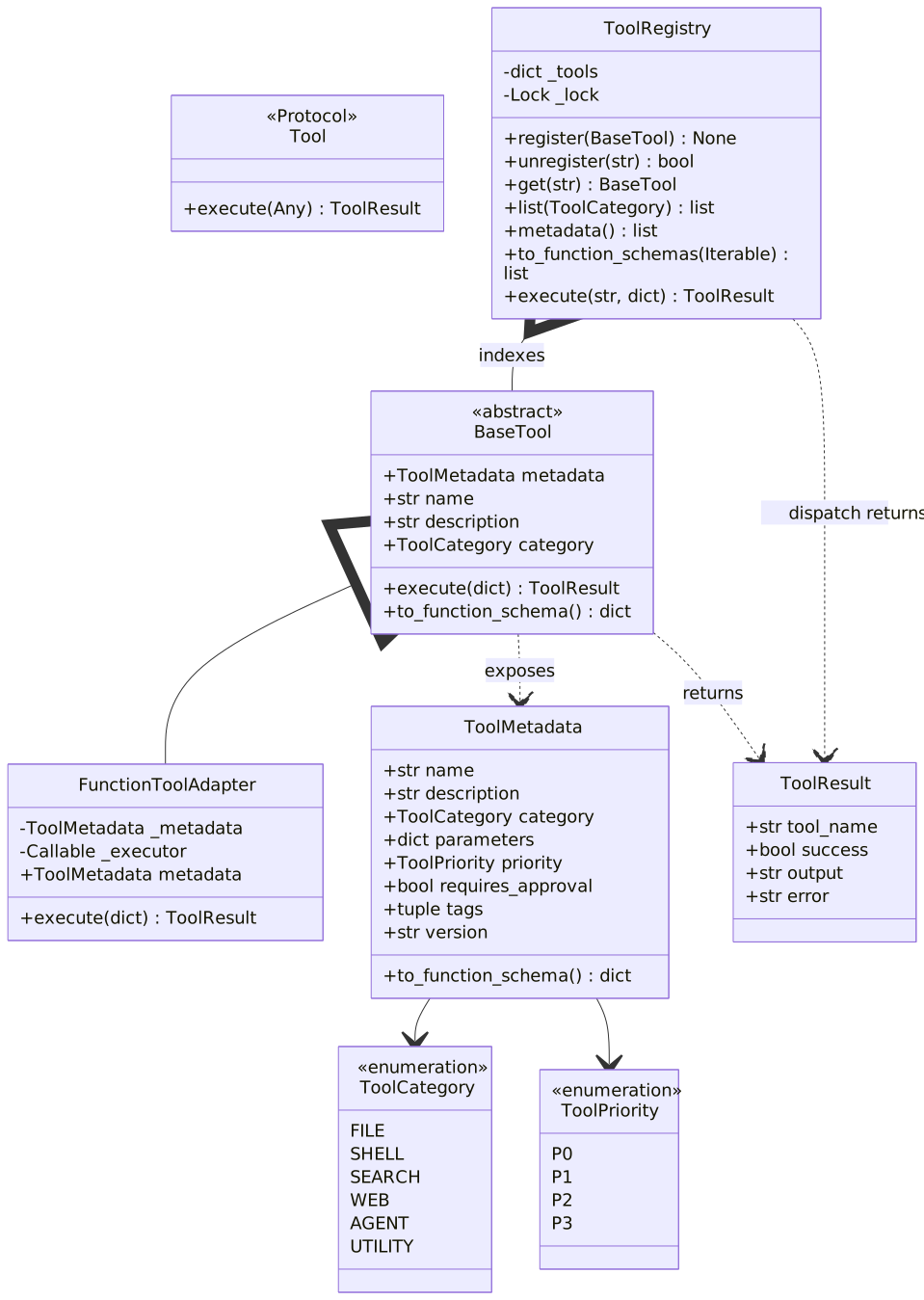
The contract lives in base.py. A tool is either a BaseTool subclass or a plain function wrapped by FunctionToolAdapter; either way it carries a frozen ToolMetadata record — a ToolCategory and ToolPriority taxonomy plus a description and a JSON-Schema parameter block. That metadata is what makes a tool describable to an LLM (rendered as an OpenAI/DeepSeek-style function schema by to_function_schema) and discoverable by search. Execution is uniform: every tool implements async execute(arguments) -> ToolResult, so the registry can route any tool without special-casing it. registry.py is the hub — ToolRegistry is a thread-safe index of tool instances keyed by name that supports register, discover, filter, describe, and dispatch. A process-wide singleton comes from default_registry(), and register_tool() is the one-line registrar. When a volk's LLM emits a tool call, dispatch is now a registry lookup rather than a branch in an if/elif ladder.
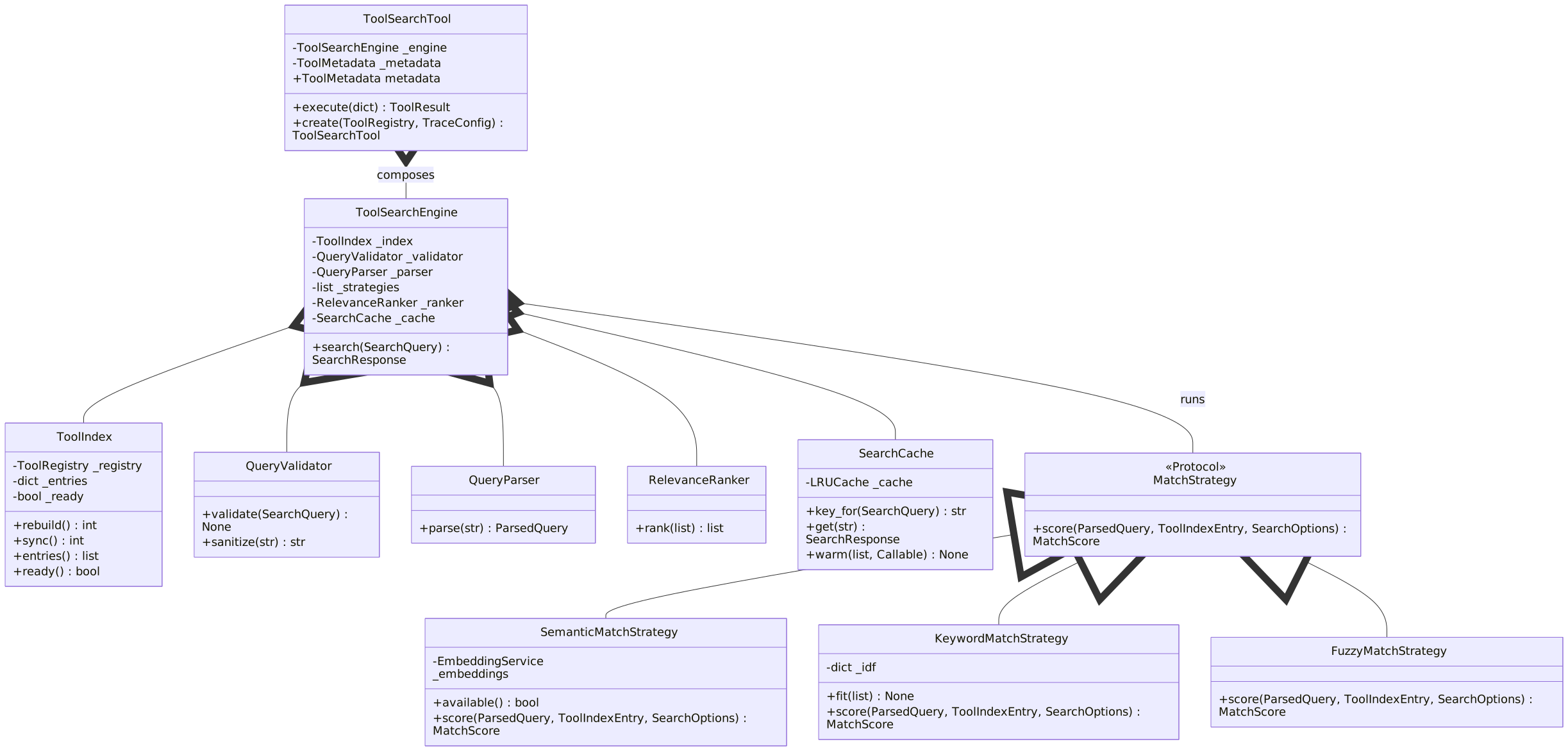
On top of the registry sits search.py, the SPEC-072 ToolSearchTool — itself a BaseTool, so the ability to find tools is exposed to volks exactly like any other capability. Internally it is composition-over-inheritance: the tool delegates to a ToolSearchEngine that builds a ToolIndex from the registry, validates and sanitizes the query (QueryValidator), parses AND/OR/wildcard expressions (QueryParser), then runs a Strategy-pattern list of MatchStrategy scorers — semantic (embedding cosine similarity, backed by memory.embedding), TF-IDF keyword, and fuzzy — before a RelevanceRanker orders the hits and a SearchCache (built on core.lru_cache) memoizes them. Every result flows back through typed, frozen dataclasses (SearchQuery, SearchResultItem, SearchResponse), and failures never propagate: they surface as a ToolSearchError folded into a failed ToolResult. If the embedding service is unavailable, semantic scoring simply contributes nothing and keyword/fuzzy carry the match — graceful degradation by composition.
The package also hosts a second, quieter concern: the AST query engine (ast_query.py + its CLI) and the ast_pipeline.py serialize-and-compare pipeline. ASTQuery loads the serialized codebase AST (plans/ast-ultimate.json) and answers structural questions programmatically — summaries, stub listings, inheritance trees, porting-coverage by tier — while ast_pipeline.main() (invoked as uv run ast-sync) serializes both this package and the frozen orchestrata monorepo and deep-compares them. This tooling was the authoritative measure of porting progress throughout the migration, and it remains the way to regenerate the AST artifacts the query engine consumes.
Key responsibilities
- Define the canonical tool contract (
BaseToolABC +ToolProtocol) and the metadata taxonomy (ToolMetadata,ToolCategory,ToolPriority) every first-class tool implements. - Render any tool as an LLM function-calling schema (
to_function_schema) so volks can invoke it, and return results as a uniformToolResult. - Provide a thread-safe registry (
ToolRegistry) for dynamic register / discover / filter / describe / dispatch — replacing the old hardcodedif/elifdispatch. - Adapt pre-existing plain-function tools into the framework without rewriting them (
FunctionToolAdapter). - Expose tool search (SPEC-072
ToolSearchTool) — semantic / keyword / fuzzy retrieval over all registered tools, as itself just another registered tool. - Host the first-class tools built on the framework (REPL, LSP, MCP resources, tasks, worktrees, cron scheduling, remote triggers, codebase and context queries, conversation capture) behind a Prolog approval gate (
approval.py). - Offer a programmatic AST query engine (
ASTQuery+ast-queryCLI) and the serialize/deep-compare pipeline (ast_pipeline) that measured porting progress.
Class diagram
The framework — contract, metadata, registry (base.py + registry.py)
The BaseTool ABC (and its thinner sibling, the Tool Protocol) is the one abstraction boundary. Each tool exposes an immutable ToolMetadata and an async execute; FunctionToolAdapter bridges legacy function-tools in; ToolRegistry indexes instances by name and dispatches through them.
The search engine — ToolSearchTool and its pipeline (search.py)
ToolSearchTool is itself a BaseTool; it composes a ToolSearchEngine that wires together the index, the query validator/parser, a list of MatchStrategy scorers (Strategy pattern), a ranker, and a cache.
The search data model (search.py)
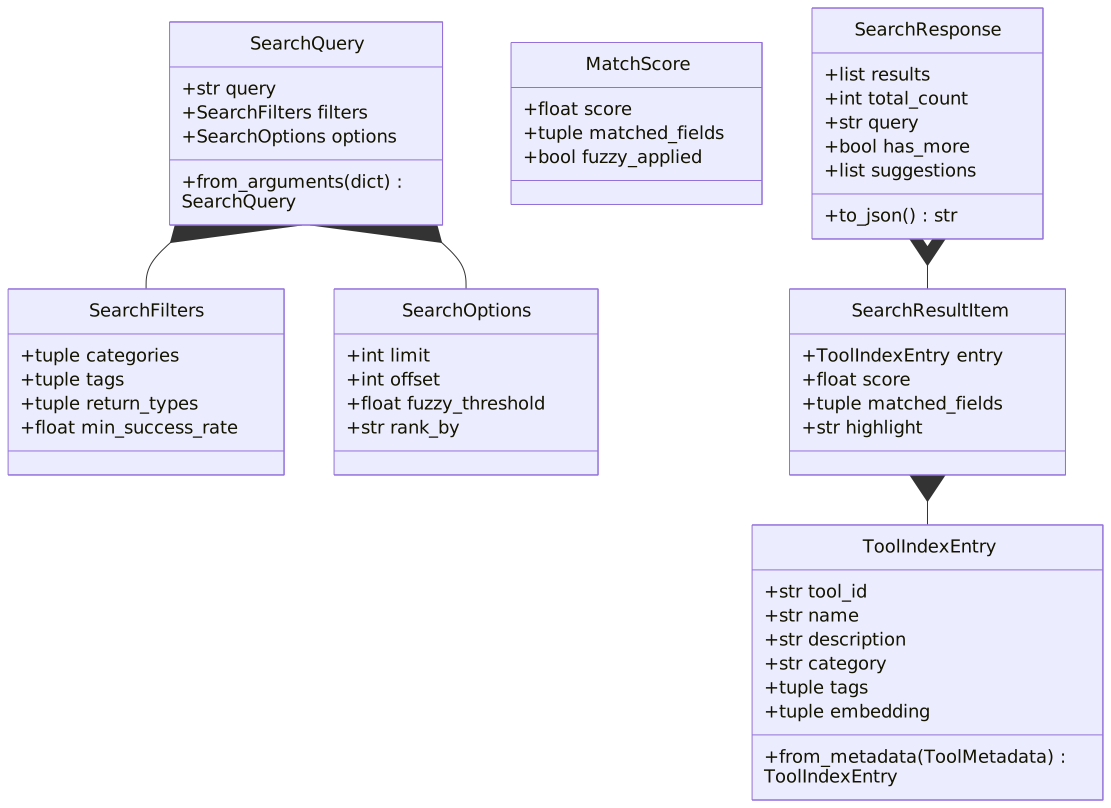
The request/response shapes are all frozen dataclasses. A SearchQuery bundles its SearchFilters and SearchOptions; the engine returns a SearchResponse of ranked SearchResultItems, each wrapping the matched ToolIndexEntry.
The AST query engine (ast_query.py)
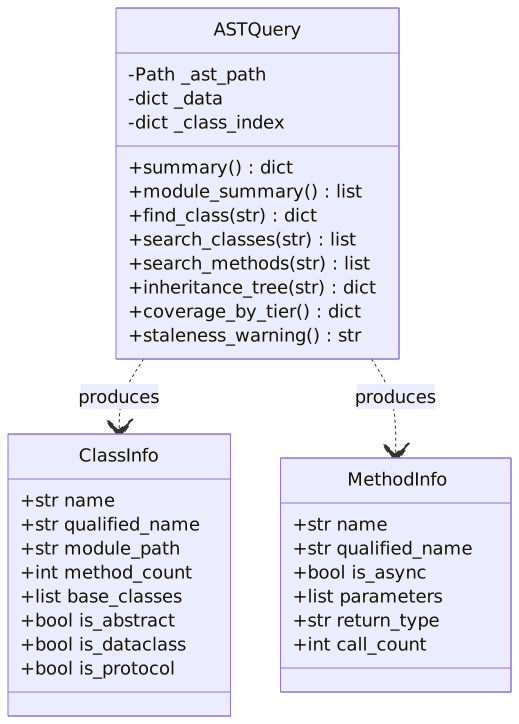
ASTQuery loads the serialized codebase AST and answers structural questions, projecting classes and methods into the lightweight ClassInfo / MethodInfo summaries.
Module dependency diagram
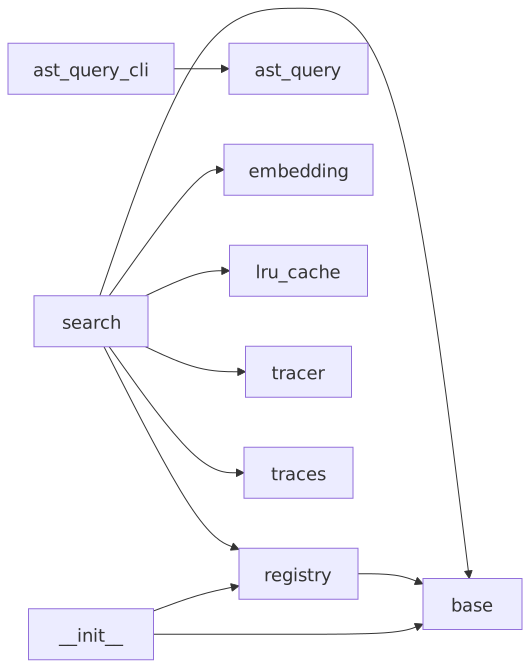
Internal module imports within orchestrata_ultimate.tools (generated from the AST, render-verified):
Module inventory
| Module | Purpose |
|---|---|
tools/__init__.py |
Package public API: re-exports BaseTool, FunctionToolAdapter, Tool, ToolCategory, ToolMetadata, ToolPriority, ToolResult, and the registry helpers. |
tools/base.py |
Unified tool framework — BaseTool + ToolMetadata: the canonical contract every first-class tool implements (register, discover, describe to an LLM as an OpenAI/DeepSeek function schema, dispatch). |
tools/registry.py |
Unified tool registry — thread-safe register/discover/describe/dispatch index of BaseTool instances keyed by name; the index SPEC-072 search runs over. |
tools/search.py |
ToolSearchTool (SPEC-072) — semantic/keyword/fuzzy search across all registered tools, composed from index, strategies, ranker, and cache. |
tools/ast_query.py |
AST Query Engine — programmatic access to the serialized Python AST (plans/ast-ultimate.json): find classes, list stubs, coverage, inheritance, method search. |
tools/ast_query_cli.py |
CLI for the AST Query Engine (ast-query summary/stubs/find/search/largest/inheritance/coverage/...). |
tools/ast_pipeline.py |
Automated AST serialization + deep-comparison pipeline (uv run ast-sync): serialize ultimate, serialize the frozen monorepo, deep-compare with class mapping — the source of truth for porting progress. |
tools/approval.py |
PrologApprovalGate — the governance-Prolog implementation of ApprovalGate, the gate tools consult before acting. (Added after the first version of this page; the 13 rows from here down are the first-class tools built on the framework.) |
tools/repl_tool.py |
REPLTool (SPEC-063) — interactive, sandboxed multi-language code execution with sessions and a session-error vocabulary (SessionNotFoundError, ConcurrentSessionLimitError and so on). |
tools/lsp_tool.py |
LSPTool (SPEC-065) — code navigation for Python targets: locations, symbols, hover, diagnostics. |
tools/mcp_resource_tools.py |
ListMcpResourcesTool / ReadMcpResourceTool (SPEC-071, MVP) — MCP resource listing and reading. |
tools/mcp_stdio_client.py |
McpStdioClient — a minimal JSON-RPC-over-stdio client for MCP servers, used by the resource tools. |
tools/task_tools.py |
TaskStopTool and TaskOutputTool (SPEC-069) — stop a task and read its output. |
tools/worktree_tools.py |
EnterWorktreeTool and ExitWorktreeTool — git worktree lifecycle for a session. |
tools/schedule_cron_tool.py |
ScheduleCronTool — cron-style job scheduling with timezone support, missed-job and concurrency policies. |
tools/remote_trigger_tool.py |
RemoteTriggerTool — outbound webhook/API trigger with authentication configuration, retry/backoff and an SSRF guard. |
tools/context_tools.py |
On-demand context tools for volks: GetCodeTool, GetTestsTool, GetRequirementsTool, SearchCodeTool. |
tools/codebase_tools.py |
CodebaseTools — the LLM-facing tool layer over the Prolog codebase database. |
tools/codebase_query_tools.py |
Registry-facing wrappers over CodebaseTools: CodebaseImpactTool, CodebaseModuleDepsTool, CodebaseFindCyclesTool, CodebaseDepPathTool. |
tools/conversation_tools.py |
ConvStatusTool and ConvSyncTool (SPEC-021) — conversation-capture tools. |
Notes on the principal classes
base.pydefines what it means to be a tool. The metadata taxonomy (ToolCategory/ToolPriority, bothStrEnums) is not decorative — it is the substrate that makes tools describable to LLMs and filterable by the SPEC-072 search facets, so every first-class tool carries it.FunctionToolAdapterlets an existing plainexecutor(name, args) -> ToolResultparticipate without being rewritten as a class.registry.py'sToolRegistryguards its_toolsdict with athreading.Lock.registerraisesValueErroron a duplicate name unlessreplace=True;executeon an unknown name returns a failedToolResultrather than raising.default_registry()supplies the process-wide singleton and doubles as the corpusToolSearchToolindexes.search.py'sToolSearchTool.create(registry)is the Factory that wires the whole pipeline: it builds and rebuilds theToolIndex, fits the keyword strategy's IDF, and warms the cache with each tool's own name (the most likely first lookup).register_search_tool(...)then registers the search tool back into the registry — closing the loop so search is itself discoverable, searchable, and dispatchable.ToolSearchTool.executenever raises; aToolSearchErrorbecomes a failedToolResult.ast_query.py+ast_pipeline.pyare the porting-progress tooling.ASTQuerywarns viastaleness_warning()when the serialized AST has drifted from the source tree;ast_pipeline.main()(uv run ast-sync) regenerates the AST artifacts and deep-compares this package against the frozenorchestratamonorepo.
Class map (generated)
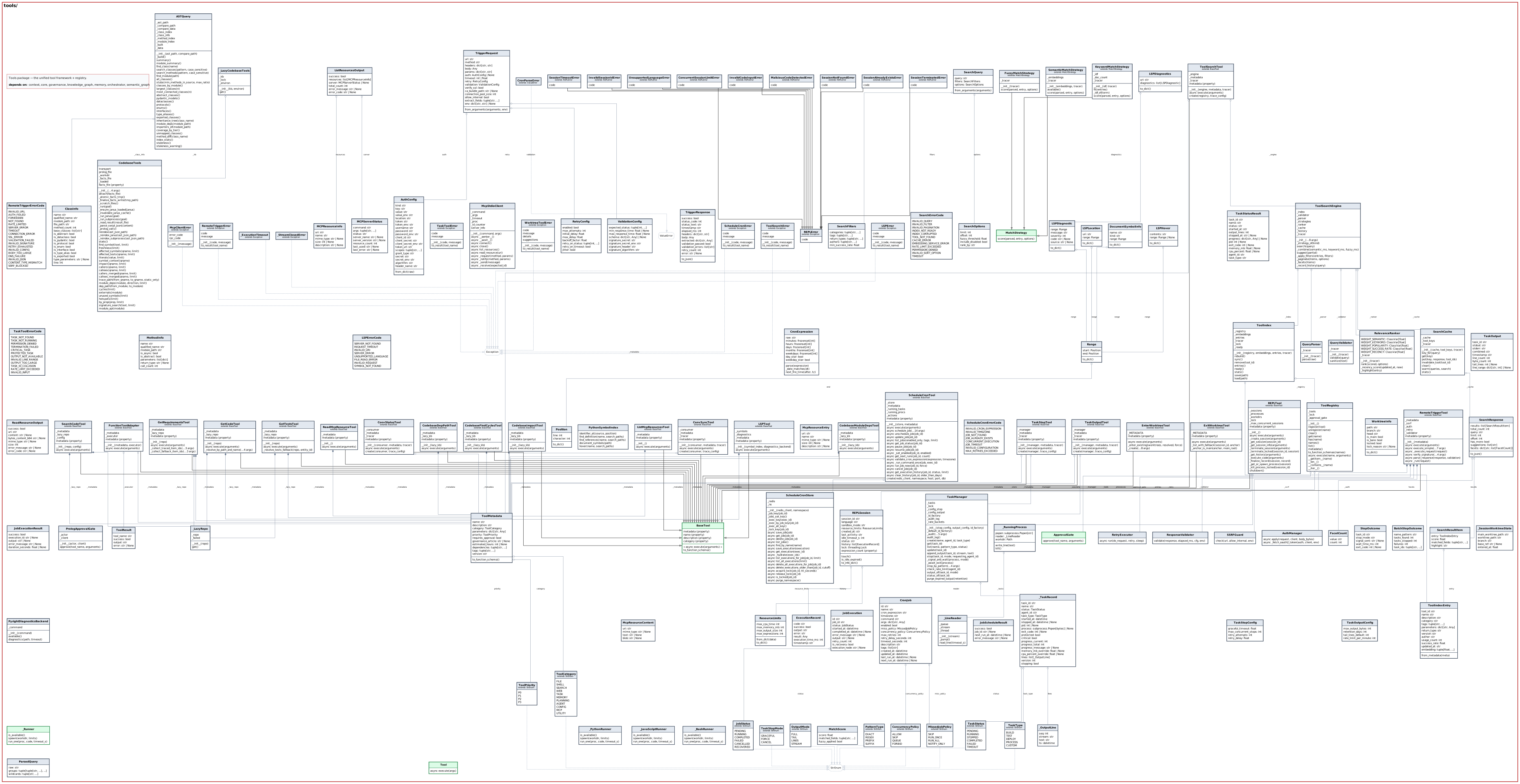
Generated from the live source AST by scripts/gen-module-class-diagrams.py — do not hand-edit. Abstract classes have a green border; members listed are those defined on the class itself (inherited members excluded). Solid empty-triangle arrows = in-package inheritance; dashed arrows into dashed boxes = external/stdlib/cross-package bases; filled diamond = composition (constructed in __init__); open diamond = aggregation (annotated/injected reference); diamond edge labels name the owning attribute.