orchestrata_ultimate.agents.swarm.coordinator
Reference › orchestrata_ultimate › agents › swarm › coordinator
coordinator in the swarm package fans code generation out file by file. SwarmCoordinator is created with a workspace path, a retry limit (default 2), the task summary, the API spec, the original intent and optional structured requirements. The CodeDirector's implementation helpers (implementation) call it after the scaffold has written a skeleton; results are ShardResult objects from types.
execute_swarm keeps the source files of the skeleton (_is_source_file), registers each Python file's exports in the knowledge-graph registry (_sync_file_to_registry), builds one prompt per file with _build_shard_prompt, and runs all shards concurrently in an asyncio TaskGroup. It returns the shard results and a scan of every file in the workspace. Each shard runs in an isolated temporary copy of the workspace (_create_shard_workspace, _copy_workspace) and uses a junior-volk driver obtained from the driver factory. After a successful generation the file is copied back atomically (_copy_file_back) and checked in order: syntax, lint, KG registration and a deterministic review (_review_file, which covers @traces presence, interface compliance against the API spec and requirement coverage). Any failure builds a fix prompt (_build_fix_prompt) and retries until the retry limit, after which the shard returns a failed ShardResult with the error. _execute_shard_safe converts any exception into a failed result so one shard cannot cancel the others.
At a glance
| Source | src/orchestrata_ultimate/agents/swarm/coordinator.py |
| Lines of code | 1030 |
| Classes | 1 |
| Functions | 2 |
| Imports (internal) | orchestrata_ultimate.agents.swarm.types, orchestrata_ultimate.drivers.driver_factory |
| Imported by | orchestrata_ultimate.agents.swarm, orchestrata_ultimate.agents.volks.codedirector.implementation, orchestrata_ultimate.agents.volks.codedirector.volk |
| Tests that import it | tests/agents/swarm/test_coordinator.py, tests/agents/swarm/test_coordinator_extended.py, tests/agents/swarm/test_coordinator_kg_registry_concurrency_regression.py, tests/agents/test_swarm_coordinator_real.py, tests/generated_agents/test_swarm_coordinator_generated.py, tests/generated_recovery/test_agents_swarm_coordinator.py |
Class diagram
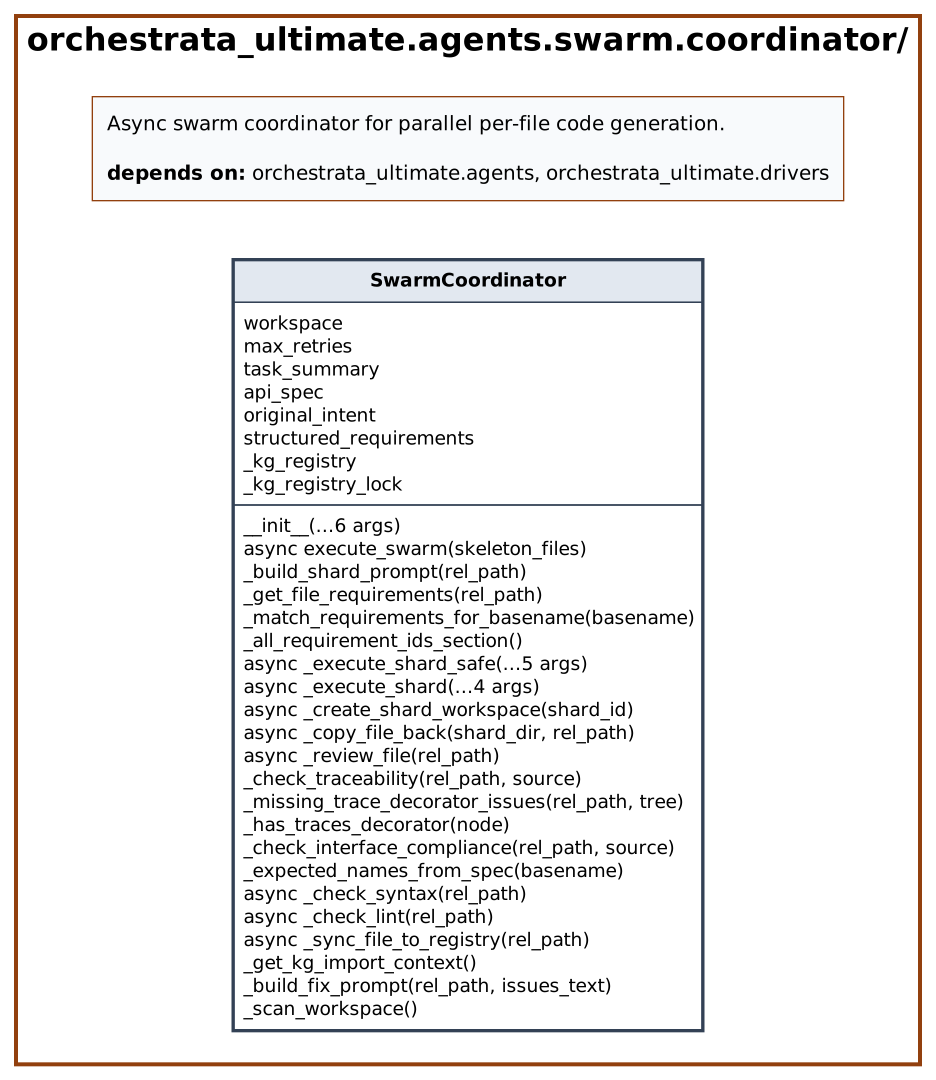
Dependency diagram

API
Classes
SwarmCoordinator
Line 91
Async parallel per-file code generation coordinator.
| Method | Signature | Summary |
|---|---|---|
__init__ |
__init__(workspace: str, max_retries: int = 2, task_summary: str = '', api_spec: str = '', original_intent: str = '', structured_requirements: list | None = None) -> None |
Initialize the swarm coordinator. |
execute_swarm |
async execute_swarm(skeleton_files: list[str]) -> tuple[list[ShardResult], list[str]] |
Execute parallel code generation for all source files. |
_build_shard_prompt |
_build_shard_prompt(rel_path: str) -> str |
Build the coding prompt for a single shard. |
_get_file_requirements |
_get_file_requirements(rel_path: str) -> str |
G222: Get requirement IDs relevant to this file. |
_match_requirements_for_basename |
_match_requirements_for_basename(basename: str) -> list[str] |
Select requirement lines whose text references basename. |
_all_requirement_ids_section |
_all_requirement_ids_section() -> str |
Build the fallback prompt section listing all requirement IDs. |
_execute_shard_safe |
async _execute_shard_safe(shard_id: int, rel_path: str, abs_path: str, prompt: str, total: int) -> ShardResult |
Run _execute_shard, converting any exception into a failed ShardResult instead of letting it propagate. |
_execute_shard |
async _execute_shard(shard_id: int, rel_path: str, abs_path: str, prompt: str) -> ShardResult |
Execute a single shard with retry. |
_create_shard_workspace |
async _create_shard_workspace(shard_id: int) -> str |
Create an isolated temp workspace for a shard. |
_copy_file_back |
async _copy_file_back(shard_dir: str, rel_path: str) -> None |
Atomically copy a generated file from shard to main workspace. |
_review_file |
async _review_file(rel_path: str) -> list[str] |
G220: Run deterministic review on a single file immediately. |
_check_traceability |
_check_traceability(rel_path: str, source: str) -> list[str] |
G221: Check that all public functions/classes have @traces. |
_missing_trace_decorator_issues |
_missing_trace_decorator_issues(rel_path: str, tree: ast.AST) -> list[str] |
List public module-level defs/classes missing a @traces decorator. |
_has_traces_decorator |
_has_traces_decorator(node: object) -> bool |
Check if an AST node has a @traces decorator. |
_check_interface_compliance |
_check_interface_compliance(rel_path: str, source: str) -> list[str] |
Check that generated code matches the API spec signatures. |
_expected_names_from_spec |
_expected_names_from_spec(basename: str) -> list[str] |
Parse the API spec for def/class names declared under basename. |
_check_syntax |
async _check_syntax(rel_path: str) -> tuple[bool, str] |
G227 Gate 1: Check if file parses as valid Python. |
_check_lint |
async _check_lint(rel_path: str) -> list[str] |
G227 Gate 2: Run linter on the file. |
_sync_file_to_registry |
async _sync_file_to_registry(rel_path: str) -> None |
G227: Parse file and register its exports in the KG registry. |
_get_kg_import_context |
_get_kg_import_context() -> str |
G227: Build import context from KG registry. |
_build_fix_prompt |
_build_fix_prompt(rel_path: str, issues_text: str) -> str |
Build a fix prompt with current file content and issues. |
_scan_workspace |
_scan_workspace() -> list[str] |
Scan the workspace for all source files. |
Functions
| Function | Signature | Summary |
|---|---|---|
_is_source_file |
_is_source_file(filepath: str) -> bool |
Check if a file is a swarm shard candidate. |
_copy_workspace |
async _copy_workspace(src: str, dst: str) -> None |
Copy workspace to a temp directory for shard isolation. |
Source
# mypy: ignore-errors
"""Async swarm coordinator for parallel per-file code generation.
Fans out N source files across N concurrent asyncio tasks, each
running an async code generation driver in an isolated temporary
workspace. Results are atomically merged back to the main workspace.
Under Python 3.14t (free-threaded), the asyncio tasks run with
true parallelism for the Python-side work (prompt building, result
parsing, file I/O), while subprocess drivers (Claude Code, Aider)
are always parallel regardless of GIL status.
"""
import ast
import asyncio
import logging
import os
import shutil
import subprocess
import threading
from orchestrata_ultimate.agents.swarm.types import ShardResult
_logger = logging.getLogger(__name__)
_SKIP_DIRS = frozenset(
{
".git",
".venv",
"__pycache__",
"node_modules",
".claude",
}
)
_SOURCE_EXTS = frozenset({".py"})
_SKIP_FILES = frozenset(
{
"__init__.py",
"conftest.py",
}
)
def _is_source_file(filepath: str) -> bool:
"""Check if a file is a swarm shard candidate.
Args:
filepath: Relative file path.
Returns:
True if the file is a source file eligible for shard gen.
"""
basename = os.path.basename(filepath)
ext = os.path.splitext(basename)[1]
if ext not in _SOURCE_EXTS:
return False
if basename in _SKIP_FILES:
return False
if basename.startswith("test_"):
return False
return True
async def _copy_workspace(
src: str,
dst: str,
) -> None:
"""Copy workspace to a temp directory for shard isolation.
Args:
src: Source workspace directory.
dst: Destination temp directory.
"""
def _copy() -> None:
shutil.copytree(
src,
dst,
ignore=shutil.ignore_patterns(
".git",
".venv",
"__pycache__",
"node_modules",
),
dirs_exist_ok=True,
)
await asyncio.to_thread(_copy)
class SwarmCoordinator:
"""Async parallel per-file code generation coordinator.
Fans out source files across N concurrent tasks, each with an
isolated temporary workspace. Files are atomically copied back
to the main workspace on success.
Attributes:
workspace: Main project workspace directory.
max_retries: Maximum retry attempts per shard.
task_summary: High-level description of the coding task.
api_spec: API specification text for context.
original_intent: Original user intent text.
"""
def __init__(
self,
workspace: str,
max_retries: int = 2,
task_summary: str = "",
api_spec: str = "",
original_intent: str = "",
structured_requirements: list | None = None,
) -> None:
"""Initialize the swarm coordinator.
Args:
workspace: Main project workspace directory.
max_retries: Max retries per shard (default 2).
task_summary: Task summary for shard prompts.
api_spec: API spec for context in shard prompts.
original_intent: Original user intent.
structured_requirements: List of requirement dicts
from the Analyst volk, each with 'id' and 'text'.
"""
self.workspace = workspace
self.max_retries = max_retries
self.task_summary = task_summary
self.api_spec = api_spec
self.original_intent = original_intent
self.structured_requirements = structured_requirements or []
# G227: Live KG registry — tracks synced modules/classes/paths
# during swarm execution. Each shard that passes syntax+lint
# gets registered here so subsequent shards know what exists.
# Guarded by a threading.Lock: under 3.14t free-threading, shard
# tasks write (_sync_file_to_registry) and read
# (_get_kg_import_context) the dict with true parallelism.
self._kg_registry: dict[str, dict] = {}
self._kg_registry_lock = threading.Lock()
async def execute_swarm(
self,
skeleton_files: list[str],
) -> tuple[list[ShardResult], list[str]]:
"""Execute parallel code generation for all source files.
Args:
skeleton_files: List of relative file paths from scaffold.
Returns:
Tuple of (shard results, all files in workspace).
"""
source_files = [f for f in skeleton_files if _is_source_file(f)]
total = len(source_files)
if total == 0:
_logger.warning("No source files for swarm")
return [], self._scan_workspace()
_logger.info("Starting %d parallel shards", total)
# G227: Pre-sync scaffold files to KG registry so shards
# know what already exists (exception classes, __init__, etc.)
for f in skeleton_files:
if f.endswith(".py"):
await self._sync_file_to_registry(f)
# Build shard prompts
shards = []
for i, rel_path in enumerate(source_files):
prompt = self._build_shard_prompt(rel_path)
abs_path = os.path.join(self.workspace, rel_path)
shards.append((i, rel_path, abs_path, prompt))
# Fan out with asyncio.TaskGroup. Each shard is wrapped by
# _execute_shard_safe() so a single shard's exception cannot
# propagate through TaskGroup.__aexit__ — an uncaught exception in
# ANY task would cancel every sibling task and abort the whole
# swarm run, defeating the per-file failure isolation this method
# is documented to provide.
results: list[ShardResult] = []
async with asyncio.TaskGroup() as tg:
tasks = {}
for shard_id, rel_path, abs_path, prompt in shards:
task = tg.create_task(
self._execute_shard_safe(
shard_id, rel_path, abs_path, prompt, total
)
)
tasks[task] = (shard_id, rel_path)
for task, (shard_id, rel_path) in tasks.items():
result = task.result()
results.append(result)
status = "OK" if result.success else "FAIL"
_logger.info(
"Shard %d/%d (%s): %s",
shard_id,
total,
rel_path,
status,
)
all_files = await asyncio.to_thread(self._scan_workspace)
succeeded = sum(1 for r in results if r.success)
_logger.info(
"Complete: %d/%d shards OK, %d total files",
succeeded,
total,
len(all_files),
)
return results, all_files
def _build_shard_prompt(self, rel_path: str) -> str:
"""Build the coding prompt for a single shard.
Args:
rel_path: Relative path of the file to generate.
Returns:
Complete prompt string.
"""
abs_path = os.path.join(self.workspace, rel_path)
skeleton = ""
if os.path.exists(abs_path):
try:
with open(abs_path, encoding="utf-8") as f:
skeleton = f.read()
except Exception as exc:
_logger.debug("read skeleton %s: %s", abs_path, exc)
parts = [
f"Generate the COMPLETE implementation for: {rel_path}",
"\nMANDATORY CODE STANDARDS (Python 3.14t):",
"- Type hints on ALL function parameters and return types",
" def func(name: str, count: int = 0) -> list[str]:",
"- Use modern syntax: list[], dict[], X | None (not Optional)",
"- Google-style docstrings on every public class and function",
"- @traces decorator on every public class and function",
"- Specific exception types (never bare except:)",
"- Max 40 lines per function, max 5 parameters",
"- snake_case functions, PascalCase classes, UPPER_CASE constants",
"- No mutable default arguments (use None + if param is None)",
"- Validate EVERY parameter in EVERY public method:",
" if not isinstance(x, str): raise TypeError(...)",
" if x is None: raise ValueError('x must not be None')",
" if x < 0: raise ValueError('x must be non-negative')",
]
if self.task_summary:
parts.append(f"\nTask: {self.task_summary}")
if skeleton:
parts.append(f"\nSkeleton:\n{skeleton}")
if self.api_spec:
parts.append(f"\nAPI Spec (read-only reference):\n{self.api_spec}")
# G222: Inject requirement IDs this file implements
req_section = self._get_file_requirements(rel_path)
if req_section:
parts.append(req_section)
# G227: Inject KG import context — what's already written
kg_context = self._get_kg_import_context()
if kg_context:
parts.append(kg_context)
parts.append(
f"\nCRITICAL: Write ONLY the file {rel_path}. "
"Do not create or modify any other file."
)
return "\n".join(parts)
def _get_file_requirements(self, rel_path: str) -> str:
"""G222: Get requirement IDs relevant to this file.
Maps requirements to files by matching module names in
the requirement text against the file basename.
Args:
rel_path: Relative file path being generated.
Returns:
Formatted requirement section for the prompt, or empty.
"""
if not self.structured_requirements:
return ""
basename = os.path.basename(rel_path).removesuffix(".py")
matched = self._match_requirements_for_basename(basename)
if not matched:
return self._all_requirement_ids_section()
return (
"\nRequirements this file implements:\n"
+ "\n".join(matched)
+ "\n\nAdd @traces(spec='001', story='US-001', "
"reqs=[<matching IDs>]) to every public function "
"and class implementing these requirements.\n"
"If orchestrata.core.traceability is not available, "
"define:\n"
" def traces(**kw): return lambda f: f"
)
def _match_requirements_for_basename(self, basename: str) -> list[str]:
"""Select requirement lines whose text references *basename*.
Args:
basename: Module basename (without .py) to match against.
Returns:
Formatted requirement lines that match this file.
"""
matched: list[str] = []
for req in self.structured_requirements:
if isinstance(req, dict):
rid = req.get("id", req.get("req_id", ""))
text = req.get("text", req.get("description", ""))
# Match if the module name appears in the requirement
if basename in text.lower() or not text:
matched.append(f" {rid}: {text[:100]}")
elif isinstance(req, str) and basename in req.lower():
matched.append(f" {req}")
return matched
def _all_requirement_ids_section(self) -> str:
"""Build the fallback prompt section listing all requirement IDs.
Returns:
Formatted requirement-ID reference section, or '' if none.
"""
all_ids = []
for req in self.structured_requirements[:10]:
if isinstance(req, dict):
rid = req.get("id", req.get("req_id", ""))
if rid:
all_ids.append(rid)
if not all_ids:
return ""
return (
f"\nRequirement IDs (for @traces decorator):\n"
f" {', '.join(all_ids)}\n"
"Add @traces(spec='001', story='US-001', "
f"reqs={all_ids[:3]}) to every public "
"function and class.\n"
"If orchestrata.core.traceability is not "
"available, define:\n"
" def traces(**kw): return lambda f: f"
)
async def _execute_shard_safe(
self,
shard_id: int,
rel_path: str,
abs_path: str,
prompt: str,
total: int,
) -> ShardResult:
"""Run ``_execute_shard``, converting any exception into a failed
``ShardResult`` instead of letting it propagate.
Required because ``asyncio.TaskGroup`` cancels every sibling task
and re-raises on exit as soon as ANY task raises — an uncaught
exception here would abort the entire swarm run instead of just
this one shard, defeating per-file failure isolation.
Args:
shard_id: Numeric shard identifier.
rel_path: Relative file path.
abs_path: Absolute file path.
prompt: The coding prompt.
total: Total number of shards (for logging).
Returns:
ShardResult with success/failure info.
"""
try:
return await self._execute_shard(shard_id, rel_path, abs_path, prompt)
except Exception as exc:
_logger.error(
"Shard %d/%d (%s) exception: %s",
shard_id,
total,
rel_path,
exc,
)
return ShardResult(
file_path=rel_path,
success=False,
error=str(exc),
)
async def _execute_shard(
self,
shard_id: int,
rel_path: str,
abs_path: str,
prompt: str,
) -> ShardResult:
"""Execute a single shard with retry.
Args:
shard_id: Numeric shard identifier.
rel_path: Relative file path.
abs_path: Absolute file path.
prompt: The coding prompt.
Returns:
ShardResult with success/failure info.
"""
current_prompt = prompt
for attempt in range(self.max_retries + 1):
shard_dir = await self._create_shard_workspace(shard_id)
try:
from orchestrata_ultimate.drivers.driver_factory import get_driver
driver = get_driver(
volk="J:Junior",
workspace=shard_dir,
)
success, output = await driver.execute(current_prompt, files=[rel_path])
if success:
await self._copy_file_back(shard_dir, rel_path)
# G227 Gate 1: Syntax check immediately
syntax_ok, syntax_err = await self._check_syntax(rel_path)
if not syntax_ok:
if attempt < self.max_retries:
current_prompt = self._build_fix_prompt(
rel_path,
f"SYNTAX ERROR: {syntax_err}\n"
"Fix the syntax error. The file must "
"parse as valid Python.",
)
_logger.info(
"Shard %d: syntax error, retrying",
shard_id,
)
continue
return ShardResult(
file_path=rel_path,
success=False,
error=f"SYNTAX ERROR: {syntax_err}",
retries=attempt,
)
# G227 Gate 2: Lint check
lint_issues = await self._check_lint(rel_path)
if lint_issues:
if attempt < self.max_retries:
current_prompt = self._build_fix_prompt(
rel_path,
"LINT ERRORS:\n"
+ "\n".join(f" - {i}" for i in lint_issues)
+ "\nFix ALL lint errors.",
)
_logger.info(
"Shard %d: %d lint issues, retrying",
shard_id,
len(lint_issues),
)
continue
return ShardResult(
file_path=rel_path,
success=False,
error=f"LINT ERRORS: {'; '.join(lint_issues)}",
retries=attempt,
)
# G227: Syntax+lint passed → sync to KG registry
await self._sync_file_to_registry(rel_path)
# G220: Full review (traceability, quality)
issues = await self._review_file(rel_path)
if issues:
if attempt < self.max_retries:
issue_list = "\n".join(f" - {i}" for i in issues)
current_prompt = self._build_fix_prompt(
rel_path,
f"CODE REVIEW ISSUES:\n{issue_list}\nFix ALL issues.",
)
_logger.info(
"Shard %d: %d review issues, retrying",
shard_id,
len(issues),
)
continue
return ShardResult(
file_path=rel_path,
success=False,
error=f"CODE REVIEW ISSUES: {'; '.join(issues)}",
retries=attempt,
)
return ShardResult(
file_path=rel_path,
success=True,
output=output,
retries=attempt,
)
except Exception as exc:
_logger.warning(
"Shard %d attempt %d failed: %s",
shard_id,
attempt + 1,
exc,
)
finally:
await asyncio.to_thread(shutil.rmtree, shard_dir, True)
return ShardResult(
file_path=rel_path,
success=False,
error=f"Failed after {self.max_retries + 1} attempts",
retries=self.max_retries,
)
async def _create_shard_workspace(self, shard_id: int) -> str:
"""Create an isolated temp workspace for a shard.
Args:
shard_id: Shard identifier for naming.
Returns:
Path to the temp workspace.
"""
import tempfile
shard_dir = os.path.join(
tempfile.gettempdir(),
f"orchestrata-shard-{shard_id}",
)
if os.path.exists(shard_dir):
await asyncio.to_thread(shutil.rmtree, shard_dir, True)
await _copy_workspace(self.workspace, shard_dir)
return shard_dir
async def _copy_file_back(
self,
shard_dir: str,
rel_path: str,
) -> None:
"""Atomically copy a generated file from shard to main workspace.
Args:
shard_dir: Shard temp directory.
rel_path: Relative file path to copy.
"""
src = os.path.join(shard_dir, rel_path)
dst = os.path.join(self.workspace, rel_path)
if not os.path.exists(src):
return
def _copy() -> None:
os.makedirs(os.path.dirname(dst), exist_ok=True)
if os.path.exists(dst) and os.path.samefile(src, dst):
_logger.debug("skip copy — same file: %s", rel_path)
return
shutil.copy2(src, dst)
await asyncio.to_thread(_copy)
async def _review_file(self, rel_path: str) -> list[str]:
"""G220: Run deterministic review on a single file immediately.
Also checks interface compliance against the API spec.
Args:
rel_path: Relative path to the generated file.
Returns:
List of issue strings. Empty if file passes review.
"""
issues: list[str] = []
abs_path = os.path.join(self.workspace, rel_path)
if not abs_path.endswith(".py") or not os.path.exists(abs_path):
return issues
# Syntax check
try:
with open(abs_path, encoding="utf-8") as f:
source = f.read()
compile(source, rel_path, "exec")
except SyntaxError as exc:
issues.append(f"SyntaxError: {exc}")
return issues
# Interface compliance: check that functions in API spec exist
if self.api_spec:
spec_issues = await asyncio.to_thread(
self._check_interface_compliance, rel_path, source
)
issues.extend(spec_issues)
# Import check: verify no spike/orchestrata imports
try:
import ast
tree = ast.parse(source)
for node in ast.walk(tree):
if isinstance(node, ast.Import):
for alias in node.names:
mod = alias.name.split(".")[0]
if mod in {"spike", "orchestrata"}:
issues.append(
f"Import '{alias.name}' — is expected to "
"not import spike/orchestrata in "
"generated code"
)
except SyntaxError as exc:
_logger.debug("AST parse failed for %s: %s", rel_path, exc)
# G221: Traceability enforcement — every public function
# and class must have a @traces decorator
trace_issues = await asyncio.to_thread(
self._check_traceability, rel_path, source
)
issues.extend(trace_issues)
return issues
def _check_traceability(
self,
rel_path: str,
source: str,
) -> list[str]:
"""G221: Check that all public functions/classes have @traces.
Args:
rel_path: File being checked.
source: Source code content.
Returns:
List of traceability issues.
"""
import ast
basename = os.path.basename(rel_path)
# Skip __init__.py, conftest.py, test files
if basename in {"__init__.py", "conftest.py"}:
return []
if basename.startswith("test_"):
return []
try:
tree = ast.parse(source)
except SyntaxError:
return []
# Check if @traces is imported or defined
if "traces" not in source:
return [
f"TRACEABILITY: {rel_path} has no @traces decorator "
"import. Add: from orchestrata_ultimate.core.tracing.traceability "
"import traces (or define: def traces(**kw): "
"return lambda f: f)"
]
return self._missing_trace_decorator_issues(rel_path, tree)
def _missing_trace_decorator_issues(
self,
rel_path: str,
tree: ast.AST,
) -> list[str]:
"""List public module-level defs/classes missing a @traces decorator.
Args:
rel_path: File being checked (for issue messages).
tree: Parsed AST module.
Returns:
One issue string per public def/class without @traces.
"""
import ast
issues: list[str] = []
for node in ast.iter_child_nodes(tree):
if isinstance(node, (ast.FunctionDef, ast.AsyncFunctionDef)):
kind = "function"
elif isinstance(node, ast.ClassDef):
kind = "class"
else:
continue
if node.name.startswith("_"):
continue
if not self._has_traces_decorator(node):
issues.append(
f"TRACEABILITY: {rel_path}:{node.lineno} "
f"{kind} '{node.name}' missing @traces"
)
return issues
def _has_traces_decorator(self, node: object) -> bool:
"""Check if an AST node has a @traces decorator.
Args:
node: AST FunctionDef, AsyncFunctionDef, or ClassDef.
Returns:
True if @traces is present.
"""
import ast
for dec in getattr(node, "decorator_list", []):
if isinstance(dec, ast.Call):
func = dec.func
if isinstance(func, ast.Name) and func.id == "traces":
return True
if isinstance(func, ast.Attribute) and func.attr == "traces":
return True
elif isinstance(dec, ast.Name) and dec.id == "traces":
return True
elif isinstance(dec, ast.Attribute) and dec.attr == "traces":
return True
return False
def _check_interface_compliance(
self,
rel_path: str,
source: str,
) -> list[str]:
"""Check that generated code matches the API spec signatures.
Args:
rel_path: File being checked.
source: Source code content.
Returns:
List of compliance issues.
"""
import ast
basename = os.path.basename(rel_path).removesuffix(".py")
# Extract function/class names from source
try:
tree = ast.parse(source)
except SyntaxError:
return []
defined_names = set()
for node in ast.walk(tree):
if isinstance(node, (ast.FunctionDef, ast.AsyncFunctionDef)):
defined_names.add(node.name)
elif isinstance(node, ast.ClassDef):
defined_names.add(node.name)
# Check API spec for expected functions/classes in this file
if not self.api_spec:
return []
expected_names = self._expected_names_from_spec(basename)
return [
f"Interface mismatch: {name} expected in "
f"{rel_path} (from API spec) but not defined"
for name in expected_names
if name not in defined_names
]
def _expected_names_from_spec(self, basename: str) -> list[str]:
"""Parse the API spec for def/class names declared under *basename*.
Scans the spec line by line, entering a file section when *basename*
appears in a header line and collecting the def/class names that follow
until the section ends.
Args:
basename: Module basename (without .py) marking the spec section.
Returns:
Expected function/class names declared for this file.
"""
in_file_section = False
expected_names: list[str] = []
for line in self.api_spec.splitlines():
stripped = line.strip()
if basename in stripped and (
"def " in stripped
or "class " in stripped
or stripped.endswith(".py")
or stripped.endswith(":")
):
in_file_section = True
continue
if not in_file_section:
continue
if stripped.startswith("def "):
expected_names.append(
stripped.split("(")[0].replace("def ", "").strip()
)
elif stripped.startswith("class "):
expected_names.append(
stripped.split("(")[0].split(":")[0].replace("class ", "").strip()
)
elif stripped and not stripped.startswith((" ", "\t", "#", '"""', "'''")):
in_file_section = False
return expected_names
# ── G227: Post-write gates + KG sync ─────────────────────────
async def _check_syntax(
self,
rel_path: str,
) -> tuple[bool, str]:
"""G227 Gate 1: Check if file parses as valid Python.
Args:
rel_path: Relative file path.
Returns:
(True, "") if syntax OK, (False, error_msg) if not.
"""
filepath = os.path.join(self.workspace, rel_path)
if not filepath.endswith(".py") or not os.path.exists(filepath):
return True, ""
def _parse() -> tuple[bool, str]:
try:
with open(filepath, encoding="utf-8") as f:
source = f.read()
ast.parse(source, filename=rel_path)
return True, ""
except SyntaxError as exc:
return False, (
f"Line {exc.lineno}: {exc.msg}" if exc.lineno else str(exc)
)
return await asyncio.to_thread(_parse)
async def _check_lint(
self,
rel_path: str,
) -> list[str]:
"""G227 Gate 2: Run linter on the file.
Tries ruff, then flake8. Returns issue strings.
Args:
rel_path: Relative file path.
Returns:
List of lint issue strings. Empty = clean.
"""
filepath = os.path.join(self.workspace, rel_path)
if not filepath.endswith(".py") or not os.path.exists(filepath):
return []
def _lint() -> list[str]:
for linter in ["ruff check", "flake8"]:
cmd_parts = linter.split() + [filepath]
try:
result = subprocess.run(
cmd_parts,
capture_output=True,
text=True,
timeout=15,
)
if result.returncode != 0 and result.stdout:
return [
line.strip()
for line in result.stdout.strip().splitlines()
if line.strip()
]
return []
except FileNotFoundError, subprocess.TimeoutExpired:
continue
return []
return await asyncio.to_thread(_lint)
async def _sync_file_to_registry(
self,
rel_path: str,
) -> None:
"""G227: Parse file and register its exports in the KG registry.
Extracts classes, functions, and their import paths so
subsequent shards can get correct import context.
Args:
rel_path: Relative file path (already syntax-checked).
"""
filepath = os.path.join(self.workspace, rel_path)
if not filepath.endswith(".py") or not os.path.exists(filepath):
return
def _extract() -> dict:
with open(filepath, encoding="utf-8") as f:
source = f.read()
tree = ast.parse(source)
classes = []
functions = []
for node in ast.iter_child_nodes(tree):
if isinstance(node, ast.ClassDef):
methods = [
n.name
for n in ast.iter_child_nodes(node)
if isinstance(n, (ast.FunctionDef, ast.AsyncFunctionDef))
]
classes.append(
{
"name": node.name,
"methods": methods,
"line": node.lineno,
}
)
elif isinstance(node, (ast.FunctionDef, ast.AsyncFunctionDef)):
functions.append(
{
"name": node.name,
"line": node.lineno,
}
)
# Build import path from relative path
# src/pkg/module.py → pkg.module
import_path = rel_path.removesuffix(".py").replace(os.sep, ".")
if import_path.startswith("src."):
import_path = import_path[4:]
return {
"rel_path": rel_path,
"import_path": import_path,
"classes": classes,
"functions": functions,
}
info = await asyncio.to_thread(_extract)
with self._kg_registry_lock:
self._kg_registry[rel_path] = info
_logger.info(
"KG sync: %s → %d classes, %d functions",
rel_path,
len(info["classes"]),
len(info["functions"]),
)
def _get_kg_import_context(self) -> str:
"""G227: Build import context from KG registry.
Returns a formatted string showing what modules, classes,
and functions already exist with their correct import paths.
Returns:
Import context string for injection into shard prompts.
"""
# Snapshot under the lock so a concurrent _sync_file_to_registry
# write cannot mutate the dict mid-iteration (3.14t parallelism).
with self._kg_registry_lock:
snapshot = list(self._kg_registry.items())
if not snapshot:
return ""
lines = [
"\nAVAILABLE MODULES (already written — use these exact import paths):"
]
for rel_path, info in sorted(snapshot):
imp = info["import_path"]
lines.append(f"\n # {rel_path}")
for cls in info["classes"]:
lines.append(f" from {imp} import {cls['name']}")
for func in info["functions"]:
if not func["name"].startswith("_"):
lines.append(f" from {imp} import {func['name']}")
lines.append(
"\nIMPORTANT: Use EXACTLY these import paths. "
"Do NOT guess or invent import paths."
)
return "\n".join(lines)
def _build_fix_prompt(
self,
rel_path: str,
issues_text: str,
) -> str:
"""Build a fix prompt with current file content and issues.
Args:
rel_path: Relative file path.
issues_text: Formatted issue description.
Returns:
Complete fix prompt string.
"""
filepath = os.path.join(self.workspace, rel_path)
current_source = ""
if os.path.exists(filepath):
try:
with open(filepath, encoding="utf-8") as f:
current_source = f.read()
except OSError as exc:
_logger.debug("read for fix: %s", exc)
# Include KG import context so fixes use correct paths
kg_context = self._get_kg_import_context()
return (
f"The file {rel_path} has issues that MUST be fixed:\n"
f"{issues_text}\n\n"
"REMINDER — mandatory on every function:\n"
"- Type hints: def f(x: str, n: int = 0) -> list[str]:\n"
"- Use list[], dict[], X | None (Python 3.14 syntax)\n"
"- Google docstring on every public class/function\n\n"
f"Current file content:\n"
f"```python\n{current_source}\n```\n"
f"{kg_context}\n\n"
f"Fix ALL listed issues. Output the complete "
f"corrected file."
)
def _scan_workspace(self) -> list[str]:
"""Scan the workspace for all source files.
Returns:
List of relative file paths.
"""
files: list[str] = []
for root, dirs, filenames in os.walk(self.workspace):
dirs[:] = [d for d in dirs if d not in _SKIP_DIRS]
for fname in filenames:
if fname.startswith("."):
continue
rel = os.path.relpath(os.path.join(root, fname), self.workspace)
files.append(rel)
return sorted(files)