orchestrata_ultimate.orchestrator.intent_broker
Reference › orchestrata_ultimate › orchestrator › intent_broker
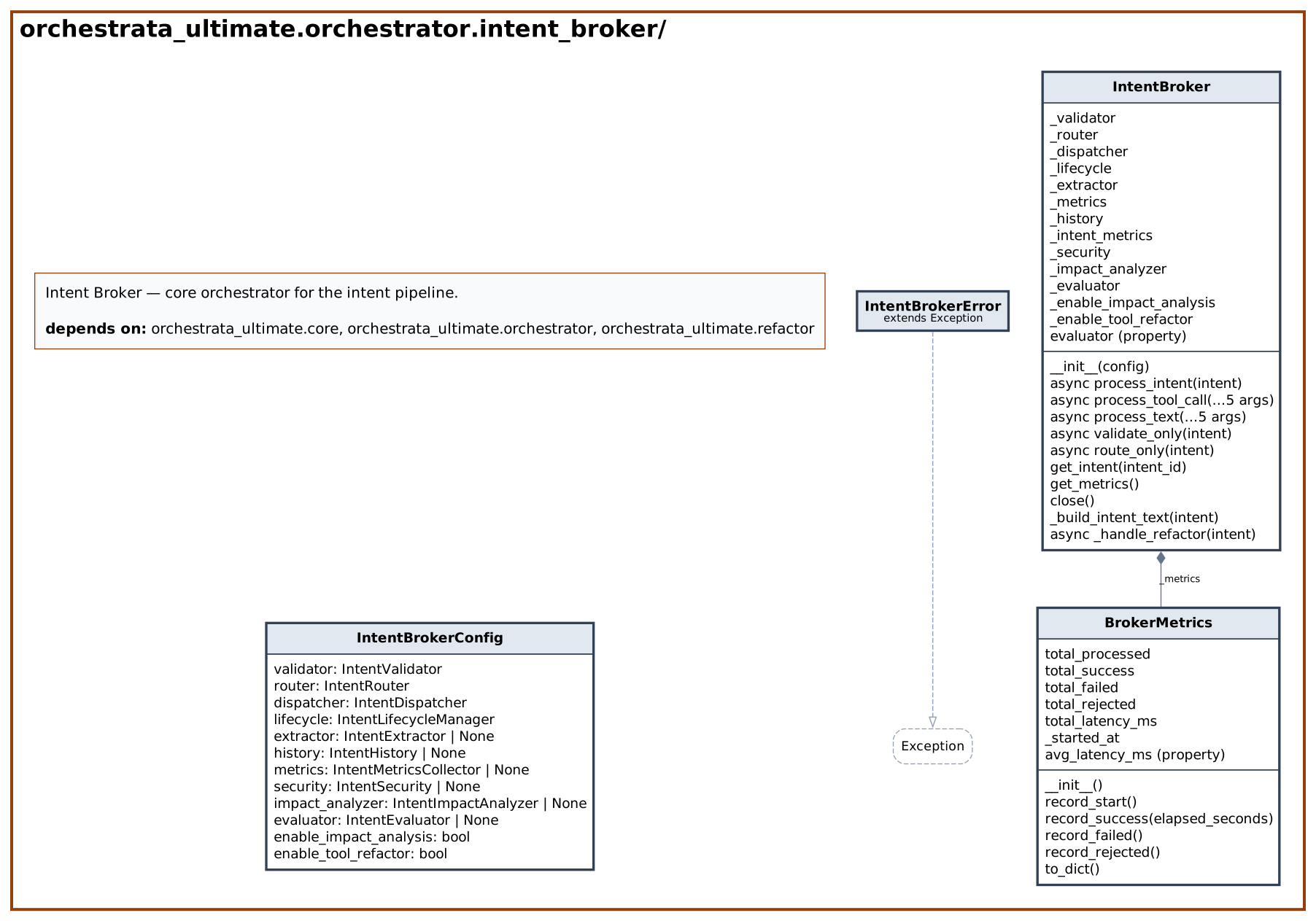
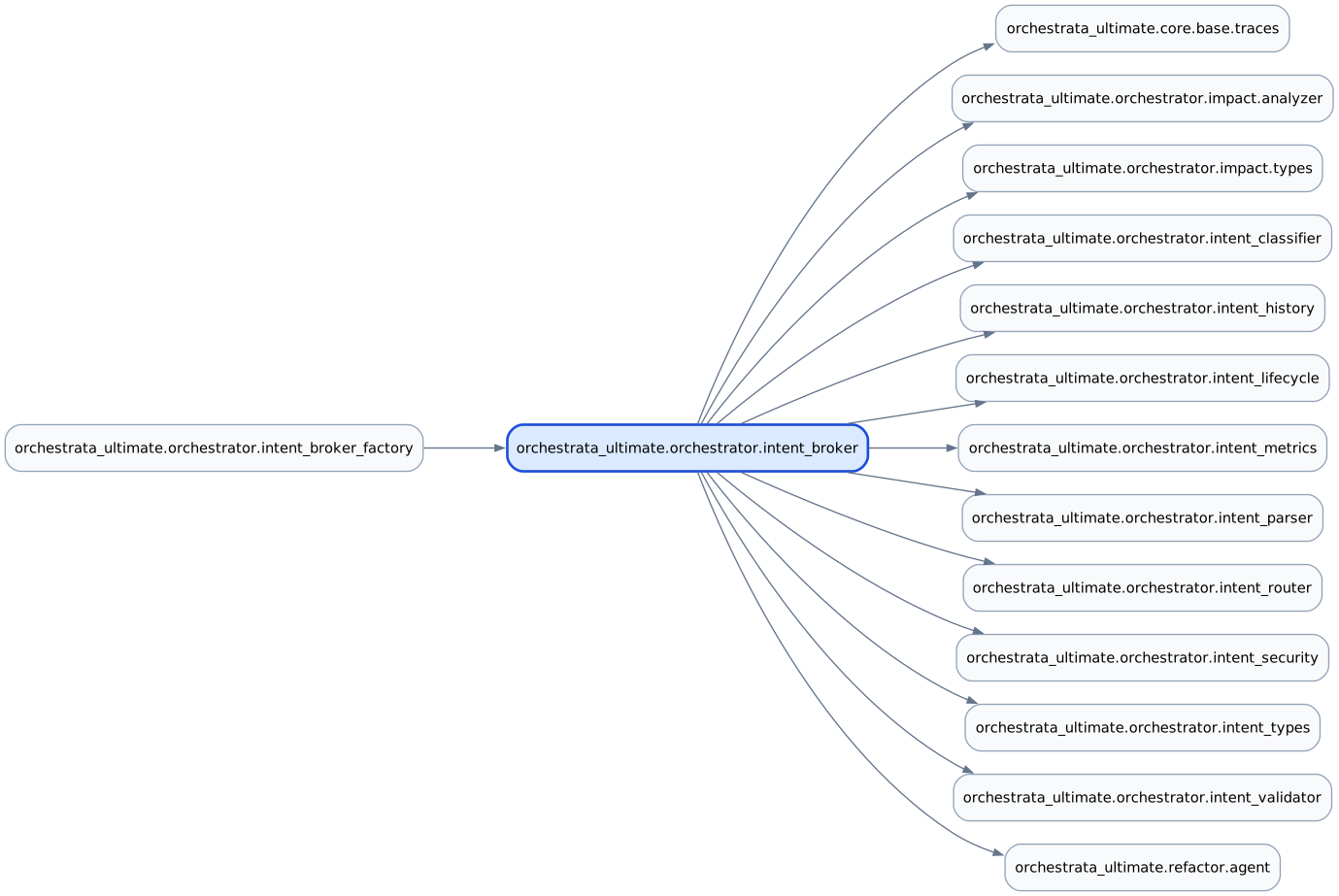
IntentBroker is the front door of the intent pipeline and the place where a human intent becomes work for the volks. Concierge, the gateway or a tool interceptor hands it a sentence, a tool call or a ready-made Intent, and the broker drives that intent through validation, optional impact analysis, routing and dispatch, recording each state change. It is assembled by intent_broker_factory and implements spec 003; see the orchestrator package narrative for the wider picture.
Dependencies arrive in one IntentBrokerConfig dataclass: an IntentValidator, an IntentRouter and IntentDispatcher, an IntentLifecycleManager, and optional history, metrics, security, impact analyzer and NL evaluator. Three entry points feed the same core:
process_textruns the IntentEvaluator (normalize, classify, map to a workflow, confidence gate). Ambiguous text, including questions, comes back as a failedDispatchResultwith an "ambiguous intent" message rather than being dispatched on a guess. Without an evaluator it fails and does not guess.process_tool_callusesIntentExtractorfrom intent_parser to turn an agent tool call into an intent.process_intentis the core. It stores the intent, validates it (a rejection moves it toREJECTED), optionally runs the impact analyzer and attaches a summary to the intent's parameters (failure of the analysis is logged and ignored), routes it, and dispatches it, moving the status toDISPATCHEDon success orFAILEDotherwise. Any exception becomes a failedDispatchResult; the method does not raise.
An intent classified as a refactor is diverted by _handle_refactor to the in-place refactor agent (SPEC-103), with target volk U:Cd. Its sandbox root comes from the root or workspace parameter, else the resource path, else the ORCHESTRATA_WORKSPACE variable. validate_only, route_only, get_intent, get_metrics and close are inspection helpers; BrokerMetrics counts started, successful, failed and rejected intents and average latency.
At a glance
Class diagram
Dependency diagram
API
Classes
IntentBrokerError
Bases: Exception · Decorators: traces(spec='003', story='US-004', reqs=['REQ-003-US-004-001']) · Line 52
Base exception for IntentBroker errors.
IntentBrokerConfig (dataclass)
Decorators: dataclass · Line 57
Configuration object for IntentBroker dependency injection.
| Attribute | Type | Default |
|---|---|---|
validator |
IntentValidator |
|
router |
IntentRouter |
|
dispatcher |
IntentDispatcher |
|
lifecycle |
IntentLifecycleManager |
|
extractor |
IntentExtractor | None |
field(default=None) |
history |
IntentHistory | None |
field(default=None) |
metrics |
IntentMetricsCollector | None |
field(default=None) |
security |
IntentSecurity | None |
field(default=None) |
impact_analyzer |
IntentImpactAnalyzer | None |
field(default=None) |
evaluator |
IntentEvaluator | None |
field(default=None) |
enable_impact_analysis |
bool |
field(default=True) |
enable_tool_refactor |
bool |
field(default=True) |
IntentBroker
Decorators: traces(spec='003', story='US-003', reqs=['REQ-003-US-003-001', 'REQ-003-US-009-024']) · Line 85
Main intent processing pipeline.
| Method | Signature | Summary |
|---|---|---|
__init__ |
__init__(config: IntentBrokerConfig) -> None |
|
evaluator property |
evaluator() -> IntentEvaluator | None |
The NL evaluator (parse -> classify -> workflow-map -> confidence gate), or None if this broker was built without NL support. |
process_intent |
async process_intent(intent: Intent) -> DispatchResult |
Process a fully-formed intent through the pipeline. |
process_tool_call |
async process_tool_call(tool_name: str, parameters: dict[str, Any], requester: str, session_id: str | None = None, priority: IntentPriority = IntentPriority.NORMAL) -> DispatchResult |
Process a tool call by extracting and processing the intent. |
process_text |
async process_text(text: str, requester: str = 'U:Ox', session_id: str | None = None, priority: IntentPriority | None = None, context: Sequence[str] | None = None) -> DispatchResult |
Process a free natural-language intent end to end. |
validate_only |
async validate_only(intent: Intent) -> ValidationResult |
Validate an intent without routing or dispatching. |
route_only |
async route_only(intent: Intent) -> RoutingResult |
Route an intent without dispatching. |
get_intent |
get_intent(intent_id: str) -> Intent | None |
Retrieve an intent by ID. |
get_metrics |
get_metrics() -> dict |
Get broker processing metrics. |
close |
close() -> None |
Clean up resources. |
_build_intent_text |
_build_intent_text(intent: Intent) -> str |
Build a text representation of an intent for impact analysis. |
_handle_refactor |
async _handle_refactor(intent: Intent) -> DispatchResult |
Dispatch a REFACTOR intent to the tool-calling refactor capability. |
BrokerMetrics
Decorators: traces(spec='003', story='US-009', reqs=['REQ-003-US-009-001']) · Line 431
Internal metrics tracker for the IntentBroker.
| Method | Signature | Summary |
|---|---|---|
__init__ |
__init__() -> None |
|
record_start |
record_start() -> None |
|
record_success |
record_success(elapsed_seconds: float) -> None |
|
record_failed |
record_failed() -> None |
|
record_rejected |
record_rejected() -> None |
|
avg_latency_ms property |
avg_latency_ms() -> float |
|
to_dict |
to_dict() -> dict |
Source
# mypy: ignore-errors
"""Intent Broker — core orchestrator for the intent pipeline.

Coordinates parsing, validation, routing, dispatch, and lifecycle
management for intents in the Orchestrata multi-agent system.

The broker is the single entry point for intent processing:
    text/tool_call → parse → validate → route → dispatch → track

Spec: 003-intent
Author: Mohamed
"""

# Spec: 003 - Intent Broker

import logging
import time
from collections.abc import Sequence
from dataclasses import dataclass, field
from datetime import UTC, datetime
from typing import Any

from orchestrata_ultimate.core.base.traces import traces
from orchestrata_ultimate.orchestrator.impact.analyzer import IntentImpactAnalyzer
from orchestrata_ultimate.orchestrator.impact.types import ImpactReport, IntentType
from orchestrata_ultimate.orchestrator.intent_classifier import IntentEvaluator
from orchestrata_ultimate.orchestrator.intent_history import IntentHistory
from orchestrata_ultimate.orchestrator.intent_lifecycle import IntentLifecycleManager
from orchestrata_ultimate.orchestrator.intent_metrics import IntentMetricsCollector
from orchestrata_ultimate.orchestrator.intent_parser import IntentExtractor
from orchestrata_ultimate.orchestrator.intent_router import (
    IntentDispatcher,
    IntentRouter,
)
from orchestrata_ultimate.orchestrator.intent_security import IntentSecurity
from orchestrata_ultimate.orchestrator.intent_types import (
    DispatchResult,
    Intent,
    IntentAction,
    IntentPriority,
    IntentStatus,
    IntentTarget,
    RoutingResult,
    ValidationResult,
)
from orchestrata_ultimate.orchestrator.intent_validator import IntentValidator

logger = logging.getLogger(__name__)


@traces(spec="003", story="US-004", reqs=["REQ-003-US-004-001"])
class IntentBrokerError(Exception):
    """Base exception for IntentBroker errors."""


@dataclass
class IntentBrokerConfig:
    """Configuration object for IntentBroker dependency injection.

    Groups all constructor dependencies so IntentBroker.__init__
    stays within the 5-parameter limit (Article V: DI).
    """

    validator: IntentValidator
    router: IntentRouter
    dispatcher: IntentDispatcher
    lifecycle: IntentLifecycleManager
    extractor: IntentExtractor | None = field(default=None)
    history: IntentHistory | None = field(default=None)
    metrics: IntentMetricsCollector | None = field(default=None)
    security: IntentSecurity | None = field(default=None)
    impact_analyzer: IntentImpactAnalyzer | None = field(default=None)
    # SPEC-003 US-001: the NL evaluator turns free natural-language text into a
    # structured Intent (parse -> classify -> workflow-map -> confidence gate)
    # so process_text() can run the full pipeline on plain text. Optional:
    # when unset, only pre-structured Intents (process_intent) are accepted.
    evaluator: IntentEvaluator | None = field(default=None)
    enable_impact_analysis: bool = field(default=True)
    # SPEC-103 FR-009: route REFACTOR intents to the tool-calling refactor
    # capability (in-place edits) instead of greenfield volk scaffolding.
    enable_tool_refactor: bool = field(default=True)


@traces(spec="003", story="US-003", reqs=["REQ-003-US-003-001", "REQ-003-US-009-024"])
class IntentBroker:
    """Main intent processing pipeline.

    Dependencies are injected via constructor (Article V: DI).
    All methods are async (Article VI: Async-first).

    Pipeline:
        1. Parse: text or tool call → Intent
        2. Validate: Intent → ValidationResult (Prolog-based)
        3. Impact Analysis: Intent → ImpactReport (KG-based)
        4. Route: Intent → target Volk(s)
        5. Dispatch: Intent → CXP packet → Volk
        6. Track: lifecycle state machine

    Fail-closed: any error in validation → DENIED.
    """

    def __init__(self, config: IntentBrokerConfig) -> None:
        self._validator = config.validator
        self._router = config.router
        self._dispatcher = config.dispatcher
        self._lifecycle = config.lifecycle
        self._extractor = config.extractor or IntentExtractor()
        self._metrics = BrokerMetrics()
        self._history = config.history
        self._intent_metrics = config.metrics
        self._security = config.security
        self._impact_analyzer = config.impact_analyzer
        self._evaluator = config.evaluator
        self._enable_impact_analysis = config.enable_impact_analysis
        self._enable_tool_refactor = config.enable_tool_refactor

    @property
    def evaluator(self) -> IntentEvaluator | None:
        """The NL evaluator (parse -> classify -> workflow-map -> confidence
        gate), or ``None`` if this broker was built without NL support.

        Exposed so an ingress (e.g. the gateway ``OrchestratorHandler``) can
        reuse the SAME configured evaluator — including its Prolog DCG-grammar
        tier — as the single NL parser, instead of a parallel heuristic."""
        return self._evaluator

    @traces(
        spec="003",
        story="US-003",
        reqs=["REQ-003-US-003-001", "REQ-003-US-009-024"],
    )
    async def process_intent(self, intent: Intent) -> DispatchResult:
        """Process a fully-formed intent through the pipeline.

        Returns DispatchResult on success or failure.
        """
        start = time.monotonic()
        self._metrics.record_start()

        try:
            # Store initial state
            self._lifecycle.store_intent(intent)

            # Step 1: Validate
            validation = await self._validator.validate(intent)

            if validation.is_valid:
                self._lifecycle.transition(intent, IntentStatus.VALIDATED)
            else:
                self._lifecycle.transition(
                    intent, IntentStatus.REJECTED, reason=validation.reason
                )
                self._metrics.record_rejected()
                return DispatchResult(
                    intent_id=intent.id,
                    packet_id="",
                    target_volk="",
                    success=False,
                    error_message=f"Validation failed: {validation.reason}",
                )

            # Step 2: Impact Analysis (between validate and route)
            impact_report: ImpactReport | None = None
            if self._enable_impact_analysis and self._impact_analyzer:
                try:
                    intent_text = self._build_intent_text(intent)
                    impact_report = await self._impact_analyzer.analyze(intent_text)
                    logger.info(
                        f"Impact analysis complete: {impact_report.classification.type.value} "
                        f"- {impact_report.scope.severity.value} severity, "
                        f"{len(impact_report.scope.affected_files)} affected files"
                    )
                    intent.parameters["_impact_report"] = {
                        "classification": impact_report.classification.type.value,
                        "severity": impact_report.scope.severity.value,
                        "affected_files": impact_report.scope.affected_files,
                        "parallel_tasks": (
                            impact_report.parallel_plan.total_tasks
                            if impact_report.parallel_plan
                            else 0
                        ),
                    }
                except Exception as e:
                    logger.warning(f"Impact analysis failed: {e}")

            # Step 2b: REFACTOR intents dispatch to the SPEC-103 tool-calling
            # refactor capability (in-place edits), not the greenfield route.
            if (
                self._enable_tool_refactor
                and impact_report is not None
                and impact_report.classification.type == IntentType.REFACTOR
            ):
                return await self._handle_refactor(intent)

            # Step 3: Route
            self._lifecycle.transition(intent, IntentStatus.ROUTING)
            routing = await self._router.route(intent)

            if not routing.is_routed:
                self._lifecycle.transition(
                    intent, IntentStatus.FAILED, reason="No route found"
                )
                self._metrics.record_failed()
                return DispatchResult(
                    intent_id=intent.id,
                    packet_id="",
                    target_volk="",
                    success=False,
                    error_message=f"Routing failed: {routing.routing_reason}",
                )

            intent.target_volk = routing.primary_volk

            # RoutingResult invariant (intent_router.route()): every path
            # that populates target_volks also sets primary_volk to its
            # first element; is_routed (checked above) is exactly
            # `len(target_volks) > 0`, so primary_volk is non-None here.
            assert routing.primary_volk is not None

            # Step 3: Dispatch
            result = await self._dispatcher.dispatch(intent, routing.primary_volk)

            if result.success:
                self._lifecycle.transition(intent, IntentStatus.DISPATCHED)
                self._metrics.record_success(time.monotonic() - start)
            else:
                self._lifecycle.transition(
                    intent,
                    IntentStatus.FAILED,
                    reason=result.error_message or "Dispatch failed",
                )
                self._metrics.record_failed()

            return result

        except Exception as e:
            logger.error(f"Intent {intent.id} processing error: {e}")
            try:
                self._lifecycle.transition(intent, IntentStatus.FAILED, reason=str(e))
            except Exception as transition_exc:
                logger.warning(
                    "Failed to transition intent %s to FAILED: %s",
                    intent.id,
                    transition_exc,
                )
            self._metrics.record_failed()
            return DispatchResult(
                intent_id=intent.id,
                packet_id="",
                target_volk="",
                success=False,
                error_message=str(e),
            )

    async def process_tool_call(
        self,
        tool_name: str,
        parameters: dict[str, Any],
        requester: str,
        session_id: str | None = None,
        priority: IntentPriority = IntentPriority.NORMAL,
    ) -> DispatchResult:
        """Process a tool call by extracting and processing the intent."""
        extracted = self._extractor.extract(tool_name, parameters)

        if extracted is None:
            return DispatchResult(
                intent_id="",
                packet_id="",
                target_volk="",
                success=False,
                error_message=f"Cannot extract intent from tool: {tool_name}",
            )

        intent = Intent(
            action=IntentAction(extracted.action.value),
            target=IntentTarget(extracted.resource_type.value),
            resource_path=extracted.resource_path,
            parameters=parameters,
            requester=requester,
            priority=priority,
            session_id=session_id,
        )

        return await self.process_intent(intent)

    @traces(spec="003", story="US-001", reqs=["REQ-003-US-001-045"])
    async def process_text(
        self,
        text: str,
        requester: str = "U:Ox",
        session_id: str | None = None,
        priority: IntentPriority | None = None,
        context: Sequence[str] | None = None,
    ) -> DispatchResult:
        """Process a free natural-language intent end to end.

        Runs the NL evaluator (parse -> classify -> workflow-map ->
        confidence gate) to turn free text into a structured ``Intent``,
        then dispatches it through the full pipeline via
        :meth:`process_intent`. Text whose classification confidence is
        below the evaluator's threshold is rejected with a disambiguation
        message rather than dispatched on a guess. Requires an
        ``IntentEvaluator`` (see ``build_intent_broker``); without one this
        returns a failed ``DispatchResult`` instead of guessing structure.

        ``context`` is the preceding conversation turns, oldest first. It
        feeds the normalization stage, which is what lets a turn whose
        subject is a pronoun ("it hangs again when I drain") classify at all
        — no vocabulary can reach that sentence on its own.
        """
        if self._evaluator is None:
            return DispatchResult(
                intent_id="",
                packet_id="",
                target_volk="",
                success=False,
                error_message=(
                    "natural-language processing unavailable: "
                    "no IntentEvaluator wired"
                ),
            )

        evaluation = await self._evaluator.evaluate_async(
            text, requester=requester, context=context
        )
        if evaluation.needs_disambiguation:
            return DispatchResult(
                intent_id=evaluation.intent.id,
                packet_id="",
                target_volk="",
                success=False,
                error_message=f"ambiguous intent: {'; '.join(evaluation.reasons)}",
            )

        intent = evaluation.intent
        if session_id:
            intent.session_id = session_id
        if priority is not None:
            intent.priority = priority
        return await self.process_intent(intent)

    @traces(spec="003", story="US-003", reqs=["REQ-003-US-003-001"])
    async def validate_only(self, intent: Intent) -> ValidationResult:
        """Validate an intent without routing or dispatching."""
        return await self._validator.validate(intent)

    @traces(spec="003", story="US-004", reqs=["REQ-003-US-004-001"])
    async def route_only(self, intent: Intent) -> RoutingResult:
        """Route an intent without dispatching."""
        return await self._router.route(intent)

    @traces(spec="003", story="US-005", reqs=["REQ-003-US-005-019"])
    def get_intent(self, intent_id: str) -> Intent | None:
        """Retrieve an intent by ID."""
        return self._lifecycle.get_intent(intent_id)

    @traces(spec="003", story="US-009", reqs=["REQ-003-US-009-001"])
    def get_metrics(self) -> dict:
        """Get broker processing metrics."""
        return self._metrics.to_dict()

    def close(self) -> None:
        """Clean up resources."""
        self._lifecycle.close()

    def _build_intent_text(self, intent: Intent) -> str:
        """Build a text representation of an intent for impact analysis."""
        parts = [intent.action.value, intent.target.value]
        if intent.resource_path:
            parts.append(intent.resource_path)
        if intent.parameters:
            params_str = ", ".join(
                f"{k}={v}" for k, v in list(intent.parameters.items())[:3]
            )
            parts.append(params_str)
        return " ".join(parts)

    @traces(spec="103", story="US-103-001", reqs=["REQ-103-025"])
    async def _handle_refactor(self, intent: Intent) -> DispatchResult:
        """Dispatch a REFACTOR intent to the tool-calling refactor capability.

        Runs in-place, tool-driven edits on the target codebase instead of the
        greenfield volk scaffolding path (SPEC-103 FR-009). The sandbox root is
        an explicit ``root``/``workspace`` parameter, else the directory of the
        intent's resource_path, else ``ORCHESTRATA_WORKSPACE``.
        """
        import os
        from pathlib import Path

        from orchestrata_ultimate.refactor.agent import arefactor

        task = self._build_intent_text(intent)
        root = intent.parameters.get("root") or intent.parameters.get("workspace")
        if not root and intent.resource_path:
            p = Path(intent.resource_path)
            root = str(p.parent if p.suffix else p)
        if not root:
            root = os.environ.get("ORCHESTRATA_WORKSPACE", ".")

        self._lifecycle.transition(intent, IntentStatus.ROUTING)
        intent.target_volk = "U:Cd"
        logger.info(
            "REFACTOR intent %s -> tool-calling refactor (root=%s)", intent.id, root
        )
        start = time.monotonic()
        result = await arefactor(task, root)
        success = result.status == "completed"
        if success:
            self._lifecycle.transition(intent, IntentStatus.DISPATCHED)
            self._metrics.record_success(time.monotonic() - start)
        else:
            self._lifecycle.transition(
                intent, IntentStatus.FAILED, reason=f"refactor {result.status}"
            )
            self._metrics.record_failed()
        return DispatchResult(
            intent_id=intent.id,
            packet_id="",
            target_volk="U:Cd",
            success=success,
            error_message=(
                None
                if success
                else f"refactor {result.status}: {result.final_message[:200]}"
            ),
        )


@traces(spec="003", story="US-009", reqs=["REQ-003-US-009-001"])
class BrokerMetrics:
    """Internal metrics tracker for the IntentBroker."""

    def __init__(self) -> None:
        self.total_processed = 0
        self.total_success = 0
        self.total_failed = 0
        self.total_rejected = 0
        self.total_latency_ms = 0.0
        self._started_at = datetime.now(UTC)

    @traces(spec="003", story="US-009", reqs=["REQ-003-US-009-012"])
    def record_start(self) -> None:
        self.total_processed += 1

    @traces(spec="003", story="US-009", reqs=["REQ-003-US-009-001"])
    def record_success(self, elapsed_seconds: float) -> None:
        self.total_success += 1
        self.total_latency_ms += elapsed_seconds * 1000

    @traces(spec="003", story="US-009", reqs=["REQ-003-US-009-001"])
    def record_failed(self) -> None:
        self.total_failed += 1

    @traces(spec="003", story="US-009", reqs=["REQ-003-US-009-001"])
    def record_rejected(self) -> None:
        self.total_rejected += 1

    @property
    @traces(spec="003", story="US-009", reqs=["REQ-003-US-009-001"])
    def avg_latency_ms(self) -> float:
        if self.total_success == 0:
            return 0.0
        return self.total_latency_ms / self.total_success

    @traces(spec="003", story="US-009", reqs=["REQ-003-US-009-001"])
    def to_dict(self) -> dict:
        return {
            "total_processed": self.total_processed,
            "total_success": self.total_success,
            "total_failed": self.total_failed,
            "total_rejected": self.total_rejected,
            "avg_latency_ms": round(self.avg_latency_ms, 2),
            "uptime_seconds": (datetime.now(UTC) - self._started_at).total_seconds(),
        }