orchestrata_ultimate.kernel.policy_evaluator
Reference › orchestrata_ultimate › kernel › policy_evaluator
The kernel's Prolog-backed policy evaluator. PolicyEvaluator asks the governance rule base four kinds of question: may this sender route this message type to this recipient, may a volk perform an action on a resource, does a volk own a component, and where should an issue be escalated. It serves SPEC-001 story US-003 (REQ-001-US-003-001 to -010). dispatcher imports it and uses it in audit-only mode on every dispatch. The rules themselves live in Prolog and are loaded through governance prolog_client; the broader decision engine is policy_engine.
evaluate_routingruns the Prolog goalpolicy_permits/4and returns aRoutingResultwhose decision is allow, deny, queue or redirect. A deny is followed by an explanation helper.check_permissionrunstool_allowed/4and returns aPermissionResultwith level allow, deny, require_approval or escalate.validate_ownershipruns the ownership form ofcheck_constraint/4and returns anOwnershipResultwith status valid, invalid, delegated or expired.get_escalation_pathrunsescalation_target/4and returns anEscalationPath; with no answer, an error or a timeout it falls back to the orchestrator aliasU:Ox, and it assigns a timeout of 60, 180, 300 or 600 seconds for critical, high, medium or low severity.dry_runbuilds the same query for a named type without side effects and returns aDryRunResult.
Queries run in a worker thread under asyncio.wait_for with a timeout (5 seconds by default); a timeout raises PolicyTimeoutError, any other failure raises PolicyQueryError, both subclasses of PolicyEvaluationError. For routing, _execute_routing_query catches these and turns them into a decision according to the governance strict flag from _strict: deny with a fail-closed reason when strict, allow with a permissive-fallback reason otherwise. Each result carries a provenance of policy or error. Results are cached for 60 seconds in a local dictionary and, when a Redis state manager is supplied, in Redis; invalidate_cache clears entries. Every query is recorded as a PolicyAuditEntry, readable with get_audit_log and cleared with clear_audit_log, and routing decisions are also reported through the governance verdict helper.
At a glance
| Source | src/orchestrata_ultimate/kernel/policy_evaluator.py |
| Lines of code | 1331 |
| Classes | 13 |
| Functions | 0 |
| Imports (internal) | orchestrata_ultimate.core.base.traces, orchestrata_ultimate.governance._strict, orchestrata_ultimate.governance.verdict |
| Imported by | orchestrata_ultimate.kernel.dispatcher |
| Tests that import it | tests/governance/e2e/test_policy_evaluator_dispatcher_enforcement_proof.py, tests/governance/test_verdict_provenance.py, tests/kernel/test_dispatcher_policy_audit.py, tests/kernel/test_policy_evaluator.py, tests/kernel/test_policy_evaluator_extended.py, tests/kernel/test_policy_evaluator_real_rules.py |
Class diagram
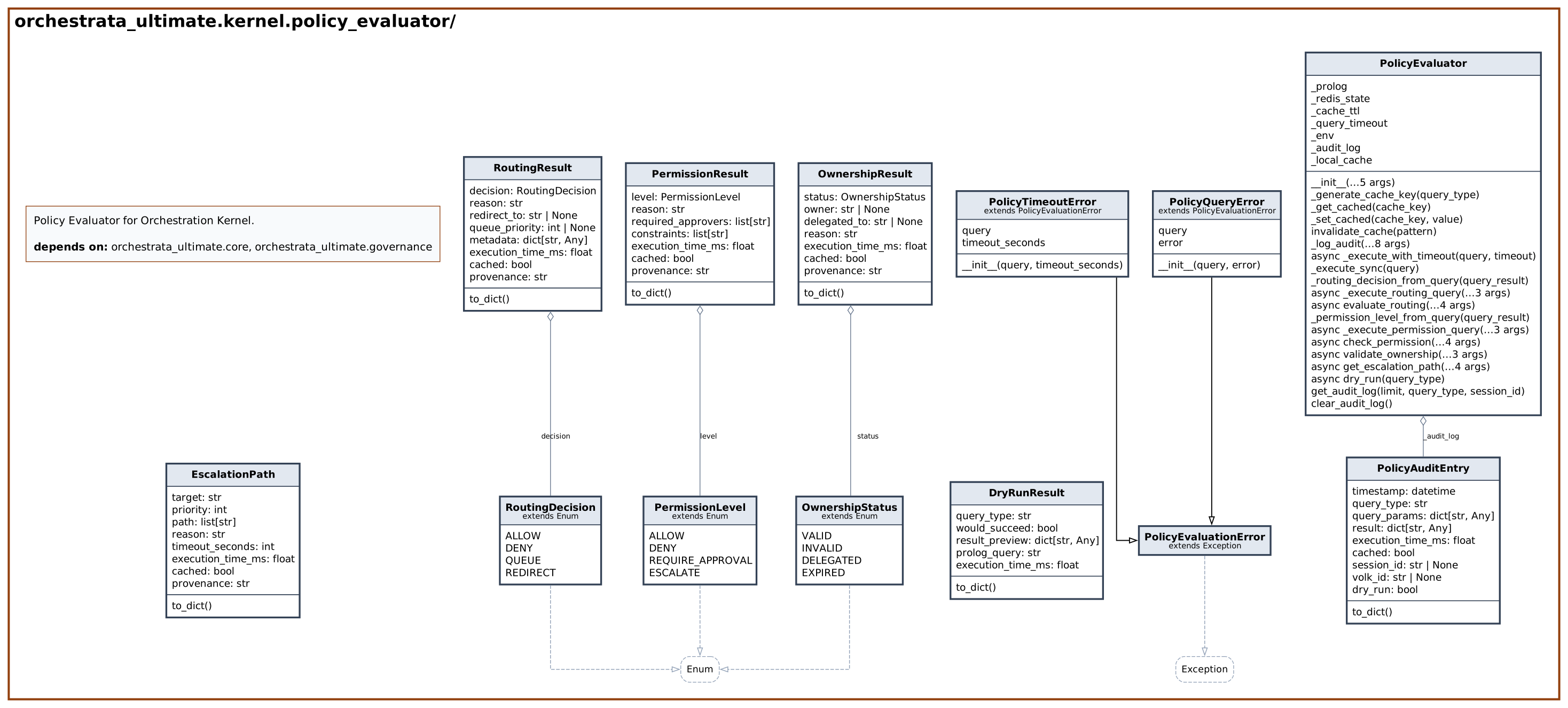
Dependency diagram

API
Classes
RoutingDecision (enum)
Bases: Enum · Decorators: traces(spec='001', story='US-003', reqs=['REQ-001-US-003-001']) · Line 53
Result of a routing policy evaluation.
| Member | Value |
|---|---|
ALLOW |
'allow' |
DENY |
'deny' |
QUEUE |
'queue' |
REDIRECT |
'redirect' |
PermissionLevel (enum)
Bases: Enum · Decorators: traces(spec='001', story='US-003', reqs=['REQ-001-US-003-002']) · Line 63
Permission levels for actions.
| Member | Value |
|---|---|
ALLOW |
'allow' |
DENY |
'deny' |
REQUIRE_APPROVAL |
'require_approval' |
ESCALATE |
'escalate' |
OwnershipStatus (enum)
Bases: Enum · Decorators: traces(spec='001', story='US-003', reqs=['REQ-001-US-003-003']) · Line 73
Ownership validation status.
| Member | Value |
|---|---|
VALID |
'valid' |
INVALID |
'invalid' |
DELEGATED |
'delegated' |
EXPIRED |
'expired' |
RoutingResult (dataclass)
Decorators: dataclass, traces(spec='001', story='US-003', reqs=['REQ-001-US-003-001']) · Line 84
Result of routing policy evaluation (REQ-001-US-003-001).
| Attribute | Type | Default |
|---|---|---|
decision |
RoutingDecision |
|
reason |
str |
|
redirect_to |
str | None |
None |
queue_priority |
int | None |
None |
metadata |
dict[str, Any] |
field(default_factory=dict) |
execution_time_ms |
float |
0.0 |
cached |
bool |
False |
provenance |
str |
'policy' |
| Method | Signature | Summary |
|---|---|---|
to_dict |
to_dict() -> dict[str, Any] |
Convert to dictionary. |
PermissionResult (dataclass)
Decorators: dataclass, traces(spec='001', story='US-003', reqs=['REQ-001-US-003-002']) · Line 116
Result of permission check (REQ-001-US-003-002).
| Attribute | Type | Default |
|---|---|---|
level |
PermissionLevel |
|
reason |
str |
|
required_approvers |
list[str] |
field(default_factory=list) |
constraints |
list[str] |
field(default_factory=list) |
execution_time_ms |
float |
0.0 |
cached |
bool |
False |
provenance |
str |
'policy' |
| Method | Signature | Summary |
|---|---|---|
to_dict |
to_dict() -> dict[str, Any] |
Convert to dictionary. |
OwnershipResult (dataclass)
Decorators: dataclass, traces(spec='001', story='US-003', reqs=['REQ-001-US-003-003']) · Line 143
Result of ownership validation (REQ-001-US-003-003).
| Attribute | Type | Default |
|---|---|---|
status |
OwnershipStatus |
|
owner |
str | None |
None |
delegated_to |
str | None |
None |
reason |
str |
'' |
execution_time_ms |
float |
0.0 |
cached |
bool |
False |
provenance |
str |
'policy' |
| Method | Signature | Summary |
|---|---|---|
to_dict |
to_dict() -> dict[str, Any] |
Convert to dictionary. |
EscalationPath (dataclass)
Decorators: dataclass, traces(spec='001', story='US-005', reqs=['REQ-001-US-005-011']) · Line 170
Escalation path for conflict resolution (REQ-001-US-003-004).
| Attribute | Type | Default |
|---|---|---|
target |
str |
|
priority |
int |
|
path |
list[str] |
|
reason |
str |
'' |
timeout_seconds |
int |
300 |
execution_time_ms |
float |
0.0 |
cached |
bool |
False |
provenance |
str |
'policy' |
| Method | Signature | Summary |
|---|---|---|
to_dict |
to_dict() -> dict[str, Any] |
Convert to dictionary. |
DryRunResult (dataclass)
Decorators: dataclass, traces(spec='001', story='US-003', reqs=['REQ-001-US-003-010']) · Line 199
Result of dry-run query (REQ-001-US-003-010).
| Attribute | Type | Default |
|---|---|---|
query_type |
str |
|
would_succeed |
bool |
|
result_preview |
dict[str, Any] |
|
prolog_query |
str |
|
execution_time_ms |
float |
0.0 |
| Method | Signature | Summary |
|---|---|---|
to_dict |
to_dict() -> dict[str, Any] |
Convert to dictionary. |
PolicyAuditEntry (dataclass)
Decorators: dataclass, traces(spec='001', story='US-003', reqs=['REQ-001-US-003-009']) · Line 222
Audit log entry for policy queries (REQ-001-US-003-009).
| Attribute | Type | Default |
|---|---|---|
timestamp |
datetime |
|
query_type |
str |
|
query_params |
dict[str, Any] |
|
result |
dict[str, Any] |
|
execution_time_ms |
float |
|
cached |
bool |
|
session_id |
str | None |
None |
volk_id |
str | None |
None |
dry_run |
bool |
False |
| Method | Signature | Summary |
|---|---|---|
to_dict |
to_dict() -> dict[str, Any] |
Convert to dictionary. |
PolicyEvaluationError
Bases: Exception · Decorators: traces(spec='001', story='US-003', reqs=['REQ-001-US-003-008']) · Line 251
Base exception for policy evaluation errors.
PolicyTimeoutError
Bases: PolicyEvaluationError · Decorators: traces(spec='001', story='US-003', reqs=['REQ-001-US-003-007']) · Line 256
Query timed out (REQ-001-US-003-007).
| Method | Signature | Summary |
|---|---|---|
__init__ |
__init__(query: str, timeout_seconds: float) -> None |
PolicyQueryError
Bases: PolicyEvaluationError · Decorators: traces(spec='001', story='US-003', reqs=['REQ-001-US-003-008']) · Line 266
Query execution failed (REQ-001-US-003-008).
| Method | Signature | Summary |
|---|---|---|
__init__ |
__init__(query: str, error: str) -> None |
PolicyEvaluator
Decorators: traces(spec='001', story='US-003', reqs=['REQ-001-US-003-001', 'REQ-001-US-003-002', 'REQ-001-US-003-003', 'REQ-001-US-… · Line 285
Evaluates governance policies via Prolog.
| Method | Signature | Summary |
|---|---|---|
__init__ |
__init__(prolog_bridge: Any, redis_state: Any | None = None, cache_ttl_seconds: int = 60, query_timeout_seconds: float = 5.0, env: Mapping[str, str] | None = None) -> None |
Initialize PolicyEvaluator. |
_generate_cache_key |
_generate_cache_key(query_type: str, ****params) -> str |
Generate cache key for a query. |
_get_cached |
_get_cached(cache_key: str) -> dict[str, Any] | None |
Get cached result (REQ-001-US-003-005). |
_set_cached |
_set_cached(cache_key: str, value: dict[str, Any]) -> None |
Store result in cache (REQ-001-US-003-005). |
invalidate_cache |
invalidate_cache(pattern: str | None = None) -> int |
Invalidate cached policy results (REQ-001-US-003-006). |
_log_audit |
_log_audit(query_type: str, params: dict[str, Any], result: dict[str, Any], execution_time_ms: float, cached: bool, session_id: str | None = None, volk_id: str | None = None, dry_run: bool = False) -> None |
Log policy query for audit (REQ-001-US-003-009). |
_execute_with_timeout |
async _execute_with_timeout(query: str, timeout: float | None = None) -> dict[str, Any] |
Execute Prolog query with timeout (REQ-001-US-003-007). |
_execute_sync |
_execute_sync(query: str) -> dict[str, Any] |
Execute Prolog query synchronously (REQ-001-US-003-008). |
_routing_decision_from_query |
_routing_decision_from_query(query_result: dict[str, Any]) -> tuple[RoutingDecision, str] |
Parse routing decision and reason from Prolog query result. |
_execute_routing_query |
async _execute_routing_query(from_volk: str, to_volk: str, message_type: str) -> tuple[RoutingDecision, str] |
Execute Prolog routing query with error handling. |
evaluate_routing |
async evaluate_routing(from_volk: str, to_volk: str, message_type: str, session_id: str | None = None) -> RoutingResult |
Evaluate routing policy (REQ-001-US-003-001). |
_permission_level_from_query |
_permission_level_from_query(query_result: dict[str, Any]) -> tuple[PermissionLevel, str] |
Parse permission level and reason from Prolog query result. |
_execute_permission_query |
async _execute_permission_query(volk_id: str, action: str, resource: str) -> tuple[PermissionLevel, str] |
Execute Prolog permission query with error handling. |
check_permission |
async check_permission(volk_id: str, action: str, resource: str, session_id: str | None = None) -> PermissionResult |
Check permission for action (REQ-001-US-003-002). |
validate_ownership |
async validate_ownership(volk_id: str, component: str, session_id: str | None = None) -> OwnershipResult |
Validate ownership of component (REQ-001-US-003-003). |
get_escalation_path |
async get_escalation_path(issue_type: str, severity: str, session_id: str | None = None, volk_id: str | None = None) -> EscalationPath |
Get escalation path for issue (REQ-001-US-003-004). |
dry_run |
async dry_run(query_type: str, ****params) -> DryRunResult |
Execute policy query in dry-run mode (REQ-001-US-003-010). |
get_audit_log |
get_audit_log(limit: int = 100, query_type: str | None = None, session_id: str | None = None) -> list[PolicyAuditEntry] |
Get audit log entries (REQ-001-US-003-009). |
clear_audit_log |
clear_audit_log() -> int |
Clear audit log. |
Source
# mypy: ignore-errors
"""Policy Evaluator for Orchestration Kernel.
This module implements governance policy evaluation via Prolog
as specified in US-003 of the Orchestration Kernel spec.
Requirements Implemented:
- REQ-001-US-003-001: Query Prolog for routing decisions
- REQ-001-US-003-002: Query Prolog for permission checks
- REQ-001-US-003-003: Query Prolog for ownership validation
- REQ-001-US-003-004: Query Prolog for escalation rules
- REQ-001-US-003-005: Cache Prolog query results for performance
- REQ-001-US-003-006: Invalidate cache on policy updates
- REQ-001-US-003-007: Handle Prolog query timeouts
- REQ-001-US-003-008: Handle Prolog query failures
- REQ-001-US-003-009: Log all policy queries for audit
- REQ-001-US-003-010: Support policy dry-run mode (testing)
Wiring status (2026-07-06, decision D3/W4.6): PolicyEvaluator was fully
built and unit-tested but had zero production callers. It is now wired into
kernel.dispatcher.MessageDispatcher, staged behind the ``policy_audit_mode``
constructor flag -- AUDIT-ONLY: every dispatch() evaluates evaluate_routing()
and logs the verdict at INFO, but never blocks or alters the dispatch
outcome, and any evaluator error is caught and logged at WARNING so the
governance layer can never break dispatch while it observes real traffic.
The flag defaults to False (zero behavior change). Promotion to an
enforcing mode -- where a DENY verdict actually blocks or redirects -- is a
later, explicit flip and is deliberately NOT implemented by this wiring.
"""
import asyncio
import hashlib
import logging
import time
from collections.abc import Mapping
from dataclasses import dataclass, field
from datetime import UTC, datetime
from enum import Enum
from typing import Any
from orchestrata_ultimate.core.base.traces import traces
from orchestrata_ultimate.governance._strict import governance_strict
from orchestrata_ultimate.governance.verdict import (
Provenance,
explain_policy_permits_deny,
make_verdict,
)
logger = logging.getLogger(__name__)
@traces(spec="001", story="US-003", reqs=["REQ-001-US-003-001"])
class RoutingDecision(Enum):
"""Result of a routing policy evaluation."""
ALLOW = "allow"
DENY = "deny"
QUEUE = "queue" # Queue for later delivery
REDIRECT = "redirect" # Redirect to different recipient
@traces(spec="001", story="US-003", reqs=["REQ-001-US-003-002"])
class PermissionLevel(Enum):
"""Permission levels for actions."""
ALLOW = "allow"
DENY = "deny"
REQUIRE_APPROVAL = "require_approval"
ESCALATE = "escalate"
@traces(spec="001", story="US-003", reqs=["REQ-001-US-003-003"])
class OwnershipStatus(Enum):
"""Ownership validation status."""
VALID = "valid"
INVALID = "invalid"
DELEGATED = "delegated"
EXPIRED = "expired"
@dataclass
@traces(spec="001", story="US-003", reqs=["REQ-001-US-003-001"])
class RoutingResult:
"""Result of routing policy evaluation (REQ-001-US-003-001)."""
decision: RoutingDecision
reason: str
redirect_to: str | None = None
queue_priority: int | None = None
metadata: dict[str, Any] = field(default_factory=dict)
execution_time_ms: float = 0.0
cached: bool = False
# W1-P6: "policy" (a real rule fired) or "error" (a query error/timeout
# made the fallback decide) -- see governance/verdict.py. Defaults to
# "policy" so pre-P6 callers constructing this dataclass positionally
# see no behavior change.
provenance: str = "policy"
def to_dict(self) -> dict[str, Any]:
"""Convert to dictionary."""
return {
"decision": self.decision.value,
"reason": self.reason,
"redirect_to": self.redirect_to,
"queue_priority": self.queue_priority,
"metadata": self.metadata,
"execution_time_ms": self.execution_time_ms,
"cached": self.cached,
"provenance": self.provenance,
}
@dataclass
@traces(spec="001", story="US-003", reqs=["REQ-001-US-003-002"])
class PermissionResult:
"""Result of permission check (REQ-001-US-003-002)."""
level: PermissionLevel
reason: str
required_approvers: list[str] = field(default_factory=list)
constraints: list[str] = field(default_factory=list)
execution_time_ms: float = 0.0
cached: bool = False
provenance: str = "policy" # W1-P6: "policy" | "error" -- see verdict.py
@traces(spec="001", story="US-003", reqs=["REQ-001-US-003-002"])
def to_dict(self) -> dict[str, Any]:
"""Convert to dictionary."""
return {
"level": self.level.value,
"reason": self.reason,
"required_approvers": self.required_approvers,
"constraints": self.constraints,
"execution_time_ms": self.execution_time_ms,
"cached": self.cached,
"provenance": self.provenance,
}
@dataclass
@traces(spec="001", story="US-003", reqs=["REQ-001-US-003-003"])
class OwnershipResult:
"""Result of ownership validation (REQ-001-US-003-003)."""
status: OwnershipStatus
owner: str | None = None
delegated_to: str | None = None
reason: str = ""
execution_time_ms: float = 0.0
cached: bool = False
provenance: str = "policy" # W1-P6: "policy" | "error" -- see verdict.py
@traces(spec="001", story="US-003", reqs=["REQ-001-US-003-003"])
def to_dict(self) -> dict[str, Any]:
"""Convert to dictionary."""
return {
"status": self.status.value,
"owner": self.owner,
"delegated_to": self.delegated_to,
"reason": self.reason,
"execution_time_ms": self.execution_time_ms,
"cached": self.cached,
"provenance": self.provenance,
}
@dataclass
@traces(spec="001", story="US-005", reqs=["REQ-001-US-005-011"])
class EscalationPath:
"""Escalation path for conflict resolution (REQ-001-US-003-004)."""
target: str # Who to escalate to
priority: int # Escalation priority
path: list[str] # Full escalation chain
reason: str = ""
timeout_seconds: int = 300 # Escalation timeout
execution_time_ms: float = 0.0
cached: bool = False
provenance: str = "policy" # W1-P6: "policy" | "error" -- see verdict.py
@traces(spec="001", story="US-003", reqs=["REQ-001-US-003-004"])
def to_dict(self) -> dict[str, Any]:
"""Convert to dictionary."""
return {
"target": self.target,
"priority": self.priority,
"path": self.path,
"reason": self.reason,
"timeout_seconds": self.timeout_seconds,
"execution_time_ms": self.execution_time_ms,
"cached": self.cached,
"provenance": self.provenance,
}
@dataclass
@traces(spec="001", story="US-003", reqs=["REQ-001-US-003-010"])
class DryRunResult:
"""Result of dry-run query (REQ-001-US-003-010)."""
query_type: str
would_succeed: bool
result_preview: dict[str, Any]
prolog_query: str
execution_time_ms: float = 0.0
@traces(spec="001", story="US-003", reqs=["REQ-001-US-003-010"])
def to_dict(self) -> dict[str, Any]:
"""Convert to dictionary."""
return {
"query_type": self.query_type,
"would_succeed": self.would_succeed,
"result_preview": self.result_preview,
"prolog_query": self.prolog_query,
"execution_time_ms": self.execution_time_ms,
}
@dataclass
@traces(spec="001", story="US-003", reqs=["REQ-001-US-003-009"])
class PolicyAuditEntry:
"""Audit log entry for policy queries (REQ-001-US-003-009)."""
timestamp: datetime
query_type: str
query_params: dict[str, Any]
result: dict[str, Any]
execution_time_ms: float
cached: bool
session_id: str | None = None
volk_id: str | None = None
dry_run: bool = False
def to_dict(self) -> dict[str, Any]:
"""Convert to dictionary."""
return {
"timestamp": self.timestamp.isoformat(),
"query_type": self.query_type,
"query_params": self.query_params,
"result": self.result,
"execution_time_ms": self.execution_time_ms,
"cached": self.cached,
"session_id": self.session_id,
"volk_id": self.volk_id,
"dry_run": self.dry_run,
}
@traces(spec="001", story="US-003", reqs=["REQ-001-US-003-008"])
class PolicyEvaluationError(Exception):
"""Base exception for policy evaluation errors."""
@traces(spec="001", story="US-003", reqs=["REQ-001-US-003-007"])
class PolicyTimeoutError(PolicyEvaluationError):
"""Query timed out (REQ-001-US-003-007)."""
def __init__(self, query: str, timeout_seconds: float) -> None:
self.query = query
self.timeout_seconds = timeout_seconds
super().__init__(f"Policy query timed out after {timeout_seconds}s: {query}")
@traces(spec="001", story="US-003", reqs=["REQ-001-US-003-008"])
class PolicyQueryError(PolicyEvaluationError):
"""Query execution failed (REQ-001-US-003-008)."""
def __init__(self, query: str, error: str) -> None:
self.query = query
self.error = error
super().__init__(f"Policy query failed: {error}")
@traces(
spec="001",
story="US-003",
reqs=[
"REQ-001-US-003-001",
"REQ-001-US-003-002",
"REQ-001-US-003-003",
"REQ-001-US-003-004",
],
)
class PolicyEvaluator:
"""Evaluates governance policies via Prolog.
This class implements policy evaluation for routing, permissions,
ownership, and escalation using Prolog rules.
Features:
- Caching for performance (REQ-001-US-003-005)
- Cache invalidation (REQ-001-US-003-006)
- Timeout handling (REQ-001-US-003-007)
- Error handling (REQ-001-US-003-008)
- Audit logging (REQ-001-US-003-009)
- Dry-run mode (REQ-001-US-003-010)
"""
def __init__(
self,
prolog_bridge: Any, # PrologBridge
redis_state: Any | None = None, # RedisStateManager
cache_ttl_seconds: int = 60,
query_timeout_seconds: float = 5.0,
env: Mapping[str, str] | None = None,
) -> None:
"""Initialize PolicyEvaluator.
Args:
prolog_bridge: PrologBridge instance for Prolog queries.
redis_state: Optional RedisStateManager for caching.
cache_ttl_seconds: TTL for cached results (REQ-001-US-003-005).
query_timeout_seconds: Timeout for Prolog queries (REQ-001-US-003-007).
env: Optional explicit environment mapping for
``governance_strict()`` (F2 fail-open fix) -- read at call
time, never mutated; defaults to ``os.environ`` when None,
matching every other governance strictness seam
(``governance/_strict.py``).
"""
self._prolog = prolog_bridge
self._redis_state = redis_state
self._cache_ttl = cache_ttl_seconds
self._query_timeout = query_timeout_seconds
self._env = env
self._audit_log: list[PolicyAuditEntry] = []
self._local_cache: dict[str, tuple[Any, float]] = {} # key -> (value, expiry)
logger.info(
f"PolicyEvaluator initialized: cache_ttl={cache_ttl_seconds}s, "
f"query_timeout={query_timeout_seconds}s"
)
@traces(spec="001", story="US-003", reqs=["REQ-001-US-003-005"])
def _generate_cache_key(self, query_type: str, **params) -> str:
"""Generate cache key for a query.
Args:
query_type: Type of query (routing, permission, etc.)
**params: Query parameters.
Returns:
Cache key string.
"""
content = f"{query_type}:{sorted(params.items())}"
hash_val = hashlib.sha256(content.encode()).hexdigest()[:16]
return f"policy:{query_type}:{hash_val}"
@traces(
spec="001", story="US-003", reqs=["REQ-001-US-003-005", "REQ-001-US-010-011"]
)
def _get_cached(self, cache_key: str) -> dict[str, Any] | None:
"""Get cached result (REQ-001-US-003-005).
Args:
cache_key: Cache key.
Returns:
Cached result or None.
"""
# Try local cache first
if cache_key in self._local_cache:
value, expiry = self._local_cache[cache_key]
if time.time() < expiry:
logger.debug(f"Local cache hit: {cache_key}")
return value
else:
del self._local_cache[cache_key]
# Try Redis cache
if self._redis_state is not None:
try:
cached = self._redis_state.cache_get(cache_key)
if cached is not None:
logger.debug(f"Redis cache hit: {cache_key}")
# Store in local cache for faster subsequent access
self._local_cache[cache_key] = (
cached,
time.time() + self._cache_ttl,
)
return cached
except Exception as e:
logger.warning(f"Cache lookup failed: {e}")
return None
@traces(spec="001", story="US-003", reqs=["REQ-001-US-003-005"])
def _set_cached(self, cache_key: str, value: dict[str, Any]) -> None:
"""Store result in cache (REQ-001-US-003-005).
Args:
cache_key: Cache key.
value: Value to cache.
"""
# Store in local cache
self._local_cache[cache_key] = (value, time.time() + self._cache_ttl)
# Store in Redis
if self._redis_state is not None:
try:
self._redis_state.cache_set(
cache_key, value, ttl_seconds=self._cache_ttl
)
logger.debug(f"Cached result: {cache_key}")
except Exception as e:
logger.warning(f"Cache store failed: {e}")
@traces(spec="001", story="US-003", reqs=["REQ-001-US-003-006"])
def invalidate_cache(self, pattern: str | None = None) -> int:
"""Invalidate cached policy results (REQ-001-US-003-006).
Args:
pattern: Optional pattern to match (e.g., "routing" for routing queries).
If None, invalidates all policy cache.
Returns:
Number of entries invalidated.
"""
count = 0
# Invalidate local cache
if pattern is None:
count = len(self._local_cache)
self._local_cache.clear()
else:
keys_to_delete = [k for k in self._local_cache if pattern in k]
for key in keys_to_delete:
del self._local_cache[key]
count += 1
logger.info(f"Invalidated {count} cached policy entries (pattern={pattern})")
return count
@traces(spec="001", story="US-003", reqs=["REQ-001-US-003-009"])
def _log_audit(
self,
query_type: str,
params: dict[str, Any],
result: dict[str, Any],
execution_time_ms: float,
cached: bool,
session_id: str | None = None,
volk_id: str | None = None,
dry_run: bool = False,
) -> None:
"""Log policy query for audit (REQ-001-US-003-009).
Args:
query_type: Type of query.
params: Query parameters.
result: Query result.
execution_time_ms: Execution time.
cached: Whether result was from cache.
session_id: Optional session ID.
volk_id: Optional Volk ID.
dry_run: Whether this was a dry-run.
"""
entry = PolicyAuditEntry(
timestamp=datetime.now(UTC),
query_type=query_type,
query_params=params,
result=result,
execution_time_ms=execution_time_ms,
cached=cached,
session_id=session_id,
volk_id=volk_id,
dry_run=dry_run,
)
self._audit_log.append(entry)
# Keep audit log bounded
if len(self._audit_log) > 10000:
self._audit_log = self._audit_log[-5000:]
# Log for external audit systems
logger.info(
f"AUDIT: {query_type} "
f"params={params} "
f"result={result.get('decision', result.get('level', 'N/A'))} "
f"time={execution_time_ms:.2f}ms "
f"cached={cached} "
f"dry_run={dry_run}"
)
@traces(spec="001", story="US-003", reqs=["REQ-001-US-003-007"])
async def _execute_with_timeout(
self,
query: str,
timeout: float | None = None,
) -> dict[str, Any]:
"""Execute Prolog query with timeout (REQ-001-US-003-007).
Args:
query: Prolog query string.
timeout: Optional timeout override.
Returns:
Query result.
Raises:
PolicyTimeoutError: If query times out.
PolicyQueryError: If query fails.
"""
timeout = timeout or self._query_timeout
try:
# Run query in thread pool to allow timeout
result = await asyncio.wait_for(
asyncio.to_thread(self._prolog.query, query),
timeout=timeout,
)
return {
"success": result.success,
"solutions": result.solutions,
"error": result.error,
}
except TimeoutError:
raise PolicyTimeoutError(query, timeout)
except Exception as e:
raise PolicyQueryError(query, str(e))
@traces(spec="001", story="US-003", reqs=["REQ-001-US-003-008"])
def _execute_sync(self, query: str) -> dict[str, Any]:
"""Execute Prolog query synchronously (REQ-001-US-003-008).
Args:
query: Prolog query string.
Returns:
Query result.
Raises:
PolicyQueryError: If query fails.
"""
try:
result = self._prolog.query(query)
return {
"success": result.success,
"solutions": result.solutions,
"error": result.error,
}
except Exception as e:
raise PolicyQueryError(query, str(e))
@traces(spec="001", story="US-003", reqs=["REQ-001-US-003-001"])
def _routing_decision_from_query(
self, query_result: dict[str, Any]
) -> tuple[RoutingDecision, str]:
"""Parse routing decision and reason from Prolog query result.
NOTE (W1-P6): signature/return-shape is UNCHANGED from pre-P6 --
this private method is directly unit-tested with strict tuple
equality (tests/kernel/test_policy_evaluator.py) that this brief may
not edit. Provenance is derived by the CALLER (evaluate_routing)
from the existing "error:"-prefix convention on ``reason`` instead
of a new return element.
Args:
query_result: Result from _execute_with_timeout.
Returns:
Tuple of (RoutingDecision, reason string).
"""
if query_result["success"] and query_result["solutions"]:
solution = query_result["solutions"][0]
decision_str = str(solution.get("Decision", "allow")).lower()
if decision_str == "deny":
return RoutingDecision.DENY, "Policy denied routing"
elif decision_str == "queue":
return RoutingDecision.QUEUE, "Recipient unavailable, message queued"
elif decision_str == "redirect":
return RoutingDecision.REDIRECT, "Message redirected by policy"
else:
return RoutingDecision.ALLOW, "Policy allows routing"
else:
# F2 fail-open fix: this branch used to hardcode ALLOW
# regardless of *why* no decision came back -- indistinguishable
# from a genuine policy allow in the audit log. Route through
# governance_strict() like every other governance error branch
# (deny under strict, the default) and prefix the reason with
# "error:" so it is never confused with a real "policy:"-shaped
# verdict (this prefix IS the P6 verdict-provenance signal --
# see evaluate_routing below).
detail = query_result.get("error") or "no policy result"
if governance_strict(self._env):
return RoutingDecision.DENY, f"error: {detail} — fail-closed"
return RoutingDecision.ALLOW, f"error: {detail} — permissive fallback"
@traces(spec="001", story="US-003", reqs=["REQ-001-US-003-001"])
async def _execute_routing_query(
self, from_volk: str, to_volk: str, message_type: str
) -> tuple[RoutingDecision, str]:
"""Execute Prolog routing query with error handling.
Args:
from_volk: Sender Volk alias.
to_volk: Recipient Volk alias.
message_type: Type of message being routed.
Returns:
Tuple of (RoutingDecision, reason string).
"""
query = (
f"policy_permits('{from_volk}', '{to_volk}', '{message_type}', Decision)"
)
try:
query_result = await self._execute_with_timeout(query)
return self._routing_decision_from_query(query_result)
except PolicyTimeoutError:
# REQ-001-US-003-007: timeout is an ERROR outcome, never a policy
# verdict — route through governance_strict() exactly like the
# no-result branches (W1-P2) and the sibling permission path:
# deny under strict (the default), allow only under the explicit
# permissive posture. Closed as the W1-P6 ERROR_ALLOW finding.
logger.warning(
f"Routing policy query timed out for {from_volk} -> {to_volk}"
)
if governance_strict(self._env):
return (
RoutingDecision.DENY,
"error: Policy query timeout — fail-closed",
)
return (
RoutingDecision.ALLOW,
"error: Policy query timeout — permissive fallback",
)
except PolicyQueryError as e:
# REQ-001-US-003-008: same ERROR-outcome discipline as the timeout
# branch — strict denies, permissive allows, both labelled.
logger.error(f"Routing policy query failed: {e}")
if governance_strict(self._env):
return (
RoutingDecision.DENY,
f"error: Policy query error: {e.error} — fail-closed",
)
return (
RoutingDecision.ALLOW,
f"error: Policy query error: {e.error} — permissive fallback",
)
@traces(spec="001", story="US-003", reqs=["REQ-001-US-003-001"])
async def evaluate_routing(
self,
from_volk: str,
to_volk: str,
message_type: str,
session_id: str | None = None,
) -> RoutingResult:
"""Evaluate routing policy (REQ-001-US-003-001).
Query Prolog for routing decision based on sender, recipient,
and message type.
Args:
from_volk: Sender Volk alias.
to_volk: Recipient Volk alias.
message_type: Type of message being routed.
session_id: Optional session ID for context.
Returns:
RoutingResult with decision and metadata.
Raises:
PolicyTimeoutError: If query times out.
PolicyQueryError: If query fails.
"""
start_time = time.time()
params = {
"from_volk": from_volk,
"to_volk": to_volk,
"message_type": message_type,
}
# REQ-001-US-003-005: Check cache
cache_key = self._generate_cache_key("routing", **params)
cached = self._get_cached(cache_key)
if cached is not None:
execution_time = (time.time() - start_time) * 1000
result = RoutingResult(
decision=RoutingDecision(cached["decision"]),
reason=cached["reason"],
redirect_to=cached.get("redirect_to"),
queue_priority=cached.get("queue_priority"),
metadata=cached.get("metadata", {}),
execution_time_ms=execution_time,
cached=True,
provenance=cached.get("provenance", "policy"),
)
self._log_audit(
"routing", params, result.to_dict(), execution_time, True, session_id
)
return result
decision, reason = await self._execute_routing_query(
from_volk, to_volk, message_type
)
# W1-P6: the "error:"-prefix convention (already established by the
# F2 fail-open fix, above) is the ONLY caller-visible signal --
# _routing_decision_from_query/_execute_routing_query keep their
# pre-P6 2-tuple signature/return exactly (they are directly
# unit-tested with strict tuple equality this brief may not edit).
is_error = reason.startswith("error:")
if decision is RoutingDecision.DENY and not is_error:
explanation = explain_policy_permits_deny(
self._prolog.query_bool, from_volk, to_volk, message_type
)
reason = f"{reason} — {explanation}"
provenance = Provenance.ERROR if is_error else Provenance.POLICY
execution_time = (time.time() - start_time) * 1000
result = RoutingResult(
decision=decision,
reason=reason,
execution_time_ms=execution_time,
cached=False,
provenance=provenance.value,
)
# REQ-001-US-003-005: Cache result
self._set_cached(cache_key, result.to_dict())
# REQ-001-US-003-009: Audit log
self._log_audit(
"routing", params, result.to_dict(), execution_time, False, session_id
)
# W1-P6: structured verdict-provenance log (surface = evaluate_routing).
make_verdict(
surface="PolicyEvaluator.evaluate_routing",
decision=decision.value,
is_deny=decision is RoutingDecision.DENY,
is_error=provenance is Provenance.ERROR,
rule_source=(
"error:policy_permits/4"
if provenance is Provenance.ERROR
else "policy_permits/4"
),
reason=reason,
logger_=logger,
)
return result
@traces(spec="001", story="US-003", reqs=["REQ-001-US-003-002"])
def _permission_level_from_query(
self, query_result: dict[str, Any]
) -> tuple[PermissionLevel, str]:
"""Parse permission level and reason from Prolog query result.
NOTE (W1-P6): signature/return-shape is UNCHANGED from pre-P6 --
see _routing_decision_from_query's matching note. Provenance is
derived by the caller (check_permission) from the existing
"error:"-prefix convention on ``reason``.
Args:
query_result: Result from _execute_with_timeout.
Returns:
Tuple of (PermissionLevel, reason string).
"""
if query_result["success"] and query_result["solutions"]:
solution = query_result["solutions"][0]
level_str = str(solution.get("Level", "allow")).lower()
if level_str == "deny":
return PermissionLevel.DENY, "Permission denied by policy"
elif level_str == "require_approval":
return PermissionLevel.REQUIRE_APPROVAL, "Approval required"
elif level_str == "escalate":
return PermissionLevel.ESCALATE, "Escalation required"
else:
return PermissionLevel.ALLOW, "Permission granted"
else:
# F2 fail-open fix: see _routing_decision_from_query's matching
# comment -- this branch used to hardcode ALLOW, inconsistent
# with this same method's OWN timeout/query-error paths just
# below (both already default to DENY). governance_strict()
# makes all three error paths agree.
detail = query_result.get("error") or "no policy result"
if governance_strict(self._env):
return PermissionLevel.DENY, f"error: {detail} — fail-closed"
return PermissionLevel.ALLOW, f"error: {detail} — permissive fallback"
@traces(spec="001", story="US-003", reqs=["REQ-001-US-003-002"])
async def _execute_permission_query(
self, volk_id: str, action: str, resource: str
) -> tuple[PermissionLevel, str]:
"""Execute Prolog permission query with error handling.
Args:
volk_id: Volk requesting permission.
action: Action to perform.
resource: Resource being accessed.
Returns:
Tuple of (PermissionLevel, reason string).
"""
query = f"tool_allowed('{volk_id}', '{action}', '{resource}', Level)"
try:
query_result = await self._execute_with_timeout(query)
return self._permission_level_from_query(query_result)
except PolicyTimeoutError:
logger.warning(
f"Permission check timed out for {volk_id}/{action}/{resource}"
)
return (
PermissionLevel.DENY,
"error: Policy query timeout, defaulting to deny for safety",
)
except PolicyQueryError as e:
logger.error(f"Permission check failed: {e}")
return PermissionLevel.DENY, f"error: Policy query error: {e.error}"
@traces(spec="001", story="US-003", reqs=["REQ-001-US-003-002"])
async def check_permission(
self,
volk_id: str,
action: str,
resource: str,
session_id: str | None = None,
) -> PermissionResult:
"""Check permission for action (REQ-001-US-003-002).
Query Prolog for permission to perform action on resource.
Args:
volk_id: Volk requesting permission.
action: Action to perform (read, write, execute, etc.).
resource: Resource being accessed.
session_id: Optional session ID.
Returns:
PermissionResult with level and constraints.
Raises:
PolicyTimeoutError: If query times out.
PolicyQueryError: If query fails.
"""
start_time = time.time()
params = {
"volk_id": volk_id,
"action": action,
"resource": resource,
}
# REQ-001-US-003-005: Check cache
cache_key = self._generate_cache_key("permission", **params)
cached = self._get_cached(cache_key)
if cached is not None:
execution_time = (time.time() - start_time) * 1000
result = PermissionResult(
level=PermissionLevel(cached["level"]),
reason=cached["reason"],
required_approvers=cached.get("required_approvers", []),
constraints=cached.get("constraints", []),
execution_time_ms=execution_time,
cached=True,
provenance=cached.get("provenance", "policy"),
)
self._log_audit(
"permission",
params,
result.to_dict(),
execution_time,
True,
session_id,
volk_id,
)
return result
level, reason = await self._execute_permission_query(volk_id, action, resource)
# W1-P6: same "error:"-prefix convention as evaluate_routing --
# _permission_level_from_query/_execute_permission_query keep their
# pre-P6 2-tuple signature/return (directly unit-tested elsewhere).
is_error = reason.startswith("error:")
provenance = Provenance.ERROR if is_error else Provenance.POLICY
execution_time = (time.time() - start_time) * 1000
result = PermissionResult(
level=level,
reason=reason,
execution_time_ms=execution_time,
cached=False,
provenance=provenance.value,
)
# REQ-001-US-003-005: Cache result
self._set_cached(cache_key, result.to_dict())
# REQ-001-US-003-009: Audit log
self._log_audit(
"permission",
params,
result.to_dict(),
execution_time,
False,
session_id,
volk_id,
)
# W1-P6: structured verdict-provenance log.
make_verdict(
surface="PolicyEvaluator.check_permission",
decision=level.value,
is_deny=level is PermissionLevel.DENY,
is_error=provenance is Provenance.ERROR,
rule_source=(
"error:tool_allowed/4"
if provenance is Provenance.ERROR
else "tool_allowed/4"
),
reason=reason,
logger_=logger,
)
return result
@traces(spec="001", story="US-003", reqs=["REQ-001-US-003-003"])
async def validate_ownership(
self,
volk_id: str,
component: str,
session_id: str | None = None,
) -> OwnershipResult:
"""Validate ownership of component (REQ-001-US-003-003).
Query Prolog to verify if Volk owns or has rights to component.
Args:
volk_id: Volk claiming ownership.
component: Component being validated.
session_id: Optional session ID.
Returns:
OwnershipResult with status and owner info.
Raises:
PolicyTimeoutError: If query times out.
PolicyQueryError: If query fails.
"""
start_time = time.time()
params = {
"volk_id": volk_id,
"component": component,
}
# REQ-001-US-003-005: Check cache
cache_key = self._generate_cache_key("ownership", **params)
cached = self._get_cached(cache_key)
if cached is not None:
execution_time = (time.time() - start_time) * 1000
result = OwnershipResult(
status=OwnershipStatus(cached["status"]),
owner=cached.get("owner"),
delegated_to=cached.get("delegated_to"),
reason=cached.get("reason", ""),
execution_time_ms=execution_time,
cached=True,
provenance=cached.get("provenance", "policy"),
)
self._log_audit(
"ownership",
params,
result.to_dict(),
execution_time,
True,
session_id,
volk_id,
)
return result
# Build Prolog query
query = f"check_constraint(ownership, '{volk_id}', '{component}', Owner)"
provenance = Provenance.POLICY
try:
query_result = await self._execute_with_timeout(query)
if query_result["success"] and query_result["solutions"]:
solution = query_result["solutions"][0]
owner = str(solution.get("Owner", ""))
if owner == volk_id:
status = OwnershipStatus.VALID
reason = f"{volk_id} owns {component}"
elif owner:
status = OwnershipStatus.INVALID
reason = f"{component} is owned by {owner}, not {volk_id}"
else:
status = OwnershipStatus.VALID
reason = "No ownership restriction"
else:
# No ownership rule, default to valid. W1-P6: a genuine
# query error (existence_error, ...) is distinguishable from
# a real "no solutions" via query_result["error"].
status = OwnershipStatus.VALID
owner = None
reason = "No ownership restriction found"
if query_result.get("error"):
provenance = Provenance.ERROR
except PolicyTimeoutError:
logger.warning(f"Ownership validation timed out for {volk_id}/{component}")
status = OwnershipStatus.INVALID
owner = None
reason = "Policy query timeout"
provenance = Provenance.ERROR
except PolicyQueryError as e:
logger.error(f"Ownership validation failed: {e}")
status = OwnershipStatus.INVALID
owner = None
reason = f"Policy query error: {e.error}"
provenance = Provenance.ERROR
execution_time = (time.time() - start_time) * 1000
result = OwnershipResult(
status=status,
owner=owner,
reason=reason,
execution_time_ms=execution_time,
cached=False,
provenance=provenance.value,
)
# REQ-001-US-003-005: Cache result
self._set_cached(cache_key, result.to_dict())
# REQ-001-US-003-009: Audit log
self._log_audit(
"ownership",
params,
result.to_dict(),
execution_time,
False,
session_id,
volk_id,
)
# W1-P6: structured verdict-provenance log.
make_verdict(
surface="PolicyEvaluator.validate_ownership",
decision=status.value,
is_deny=status is OwnershipStatus.INVALID,
is_error=provenance is Provenance.ERROR,
rule_source=(
"error:check_constraint/4"
if provenance is Provenance.ERROR
else "check_constraint/4"
),
reason=reason,
logger_=logger,
)
return result
@traces(
spec="001",
story="US-003",
reqs=["REQ-001-US-003-004", "REQ-001-US-003-022", "REQ-001-US-005-011"],
)
async def get_escalation_path(
self,
issue_type: str,
severity: str,
session_id: str | None = None,
volk_id: str | None = None,
) -> EscalationPath:
"""Get escalation path for issue (REQ-001-US-003-004).
Query Prolog for escalation rules based on issue type and severity.
Args:
issue_type: Type of issue (conflict, permission, resource, etc.).
severity: Issue severity (low, medium, high, critical).
session_id: Optional session ID.
volk_id: Optional requesting Volk ID.
Returns:
EscalationPath with target and chain.
Raises:
PolicyTimeoutError: If query times out.
PolicyQueryError: If query fails.
"""
start_time = time.time()
params = {
"issue_type": issue_type,
"severity": severity,
}
# REQ-001-US-003-005: Check cache
cache_key = self._generate_cache_key("escalation", **params)
cached = self._get_cached(cache_key)
if cached is not None:
execution_time = (time.time() - start_time) * 1000
result = EscalationPath(
target=cached["target"],
priority=cached["priority"],
path=cached["path"],
reason=cached.get("reason", ""),
timeout_seconds=cached.get("timeout_seconds", 300),
execution_time_ms=execution_time,
cached=True,
provenance=cached.get("provenance", "policy"),
)
self._log_audit(
"escalation",
params,
result.to_dict(),
execution_time,
True,
session_id,
volk_id,
)
return result
# Build Prolog query
query = f"escalation_target('{issue_type}', '{severity}', Target, Priority)"
provenance = Provenance.POLICY
try:
query_result = await self._execute_with_timeout(query)
if query_result["success"] and query_result["solutions"]:
solution = query_result["solutions"][0]
target = str(solution.get("Target", "U:Ox"))
priority = int(solution.get("Priority", 1))
path = [target] # Default path is just target
reason = f"Escalating {issue_type} ({severity}) to {target}"
else:
# Default escalation to Orchestrator. W1-P6: a genuine query
# error is distinguishable from a real "no solutions" via
# query_result["error"].
target = "U:Ox"
priority = 1
path = ["U:Ox"]
reason = "Default escalation to Orchestrator"
if query_result.get("error"):
provenance = Provenance.ERROR
except PolicyTimeoutError:
logger.warning(f"Escalation query timed out for {issue_type}/{severity}")
target = "U:Ox"
priority = 1
path = ["U:Ox"]
reason = "Policy query timeout, default escalation"
provenance = Provenance.ERROR
except PolicyQueryError as e:
logger.error(f"Escalation query failed: {e}")
target = "U:Ox"
priority = 1
path = ["U:Ox"]
reason = f"Policy query error: {e.error}"
provenance = Provenance.ERROR
execution_time = (time.time() - start_time) * 1000
# Determine timeout based on severity
timeout_map = {
"critical": 60,
"high": 180,
"medium": 300,
"low": 600,
}
timeout_seconds = timeout_map.get(severity.lower(), 300)
result = EscalationPath(
target=target,
priority=priority,
path=path,
reason=reason,
timeout_seconds=timeout_seconds,
execution_time_ms=execution_time,
cached=False,
provenance=provenance.value,
)
# REQ-001-US-003-005: Cache result
self._set_cached(cache_key, result.to_dict())
# REQ-001-US-003-009: Audit log
self._log_audit(
"escalation",
params,
result.to_dict(),
execution_time,
False,
session_id,
volk_id,
)
# W1-P6: structured verdict-provenance log. Escalation always picks
# A target (never a hard deny), so is_deny is always False here.
make_verdict(
surface="PolicyEvaluator.get_escalation_path",
decision=f"escalate_to:{target}",
is_deny=False,
is_error=provenance is Provenance.ERROR,
rule_source=(
"error:escalation_target/4"
if provenance is Provenance.ERROR
else "escalation_target/4"
),
reason=reason,
logger_=logger,
)
return result
@traces(spec="001", story="US-003", reqs=["REQ-001-US-003-010"])
async def dry_run(
self,
query_type: str,
**params,
) -> DryRunResult:
"""Execute policy query in dry-run mode (REQ-001-US-003-010).
Tests query without side effects or caching.
Args:
query_type: Type of query (routing, permission, ownership, escalation).
**params: Query-specific parameters.
Returns:
DryRunResult with preview of what would happen.
"""
start_time = time.time()
# Build query based on type
if query_type == "routing":
query = (
f"policy_permits('{params.get('from_volk', '')}', "
f"'{params.get('to_volk', '')}', "
f"'{params.get('message_type', '')}', Decision)"
)
elif query_type == "permission":
query = (
f"tool_allowed('{params.get('volk_id', '')}', "
f"'{params.get('action', '')}', "
f"'{params.get('resource', '')}', Level)"
)
elif query_type == "ownership":
query = (
f"check_constraint(ownership, '{params.get('volk_id', '')}', "
f"'{params.get('component', '')}', Owner)"
)
elif query_type == "escalation":
query = (
f"escalation_target('{params.get('issue_type', '')}', "
f"'{params.get('severity', '')}', Target, Priority)"
)
else:
query = f"unknown_query_type({query_type})"
try:
query_result = self._execute_sync(query)
would_succeed = query_result["success"]
result_preview = {
"solutions": query_result["solutions"],
"error": query_result["error"],
}
except Exception as e:
would_succeed = False
result_preview = {"error": str(e)}
execution_time = (time.time() - start_time) * 1000
result = DryRunResult(
query_type=query_type,
would_succeed=would_succeed,
result_preview=result_preview,
prolog_query=query,
execution_time_ms=execution_time,
)
# REQ-001-US-003-009: Log dry-run in audit
self._log_audit(
f"dry_run:{query_type}",
params,
result.to_dict(),
execution_time,
False,
dry_run=True,
)
return result
@traces(spec="001", story="US-003", reqs=["REQ-001-US-003-009"])
def get_audit_log(
self,
limit: int = 100,
query_type: str | None = None,
session_id: str | None = None,
) -> list[PolicyAuditEntry]:
"""Get audit log entries (REQ-001-US-003-009).
Args:
limit: Maximum entries to return.
query_type: Optional filter by query type.
session_id: Optional filter by session ID.
Returns:
List of audit entries.
"""
entries = self._audit_log
if query_type is not None:
entries = [e for e in entries if e.query_type == query_type]
if session_id is not None:
entries = [e for e in entries if e.session_id == session_id]
# Return most recent entries
return entries[-limit:]
def clear_audit_log(self) -> int:
"""Clear audit log.
Returns:
Number of entries cleared.
"""
count = len(self._audit_log)
self._audit_log.clear()
logger.info(f"Cleared {count} audit log entries")
return count