orchestrata_ultimate.governance.prolog_client
Reference › orchestrata_ultimate › governance › prolog_client
The governance-flavoured Prolog client, and the largest module of the package. GovernancePrologClient wraps the shared PrologBridge (janus-swi, from core.prolog_adapter) and turns Python questions such as "may this actor execute this action" into Prolog goals, then turns the answers back into booleans. policy_engine, constitutional, ethical, resource_access, safe_mode, dynamic_policy and the gateway server use it. It serves SPEC-007 (REQ-007-FR10-032, REQ-007-US-001-001, -007 and the constitutional, resource and safe-mode requirements).
Loading rules: load_governance_rules(bridge, rules_dir) is described in its docstring as the one blessed loader. It consults every file in GOVERNANCE_RULE_FILES into the bridge and returns the number loaded, logging a warning for each file that is missing or fails to consult. dispatcher and cli_main call it at boot; the docstring records that an earlier hand-picked subset left ownership checks unable to discriminate. count_governance_predicates counts what was loaded for the boot log line.
The query methods, each mapping to a Prolog predicate:
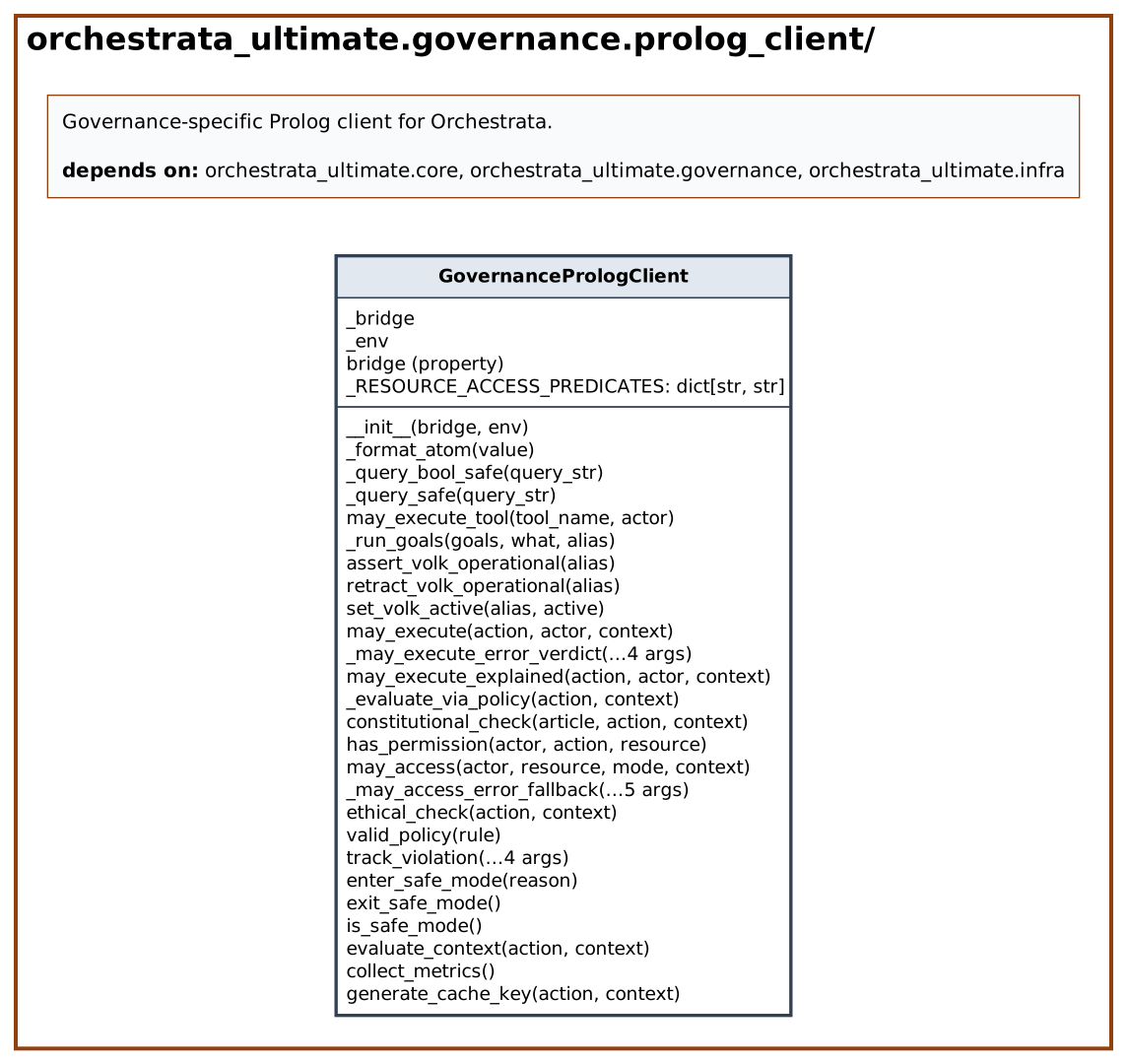
may_execute(action, actor, context)asksgovernance:may_execute/2and returns the boolean;may_execute_explainedreturns aProofResult;may_execute_toolis the tool-level variant.constitutional_check(article, action, context)asksconstitutional_check/3.has_permissionandmay_access(dispatched by resource type to the file, network, API or database predicate) answer resource questions; an unrecognised resource type is resolved by the strict flag, never treated as a file.ethical_checkandvalid_policycover ethics and rule validation.track_violation,enter_safe_mode,exit_safe_modeandis_safe_modeassert and read the violation and safe-mode facts;assert_volk_operational,retract_volk_operationalandset_volk_activeuse the goals from volk_facts.
Failure handling is uniform. A query that raises or returns an error goes through governance_strict (see _strict): strict mode, the default, denies, and non-strict mode allows or falls back to evaluate_policy. Every answer is logged through make_verdict from verdict as a policy or error verdict. Atoms are quoted by _format_atom before they go into a goal.
At a glance
| Source | src/orchestrata_ultimate/governance/prolog_client.py |
| Lines of code | 1093 |
| Classes | 1 |
| Functions | 3 |
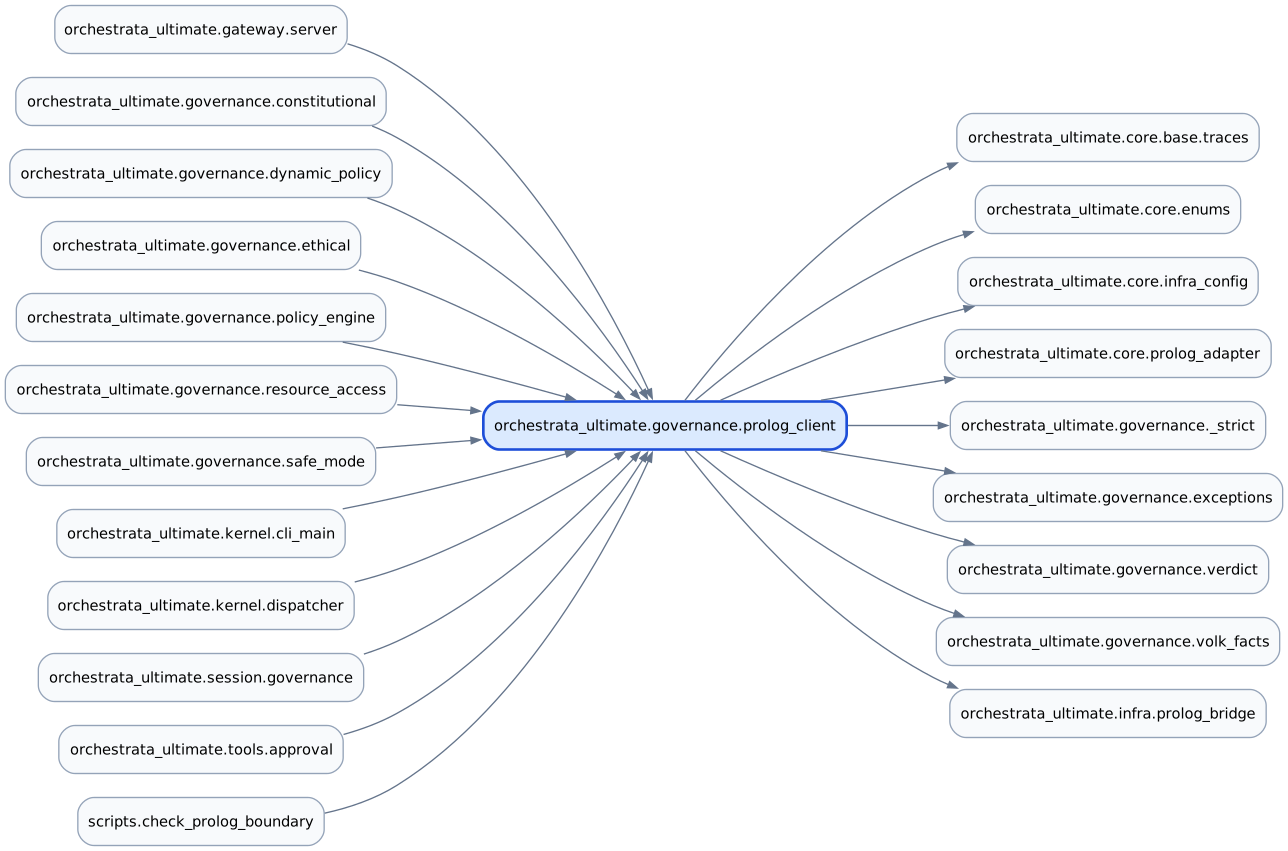
| Imports (internal) | orchestrata_ultimate.core.base.traces, orchestrata_ultimate.core.enums, orchestrata_ultimate.core.infra_config, orchestrata_ultimate.core.prolog_adapter, orchestrata_ultimate.governance._strict, orchestrata_ultimate.governance.exceptions, orchestrata_ultimate.governance.verdict, orchestrata_ultimate.governance.volk_facts, orchestrata_ultimate.infra.prolog_bridge |
| Imported by | orchestrata_ultimate.gateway.server, orchestrata_ultimate.governance.constitutional, orchestrata_ultimate.governance.dynamic_policy, orchestrata_ultimate.governance.ethical, orchestrata_ultimate.governance.policy_engine, orchestrata_ultimate.governance.resource_access, orchestrata_ultimate.governance.safe_mode, orchestrata_ultimate.kernel.cli_main, orchestrata_ultimate.kernel.dispatcher, orchestrata_ultimate.session.governance, orchestrata_ultimate.tools.approval, scripts.check_prolog_boundary |
| Tests that import it | tests/gateway/handlers/test_policy_gate.py, tests/gateway/handlers/test_workflow.py, tests/gateway/test_publisher_wiring.py, tests/generated_recovery/test_governance_event_emitting_policy_engine.py, tests/generated_recovery/test_governance_policy_engine.py, tests/governance/conftest.py, tests/governance/e2e/test_governance_prolog_client_enforcement_proof.py, tests/governance/e2e/test_retro_incidents.py, tests/governance/test_constitutional.py, tests/governance/test_constitutional_real_rules.py, tests/governance/test_constitutional_suite.py, tests/governance/test_dynamic_policy.py, tests/governance/test_dynamic_policy_extended.py, tests/governance/test_error_paths.py, tests/governance/test_ethical.py, tests/governance/test_ethical_real_rules.py, tests/governance/test_event_emitting_policy_engine.py, tests/governance/test_explain.py, tests/governance/test_gateway_governance_handler.py, tests/governance/test_may_execute_real_rules.py, tests/governance/test_policy_engine.py, tests/governance/test_policy_engine_extended.py, tests/governance/test_policy_layers.py, tests/governance/test_prolog_client.py, tests/governance/test_resource_access.py … and 11 more |
Class diagram
Dependency diagram
API
Constants
| Name | Type | Value |
|---|---|---|
GOVERNANCE_RULE_FILES |
tuple[str, ...] |
('governance.pl', 'constitutional.pl', 'agents.pl', 'ethics.pl', 'pam_rules.pl'… |
Classes
GovernancePrologClient
Decorators: traces(spec='000', story='US-007', reqs=['REQ-000-066']) · Line 174
Governance-specific wrapper around PrologBridge.
| Attribute | Type | Default |
|---|---|---|
_RESOURCE_ACCESS_PREDICATES |
dict[str, str] |
{'file': 'may_access_file', 'network': 'may_access_network'… |
| Method | Signature | Summary |
|---|---|---|
__init__ |
__init__(bridge: PrologBridge, env: Mapping[str, str] | None = None) -> None |
|
bridge property |
bridge() -> PrologBridge |
|
_format_atom |
_format_atom(value: str) -> str |
Format a Python string as a safe Prolog atom. |
_query_bool_safe |
_query_bool_safe(query_str: str) -> bool |
Execute a boolean query with error handling. |
_query_safe |
_query_safe(query_str: str) -> QueryResult |
Execute a query with error handling. |
may_execute_tool |
may_execute_tool(tool_name: str, actor: str | None) -> bool |
Whether actor may execute the approval-requiring tool tool_name. |
_run_goals |
_run_goals(goals: tuple[str, ...], what: str, alias: str) -> bool |
|
assert_volk_operational |
assert_volk_operational(alias: str) -> bool |
Make alias satisfy governance:volk_operational/1. |
retract_volk_operational |
retract_volk_operational(alias: str) -> bool |
Remove every volk_* fact for alias. |
set_volk_active |
set_volk_active(alias: str, active: bool) -> bool |
Track a live status transition on governance:volk_active/1. |
may_execute |
may_execute(action: str, actor: str, context: dict[str, Any]) -> bool |
Check if an actor may execute an action in a given context. |
_may_execute_error_verdict |
_may_execute_error_verdict(error: str, action: str, actor: str, context: dict[str, Any]) -> bool |
The query itself errored (undefined predicate, janus exception, or a genuinely broken bridge). |
may_execute_explained |
may_execute_explained(action: str, actor: str, context: dict[str, Any]) -> ProofResult |
Opt-in explaining variant of the may_execute decision (ADR-0031). |
_evaluate_via_policy |
_evaluate_via_policy(action: str, context: dict[str, Any]) -> bool |
Fallback evaluation using existing evaluate_policy/3. |
constitutional_check |
constitutional_check(article: int, action: str, context: dict[str, Any] | None = None) -> bool |
Check if action complies with a constitutional article. |
has_permission |
has_permission(actor: str, action: str, resource: str) -> bool |
Check if actor has permission for action on resource. |
may_access |
may_access(actor: str, resource: str, mode: str, context: dict[str, Any] | None = None) -> bool |
Check resource access permission. |
_may_access_error_fallback |
_may_access_error_fallback(predicate: str, error: str, mode: str, resource_atom: str, context: dict[str, Any]) -> bool |
The resource-kind query errored. |
ethical_check |
ethical_check(action: str, context: dict[str, Any] | None = None) -> bool |
Check if action passes ethical boundaries. |
valid_policy |
valid_policy(rule: dict[str, Any]) -> bool |
Validate a policy rule before activation. |
track_violation |
track_violation(actor: str, action: str, violation_type: str, details: str) -> str |
Record a governance violation as a Prolog fact. |
enter_safe_mode |
enter_safe_mode(reason: str) -> str |
Assert safe_mode fact in Prolog. |
exit_safe_mode |
exit_safe_mode() -> bool |
Retract all safe_mode_active facts. |
is_safe_mode |
is_safe_mode() -> bool |
Check if safe mode is currently active in Prolog. |
evaluate_context |
evaluate_context(action: str, context: dict[str, Any]) -> dict[str, Any] |
Evaluate action in context, returning full decision details. |
collect_metrics |
collect_metrics() -> dict[str, Any] |
Collect governance metrics from Prolog state. |
generate_cache_key |
generate_cache_key(action: str, context: dict[str, Any]) -> str |
Generate a deterministic cache key for a governance query. |
Functions
| Function | Signature | Summary |
|---|---|---|
load_governance_rules |
load_governance_rules(bridge: PrologBridge, rules_dir: str | Path | None = None) -> int |
Consult the COMPLETE governance rule corpus (GOVERNANCE_RULE_FILES) into bridge's Prolog engine. |
_governance_modules |
_governance_modules(rules_dir: str | Path) -> set[str] |
Module names declared by the files in GOVERNANCE_RULE_FILES, plus user -- completion.pl and intent_policy.pl ship no :- module(...) declaration, so their clauses consult into… |
count_governance_predicates |
count_governance_predicates(bridge: PrologBridge, rules_dir: str | Path | None = None) -> int |
Count the distinct predicate NAMES current_predicate/1 reports across the governance-domain modules (W1-P6 boot health line). |
Source
"""Governance-specific Prolog client for Orchestrata.
Wraps PrologBridge with governance-domain operations that map
to Prolog predicates in governance.pl, constitutional.pl, ethics.pl,
and resources.pl.
"""
from __future__ import annotations
import hashlib
import logging
import re
from collections.abc import Mapping
from pathlib import Path
from typing import TYPE_CHECKING, Any
if TYPE_CHECKING:
from orchestrata_ultimate.core.prolog_adapter import ProofResult
from orchestrata_ultimate.infra.prolog_bridge import (
PrologBridge,
QueryResult,
)
from orchestrata_ultimate.core.base.traces import traces
from orchestrata_ultimate.core.enums import FactScope
from orchestrata_ultimate.core.infra_config import PROLOG_RULES_DIR
from orchestrata_ultimate.governance._strict import governance_strict
from orchestrata_ultimate.governance.exceptions import PrologClientError
from orchestrata_ultimate.governance.verdict import (
explain_may_execute_deny,
make_verdict,
)
from orchestrata_ultimate.governance.volk_facts import (
active_goals,
assert_goals,
retract_goals,
)
_logger = logging.getLogger(__name__)
# The governance-domain Prolog rule files that back every predicate
# GovernancePrologClient queries (constitutional_check/3, ethical_harm_check/3,
# has_permission/3, may_access_file/3, may_execute/2, tool_allowed/3,
# evaluate_policy/3, ...). Mirrors the curated list PrologGate.load_rules()
# consults (governance/prolog_gate.py) plus resources.pl, which
# GovernancePrologClient.may_access's fallback and has_permission depend on.
#
# completion.pl is CONSULTED here too (not runtime-asserted) for the same
# reason PrologGate consults it: its variable-bearing clauses only load
# correctly via consult on the janus-swi backend.
#
# W1-P3 audit: intent_policy.pl (SPEC-003 permission_granted/2 --
# IntentValidator's fail-closed terminal predicate) and
# postman_governance.pl (SPEC-002 PostmanGovernanceManager's send/topic/
# queue/admin authority rules) are governance-domain rule files the original
# curated list omitted (proposal `reports/proposal-wire-prolog-governance.md`
# §3 finding F5); neither declares a predicate name that collides with the
# other files, and both are included below. The e2e enforcement-proof tests
# count ``len(GOVERNANCE_RULE_FILES)`` rather than a hard-coded number, so
# the list can grow without silently breaking them.
GOVERNANCE_RULE_FILES: tuple[str, ...] = (
"governance.pl",
"constitutional.pl",
"agents.pl",
"ethics.pl",
"pam_rules.pl",
"resources.pl",
"completion.pl",
# Governance-domain files identified by the W1-P3 audit (proposal §3
# F5): the SPEC-003 intent policy (default-allow rule base the intent
# validator queries) and the postman governance predicates. Landed
# together with the e2e assertions that count this tuple's length.
"intent_policy.pl",
"postman_governance.pl",
)
def load_governance_rules(
bridge: PrologBridge, rules_dir: str | Path | None = None
) -> int:
"""Consult the COMPLETE governance rule corpus (``GOVERNANCE_RULE_FILES``)
into ``bridge``'s Prolog engine.
This is the ONE blessed loader (W1-P3): every production construction
site that needs governance verdicts calls this instead of hand-picking
its own rule-file subset. It is the wiring step that was missing at the
original production call site (gateway/server.py's ``_make_policy_engine``
factory): without it, ``constitutional_check/3``, ``ethical_harm_check/3``,
``has_permission/3``, etc. are undefined predicates in the janus-swi
engine, so every GovernancePrologClient/EthicalBoundary/
ConstitutionalEnforcer query hits its except-block safe default and
enforcement is a silent no-op (SPEC-007). A second production site,
``kernel/dispatcher.py::_build_default_policy_evaluator``, hand-loaded
only ``governance.pl`` and so never consulted ``pam_rules.pl`` --
``governance.pl``'s ``check_constraint/4`` (ownership) delegates to
``pam:pam_owns/2``, which errored into ``fail`` and made
``PolicyEvaluator.validate_ownership`` silently unable to discriminate
ownership in production; it now calls this loader too.
Idempotent: ``PrologBridge.load_rules`` tracks consulted paths per
instance and skips re-consulting a file already loaded on that bridge,
so calling this twice on the same bridge (or passing a bridge some
files were already consulted into) is a safe no-op for those files.
Args:
bridge: The PrologBridge whose engine should have the rules consulted.
rules_dir: Directory containing the .pl files. Defaults to
``PROLOG_RULES_DIR`` (src/orchestrata_ultimate/prolog/).
Returns:
Number of rule files successfully consulted.
"""
directory = Path(rules_dir) if rules_dir is not None else Path(PROLOG_RULES_DIR)
loaded = 0
for filename in GOVERNANCE_RULE_FILES:
if bridge.load_rules(directory / filename):
loaded += 1
else:
_logger.warning(
"Governance rule file not loaded (missing or consult failed): %s",
directory / filename,
)
return loaded
_MODULE_DECL_RE = re.compile(r"^:-\s*module\((\w+)\s*,", re.MULTILINE)
def _governance_modules(rules_dir: str | Path) -> set[str]:
"""Module names declared by the files in ``GOVERNANCE_RULE_FILES``, plus
``user`` -- ``completion.pl`` and ``intent_policy.pl`` ship no ``:-
module(...)`` declaration, so their clauses consult into ``user``."""
modules = {"user"}
for filename in GOVERNANCE_RULE_FILES:
path = Path(rules_dir) / filename
try:
text = path.read_text(encoding="utf-8")
except OSError:
continue
match = _MODULE_DECL_RE.search(text)
if match:
modules.add(match.group(1))
return modules
def count_governance_predicates(
bridge: PrologBridge, rules_dir: str | Path | None = None
) -> int:
"""Count the distinct predicate NAMES ``current_predicate/1`` reports
across the governance-domain modules (W1-P6 boot health line).
This is the "did the rules actually load" signal for the boot log: a
rule base that consulted zero files reports 0 here too (no module has
any predicate), making that failure mode unmistakable rather than a
silent no-op (the exact class of incidents 1-3 in
``reports/proposal-wire-prolog-governance.md``).
"""
directory = Path(rules_dir) if rules_dir is not None else Path(PROLOG_RULES_DIR)
names: set[str] = set()
for module in sorted(_governance_modules(directory)):
result = bridge.query(f"current_predicate({module}:N/_)")
for sol in result.solutions:
value = sol.get("N")
if isinstance(value, str):
names.add(value)
return len(names)
@traces(
spec="000",
story="US-007",
reqs=["REQ-000-066"],
)
class GovernancePrologClient:
"""Governance-specific wrapper around PrologBridge.
Maps governance operations to Prolog queries and fact assertions.
All 10 core governance predicates from the spec are exposed here.
"""
def __init__(
self, bridge: PrologBridge, env: Mapping[str, str] | None = None
) -> None:
self._bridge = bridge
self._env = env
@property
def bridge(self) -> PrologBridge:
return self._bridge
def _format_atom(self, value: str) -> str:
"""Format a Python string as a safe Prolog atom."""
sanitized = value.replace("\\", "\\\\").replace("'", "\\'")
return f"'{sanitized}'"
@traces(
spec="007",
story="US-PGOV-001",
reqs=[
"REQ-007-FR10-032",
"REQ-007-FR10-034",
"REQ-007-US-001-007",
],
)
def _query_bool_safe(self, query_str: str) -> bool:
"""Execute a boolean query with error handling."""
try:
return self._bridge.query_bool(query_str)
except Exception as exc:
_logger.error("Prolog query failed: %s — %s", query_str, exc)
raise PrologClientError(f"Query failed: {query_str}") from exc
@traces(spec="007", story="FR-PGOV-010", reqs=["REQ-007-FR10-034"])
def _query_safe(self, query_str: str) -> QueryResult:
"""Execute a query with error handling."""
try:
return self._bridge.query(query_str)
except Exception as exc:
_logger.error("Prolog query failed: %s — %s", query_str, exc)
raise PrologClientError(f"Query failed: {query_str}") from exc
# ------------------------------------------------------------------
# 1. may_execute/3
# ------------------------------------------------------------------
def may_execute_tool(self, tool_name: str, actor: str | None) -> bool:
"""Whether *actor* may execute the approval-requiring tool *tool_name*.
Maps to ``governance:may_execute_tool/2`` — a STRICT allowlist with no
default clause, so an unmatched pair fails and failure means denied.
Deliberately not :meth:`may_execute`. That predicate is default-ALLOW
(its second clause succeeds when the agent is unregistered, and
``agent_action_blocked/2`` carries no facts), so it returns true for
every pair and cannot carry an approval decision.
Fails closed on every uncertainty: a caller with no alias is denied
without querying at all, since an unattributed request cannot be
attributed to a granted volk; and a query that ERRORS — rules not
consulted, engine unavailable — is denied rather than allowed, which
is the opposite of :meth:`may_execute`'s permissive fallback.
"""
if not actor:
make_verdict(
surface="GovernancePrologClient.may_execute_tool",
decision="deny",
is_deny=True,
is_error=False,
rule_source="governance:may_execute_tool/2",
reason=(
f"{tool_name} requires approval and the call carried no "
f"actor alias — an unattributed request cannot be granted"
),
logger_=_logger,
)
return False
query_str = (
f"governance:may_execute_tool("
f"{self._format_atom(actor)}, {self._format_atom(f'tool_{tool_name}')})"
)
try:
result = self._bridge.query(query_str)
except Exception as exc: # pragma: no cover - defensive
make_verdict(
surface="GovernancePrologClient.may_execute_tool",
decision="deny",
is_deny=True,
is_error=True,
rule_source="governance:may_execute_tool/2",
reason=f"query raised {exc} — failing closed",
logger_=_logger,
)
return False
if result.error is not None:
make_verdict(
surface="GovernancePrologClient.may_execute_tool",
decision="deny",
is_deny=True,
is_error=True,
rule_source="governance:may_execute_tool/2",
reason=f"query errored ({result.error}) — failing closed",
logger_=_logger,
)
return False
allowed = result.success
make_verdict(
surface="GovernancePrologClient.may_execute_tool",
decision="allow" if allowed else "deny",
is_deny=not allowed,
is_error=False,
rule_source="governance:may_execute_tool/2",
reason=(
f"may_execute_tool({actor}, tool_{tool_name}) matched a fact"
if allowed
else f"no may_execute_tool fact grants tool_{tool_name} to {actor}"
),
logger_=_logger,
)
return allowed
# ------------------------------------------------------------------
# Volk fact sync -- what makes may_execute/2 able to say no
# ------------------------------------------------------------------
#
# The facts themselves, and why they are these facts, live in
# ``governance.volk_facts``: PrologGate runs the identical goals against a
# different engine, and two copies of the list is how the two gates start
# disagreeing about what "operational" means. This class supplies only the
# execution.
#
# All three are best-effort by contract: registration must not fail
# because the rule base is unavailable. False means the volk stays UNKNOWN
# to governance, which under the deny-unknown posture means denied — the
# safe direction to fail in.
def _run_goals(self, goals: tuple[str, ...], what: str, alias: str) -> bool:
try:
for goal in goals:
self._bridge.query(goal)
except Exception as exc:
_logger.warning("governance %s failed for %s: %s", what, alias, exc)
return False
return True
def assert_volk_operational(self, alias: str) -> bool:
"""Make *alias* satisfy ``governance:volk_operational/1``."""
return self._run_goals(assert_goals(alias), "volk-fact assert", alias)
def retract_volk_operational(self, alias: str) -> bool:
"""Remove every ``volk_*`` fact for *alias*."""
return self._run_goals(retract_goals(alias), "volk-fact retract", alias)
def set_volk_active(self, alias: str, active: bool) -> bool:
"""Track a live status transition on ``governance:volk_active/1``."""
return self._run_goals(active_goals(alias, active), "volk_active update", alias)
@traces(
spec="007",
story="US-PGOV-001",
reqs=[
"REQ-007-FR10-032",
"REQ-007-US-001-001",
"REQ-007-US-001-007",
],
)
def may_execute(self, action: str, actor: str, context: dict[str, Any]) -> bool:
"""Check if an actor may execute an action in a given context.
Maps to Prolog: governance:may_execute(Agent, Action) — the /2
predicate governance.pl actually declares (SPEC-007 FR-GOV-SPIKE-1;
REQ-007-US-001-001). The agent comes FIRST. The module qualifier makes
resolution independent of whether the export was imported into
``user`` (janus state is process-global; import order varies).
``context`` feeds only the evaluate_policy/3 fallback, which runs if
the query itself errors (e.g. rules not consulted) and strict mode
is off.
"""
action_atom = self._format_atom(action)
actor_atom = self._format_atom(actor)
query_str = f"governance:may_execute({actor_atom}, {action_atom})"
try:
# W1-P6: query() (not query_bool()) so the ``error`` field is
# available -- it is the ONLY reliable POLICY-vs-ERROR signal
# (see governance/verdict.py's module docstring): PrologBridge.
# query already swallows every exception internally into
# QueryResult(success=False, error=<msg>), so a bare bool loses
# exactly the distinction this method needs to attribute.
result = self._bridge.query(query_str)
except Exception as exc:
return self._may_execute_error_verdict(str(exc), action, actor, context)
if result.error is not None:
return self._may_execute_error_verdict(result.error, action, actor, context)
allowed = result.success
explanation = (
None
if allowed
else explain_may_execute_deny(self._bridge.query_bool, actor, action)
)
reason = (
"governance:may_execute/2 matched a clause"
if allowed
else "governance:may_execute/2 had no matching clause"
)
if explanation:
reason = f"{reason} — {explanation}"
make_verdict(
surface="GovernancePrologClient.may_execute",
decision="allow" if allowed else "deny",
is_deny=not allowed,
is_error=False,
rule_source="governance:may_execute/2",
reason=reason,
logger_=_logger,
)
return allowed
@traces(
spec="007",
story="US-PGOV-001",
reqs=[
"REQ-007-FR10-032",
"REQ-007-US-001-001",
"REQ-007-US-001-007",
],
)
def _may_execute_error_verdict(
self, error: str, action: str, actor: str, context: dict[str, Any]
) -> bool:
"""The query itself errored (undefined predicate, janus exception,
or a genuinely broken bridge). Resolve via governance_strict() like
every other governance error branch, then label the verdict ERROR
(W1-P6) so it is never confused with a real policy verdict."""
_logger.error("may_execute Prolog query failed: %s", error)
if governance_strict(self._env):
allowed = False
else:
# Fallback: use evaluate_policy/3 which exists in governance.pl.
# Deliberately unguarded, matching the pre-P6 behavior: if the
# bridge is genuinely broken (e.g. None), this raises and
# propagates -- it is not this method's job to mask that.
allowed = self._evaluate_via_policy(action, context)
make_verdict(
surface="GovernancePrologClient.may_execute",
decision="allow" if allowed else "deny",
is_deny=not allowed,
is_error=True,
rule_source="error:governance:may_execute/2",
reason=f"query error: {error}",
logger_=_logger,
)
return allowed
@traces(
spec="007",
story="US-PGOV-001",
reqs=[
"REQ-007-FR10-032",
"REQ-007-US-001-001",
"REQ-007-US-001-007",
],
)
def may_execute_explained(
self, action: str, actor: str, context: dict[str, Any]
) -> ProofResult:
"""Opt-in explaining variant of the may_execute decision (ADR-0031).
Explains the SAME governance-domain rule ``governance:may_execute(Agent,
Action)`` (agent-first, per governance.pl) that decides whether
``actor`` may perform ``action`` -- naming, on success, which rule
fired and which facts it consumed, and on denial, the first failing
precondition of every candidate clause. This is deliberately a
SEPARATE query from ``may_execute`` (never delegates to it): the two
must stay independently correct against governance.pl, and
``may_execute`` itself is frozen -- unchanged by this method, as its
own tests prove.
Persistence: this decision is not currently written to any audit
record on this call path (``may_execute`` has none either).
# B19: audit persistence lands with the gateway audit writer.
"""
# Local import (not a module-level one): core.prolog_adapter imports
# janus_swi at ITS OWN module top level, which eagerly bootstraps the
# SWI engine (_swipl.initialize). Every other Prolog access on this
# class already goes through PrologBridge/PrologWorker, which defers
# that bootstrap to first real use; a top-level import here would
# silently change GovernancePrologClient's import-time behavior for
# every caller, not just this method.
from orchestrata_ultimate.core.prolog_adapter import ProofResult
actor_atom = self._format_atom(actor)
action_atom = self._format_atom(action)
goal = f"governance:may_execute({actor_atom}, {action_atom})"
try:
result: ProofResult = self._bridge._prolog.query_explained(goal)
return result
except Exception as exc:
_logger.error("may_execute_explained Prolog query failed: %s", exc)
return ProofResult(succeeded=False, tree=None, whynot=[], goal=goal)
@traces(
spec="007",
story="US-PGOV-001",
reqs=[
"REQ-007-FR10-032",
"REQ-007-US-001-001",
"REQ-007-US-001-007",
],
)
def _evaluate_via_policy(self, action: str, context: dict[str, Any]) -> bool:
"""Fallback evaluation using existing evaluate_policy/3."""
action_atom = self._format_atom(action)
resource = context.get("resource", "unknown")
resource_atom = self._format_atom(resource)
result = self._bridge.query(
f"evaluate_policy({action_atom}, {resource_atom}, Decision)"
)
if result.success and result.solutions:
decision = result.solutions[0].get("Decision", "deny")
if isinstance(decision, bytes):
decision = decision.decode()
return str(decision).lower() in ("allow", "true")
return False
# ------------------------------------------------------------------
# 2. constitutional_check/3
# ------------------------------------------------------------------
@traces(
spec="007",
story="US-PGOV-002",
reqs=["REQ-007-FR1-003", "REQ-007-US-002-008"],
)
def constitutional_check(
self, article: int, action: str, context: dict[str, Any] | None = None
) -> bool:
"""Check if action complies with a constitutional article.
Maps to Prolog: constitutional_check(Article, Action, Result).
"""
action_atom = self._format_atom(action)
session = self._format_atom((context or {}).get("session_id", "unknown"))
try:
# ``article`` is embedded directly (not re-embedded below) --
# constructing a SECOND f-string with ``article`` in the error
# path would risk re-raising on a caller whose article value
# only formats successfully once (see
# test_constitutional_check_fails_closed_on_internal_exception_by_default).
query_str = f"constitutional_check({article}, {action_atom}, {session})"
result = self._bridge.query(query_str)
except Exception as exc:
_logger.error(
"constitutional_check/%d Prolog query failed: %s", article, exc
)
allowed = not governance_strict(self._env)
make_verdict(
surface="GovernancePrologClient.constitutional_check",
decision="allow" if allowed else "deny",
is_deny=not allowed,
is_error=True,
rule_source="error:constitutional_check/3",
reason=f"query error: {exc}",
logger_=_logger,
)
return allowed
if result.error is not None:
_logger.error(
"constitutional_check/%d Prolog query failed: %s",
article,
result.error,
)
allowed = not governance_strict(self._env)
make_verdict(
surface="GovernancePrologClient.constitutional_check",
decision="allow" if allowed else "deny",
is_deny=not allowed,
is_error=True,
rule_source="error:constitutional_check/3",
reason=f"query error: {result.error}",
logger_=_logger,
)
return allowed
allowed = result.success
make_verdict(
surface="GovernancePrologClient.constitutional_check",
decision="allow" if allowed else "deny",
is_deny=not allowed,
is_error=False,
rule_source="constitutional_check/3",
reason=(
"constitutional_check/3 matched a clause"
if allowed
else "constitutional_check/3 had no matching clause"
),
logger_=_logger,
)
return allowed
# ------------------------------------------------------------------
# 3. has_permission/3
# ------------------------------------------------------------------
@traces(
spec="007",
story="US-PGOV-004",
reqs=[
"REQ-007-FR1-004",
"REQ-007-FR3-001",
"REQ-007-US-004-008",
],
)
def has_permission(self, actor: str, action: str, resource: str) -> bool:
"""Check if actor has permission for action on resource.
Maps to Prolog: has_permission(Volk, Resource, Operation) -- the
arity/ORDER pam_rules.pl actually declares (F3 fix). The Python
signature keeps (actor, action, resource) for backward
compatibility with existing callers; only the query's argument
ORDER changes, from (Actor, Action, Resource) to (Actor, Resource,
Action), to match pam_rules.pl:109,113. Before this fix, args 2/3
were swapped relative to the shipped predicate, so every call
queried a permutation that could never match a real pam_owns/
grant_active fact -- has_permission always failed silently.
"""
query_str = (
f"has_permission({self._format_atom(actor)}, "
f"{self._format_atom(resource)}, {self._format_atom(action)})"
)
try:
allowed = self._query_bool_safe(query_str)
except PrologClientError as exc:
# _query_bool_safe raises on a genuine internal failure -- keep
# that contract EXACTLY (no test drives it today, but it is the
# documented behavior of the shared helper); log+re-raise so the
# verdict is still attributed before the exception propagates.
make_verdict(
surface="GovernancePrologClient.has_permission",
decision="deny",
is_deny=True,
is_error=True,
rule_source="error:has_permission/3",
reason=f"query error: {exc}",
logger_=_logger,
)
raise
make_verdict(
surface="GovernancePrologClient.has_permission",
decision="allow" if allowed else "deny",
is_deny=not allowed,
is_error=False,
rule_source="pam:has_permission/3",
reason=(
"pam:has_permission/3 matched a clause"
if allowed
else "no matching has_permission/3 clause"
),
logger_=_logger,
)
return allowed
# ------------------------------------------------------------------
# 4. may_access/4
# ------------------------------------------------------------------
# F5: resources.pl declares FOUR resource-kind predicates
# (may_access_file/3, may_access_network/3, may_access_api/3,
# may_access_db/3), each with a different meaning for its third
# argument (Mode: read/write/execute/delete; Port: a number; Method:
# get/post/...; Operation: select/insert/...). may_access's own
# signature carries no resource-kind parameter, so the caller supplies
# it via context["resource_type"] (defaulting to "file" -- the ONLY
# kind the pre-fix code ever queried, so existing callers see no
# behavior change unless they opt in to a different kind).
_RESOURCE_ACCESS_PREDICATES: dict[str, str] = {
"file": "may_access_file",
"network": "may_access_network",
"api": "may_access_api",
"db": "may_access_db",
}
@traces(
spec="007",
story="US-PGOV-004",
reqs=[
"REQ-007-FR1-005",
"REQ-007-FR3-005",
"REQ-007-FR4-002",
"REQ-007-US-004-005",
],
)
def may_access(
self,
actor: str,
resource: str,
mode: str,
context: dict[str, Any] | None = None,
) -> bool:
"""Check resource access permission.
Maps to Prolog: may_access_file/3, may_access_network/3,
may_access_api/3, or may_access_db/3 -- dispatched by
``context["resource_type"]`` (F5 fix; before this fix every mode
hardcoded may_access_file/3, so may_access_network/api/db were
unreachable dead code even though resources.pl ships all three).
An unrecognized resource_type is a genuine "unknown mode" --
never silently treated as file mode -- and resolves via
governance_strict() like every other error branch in this class.
"""
context = context or {}
resource_type = context.get("resource_type", "file")
predicate = self._RESOURCE_ACCESS_PREDICATES.get(resource_type)
actor_atom = self._format_atom(actor)
resource_atom = self._format_atom(resource)
if predicate is None:
_logger.error(
"may_access: unrecognized resource_type %r for actor=%s resource=%s",
resource_type,
actor,
resource,
)
allowed = not governance_strict(self._env)
make_verdict(
surface="GovernancePrologClient.may_access",
decision="allow" if allowed else "deny",
is_deny=not allowed,
is_error=True,
rule_source=f"error:unrecognized_resource_type:{resource_type}",
reason=f"unrecognized resource_type {resource_type!r}",
logger_=_logger,
)
return allowed
# may_access_network/3's third argument is a Port NUMBER, not an
# atom (resources.pl:119-127) -- pass it unquoted when it parses
# as one so number(Port) can actually succeed; every other kind's
# third argument is a mode/method/operation atom.
if resource_type == "network" and mode.isdigit():
mode_term = mode
else:
mode_term = self._format_atom(mode)
query_str = f"{predicate}({actor_atom}, {resource_atom}, {mode_term})"
try:
result = self._bridge.query(query_str)
except Exception as exc:
return self._may_access_error_fallback(
predicate, str(exc), mode, resource_atom, context
)
if result.error is not None:
return self._may_access_error_fallback(
predicate, result.error, mode, resource_atom, context
)
allowed = result.success
make_verdict(
surface="GovernancePrologClient.may_access",
decision="allow" if allowed else "deny",
is_deny=not allowed,
is_error=False,
rule_source=f"{predicate}/3",
reason=(
f"{predicate}/3 matched a clause"
if allowed
else f"no matching {predicate}/3 clause"
),
logger_=_logger,
)
return allowed
@traces(
spec="007", story="US-PGOV-004", reqs=["REQ-007-FR4-002", "REQ-007-US-004-005"]
)
def _may_access_error_fallback(
self,
predicate: str,
error: str,
mode: str,
resource_atom: str,
context: dict[str, Any],
) -> bool:
"""The resource-kind query errored. Deny under strict; otherwise
fall back to ``tool_allowed/3`` (governance.pl), deliberately
unguarded like the pre-P6 code -- if the bridge is genuinely broken
this fallback also raises, and it is not this helper's job to mask
that."""
_logger.error("%s Prolog query failed: %s", predicate, error)
if governance_strict(self._env):
make_verdict(
surface="GovernancePrologClient.may_access",
decision="deny",
is_deny=True,
is_error=True,
rule_source=f"error:{predicate}/3",
reason=f"query error: {error} — fail-closed",
logger_=_logger,
)
return False
# Fallback: use tool_allowed/3 which exists in governance.pl.
# Intent must be the intent(Action, Resource, Constraints) term
# tool_allowed/3's own body (policy_permits/2, intent_action/2)
# expects -- a bare resource atom there would never match.
tool = "read" if mode == "read" else "write"
intent_term = f"intent({tool}, {resource_atom}, [])"
allowed = self._bridge.query_bool(
f"tool_allowed({self._format_atom(tool)}, {intent_term}, "
f"{self._format_atom(context.get('session_id', 'unknown'))})"
)
make_verdict(
surface="GovernancePrologClient.may_access",
decision="allow" if allowed else "deny",
is_deny=not allowed,
is_error=True,
rule_source=f"error:{predicate}/3 fallback=tool_allowed/3",
reason=f"query error: {error} — permissive fallback via tool_allowed/3",
logger_=_logger,
)
return allowed
# ------------------------------------------------------------------
# 5. ethical_check/2
# ------------------------------------------------------------------
@traces(spec="007", story="FR-PGOV-001", reqs=["REQ-007-FR1-006"])
def ethical_check(self, action: str, context: dict[str, Any] | None = None) -> bool:
"""Check if action passes ethical boundaries.
Maps to Prolog: ethical_check(Action, Result).
"""
action_atom = self._format_atom(action)
query_str = f"ethical_check({action_atom}, pass)"
try:
result = self._bridge.query(query_str)
except Exception as exc:
_logger.error("ethical_check Prolog query failed: %s", exc)
allowed = not governance_strict(self._env)
make_verdict(
surface="GovernancePrologClient.ethical_check",
decision="allow" if allowed else "deny",
is_deny=not allowed,
is_error=True,
rule_source="error:ethical_check/2",
reason=f"query error: {exc}",
logger_=_logger,
)
return allowed
if result.error is not None:
_logger.error("ethical_check Prolog query failed: %s", result.error)
allowed = not governance_strict(self._env)
make_verdict(
surface="GovernancePrologClient.ethical_check",
decision="allow" if allowed else "deny",
is_deny=not allowed,
is_error=True,
rule_source="error:ethical_check/2",
reason=f"query error: {result.error}",
logger_=_logger,
)
return allowed
allowed = result.success
make_verdict(
surface="GovernancePrologClient.ethical_check",
decision="allow" if allowed else "deny",
is_deny=not allowed,
is_error=False,
rule_source="ethical_check/2",
reason=(
"ethical_check/2 matched a clause"
if allowed
else "no matching ethical_check/2 clause"
),
logger_=_logger,
)
return allowed
# ------------------------------------------------------------------
# 6. valid_policy/1
# ------------------------------------------------------------------
@traces(
spec="007",
story="US-PGOV-003",
reqs=[
"REQ-007-FR6-001",
"REQ-007-US-003-002",
"REQ-007-US-003-008",
],
)
def valid_policy(self, rule: dict[str, Any]) -> bool:
"""Validate a policy rule before activation.
Maps to Prolog: valid_policy(Decision) -- governance.pl:
validates that the rule's ``decision`` is one of the recognized
governance verdicts (F6 fix). Before this fix, valid_policy/1 was
declared nowhere, and the caller treated the resulting
existence_error as "no validation rule -> allow" unconditionally
(allow-by-absence, ignoring strictness entirely) -- absence now
denies under strict mode like every other error branch here.
"""
decision = str(rule.get("decision", "allow"))
decision_atom = self._format_atom(decision)
query_str = f"valid_policy({decision_atom})"
try:
result = self._bridge.query(query_str)
except Exception as exc:
_logger.error("valid_policy Prolog query failed: %s", exc)
allowed = not governance_strict(self._env)
make_verdict(
surface="GovernancePrologClient.valid_policy",
decision="allow" if allowed else "deny",
is_deny=not allowed,
is_error=True,
rule_source="error:valid_policy/1",
reason=f"query error: {exc}",
logger_=_logger,
)
return allowed
is_error = result.error is not None
if is_error:
_logger.error("valid_policy Prolog query failed: %s", result.error)
if not result.success:
# NOTE (W1-P6): this applies the strict-mode fallback even when
# the query genuinely executed with zero solutions
# (result.error is None) -- a pre-existing F6 design choice
# (valid_policy/1's absence and a genuine non-match were
# historically treated identically; preserved exactly here).
# ``is_error`` below still keys off result.error, so a TRUE
# query failure (undefined predicate) stays distinguishable in
# the log from a real "no" against the loaded rule base.
allowed = not governance_strict(self._env)
else:
allowed = len(result.solutions) > 0
make_verdict(
surface="GovernancePrologClient.valid_policy",
decision="allow" if allowed else "deny",
is_deny=not allowed,
is_error=is_error,
rule_source="error:valid_policy/1" if is_error else "valid_policy/1",
reason=(
f"query error: {result.error}"
if is_error
else (
"valid_policy/1 matched a clause"
if allowed
else "no matching valid_policy/1 clause"
)
),
logger_=_logger,
)
return allowed
# ------------------------------------------------------------------
# 7. track_violation/4
# ------------------------------------------------------------------
@traces(
spec="007",
story="US-PGOV-002",
reqs=[
"REQ-007-FR7-001",
"REQ-007-US-002-004",
],
)
def track_violation(
self,
actor: str,
action: str,
violation_type: str,
details: str,
) -> str:
"""Record a governance violation as a Prolog fact.
Maps to Prolog: assertz(violation(Actor, Action, Type, Details)).
Returns the fact ID.
"""
return self._bridge.assert_fact(
"violation",
[actor, action, violation_type, details],
FactScope.SESSION,
)
# ------------------------------------------------------------------
# 8. enter_safe_mode/1
# ------------------------------------------------------------------
@traces(
spec="007",
story="US-PGOV-002",
reqs=[
"REQ-007-FR8-005",
"REQ-007-FR8-008",
"REQ-007-US-002-010",
],
)
def enter_safe_mode(self, reason: str) -> str:
"""Assert safe_mode fact in Prolog.
Maps to Prolog: assertz(safe_mode_active(Reason)).
Returns fact ID.
"""
return self._bridge.assert_fact(
"safe_mode_active",
[reason],
FactScope.PERSISTENT,
)
@traces(
spec="007",
story="US-PGOV-002",
reqs=["REQ-007-FR8-006", "REQ-007-US-002-010"],
)
def exit_safe_mode(self) -> bool:
"""Retract all safe_mode_active facts."""
retracted = False
# Retract via tracked facts in bridge
fact_ids_to_remove = []
for fact_id, fact in self._bridge._facts.items():
if fact.predicate == "safe_mode_active":
fact_ids_to_remove.append(fact_id)
for fact_id in fact_ids_to_remove:
if self._bridge.retract_fact(fact_id):
retracted = True
# Also try direct retraction for untracked facts
if not retracted:
try:
list(self._bridge._prolog.query("retract(safe_mode_active(_))"))
retracted = True
except Exception as exc:
_logger.warning(
"Direct safe_mode_active retraction failed: %s", exc, exc_info=True
)
return retracted
@traces(
spec="007",
story="US-PGOV-002",
reqs=["REQ-007-US-002-010"],
)
def is_safe_mode(self) -> bool:
"""Check if safe mode is currently active in Prolog."""
try:
return self._bridge.query_bool("safe_mode_active(_)")
except Exception as exc:
_logger.warning("safe_mode_active check failed: %s", exc, exc_info=True)
return False
# ------------------------------------------------------------------
# 9. evaluate_context/2
# ------------------------------------------------------------------
@traces(
spec="007",
story="US-PGOV-001",
reqs=["REQ-007-US-001-003"],
)
def evaluate_context(self, action: str, context: dict[str, Any]) -> dict[str, Any]:
"""Evaluate action in context, returning full decision details.
Maps to Prolog: evaluate_policy(Action, Resource, Decision).
"""
action_atom = self._format_atom(action)
resource = context.get("resource", context.get("path", "unknown"))
resource_atom = self._format_atom(resource)
result = self._bridge.query(
f"evaluate_policy({action_atom}, {resource_atom}, Decision)"
)
if result.success and result.solutions:
decision = result.solutions[0].get("Decision", "deny")
if isinstance(decision, bytes):
decision = decision.decode()
return {
"decision": str(decision),
"action": action,
"resource": resource,
"execution_time_ms": result.execution_time_ms,
}
return {
"decision": "deny",
"action": action,
"resource": resource,
"reason": "no matching policy",
}
# ------------------------------------------------------------------
# 10. collect_metrics/0
# ------------------------------------------------------------------
@traces(
spec="007",
story="US-PGOV-006",
reqs=["REQ-007-US-006-003"],
)
def collect_metrics(self) -> dict[str, Any]:
"""Collect governance metrics from Prolog state.
Returns counts of active facts, sessions, violations.
"""
fact_counts = self._bridge.get_fact_count()
violations = self._bridge.query("violation(_, _, _, _)")
violation_count = len(violations.solutions) if violations.success else 0
safe_mode = self.is_safe_mode()
return {
"fact_counts": fact_counts,
"violation_count": violation_count,
"safe_mode_active": safe_mode,
}
# ------------------------------------------------------------------
# Utility: generate cache key from action + context
# ------------------------------------------------------------------
@traces(
spec="007",
story="FR-PGOV-001",
reqs=["REQ-007-FR1-008", "REQ-007-FR9-007"],
)
def generate_cache_key(self, action: str, context: dict[str, Any]) -> str:
"""Generate a deterministic cache key for a governance query."""
key_data = f"{action}:{sorted(context.items())}"
return hashlib.sha256(key_data.encode()).hexdigest()[:32]