orchestrata_ultimate.governance.escalation_handler.handler
Reference › orchestrata_ultimate › governance › escalation_handler › handler
Multi-hop escalation, the part of governance that carries an unresolved conflict up the chain of authority, SPEC-001 story US-005 (REQ-001-US-005-001 to -017). AdvancedEscalationHandler takes a Conflict and a starting volk, asks Prolog for the escalation path of the affected component, then sends an escalation packet to each authority in turn until one accepts or the chain reaches a terminal authority. The kernel's MultiHopEscalationManager delegates to it, and orchestrator.graph_audit imports the package. The SLA tracker in sla imports this module, and the data types are in models.
escalate makes an escalation id, calls get_escalation_path (which queries pam:multi_hop_escalation/2 and falls back to the single authority orchestrator), runs execute_multi_hop, builds an EscalationResult from the hops and the elapsed time, stores it in Redis (_store_escalation) and writes it to the graph audit trail. execute_multi_hop walks the path creating an EscalationHop with a deadline (DEFAULT_HOP_TIMEOUT_SECONDS, 300 seconds) for each volk alias; _execute_hop retries up to the configured maximum, and _attempt_hop_once marks a hop timed out when its deadline has passed (calling handle_escalation_timeout), otherwise builds a packet and dispatches it. The walk stops at the first hop that succeeds or that targets a terminal authority (_is_terminal_authority); a failed hop moves on to the next.
The message that moves between packages: _build_escalation_packet creates a CXPPacket from governance to the hop's volk with subject escalation, high priority, and a payload naming the conflict id and type, component, volks, description, hop index and retry count. _dispatch_packet hands it to a route callback supplied by the caller, which is how the packet reaches the postman; with no callback it logs a warning and reports failure. track_escalation_state keeps hop state in Redis, handle_escalation_timeout records the timeout in Redis and the graph, and override_escalation_path lets an operator replace the path.
At a glance
| Source | src/orchestrata_ultimate/governance/escalation_handler/handler.py |
| Lines of code | 636 |
| Classes | 2 |
| Functions | 1 |
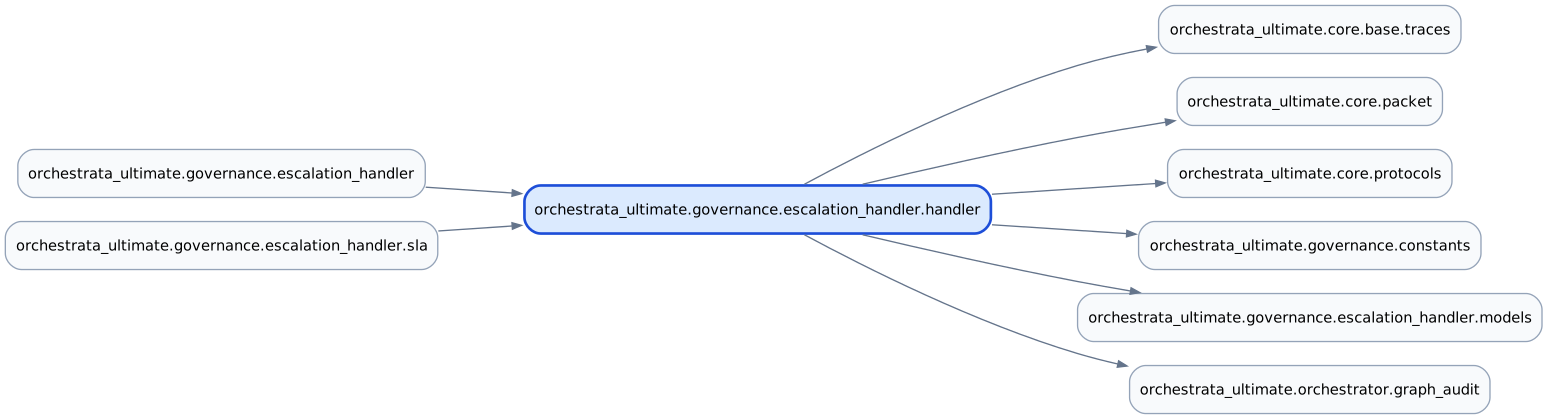
| Imports (internal) | orchestrata_ultimate.core.base.traces, orchestrata_ultimate.core.packet, orchestrata_ultimate.core.protocols, orchestrata_ultimate.governance.constants, orchestrata_ultimate.governance.escalation_handler.models, orchestrata_ultimate.orchestrator.graph_audit |
| Imported by | orchestrata_ultimate.governance.escalation_handler, orchestrata_ultimate.governance.escalation_handler.sla |
| Tests that import it | none |
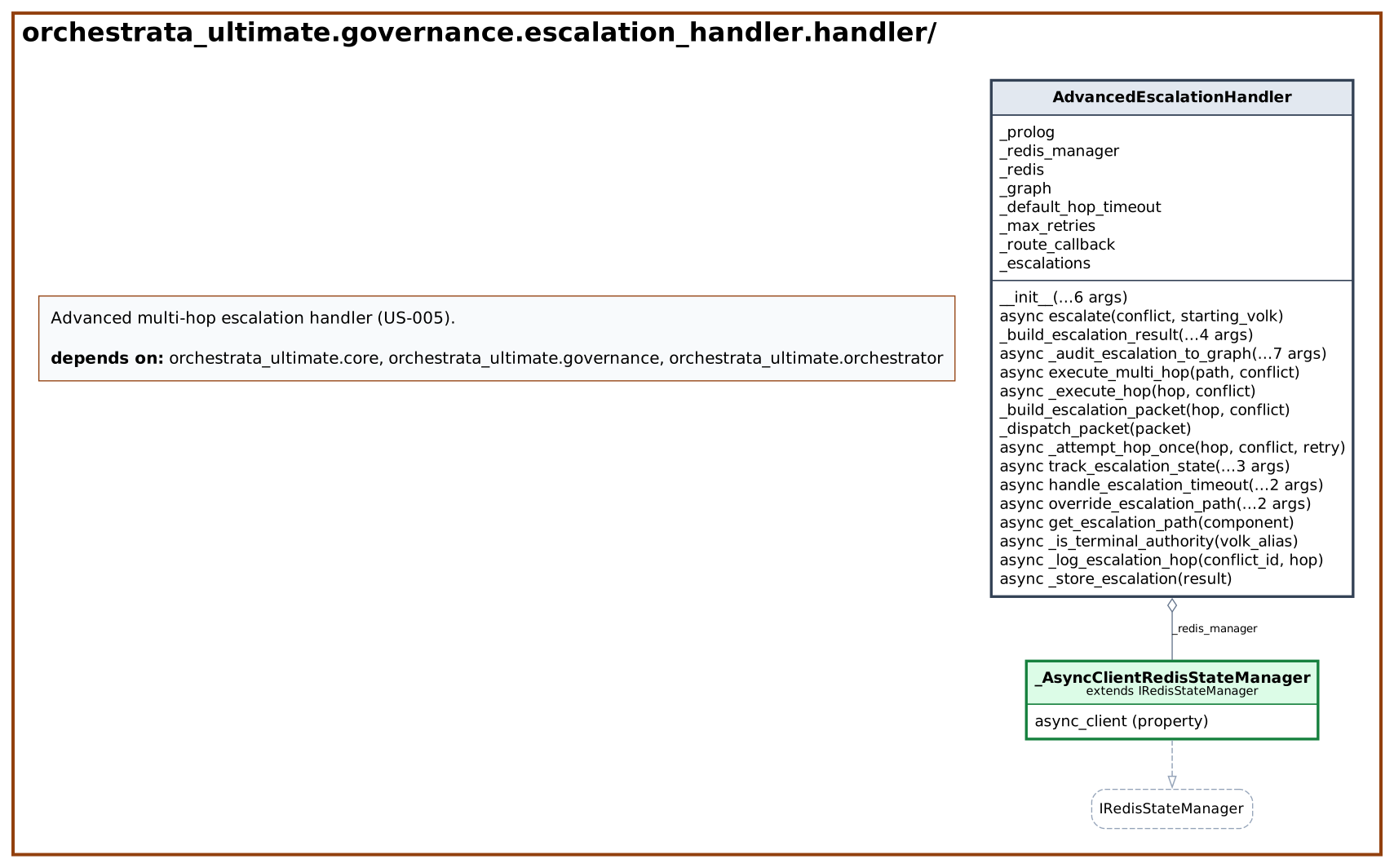
Class diagram
Dependency diagram
API
Classes
_AsyncClientRedisStateManager (protocol)
Bases: IRedisStateManager, Protocol · Decorators: runtime_checkable · Line 49
IRedisStateManager plus the async_client property this handler needs.
| Method | Signature | Summary |
|---|---|---|
async_client property |
async_client() -> Any |
AdvancedEscalationHandler
Decorators: traces(spec='001', story='US-005', reqs=['REQ-001-US-005-011', 'REQ-001-US-005-014']) · Line 70
Handles advanced multi-hop escalation logic (US-005).
| Method | Signature | Summary |
|---|---|---|
__init__ |
__init__(prolog: IGovernancePrologBridge, redis: _AsyncClientRedisStateManager, graph: IAuditTrail | None = None, default_hop_timeout: int = DEFAULT_HOP_TIMEOUT_SECONDS, max_retries: int = DEFAULT_ESCALATION_MAX_RETRIES, route_callback: Callable[[CXPPacket], bool] | None = None) -> None |
Initialize escalation handler. |
escalate |
async escalate(conflict: Conflict, starting_volk: str) -> EscalationResult |
Execute multi-hop escalation (REQ-001-US-005-001). |
_build_escalation_result |
_build_escalation_result(escalation_id: str, conflict: Conflict, hops: list, total_time_ms: int) -> EscalationResult |
Determine resolution state and construct the EscalationResult. |
_audit_escalation_to_graph |
async _audit_escalation_to_graph(escalation_id: str, conflict: Conflict, path: list, result: EscalationResult, starting_volk: str, total_time_ms: int, hops: list) -> None |
Log the completed escalation to graph audit trail (REQ-001-US-005-020). |
execute_multi_hop |
async execute_multi_hop(path: list[str], conflict: Conflict) -> list[EscalationHop] |
Execute multi-hop escalation sequence (REQ-001-US-005-001, REQ-001-US-005-002). |
_execute_hop |
async _execute_hop(hop: EscalationHop, conflict: Conflict) -> bool |
Execute a single escalation hop with retry (REQ-001-US-005-010). |
_build_escalation_packet |
_build_escalation_packet(hop: EscalationHop, conflict: Conflict) -> CXPPacket |
Build a CXP packet for escalation routing. |
_dispatch_packet |
_dispatch_packet(packet: CXPPacket) -> bool |
Dispatch a CXP packet via the route callback. |
_attempt_hop_once |
async _attempt_hop_once(hop: EscalationHop, conflict: Conflict, retry: int) -> tuple |
Perform one attempt of a hop, handling timeout and routing. |
track_escalation_state |
async track_escalation_state(escalation_id: str, hop_index: int, status: EscalationStatus) -> None |
Track escalation state at each hop (REQ-001-US-005-002). |
handle_escalation_timeout |
async handle_escalation_timeout(escalation_id: str, hop_index: int) -> None |
Handle escalation timeout at specific hop (REQ-001-US-005-003). |
override_escalation_path |
async override_escalation_path(escalation_id: str, new_path: list[str]) -> None |
Emergency override of escalation path (REQ-001-US-005-004). |
get_escalation_path |
async get_escalation_path(component: str) -> list[str] |
Query Prolog for escalation path (REQ-001-US-005-001). |
_is_terminal_authority |
async _is_terminal_authority(volk_alias: str) -> bool |
Check if volk is terminal authority (REQ-001-US-005-008). |
_log_escalation_hop |
async _log_escalation_hop(conflict_id: str, hop: EscalationHop) -> None |
Log escalation hop details (REQ-001-US-005-005). |
_store_escalation |
async _store_escalation(result: EscalationResult) -> None |
Store escalation result in Redis. |
Functions
| Function | Signature | Summary |
|---|---|---|
_quote_atom |
_quote_atom(value: str) -> str |
Escape a string for safe use inside a single-quoted Prolog atom. |
Source
# mypy: ignore-errors
"""Advanced multi-hop escalation handler (US-005)."""
import asyncio
import json
import logging
import time
import uuid
from collections.abc import Callable
from datetime import timedelta
from typing import Any, Protocol, runtime_checkable
from orchestrata_ultimate.core.base.traces import traces
from orchestrata_ultimate.core.packet import CXPPacket, Priority
from orchestrata_ultimate.core.protocols import (
IAuditTrail,
IGovernancePrologBridge,
IRedisStateManager,
)
from orchestrata_ultimate.governance.constants import (
DEFAULT_ESCALATION_MAX_RETRIES,
DEFAULT_HOP_TIMEOUT_SECONDS,
)
from orchestrata_ultimate.governance.escalation_handler.models import (
Conflict,
EscalationHop,
EscalationResult,
EscalationStatus,
_utc_now,
)
logger = logging.getLogger(__name__)
def _quote_atom(value: str) -> str:
"""Escape a string for safe use inside a single-quoted Prolog atom.
Without this, an unquoted volk alias like ``U:Cd`` parses as the
module-qualification OPERATOR (``:``) applied to two unbound
variables (``U`` and ``Cd``, both uppercase) rather than the intended
atom -- a silent wrong-contract bug distinct from, but adjacent to,
F4's nonexistent-predicate defect (both query sites this backs were
touched to fix F4).
"""
return "'" + value.replace("\\", "\\\\").replace("'", "\\'") + "'"
@runtime_checkable
class _AsyncClientRedisStateManager(IRedisStateManager, Protocol):
"""``IRedisStateManager`` plus the ``async_client`` property this
handler needs.
``IRedisStateManager`` (``core/protocols/decoupling.py``) is the shared
cycle-breaking decoupling interface and deliberately doesn't declare
``async_client`` (most consumers only need the sync surface). This
handler needs the async Redis client (escalation hops are async),
so it extends the shared Protocol locally rather than widening it
project-wide (precedent: escalation_handler/resolver.py).
"""
@property
def async_client(self) -> Any: ...
@traces(
spec="001",
story="US-005",
reqs=["REQ-001-US-005-011", "REQ-001-US-005-014"],
)
class AdvancedEscalationHandler:
"""Handles advanced multi-hop escalation logic (US-005)."""
def __init__(
self,
prolog: IGovernancePrologBridge,
redis: _AsyncClientRedisStateManager,
graph: IAuditTrail | None = None,
default_hop_timeout: int = DEFAULT_HOP_TIMEOUT_SECONDS,
max_retries: int = DEFAULT_ESCALATION_MAX_RETRIES,
route_callback: Callable[[CXPPacket], bool] | None = None,
) -> None:
"""Initialize escalation handler.
Args:
prolog: Prolog bridge for querying rules
redis: Redis state manager
graph: Optional graph audit logger
default_hop_timeout: Default timeout per hop in seconds
max_retries: Maximum retries per hop
route_callback: Optional callback to dispatch CXP
packets. Returns True on success. Falls back
to logging when None.
"""
self._prolog = prolog
self._redis_manager = redis
self._redis = redis.async_client # Use async Redis client
self._graph = graph
self._default_hop_timeout = default_hop_timeout
self._max_retries = max_retries
self._route_callback = route_callback
# In-memory cache (backed by Redis)
self._escalations: dict[str, EscalationResult] = {}
@traces(spec="001", reqs=["REQ-001-US-005-003"])
async def escalate(
self, conflict: Conflict, starting_volk: str
) -> EscalationResult:
"""Execute multi-hop escalation (REQ-001-US-005-001).
Args:
conflict: Conflict to escalate
starting_volk: Volk that initiated escalation
Returns:
EscalationResult with full escalation history
"""
escalation_id = f"esc-{uuid.uuid4().hex[:8]}"
start_time = time.time()
path = await self.get_escalation_path(conflict.component)
logger.info(
f"Starting escalation {escalation_id} for conflict {conflict.conflict_id} "
f"from {starting_volk} through path: {path}"
)
hops = await self.execute_multi_hop(path, conflict)
total_time_ms = int((time.time() - start_time) * 1000)
result = self._build_escalation_result(
escalation_id, conflict, hops, total_time_ms
)
self._escalations[escalation_id] = result
await self._store_escalation(result)
await self._audit_escalation_to_graph(
escalation_id, conflict, path, result, starting_volk, total_time_ms, hops
)
return result
@traces(spec="001", story="US-005", reqs=["REQ-001-US-005-021"])
def _build_escalation_result(
self,
escalation_id: str,
conflict: Conflict,
hops: list,
total_time_ms: int,
) -> EscalationResult:
"""Determine resolution state and construct the EscalationResult."""
resolved = any(hop.status == EscalationStatus.completed for hop in hops)
resolution = None
resolved_at = None
if resolved:
completed_hop = next(
hop for hop in hops if hop.status == EscalationStatus.completed
)
resolution = completed_hop.response
resolved_at = _utc_now()
return EscalationResult(
escalation_id=escalation_id,
conflict=conflict,
hops=hops,
resolved=resolved,
resolution=resolution,
total_time_ms=total_time_ms,
resolved_at=resolved_at,
)
@traces(spec="001", story="US-008", reqs=["REQ-001-US-008-011"])
async def _audit_escalation_to_graph(
self,
escalation_id: str,
conflict: Conflict,
path: list,
result: EscalationResult,
starting_volk: str,
total_time_ms: int,
hops: list,
) -> None:
"""Log the completed escalation to graph audit trail (REQ-001-US-005-020)."""
if not self._graph:
return
from orchestrata_ultimate.orchestrator.graph_audit import ( # noqa: PLC0415
AuditEvent,
AuditEventType,
)
event = AuditEvent(
event_type=AuditEventType.ESCALATION,
session_id=escalation_id,
volk_id=starting_volk,
timestamp=_utc_now(),
data={
"escalation_id": escalation_id,
"conflict_id": conflict.conflict_id,
"path": path,
"resolved": result.resolved,
"total_time_ms": total_time_ms,
"hop_count": len(hops),
},
)
await self._graph.log_event(event)
@traces(spec="001", story="US-005", reqs=["REQ-001-US-005-014"])
async def execute_multi_hop(
self, path: list[str], conflict: Conflict
) -> list[EscalationHop]:
"""Execute multi-hop escalation sequence (REQ-001-US-005-001, REQ-001-US-005-002).
Args:
path: List of volk aliases in escalation path
conflict: Conflict being escalated
Returns:
List of escalation hops with statuses
"""
hops: list[EscalationHop] = []
for hop_index, volk_alias in enumerate(path):
# Check if terminal authority (REQ-001-US-005-008)
is_terminal = await self._is_terminal_authority(volk_alias)
# Create hop
hop = EscalationHop(
hop_index=hop_index,
volk_alias=volk_alias,
status=EscalationStatus.pending,
timestamp=_utc_now(),
timeout_at=_utc_now() + timedelta(seconds=self._default_hop_timeout),
)
# Execute hop with retry logic (REQ-001-US-005-010)
success = await self._execute_hop(hop, conflict)
# Track state (REQ-001-US-005-002)
await self.track_escalation_state(
f"esc-{conflict.conflict_id}", hop_index, hop.status
)
# Log hop (REQ-001-US-005-005)
await self._log_escalation_hop(conflict.conflict_id, hop)
hops.append(hop)
# If resolved or terminal authority reached, stop
if success or is_terminal:
hop.status = EscalationStatus.completed
hop.response = f"Resolved by {volk_alias}"
break
# If hop failed after retries, continue to next
if hop.status == EscalationStatus.failed:
logger.warning(
f"Hop {hop_index} to {volk_alias} failed after {hop.retry_count} retries"
)
continue
return hops
async def _execute_hop(self, hop: EscalationHop, conflict: Conflict) -> bool:
"""Execute a single escalation hop with retry (REQ-001-US-005-010).
Args:
hop: Hop to execute
conflict: Conflict being escalated
Returns:
True if hop succeeded, False otherwise
"""
hop.status = EscalationStatus.in_progress
for retry in range(self._max_retries):
hop.retry_count = retry
succeeded, done = await self._attempt_hop_once(hop, conflict, retry)
if done:
return succeeded
# All retries exhausted
hop.status = EscalationStatus.failed # pragma: no cover
return False # pragma: no cover
@traces(spec="001", story="US-005", reqs=["REQ-001-US-005-017"])
def _build_escalation_packet(
self, hop: EscalationHop, conflict: Conflict
) -> CXPPacket:
"""Build a CXP packet for escalation routing.
Args:
hop: Current escalation hop
conflict: Conflict being escalated
Returns:
CXPPacket addressed to the target volk
"""
payload = {
"conflict_id": conflict.conflict_id,
"conflict_type": conflict.conflict_type.value,
"component": conflict.component,
"volks": conflict.volks,
"description": conflict.description,
"hop_index": hop.hop_index,
"retry_count": hop.retry_count,
}
return CXPPacket(
from_agent="governance",
to_agent=hop.volk_alias,
subject="escalation",
payload=payload,
priority=Priority.HIGH,
)
def _dispatch_packet(self, packet: CXPPacket) -> bool:
"""Dispatch a CXP packet via the route callback.
Falls back to logging when no callback is configured.
Args:
packet: CXP packet to dispatch
Returns:
True if dispatched successfully
"""
if self._route_callback is None:
logger.warning(
"No route_callback configured; cannot dispatch packet %s to %s",
packet.message_id,
packet.to_agent,
)
return False
return self._route_callback(packet)
@traces(spec="001", story="US-005", reqs=["REQ-001-US-005-016"])
async def _attempt_hop_once(
self, hop: EscalationHop, conflict: Conflict, retry: int
) -> tuple:
"""Perform one attempt of a hop, handling timeout and routing.
Returns:
(succeeded, done) where done=True means stop retrying.
"""
try:
if hop.timeout_at and _utc_now() > hop.timeout_at:
hop.status = EscalationStatus.timeout
await self.handle_escalation_timeout(
f"esc-{conflict.conflict_id}",
hop.hop_index,
)
return False, True
packet = self._build_escalation_packet(hop, conflict)
dispatched = self._dispatch_packet(packet)
if dispatched:
hop.status = EscalationStatus.completed
hop.response = f"Routed to {hop.volk_alias}"
return True, True
# Dispatch failed — retry or give up
if retry < self._max_retries - 1:
await asyncio.sleep(0.01)
return False, False
hop.status = EscalationStatus.failed
return False, True
except Exception as e:
logger.error(
"Error in hop %d retry %d: %s",
hop.hop_index,
retry,
e,
)
if retry < self._max_retries - 1:
await asyncio.sleep(0.01)
return False, False
else: # pragma: no cover
hop.status = EscalationStatus.failed # pragma: no cover
return False, True # pragma: no cover
@traces(
spec="001",
story="US-003",
reqs=["REQ-001-US-003-024"],
)
async def track_escalation_state(
self, escalation_id: str, hop_index: int, status: EscalationStatus
) -> None:
"""Track escalation state at each hop (REQ-001-US-005-002).
Args:
escalation_id: Escalation ID
hop_index: Index of current hop
status: Status of hop
"""
key = f"escalation:{escalation_id}"
state = {
"current_hop": hop_index,
"status": status.value,
"updated_at": _utc_now().isoformat(),
}
try:
await self._redis.set(key, json.dumps(state))
except Exception as e:
logger.error(f"Failed to track escalation state for {escalation_id}: {e}")
raise
logger.debug(
f"Escalation {escalation_id} hop {hop_index} state: {status.value}"
)
@traces(
spec="001",
story="US-005",
reqs=["REQ-001-US-005-016"],
)
async def handle_escalation_timeout(
self, escalation_id: str, hop_index: int
) -> None:
"""Handle escalation timeout at specific hop (REQ-001-US-005-003).
Args:
escalation_id: Escalation ID
hop_index: Index of hop that timed out
"""
logger.warning(f"Escalation {escalation_id} hop {hop_index} timed out")
try:
# Update state
key = f"escalation:{escalation_id}"
state = await self._redis.get(key)
if state:
state_dict = json.loads(state)
state_dict["timeout_hop"] = hop_index
state_dict["timeout_at"] = _utc_now().isoformat()
else:
# Create new timeout record if no existing state
state_dict = {
"escalation_id": escalation_id,
"timeout_hop": hop_index,
"timeout_at": _utc_now().isoformat(),
"status": "timed_out",
}
await self._redis.set(key, json.dumps(state_dict))
except Exception as e:
logger.error(f"Failed to update timeout state for {escalation_id}: {e}")
raise
# Log to graph (graph.log_event may need await if it's async)
if self._graph:
from orchestrata_ultimate.orchestrator.graph_audit import ( # noqa: PLC0415
AuditEvent,
AuditEventType,
)
event = AuditEvent(
event_type=AuditEventType.ESCALATION,
session_id=escalation_id,
volk_id="system",
timestamp=_utc_now(),
data={
"escalation_id": escalation_id,
"hop_index": hop_index,
"action": "timeout",
},
)
await self._graph.log_event(event)
async def override_escalation_path(
self, escalation_id: str, new_path: list[str]
) -> None:
"""Emergency override of escalation path (REQ-001-US-005-004).
Args:
escalation_id: Escalation to override
new_path: New escalation path
"""
logger.warning(
f"Emergency override of escalation {escalation_id} to path: {new_path}"
)
try:
key = f"escalation_override:{escalation_id}"
await self._redis.set(key, json.dumps(new_path))
except Exception as e:
logger.error(f"Failed to override escalation path for {escalation_id}: {e}")
raise
# Log override
if self._graph:
from orchestrata_ultimate.orchestrator.graph_audit import ( # noqa: PLC0415
AuditEvent,
AuditEventType,
)
event = AuditEvent(
event_type=AuditEventType.ESCALATION,
session_id=escalation_id,
volk_id="system",
timestamp=_utc_now(),
data={
"escalation_id": escalation_id,
"new_path": new_path,
"action": "override",
},
)
await self._graph.log_event(event)
@traces(spec="001", story="US-003", reqs=["REQ-001-US-003-022"])
async def get_escalation_path(self, component: str) -> list[str]:
"""Query Prolog for escalation path (REQ-001-US-005-001).
Args:
component: Component being escalated
Returns:
List of volk aliases in escalation order
"""
# Query Prolog for multi-hop escalation path (pam_rules.pl -- F4:
# this predicate did not exist before this fix; every call errored
# into the "default to orchestrator" fallback below regardless of
# the real PAM ownership/authority chain). Module-qualified + the
# component atom quoted (component names are plain lowercase
# words today, but quoting makes the query correct regardless).
query = f"pam:multi_hop_escalation({_quote_atom(component)}, Path)"
loop = asyncio.get_event_loop()
result = await loop.run_in_executor(None, self._prolog.query_one, query)
if result and "Path" in result:
path = result["Path"]
# Convert Prolog list to Python list
if isinstance(path, list):
return path
return [path]
# Default to orchestrator
return ["orchestrator"]
@traces(spec="001", story="US-005", reqs=["REQ-001-US-005-014"])
async def _is_terminal_authority(self, volk_alias: str) -> bool:
"""Check if volk is terminal authority (REQ-001-US-005-008).
Args:
volk_alias: Volk alias to check
Returns:
True if terminal authority
"""
# F4: terminal_authority/1 did not exist before this fix; module-
# qualified + quoted for the same reason as get_escalation_path
# above -- a bare volk alias like 'U:Cd' is NOT a valid unquoted
# Prolog atom (':' is the module-qualification operator, so it
# would parse as two unbound variables, not the intended atom).
query = f"pam:terminal_authority({_quote_atom(volk_alias)})"
loop = asyncio.get_event_loop()
return await loop.run_in_executor(None, self._prolog.query_bool, query)
@traces(spec="001", story="US-005", reqs=["REQ-001-US-005-019"])
async def _log_escalation_hop(self, conflict_id: str, hop: EscalationHop) -> None:
"""Log escalation hop details (REQ-001-US-005-005).
Args:
conflict_id: Conflict ID
hop: Hop to log
"""
hop_key = f"escalation_hops:esc-{conflict_id}"
hop_data = {
"hop_index": hop.hop_index,
"volk_alias": hop.volk_alias,
"status": hop.status.value,
"timestamp": hop.timestamp.isoformat(),
"response": hop.response,
"retry_count": hop.retry_count,
}
try:
# Append to hop history in Redis
await self._redis.lpush(hop_key, json.dumps(hop_data))
except Exception as e:
logger.error(f"Failed to log escalation hop for {conflict_id}: {e}")
raise
logger.info(
f"Logged escalation hop {hop.hop_index} to {hop.volk_alias}: {hop.status.value}"
)
@traces(spec="001", story="US-005", reqs=["REQ-001-US-005-028"])
async def _store_escalation(self, result: EscalationResult) -> None:
"""Store escalation result in Redis.
Args:
result: Escalation result to store
"""
key = f"escalation:{result.escalation_id}"
# Determine current hop and status
current_hop = len(result.hops) - 1 if result.hops else 0
if result.resolved:
status = "completed"
elif any(hop.status == EscalationStatus.failed for hop in result.hops):
status = "failed"
elif any(hop.status == EscalationStatus.timeout for hop in result.hops):
status = "timeout"
else:
status = "in_progress"
data = {
"conflict_id": result.conflict.conflict_id,
"resolved": result.resolved,
"resolution": result.resolution,
"total_time_ms": result.total_time_ms,
"hop_count": len(result.hops),
"current_hop": current_hop,
"status": status,
"created_at": result.created_at.isoformat(),
"updated_at": _utc_now().isoformat(),
"resolved_at": (
result.resolved_at.isoformat() if result.resolved_at else None
),
}
try:
await self._redis.set(key, json.dumps(data))
except Exception as e:
logger.error(f"Failed to store escalation {result.escalation_id}: {e}")
raise