orchestrata_ultimate.agents.volks.qa._autofix
Reference › orchestrata_ultimate › agents › volks › qa › _autofix
_autofix provides AutofixMixin for the QA volk (volk): mechanical repairs applied to the generated workspace before the review gates run, so the model is not asked to fix what a script can fix. _iter_workspace_py_files and _apply_py_file_fix apply a content transform to every workspace Python file and count the changes. The transforms cover Redis usage (_autofix_aioredis, _autofix_sync_redis, _autofix_redis_decode, _autofix_xadd_dict, _autofix_hset_dict, and _autofix_redis_host, which replaces hardcoded local Redis settings in test files with environment reads via _replace_redis_host_in_content), missing imports (_autofix_f821_datetime, _autofix_missing_stdlib_imports, _autofix_missing_barename_imports), relative imports (_autofix_relative_imports, with _detect_package_name), and formatting (_autofix_line_length with black, _autofix_import_order with isort, _autofix_unused_imports with ruff), plus _autofix_parse_args, which lets parse_args() accept an optional argument list.
At a glance
| Source | src/orchestrata_ultimate/agents/volks/qa/_autofix.py |
| Lines of code | 935 |
| Classes | 1 |
| Functions | 0 |
| Imports (internal) | orchestrata_ultimate.agents.volks.qa._host, orchestrata_ultimate.core.base.traces |
| Imported by | orchestrata_ultimate.agents.volks.qa.volk |
| Tests that import it | none |
Class diagram
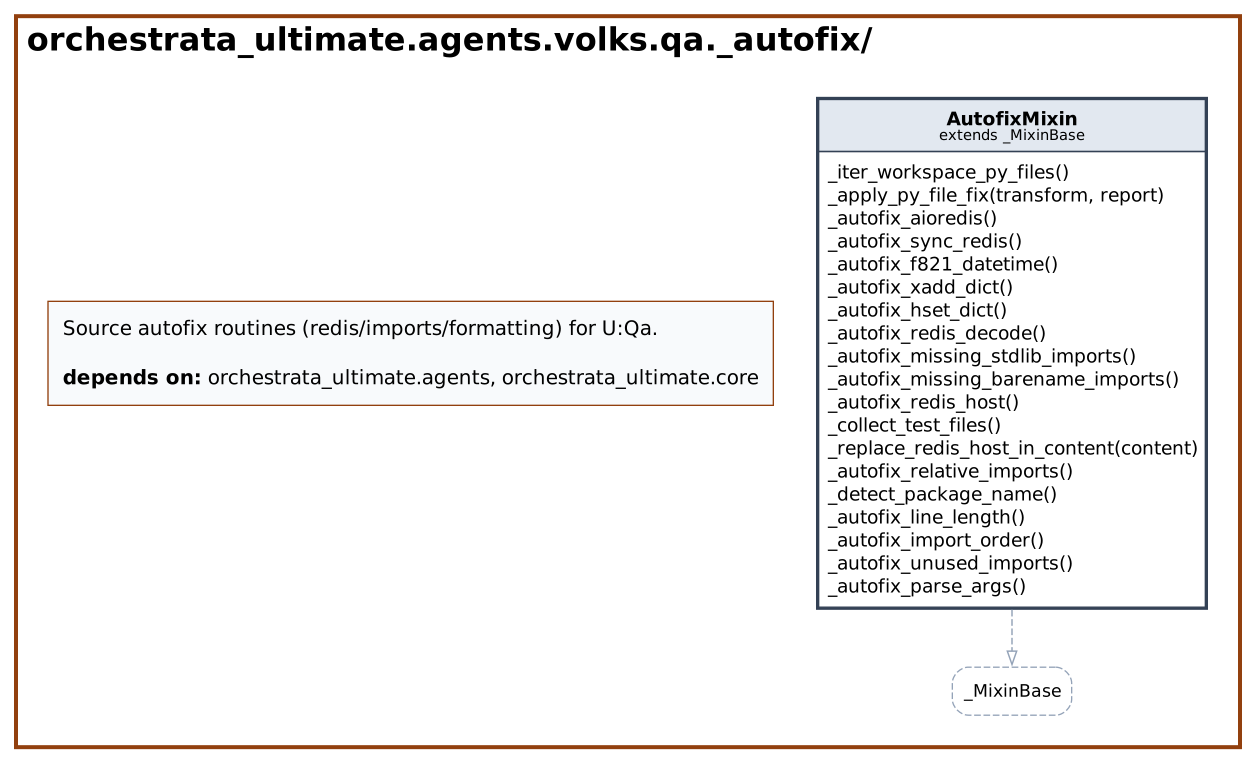
Dependency diagram

API
Classes
AutofixMixin
Bases: _MixinBase · Line 26
Source autofix routines (redis/imports/formatting) for U:Qa.
| Method | Signature | Summary |
|---|---|---|
_iter_workspace_py_files |
_iter_workspace_py_files() |
Yield absolute paths of workspace .py files (standard dir filter). |
_apply_py_file_fix |
_apply_py_file_fix(transform: Callable[[str], str], report: str | None = None) -> int |
Apply a content transform to every workspace .py file. |
_autofix_aioredis |
_autofix_aioredis() -> None |
G131-1: Replace deprecated redis with redis.asyncio. |
_autofix_sync_redis |
_autofix_sync_redis() -> None |
G138-3: Replace sync redis.Redis with redis.asyncio.Redis. |
_autofix_f821_datetime |
_autofix_f821_datetime() -> None |
G132-1: Add missing datetime import when datetime.X is used. |
_autofix_xadd_dict |
_autofix_xadd_dict() -> None |
G134-1: Fix XADD calls that pass dicts with non-string values. |
_autofix_hset_dict |
_autofix_hset_dict() -> None |
G136-1: Fix HSET mapping with non-string values. |
_autofix_redis_decode |
_autofix_redis_decode() -> None |
G158-1: Ensure Redis clients use decode_responses=True. |
_autofix_missing_stdlib_imports |
_autofix_missing_stdlib_imports() -> None |
G134-2: Add missing stdlib imports when module.X is used. |
_autofix_missing_barename_imports |
_autofix_missing_barename_imports() -> None |
G150-3: Add missing bare-name imports (timedelta, Optional, etc.). |
_autofix_redis_host |
_autofix_redis_host() -> None |
G125-1 + G141-1: Replace hardcoded localhost Redis in ALL test files. |
_collect_test_files |
_collect_test_files() -> list |
Collect workspace test_*.py and conftest.py paths. |
_replace_redis_host_in_content |
_replace_redis_host_in_content(content: str) -> str |
Replace hardcoded localhost/port Redis config with env reads. |
_autofix_relative_imports |
_autofix_relative_imports() -> None |
G125-2: Convert relative imports to absolute in source files. |
_detect_package_name |
_detect_package_name() -> str |
Detect the project's top-level package name. |
_autofix_line_length |
_autofix_line_length() -> None |
G127-3: Auto-format source files with black to fix LINE_LENGTH. |
_autofix_import_order |
_autofix_import_order() -> None |
G129-3: Auto-fix import ordering with isort. |
_autofix_unused_imports |
_autofix_unused_imports() -> None |
G194-2: Remove unused imports with ruff after isort/black. |
_autofix_parse_args |
_autofix_parse_args() -> None |
G129-2: Patch parse_args() to accept optional args parameter. |
Source
# mypy: ignore-errors
"""Source autofix routines (redis/imports/formatting) for U:Qa."""
import logging
import os
import re
import shutil
import subprocess
from collections.abc import Callable
from typing import TYPE_CHECKING
from orchestrata_ultimate.agents.volks.qa._host import _QaHost
from orchestrata_ultimate.core.base.traces import traces
_logger = logging.getLogger(__name__)
# W6.4b: typing-only host contract so pyright can see across mixin
# composition (see _host.py). No runtime effect — AutofixMixin still
# inherits from plain ``object`` outside TYPE_CHECKING.
if TYPE_CHECKING:
_MixinBase = _QaHost
else:
_MixinBase = object
class AutofixMixin(_MixinBase):
"""Source autofix routines (redis/imports/formatting) for U:Qa."""
@traces(spec="031", story="US-031-001", reqs=["REQ-031-015"])
def _iter_workspace_py_files(self):
"""Yield absolute paths of workspace .py files (standard dir filter).
Skips dot-dirs, ``__pycache__`` and ``site-packages`` — the dir
filter shared by every per-file source auto-fix.
"""
for root, _dirs, files in os.walk(self.workspace):
_dirs[:] = [
d
for d in _dirs
if not d.startswith(".") and d != "__pycache__" and d != "site-packages"
]
for fname in files:
if not fname.endswith(".py"):
continue
yield os.path.join(root, fname)
@traces(spec="031", story="US-031-001", reqs=["REQ-031-015"])
def _apply_py_file_fix(
self, transform: Callable[[str], str], report: str | None = None
) -> int:
"""Apply a content transform to every workspace .py file.
Reads each file, runs ``transform(content) -> new_content`` and
writes the result back when it changed. Files that cannot be read
are skipped. When ``report`` is given it is printed (with the
changed-file count) once one or more files were rewritten.
Args:
transform: Callable mapping file content to new content.
report: Format string with a single ``{count}`` placeholder,
or None to suppress the summary print.
Returns:
Number of files that were rewritten.
"""
fixed_count = 0
for fpath in self._iter_workspace_py_files():
try:
with open(fpath, encoding="utf-8") as f:
content = f.read()
except OSError, UnicodeDecodeError:
continue
new_content = transform(content)
if new_content != content:
with open(fpath, "w", encoding="utf-8") as f:
f.write(new_content)
fixed_count += 1
if fixed_count and report is not None:
print(report.format(count=fixed_count), flush=True)
return fixed_count
@traces(
spec="031",
story="US-031-001",
reqs=["REQ-031-001", "REQ-031-002"],
)
def _autofix_aioredis(self) -> None:
"""G131-1: Replace deprecated redis with redis.asyncio.
DeepSeek sometimes uses the deprecated `redis` package instead
of `redis.asyncio` (included in redis>=5.0). This auto-fix
replaces all redis imports and usage patterns.
"""
fixed_count = 0
for root, _dirs, files in os.walk(self.workspace):
_dirs[:] = [
d
for d in _dirs
if not d.startswith(".") and d != "__pycache__" and d != "site-packages"
]
for fname in files:
if not fname.endswith(".py"):
continue
fpath = os.path.join(root, fname)
try:
with open(fpath, encoding="utf-8") as f:
content = f.read()
except OSError, UnicodeDecodeError:
continue
if "redis" not in content:
continue
original = content
# Replace import statements
content = re.sub(
r"^import redis$",
"import redis.asyncio as redis",
content,
flags=re.MULTILINE,
)
content = re.sub(
r"^from redis import",
"from redis.asyncio import",
content,
flags=re.MULTILINE,
)
# Replace usage patterns
content = content.replace("redis.from_url", "redis.from_url")
content = content.replace("redis.Redis", "redis.Redis")
content = content.replace(
"redis.ConnectionError",
"redis.ConnectionError",
)
content = content.replace(
"redis.ResponseError",
"redis.ResponseError",
)
# Catch any remaining redis references
content = re.sub(
r"\baioredis\b",
"redis",
content,
)
if content != original:
with open(fpath, "w", encoding="utf-8") as f:
f.write(content)
fixed_count += 1
if fixed_count:
print(
f" [U:Qa] G131-1: auto-fixed redis→redis.asyncio "
f"in {fixed_count} files",
flush=True,
)
@traces(
spec="031",
story="US-031-001",
reqs=["REQ-031-003"],
)
def _autofix_sync_redis(self) -> None:
"""G138-3: Replace sync redis.Redis with redis.asyncio.Redis.
DeepSeek sometimes uses the synchronous redis.Redis client
instead of redis.asyncio.Redis. This causes blocking in async
code. Detect `import redis` (bare) + `redis.Redis(` usage and
convert to async Redis.
"""
@traces(
spec="031",
story="US-031-001",
reqs=["REQ-031-003"],
)
def transform(content: str) -> str:
# Skip if already using async redis
if "redis.asyncio" in content:
return content
# Only fix files that use sync redis.Redis
if not re.search(r"^import redis\b", content, re.MULTILINE):
return content
if "redis.Redis(" not in content:
return content
# Replace: import redis → from redis.asyncio import Redis
content = re.sub(
r"^import redis$",
"from redis.asyncio import Redis",
content,
flags=re.MULTILINE,
)
# Replace: redis.Redis( → Redis(
content = content.replace("redis.Redis(", "Redis(")
# Replace type hints: redis.Redis → Redis
content = re.sub(r"\bredis\.Redis\b", "Redis", content)
# Replace exception refs
content = content.replace(
"redis.exceptions.",
"redis.exceptions.",
)
# Add redis.exceptions import if needed
if "redis.exceptions" in content and (
"from redis" not in content or "exceptions" not in content
):
content = re.sub(
r"^(from redis\.asyncio import Redis)$",
r"\1\nfrom redis.exceptions import RedisError",
content,
count=1,
flags=re.MULTILINE,
)
return content
self._apply_py_file_fix(
transform,
report=" [U:Qa] G138-3: auto-fixed sync redis→"
"redis.asyncio in {count} files",
)
@traces(
spec="031",
story="US-031-001",
reqs=["REQ-031-004"],
)
def _autofix_f821_datetime(self) -> None:
"""G132-1: Add missing datetime import when datetime.X is used.
DeepSeek often uses datetime.now(), datetime.fromisoformat(),
etc. but only imports timezone from the datetime module,
omitting the datetime class itself. This causes F821.
"""
@traces(
spec="031",
story="US-031-001",
reqs=["REQ-031-004"],
)
def transform(content: str) -> str:
# Check if datetime.X is used as a standalone name
if not re.search(
r"\bdatetime\.(now|utcnow|fromisoformat|"
r"strptime|combine|min|max|today)\b",
content,
):
return content
# Check if datetime class is already imported
if re.search(
r"^from datetime import .*\bdatetime\b",
content,
re.MULTILINE,
):
return content
if re.search(r"^import datetime$", content, re.MULTILINE):
return content
original = content
# Case 1: from datetime import timezone → add datetime
content = re.sub(
r"^(from datetime import )((?!.*\bdatetime\b).*)",
r"\1datetime, \2",
content,
count=1,
flags=re.MULTILINE,
)
# Case 2: no datetime import at all → add one
if content == original:
content = re.sub(
r"^(import os\b.*\n)",
r"\1from datetime import datetime\n",
content,
count=1,
flags=re.MULTILINE,
)
# Case 3: fallback — prepend import
if content == original:
content = "from datetime import datetime\n" + content
return content
self._apply_py_file_fix(
transform,
report=" [U:Qa] G132-1: auto-fixed missing datetime "
"import in {count} files",
)
@traces(
spec="031",
story="US-031-001",
reqs=["REQ-031-007"],
)
def _autofix_xadd_dict(self) -> None:
"""G134-1: Fix XADD calls that pass dicts with non-string values.
DeepSeek often writes `xadd(key, **event.to_dict())` or passes
dicts containing nested objects. Redis XADD requires all field
values to be strings. This auto-fix wraps dict values with
json.dumps for non-primitive types.
"""
fixed_count = 0
for root, _dirs, files in os.walk(self.workspace):
_dirs[:] = [
d
for d in _dirs
if not d.startswith(".") and d != "__pycache__" and d != "site-packages"
]
for fname in files:
if not fname.endswith(".py"):
continue
fpath = os.path.join(root, fname)
try:
with open(fpath, encoding="utf-8") as f:
content = f.read()
except OSError, UnicodeDecodeError:
continue
if "xadd" not in content.lower():
continue
original = content
# Fix: xadd(key, **obj.to_dict()) → xadd(key, {k: str(v) for ...})
content = re.sub(
r"\.xadd\(\s*(\w+)\s*,\s*\*\*(\w+)\.to_dict\(\)",
r".xadd(\1, {k: str(v) for k, v in \2.to_dict().items()}",
content,
)
# Fix: xadd(key, **dict_var) → xadd(key, {k: str(v)...})
content = re.sub(
r"\.xadd\(\s*(\w+)\s*,\s*\*\*(\w+)\s*\)",
r".xadd(\1, {k: str(v) for k, v in \2.items()})",
content,
)
if content != original:
with open(fpath, "w", encoding="utf-8") as f:
f.write(content)
fixed_count += 1
if fixed_count:
print(
f" [U:Qa] G134-1: auto-fixed XADD dict "
f"encoding in {fixed_count} files",
flush=True,
)
@traces(
spec="031",
story="US-031-001",
reqs=["REQ-031-008"],
)
def _autofix_hset_dict(self) -> None:
"""G136-1: Fix HSET mapping with non-string values.
DeepSeek often writes `hset(key, mapping=obj.to_dict())` where
to_dict() returns dicts with datetime objects, Enum values, or
nested dicts. Redis HSET requires all field values to be
strings, bytes, or numbers. This auto-fix wraps mapping values
with str() conversion.
"""
fixed_count = 0
for root, _dirs, files in os.walk(self.workspace):
_dirs[:] = [
d
for d in _dirs
if not d.startswith(".") and d != "__pycache__" and d != "site-packages"
]
for fname in files:
if not fname.endswith(".py"):
continue
fpath = os.path.join(root, fname)
try:
with open(fpath, encoding="utf-8") as f:
content = f.read()
except OSError, UnicodeDecodeError:
continue
if "hset" not in content.lower():
continue
original = content
# Fix: hset(key, mapping=obj.to_dict())
content = re.sub(
r"\.hset\(([^,]+),\s*mapping\s*=\s*" r"(\w+)\.to_dict\(\)\s*\)",
r".hset(\1, mapping="
r"{k: str(v) for k, v in \2.to_dict().items()})",
content,
)
# Fix: hset(key, mapping={**obj.to_dict()})
content = re.sub(
r"\.hset\(([^,]+),\s*mapping\s*=\s*\{"
r"\s*\*\*(\w+)\.to_dict\(\)\s*\}\s*\)",
r".hset(\1, mapping="
r"{k: str(v) for k, v in \2.to_dict().items()})",
content,
)
if content != original:
with open(fpath, "w", encoding="utf-8") as f:
f.write(content)
fixed_count += 1
if fixed_count:
print(
f" [U:Qa] G136-1: auto-fixed HSET dict "
f"encoding in {fixed_count} files",
flush=True,
)
@traces(
spec="031",
story="US-031-001",
reqs=["REQ-031-009"],
)
def _autofix_redis_decode(self) -> None:
"""G158-1: Ensure Redis clients use decode_responses=True.
DeepSeek often creates Redis clients without decode_responses,
causing bytes vs string comparison failures in tests.
"""
fixed_count = 0
for root, _dirs, files in os.walk(self.workspace):
_dirs[:] = [
d for d in _dirs if d not in {".venv", "__pycache__", "site-packages"}
]
for fname in files:
if not fname.endswith(".py"):
continue
fpath = os.path.join(root, fname)
try:
with open(fpath, encoding="utf-8") as f:
content = f.read()
except OSError, UnicodeDecodeError:
continue
if "Redis(" not in content and "redis.Redis(" not in content:
continue
original = content
# Add decode_responses=True if missing
# Match: Redis(...) without decode_responses
if "decode_responses" not in content:
content = re.sub(
r"(redis\.(?:async)?Redis\([^)]*)\)",
r"\1, decode_responses=True)",
content,
)
# Fix double comma from empty args
content = content.replace(
"(, decode_responses",
"(decode_responses",
)
if content != original:
with open(fpath, "w", encoding="utf-8") as f:
f.write(content)
fixed_count += 1
if fixed_count:
print(
f" [U:Qa] G158-1: auto-added decode_responses=True "
f"in {fixed_count} files",
flush=True,
)
@traces(
spec="031",
story="US-031-001",
reqs=["REQ-031-005"],
)
def _autofix_missing_stdlib_imports(self) -> None:
"""G134-2: Add missing stdlib imports when module.X is used.
Handles common patterns where DeepSeek or QA-generated tests
use `dataclasses.FrozenInstanceError`, `json.dumps`, etc.
without importing the module.
"""
# Map: module name → (usage pattern regex, import statement)
patterns = {
"dataclasses": (
r"\bdataclasses\.(FrozenInstanceError|fields|" r"asdict|astuple)\b",
"import dataclasses",
),
"json": (
r"\bjson\.(dumps|loads|dump|load)\b",
"import json",
),
}
@traces(
spec="031",
story="US-031-001",
reqs=["REQ-031-005"],
)
def transform(content: str) -> str:
original = content
for module, (usage_re, import_stmt) in patterns.items():
if not re.search(usage_re, content):
continue
# Check if already imported
if re.search(
rf"^import {module}\b|^from {module} import",
content,
re.MULTILINE,
):
continue
# Add import after first import line
content = re.sub(
r"^(import \w+.*\n)",
rf"\1{import_stmt}\n",
content,
count=1,
flags=re.MULTILINE,
)
# Fallback: prepend
if content == original:
content = import_stmt + "\n" + content
return content
self._apply_py_file_fix(
transform,
report=" [U:Qa] G134-2: auto-fixed missing stdlib "
"imports in {count} files",
)
@traces(
spec="031",
story="US-031-001",
reqs=["REQ-031-006"],
)
def _autofix_missing_barename_imports(self) -> None:
"""G150-3: Add missing bare-name imports (timedelta, Optional, etc.).
DeepSeek frequently uses bare names like timedelta(days=7) or
Optional[str] without importing them. These cause F821 lint
errors that persist through fix cycles because DeepSeek's fix
responses often fail to extract.
This auto-fix detects bare-name usage and adds the correct
from-import statement.
"""
# Map: bare name → (usage regex, from-module, import name)
bare_imports: list[tuple[str, str, str, str]] = [
# (name, usage_regex, module, import_name)
(
"timedelta",
r"\btimedelta\s*\(",
"datetime",
"timedelta",
),
(
"Optional",
r"\bOptional\s*\[",
"typing",
"Optional",
),
(
"List",
r"\bList\s*\[",
"typing",
"List",
),
(
"Dict",
r"\bDict\s*\[",
"typing",
"Dict",
),
(
"Any",
r"\bAny\b",
"typing",
"Any",
),
(
"Union",
r"\bUnion\s*\[",
"typing",
"Union",
),
(
"Tuple",
r"\bTuple\s*\[",
"typing",
"Tuple",
),
]
@traces(
spec="031",
story="US-031-001",
reqs=["REQ-031-006"],
)
def transform(content: str) -> str:
original = content
for name, usage_re, module, import_name in bare_imports:
if not re.search(usage_re, content):
continue
# Already imported?
if re.search(
rf"^from {module} import .*\b{name}\b",
content,
re.MULTILINE,
):
continue
if re.search(
rf"^import {module}$",
content,
re.MULTILINE,
):
continue
# Try to extend existing from-import
existing = re.search(
rf"^(from {module} import .+)$",
content,
re.MULTILINE,
)
if existing:
old_line = existing.group(1)
new_line = old_line + f", {import_name}"
content = content.replace(old_line, new_line, 1)
else:
# Add new from-import after first import
stmt = f"from {module} import {import_name}"
content = re.sub(
r"^(import \w+.*\n)",
rf"\1{stmt}\n",
content,
count=1,
flags=re.MULTILINE,
)
if content == original:
content = stmt + "\n" + content
return content
self._apply_py_file_fix(
transform,
report=" [U:Qa] G150-3: auto-fixed missing bare-name "
"imports in {count} files",
)
@traces(
spec="031",
story="US-031-001",
reqs=["REQ-031-010"],
)
def _autofix_redis_host(self) -> None:
"""G125-1 + G141-1: Replace hardcoded localhost Redis in ALL test files.
Scans both QA-generated and DeepSeek-generated test/conftest
files for patterns like:
host="localhost" / host='localhost' / Redis(host="localhost"
and replaces them with os.environ['REDIS_HOST'].
Also ensures 'import os' is present when env var reads are injected.
"""
# G141-1: Scan ALL test/conftest files, not just QA-generated ones
fixed_count = 0
for fpath in self._collect_test_files():
if not os.path.isfile(fpath):
continue
try:
with open(fpath, encoding="utf-8") as f:
content = f.read()
except OSError, UnicodeDecodeError:
continue
new_content = self._replace_redis_host_in_content(content)
if new_content != content:
with open(fpath, "w", encoding="utf-8") as f:
f.write(new_content)
fixed_count += 1
if fixed_count:
print(
f" [U:Qa] G125-1: auto-fixed Redis host in {fixed_count} test files",
flush=True,
)
@traces(spec="031", story="US-031-001", reqs=["REQ-031-010"])
def _collect_test_files(self) -> list:
"""Collect workspace test_*.py and conftest.py paths.
Uses the redis-host dir filter (also excludes ``.venv``).
"""
all_test_files = []
for root, _dirs, files in os.walk(self.workspace):
_dirs[:] = [
d
for d in _dirs
if not d.startswith(".")
and d != "__pycache__"
and d != "site-packages"
and d != ".venv"
]
for fname in files:
if not fname.endswith(".py"):
continue
if fname.startswith("test_") or fname == "conftest.py":
all_test_files.append(os.path.join(root, fname))
return all_test_files
@traces(spec="031", story="US-031-001", reqs=["REQ-031-010"])
def _replace_redis_host_in_content(self, content: str) -> str:
"""Replace hardcoded localhost/port Redis config with env reads.
Injects ``import os`` when a replacement was made and the import
is absent. Returns content unchanged when nothing matched.
"""
original = content
# Replace hardcoded localhost in Redis-related contexts
# Pattern: host="localhost" or host='localhost'
content = re.sub(
r"""host\s*=\s*["']localhost["']""",
"host=os.environ['REDIS_HOST']",
content,
)
# Pattern: "localhost" as standalone arg (e.g. Redis("localhost"))
content = re.sub(
r"""Redis\(\s*["']localhost["']""",
"Redis(os.environ['REDIS_HOST']",
content,
)
# Pattern: port=6379 or 6380 hardcoded (replace with env var)
content = re.sub(
r"port\s*=\s*(?:6379|6380)\b",
"port=int(os.environ['REDIS_PORT'])",
content,
)
if content != original:
# Ensure 'import os' is present
if "import os" not in content:
content = "import os\n" + content
return content
@traces(
spec="031",
story="US-031-001",
reqs=["REQ-031-011"],
)
def _autofix_relative_imports(self) -> None:
"""G125-2: Convert relative imports to absolute in source files.
DeepSeek consistently generates `from orchestrata_ultimate.agents.volks.qa.module import X` which
the deterministic review flags as IMPORTS errors. This auto-fix
detects the package name from the src/ layout and rewrites.
"""
pkg_name = self._detect_package_name()
if not pkg_name:
return
fixed_count = 0
for root, _dirs, files in os.walk(self.workspace):
# Skip venv and non-source dirs
if ".venv" in root or "__pycache__" in root:
continue
for fname in files:
if not fname.endswith(".py"):
continue
fpath = os.path.join(root, fname)
with open(fpath, encoding="utf-8") as f:
content = f.read()
original = content
# Replace `from orchestrata_ultimate.agents.volks.qa.module import X` with `from pkg.module import X`
content = re.sub(
r"from \.([\w.]+) import",
f"from {pkg_name}.\\1 import",
content,
)
# Replace `from orchestrata_ultimate.agents.volks.qa. import X` with `from pkg import X`
content = re.sub(
r"from \. import",
f"from {pkg_name} import",
content,
)
if content != original:
with open(fpath, "w", encoding="utf-8") as f:
f.write(content)
fixed_count += 1
if fixed_count:
print(
f" [U:Qa] G125-2: auto-fixed relative imports "
f"in {fixed_count} files (pkg={pkg_name})",
flush=True,
)
@traces(spec="031", story="US-031-001", reqs=["REQ-031-011"])
def _detect_package_name(self) -> str:
"""Detect the project's top-level package name.
Prefers the ``src/`` layout (first package dir with an
``__init__.py``), then falls back to a flat layout. Returns an
empty string when no package directory is found.
"""
# Find the package name from src/ layout
src_dir = os.path.join(self.workspace, "src")
if os.path.isdir(src_dir):
for entry in os.listdir(src_dir):
entry_path = os.path.join(src_dir, entry)
if os.path.isdir(entry_path) and not entry.startswith((".", "__")):
init = os.path.join(entry_path, "__init__.py")
if os.path.isfile(init):
return entry
# Try flat layout — look for __init__.py in workspace dirs
for entry in os.listdir(self.workspace):
entry_path = os.path.join(self.workspace, entry)
if os.path.isdir(entry_path) and not entry.startswith(
(".", "__", "tests", "design", "docs")
):
init = os.path.join(entry_path, "__init__.py")
if os.path.isfile(init):
return entry
return ""
@traces(
spec="031",
story="US-031-001",
reqs=["REQ-031-012"],
)
def _autofix_line_length(self) -> None:
"""G127-3: Auto-format source files with black to fix LINE_LENGTH.
DeepSeek consistently generates lines >88 chars. Rather than
burning review cycles asking DeepSeek to fix them, run black
as post-processing — analogous to F401/Redis host auto-fixes.
"""
venv_python = self._get_venv_python()
try:
subprocess.run(
[venv_python, "-m", "black", "--line-length", "88", "."],
cwd=self.workspace,
capture_output=True,
text=True,
timeout=30,
env=self._venv_env(),
)
print(
" [U:Qa] G127-3: auto-formatted with black",
flush=True,
)
except (subprocess.TimeoutExpired, FileNotFoundError) as exc:
_logger.debug("black autoformat skipped: %s", exc)
@traces(
spec="031",
story="US-031-001",
reqs=["REQ-031-013"],
)
def _autofix_import_order(self) -> None:
"""G129-3: Auto-fix import ordering with isort.
DeepSeek consistently fails to fix import ordering
(stdlib vs third-party). Running isort as post-processing
fixes IMPORTS issues structurally.
"""
venv_python = self._get_venv_python()
try:
subprocess.run(
[venv_python, "-m", "isort", "--profile", "black", "."],
cwd=self.workspace,
capture_output=True,
text=True,
timeout=30,
env=self._venv_env(),
)
print(
" [U:Qa] G129-3: auto-fixed import ordering with isort",
flush=True,
)
except (subprocess.TimeoutExpired, FileNotFoundError) as exc:
_logger.debug("isort autofix skipped: %s", exc)
@traces(
spec="031",
story="US-031-001",
reqs=["REQ-031-014"],
)
def _autofix_unused_imports(self) -> None:
"""G194-2: Remove unused imports with ruff after isort/black.
isort can re-add imports that were removed. Running ruff --fix
F401 as the final auto-fix step ensures unused imports are
cleaned up without being re-introduced.
"""
venv_python = self._get_venv_python()
venv_dir = os.path.dirname(os.path.dirname(venv_python))
ruff_bin = os.path.join(venv_dir, "bin", "ruff")
if not os.path.isfile(ruff_bin):
ruff_bin = shutil.which("ruff") or ""
if not ruff_bin:
return
try:
# Skip __init__.py — re-exports look unused but are
# public API. Ruff removing them breaks the package.
subprocess.run(
[
ruff_bin,
"check",
"--fix",
"--select=F401",
"--exclude=__init__.py",
".",
],
cwd=self.workspace,
capture_output=True,
text=True,
timeout=30,
)
print(
" [U:Qa] G194-2: auto-removed unused imports with ruff F401",
flush=True,
)
except (subprocess.TimeoutExpired, FileNotFoundError) as exc:
_logger.debug("ruff F401 autofix skipped: %s", exc)
def _autofix_parse_args(self) -> None:
"""G129-2: Patch parse_args() to accept optional args parameter.
QA generates tests calling parse_args(["create", ...]) but
DeepSeek's parse_args() reads sys.argv directly. Standard
argparse testability pattern: parse_args(args=None) where
None reads sys.argv and a list uses that directly.
"""
for root, _dirs, files in os.walk(self.workspace):
_dirs[:] = [
d
for d in _dirs
if not d.startswith(".") and d != "__pycache__" and d != "site-packages"
]
for fname in files:
if not fname.endswith(".py"):
continue
fpath = os.path.join(root, fname)
try:
with open(fpath, encoding="utf-8") as f:
content = f.read()
except OSError, UnicodeDecodeError:
continue
original = content
# Match: def parse_args(args=None) : ... parser.parse_args()
# Replace with: def parse_args(args=None): ... parser.parse_args(args)
content = re.sub(
r"def parse_args\(\)\s*(->\s*\S+\s*)?:",
r"def parse_args(args=None) \1:",
content,
)
content = re.sub(
r"(return\s+\w+\.parse_args)\(\)",
r"\1(args)",
content,
)
if content != original:
with open(fpath, "w", encoding="utf-8") as f:
f.write(content)
print(
f" [U:Qa] G129-2: auto-fixed parse_args in {fname}",
flush=True,
)