orchestrata_ultimate.tools.ast_query
Reference › orchestrata_ultimate › tools › ast_query
This module is the AST Query Engine: programmatic access to a serialized AST snapshot (plans/ast-ultimate.json by default) and, optionally, a comparison file against the frozen source. The command line in ast_query_cli is its only importer; tests are tests/test_ast_query.py and tests/tools/test_ast_query_cli.py. The snapshot is produced by ast_pipeline and its format is defined in orchestrata_ast.models.
ASTQuery loads the JSON and builds internal indexes in _build. ClassInfo and MethodInfo are lightweight summaries. Query methods fall into groups:
- Summaries:
summary,module_summary,index_stats. - Lookup:
find_class,search_classes,search_methods,find_module,all_classes,classes_by_module. - Shape:
stubs(classes with few methods against their source),largest_classes,most_connected_classes,abstract_classes,pydantic_models,dataclasses,protocols,enums, plusinterfaces,type_aliasesandexported_classesfor JavaScript and TypeScript snapshots. - Structure:
inheritance_tree,module_deps,importers_of. - Comparison:
coverage_by_tier,unmapped_classes,method_diff, which need the comparison file. - Freshness:
stalenessandstaleness_warningcheck whether the live source tree is newer than the snapshot.
The helpers _find_project_root and _resolve_path locate the snapshot by walking up from the working directory for plans/ast-ultimate.json or a pyproject.toml, and also accept absolute paths.
At a glance
| Source | src/orchestrata_ultimate/tools/ast_query.py |
| Lines of code | 615 |
| Classes | 3 |
| Functions | 2 |
| Imports (internal) | orchestrata_ultimate.core.paths |
| Imported by | orchestrata_ultimate.tools.ast_query_cli |
| Tests that import it | tests/test_ast_query.py, tests/tools/test_ast_query_cli.py |
Class diagram
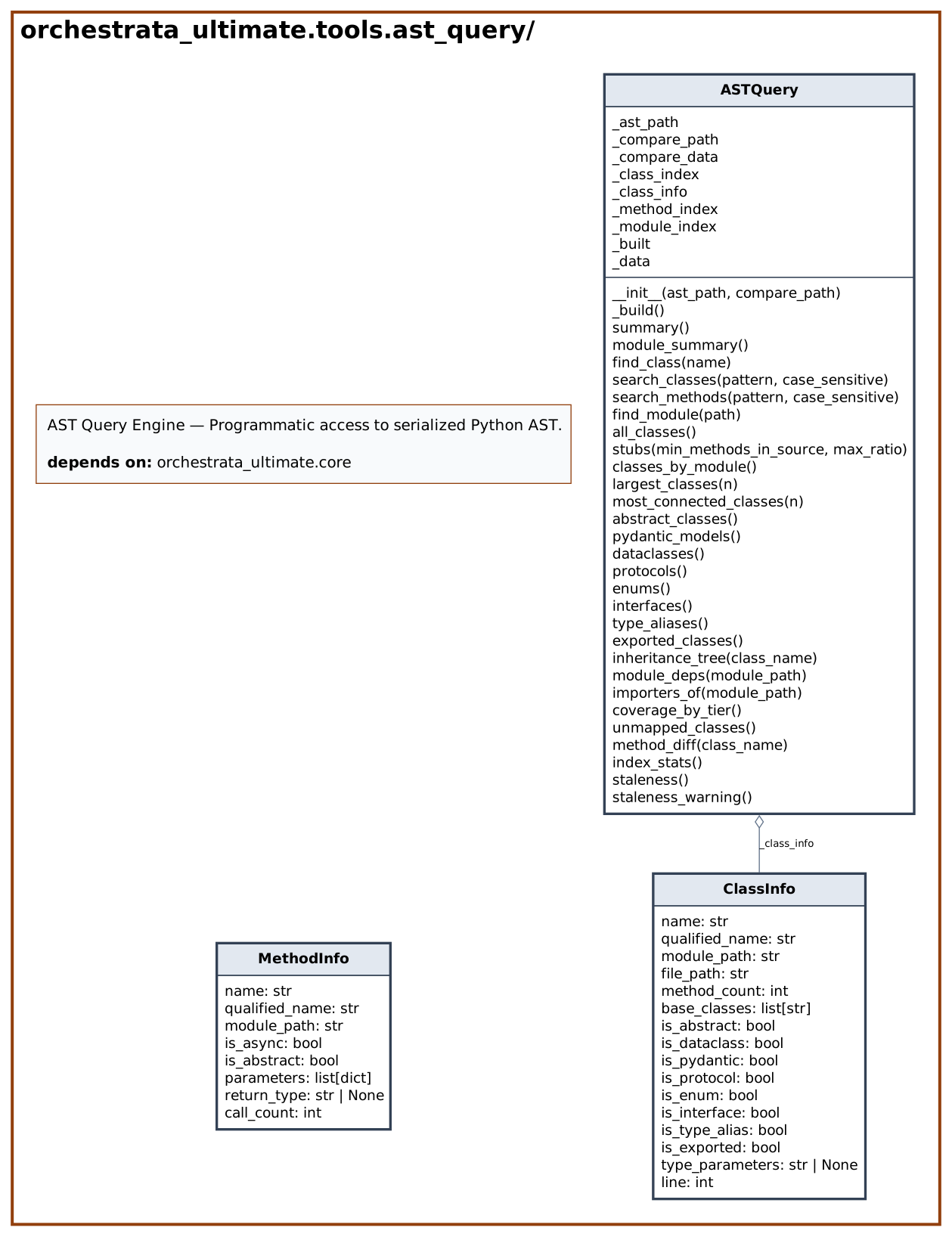
Dependency diagram

API
Classes
ClassInfo (dataclass)
Decorators: dataclass · Line 66
Lightweight class summary for fast iteration.
| Attribute | Type | Default |
|---|---|---|
name |
str |
|
qualified_name |
str |
|
module_path |
str |
|
file_path |
str |
|
method_count |
int |
|
base_classes |
list[str] |
field(default_factory=list) |
is_abstract |
bool |
False |
is_dataclass |
bool |
False |
is_pydantic |
bool |
False |
is_protocol |
bool |
False |
is_enum |
bool |
False |
is_interface |
bool |
False |
is_type_alias |
bool |
False |
is_exported |
bool |
False |
type_parameters |
str | None |
None |
line |
int |
0 |
MethodInfo (dataclass)
Decorators: dataclass · Line 89
Lightweight method/function summary.
| Attribute | Type | Default |
|---|---|---|
name |
str |
|
qualified_name |
str |
|
module_path |
str |
|
is_async |
bool |
False |
is_abstract |
bool |
False |
parameters |
list[dict] |
field(default_factory=list) |
return_type |
str | None |
None |
call_count |
int |
0 |
ASTQuery
Line 102
Query engine over serialized Python AST JSON.
| Method | Signature | Summary |
|---|---|---|
__init__ |
__init__(ast_path: str | Path = 'plans/ast-ultimate.json', compare_path: str | Path | None = None) |
|
_build |
_build() -> None |
|
summary |
summary() -> dict[str, Any] |
Return top-level project summary. |
module_summary |
module_summary() -> list[dict[str, Any]] |
Return per-module LOC, class count, function count. |
find_class |
find_class(name: str) -> dict | None |
Find a class by exact or partial name. |
search_classes |
search_classes(pattern: str, case_sensitive: bool = False) -> list[ClassInfo] |
Return ClassInfo for all classes whose name matches a regex. |
search_methods |
search_methods(pattern: str, case_sensitive: bool = False) -> list[dict] |
Return method dicts matching a regex against qualified name. |
find_module |
find_module(path: str) -> dict | None |
Return module dict by path (e.g. 'agents.base_agent'). |
all_classes |
all_classes() -> list[ClassInfo] |
Return all ClassInfo summaries. |
stubs |
stubs(min_methods_in_source: int = 3, max_ratio: float = 0.3) -> list[dict[str, Any]] |
Return classes that appear to be stubs (low method count vs source). |
classes_by_module |
classes_by_module() -> dict[str, list[ClassInfo]] |
Return classes grouped by top-level module. |
largest_classes |
largest_classes(n: int = 20) -> list[dict[str, Any]] |
Return the n classes with the most methods. |
most_connected_classes |
most_connected_classes(n: int = 20) -> list[dict[str, Any]] |
Return classes with the most subclasses (via inheritance graph). |
abstract_classes |
abstract_classes() -> list[ClassInfo] |
Return all abstract classes. |
pydantic_models |
pydantic_models() -> list[ClassInfo] |
Return all Pydantic BaseModel classes. |
dataclasses |
dataclasses() -> list[ClassInfo] |
Return all dataclass-annotated classes. |
protocols |
protocols() -> list[ClassInfo] |
Return all Protocol classes. |
enums |
enums() -> list[ClassInfo] |
Return all Enum classes. |
interfaces |
interfaces() -> list[ClassInfo] |
Return all Interface declarations (JS/TS: interface Foo { ... }). |
type_aliases |
type_aliases() -> list[ClassInfo] |
Return all Type alias declarations (JS/TS: type Foo = ...). |
exported_classes |
exported_classes() -> list[ClassInfo] |
Return all exported classes/functions/interfaces (JS/TS: export class ...). |
inheritance_tree |
inheritance_tree(class_name: str) -> dict[str, Any] | None |
Return parents and children for a class. |
module_deps |
module_deps(module_path: str) -> list[str] |
Return modules that this module imports. |
importers_of |
importers_of(module_path: str) -> list[str] |
Return modules that import this module. |
coverage_by_tier |
coverage_by_tier() -> dict[str, dict[str, Any]] |
Return coverage stats by tier if comparison data is loaded. |
unmapped_classes |
unmapped_classes() -> dict[str, list[str]] |
Return orchestrata classes not yet ported and ultimate orphan classes. |
method_diff |
method_diff(class_name: str) -> dict[str, Any] | None |
Return method-level diff for a class (requires comparison data). |
index_stats |
index_stats() -> dict[str, int] |
Return size of internal indexes. |
staleness |
staleness() -> tuple[int, float] | None |
Check whether the live source tree is newer than this snapshot. |
staleness_warning |
staleness_warning() -> str | None |
Return a one-line staleness WARNING, or None if the snapshot is fresh. |
Functions
| Function | Signature | Summary |
|---|---|---|
_find_project_root |
_find_project_root() -> Path | None |
Walk up from CWD looking for a project with plans/ast-ultimate.json. |
_resolve_path |
_resolve_path(path: str | Path) -> Path |
Resolve a path relative to the project root, CWD, or as absolute. |
Source
"""
AST Query Engine — Programmatic access to serialized Python AST.
Loads ``plans/ast-ultimate.json`` (and optionally the orchestrata comparison)
and exposes a rich query API: find classes, list stubs, compute coverage,
trace inheritance, search methods, and more.
Usage::
from orchestrata_ultimate.tools.ast_query import ASTQuery
ast = ASTQuery()
ast.summary()
ast.stubs()
ast.find_class("BaseAgent")
ast.classes_by_module()
"""
from __future__ import annotations
import json
import re
from collections import defaultdict
from dataclasses import dataclass, field
from datetime import datetime
from pathlib import Path
from typing import Any
from orchestrata_ultimate.core.paths import resolve_project_root
def _find_project_root() -> Path | None:
"""Walk up from CWD looking for a project with plans/ast-ultimate.json."""
current = Path.cwd().resolve()
for parent in [current, *current.parents]:
if (parent / "plans" / "ast-ultimate.json").exists():
return parent
if (parent / "pyproject.toml").exists():
return parent
return None
def _resolve_path(path: str | Path) -> Path:
"""Resolve a path relative to the project root, CWD, or as absolute."""
p = Path(path)
if p.is_absolute():
return p
project_root = _find_project_root()
candidates = []
if project_root:
candidates.append(project_root / p)
candidates.extend(
[
resolve_project_root() / p,
Path.cwd() / p,
]
)
for c in candidates:
if c.exists():
return c
return candidates[0]
@dataclass
class ClassInfo:
"""Lightweight class summary for fast iteration."""
name: str
qualified_name: str
module_path: str
file_path: str
method_count: int
base_classes: list[str] = field(default_factory=list)
is_abstract: bool = False
is_dataclass: bool = False
is_pydantic: bool = False
is_protocol: bool = False
is_enum: bool = False
# JS/TS extensions (zero for Python)
is_interface: bool = False
is_type_alias: bool = False
is_exported: bool = False
type_parameters: str | None = None
line: int = 0
@dataclass
class MethodInfo:
"""Lightweight method/function summary."""
name: str
qualified_name: str
module_path: str
is_async: bool = False
is_abstract: bool = False
parameters: list[dict] = field(default_factory=list)
return_type: str | None = None
call_count: int = 0
class ASTQuery:
"""Query engine over serialized Python AST JSON."""
def __init__(
self,
ast_path: str | Path = "plans/ast-ultimate.json",
compare_path: str | Path | None = None,
):
self._ast_path = _resolve_path(ast_path)
self._compare_path = _resolve_path(compare_path) if compare_path else None
with open(self._ast_path) as f:
self._data: dict = json.load(f)
self._compare_data: dict | None = None
if self._compare_path and self._compare_path.exists():
with open(self._compare_path) as f:
self._compare_data = json.load(f)
# Indexes built lazily
self._class_index: dict[str, dict] = {}
self._class_info: dict[str, ClassInfo] = {}
self._method_index: dict[str, dict] = {}
self._module_index: dict[str, dict] = {}
self._built = False
# ── building indexes ──────────────────────────────────────────────
def _build(self) -> None:
if self._built:
return
for mod in self._data.get("modules", []):
mp = mod["path"]
self._module_index[mp] = mod
for cls in mod.get("classes", []):
qn = cls["qualified_name"]
self._class_index[qn] = cls
self._class_info[qn] = ClassInfo(
name=cls["name"],
qualified_name=qn,
module_path=cls.get("module_path", mp),
file_path=cls.get("file_path", mod.get("file_path", "")),
method_count=len(cls.get("methods", [])),
base_classes=cls.get("bases") or [],
is_abstract=cls.get("is_abstract", False),
is_dataclass=cls.get("is_dataclass", False),
is_pydantic=cls.get("is_pydantic", False),
is_protocol=cls.get("is_protocol", False),
is_enum=cls.get("is_enum", False),
is_interface=cls.get("is_interface", False),
is_type_alias=cls.get("is_type_alias", False),
is_exported=cls.get("is_exported", False),
type_parameters=cls.get("type_parameters"),
line=cls.get("line", 0),
)
for meth in cls.get("methods", []):
mqn = meth["qualified_name"]
self._method_index[mqn] = meth
self._built = True
# ── summaries ─────────────────────────────────────────────────────
def summary(self) -> dict[str, Any]:
"""Return top-level project summary."""
self._build()
return {
"name": self._data.get("name"),
"root_path": self._data.get("root_path"),
"modules": len(self._data.get("modules", [])),
"classes": self._data.get("total_classes", 0),
"functions": self._data.get("total_functions", 0),
"methods": self._data.get("total_methods", 0),
"total_loc": self._data.get("total_loc", 0),
}
def module_summary(self) -> list[dict[str, Any]]:
"""Return per-module LOC, class count, function count."""
self._build()
result = [
{
"path": mod["path"],
"file_path": mod.get("file_path", ""),
"line_count": mod.get("line_count", 0),
"classes": len(mod.get("classes", [])),
"functions": len(mod.get("functions", [])),
"imports": len(mod.get("imports", [])),
}
for mod in self._data.get("modules", [])
]
return sorted(result, key=lambda m: m["line_count"], reverse=True)
# ── finding ───────────────────────────────────────────────────────
def find_class(self, name: str) -> dict | None:
"""Find a class by exact or partial name. Returns full class dict."""
self._build()
# Try exact qualified name first
if name in self._class_index:
return self._class_index[name]
# Try short name
for qn, cls in self._class_index.items():
if cls["name"] == name:
return cls
# Fuzzy: substring match
matches = [
cls for qn, cls in self._class_index.items() if name.lower() in qn.lower()
]
if len(matches) == 1:
return matches[0]
return None
def search_classes(
self, pattern: str, case_sensitive: bool = False
) -> list[ClassInfo]:
"""Return ClassInfo for all classes whose name matches a regex."""
self._build()
flags = 0 if case_sensitive else re.IGNORECASE
rx = re.compile(pattern, flags)
return [
ci
for ci in self._class_info.values()
if rx.search(ci.name) or rx.search(ci.qualified_name)
]
def search_methods(self, pattern: str, case_sensitive: bool = False) -> list[dict]:
"""Return method dicts matching a regex against qualified name."""
self._build()
flags = 0 if case_sensitive else re.IGNORECASE
rx = re.compile(pattern, flags)
return [
m for m in self._method_index.values() if rx.search(m["qualified_name"])
]
def find_module(self, path: str) -> dict | None:
"""Return module dict by path (e.g. 'agents.base_agent')."""
self._build()
return self._module_index.get(path)
# ── analysis ──────────────────────────────────────────────────────
def all_classes(self) -> list[ClassInfo]:
"""Return all ClassInfo summaries."""
self._build()
return list(self._class_info.values())
def stubs(
self,
min_methods_in_source: int = 3,
max_ratio: float = 0.3,
) -> list[dict[str, Any]]:
"""Return classes that appear to be stubs (low method count vs source).
If a comparison AST is loaded, uses the deep-compare readiness data.
Otherwise heuristically flags classes with few methods.
"""
self._build()
stubs = []
if self._compare_data:
# Use deep-comparison data. Support both the legacy schema
# (`ultimate_class`/`orchestrata_class` dicts with a
# `method_count`, falling back to a `methods` list) and the
# schema actually produced by
# `scripts/serialize_codebase_ast.py deep-compare`, where each
# pair carries `ultimate`/`orchestrata` dicts whose `methods` is
# already an int count.
for pair in self._compare_data.get("pairs", []):
readiness = pair.get("readiness", "")
if readiness in ("stub", "partial"):
uc = pair.get("ultimate_class") or pair.get("ultimate") or {}
oc = pair.get("orchestrata_class") or pair.get("orchestrata") or {}
u_methods = uc.get("method_count", uc.get("methods"))
if not isinstance(u_methods, int):
u_methods = len(u_methods or [])
o_methods = oc.get("method_count", oc.get("methods"))
if not isinstance(o_methods, int):
o_methods = len(o_methods or [])
method_diff = pair.get("method_diff", {})
stubs.append(
{
"name": uc.get("name", pair.get("ultimate_name", "?")),
"module": uc.get("module_path", uc.get("module", "")),
"readiness": readiness,
"ultimate_methods": u_methods,
"orchestrata_methods": o_methods,
"ratio": round(u_methods / max(o_methods, 1), 2),
"missing_methods": (
pair.get("ultimate_only_methods")
or pair.get("orchestrata_only_methods")
or method_diff.get("only_in_ultimate")
or method_diff.get("only_in_orchestrata")
or []
),
}
)
return sorted(stubs, key=lambda s: s["ratio"])
# Heuristic: flag classes with very few methods
for ci in self._class_info.values():
# Skip enums, protocols, exceptions, abstract base classes
if ci.is_enum or ci.is_protocol:
continue
if ci.method_count < min_methods_in_source and ci.method_count > 0:
stubs.append(
{
"name": ci.name,
"module": ci.module_path,
"readiness": "heuristic",
"ultimate_methods": ci.method_count,
"orchestrata_methods": "?",
"ratio": 0.0,
"missing_methods": [],
}
)
return sorted(stubs, key=lambda s: s["ultimate_methods"])
def classes_by_module(self) -> dict[str, list[ClassInfo]]:
"""Return classes grouped by top-level module."""
self._build()
groups: dict[str, list[ClassInfo]] = defaultdict(list)
for ci in self._class_info.values():
top = ci.module_path.split(".")[0] if ci.module_path else "root"
groups[top].append(ci)
return dict(groups)
def largest_classes(self, n: int = 20) -> list[dict[str, Any]]:
"""Return the n classes with the most methods."""
self._build()
ranked = sorted(
self._class_info.values(),
key=lambda c: c.method_count,
reverse=True,
)[:n]
return [
{
"name": ci.name,
"qualified_name": ci.qualified_name,
"module": ci.module_path,
"methods": ci.method_count,
"line": ci.line,
}
for ci in ranked
]
def most_connected_classes(self, n: int = 20) -> list[dict[str, Any]]:
"""Return classes with the most subclasses (via inheritance graph)."""
self._build()
ig = self._data.get("inheritance_graph", {})
# Count how many classes inherit from each class
child_count: dict[str, int] = defaultdict(int)
for child, parents in ig.items():
for parent in parents:
child_count[parent] += 1
ranked = sorted(child_count.items(), key=lambda x: x[1], reverse=True)[:n]
return [{"class": name, "subclasses": count} for name, count in ranked]
def abstract_classes(self) -> list[ClassInfo]:
"""Return all abstract classes."""
self._build()
return [ci for ci in self._class_info.values() if ci.is_abstract]
def pydantic_models(self) -> list[ClassInfo]:
"""Return all Pydantic BaseModel classes."""
self._build()
return [ci for ci in self._class_info.values() if ci.is_pydantic]
def dataclasses(self) -> list[ClassInfo]:
"""Return all dataclass-annotated classes."""
self._build()
return [ci for ci in self._class_info.values() if ci.is_dataclass]
def protocols(self) -> list[ClassInfo]:
"""Return all Protocol classes."""
self._build()
return [ci for ci in self._class_info.values() if ci.is_protocol]
def enums(self) -> list[ClassInfo]:
"""Return all Enum classes."""
self._build()
return [ci for ci in self._class_info.values() if ci.is_enum]
def interfaces(self) -> list[ClassInfo]:
"""Return all Interface declarations (JS/TS: ``interface Foo { ... }``)."""
self._build()
return [ci for ci in self._class_info.values() if ci.is_interface]
def type_aliases(self) -> list[ClassInfo]:
"""Return all Type alias declarations (JS/TS: ``type Foo = ...``)."""
self._build()
return [ci for ci in self._class_info.values() if ci.is_type_alias]
def exported_classes(self) -> list[ClassInfo]:
"""Return all exported classes/functions/interfaces (JS/TS: ``export class ...``)."""
self._build()
return [ci for ci in self._class_info.values() if ci.is_exported]
def inheritance_tree(self, class_name: str) -> dict[str, Any] | None:
"""Return parents and children for a class."""
self._build()
ig = self._data.get("inheritance_graph", {})
# Find the fully qualified name
qn = class_name
if qn not in ig:
for k in ig:
if k.endswith(class_name):
qn = k
break
if qn not in ig:
return None
children = [k for k, parents in ig.items() if qn in parents]
return {
"class": qn,
"parents": ig.get(qn, []),
"children": children,
"child_count": len(children),
}
def module_deps(self, module_path: str) -> list[str]:
"""Return modules that this module imports."""
dg: dict[str, list[str]] = self._data.get("dependency_graph", {})
return dg.get(module_path, [])
def importers_of(self, module_path: str) -> list[str]:
"""Return modules that import this module."""
dg = self._data.get("dependency_graph", {})
return [k for k, deps in dg.items() if module_path in deps]
# ── comparison helpers (require compare_path) ─────────────────────
def coverage_by_tier(self) -> dict[str, dict[str, Any]]:
"""Return coverage stats by tier if comparison data is loaded.
Supports the legacy ``tier_summary`` list schema as well as the
``coverage_by_tier`` mapping schema actually produced by the
current ``scripts/serialize_codebase_ast.py deep-compare`` command.
"""
if not self._compare_data:
return {}
result: dict[str, dict[str, Any]] = {}
legacy = self._compare_data.get("tier_summary")
if legacy:
for tier_entry in legacy:
tier = str(tier_entry.get("tier", "?"))
result[tier] = {
"packages": tier_entry.get("package_count", 0),
"orchestrata_loc": tier_entry.get("orchestrata_loc", 0),
"ultimate_loc": tier_entry.get("ultimate_loc", 0),
"coverage": tier_entry.get("loc_coverage", 0),
"class_coverage": tier_entry.get("class_coverage", 0),
}
return result
for tier, tier_entry in self._compare_data.get("coverage_by_tier", {}).items():
result[str(tier)] = {
"packages": len(tier_entry.get("packages", [])),
"orchestrata_loc": tier_entry.get("orch_loc", 0),
"ultimate_loc": tier_entry.get("ult_loc", 0),
"coverage": tier_entry.get("loc_coverage_pct", 0),
"class_coverage": tier_entry.get("class_coverage_pct", 0),
}
return result
def unmapped_classes(self) -> dict[str, list[str]]:
"""Return orchestrata classes not yet ported and ultimate orphan classes.
Supports the legacy top-level ``orchestrata_only``/``ultimate_only``
lists of class dicts as well as the ``unmapped`` mapping produced by
the current deep-compare command. In that mapping ``ultimate_only``
is a flat list of class-name strings, but the unmapped orchestrata
classes are grouped by package under ``orchestrata_by_package``
(a ``{package: [class_name, ...]}`` mapping) — NOT a flat
``orchestrata_only`` list — so they must be flattened out.
"""
if not self._compare_data:
return {}
unmapped = self._compare_data.get("unmapped")
if unmapped is not None:
orch = list(unmapped.get("orchestrata_only", []))
if not orch:
by_pkg = unmapped.get("orchestrata_by_package", {})
if isinstance(by_pkg, dict):
orch = [name for names in by_pkg.values() for name in names]
return {
"orchestrata_only": orch,
"ultimate_only": list(unmapped.get("ultimate_only", [])),
}
return {
"orchestrata_only": [
c.get("name", "?")
for c in self._compare_data.get("orchestrata_only", [])
],
"ultimate_only": [
c.get("name", "?") for c in self._compare_data.get("ultimate_only", [])
],
}
def method_diff(self, class_name: str) -> dict[str, Any] | None:
"""Return method-level diff for a class (requires comparison data).
Supports the legacy schema (``ultimate_class``/``orchestrata_class``
dicts, flat ``shared_methods``/``param_mismatches`` lists on the
pair) and the schema produced by the current deep-compare command,
where each pair nests a ``method_diff`` dict with ``shared``/
``only_in_ultimate``/``only_in_orchestrata`` keys.
"""
if not self._compare_data:
return None
for pair in self._compare_data.get("pairs", []):
uc = pair.get("ultimate_class", {})
oc = pair.get("orchestrata_class", {})
u_name = uc.get("name") or pair.get("ultimate_name", "?")
o_name = oc.get("name") or pair.get("orchestrata_name", "?")
if u_name != class_name and o_name != class_name:
continue
method_diff = pair.get("method_diff")
if method_diff is None:
return {
"pair_name": f"{u_name} ↔ {o_name}",
"readiness": pair.get("readiness", "?"),
"ultimate_method_count": uc.get(
"method_count", len(uc.get("methods", []))
),
"orchestrata_method_count": oc.get(
"method_count", len(oc.get("methods", []))
),
"shared_methods": pair.get("shared_methods", []),
"ultimate_only_methods": pair.get("ultimate_only_methods", []),
"orchestrata_only_methods": pair.get(
"orchestrata_only_methods", []
),
"param_mismatches": pair.get("param_mismatches", []),
}
ultimate = pair.get("ultimate", {})
orchestrata = pair.get("orchestrata", {})
shared = method_diff.get("shared", [])
return {
"pair_name": f"{u_name} ↔ {o_name}",
"readiness": pair.get("readiness", "?"),
"ultimate_method_count": ultimate.get("methods", 0),
"orchestrata_method_count": orchestrata.get("methods", 0),
"shared_methods": [m.get("name", "?") for m in shared],
"ultimate_only_methods": method_diff.get("only_in_ultimate", []),
"orchestrata_only_methods": method_diff.get("only_in_orchestrata", []),
"param_mismatches": [
m.get("name", "?")
for m in shared
if m.get("param_diffs") or m.get("params_a") != m.get("params_b")
],
}
return None
# ── introspection ─────────────────────────────────────────────────
def index_stats(self) -> dict[str, int]:
"""Return size of internal indexes."""
self._build()
return {
"classes": len(self._class_index),
"methods": len(self._method_index),
"modules": len(self._module_index),
}
# ── snapshot freshness ────────────────────────────────────────────
def staleness(self) -> tuple[int, float] | None:
"""Check whether the live source tree is newer than this snapshot.
Compares the snapshot file's mtime against every ``.py`` file under
the snapshot's recorded ``root_path``. Returns ``None`` if the
snapshot appears fresh (no newer source file found) or its source
root can't be located; otherwise returns
``(stale_file_count, snapshot_mtime)``.
"""
root_path = self._data.get("root_path")
if not root_path:
return None
src_root = _resolve_path(root_path)
if not src_root.exists():
return None
try:
snapshot_mtime = self._ast_path.stat().st_mtime
except OSError:
return None
stale = 0
for py_file in src_root.rglob("*.py"):
try:
if py_file.stat().st_mtime > snapshot_mtime:
stale += 1
except OSError:
continue
if stale == 0:
return None
return stale, snapshot_mtime
def staleness_warning(self) -> str | None:
"""Return a one-line staleness WARNING, or ``None`` if the snapshot is fresh.
Includes the snapshot's generation date and the number of stale
(changed-since-snapshot) source files, so a caller can print it to
stderr without altering its own stdout output format.
"""
info = self.staleness()
if info is None:
return None
stale, snapshot_mtime = info
snap_date = datetime.fromtimestamp(snapshot_mtime).strftime("%Y-%m-%d %H:%M")
return (
f"WARNING: AST snapshot {self._ast_path} is stale "
f"(generated {snap_date}); {stale} source file(s) under "
f"{self._data.get('root_path')} changed since — re-run "
f"'serialize_codebase_ast.py serialize' for accurate numbers."
)