orchestrata_ultimate.kernel.queue_manager
Reference › orchestrata_ultimate › kernel › queue_manager
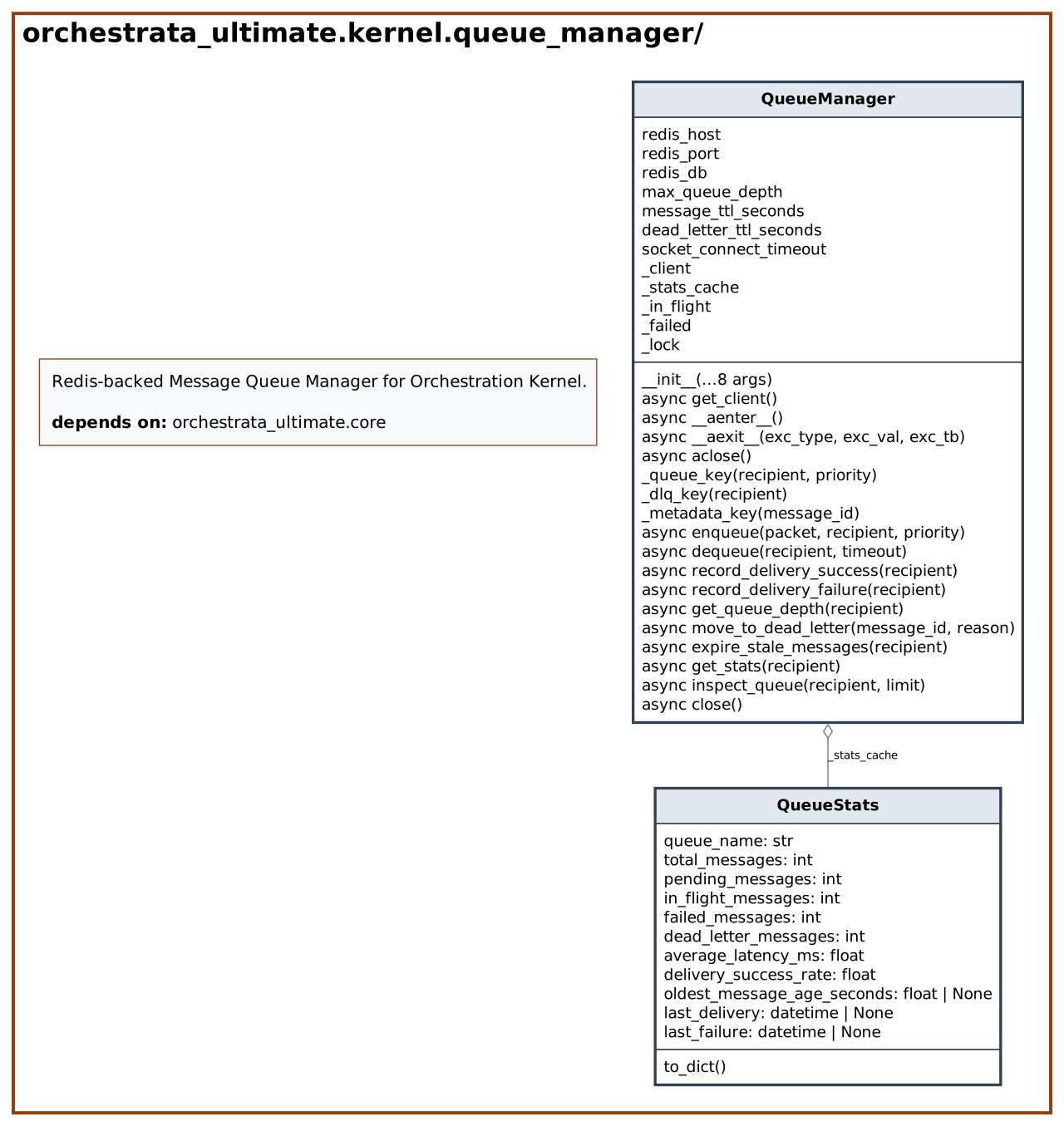
The durable parking place for packets whose recipient is offline. QueueManager keeps one Redis list per recipient and priority, so a packet survives a restart and is delivered when the volk returns. It serves SPEC-001 story US-002 (REQ-001-US-002-021 to -030). It sits behind router, which marks packets for offline recipients as queued, and dispatcher, which parks undeliverable packets here. The Redis client is built lazily through core.redis_factory, with the host and port passed in or resolved from the environment. The postman queue manager is the separate queue layer of the broker.
enqueue first checks the total depth against max_queue_depth (10000 by default) and returns False when the queue is full (backpressure). Otherwise it serialises the packet with its queue time, priority, recipient and message id, pushes it to the list orchestrata:queue:<recipient>:p<priority>, sets the expiry from message_ttl_seconds (one day by default) and writes a metadata hash keyed by the packet id. dequeue probes the priority queues from CRITICAL down to LOWEST and pops the first message, using a blocking pop when a timeout is given; it updates the metadata, counts the message in flight and returns the rebuilt CXPPacket, or None when all queues are empty. record_delivery_success and record_delivery_failure move the in-flight counters. expire_stale_messages scans each queue, collects entries older than the TTL, removes them and moves them to the dead-letter list through move_to_dead_letter, which writes a reason and keeps the list for dead_letter_ttl_seconds (seven days by default). get_stats returns a QueueStats; inspect_queue lists messages for debugging.
Redis failures in these methods are logged and reported as False, None or 0 rather than raised.
At a glance
| Source | src/orchestrata_ultimate/kernel/queue_manager.py |
| Lines of code | 674 |
| Classes | 2 |
| Functions | 1 |
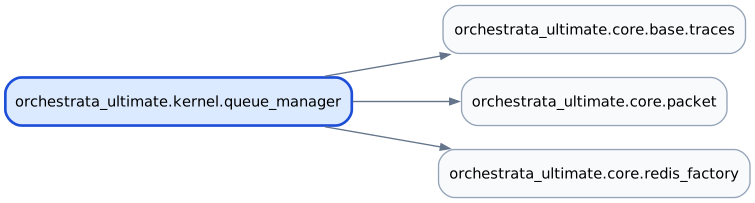
| Imports (internal) | orchestrata_ultimate.core.base.traces, orchestrata_ultimate.core.packet, orchestrata_ultimate.core.redis_factory |
| Imported by | none |
| Tests that import it | tests/kernel/test_queue_expire_regression.py, tests/kernel/test_queue_manager_extended.py, tests/postman/test_coverage_queue_manager.py |
Class diagram
Dependency diagram
API
Classes
QueueStats (dataclass)
Decorators: traces(spec='001', story='US-002', reqs=['REQ-001-US-002-028']), dataclass · Line 50
Statistics for a message queue.
| Attribute | Type | Default |
|---|---|---|
queue_name |
str |
|
total_messages |
int |
|
pending_messages |
int |
|
in_flight_messages |
int |
|
failed_messages |
int |
|
dead_letter_messages |
int |
|
average_latency_ms |
float |
0.0 |
delivery_success_rate |
float |
0.0 |
oldest_message_age_seconds |
float | None |
None |
last_delivery |
datetime | None |
None |
last_failure |
datetime | None |
None |
| Method | Signature | Summary |
|---|---|---|
to_dict |
to_dict() -> dict[str, Any] |
Convert to dictionary. |
QueueManager
Decorators: traces(spec='001', story='US-002', reqs=['REQ-001-US-002-021', 'REQ-001-US-002-022', 'REQ-001-US-002-023', 'REQ-001-US-… · Line 98
Manages Redis-backed message queues for offline Volks.
| Method | Signature | Summary |
|---|---|---|
__init__ |
__init__(redis_host: str | None = None, redis_port: int | None = None, redis_db: int = 0, max_queue_depth: int = 10000, message_ttl_seconds: int = 86400, dead_letter_ttl_seconds: int = 604800, socket_connect_timeout: float = 30.0, redis_client: redis.Redis | None = None) -> None |
Initialize queue manager. |
get_client |
async get_client() -> redis.Redis |
Get or create async Redis client (lazy initialization). |
__aenter__ |
async __aenter__() -> QueueManager |
Context manager entry. |
__aexit__ |
async __aexit__(exc_type: type[BaseException] | None, exc_val: BaseException | None, exc_tb: TracebackType | None) -> bool |
Context manager exit - close connection. |
aclose |
async aclose() -> None |
Async close Redis connection. |
_queue_key |
_queue_key(recipient: str, priority: int = 0) -> str |
Build Redis key for queue. |
_dlq_key |
_dlq_key(recipient: str) -> str |
Build Redis key for dead-letter queue. |
_metadata_key |
_metadata_key(message_id: str) -> str |
Build Redis key for message metadata. |
enqueue |
async enqueue(packet: CXPPacket, recipient: str, priority: int = 0) -> bool |
Enqueue message for offline recipient. |
dequeue |
async dequeue(recipient: str, timeout: float = 0) -> CXPPacket | None |
Dequeue message for recipient. |
record_delivery_success |
async record_delivery_success(recipient: str) -> None |
Record successful delivery, decrementing in-flight count. |
record_delivery_failure |
async record_delivery_failure(recipient: str) -> None |
Record failed delivery, moving from in-flight to failed. |
get_queue_depth |
async get_queue_depth(recipient: str) -> int |
Get total queue depth across all priorities. |
move_to_dead_letter |
async move_to_dead_letter(message_id: str, reason: str) -> bool |
Move failed message to dead-letter queue. |
expire_stale_messages |
async expire_stale_messages(recipient: str) -> int |
Remove expired messages from queue. |
get_stats |
async get_stats(recipient: str) -> QueueStats |
Get queue statistics. |
inspect_queue |
async inspect_queue(recipient: str, limit: int = 10) -> list[dict[str, Any]] |
Inspect queued messages for debugging. |
close |
async close() -> None |
Close Redis connection. |
Functions
| Function | Signature | Summary |
|---|---|---|
_redis_result traces |
_redis_result(value: Awaitable[T] | T) -> Awaitable[T] |
Narrow a redis-py command result back to its true async type. |
Source
# mypy: ignore-errors
"""Redis-backed Message Queue Manager for Orchestration Kernel.
This module implements persistent message queuing for offline Volks
with priority support, dead-letter queue, and monitoring as specified in Stream 2A.
Requirements Implemented:
- REQ-001-US-002-021 to REQ-001-US-002-030: Queue management with Redis persistence
"""
import asyncio
import json
import logging
from collections.abc import Awaitable
from dataclasses import dataclass
from datetime import UTC, datetime, timedelta
from typing import TYPE_CHECKING, Any, cast
if TYPE_CHECKING:
from types import TracebackType
import redis.asyncio as redis
from orchestrata_ultimate.core.base.traces import traces
from orchestrata_ultimate.core.packet import CXPPacket, DeliveryStatus, Priority
from orchestrata_ultimate.core.redis_factory import (
resolve_redis_host,
resolve_redis_port,
)
logger = logging.getLogger(__name__)
@traces(spec="001", story="US-002", reqs=["REQ-001-US-002-021"])
def _redis_result[T](value: Awaitable[T] | T) -> Awaitable[T]:
"""Narrow a redis-py command result back to its true async type.
redis-py types command methods (``rpush``, ``hset``, ``llen``, ...) as
``Awaitable[T] | T`` because the same command mixin backs both the sync
and async clients (see ``redis.typing.ResponseT``). This manager only
ever holds an async client (``get_client()``), which always returns an
awaitable at runtime -- this documents that fact for pyright instead of
suppressing the check.
"""
return cast(Awaitable[T], value)
@traces(spec="001", story="US-002", reqs=["REQ-001-US-002-028"])
@dataclass
class QueueStats:
"""Statistics for a message queue."""
queue_name: str
total_messages: int
pending_messages: int
in_flight_messages: int
failed_messages: int
dead_letter_messages: int
average_latency_ms: float = 0.0
delivery_success_rate: float = 0.0
oldest_message_age_seconds: float | None = None
last_delivery: datetime | None = None
last_failure: datetime | None = None
def to_dict(self) -> dict[str, Any]:
"""Convert to dictionary."""
return {
"queue_name": self.queue_name,
"total_messages": self.total_messages,
"pending_messages": self.pending_messages,
"in_flight_messages": self.in_flight_messages,
"failed_messages": self.failed_messages,
"dead_letter_messages": self.dead_letter_messages,
"average_latency_ms": self.average_latency_ms,
"delivery_success_rate": self.delivery_success_rate,
"oldest_message_age_seconds": self.oldest_message_age_seconds,
"last_delivery": (
self.last_delivery.isoformat() if self.last_delivery else None
),
"last_failure": (
self.last_failure.isoformat() if self.last_failure else None
),
}
@traces(
spec="001",
story="US-002",
reqs=[
"REQ-001-US-002-021",
"REQ-001-US-002-022",
"REQ-001-US-002-023",
"REQ-001-US-002-024",
"REQ-001-US-002-027",
"REQ-001-US-002-028",
],
)
class QueueManager:
"""Manages Redis-backed message queues for offline Volks.
Provides durable queuing with priority support, backpressure,
and dead-letter queue for failed messages.
"""
def __init__(
self,
redis_host: str | None = None,
redis_port: int | None = None,
redis_db: int = 0,
max_queue_depth: int = 10000,
message_ttl_seconds: int = 86400, # 24 hours
dead_letter_ttl_seconds: int = 604800, # 7 days
socket_connect_timeout: float = 30.0,
redis_client: redis.Redis | None = None,
) -> None:
"""Initialize queue manager.
Args:
redis_host: Redis server host
redis_port: Redis server port
redis_db: Redis database number
max_queue_depth: Maximum messages per queue (backpressure threshold)
message_ttl_seconds: Time-to-live for queued messages
dead_letter_ttl_seconds: Time-to-live for dead-letter messages
socket_connect_timeout: TCP connect timeout in seconds
redis_client: Pre-built async client injected directly (the
host/port/db/timeout args are ignored for connection
purposes when provided). The seam for callers that need a
non-default retry policy — e.g. error-path tests inject a
fail-fast client because redis-py 7's default
``Retry(ExponentialWithJitterBackoff(), 3)`` turns each
command against a dead address into a 4-13s backoff loop.
"""
self.redis_host = redis_host if redis_host is not None else resolve_redis_host()
self.redis_port = redis_port if redis_port is not None else resolve_redis_port()
self.redis_db = redis_db
self.max_queue_depth = max_queue_depth
self.message_ttl_seconds = message_ttl_seconds
self.dead_letter_ttl_seconds = dead_letter_ttl_seconds
self.socket_connect_timeout = socket_connect_timeout
self._client: redis.Redis | None = redis_client
self._stats_cache: dict[str, QueueStats] = {}
self._in_flight: dict[str, int] = {}
self._failed: dict[str, int] = {}
self._lock = asyncio.Lock()
@traces(spec="001", story="US-010", reqs=["REQ-001-US-010-012"])
async def get_client(self) -> redis.Redis:
"""Get or create async Redis client (lazy initialization)."""
if self._client is None:
from orchestrata_ultimate.core.redis_factory import create_async_redis
self._client = create_async_redis(
host=self.redis_host,
port=self.redis_port,
db=self.redis_db,
socket_connect_timeout=self.socket_connect_timeout,
)
return self._client
async def __aenter__(self) -> QueueManager:
"""Context manager entry."""
return self
async def __aexit__(
self,
exc_type: type[BaseException] | None,
exc_val: BaseException | None,
exc_tb: TracebackType | None,
) -> bool:
"""Context manager exit - close connection."""
await self.aclose()
return False
async def aclose(self) -> None:
"""Async close Redis connection."""
if self._client:
await self._client.aclose()
self._client = None
@traces(spec="001", story="US-002", reqs=["REQ-001-US-002-023"])
def _queue_key(self, recipient: str, priority: int = 0) -> str:
"""Build Redis key for queue."""
return f"orchestrata:queue:{recipient}:p{priority}"
@traces(spec="001", story="US-002", reqs=["REQ-001-US-002-027"])
def _dlq_key(self, recipient: str) -> str:
"""Build Redis key for dead-letter queue."""
return f"orchestrata:dlq:{recipient}"
@traces(spec="001", story="US-002", reqs=["REQ-001-US-002-037"])
def _metadata_key(self, message_id: str) -> str:
"""Build Redis key for message metadata."""
return f"orchestrata:msg_meta:{message_id}"
@traces(
spec="001",
story="US-002",
reqs=[
"REQ-001-US-002-018",
"REQ-001-US-002-021",
"REQ-001-US-002-023",
"REQ-001-US-002-030",
"REQ-001-US-010-015",
],
)
async def enqueue(
self, packet: CXPPacket, recipient: str, priority: int = 0
) -> bool:
"""Enqueue message for offline recipient.
REQ-001-US-002-021: Queue messages when recipient unavailable
REQ-001-US-002-022: Persist queue to Redis
REQ-001-US-002-023: Support priority queuing
REQ-001-US-002-024: Apply backpressure when queue full
Args:
packet: CXP packet to queue
recipient: Recipient Volk alias
priority: Message priority (0-5, higher = more urgent)
Returns:
True if message was queued, False if queue is full
"""
# REQ-001-US-002-024: Check backpressure
queue_depth = await self.get_queue_depth(recipient)
if queue_depth >= self.max_queue_depth:
logger.warning(
f"Queue full for {recipient}: {queue_depth}/{self.max_queue_depth}"
)
return False
# REQ-001-US-002-023: Use priority-based queue
queue_key = self._queue_key(recipient, priority)
# REQ-001-US-002-021: Mark as queued
packet.delivery_status = DeliveryStatus.PENDING
# Serialize packet with metadata
message_data = {
"packet": packet.to_dict(),
"queued_at": datetime.now(UTC).isoformat(),
"priority": priority,
"recipient": recipient,
"message_id": packet.header.packet_id,
}
try:
# REQ-001-US-002-022: Persist to Redis (native async)
client = await self.get_client()
message_json = json.dumps(message_data)
await _redis_result(client.rpush(queue_key, message_json))
# Set TTL for message expiration (REQ-001-US-002-026)
await client.expire(queue_key, self.message_ttl_seconds)
# Store metadata for tracking
metadata = {
"recipient": recipient,
"priority": str(priority),
"queued_at": datetime.now(UTC).isoformat(),
"status": "queued",
}
await _redis_result(
client.hset(
self._metadata_key(packet.header.packet_id), mapping=metadata
)
)
logger.info(
f"Queued message {packet.header.packet_id} for {recipient} "
f"(priority={priority}, depth={queue_depth + 1})"
)
return True
except Exception as e:
logger.error(
f"Failed to enqueue message {packet.header.packet_id} for {recipient}: {e}",
exc_info=True,
)
return False
@traces(spec="001", story="US-002", reqs=["REQ-001-US-002-021"])
async def dequeue(self, recipient: str, timeout: float = 0) -> CXPPacket | None:
"""Dequeue message for recipient.
REQ-001-US-002-021: Dequeue messages when recipient becomes available
Args:
recipient: Recipient Volk alias
timeout: Blocking timeout in seconds (0 = non-blocking). Redis
BLPOP has supported fractional-second timeouts since 6.0, so
this accepts a float -- tests can shrink the real per-priority
blocking wait (this method probes every priority queue from
CRITICAL to LOWEST, so a naive timeout=1 costs up to 11
REAL seconds against empty queues) without changing which
branch runs.
Returns:
CXP packet or None if queue is empty
"""
# Try priority queues from highest to lowest (REQ-001-US-002-023)
try:
client = await self.get_client()
for priority in range(
Priority.CRITICAL.value, Priority.LOWEST.value - 1, -1
):
queue_key = self._queue_key(recipient, priority)
# Native async Redis calls. blpop/lpop are typed by redis-py
# as returning "list" resp. "str | list | None" (the same
# command mixin backs count-based lpop variants), but with a
# single key and no count this client always gets back
# exactly a (key, value) tuple or None -- see redis-py's
# BLPOP/BRPOP response callback (tuple(r) or None) and the
# LPOP-without-count RESP reply (bulk string or nil).
if timeout > 0:
result = await cast(
Awaitable[tuple[str, str] | None],
client.blpop(queue_key, timeout),
)
else:
result = await cast(Awaitable[str | None], client.lpop(queue_key))
if result:
# Handle blpop tuple result (queue_key, message) vs lpop string result
# blpop returns (key, value) tuple, lpop returns value directly
if isinstance(result, tuple):
# blpop always returns tuple (queue_key, message_json)
_, message_json = result
else:
# lpop returns message_json directly
message_json = result
message_data = json.loads(message_json)
packet = CXPPacket.from_dict(message_data["packet"])
# Update metadata (native async)
meta_key = self._metadata_key(packet.header.packet_id)
await _redis_result(client.hset(meta_key, "status", "dequeued"))
await _redis_result(
client.hset(
meta_key, "dequeued_at", datetime.now(UTC).isoformat()
)
)
# Track in-flight message
async with self._lock:
self._in_flight[recipient] = (
self._in_flight.get(recipient, 0) + 1
)
logger.info(
f"Dequeued message {packet.header.packet_id} for {recipient}"
)
return packet
return None
except Exception as e:
logger.error(
f"Failed to dequeue message for {recipient}: {e}", exc_info=True
)
return None
@traces(spec="001", story="US-002", reqs=["REQ-001-US-002-028"])
async def record_delivery_success(self, recipient: str) -> None:
"""Record successful delivery, decrementing in-flight count.
Args:
recipient: Recipient Volk alias
"""
async with self._lock:
current = self._in_flight.get(recipient, 0)
self._in_flight[recipient] = max(0, current - 1)
@traces(spec="001", story="US-002", reqs=["REQ-001-US-002-028"])
async def record_delivery_failure(self, recipient: str) -> None:
"""Record failed delivery, moving from in-flight to failed.
Args:
recipient: Recipient Volk alias
"""
async with self._lock:
current = self._in_flight.get(recipient, 0)
self._in_flight[recipient] = max(0, current - 1)
self._failed[recipient] = self._failed.get(recipient, 0) + 1
@traces(spec="001", story="US-002", reqs=["REQ-001-US-002-025"])
async def get_queue_depth(self, recipient: str) -> int:
"""Get total queue depth across all priorities.
Args:
recipient: Recipient Volk alias
Returns:
Total number of queued messages
"""
try:
client = await self.get_client()
total = 0
for priority in range(Priority.CRITICAL.value + 1):
queue_key = self._queue_key(recipient, priority)
# Native async llen call
length = await _redis_result(client.llen(queue_key))
total += length
return total
except Exception as e:
logger.error(
f"Failed to get queue depth for {recipient}: {e}", exc_info=True
)
return 0
@traces(spec="001", story="US-002", reqs=["REQ-001-US-002-027"])
async def move_to_dead_letter(self, message_id: str, reason: str) -> bool:
"""Move failed message to dead-letter queue.
REQ-001-US-002-027: Support dead-letter queue
Args:
message_id: Message ID to move
reason: Failure reason
Returns:
True if message was moved to DLQ
"""
try:
# Get message metadata (native async)
client = await self.get_client()
meta_key = self._metadata_key(message_id)
metadata = await _redis_result(client.hgetall(meta_key))
if not metadata:
logger.warning(f"No metadata found for message {message_id}")
return False
recipient = metadata.get("recipient")
if not recipient:
return False
# Create DLQ entry
dlq_entry = {
"message_id": message_id,
"recipient": recipient,
"failed_at": datetime.now(UTC).isoformat(),
"reason": reason,
"metadata": metadata,
}
# Add to DLQ (native async)
dlq_key = self._dlq_key(recipient)
await _redis_result(client.rpush(dlq_key, json.dumps(dlq_entry)))
# Set TTL for DLQ (native async)
await client.expire(dlq_key, self.dead_letter_ttl_seconds)
# Update metadata (native async)
await _redis_result(client.hset(meta_key, "status", "dead_letter"))
await _redis_result(
client.hset(meta_key, "failed_at", datetime.now(UTC).isoformat())
)
await _redis_result(client.hset(meta_key, "failure_reason", reason))
logger.info(f"Moved message {message_id} to DLQ: {reason}")
return True
except Exception as e:
logger.error(
f"Failed to move message {message_id} to DLQ: {e}", exc_info=True
)
return False
@traces(spec="001", story="US-002", reqs=["REQ-001-US-002-026"])
async def expire_stale_messages(self, recipient: str) -> int:
"""Remove expired messages from queue.
REQ-001-US-002-026: Expire stale messages
Args:
recipient: Recipient Volk alias
Returns:
Number of expired messages removed
"""
try:
client = await self.get_client()
expired_count = 0
cutoff_time = datetime.now(UTC) - timedelta(
seconds=self.message_ttl_seconds
)
# Check all priority queues
for priority in range(Priority.CRITICAL.value + 1):
queue_key = self._queue_key(recipient, priority)
# Native async llen call
queue_length = await _redis_result(client.llen(queue_key))
# Scan first, remove after. lrem() shifts later elements down,
# so removing during the index walk skips the element that
# shifts into the current position (it would miss ~half of any
# run of consecutive expired messages). Collect, then remove.
expired: list[tuple[str, dict[str, Any]]] = []
for i in range(queue_length):
# Native async lindex call
message_json = await _redis_result(client.lindex(queue_key, i))
if not message_json:
continue
message_data = json.loads(message_json)
queued_at = datetime.fromisoformat(message_data["queued_at"])
if queued_at < cutoff_time:
expired.append((message_json, message_data))
for message_json, message_data in expired:
# count=1 removes the first matching occurrence.
removed = await _redis_result(
client.lrem(queue_key, 1, message_json)
)
if not removed:
continue
expired_count += 1
# Move to DLQ
await self.move_to_dead_letter(
message_data["message_id"], "Message expired"
)
if expired_count > 0:
logger.info(f"Expired {expired_count} messages for {recipient}")
return expired_count
except Exception as e:
logger.error(
f"Failed to expire stale messages for {recipient}: {e}", exc_info=True
)
return 0
@traces(
spec="001",
story="US-002",
reqs=["REQ-001-US-002-025", "REQ-001-US-002-028"],
)
async def get_stats(self, recipient: str) -> QueueStats:
"""Get queue statistics.
REQ-001-US-002-025: Monitor queue depth and latency
REQ-001-US-002-028: Provide queue statistics
Args:
recipient: Recipient Volk alias
Returns:
Queue statistics
"""
try:
client = await self.get_client()
total_messages = await self.get_queue_depth(recipient)
# Count DLQ messages (native async)
dlq_key = self._dlq_key(recipient)
dead_letter_count = await _redis_result(client.llen(dlq_key))
# Calculate oldest message age
oldest_age = None
for priority in range(Priority.CRITICAL.value + 1):
queue_key = self._queue_key(recipient, priority)
# Native async lindex call
oldest_json = await _redis_result(client.lindex(queue_key, 0))
if oldest_json:
oldest_data = json.loads(oldest_json)
queued_at = datetime.fromisoformat(oldest_data["queued_at"])
age_seconds = (datetime.now(UTC) - queued_at).total_seconds()
if oldest_age is None or age_seconds > oldest_age:
oldest_age = age_seconds
in_flight = self._in_flight.get(recipient, 0)
failed = self._failed.get(recipient, 0)
stats = QueueStats(
queue_name=recipient,
total_messages=total_messages,
pending_messages=total_messages,
in_flight_messages=in_flight,
failed_messages=failed,
dead_letter_messages=dead_letter_count,
oldest_message_age_seconds=oldest_age,
)
# Cache stats
self._stats_cache[recipient] = stats
return stats
except Exception as e:
logger.error(f"Failed to get stats for {recipient}: {e}", exc_info=True)
# Return empty stats on error
return QueueStats(
queue_name=recipient,
total_messages=0,
pending_messages=0,
in_flight_messages=0,
failed_messages=0,
dead_letter_messages=0,
)
@traces(spec="001", story="US-002", reqs=["REQ-001-US-002-029"])
async def inspect_queue(
self, recipient: str, limit: int = 10
) -> list[dict[str, Any]]:
"""Inspect queued messages for debugging.
REQ-001-US-002-029: Support queue inspection
Args:
recipient: Recipient Volk alias
limit: Maximum messages to return
Returns:
List of queued message summaries
"""
try:
client = await self.get_client()
messages = []
# Inspect all priority queues
for priority in range(
Priority.CRITICAL.value, Priority.LOWEST.value - 1, -1
):
queue_key = self._queue_key(recipient, priority)
# Native async llen call
queue_length = await _redis_result(client.llen(queue_key))
for i in range(min(queue_length, limit - len(messages))):
# Native async lindex call
message_json = await _redis_result(client.lindex(queue_key, i))
if not message_json:
continue
message_data = json.loads(message_json)
summary = {
"message_id": message_data["message_id"],
"priority": message_data["priority"],
"queued_at": message_data["queued_at"],
"sender": message_data["packet"]["header"]["sender"],
"packet_type": message_data["packet"]["header"]["type"],
}
messages.append(summary)
if len(messages) >= limit:
break
if len(messages) >= limit:
break
return messages
except Exception as e:
logger.error(f"Failed to inspect queue for {recipient}: {e}", exc_info=True)
return []
async def close(self) -> None:
"""Close Redis connection."""
if self._client:
await self._client.aclose()
self._client = None