orchestrata_ultimate.kernel.performance.resources
Reference › orchestrata_ultimate › kernel › performance › resources
The resource-management building blocks of the performance package, SPEC-001 story US-010. manager uses LRUCache and BackpressureController directly; the others are available for callers that need pooling, batching or bounded buffers. Defaults come from _common.
LRUCacheis a bounded least-recently-used cache with a per-entry time-to-live:get,put(with an optional time-to-live),invalidate,clearandget_stats.ConnectionPoolpools async connections made by a factory between a minimum and maximum size.acquiretakes a pooled connection or creates one, or waits up to a timeout;releasereturns it;closecloses all, using the structural protocols_AsyncCloseable(aclose) or_SyncCloseable(close).BatchProcessorcollects items and passes them to a processor callable when the batch reaches a maximum size or a timed flush fires;flushforces it.RingBufferis a fixed-capacity buffer withpush(which returns the evicted item when full),pop,peekandto_list.BackpressureControllerturns a load between 0 and 1 into a state (normal, warning, critical, shedding) using thresholds, with a recovery threshold back to normal, and calls registered callbacks on a change.should_accept(priority)accepts everything in normal and warning states, only priority 5 or higher when critical, and only priority 8 or higher when shedding, counting each shed request while shedding. It is traced toREQ-001-US-010-020and the graceful-degradation requirement.
At a glance
| Source | src/orchestrata_ultimate/kernel/performance/resources.py |
| Lines of code | 665 |
| Classes | 7 |
| Functions | 0 |
| Imports (internal) | orchestrata_ultimate.core.base.traces, orchestrata_ultimate.kernel.performance._common |
| Imported by | orchestrata_ultimate.kernel.performance, orchestrata_ultimate.kernel.performance.manager |
| Tests that import it | none |
Class diagram
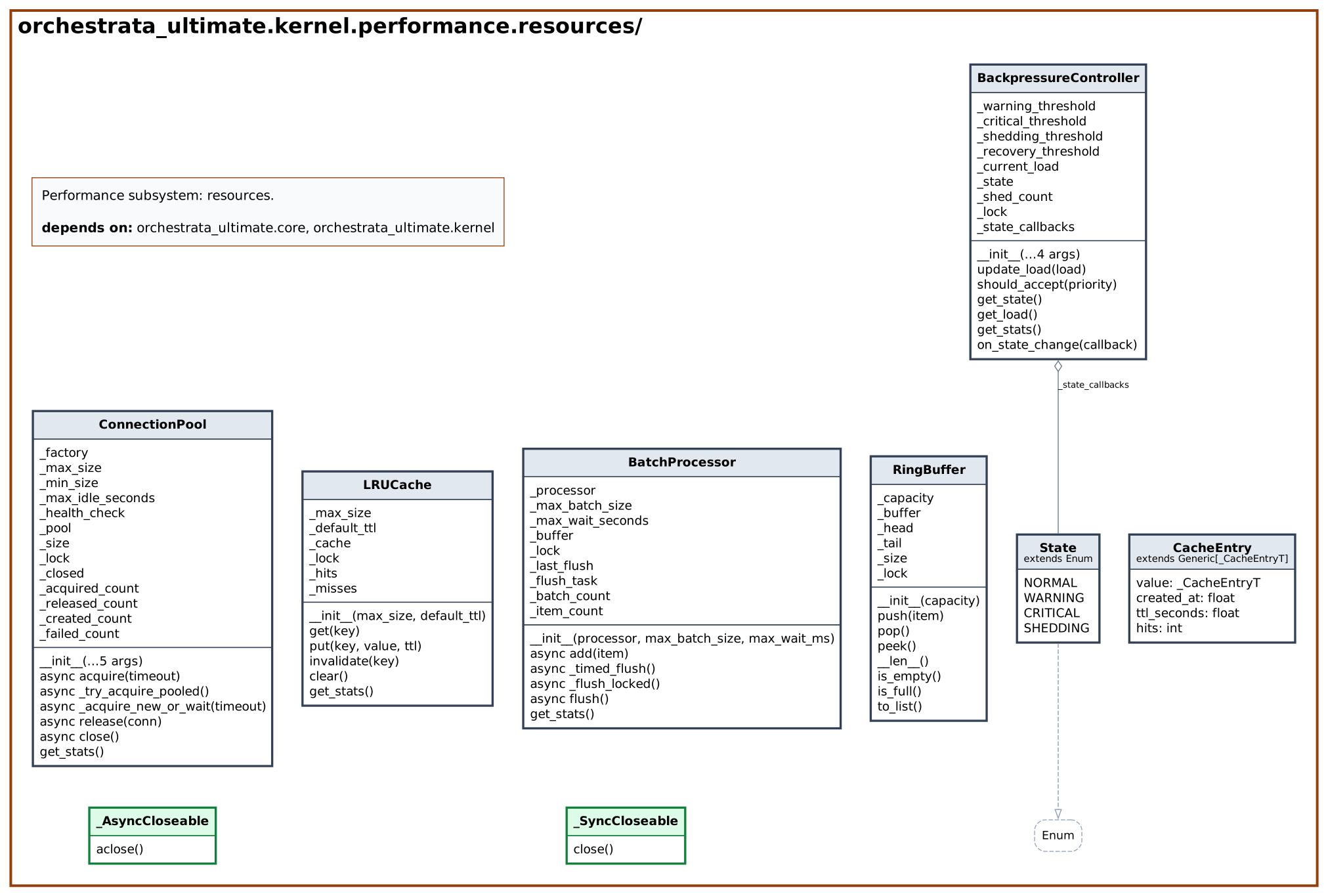
Dependency diagram

API
Classes
_AsyncCloseable (protocol)
Bases: Protocol · Decorators: runtime_checkable · Line 39
Structural type for pooled connections exposing an aclose().
| Method | Signature | Summary |
|---|---|---|
aclose |
aclose() -> Any |
_SyncCloseable (protocol)
Bases: Protocol · Decorators: runtime_checkable · Line 58
Structural type for pooled connections exposing a close().
| Method | Signature | Summary |
|---|---|---|
close |
close() -> Any |
LRUCache
Decorators: traces(spec='001', story='US-010', reqs=['REQ-001-US-010-011']) · Line 66
LRU cache for query results (REQ-001-US-010-011).
| Method | Signature | Summary |
|---|---|---|
__init__ |
__init__(max_size: int = CACHE_DEFAULT_MAX_SIZE, default_ttl: float = CACHE_DEFAULT_TTL_SECONDS) -> None |
Initialize cache. |
get |
get(key: str) -> T | None |
Get value from cache. |
put |
put(key: str, value: T, ttl: float | None = None) -> None |
Put value in cache. |
invalidate |
invalidate(key: str) -> bool |
Invalidate cache entry. |
clear |
clear() -> None |
Clear entire cache. |
get_stats |
get_stats() -> dict[str, Any] |
Get cache statistics. |
ConnectionPool
Decorators: traces(spec='001', story='US-010', reqs=['REQ-001-US-010-012', 'REQ-001-US-010-013']) · Line 186
Generic connection pool (REQ-001-US-010-012, REQ-001-US-010-013).
| Method | Signature | Summary |
|---|---|---|
__init__ |
__init__(factory: Callable[[], Awaitable[T]], max_size: int = CONNECTION_POOL_DEFAULT_MAX_SIZE, min_size: int = 2, max_idle_seconds: float = CONNECTION_POOL_DEFAULT_MAX_IDLE_SECONDS, health_check: Callable[[T], Awaitable[bool]] | None = None) -> None |
Initialize connection pool. |
acquire |
async acquire(timeout: float | None = None) -> T |
Acquire connection from pool (REQ-001-US-010-015 - async I/O). |
_try_acquire_pooled |
async _try_acquire_pooled() -> T | None |
Try to get a healthy, non-stale connection from the pool without blocking. |
_acquire_new_or_wait |
async _acquire_new_or_wait(timeout: float | None) -> T |
Create a new connection if under limit, otherwise wait for one. |
release |
async release(conn: T) -> None |
Release connection back to pool. |
close |
async close() -> None |
Close all connections in pool. |
get_stats |
get_stats() -> dict[str, Any] |
Get pool statistics. |
BatchProcessor
Decorators: traces(spec='001', story='US-010', reqs=['REQ-001-US-010-014', 'REQ-001-US-010-018']) · Line 365
Batch processor for message dispatches (REQ-001-US-010-014).
| Method | Signature | Summary |
|---|---|---|
__init__ |
__init__(processor: Callable[[list[T]], Awaitable[None]], max_batch_size: int = BATCH_PROCESSOR_DEFAULT_MAX_SIZE, max_wait_ms: float = BATCH_PROCESSOR_DEFAULT_MAX_WAIT_MS) -> None |
Initialize batch processor. |
add |
async add(item: T) -> None |
Add item to batch. |
_timed_flush |
async _timed_flush() -> None |
Flush after max wait time. |
_flush_locked |
async _flush_locked() -> None |
Flush buffer (must hold lock). |
flush |
async flush() -> None |
Force flush any pending items. |
get_stats |
get_stats() -> dict[str, Any] |
Get processor statistics. |
RingBuffer
Decorators: traces(spec='001', story='US-010', reqs=['REQ-001-US-010-017']) · Line 450
Fixed-size ring buffer (REQ-001-US-010-017).
| Method | Signature | Summary |
|---|---|---|
__init__ |
__init__(capacity: int) -> None |
Initialize ring buffer. |
push |
push(item: T) -> T | None |
Push item to buffer. |
pop |
pop() -> T | None |
Pop oldest item from buffer. |
peek |
peek() -> T | None |
Peek at oldest item without removing. |
__len__ |
__len__() -> int |
Get current size. |
is_empty |
is_empty() -> bool |
Check if buffer is empty. |
is_full |
is_full() -> bool |
Check if buffer is full. |
to_list |
to_list() -> list[T] |
Convert to list (oldest first). |
BackpressureController
Decorators: traces(spec='001', story='US-002', reqs=['REQ-001-US-002-024', 'REQ-001-US-007-005', 'REQ-001-US-010-010', 'REQ-001-US-… · Line 550
Backpressure mechanism (REQ-001-US-010-020).
| Method | Signature | Summary |
|---|---|---|
__init__ |
__init__(warning_threshold: float = BACKPRESSURE_WARNING_THRESHOLD, critical_threshold: float = BACKPRESSURE_CRITICAL_THRESHOLD, shedding_threshold: float = BACKPRESSURE_SHEDDING_THRESHOLD, recovery_threshold: float = 0.5) -> None |
Initialize backpressure controller. |
update_load |
update_load(load: float) -> None |
Update current load level. |
should_accept |
should_accept(priority: int = 0) -> bool |
Check if request is accepted (REQ-001-US-010-010 - graceful degradation). |
get_state |
get_state() -> BackpressureController.State |
Get current state. |
get_load |
get_load() -> float |
Get current load. |
get_stats |
get_stats() -> dict[str, Any] |
Get controller statistics. |
on_state_change |
on_state_change(callback: Callable[[BackpressureController.State], None]) -> None |
Register state change callback. |
Source
# mypy: ignore-errors
"""Performance subsystem: resources."""
import asyncio
import collections
import inspect
import threading
import time
from collections.abc import Awaitable, Callable
from dataclasses import dataclass
from enum import Enum
from typing import Any, Generic, Protocol, TypeVar, runtime_checkable
from orchestrata_ultimate.core.base.traces import traces
from orchestrata_ultimate.kernel.performance._common import (
BACKPRESSURE_CRITICAL_THRESHOLD,
BACKPRESSURE_SHEDDING_THRESHOLD,
BACKPRESSURE_WARNING_THRESHOLD,
BATCH_PROCESSOR_DEFAULT_MAX_SIZE,
BATCH_PROCESSOR_DEFAULT_MAX_WAIT_MS,
CACHE_DEFAULT_MAX_SIZE,
CACHE_DEFAULT_TTL_SECONDS,
CONNECTION_POOL_DEFAULT_MAX_IDLE_SECONDS,
CONNECTION_POOL_DEFAULT_MAX_SIZE,
T,
_logger,
)
# Dedicated TypeVar for LRUCache.CacheEntry: reusing the outer PEP-695 `T`
# (via `Generic[T]`) makes pyright treat `LRUCache.CacheEntry` as already
# fully specialized by the enclosing class, so `CacheEntry[T]` at the usage
# site below errors as "already specialized" (reportInvalidTypeArguments).
# A distinctly-named TypeVar keeps CacheEntry genuinely generic in its own
# right while still resolving to the enclosing `T@LRUCache` at each use.
_CacheEntryT = TypeVar("_CacheEntryT")
@runtime_checkable
class _AsyncCloseable(Protocol):
"""Structural type for pooled connections exposing an ``aclose()``.
``ConnectionPool[T]`` is generic over an unbounded ``T`` (any pooled
resource), so pyright can't narrow ``hasattr(conn, "aclose")`` the way
the original duck-typed code relied on -- ``conn`` stays typed as
``object*`` (reportAttributeAccessIssue). A ``runtime_checkable``
Protocol gives ``isinstance()`` the same structural check with real
narrowing. The method is intentionally NOT declared ``async def``: some
pooled resources expose a synchronous ``aclose``/``close``, and this
class only needs to assert the attribute exists, not its call
convention (that is still resolved via ``inspect.iscoroutinefunction``
below).
"""
def aclose(self) -> Any: ...
@runtime_checkable
class _SyncCloseable(Protocol):
"""Structural type for pooled connections exposing a ``close()``. See
``_AsyncCloseable`` for why this exists."""
def close(self) -> Any: ...
@traces(spec="001", story="US-010", reqs=["REQ-001-US-010-011"])
class LRUCache[T]:
"""LRU cache for query results (REQ-001-US-010-011).
Thread-safe implementation with TTL support.
"""
@dataclass
class CacheEntry(Generic[_CacheEntryT]):
"""Cache entry with metadata."""
value: _CacheEntryT
created_at: float
ttl_seconds: float
hits: int = 0
def __init__(
self,
max_size: int = CACHE_DEFAULT_MAX_SIZE,
default_ttl: float = CACHE_DEFAULT_TTL_SECONDS,
) -> None:
"""Initialize cache.
Args:
max_size: Maximum cache entries
default_ttl: Default TTL in seconds
"""
self._max_size = max_size
self._default_ttl = default_ttl
self._cache: collections.OrderedDict[str, LRUCache.CacheEntry[T]] = (
collections.OrderedDict()
)
self._lock = threading.Lock()
self._hits = 0
self._misses = 0
def get(self, key: str) -> T | None:
"""Get value from cache.
Args:
key: Cache key
Returns:
Cached value or None if not found/expired
"""
with self._lock:
entry = self._cache.get(key)
if entry is None:
self._misses += 1
return None
# Check TTL
if time.monotonic() - entry.created_at > entry.ttl_seconds:
del self._cache[key]
self._misses += 1
return None
# Move to end (most recently used)
self._cache.move_to_end(key)
entry.hits += 1
self._hits += 1
return entry.value
def put(self, key: str, value: T, ttl: float | None = None) -> None:
"""Put value in cache.
Args:
key: Cache key
value: Value to cache
ttl: Optional TTL override
"""
with self._lock:
# Remove if exists
if key in self._cache:
del self._cache[key]
# Evict oldest if at capacity
while len(self._cache) >= self._max_size:
self._cache.popitem(last=False)
self._cache[key] = LRUCache.CacheEntry(
value=value,
created_at=time.monotonic(),
ttl_seconds=ttl or self._default_ttl,
)
def invalidate(self, key: str) -> bool:
"""Invalidate cache entry.
Args:
key: Cache key
Returns:
True if entry was found and removed
"""
with self._lock:
if key in self._cache:
del self._cache[key]
return True
return False
def clear(self) -> None:
"""Clear entire cache."""
with self._lock:
self._cache.clear()
def get_stats(self) -> dict[str, Any]:
"""Get cache statistics."""
with self._lock:
total = self._hits + self._misses
hit_rate = (self._hits / total * 100) if total > 0 else 0
return {
"size": len(self._cache),
"max_size": self._max_size,
"hits": self._hits,
"misses": self._misses,
"hit_rate_percent": hit_rate,
}
@traces(spec="001", story="US-010", reqs=["REQ-001-US-010-012", "REQ-001-US-010-013"])
class ConnectionPool[T]:
"""Generic connection pool (REQ-001-US-010-012, REQ-001-US-010-013).
Provides async connection pooling with health checks.
"""
def __init__(
self,
factory: Callable[[], Awaitable[T]],
max_size: int = CONNECTION_POOL_DEFAULT_MAX_SIZE,
min_size: int = 2,
max_idle_seconds: float = CONNECTION_POOL_DEFAULT_MAX_IDLE_SECONDS,
health_check: Callable[[T], Awaitable[bool]] | None = None,
) -> None:
"""Initialize connection pool.
Args:
factory: Async function to create new connections
max_size: Maximum pool size
min_size: Minimum connections to maintain
max_idle_seconds: Max idle time before closing connection
health_check: Optional async function to check connection health
"""
self._factory = factory
self._max_size = max_size
self._min_size = min_size
self._max_idle_seconds = max_idle_seconds
self._health_check = health_check
self._pool: asyncio.Queue[tuple[T, float]] = asyncio.Queue(maxsize=max_size)
self._size = 0
self._lock = asyncio.Lock()
self._closed = False
self._acquired_count = 0
self._released_count = 0
self._created_count = 0
self._failed_count = 0
@traces(spec="001", story="US-010", reqs=["REQ-001-US-010-015"])
async def acquire(self, timeout: float | None = None) -> T:
"""Acquire connection from pool (REQ-001-US-010-015 - async I/O).
Args:
timeout: Optional timeout in seconds
Returns:
Connection instance
Raises:
RuntimeError: If pool is closed
asyncio.TimeoutError: If timeout exceeded
"""
if self._closed:
raise RuntimeError("Connection pool is closed")
conn = await self._try_acquire_pooled()
if conn is not None:
return conn
return await self._acquire_new_or_wait(timeout)
@traces(spec="001", story="US-010", reqs=["REQ-001-US-010-015"])
async def _try_acquire_pooled(self) -> T | None:
"""Try to get a healthy, non-stale connection from the pool without blocking.
Returns:
A ready connection, or None if none available.
"""
try:
conn, acquired_at = self._pool.get_nowait()
except asyncio.QueueEmpty:
return None
if time.monotonic() - acquired_at > self._max_idle_seconds:
self._size -= 1
return None
if self._health_check:
try:
if await self._health_check(conn):
self._acquired_count += 1
return conn
except Exception as exc:
_logger.warning(
"Connection health check failed: %s", exc, exc_info=True
)
self._size -= 1
return None
self._acquired_count += 1
return conn
@traces(spec="001", story="US-010", reqs=["REQ-001-US-010-015"])
async def _acquire_new_or_wait(self, timeout: float | None) -> T:
"""Create a new connection if under limit, otherwise wait for one.
Args:
timeout: Optional timeout in seconds
Returns:
Connection instance
Raises:
asyncio.TimeoutError: If timeout exceeded while waiting
"""
async with self._lock:
if self._size < self._max_size:
try:
conn = await asyncio.wait_for(self._factory(), timeout=timeout)
self._size += 1
self._created_count += 1
self._acquired_count += 1
return conn
except Exception as exc:
self._failed_count += 1
_logger.warning(
"Failed to create new pool connection: %s", exc, exc_info=True
)
raise
try:
conn, _ = await asyncio.wait_for(self._pool.get(), timeout=timeout)
self._acquired_count += 1
return conn
except TimeoutError:
self._failed_count += 1
raise
async def release(self, conn: T) -> None:
"""Release connection back to pool.
Args:
conn: Connection to release
"""
if self._closed:
return
try:
self._pool.put_nowait((conn, time.monotonic()))
self._released_count += 1
except asyncio.QueueFull:
# Pool full, discard connection
self._size -= 1
async def close(self) -> None:
"""Close all connections in pool."""
self._closed = True
while not self._pool.empty():
try:
conn, _ = self._pool.get_nowait()
# If connection has close method, call it
if isinstance(conn, _AsyncCloseable):
if inspect.iscoroutinefunction(conn.aclose):
await conn.aclose()
else:
conn.aclose()
elif isinstance(conn, _SyncCloseable):
if inspect.iscoroutinefunction(conn.close):
await conn.close()
else:
conn.close()
except asyncio.QueueEmpty: # pragma: no cover
break # pragma: no cover
def get_stats(self) -> dict[str, Any]:
"""Get pool statistics."""
return {
"size": self._size,
"max_size": self._max_size,
"available": self._pool.qsize(),
"acquired": self._acquired_count,
"released": self._released_count,
"created": self._created_count,
"failed": self._failed_count,
}
@traces(spec="001", story="US-010", reqs=["REQ-001-US-010-014", "REQ-001-US-010-018"])
class BatchProcessor[T]:
"""Batch processor for message dispatches (REQ-001-US-010-014).
Accumulates items and processes in batches for efficiency.
"""
def __init__(
self,
processor: Callable[[list[T]], Awaitable[None]],
max_batch_size: int = BATCH_PROCESSOR_DEFAULT_MAX_SIZE,
max_wait_ms: float = BATCH_PROCESSOR_DEFAULT_MAX_WAIT_MS,
) -> None:
"""Initialize batch processor.
Args:
processor: Async function to process a batch
max_batch_size: Maximum items per batch
max_wait_ms: Maximum wait time before flushing
"""
self._processor = processor
self._max_batch_size = max_batch_size
self._max_wait_seconds = max_wait_ms / 1000.0
self._buffer: list[T] = []
self._lock = asyncio.Lock()
self._last_flush = time.monotonic()
self._flush_task: asyncio.Task | None = None
self._batch_count = 0
self._item_count = 0
async def add(self, item: T) -> None:
"""Add item to batch.
Args:
item: Item to add
"""
async with self._lock:
self._buffer.append(item)
self._item_count += 1
# Flush if batch is full
if len(self._buffer) >= self._max_batch_size:
await self._flush_locked()
elif self._flush_task is None or self._flush_task.done():
# Schedule timed flush
self._flush_task = asyncio.create_task(self._timed_flush())
async def _timed_flush(self) -> None:
"""Flush after max wait time."""
await asyncio.sleep(self._max_wait_seconds)
async with self._lock:
if self._buffer:
await self._flush_locked()
async def _flush_locked(self) -> None:
"""Flush buffer (must hold lock)."""
if not self._buffer:
return
batch = self._buffer
self._buffer = []
self._last_flush = time.monotonic()
self._batch_count += 1
await self._processor(batch)
async def flush(self) -> None:
"""Force flush any pending items."""
async with self._lock:
await self._flush_locked()
def get_stats(self) -> dict[str, Any]:
"""Get processor statistics."""
return {
"pending": len(self._buffer),
"batch_count": self._batch_count,
"item_count": self._item_count,
"avg_batch_size": (
self._item_count / self._batch_count if self._batch_count > 0 else 0
),
}
@traces(spec="001", story="US-010", reqs=["REQ-001-US-010-017"])
class RingBuffer[T]:
"""Fixed-size ring buffer (REQ-001-US-010-017).
Efficient data structure for bounded collections.
"""
def __init__(self, capacity: int) -> None:
"""Initialize ring buffer.
Args:
capacity: Maximum number of items
"""
self._capacity = capacity
self._buffer: list[T | None] = [None] * capacity
self._head = 0 # Next write position
self._tail = 0 # Next read position
self._size = 0
self._lock = threading.Lock()
def push(self, item: T) -> T | None:
"""Push item to buffer.
Args:
item: Item to push
Returns:
Evicted item if buffer was full, None otherwise
"""
with self._lock:
evicted = None
if self._size == self._capacity:
evicted = self._buffer[self._tail]
self._tail = (self._tail + 1) % self._capacity
else:
self._size += 1
self._buffer[self._head] = item
self._head = (self._head + 1) % self._capacity
return evicted
def pop(self) -> T | None:
"""Pop oldest item from buffer.
Returns:
Oldest item or None if empty
"""
with self._lock:
if self._size == 0:
return None
item = self._buffer[self._tail]
self._buffer[self._tail] = None
self._tail = (self._tail + 1) % self._capacity
self._size -= 1
return item
def peek(self) -> T | None:
"""Peek at oldest item without removing.
Returns:
Oldest item or None if empty
"""
with self._lock:
if self._size == 0:
return None
return self._buffer[self._tail]
def __len__(self) -> int:
"""Get current size."""
return self._size
def is_empty(self) -> bool:
"""Check if buffer is empty."""
return self._size == 0
def is_full(self) -> bool:
"""Check if buffer is full."""
return self._size == self._capacity
def to_list(self) -> list[T]:
"""Convert to list (oldest first)."""
with self._lock:
result = []
idx = self._tail
for _ in range(self._size):
result.append(self._buffer[idx])
idx = (idx + 1) % self._capacity
return result
@traces(
spec="001",
story="US-002",
reqs=[
"REQ-001-US-002-024",
"REQ-001-US-007-005",
"REQ-001-US-010-010",
"REQ-001-US-010-020",
],
)
class BackpressureController:
"""Backpressure mechanism (REQ-001-US-010-020).
Implements load shedding and flow control.
"""
class State(Enum):
"""Backpressure state."""
NORMAL = "normal"
WARNING = "warning"
CRITICAL = "critical"
SHEDDING = "shedding"
def __init__(
self,
warning_threshold: float = BACKPRESSURE_WARNING_THRESHOLD,
critical_threshold: float = BACKPRESSURE_CRITICAL_THRESHOLD,
shedding_threshold: float = BACKPRESSURE_SHEDDING_THRESHOLD,
recovery_threshold: float = 0.5,
) -> None:
"""Initialize backpressure controller.
Args:
warning_threshold: Load level for warning state (0-1)
critical_threshold: Load level for critical state (0-1)
shedding_threshold: Load level to start shedding (0-1)
recovery_threshold: Load level to recover to normal (0-1)
"""
self._warning_threshold = warning_threshold
self._critical_threshold = critical_threshold
self._shedding_threshold = shedding_threshold
self._recovery_threshold = recovery_threshold
self._current_load = 0.0
self._state = BackpressureController.State.NORMAL
self._shed_count = 0
self._lock = threading.Lock()
self._state_callbacks: list[Callable[[BackpressureController.State], None]] = []
@traces(spec="001", story="US-010", reqs=["REQ-001-US-010-020"])
def update_load(self, load: float) -> None:
"""Update current load level.
Args:
load: Current load (0-1)
"""
with self._lock:
self._current_load = max(0.0, min(1.0, load))
old_state = self._state
if self._current_load >= self._shedding_threshold:
self._state = BackpressureController.State.SHEDDING
elif self._current_load >= self._critical_threshold:
self._state = BackpressureController.State.CRITICAL
elif self._current_load >= self._warning_threshold:
self._state = BackpressureController.State.WARNING
elif self._current_load <= self._recovery_threshold:
self._state = BackpressureController.State.NORMAL
if old_state != self._state:
for callback in self._state_callbacks:
try:
callback(self._state)
except Exception as exc:
_logger.warning(
"Backpressure state callback failed: %s", exc, exc_info=True
)
@traces(spec="001", story="US-002", reqs=["REQ-001-US-002-024"])
def should_accept(self, priority: int = 0) -> bool:
"""Check if request is accepted (REQ-001-US-010-010 - graceful degradation).
Args:
priority: Request priority (higher = more important)
Returns:
True if request is accepted
"""
with self._lock:
if self._state == BackpressureController.State.NORMAL:
return True
elif self._state == BackpressureController.State.WARNING:
return True # Accept all in warning
elif self._state == BackpressureController.State.CRITICAL:
return priority >= 5 # Only high priority
else: # SHEDDING
self._shed_count += 1
return priority >= 8 # Only critical
def get_state(self) -> BackpressureController.State:
"""Get current state."""
return self._state
def get_load(self) -> float:
"""Get current load."""
return self._current_load
def get_stats(self) -> dict[str, Any]:
"""Get controller statistics."""
return {
"state": self._state.value,
"load": self._current_load,
"shed_count": self._shed_count,
}
def on_state_change(
self, callback: Callable[[BackpressureController.State], None]
) -> None:
"""Register state change callback.
Args:
callback: Function to call on state change
"""
self._state_callbacks.append(callback)