orchestrata_ultimate.harness.evaluators
Reference › orchestrata_ultimate › harness › evaluators › init
The evaluator registry of the harness. A module-level dictionary maps a name to an Evaluator subclass. register_evaluator is a class decorator that stores a class under its name class variable and raises ValueError if the class defines none; it is generic over the subclass so decorated classes keep their own type. get_evaluator(name) returns a new instance, or raises ValueError listing the registered names when the name is unknown. The five concrete evaluators, file_exists, syntax, lint, trace and llm_judge, are imported here so that importing the package registers them. The runner looks evaluators up by the names in scenario YAML.
At a glance
| Source | src/orchestrata_ultimate/harness/evaluators/__init__.py |
| Lines of code | 78 |
| Classes | 0 |
| Functions | 3 |
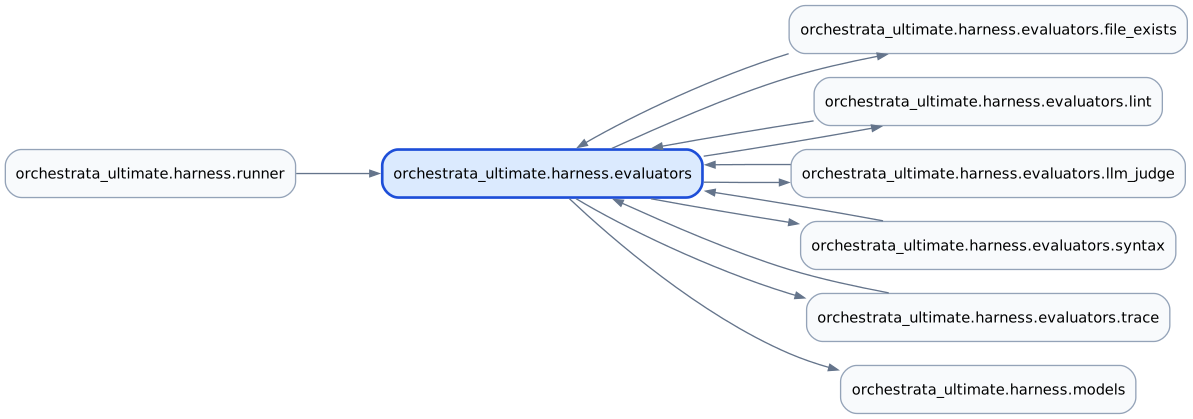
| Imports (internal) | orchestrata_ultimate.harness.evaluators.file_exists, orchestrata_ultimate.harness.evaluators.lint, orchestrata_ultimate.harness.evaluators.llm_judge, orchestrata_ultimate.harness.evaluators.syntax, orchestrata_ultimate.harness.evaluators.trace, orchestrata_ultimate.harness.models |
| Imported by | orchestrata_ultimate.harness.evaluators.file_exists, orchestrata_ultimate.harness.evaluators.lint, orchestrata_ultimate.harness.evaluators.llm_judge, orchestrata_ultimate.harness.evaluators.syntax, orchestrata_ultimate.harness.evaluators.trace, orchestrata_ultimate.harness.runner |
| Tests that import it | tests/harness/test_evaluator_file_exists.py, tests/harness/test_evaluator_lint.py, tests/harness/test_evaluator_llm_judge.py, tests/harness/test_evaluator_syntax.py, tests/harness/test_evaluator_trace.py, tests/harness/test_evaluators_registry.py, tests/test_module_shims.py |
Class diagram
No classes; see Functions.
Dependency diagram
API
Constants
| Name | Type | Value |
|---|---|---|
_EVALUATORS |
dict[str, type[Evaluator]] |
{} |
Functions
| Function | Signature | Summary |
|---|---|---|
register_evaluator |
register_evaluator() -> type[EvaluatorT] |
Decorator to register an evaluator class by its name classvar. |
get_evaluator |
get_evaluator(name: str) -> Evaluator |
Return an instantiated evaluator by name. |
list_evaluators |
list_evaluators() -> list[str] |
Return a sorted list of registered evaluator names. |
Source
"""Evaluator registry for the Volk Test Harness."""

from __future__ import annotations

from typing import TYPE_CHECKING

from orchestrata_ultimate.harness.models import Evaluator

if TYPE_CHECKING:
    pass

# Registry populated by individual evaluator modules at import time.
_EVALUATORS: dict[str, type[Evaluator]] = {}


def register_evaluator[EvaluatorT: Evaluator](
    cls: type[EvaluatorT],
) -> type[EvaluatorT]:
    """Decorator to register an evaluator class by its ``name`` classvar.

    Generic over the concrete subclass (rather than fixed to ``Evaluator``)
    so a decorated class keeps its own static type — e.g. ``LintEvaluator``
    stays ``type[LintEvaluator]`` after decoration instead of widening to
    ``type[Evaluator]``, which would otherwise erase subclass-only members
    (like ``LintEvaluator.evaluate``'s extra ``env`` parameter) for every
    caller of ``get_evaluator()`` that narrows the result via ``cast``.
    """
    if not cls.name:
        raise ValueError(f"Evaluator {cls.__name__} must define a 'name' classvar")
    _EVALUATORS[cls.name] = cls
    return cls


def get_evaluator(name: str) -> Evaluator:
    """Return an instantiated evaluator by name.

    Args:
        name: The evaluator's registered name (e.g. ``"syntax_check"``).

    Raises:
        ValueError: If no evaluator is registered under ``name``.
    """
    if name not in _EVALUATORS:
        available = ", ".join(sorted(_EVALUATORS))
        raise ValueError(f"Unknown evaluator: {name}. Available: [{available}]")
    return _EVALUATORS[name]()


def list_evaluators() -> list[str]:
    """Return a sorted list of registered evaluator names."""
    return sorted(_EVALUATORS)


# isort: off
# These imports MUST stay at the bottom to avoid circular imports.
from orchestrata_ultimate.harness.evaluators.file_exists import (  # noqa: E402
    FileExistsEvaluator,
)
from orchestrata_ultimate.harness.evaluators.lint import LintEvaluator  # noqa: E402
from orchestrata_ultimate.harness.evaluators.llm_judge import (  # noqa: E402
    LLMJudgeEvaluator,
)
from orchestrata_ultimate.harness.evaluators.syntax import SyntaxEvaluator  # noqa: E402
from orchestrata_ultimate.harness.evaluators.trace import TraceEvaluator  # noqa: E402

# isort: on

__all__ = [
    "Evaluator",
    "FileExistsEvaluator",
    "get_evaluator",
    "LintEvaluator",
    "list_evaluators",
    "LLMJudgeEvaluator",
    "register_evaluator",
    "SyntaxEvaluator",
    "TraceEvaluator",
]