orchestrata_ultimate.gateway.handlers.governance
Reference › orchestrata_ultimate › gateway › handlers › governance
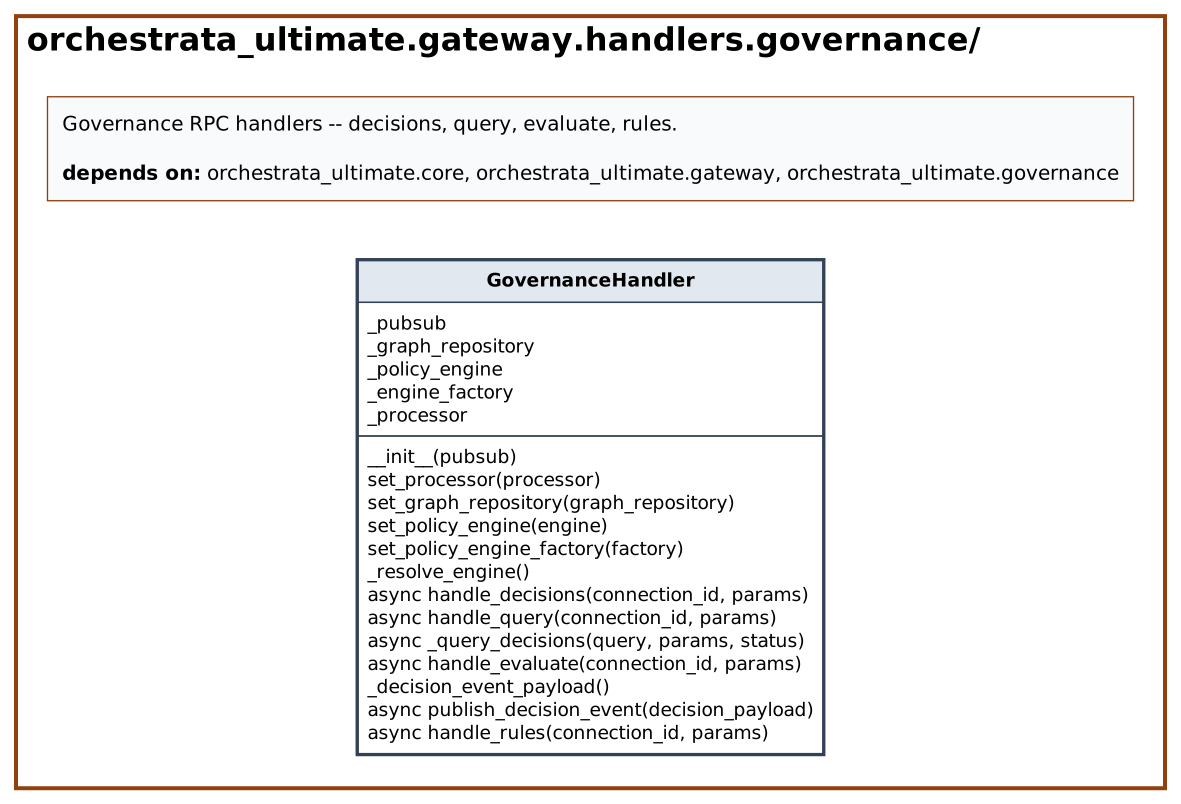
GovernanceHandler exposes the constitutional governance engine over RPC: governance.decisions, governance.query, governance.evaluate and governance.rules. rpc creates it and server supplies the policy engine or its factory, the graph repository and the message processor through setters. See the governance package and gateway.
handle_evaluateis a dry-run check. With a policy engine wired it evaluates theintentwith a context that carries the actor, publishes a decision event on the governance topics throughpublish_decision_event, and returnsallowedordeniedwith the reason, decision type and articles checked. An evaluation error is treated as a denial. With no engine it returns a permissive stub result that says so.handle_queryreads recentPolicyDecisionnodes from the graph audit trail, newest first, with an optional status filter and a limit capped at 1000, under a timeout. It returns an empty list with an error text on failure.handle_ruleslists the constitutional articles (number, title, description, priority, predicates) when an engine is configured, otherwise an empty list.handle_decisionssubscribes the connection to thegovernance.decisionstopic, with optional filters, and_resolve_enginebuilds the engine lazily from the factory.
At a glance
| Source | src/orchestrata_ultimate/gateway/handlers/governance.py |
| Lines of code | 349 |
| Classes | 1 |
| Functions | 0 |
| Imports (internal) | orchestrata_ultimate.core.base.traces, orchestrata_ultimate.gateway.pubsub, orchestrata_ultimate.governance.constitutional |
| Imported by | orchestrata_ultimate.gateway.handlers, orchestrata_ultimate.gateway.rpc |
| Tests that import it | tests/gateway/handlers/test_governance.py, tests/gateway/test_handlers_behavioral.py, tests/gateway/test_publisher_wiring.py, tests/gateway/test_rpc_behavioral.py, tests/generated_gateway/test_handlers_governance_generated.py, tests/governance/test_gateway_governance_handler.py |
Class diagram
Dependency diagram

API
Classes
GovernanceHandler
Line 19
Governance decision streaming and query methods.
| Method | Signature | Summary |
|---|---|---|
__init__ |
__init__(pubsub: PubSubManager) -> None |
Wire handler to governance subsystems. |
set_processor |
set_processor(processor: Any) -> None |
Inject the message processor after construction. |
set_graph_repository |
set_graph_repository(graph_repository: Any) -> None |
Inject the operational-graph repository for historical decision queries. |
set_policy_engine |
set_policy_engine(engine: Any) -> None |
Inject a pre-built governance PolicyEngine for dry-run evaluation. |
set_policy_engine_factory |
set_policy_engine_factory(factory: Any) -> None |
Register a zero-arg factory that builds the PolicyEngine on first use. |
_resolve_engine |
_resolve_engine() -> Any |
Return the PolicyEngine, building it once from the factory on first use. |
handle_decisions |
async handle_decisions(connection_id: str, params: dict[str, Any]) -> dict[str, Any] |
Handle governance.decisions -- subscribe to decisions. |
handle_query |
async handle_query(connection_id: str, params: dict[str, Any]) -> dict[str, Any] |
Handle governance.query -- historical governance decisions. |
_query_decisions |
async _query_decisions(query: str, params: dict[str, Any], status: str | None) -> list[dict[str, Any]] |
Run the decision query and deserialize each node's JSON data. |
handle_evaluate |
async handle_evaluate(connection_id: str, params: dict[str, Any]) -> dict[str, Any] |
Handle governance.evaluate -- dry-run check via the PolicyEngine. |
_decision_event_payload staticmethod |
_decision_event_payload(*, actor: str, action: str, allowed: bool, reason: str, articles_checked: list[int] | None = None, duration_ms: float = 0.0, metadata: dict[str, Any] | None = None, timestamp: str | None = None) -> dict[str, Any] |
Build the governance.events decision payload shape consumed by the VizInt audit-trail and notification-center gadgets (``{decision: {decision_id, timestamp, actor, action, resource, result… |
publish_decision_event |
async publish_decision_event(decision_payload: dict[str, Any]) -> None |
Broadcast a real governance decision to governance.events subscribers. |
handle_rules |
async handle_rules(connection_id: str, params: dict[str, Any]) -> dict[str, Any] |
Handle governance.rules -- the active constitutional rule set. |
Source
"""Governance RPC handlers -- decisions, query, evaluate, rules.

Implements SPEC-014 FR-018 governance methods.
"""

import asyncio
import json
import logging
import uuid
from datetime import UTC, datetime
from typing import Any

from orchestrata_ultimate.core.base.traces import traces
from orchestrata_ultimate.gateway.pubsub import PubSubManager

logger = logging.getLogger(__name__)


class GovernanceHandler:
    """Governance decision streaming and query methods."""

    def __init__(self, pubsub: PubSubManager) -> None:
        """Wire handler to governance subsystems.

        Args:
            pubsub: Pub/sub subscription manager.
        """
        self._pubsub = pubsub
        self._graph_repository: Any = None
        self._policy_engine: Any = None
        self._engine_factory: Any = None
        self._processor: Any = None

    def set_processor(self, processor: Any) -> None:
        """Inject the message processor after construction.

        Args:
            processor: MessageProcessor instance.
        """
        self._processor = processor

    def set_graph_repository(self, graph_repository: Any) -> None:
        """Inject the operational-graph repository for historical decision
        queries.

        Args:
            graph_repository: An AsyncGraphRepository instance.
        """
        self._graph_repository = graph_repository

    def set_policy_engine(self, engine: Any) -> None:
        """Inject a pre-built governance PolicyEngine for dry-run evaluation.

        Args:
            engine: A PolicyEngine (or EventEmittingPolicyEngine) exposing
                ``async evaluate(action, context) -> PolicyDecision``.
        """
        self._policy_engine = engine

    def set_policy_engine_factory(self, factory: Any) -> None:
        """Register a zero-arg factory that builds the PolicyEngine on first
        use. Deferred so constructing the gateway does not spin up the Prolog
        (janus) engine until governance is actually evaluated.

        Args:
            factory: ``() -> PolicyEngine``.
        """
        self._engine_factory = factory

    @traces(spec="014", story="US-003", reqs=["REQ-014-041"])
    def _resolve_engine(self) -> Any:
        """Return the PolicyEngine, building it once from the factory on first
        use. Returns None when no engine/factory is configured (stub mode)."""
        if self._policy_engine is None and self._engine_factory is not None:
            try:
                self._policy_engine = self._engine_factory()
            except Exception as exc:
                logger.warning("policy engine init failed: %s", exc)
                self._engine_factory = None  # don't retry on every call
        return self._policy_engine

    @traces(spec="014", story="US-003", reqs=["REQ-014-031"])
    async def handle_decisions(
        self,
        connection_id: str,
        params: dict[str, Any],
    ) -> dict[str, Any]:
        """Handle governance.decisions -- subscribe to decisions.

        Args:
            connection_id: Caller connection ID.
            params: Optional filters.

        Returns:
            subscription_id and topic.
        """
        filters = params.get("filters", {})
        sub_id = await self._pubsub.subscribe(
            connection_id,
            "governance.decisions",
            filters,
        )
        return {
            "subscription_id": sub_id,
            "topic": "governance.decisions",
        }

    @traces(spec="014", story="US-003", reqs=["REQ-014-036"])
    async def handle_query(
        self,
        connection_id: str,
        params: dict[str, Any],
    ) -> dict[str, Any]:
        """Handle governance.query -- historical governance decisions.

        Reads recent PolicyDecision nodes from the graph audit trail
        (written by GraphAuditTrail.log_policy_decision as
        ``(:PolicyDecision {data: <json>, timestamp, session_id})``).

        Args:
            connection_id: Caller connection ID.
            params: optional ``status`` filter and ``limit``.

        Returns:
            List of recent decisions, most recent first.
        """
        if not self._graph_repository:
            return {"decisions": []}

        try:
            limit = min(int(params.get("limit", 50)), 1000)
            status = params.get("status")
            query = (
                "MATCH (d:PolicyDecision) "
                "RETURN d.data AS data, d.timestamp AS timestamp "
                "ORDER BY d.timestamp DESC LIMIT $limit"
            )
            decisions = await asyncio.wait_for(
                self._query_decisions(query, {"limit": limit}, status),
                timeout=10.0,
            )
            return {"decisions": decisions}
        except TimeoutError:
            return {"decisions": [], "error": "Query timeout"}
        except Exception as exc:
            return {"decisions": [], "error": str(exc)}

    @traces(spec="014", story="US-003", reqs=["REQ-014-036"])
    async def _query_decisions(
        self,
        query: str,
        params: dict[str, Any],
        status: str | None,
    ) -> list[dict[str, Any]]:
        """Run the decision query and deserialize each node's JSON ``data``."""
        decisions: list[dict[str, Any]] = []
        rows = await self._graph_repository.execute_read(query, params)
        for row in rows:
            raw = row["data"]
            try:
                decision = json.loads(raw) if isinstance(raw, str) else dict(raw or {})
            except json.JSONDecodeError, TypeError, ValueError:
                decision = {"data": raw}
            if row["timestamp"] is not None:
                decision.setdefault("timestamp", row["timestamp"])
            if status and status not in (
                decision.get("status"),
                decision.get("result"),
                decision.get("decision"),
            ):
                continue
            decisions.append(decision)
        return decisions

    @traces(spec="014", story="US-003", reqs=["REQ-014-041"])
    async def handle_evaluate(
        self,
        connection_id: str,
        params: dict[str, Any],
    ) -> dict[str, Any]:
        """Handle governance.evaluate -- dry-run check via the PolicyEngine.

        When a PolicyEngine is wired, evaluates the intent for real (fail-closed:
        any evaluation error denies). Without an engine, returns the historical
        permissive stub so the gateway still answers in degraded mode.

        Args:
            connection_id: Caller connection ID.
            params: ``intent`` to evaluate; optional ``actor`` and ``context``.

        Returns:
            Evaluation result with ``result`` (allowed/denied) and ``reason``.
        """
        intent = params.get("intent", "")
        engine = self._resolve_engine()
        if engine is None:
            return {
                "intent": intent,
                "result": "allowed",
                "reason": "stub: no governance engine connected",
            }

        raw_context = params.get("context")
        context = dict(raw_context) if isinstance(raw_context, dict) else {}
        actor = context.setdefault("actor", params.get("actor", connection_id))
        try:
            decision = await engine.evaluate(intent, context)
        except Exception as exc:  # fail-closed: deny on evaluation error
            logger.warning("governance evaluate failed: %s", exc)
            await self.publish_decision_event(
                self._decision_event_payload(
                    actor=actor,
                    action=intent,
                    allowed=False,
                    reason=f"evaluation error: {exc}",
                )
            )
            return {
                "intent": intent,
                "result": "denied",
                "reason": f"evaluation error: {exc}",
            }
        await self.publish_decision_event(
            self._decision_event_payload(
                actor=decision.actor,
                action=intent,
                allowed=decision.allowed,
                reason=decision.reason,
                articles_checked=list(decision.articles_checked),
                duration_ms=decision.duration_ms,
                metadata=dict(decision.metadata) if decision.metadata else None,
                timestamp=(
                    decision.timestamp.isoformat() if decision.timestamp else None
                ),
            )
        )
        return {
            "intent": intent,
            "result": "allowed" if decision.allowed else "denied",
            "reason": decision.reason,
            "decision_type": getattr(
                decision.decision_type, "name", str(decision.decision_type)
            ),
            "articles_checked": list(decision.articles_checked),
        }

    @staticmethod
    @traces(spec="014", story="US-003", reqs=["REQ-014-041"])
    def _decision_event_payload(
        *,
        actor: str,
        action: str,
        allowed: bool,
        reason: str,
        articles_checked: list[int] | None = None,
        duration_ms: float = 0.0,
        metadata: dict[str, Any] | None = None,
        timestamp: str | None = None,
    ) -> dict[str, Any]:
        """Build the ``governance.events`` decision payload shape consumed by
        the VizInt audit-trail and notification-center gadgets
        (``{decision: {decision_id, timestamp, actor, action, resource,
        result, latency_ms, article_violation, details}}``).

        Args:
            actor: The subject the decision was evaluated for.
            action: The intent/action string that was evaluated.
            allowed: Whether the decision permits the action.
            reason: Human-readable rationale from the engine.
            articles_checked: Constitutional article numbers consulted.
            duration_ms: Evaluation latency in milliseconds.
            metadata: Additional engine-supplied decision metadata.
            timestamp: ISO-8601 timestamp; defaults to now.

        Returns:
            The decision dict (unwrapped -- callers nest it under
            ``{"decision": ...}`` via :meth:`publish_decision_event`).
        """
        articles = list(articles_checked or [])
        return {
            "decision_id": str(uuid.uuid4()),
            "timestamp": timestamp or datetime.now(UTC).isoformat(),
            "actor": actor,
            "action": action,
            "resource": "",
            "result": "allowed" if allowed else "denied",
            "latency_ms": duration_ms,
            "article_violation": articles[0] if (not allowed and articles) else None,
            "details": dict(metadata or {}),
        }

    @traces(spec="014", story="US-003", reqs=["REQ-014-031"])
    async def publish_decision_event(self, decision_payload: dict[str, Any]) -> None:
        """Broadcast a real governance decision to ``governance.events``
        subscribers.

        Delivers through the message processor's real broadcast (the same
        path ``volk.lifecycle``/``session.events``/``cxp.traffic`` use), so
        the audit-trail and notification-center gadgets' real-time
        subscriptions actually receive it. A no-op when no processor has
        been injected yet (e.g. constructed before gateway boot wires it via
        ``set_processor``) -- mirrors ``VolkHandler.publish_lifecycle_event``.

        Args:
            decision_payload: The decision dict built by
                :meth:`_decision_event_payload`.
        """
        if self._processor is None:
            return
        await self._processor.broadcast(
            "governance.events", {"decision": decision_payload}
        )

    @traces(spec="014", story="US-003", reqs=["REQ-014-046"])
    async def handle_rules(
        self,
        connection_id: str,
        params: dict[str, Any],
    ) -> dict[str, Any]:
        """Handle governance.rules -- the active constitutional rule set.

        When a PolicyEngine is wired, returns the constitutional articles the
        engine enforces; otherwise an empty list (degraded mode).

        Args:
            connection_id: Caller connection ID.
            params: Ignored.

        Returns:
            List of rules (constitutional articles).
        """
        if self._policy_engine is None and self._engine_factory is None:
            return {"rules": []}

        # The constitutional articles are static — no need to build (spin up
        # janus) the engine just to list the active rule set.
        from orchestrata_ultimate.governance.constitutional import ARTICLES

        rules = [
            {
                "number": article.number,
                "title": article.title,
                "description": article.description,
                "priority": getattr(article.priority, "name", str(article.priority)),
                "predicates": list(article.predicates),
            }
            for article in ARTICLES
        ]
        return {"rules": rules}