scripts.serialize_codebase_ast
Reference › scripts › serialize_codebase_ast
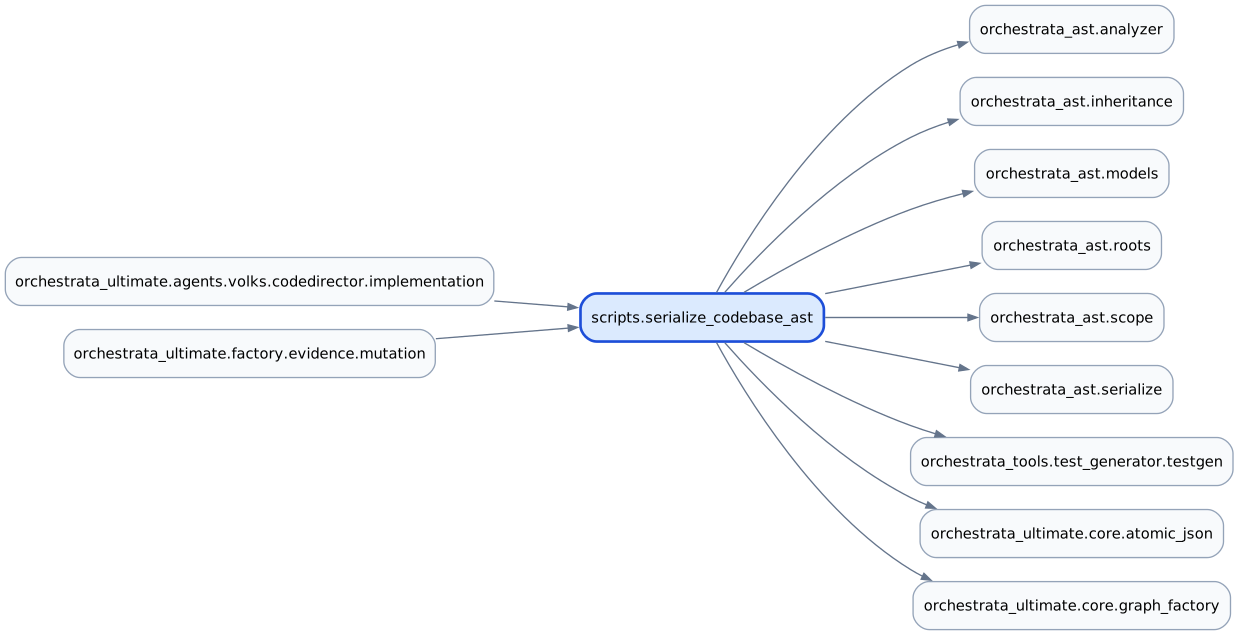
scripts/serialize_codebase_ast.py is the AST toolkit: a full codebase AST serializer, a deep semantic comparison engine and a large family of read-only code-intelligence subcommands in one 13,800-line module. It is the main way to inspect Python structure in this project without reading source files. A human or an agent runs it, usually through the deployed toolkit or the resident ast_daemon (the --no-daemon flag forces a direct run); orchestrata_ultimate.agents.volks.codedirector.implementation and orchestrata_ultimate.factory.evidence.mutation import it, and gen_brief_pack and gen_codebase_map call it. Parsing, the data model, scope and inheritance analysis come from the orchestrata_ast package (analyzer, inheritance, models, roots, scope, serialize) and from orchestrata_tools.
_build_parser defines the command line, with a global --verbose, and _dispatch runs the chosen subcommand. main calls _dispatch and always flushes the warm-cache sidecar in a finally block, because some handlers exit mid-dispatch (for example find-cycles --strict). The subcommands include serialize (write the full AST of one or more --source trees to a JSON --output under a --name; the first source is the primary root for dotted module paths and the default comes from ORCHESTRATA_AST_ROOTS), compare and deep-compare, symbols, refs, who-imports, source, call-graph, find-cycles, orphans, unused, dead-params, untyped, complexity, nesting, long-params, branches, interface, docs, diagram, audit, pattern, check-deps, check-traces, trace-audit, trace-lint, ast-to-kg, and refactoring helpers such as rename, inline, extract-method, extract-class and move-symbol, plus generators (gen-tests, testgen, gen-dto, gen-enum, gen-volk, gen-protocol, gen-skeleton, gen-facade, gen-serde, skeleton-diff).
A parse cache keyed by a content hash of each file (never its modification time) makes repeat runs cheap: configure_parse_cache and parse_cache_stats manage it, and a persisted sidecar is loaded lazily and written back at exit. Stale temporary sidecar files left by dead processes are removed by _reap_dead_sidecar_temps. configure_repo_root sets the served tree.
At a glance
| Source | scripts/serialize_codebase_ast.py |
| Lines of code | 13843 |
| Classes | 14 |
| Functions | 368 |
| Imports (internal) | orchestrata_ast.analyzer, orchestrata_ast.inheritance, orchestrata_ast.models, orchestrata_ast.roots, orchestrata_ast.scope, orchestrata_ast.serialize, orchestrata_tools.test_generator.testgen, orchestrata_ultimate.core.atomic_json, orchestrata_ultimate.core.graph_factory |
| Imported by | orchestrata_ultimate.agents.volks.codedirector.implementation, orchestrata_ultimate.factory.evidence.mutation |
| Tests that import it | none |
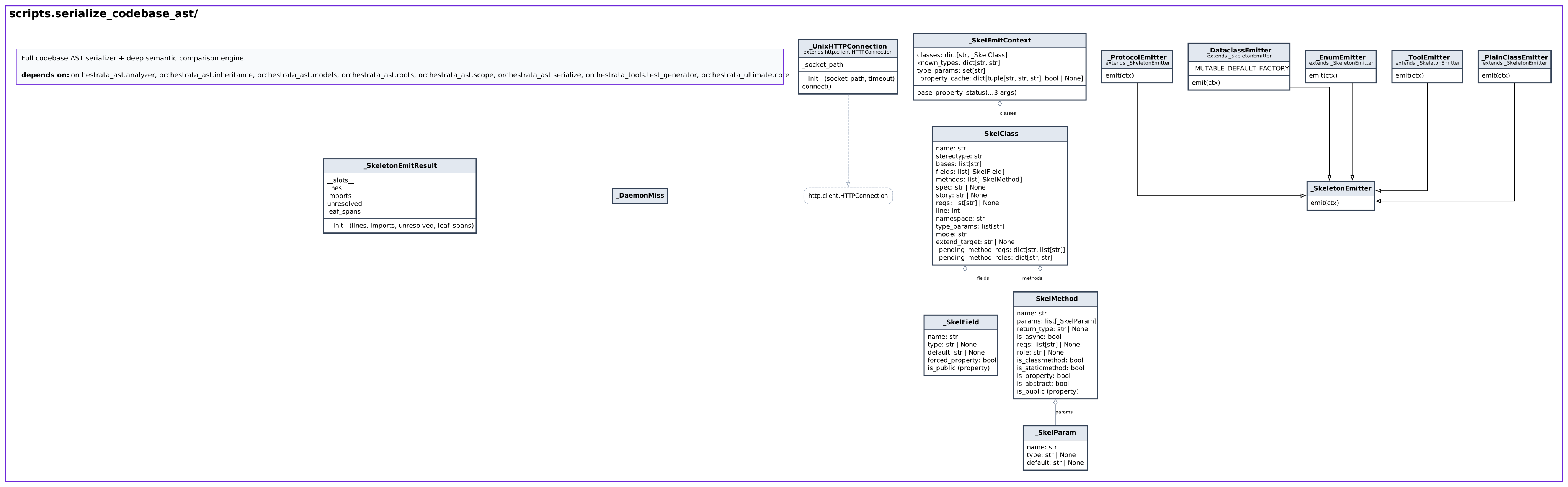
Class diagram
Dependency diagram
API
Constants
| Name | Type | Value |
|---|---|---|
_DATA_ROOT |
Path | None |
None |
_CACHE_STATE |
dict[str, Any] |
{'enabled': False, 'sidecar_path': None, 'data': None, 'dirty': False, 'hits': … |
_PARSE_CACHE |
dict[str, tuple[tuple[int, int], tuple[str, ast.Module]]] |
{} |
_DEF_BEARING_NODES |
tuple[type[ast.AST], ...] |
(ast.stmt, ast.excepthandler, ast.match_case) |
_SOURCE_ROWS_CACHE |
dict[str, tuple[ast.Module, tuple[tuple[str, str, int, int], ...]]] |
{} |
_SKEL_KNOWN_TYPE_IMPORTS |
dict[str, str] |
{'Tool': 'orchestrata_ultimate.tools.base', 'ToolResult': 'orchestrata_ultimate… |
_SKELETON_EMITTERS |
dict[str, _SkeletonEmitter] |
{'Protocol': _ProtocolEmitter(), 'dataclass': _DataclassEmitter(), 'enum': _Enu… |
_COMMANDS |
dict[str, Callable[[argparse.Namespace], None]] |
{'serialize': _cmd_serialize, 'compare': _cmd_compare, 'deep-compare': _cmd_dee… |
Classes
_DaemonMiss
Line 577
Sentinel: no usable daemon result — caller must compute locally.
_UnixHTTPConnection
Bases: http.client.HTTPConnection · Line 588
http.client.HTTPConnection over an AF_UNIX socket.
| Method | Signature | Summary |
|---|---|---|
__init__ |
__init__(socket_path: str, timeout: float) -> None |
|
connect |
connect() -> None |
_SkelParam (dataclass)
Decorators: dataclass · Line 5139
One parsed method parameter (name + optional Mermaid type + default).
| Attribute | Type | Default |
|---|---|---|
name |
str |
|
type |
str | None |
None |
default |
str | None |
None |
_SkelField (dataclass)
Decorators: dataclass · Line 5148
One parsed class member (+name: str / -_sandbox: ReplSandbox).
| Attribute | Type | Default |
|---|---|---|
name |
str |
|
type |
str | None |
None |
default |
str | None |
None |
forced_property |
bool |
False |
| Method | Signature | Summary |
|---|---|---|
is_public property |
is_public() -> bool |
_SkelMethod (dataclass)
Decorators: dataclass · Line 5166
One parsed method (+execute(args: ReplArgs) ToolResult).
| Attribute | Type | Default |
|---|---|---|
name |
str |
|
params |
list[_SkelParam] |
field(default_factory=list) |
return_type |
str | None |
None |
is_async |
bool |
False |
reqs |
list[str] | None |
None |
role |
str | None |
None |
is_classmethod |
bool |
False |
is_staticmethod |
bool |
False |
is_property |
bool |
False |
is_abstract |
bool |
False |
| Method | Signature | Summary |
|---|---|---|
is_public property |
is_public() -> bool |
_SkelClass (dataclass)
Decorators: dataclass · Line 5189
One parsed class X { <<stereotype>> ... } block.
| Attribute | Type | Default |
|---|---|---|
name |
str |
|
stereotype |
str |
'' |
bases |
list[str] |
field(default_factory=list) |
fields |
list[_SkelField] |
field(default_factory=list) |
methods |
list[_SkelMethod] |
field(default_factory=list) |
spec |
str | None |
None |
story |
str | None |
None |
reqs |
list[str] | None |
None |
line |
int |
0 |
namespace |
str |
'' |
type_params |
list[str] |
field(default_factory=list) |
mode |
str |
'generate' |
extend_target |
str | None |
None |
_pending_method_reqs |
dict[str, list[str]] |
field(default_factory=dict) |
_pending_method_roles |
dict[str, str] |
field(default_factory=dict) |
_SkelEmitContext (dataclass)
Decorators: dataclass · Line 5675
Threaded through every emitter + method-rendering helper below:
| Attribute | Type | Default |
|---|---|---|
classes |
dict[str, _SkelClass] |
|
known_types |
dict[str, str] |
|
type_params |
set[str] |
field(default_factory=set) |
_property_cache |
dict[tuple[str, str, str], bool | None] |
field(default_factory=dict) |
| Method | Signature | Summary |
|---|---|---|
base_property_status |
base_property_status(module_path: str, class_name: str, attr_name: str) -> bool | None |
_SkeletonEmitResult
Line 6101
What one emitter contributes to the combined module.
| Method | Signature | Summary |
|---|---|---|
__init__ |
__init__(lines: list[str], imports: set[str], unresolved: set[str], leaf_spans: list[tuple[str, int, int]] | None = None) -> None |
_SkeletonEmitter
Line 6121
Structural base for the per-stereotype Strategy emitters, selected by the _select_skeleton_emitter Factory.
| Method | Signature | Summary |
|---|---|---|
emit |
emit(ctx: _SkelEmitContext) -> _SkeletonEmitResult |
_ProtocolEmitter
Bases: _SkeletonEmitter · Line 6132
<<Protocol>> -> typing.Protocol, ... method bodies.
| Method | Signature | Summary |
|---|---|---|
emit |
emit(ctx: _SkelEmitContext) -> _SkeletonEmitResult |
_DataclassEmitter
Bases: _SkeletonEmitter · Line 6181
<<dataclass>> -> @dataclass(slots=True) typed fields.
| Method | Signature | Summary |
|---|---|---|
emit |
emit(ctx: _SkelEmitContext) -> _SkeletonEmitResult |
_EnumEmitter
Bases: _SkeletonEmitter · Line 6247
<<enum>> -> StrEnum with each field name a lowercased member, UNLESS the diagram declares an explicit = value (fix 4).
| Method | Signature | Summary |
|---|---|---|
emit |
emit(ctx: _SkelEmitContext) -> _SkeletonEmitResult |
_ToolEmitter
Bases: _SkeletonEmitter · Line 6409
<<Tool>> -> a class COMPOSING injected collaborators (never a deep inheritance chain), realizing whatever ABC/Protocol its ..|> X relationship names (Tool — gen-skeleton's own baseline…
| Method | Signature | Summary |
|---|---|---|
emit |
emit(ctx: _SkelEmitContext) -> _SkeletonEmitResult |
_PlainClassEmitter
Bases: _SkeletonEmitter · Line 6470
<<class>> — a plain composed service class with no ABC/Protocol of its own (unless it realizes one via ..|> X); needed once a real analyst contract (SPEC-072) used it for ordinary composed…
| Method | Signature | Summary |
|---|---|---|
emit |
emit(ctx: _SkelEmitContext) -> _SkeletonEmitResult |
Functions
| Function | Signature | Summary |
|---|---|---|
configure_repo_root |
configure_repo_root(path: Path | None) -> Path |
Set (or, with None, clear) the served tree's root; idempotent. |
_served_root |
_served_root() -> Path |
The served tree's root: the configured data root, else the toolkit's own. |
_locate |
_locate(path: str | Path) -> Path |
path anchored on the configured data root when it is relative. |
configure_parse_cache |
configure_parse_cache(cache_path: str | Path | None, enabled: bool = True) -> None |
Configure the process-wide read-only AST warm cache. |
parse_cache_stats |
parse_cache_stats() -> dict[str, int] |
{"hits": N, "misses": M} since the last configure_parse_cache. |
_file_sha1 |
_file_sha1(text: str) -> str |
Content hash of file text — the freshness authority (never mtime). |
_load_sidecar |
_load_sidecar() -> dict[str, Any] |
Lazily load (and memoize) the warm-cache sidecar for this process. |
_pid_alive |
_pid_alive(pid: int) -> bool |
True while a process with pid exists (a dead-PID janitor's liveness check). |
_parse_temp_pid |
_parse_temp_pid(middle: str) -> int | None |
Best-effort pid parse from the <middle> of <sidecar>.<middle>.tmp. |
_reap_dead_sidecar_temps |
_reap_dead_sidecar_temps(path: Path) -> None |
Unlink sibling <sidecar>.<pid>.tmp files that are both OLD and (pid dead or unresolvable). |
_save_sidecar |
_save_sidecar() -> None |
Persist the sidecar if it changed, pruning entries for deleted files. |
_atomic_write_json |
_atomic_write_json(path: Path, payload: Any, *, default: Callable[[Any], Any] | None = None) -> None |
Write payload as JSON so a concurrent writer cannot shred it. |
_cached_extract |
_cached_extract(path: Path, text: str, kind: str, compute: Callable[[], T]) -> T |
Per-file DERIVED-extraction cache (kind-scoped), sha1-keyed. |
_daemon_socket_path |
_daemon_socket_path() -> str | None |
The daemon's Unix socket path, or None if nothing is listening there. |
_daemon_http |
_daemon_http(sock_path: str, method: str, path: str, timeout: float, body: bytes | None = None) -> Any |
One request/response round-trip over the daemon's socket, or None on ANY failure (timeout, refused, non-200, malformed JSON) — the caller treats None as "delegation unavailable right now". |
_log_daemon_identity |
_log_daemon_identity(health: Any) -> None |
Log the daemon's /health identity at DEBUG, once per process. |
query_ast_daemon |
query_ast_daemon(cmd: str, params: dict, use_daemon: bool = True) -> Any |
Delegate a read-only query to the resident AST daemon. |
_add_daemon_arg |
_add_daemon_arg(p: argparse.ArgumentParser) -> None |
--no-daemon for a subcommand that can delegate to the resident scripts/ast_daemon.py (see query_ast_daemon). |
compare_codebases |
compare_codebases(ast_a: dict, ast_b: dict) -> dict |
Compare two serialized codebase ASTs. |
index_codebase |
index_codebase(ast_data: dict) -> dict |
Build fast lookup dicts from serialized AST data. |
resolve_chain |
resolve_chain(qualified: str, graph: dict, visited: set | None = None) -> list[str] |
Resolve full inheritance chain for a class (recursive). |
summarize_method |
summarize_method(m: dict) -> dict |
Compact method summary for reporting. |
compare_methods_deep |
compare_methods_deep(a_methods: list, b_methods: list) -> dict |
Deep method-level comparison with full signature diffs. |
classify_readiness |
classify_readiness(a_cls: dict | None, b_cls: dict | None) -> str |
Classify porting readiness of a class pair based on method coverage ratio. |
pair_classes |
pair_classes(a_idx: dict, b_idx: dict, class_mappings: dict, name_transforms: list[dict]) -> tuple[list[dict], set[str], set[str]] |
Pair classes semantically across two codebases using 3-pass strategy. |
analyze_pair |
analyze_pair(pair: dict, a_graph: dict, b_graph: dict) -> dict |
Full analysis of a paired class: methods, bases, inheritance, vars. |
path_to_package |
path_to_package(path: str) -> str |
Map an orchestrata module path to its source package name. |
analyze_subsystems |
analyze_subsystems(b_data: dict, a_idx: dict, tier_data: dict, mod_map: dict) -> list[dict] |
Per-package analysis of orchestrata with ultimate coverage check. |
coverage_gaps_by_tier |
coverage_gaps_by_tier(subsystems: list[dict]) -> dict |
Aggregate subsystem data by porting tier. |
audit_imports |
audit_imports(b_data: dict, mod_map: dict) -> dict |
Audit all orchestrata internal imports and determine translations. |
compare_dep_graphs |
compare_dep_graphs(a_data: dict, b_data: dict) -> dict |
Compare module dependency graphs — external package analysis. |
complexity_metrics |
complexity_metrics(a_idx: dict, b_idx: dict) -> dict |
Complexity metrics for both codebases. |
deep_compare |
deep_compare(ast_a: dict, ast_b: dict, mapping: dict) -> dict |
Deep semantic comparison: ultimate (a) vs orchestrata (b) using mapping table. |
_normalize_dist |
_normalize_dist(spec: str) -> str |
Normalize a dependency spec/name to a comparable distribution name. |
_declared_dependencies |
_declared_dependencies(pyproject_path: Path) -> set[str] |
All distribution names declared in pyproject (deps + groups + extras). |
_collect_imports |
_collect_imports(sources: list[Path]) -> dict[str, list[dict]] |
Walk every .py under sources and collect each top-level external import module -> [{file, line, lazy}]. |
_local_module_names |
_local_module_names(repo_root: Path) -> set[str] |
Every module/package name defined locally under src/ scripts/ tests/ claude/. |
find_undeclared_dependencies |
find_undeclared_dependencies(sources: list[Path], pyproject_path: Path, repo_root: Path) -> dict |
Find third-party imports that are NOT declared in pyproject. |
_parse_cached |
_parse_cached(path: Path) -> tuple[str, ast.Module] | None |
Parse path to (text, tree), memoized by (mtime_ns, size). |
_iter_py_files |
_iter_py_files(sources: SourceList) -> Iterator[tuple[Path, str, ast.Module]] |
Yield (path, text, tree) for every parseable .py under sources. |
_func_signature |
_func_signature(node: ast.FunctionDef | ast.AsyncFunctionDef) -> str |
|
_class_signature |
_class_signature(node: ast.ClassDef) -> str |
|
_extract_symbols |
_extract_symbols(tree: ast.AST, path: str | Path) -> list[dict] |
Every class/func/method row in tree (one file) — the per-file unit list_symbols caches (kind "symbols") and _find_function reuses for a fast, non-walking lookup. |
list_symbols |
list_symbols(sources: SourceList, pattern: str | None = None, kind: str | None = None) -> list[dict] |
List classes/functions/methods (qualified name + signature + location). |
_extract_refs_index |
_extract_refs_index(tree: ast.AST, path: str | Path) -> dict |
Every definition/use/import occurrence in tree (one file), each tagged with the name it binds/refers to — the per-file unit find_references caches (kind "refs_index"). |
_refs_index_for_file |
_refs_index_for_file(args: tuple[Path, str, ast.Module]) -> dict |
The refs_index derived extraction for ONE file — the thread-pool unit of work (cold refs walks every tree serially: ~8s of a 17s cold call measured 2026-08-11; read-only extractions scale… |
find_references |
find_references(name: str, sources: SourceList) -> dict |
Every reference to name, split into definitions / uses / imports. |
_owning_module_for |
_owning_module_for(file_path: Path, repo_root: Path) -> str | None |
Dotted import path for file_path, matching how the rest of the repo actually spells it: a leading src path component is stripped (the installed package root — src/orchestrata_ultimate/x.py… |
_resolve_symbol_aliases |
_resolve_symbol_aliases(symbol: str, owning_module: str, sources: SourceList) -> dict |
Every genuine reference to symbol (defined in owning_module) anywhere under sources — resolving each file's LOCAL binding for the symbol first, then searching that same file for uses of the… |
_find_string_literal_uses |
_find_string_literal_uses(name: str, sources: SourceList) -> list[dict] |
Every occurrence of name as an EXACT string constant under sources — WEAK evidence (the same graded-evidence concept as find_unused's string_ref_locations: dynamic dispatch via… |
alias_aware_references |
alias_aware_references(name: str, sources: SourceList, repo_root: Path, module: str | None = None, base: dict | None = None) -> dict |
find_references enriched with alias resolution (DEFECT 2) and graded string-literal evidence (the same false-negative fix as find_unused's ref_sources grading). |
_pick_module_root |
_pick_module_root(path: str | Path, roots: list[Path]) -> Path | None |
The most specific roots entry (longest matching path) path is nested under, or None if it isn't under any of them. |
_dotted_module_name |
_dotted_module_name(path: str | Path, root: Path) -> str |
Dotted module name for path relative to root — the toolkit's module-path convention (e.g. core.lru_cache for <root>/core/lru_cache.py, __init__ stripped to the package name). |
_iter_source_modules |
_iter_source_modules(sources: SourceList) -> Iterator[tuple[str, Path, str, ast.Module]] |
Yield (module_name, path, text, tree) for every file _iter_py_files finds under sources, with module_name computed relative to whichever --source root contains it (a bare file source… |
_extract_symbol_nodes |
_extract_symbol_nodes(tree: ast.AST) -> Iterator[tuple[str, str, ast.FunctionDef | ast.AsyncFunctionDef | ast.ClassDef]] |
Yield (qualname, kind, node) for every class/func/method in tree, mirroring _extract_symbols's traversal (qualname is the bare name for classes/top-level funcs, Class.method inside a… |
_node_span |
_node_span(node: ast.FunctionDef | ast.AsyncFunctionDef | ast.ClassDef) -> tuple[int, int] |
(start_line, end_line), 1-indexed inclusive. start is pulled back to the earliest decorator line — ast.get_source_segment excludes decorators, but source must include them. |
_source_symbol_rows |
_source_symbol_rows(path: str | Path, tree: ast.Module) -> tuple[tuple[str, str, int, int], ...] |
(qualname, kind, start, end) for every class/func/method in tree, computed once per parsed tree (see _SOURCE_ROWS_CACHE). |
_slice_source |
_slice_source(text: str, start: int, end: int) -> str |
Bytes [start, end] (1-indexed, inclusive line numbers) of text, keeping line endings — byte-identical to that span of the file. |
_module_residue |
_module_residue(text: str, tree: ast.Module) -> str |
text minus every TOP-LEVEL def/class span (imports, constants, the module docstring, other module-level statements survive) — nested defs are already excluded as part of their parent's top-level… |
_qualify |
_qualify(candidate: dict) -> str |
Display name for a resolve_source symbol candidate: its module dotted-prefixed onto its qualname (or the bare qualname for a rootless module, e.g. a lone top-level script). |
resolve_source |
resolve_source(name: str, sources: SourceList) -> dict |
Resolve name — a qualified symbol (module.Class.method, module.Class, module.function, a dotted module path) or a bare name — to exactly one class/func/method/module under sources. |
resolve_source_payload |
resolve_source_payload(name: str, sources: SourceList, *, residue: bool = False) -> dict |
The full source subcommand result: resolve name via :func:resolve_source, then materialize the exact byte-identical source span (or --residue) into a plain, JSON-serializable payload —… |
_def_name_span |
_def_name_span(line: str, name: str, keyword: str) -> tuple[int, int] | None |
Column span of name right after def/class on a def line. |
_binds_old_in_stmt |
_binds_old_in_stmt(node: ast.AST, old: str) -> bool |
Scope-respecting search for a genuine (non-import) binding of old. |
_scope_binds_old |
_scope_binds_old(func_node: ast.FunctionDef | ast.AsyncFunctionDef | ast.Lambda, old: str) -> bool |
True if old is a GENUINE local binding of func_node's own scope. |
_shadow_line_ranges |
_shadow_line_ranges(source: str, old: str) -> list[tuple[int, int]] |
Line ranges of function scopes where old is a local binding. |
_imported_module_names |
_imported_module_names(tree: ast.AST) -> set |
Local names that refer to imported modules — roots of qualified references. |
_attr_root_name |
_attr_root_name(node: ast.expr) -> str | None |
Root identifier of an attribute chain (a.b.c -> a); None if dynamic. |
_module_path_span |
_module_path_span(line: str, old: str, start_col: int, end_col: int) -> tuple[int, int] | None |
Column span of old as a dotted-path segment within line[start:end]. |
_rename_spans |
_rename_spans(text: str, tree: ast.AST, old: str, new: str, kind: str, class_name: str | None = None) -> list[tuple[int, int, int]] |
List of (lineno, col_start, col_end) identifier spans to rewrite. |
_apply_spans |
_apply_spans(text: str, spans: list[tuple[int, int, int]], new: str) -> str |
Rewrite each (line, c0, c1) span to new; spans must be sorted desc. |
rename_symbol |
rename_symbol(old: str, new: str, sources: SourceList, kind: str = 'name', apply: bool = False, class_name: str | None = None) -> dict |
Rename old -> new across sources (AST-token-precise, dry-run default). |
_pytest_hook_names |
_pytest_hook_names() -> frozenset[str] |
The canonical set of pytest hookspec names (pytest_*) — DEFECT 3 of the 2026-08-19 false-dead-code audit (92% FP rate on a 101-item sweep). |
_pytest_plugin_registration_sites |
_pytest_plugin_registration_sites(ref_sources: SourceList) -> dict[str, list[dict]] |
Best-effort structural evidence for a DEFECT-3 exemption message: every [..., "-p", "<dotted.module>", ...]-shaped argv literal (subprocess pytest invocations) under ref_sources, keyed by the… |
find_unused |
find_unused(sources: SourceList, include_traced: bool = False, ref_sources: SourceList | None = None, exempted: list[dict] | None = None) -> list[dict] |
Module-level functions/classes defined but never referenced anywhere in the project. |
_cyclomatic |
_cyclomatic(node: ast.AST) -> int |
McCabe cyclomatic complexity of a function body (includes nested). |
measure_complexity |
measure_complexity(sources: SourceList, threshold: int = 1) -> list[dict] |
Cyclomatic complexity of every function/method, descending, >= threshold. |
_int_line |
_int_line(d: dict, key: str = 'line') -> int | None |
Safely pull an int line number out of a serialized JSON-ish dict. |
_augment_end_line_and_complexity |
_augment_end_line_and_complexity(data: object, trees: dict[str, ast.Module] | None = None) -> object |
Additively inject end_line (classes + functions/methods) and complexity (functions/methods only) into a serialize()d CodebaseAST dict. |
generate_interface |
generate_interface(class_name: str, sources: SourceList) -> str | None |
Emit a typing.Protocol (structural interface) for a class's public API. |
generate_protocol |
generate_protocol(class_name: str, sources: SourceList, kind: str = 'protocol', name: str | None = None) -> str | None |
Emit an interface for class_name's public API in one of three shapes: |
generate_docs |
generate_docs(sources: SourceList) -> str |
Render a markdown API reference from docstrings + signatures. |
generate_mermaid |
generate_mermaid(sources: SourceList, kind: str = 'class') -> str |
Mermaid diagram source: class (inheritance) or deps (module imports). |
_try_unparse |
_try_unparse(node: ast.AST) -> str |
|
_branches_of |
_branches_of(func: ast.AST) -> list[dict] |
Every decision point inside func (includes nested bodies). |
list_branches |
list_branches(func_name: str | None, sources: SourceList) -> list[dict] |
Enumerate branches of each function (optionally only func_name). |
_fixed_label_query |
_fixed_label_query(query: str) -> LiteralString |
Assert a Cypher query built from a FIXED (non-user-input) label is safe to run. |
ast_to_kg |
ast_to_kg(ast_path: str, project_id: str, *, graph_uri: str | None = None, graph_user: str | None = None, graph_password: str | None = None, dry_run: bool = False) -> dict |
Write AST-derived signals (complexity, branch count, call-graph edges) from a serialized AST into the knowledge graph. |
_dotted_module |
_dotted_module(path: str | Path) -> str |
Dotted import path for a .py file (walks up while init.py exists). |
_default_for_annotation |
_default_for_annotation(ann: str | None) -> str |
A literal source for a plausible value of a type annotation. |
_other_literal |
_other_literal(value: object) -> str |
|
_value_for_compare |
_value_for_compare(op: ast.cmpop, comp: ast.expr, want_true: bool) -> str | None |
Literal src for the left operand of left OP comp to make it want_true. |
_infer_param_values |
_infer_param_values(test: ast.expr, want_true: bool) -> dict |
Best-effort {param: literal_src} making boolean test == want_true. |
_literal_return |
_literal_return(body: list[ast.stmt] | None) -> str | None |
Repr of the first literal return reachable in body (skips nested defs). |
_raised_exception |
_raised_exception(body: list[ast.stmt] | None) -> str | None |
Name of the exception an arm directly raises (its first meaningful stmt). |
_build_call |
_build_call(callee: str, params: list[dict], vals: dict) -> str |
callee(p=v, ...) supplying inferred or type-default values for required params (params with their own defaults are omitted unless constrained). |
_trivial_ctor |
_trivial_ctor(class_node: ast.ClassDef) -> str |
ClassName(...) with inferred/type-default args for required init params. |
_class_node |
_class_node(class_name: str, sources: SourceList) -> ast.ClassDef | None |
|
generate_branch_tests |
generate_branch_tests(func_name: str, sources: SourceList) -> str |
Generate RUNNABLE pytest tests covering each branch of a function. |
audit_error_handling |
audit_error_handling(sources: SourceList) -> list[dict] |
Advisory audit for unified logging + exception handling. |
_main_guard_line_ranges |
_main_guard_line_ranges(tree: ast.AST) -> list[tuple[int, int]] |
Line ranges of if __name__ == "__main__": blocks at module level. |
_max_nesting |
_max_nesting(func: ast.AST) -> int |
Deepest chain of nested compound blocks in a function (excludes nested defs). |
measure_nesting |
measure_nesting(sources: SourceList, threshold: int = 1) -> list[dict] |
Max nesting depth per function/method, descending, >= threshold. |
_find_class |
_find_class(class_name: str, sources: SourceList) -> tuple[ast.ClassDef, Path] | tuple[None, None] |
|
_public_methods |
_public_methods(class_node: ast.ClassDef) -> list |
|
_call_args |
_call_args(fn: ast.FunctionDef | ast.AsyncFunctionDef) -> str |
|
generate_pattern |
generate_pattern(class_name: str, pattern: str, sources: SourceList) -> str | None |
Scaffold a Gang-of-Four pattern around class_name (reviewable code). |
_params_of |
_params_of(fn: ast.FunctionDef | ast.AsyncFunctionDef) -> list[dict] |
Parameters of fn (excluding self/cls) with annotation + default. |
_locate_function_node |
_locate_function_node(tree: ast.AST, qual_name: str, line: int) -> tuple[ast.FunctionDef | ast.AsyncFunctionDef | None, str | None] |
(FunctionDef, class_name_or_None) for a _extract_symbols row (qualified name + line) within its own already-parsed tree — a single targeted walk of ONE file, not a whole-codebase scan.… |
_find_function |
_find_function(func_name: str, sources: SourceList) -> tuple[ast.FunctionDef | ast.AsyncFunctionDef | None, str | None, Path | None] |
Return (fn_node, class_name_or_None, path) for the first match. |
_snake |
_snake(name: str) -> str |
CamelCase -> snake_case (ServiceSubject -> service_subject). |
_dir_dotted_prefix |
_dir_dotted_prefix(d: str | Path) -> str |
Dotted package path for directory d (treating it as a package). |
split_pattern_files |
split_pattern_files(class_name: str, pattern: str, sources: SourceList, target_dir: str | None = None, apply: bool = False) -> dict | None |
Generate a GoF pattern as ONE module file per generated class. |
find_long_param_lists |
find_long_param_lists(sources: SourceList, threshold: int = 5) -> list[dict] |
Functions/methods whose parameter count (excl. self/cls) exceeds threshold. |
generate_dto |
generate_dto(func_name: str, sources: SourceList, kind: str = 'dataclass') -> str | None |
Generate a DTO (dataclass or pydantic model) from a function's parameters. |
generate_enum |
generate_enum(name: str, members: list[str], base: str = 'StrEnum', spec: str | None = None, story: str | None = None, reqs: list[str] | None = None, values: dict | None = None, docstring: str | None = None, traces_specs: list[dict] | None = None, import_prefix: str = 'orchestrata_ultimate') -> str |
Emit an enum class from a member-name list. |
generate_enum_from_spec |
generate_enum_from_spec(spec: dict, import_prefix: str = 'orchestrata_ultimate') -> str |
Generate an enum class from a JSON-style specification dict. |
_load_enum_spec |
_load_enum_spec(path: str) -> dict |
Load an enum spec JSON file. |
_extract_class_text |
_extract_class_text(text: str, class_name: str) -> str |
Return the source text of class_name from text. |
_extract_enum_from_source |
_extract_enum_from_source(path: str, class_name: str) -> str |
Return the source text of class_name from path, or raise ValueError. |
check_enum_drift |
check_enum_drift(spec_path: str) -> list[str] |
Verify that enums in spec_path match their generated counterparts. |
_volk_handler_ident |
_volk_handler_ident(subject: str) -> str |
Sanitize a CXP subject string into a valid _handle_<x> method name suffix — hyphens/spaces/other non-word characters become underscores, and a leading digit gets an underscore guard. |
generate_volk |
generate_volk(class_name: str, alias: str, role: str, subjects: list[str], spec: str | None = None, reqs: list[str] | None = None, import_prefix: str = 'orchestrata_ultimate') -> str |
Emit the deterministic scaffold shell of a new volk: a BaseAgent subclass with alias/role fields, an __init__ calling super().__init__(), and a process() router dispatching… |
generate_volk_init |
generate_volk_init(class_name: str, module: str) -> str |
Emit an __init__.py that re-exports class_name from module (the dotted import path of the sibling volk.py). |
_convert_skeleton_tildes |
_convert_skeleton_tildes(text: str) -> str |
Convert Mermaid tilde generics to Python brackets: X~T~ -> X[T]. |
_skeleton_kv_pragma |
_skeleton_kv_pragma(kv: str) -> dict[str, str] |
Parse spec=SPEC-063 story=US-063-001 reqs=A,B into a dict. |
_skeleton_reqs_list |
_skeleton_reqs_list(kv: dict[str, str]) -> list[str] |
|
_split_top_level |
_split_top_level(s: str, sep: str) -> list[str] |
Split s on sep ignoring occurrences nested inside ()/[]/{}. |
_split_skeleton_on_first_eq |
_split_skeleton_on_first_eq(s: str) -> list[str] |
Split s on the FIRST top-level = (ignoring ()/[]/{} nesting) — ported from diagram_to_code.DiagramToCode._split_on_first_eq so param DEFAULTS survive the round-trip (fix: param… |
_parse_skeleton_params |
_parse_skeleton_params(raw: str) -> list[_SkelParam] |
|
_render_skeleton_param |
_render_skeleton_param(p: _SkelParam) -> str |
|
_parse_skeleton_method_line |
_parse_skeleton_method_line(line: str) -> None |
|
_parse_skeleton_field_line |
_parse_skeleton_field_line(line: str) -> None |
|
_parse_skeleton_pragma |
_parse_skeleton_pragma(line: str) -> None |
|
_skeleton_is_self_returning_factory_name |
_skeleton_is_self_returning_factory_name(m: _SkelMethod) -> bool |
Bare create/default/from_* names on a class returning its OWN type are classmethod factories by convention, even with no explicit {classmethod} bracket marker — legacy contracts… |
_finalize_skeleton_class |
_finalize_skeleton_class() -> None |
|
_parse_skeleton_diagram |
_parse_skeleton_diagram(text: str) -> dict[str, _SkelClass] |
Parse a Mermaid classDiagram CONTRACT into {name: _SkelClass}, preserving diagram declaration order (see module convention above). |
_normalize_skeleton_module_path |
_normalize_skeleton_module_path(module: str) -> str |
|
_parse_skeleton_reuse_imports |
_parse_skeleton_reuse_imports(diagram_text: str) -> dict[str, str] |
Parse the contract's own %% REUSE (...): Name1 / Name2 (module.path), ... comment block into {name: dotted_module_path}. |
_build_skeleton_known_types |
_build_skeleton_known_types(diagram_text: str) -> dict[str, str] |
|
_skeleton_type_tokens |
_skeleton_type_tokens(annotation: str | None) -> set[str] |
|
_skel_generic_suffix |
_skel_generic_suffix() -> str |
PEP 695 type-param suffix for a class header: [T] or "". |
_resolve_skeleton_type |
_resolve_skeleton_type(token: str, local_names: set[str], imports: set[str], unresolved: set[str], ctx: _SkelEmitContext) -> None |
|
_resolve_skeleton_annotation |
_resolve_skeleton_annotation(annotation: str | None, local_names: set[str], imports: set[str], unresolved: set[str], ctx: _SkelEmitContext) -> None |
|
_introspect_base_readonly_property |
_introspect_base_readonly_property(module_path: str, class_name: str, attr_name: str) -> bool | None |
Real introspection of a RESOLVABLE base class's attribute (fix 3 — "never a guess"): True when attr_name is a property with no setter (assigning self.<attr_name> = ... in a composing class… |
_skeleton_field_is_readonly_property |
_skeleton_field_is_readonly_property(f: _SkelField, ctx: _SkelEmitContext) -> tuple[bool, bool] |
(is_property, resolved) for one composed field vs. cls's realized base(s) (fix 3). resolved=False means no base could be confirmed either way (the base itself isn't resolvable) — the… |
_traces_call |
_traces_call(spec: str | None, story: str | None, reqs: list[str]) -> str |
|
_not_implemented_message |
_not_implemented_message(cls_name: str, method_name: str, spec: str | None) -> str |
|
_skeleton_method_role |
_skeleton_method_role(m: _SkelMethod) -> str |
patternRole for one method. |
_skeleton_method_decorator_lines |
_skeleton_method_decorator_lines(m: _SkelMethod) -> list[str] |
Bracket-decorator convention (ported from orchestrata_tools.diagram .diagram_to_code.DiagramToCode._parse_class_member/_generate_method)… |
_note_method_decorator_imports |
_note_method_decorator_imports(m: _SkelMethod, imports: set[str]) -> None |
|
_skeleton_method_first_param |
_skeleton_method_first_param(m: _SkelMethod) -> str | None |
|
_emit_leaf_method_lines |
_emit_leaf_method_lines(m: _SkelMethod, local_names: set[str], imports: set[str], unresolved: set[str], ctx: _SkelEmitContext) -> tuple[list[str], list[tuple[str, int, int]]] |
Signature-faithful stub whose body is always raise NotImplementedError(...) — the leaf role, and the safe fallback for factory/non-Tool command roles: their body can't be fabricated… |
_emit_accessor_method_lines |
_emit_accessor_method_lines(m: _SkelMethod, local_names: set[str], imports: set[str], unresolved: set[str], ctx: _SkelEmitContext) -> tuple[list[str], list[tuple[str, int, int]]] | None |
return self._<field> when m takes no params and a composed field's name AND type match exactly (get_x -> _x) — deterministic wiring, never a guess. None when no such clean… |
_find_delegate_leaf |
_find_delegate_leaf(args_type: str | None, ctx: _SkelEmitContext) -> _SkelMethod | None |
The delegation target for execute()'s single # IMPLEMENT: line: the first non-execute method whose parameters all name-match a field of the Args dataclass (so the call can be wired as… |
_emit_tool_execute_lines |
_emit_tool_execute_lines(m: _SkelMethod, ctx: _SkelEmitContext, local_names: set[str], imports: set[str], unresolved: set[str]) -> tuple[list[str], list[tuple[str, int, int]]] |
The Command patternRole's FULLY GENERATED boilerplate: arg parse/ validate from the Args dataclass (when one is locally recognizable), try/except -> ToolResult wrapping, a config-gated tracer span —… |
_dispatch_method_lines |
_dispatch_method_lines(m: _SkelMethod, ctx: _SkelEmitContext, local_names: set[str], imports: set[str], unresolved: set[str]) -> tuple[list[str], list[tuple[str, int, int]]] |
Shape one method's generated body by its resolved patternRole, uniformly across the Tool/class/dataclass stereotypes (Protocol bodies are handled separately — always ...). |
_emit_composed_init_lines |
_emit_composed_init_lines(fields: list[_SkelField], local_names: set[str], imports: set[str], unresolved: set[str], ctx: _SkelEmitContext) -> tuple[list[str], list[str]] |
Composition/DI __init__ — wiring of fields as injected collaborators (private -> self._x) or plain values (public -> self.x). |
_select_skeleton_emitter |
_select_skeleton_emitter(stereotype: str) -> _SkeletonEmitter | None |
Factory: select the Strategy emitter for a class's <<stereotype>>, or None when unsupported. |
_build_skeleton_trace_map |
_build_skeleton_trace_map(classes: dict[str, _SkelClass], output_file: str) -> dict |
Companion trace-map: REQ -> {file, class, method} for KG/RTM ingestion (method is None for a class-level requirement). |
_build_skeleton_leafmap |
_build_skeleton_leafmap(class_blocks: list[tuple[_SkelClass, _SkeletonEmitResult, int]]) -> dict |
Per-class, per-method LINE SPANS (1-indexed, inclusive) of the generated # IMPLEMENT: leaf regions in the FINAL assembled module — the substrate for a later structural-escape gate (fix 8).… |
_merge_skeleton_imports |
_merge_skeleton_imports(imports: set[str]) -> list[str] |
Merge {"from X import A", "from X import B"} -> one sorted from X import A, B line per module (matches project isort style). |
_render_skeleton_module |
_render_skeleton_module(classes_to_emit: dict[str, _SkelClass], ctx: _SkelEmitContext) -> tuple[str, list[tuple[_SkelClass, _SkeletonEmitResult, int]]] |
Emit ONE module's Python source for classes_to_emit (the whole diagram, or one namespace's slice of it per fix 7); cross-class type references resolve against the FULL ctx.classes table so a… |
_generate_skeleton_full |
_generate_skeleton_full(diagram_text: str, *, output_file: str = '<generated>') -> tuple[str, dict, dict] |
Core implementation shared by generate_skeleton (the stable (code, trace_map) public API, unchanged for every existing caller) and the CLI, which also wants the companion leafmap (fix 8). |
generate_skeleton |
generate_skeleton(diagram_text: str, *, output_file: str = '<generated>') -> tuple[str, dict] |
Convert a Mermaid classDiagram CONTRACT into typed, @traces'd Python skeletons — the build-factory's linchpin generator (see plans/build-factory-architecture.md). |
_group_skeleton_classes_by_namespace |
_group_skeleton_classes_by_namespace(classes: dict[str, _SkelClass]) -> dict[str, dict[str, _SkelClass]] |
|
_namespace_output_file |
_namespace_output_file(namespace: str) -> str |
|
generate_skeleton_modules |
generate_skeleton_modules(diagram_text: str) -> dict[str, tuple[str, dict, dict]] |
Multi-module variant of generate_skeleton (fix 7): classes inside a Mermaid namespace <dotted.path> { ... } block route to their OWN module; classes outside any namespace land in the ""… |
_cheapest_dummy_for_annotation |
_cheapest_dummy_for_annotation(ann_text: str | None) -> object |
The cheapest REAL dummy value for one parameter, derived from its annotation TEXT alone — Gate 0 never imports an annotated type just to probe construction. "" for str, 0 for… |
_gate0_init_required_params |
_gate0_init_required_params(node: ast.ClassDef) -> list[tuple[str, str | None]] | None |
[(name, annotation_text)] for every __init__ parameter with NO default (self excluded), read straight off the AST — never imports the annotated type. None when the class declares no… |
_gate0_required_ctor_dummies |
_gate0_required_ctor_dummies(node: ast.ClassDef, cls_obj: type) -> dict[str, object] |
Cheapest-dummy kwargs to construct cls_obj once — every required __init__ parameter, resolved from the AST when the class writes its own __init__ (Tool/class emitters), or via real… |
_gate0_zero_arg_callables |
_gate0_zero_arg_callables(node: ast.ClassDef) -> list[tuple[str, bool, bool]] |
[(method_name, is_property, is_async)] for every concrete, zero-arg method the class defines directly (__init__ and dunders excluded) — Gate 0 calls (or, for a @property, merely… |
gate0_construction_smoke |
gate0_construction_smoke(code: str, label: str) -> tuple[list[str], list[str]] |
Gate 0 — construction smoke (hard-fail): exec code in an isolated, sys.modules-registered namespace, then attempt to construct every generated non-Protocol/non-enum concrete class (cheapest… |
gate2_leaf_fraction_table |
gate2_leaf_fraction_table(code: str, leafmap: dict) -> list[dict] |
Gate 2 (advisory only — never affects exit code): per generated class, leaves/methods computed from the leafmap + a fresh AST parse of the written code. |
_print_gate2_table |
_print_gate2_table(rows: list[dict]) -> None |
|
_gen_skeleton_self_verify_traces |
_gen_skeleton_self_verify_traces(output_path: Path, specs_dir: str) -> bool |
plans/build-factory-architecture.md documents that 'gen-skeleton re-parses its own output (ast.parse) + runs check-traces to self-verify' — this makes the code match that doc (it never… |
run_gen_skeleton_gates |
run_gen_skeleton_gates(code: str, label: str, leafmap: dict, specs_dir: str, no_smoke: bool, output_path: Path | None) -> bool |
Run Gate 0 (unless no_smoke), Gate 2, and — when the generated code carries at least one @traces(...) AND it was actually written to disk (output_path is not None) — the check-traces… |
_skeldiff_class_index |
_skeldiff_class_index(tree: ast.Module) -> dict[str, ast.ClassDef] |
|
_skeldiff_toplevel_func_index |
_skeldiff_toplevel_func_index(tree: ast.Module) -> dict[str, ast.FunctionDef | ast.AsyncFunctionDef] |
|
_skeldiff_method_index |
_skeldiff_method_index() -> dict[str, ast.FunctionDef | ast.AsyncFunctionDef] |
|
_skeldiff_signature |
_skeldiff_signature(node: ast.FunctionDef | ast.AsyncFunctionDef) -> str |
AST-dump-normalized signature: params/annotations/defaults, return annotation, decorators, and sync/async-ness — never source text (pure whitespace/reflow must never register as a change). |
_skeldiff_body |
_skeldiff_body(node: ast.FunctionDef | ast.AsyncFunctionDef) -> str |
|
_skeldiff_import_lines |
_skeldiff_import_lines(tree: ast.Module) -> set[str] |
|
skeleton_diff |
skeleton_diff(skeleton_path: str, final_path: str, leafmap_path: str) -> dict |
Gate 3: STRUCTURAL ESCAPE report — differences between skeleton_path (the gen-skeleton output) and final_path (the builder-completed version) OUTSIDE the leaf regions leafmap_path recorded. |
_module_export_names |
_module_export_names(tree: ast.Module) -> list[str] |
Public export names for one already-parsed module. |
_isort_sort_key |
_isort_sort_key(name: str) -> tuple[int, str] |
Ruff/isort's default order-by-type bucketing for names sharing one from ... import statement: CONSTANT_CASE names first, then ClassCase names, then lower_case names/functions —… |
_format_facade_import |
_format_facade_import(module: str, names: list[str]) -> str |
from module import a, b — wrapped in parens, one name per line with a trailing comma (black/ruff style) once the single-line form would exceed the project's 88-column limit. |
generate_facade |
generate_facade(package_dir: str | Path, exclude: list[str] | None = None) -> tuple[str, list[str]] |
Generate a facade __init__.py re-exporting every sibling module's public API under package_dir (direct children only — not recursive). |
_loaded_stored_names |
_loaded_stored_names(node: ast.AST) -> tuple[set, set] |
(loaded, stored) plain Name ids referenced anywhere under node. |
_range_stmts |
_range_stmts(fn: ast.FunctionDef | ast.AsyncFunctionDef, start: int, end: int) -> list |
Top-level statements of fn's body whose lineno falls in [start, end]. |
_names_bound_before |
_names_bound_before(fn: ast.FunctionDef | ast.AsyncFunctionDef, before_line: int) -> set |
Names bound in fn before before_line — its params plus anything Stored on an earlier top-level statement (the candidate inputs). |
_param_annotations |
_param_annotations(fn: ast.FunctionDef | ast.AsyncFunctionDef) -> dict |
Map each fn parameter name -> its annotation source (or None). |
extract_method |
extract_method(func_name: str, start: int, end: int, new_name: str, sources: SourceList, apply: bool = False) -> dict |
Extract the contiguous statement run [start, end] from func_name into a new callable new_name. |
_dto_fields |
_dto_fields(dto_node: ast.ClassDef) -> list[dict] |
Fields of a DTO class: init params if present, else module-level AnnAssign attributes (name + annotation + default), required first. |
_rewrite_signature_inline |
_rewrite_signature_inline(fn_node: ast.FunctionDef | ast.AsyncFunctionDef, dto_param: str, fields: list[dict]) -> str |
Return the new args source so the dto_param is gone and the DTO fields are spliced in (annotations + defaults preserved, self/cls kept in front). |
inline_dto_param |
inline_dto_param(func_name: str, dto_param: str, sources: SourceList, apply: bool = False) -> dict |
Inline a DTO parameter of func_name: expand its fields into the signature, rewrite dto.field -> field in the body, and best-effort expand keyword-constructed call sites. |
_inline_rewrite_callsites |
_inline_rewrite_callsites(path: str | Path, text: str, tree: ast.Module, func_name: str, dto_param: str, dto_name: str, resolver: tuple[dict, dict, str]) -> tuple[str | None, list[str]] |
Rewrite each call ``func_name(... |
_class_is_enum |
_class_is_enum(node: ast.ClassDef) -> bool |
Same rule CodebaseAnalyzer uses for ClassInfo.is_enum (bases naming Enum/IntEnum, which also covers StrEnum). |
_class_has_serde |
_class_has_serde(node: ast.ClassDef) -> bool |
True if node already defines both to_dict and from_dict — a nested value this codebase already knows how to (de)serialize on its own. |
_class_lookup_by_name |
_class_lookup_by_name(sources: SourceList) -> dict[str, ast.ClassDef] |
First ClassDef per bare name across sources — enough to classify a field's annotation as an Enum vs. a serde-able nested dataclass without re-walking the tree once per field. |
_unwrap_annotation |
_unwrap_annotation(ann: str | None) -> tuple[bool, str | None, str | None] |
(is_optional, container, element) from a field's annotation source. container is "list"/"dict"/None; element is the bare inner type (a dict's value type, a list's item type, or… |
_classify_element |
_classify_element(elem: str | None, lookup: dict[str, ast.ClassDef]) -> str |
"datetime"/"date"/"enum"/"dataclass"/"plain" for one bare element type name. |
_factory_call_text |
_factory_call_text(factory_node: ast.expr) -> str |
Call-text for a default_factory= expression — bare name() for a simple reference (matching e.g. created_at=... else _utc_now()), parenthesized for anything more complex (e.g. a… |
_default_fallback |
_default_fallback(default_src: str | None, container: str | None) -> str |
The from_dict fallback for a field: its own dataclass default where present (field(default_factory=X) unwraps to a call of X; field(default=X) unwraps to X), else a type-sensible… |
_to_dict_field_expr |
_to_dict_field_expr(accessor: str, kind: str, container: str | None, optional: bool) -> str |
The to_dict value expression for one field, e.g. self.f.isoformat() if self.f else None. |
_from_dict_field_expr |
_from_dict_field_expr(key: str, kind: str, container: str | None, optional: bool, type_name: str | None, default_src: str | None) -> str |
The from_dict kwarg expression for one field — the inverse of _to_dict_field_expr's transforms. |
generate_serde |
generate_serde(class_name: str, sources: SourceList) -> str | None |
Emit to_dict/from_dict for class_name from its fields — type-aware per the conventions hand-written across the codebase (agents/types.py et al): datetime/date -> .isoformat(), an… |
_returns_in |
_returns_in(fn: ast.FunctionDef | ast.AsyncFunctionDef) -> list |
Every Return value node directly inside fn's own scope (mirrors _returns_value's nested-scope skip, but collects the values instead of just checking whether one exists). |
_to_dict_keys |
_to_dict_keys(fn: ast.FunctionDef | ast.AsyncFunctionDef) -> list[str] | None |
String-literal keys of the dict a to_dict returns, or None if it isn't a single literal-dict return (too dynamic to verify statically). |
_from_dict_kwargs |
_from_dict_kwargs(fn: ast.FunctionDef | ast.AsyncFunctionDef, class_name: str) -> list[str] | None |
Keyword names of the cls(...)/<Class>(...) call a from_dict returns, or None if it isn't a single direct-construction return (too dynamic to verify statically). |
_self_attrs_used |
_self_attrs_used(fn: ast.FunctionDef | ast.AsyncFunctionDef) -> set |
Attr names x where self.x is read anywhere in fn — used to tell whether a field's VALUE is serialized regardless of the dict key it lands under (so a keyword-avoidance rename like… |
_serde_exclude |
_serde_exclude(node: ast.ClassDef) -> set |
Field names a class deliberately keeps OUT of its dict serde, declared via a class-level __serde_exclude__ = {"f", ...} (also accepts frozenset/set/ list/tuple of string literals). |
check_serde_drift |
check_serde_drift(sources: SourceList, class_name: str | None = None) -> dict |
Verify every @dataclass that defines BOTH to_dict+from_dict wires every field into both. |
_funcs_named |
_funcs_named(func_name: str | None, tree: ast.AST) -> list[ast.FunctionDef | ast.AsyncFunctionDef] |
All FunctionDef/AsyncFunctionDef matching func_name (bare or Class.method). |
_entry_stmt |
_entry_stmt(fn: ast.FunctionDef | ast.AsyncFunctionDef) -> ast.stmt | None |
First real statement of a function body (skips a leading docstring). |
_breakpoint_points |
_breakpoint_points(fn: ast.FunctionDef | ast.AsyncFunctionDef, mode: str) -> list[tuple[int, int]] |
List of (lineno, indent_col) at which to insert a breakpoint. |
insert_breakpoints |
insert_breakpoints(sources: SourceList, func_name: str | None = None, mode: str = 'entry', line: int | None = None, apply: bool = False) -> dict |
Inject breakpoint() # ast-debug at function entry / branches / a line. |
clear_breakpoints |
clear_breakpoints(sources: SourceList, apply: bool = False) -> dict |
Remove every breakpoint() # ast-debug line previously injected. |
_who_imports_file |
_who_imports_file(args: tuple[Path, str, ast.Module], target: str, tlast: str) -> list[dict] |
Import hits for target in ONE file — the thread-pool unit of work (the walk dominates a warm who-imports: 2.9s of 8.5s measured 2026-08-11; trees are read-only here so the free-threaded build… |
who_imports |
who_imports(target: str, sources: SourceList) -> list[dict] |
Files that import target — a module path or a symbol name — with the statement. |
attr_refs |
attr_refs(attrs: list[str], sources: SourceList, calls_only: bool = False) -> list[dict] |
Attribute access/call sites by attribute NAME (e.g. session, _driver) across sources. |
_has_traces_decorator |
_has_traces_decorator(node: ast.FunctionDef | ast.AsyncFunctionDef) -> bool |
|
_imports_traces |
_imports_traces(tree: ast.AST) -> bool |
|
_import_insert_line |
_import_insert_line(tree: ast.Module) -> int |
1-based line to insert a new import after (last import, else docstring). |
find_untraced |
find_untraced(sources: SourceList) -> list[dict] |
Public (non-underscore) functions/methods lacking an @traces decorator. |
add_traces |
add_traces(sources: SourceList, apply: bool = False) -> dict |
Insert an import-safe placeholder @traces above each untraced public function/method (and the traces import if missing). |
_module_root |
_module_root(path: str | Path) -> Path |
Directory containing the top-level package of path (dotted<->path base). |
_free_names |
_free_names(node: ast.AST) -> set |
Names loaded in node but not bound within it (approximate free vars). |
_module_level_names |
_module_level_names(tree: ast.AST, exclude: str) -> set |
Module-level names DEFINED via assignment or def/class (not imports). |
_rewrite_import_module |
_rewrite_import_module(text: str, tree: ast.AST, name: str, src_module: str, dest_module: str) -> str |
Repoint from src_module import …name… to dest_module, splitting the statement when other names are imported alongside name. |
_splice_module_imports |
_splice_module_imports(text: str, imports: str) -> str |
Insert imports (newline-terminated) after the module docstring and any leading run of top-level imports; fall back to the very top when absent. |
move_symbol |
move_symbol(name: str, dest_module: str, sources: SourceList, apply: bool = False) -> dict |
Move a top-level class/function name to dest_module and repoint every importer. |
apply_pattern_inplace |
apply_pattern_inplace(class_name: str, pattern: str, sources: SourceList, apply: bool = False) -> dict | None |
Inject a singleton/factory pattern directly INTO the class body (the wrapper patterns stay separate — use --output for those). |
_resolve_relative_module |
_resolve_relative_module(importer: str, module: str | None, level: int) -> str |
Resolve a from . import x target to an absolute dotted module. |
_resolve_local_node |
_resolve_local_node(name: str, local_modules: set[str]) -> str | None |
Map a dotted name to its graph node: itself, or — since :func:_dotted_module names a package's own module pkg.__init__, never bare pkg — its package __init__ node. |
_import_edges |
_import_edges(importer: str, tree: ast.AST, local_modules: set[str]) -> set[str] |
First-party modules importer (a dotted module) depends on. |
_extract_raw_imports |
_extract_raw_imports(tree: ast.AST, path: str | Path) -> list[tuple] |
Every Import/ImportFrom node in tree, decoupled from local_modules resolution (which needs the FULL codebase's module set first, so it can't be computed per-file) — the per-file unit… |
_import_edges_from_raw |
_import_edges_from_raw(importer: str, raw: list[tuple], local_modules: set[str]) -> set[str] |
Resolve one file's raw import list (see :func:_extract_raw_imports) into first-party edges — the exact same resolution rules as :func:_import_edges, split out so they can run over a CACHED… |
_build_import_graph |
_build_import_graph(sources: SourceList) -> dict[str, set[str]] |
First-party import graph at module granularity: module -> {deps}. |
_tarjan_sccs |
_tarjan_sccs(graph: dict[str, set[str]]) -> list[list[str]] |
Strongly connected components of graph, via iterative Tarjan. |
_order_cycle |
_order_cycle(component: set[str], graph: dict[str, set[str]]) -> list[str] |
Order an SCC's nodes into a closed chain following real edges. |
find_import_cycles |
find_import_cycles(sources: SourceList) -> list[list[str]] |
Detect first-party import cycles among the modules under sources. |
_script_root_edges |
_script_root_edges(scripts_dir: str | Path, local_modules: set[str]) -> set[str] |
First-party src modules imported (directly) by top-level scripts/*.py. |
_pyproject_entrypoint_modules |
_pyproject_entrypoint_modules(pyproject_path: str | Path, local_modules: set[str]) -> set[str] |
src modules named by [project.scripts]/[project.entry-points.*]. |
_main_guard_modules |
_main_guard_modules(sources: SourceList, local_modules: set[str]) -> set[str] |
src modules with a module-level if __name__ == "__main__": guard — self-executing entrypoints, reused from the existing serializer helper. |
_module_ancestors |
_module_ancestors(module: str) -> list[str] |
Dotted package-ancestor NODES of module, nearest first. |
find_orphan_modules |
find_orphan_modules(src_root: str | Path = 'src/orchestrata_ultimate', scripts_dir: str | Path = 'scripts', pyproject_path: str | Path = 'pyproject.toml') -> dict |
Which src modules are production-unreachable (AGENTS.md Hard Rule 8). |
_load_orphan_baseline |
_load_orphan_baseline(path: str | Path) -> set[str] |
|
_write_orphan_baseline |
_write_orphan_baseline(path: str | Path, orphans: list[str]) -> None |
|
_self_attr_names |
_self_attr_names(nodes: Sequence[ast.AST]) -> set |
Every self.<attr> attribute name read or written within nodes. |
_self_calls |
_self_calls(nodes: Sequence[ast.AST]) -> set |
Names of methods invoked as self.<m>(...) within nodes. |
_find_init |
_find_init(class_node: ast.ClassDef) -> ast.FunctionDef | ast.AsyncFunctionDef | None |
The __init__ def of class_node, or None. |
_init_assigned_attrs |
_init_assigned_attrs(init_node: ast.FunctionDef | ast.AsyncFunctionDef | None) -> set |
Names assigned via self.<x> = ... (incl. annotated) in init_node. |
_class_by_name |
_class_by_name(text: str, class_name: str) -> ast.ClassDef |
Locate class_name's ClassDef in freshly parsed text. |
extract_class |
extract_class(class_name: str, methods: list[str], new_name: str, sources: SourceList, apply: bool = False) -> dict |
Pull methods out of class_name into a new collaborator new_name and leave class_name delegating to an instance of it. |
_inject_init |
_inject_init(text: str, class_name: str, body_pad: str, attr: str, new_name: str, wire_args: str) -> str |
Add an __init__ to class_name that wires the collaborator. |
_splice_delegators |
_splice_delegators(text: str, class_name: str, delegators_block: str) -> str |
Append delegators_block at the end of class_name's body. |
_insert_before_class |
_insert_before_class(text: str, class_name: str, new_cls_block: str) -> str |
Insert new_cls_block on the lines just before class_name's class. |
_iter_funcs_with_class |
_iter_funcs_with_class(tree: ast.Module) -> Iterator[tuple[str | None, ast.FunctionDef | ast.AsyncFunctionDef]] |
Yield (class_name_or_None, func_node) for every function/method at any nesting depth. |
_iter_own_scope |
_iter_own_scope(fn: ast.FunctionDef | ast.AsyncFunctionDef) -> Iterator[ast.AST] |
Yield descendant nodes within fn's own body, without descending into nested def / async def / class scopes. |
_all_arg_nodes |
_all_arg_nodes(fn: ast.FunctionDef | ast.AsyncFunctionDef) -> list[ast.arg] |
|
_is_self_attr |
_is_self_attr(node: ast.expr) -> TypeIs[ast.Attribute] |
|
_ann_type_name |
_ann_type_name(node: ast.expr | None) -> str | None |
Base class name of a type annotation (Optional[X]/X | None -> X; list[X] -> list; forward-ref str -> its base); None if not a name. |
_call_type_name |
_call_type_name(func_node: ast.expr) -> str | None |
|
_dotted_from_attr |
_dotted_from_attr(node: ast.expr) -> str | None |
a.b.c for an attribute chain rooted at a Name, else None. |
_file_import_map |
_file_import_map(tree: ast.AST) -> dict |
Bound name -> ('module', qual) or ('symbol', qual). |
_extract_symbol_index_entry |
_extract_symbol_index_entry(tree: ast.Module, path: str | Path) -> dict |
One file's modules[mod] entry for :func:_build_symbol_index (functions with return types, classes with methods/fields/bases, and the file's import map) — the per-file unit that function caches… |
_build_symbol_index |
_build_symbol_index(sources: SourceList) -> tuple[dict, dict] |
(modules, class_index) — per-module functions (with return types), classes (methods+returns, field types, bases), and import maps. |
_resolve_type_name |
_resolve_type_name(name: str | None, module: str, modules: dict, class_index: dict) -> str | None |
A bare type name -> class qualname via imports, local classes, then a unique global match. |
_resolve_method |
_resolve_method(class_qual: str, method: str, modules: dict, class_index: dict, seen: set | None = None) -> str | None |
Resolve method on class_qual via MRO -> the defining class's method qualname, or None (method defined on an external base / not found). |
_resolve_field_type |
_resolve_field_type(class_qual: str, field: str, modules: dict, class_index: dict, seen: set | None = None) -> str | None |
|
_resolve_module_ref |
_resolve_module_ref(prefix: str, module: str, modules: dict) -> str | None |
|
_func_type_env |
_func_type_env(fn: ast.FunctionDef | ast.AsyncFunctionDef, class_qual: str | None, module: str, modules: dict, class_index: dict) -> dict |
Map local names to class qualnames within fn (self, annotated params, annotated locals, x = Cls(...)). |
_resolve_call_target |
_resolve_call_target(func: ast.expr, env: dict, module: str, modules: dict, class_index: dict) -> str | None |
Fully-qualified target of a call's func node, or None if the type is not statically determinable. |
_extract_call_names |
_extract_call_names(tree: ast.AST, path: str | Path) -> frozenset[str] |
Every syntactic call-site name in tree (f(...) -> "f", x.m(...) -> "m") — the per-file unit build_call_graph's caller-scan caches (kind "call_names") as a SOUND pre-filter… |
build_call_graph |
build_call_graph(func_name: str, sources: SourceList) -> dict | None |
Type-resolved forward (callees) and reverse (callers) call graph. |
_iter_calls_with_env |
_iter_calls_with_env(node: ast.AST, env: dict, class_qual: str | None, module: str, modules: dict, class_index: dict) -> Iterator[tuple[ast.Call, dict]] |
Yield (call_node, type_env) for every Call under node, carrying the enclosing scope's name->type environment (for receiver resolution). |
_class_defines |
_class_defines(class_qual: str, method: str, modules: dict) -> bool |
|
_ancestors |
_ancestors(class_qual: str, modules: dict, class_index: dict, seen: set) -> Iterator[str] |
|
_children_map |
_children_map(modules: dict, class_index: dict) -> dict |
|
_descendants |
_descendants(root: str, children: dict, seen: set | None = None) -> set |
|
_method_roots |
_method_roots(c_qual: str, old: str, modules: dict, class_index: dict) -> set |
Top-most ancestor(s) of c_qual that define old (no super defines it). |
_method_family |
_method_family(class_name: str, old: str, modules: dict, class_index: dict) -> tuple[set, set] |
All class qualnames whose .old belongs to class_name's override family: the root definer(s) reachable from it, plus every descendant. |
_module_type_env |
_module_type_env(tree: ast.Module, module: str, modules: dict, class_index: dict) -> dict |
|
_attr_receiver_type |
_attr_receiver_type(recv: ast.expr, env: dict, module: str, modules: dict, class_index: dict) -> str | None |
|
_scan_method_calls |
_scan_method_calls(node: ast.AST, env: dict, class_qual: str | None, module: str, modules: dict, class_index: dict, old: str, family: set, spans: set, counts: dict) -> None |
|
_type_scoped_method_rename |
_type_scoped_method_rename(old: str, new: str, sources: SourceList, class_name: str, apply: bool) -> dict |
Rename method old -> new on class_name and its inheritance family, rewriting only call sites whose receiver type resolves into that family. |
_decorator_name |
_decorator_name(dec: ast.expr) -> str | None |
|
_is_declaration_only |
_is_declaration_only(fn: ast.FunctionDef | ast.AsyncFunctionDef) -> bool |
True if fn is a declaration with no implementation — body is only a docstring and/or .../pass/raise. |
_is_interface_class |
_is_interface_class(node: ast.ClassDef) -> bool |
True if node is a Protocol / ABC — its methods are interface contracts. |
_dead_params_of |
_dead_params_of(fn: ast.FunctionDef | ast.AsyncFunctionDef, cname: str | None, path: str | Path) -> dict | None |
|
find_dead_params |
find_dead_params(sources: SourceList) -> list[dict] |
Parameters never referenced in their function body. |
_returns_value |
_returns_value(fn: ast.FunctionDef | ast.AsyncFunctionDef) -> bool |
True if fn has a return <non-None> (ignoring nested scopes). |
_is_generated_file |
_is_generated_file(path: Path, text: str) -> bool |
True for machine-generated modules (protobuf stubs, @generated files) that must not be hand-edited — so type-hint enforcement skips them. |
find_untyped |
find_untyped(sources: SourceList) -> list[dict] |
Public functions/methods missing type hints — the precondition for reliable type resolution. |
_requirement_source_files |
_requirement_source_files(specs_dir: str | Path) -> list[Path] |
The NORMATIVE requirement-definition files, in precedence order. |
_load_spec_requirements |
_load_spec_requirements(specs_dir: str | Path) -> dict[str, tuple[str, int]] |
REQ ids defined in the normative files of <specs_dir>/*/. |
_is_traces_call |
_is_traces_call(dec: ast.expr) -> TypeIs[ast.Call] |
True for a @traces(...) call (mirrors generate_rtm.py's _is_traces_decorator). |
_collect_code_traces |
_collect_code_traces(sources: SourceList) -> tuple[dict[str, list[tuple[str, int]]], list[dict]] |
Walk sources for @traces(reqs=[...]) decorators on classes AND functions/methods, at any nesting depth (ast.walk covers it). |
check_traces |
check_traces(sources: SourceList, specs_dir: str | Path) -> dict |
Requirement-traceability VERIFY GATE — read-only, never writes @traces. |
_traces_kwarg_str |
_traces_kwarg_str(dec: ast.Call, name: str) -> str | None |
A @traces(...) string keyword value (spec=/story=), or None if absent / not a string literal. |
_traces_kwarg_reqs |
_traces_kwarg_reqs(dec: ast.Call) -> list[str] |
The string constants of a @traces(reqs=[...]) list literal (non-list or non-string entries are silently skipped, mirroring _collect_code_traces). |
_package_for |
_package_for(path: str | Path, root: str | Path) -> str |
The package dir directly under root that path lives in (e.g. gateway for src/orchestrata_ultimate/gateway/handlers/auth.py), or "" for a top-level module directly in root. |
_trace_records |
_trace_records(sources: SourceList) -> list[dict] |
Census walk: every @traces(...) decorator under sources -> {file, pkg, line, name, kind, spec, story, reqs}. |
_req_family |
_req_family(req_id: str) -> str | None |
|
_family_matrix |
_family_matrix(records: list[dict]) -> dict[str, dict[str, int]] |
package -> {req family -> occurrence count}. |
_shotgun |
_shotgun(records: list[dict], shotgun_min: int) -> list[dict] |
Decorators with len(reqs) >= shotgun_min, sorted desc by count. |
_fanout |
_fanout(records: list[dict], fanout_min: int) -> list[dict] |
Req ids used on >= fanout_min DISTINCT decorators, sorted desc. |
_prefix_and_num |
_prefix_and_num(req_id: str) -> tuple[str, int] | None |
|
_is_sequential_pair |
_is_sequential_pair(a: dict, b: dict) -> bool |
True if some req in a and some req in b share a prefix and b's trailing integer is a's + 1 (mechanical enumeration, not mapping). |
_sequential_runs |
_sequential_runs(records: list[dict], seq_min: int) -> list[dict] |
Per file: count of adjacent (by line) decorator pairs that are sequential (see _is_sequential_pair). |
_classify_story |
_classify_story(story: str | None) -> str |
Coarse shape classification for a story= value (convention-drift analytic — not a validity check). |
_convention_stats |
_convention_stats(records: list[dict]) -> dict |
Counts of spec= SPEC-prefixed vs. bare vs. missing, and story= format-shape distribution. |
trace_audit |
trace_audit(sources: SourceList, shotgun_min: int = 10, fanout_min: int = 20, seq_min: int = 3) -> dict |
Census + analytics INSTRUMENT over every @traces(...) decorator under sources — the wave-sizing and acceptance instrument for the trace remediation program (plans/trace-remediation-plan.md §3). |
_load_requirement_ground_truth |
_load_requirement_ground_truth(specs_dir: str | Path) -> set[str] |
REQ ids defined anywhere in the normative files of <specs_dir>/*/ as either a ### REQ-... heading or a **REQ-...** bold span. |
_ground_truth_by_spec |
_ground_truth_by_spec(specs_dir: str | Path) -> dict[str, set[str]] |
Map each spec NUMBER (dir-name prefix, e.g. 007) to the REQ ids its own checklists/requirements.md defines. |
_known_spec_numbers |
_known_spec_numbers(specs_dir: str | Path) -> set[str] |
Known spec numbers = REQ families present in the ground truth UNION the numeric prefixes of the spec dir names themselves (covers a spec that has a directory but no requirements.md yet). |
trace_lint |
trace_lint(sources: SourceList, specs_dir: str | Path = 'specs') -> dict |
Deterministic PREVENTION gate for @traces(...): dangling ids, placeholder ids (REQ-000-000), reqs-per-decorator ceilings (error >25, warning 11-25), spec= values naming no known spec… |
_add_cache_args |
_add_cache_args(p: argparse.ArgumentParser) -> None |
--cache/--no-cache for a read-only, tree-scanning subcommand. |
main |
main() -> None |
Thin wrapper: dispatch (_dispatch), then ALWAYS flush the warm cache — a try/finally rather than trailing code, because several subcommand handlers sys.exit(...) mid-dispatch (e.g.… |
_build_parser |
_build_parser() -> argparse.ArgumentParser |
Build the full serialize_codebase_ast argument parser. |
_declared_ast_roots |
_declared_ast_roots() -> list[str] |
The root set from $ORCHESTRATA_AST_ROOTS (whitespace/colon separated). |
_cmd_serialize |
_cmd_serialize(args: argparse.Namespace) -> None |
serialize subcommand. |
_cmd_compare |
_cmd_compare(args: argparse.Namespace) -> None |
compare subcommand. |
_cmd_deep_compare |
_cmd_deep_compare(args: argparse.Namespace) -> None |
deep-compare subcommand. |
_cmd_check_deps |
_cmd_check_deps(args: argparse.Namespace) -> None |
check-deps subcommand. |
_cmd_symbols |
_cmd_symbols(args: argparse.Namespace) -> None |
symbols subcommand. |
_cmd_refs |
_cmd_refs(args: argparse.Namespace) -> None |
refs subcommand. |
_cmd_source |
_cmd_source(args: argparse.Namespace) -> None |
source subcommand. |
_cmd_rename |
_cmd_rename(args: argparse.Namespace) -> None |
rename subcommand. |
_cmd_unused |
_cmd_unused(args: argparse.Namespace) -> None |
unused subcommand. |
_cmd_complexity |
_cmd_complexity(args: argparse.Namespace) -> None |
complexity subcommand. |
_cmd_ast_to_kg |
_cmd_ast_to_kg(args: argparse.Namespace) -> None |
ast-to-kg subcommand. |
_cmd_interface |
_cmd_interface(args: argparse.Namespace) -> None |
interface subcommand. --kind protocol (default) is byte-identical to the original Protocol-only behavior; --kind abc is additive, delegating to generate_protocol's ABC shape. |
_cmd_docs |
_cmd_docs(args: argparse.Namespace) -> None |
docs subcommand. |
_cmd_diagram |
_cmd_diagram(args: argparse.Namespace) -> None |
diagram subcommand. |
_cmd_branches |
_cmd_branches(args: argparse.Namespace) -> None |
branches subcommand. |
_cmd_gen_tests |
_cmd_gen_tests(args: argparse.Namespace) -> None |
gen-tests subcommand. |
_cmd_testgen |
_cmd_testgen(args: argparse.Namespace) -> None |
testgen subcommand — restored Layer 1+2 generator (orchestrata_tools.test_generator.testgen, restored 2026-08-19 after its 2026-07-09 deletion left tests/generated_recovery/ claiming a… |
_cmd_audit |
_cmd_audit(args: argparse.Namespace) -> None |
audit subcommand. |
_cmd_nesting |
_cmd_nesting(args: argparse.Namespace) -> None |
nesting subcommand. |
_cmd_pattern |
_cmd_pattern(args: argparse.Namespace) -> None |
pattern subcommand. |
_cmd_long_params |
_cmd_long_params(args: argparse.Namespace) -> None |
long-params subcommand. |
_cmd_gen_dto |
_cmd_gen_dto(args: argparse.Namespace) -> None |
gen-dto subcommand. |
_cmd_gen_enum |
_cmd_gen_enum(args: argparse.Namespace) -> None |
gen-enum subcommand. |
_cmd_gen_volk |
_cmd_gen_volk(args: argparse.Namespace) -> None |
gen-volk subcommand. |
_cmd_gen_protocol |
_cmd_gen_protocol(args: argparse.Namespace) -> None |
gen-protocol subcommand. |
_cmd_gen_skeleton |
_cmd_gen_skeleton(args: argparse.Namespace) -> None |
gen-skeleton subcommand. |
_cmd_skeleton_diff |
_cmd_skeleton_diff(args: argparse.Namespace) -> None |
skeleton-diff subcommand. |
_cmd_gen_facade |
_cmd_gen_facade(args: argparse.Namespace) -> None |
gen-facade subcommand. |
_cmd_gen_serde |
_cmd_gen_serde(args: argparse.Namespace) -> None |
gen-serde subcommand. |
_cmd_extract_method |
_cmd_extract_method(args: argparse.Namespace) -> None |
extract-method subcommand. |
_cmd_inline |
_cmd_inline(args: argparse.Namespace) -> None |
inline subcommand. |
_cmd_debug |
_cmd_debug(args: argparse.Namespace) -> None |
debug subcommand. |
_cmd_who_imports |
_cmd_who_imports(args: argparse.Namespace) -> None |
who-imports subcommand. |
_cmd_attr_refs |
_cmd_attr_refs(args: argparse.Namespace) -> None |
attr-refs subcommand. |
_cmd_add_trace |
_cmd_add_trace(args: argparse.Namespace) -> None |
add-trace subcommand. |
_cmd_move_symbol |
_cmd_move_symbol(args: argparse.Namespace) -> None |
move-symbol subcommand. |
_cmd_find_cycles |
_cmd_find_cycles(args: argparse.Namespace) -> None |
find-cycles subcommand. |
_cmd_orphans |
_cmd_orphans(args: argparse.Namespace) -> None |
orphans subcommand. |
_cmd_extract_class |
_cmd_extract_class(args: argparse.Namespace) -> None |
extract-class subcommand. |
_cmd_call_graph |
_cmd_call_graph(args: argparse.Namespace) -> None |
call-graph subcommand. |
_cmd_dead_params |
_cmd_dead_params(args: argparse.Namespace) -> None |
dead-params subcommand. |
_cmd_untyped |
_cmd_untyped(args: argparse.Namespace) -> None |
untyped subcommand. |
_cmd_check_traces |
_cmd_check_traces(args: argparse.Namespace) -> None |
check-traces subcommand. |
_cmd_trace_audit |
_cmd_trace_audit(args: argparse.Namespace) -> None |
trace-audit subcommand. |
_cmd_trace_lint |
_cmd_trace_lint(args: argparse.Namespace) -> None |
trace-lint subcommand. |
_dispatch |
_dispatch() -> None |
Parse argv and run the selected subcommand. |
Source
File has 13844 lines (over 3000); see the permalink above.