scripts.generate_rtm_evidence
Reference › scripts › generate_rtm_evidence
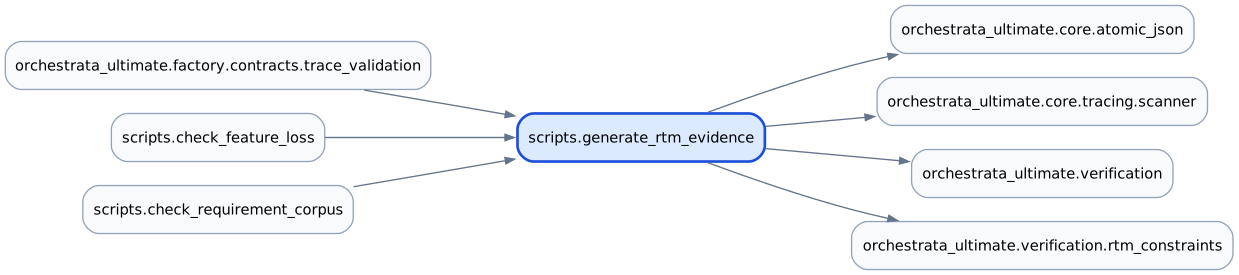
scripts/generate_rtm_evidence.py generates the evidence-graded requirements traceability matrix (RTM): every requirement row carries the class of proof behind it. It is used by a human and by other scripts as a library: check_feature_loss and check_requirement_corpus import it, as does orchestrata_ultimate.factory.contracts.trace_validation. It builds on orchestrata_ultimate.core.tracing.scanner, orchestrata_ultimate.verification and orchestrata_ultimate.verification.rtm_constraints.
Three harvesters feed it: load_requirements reads requirement definitions from the spec files (requirement_ids_in, requirement_source_files), harvest_src_declarations collects @traces decorators in the source tree, harvest_web_declarations collects @traces comment tags from JS and TS roots (skipping text inside comment spans via _ts_comment_spans), and harvest_test_citations finds requirement ids cited by tests. build_matrix joins them into rows, and build_rtm_facts produces the facts for the integrity check.
main options: --specs (default specs), --src, --web or --ts (repeatable), --tests, --json and --md output paths, --verify (run every citing test module with plain pytest, never xdist, and grade rows TESTED or FAILING; --verify-timeout defaults to 600 seconds) and --check-constraints (list the SPEC-033 REQ-033-C4 integrity violations: untraced, unproven, dangling; exit 1 if any). It writes the JSON and markdown matrices.
At a glance
| Source | scripts/generate_rtm_evidence.py |
| Lines of code | 788 |
| Classes | 0 |
| Functions | 16 |
| Imports (internal) | orchestrata_ultimate.core.atomic_json, orchestrata_ultimate.core.tracing.scanner, orchestrata_ultimate.verification, orchestrata_ultimate.verification.rtm_constraints |
| Imported by | orchestrata_ultimate.factory.contracts.trace_validation, scripts.check_feature_loss, scripts.check_requirement_corpus |
| Tests that import it | tests/scripts/test_check_feature_loss_corpus.py, tests/scripts/test_check_requirement_corpus.py, tests/scripts/test_rtm_evidence_paths.py |
Class diagram
No classes; see Functions.
Dependency diagram
API
Constants
| Name | Type | Value |
|---|---|---|
WEB_SOURCE_SUFFIXES |
tuple[str, ...] |
('.ts', '.tsx', '.js', '.jsx') |
WEB_SOURCE_ROOTS |
tuple[str, ...] |
('opencode', 'vizint-ui') |
Functions
| Function | Signature | Summary |
|---|---|---|
__getattr__ |
__getattr__(name: str) -> Any |
|
requirement_ids_in |
requirement_ids_in(text: str) -> dict[str, str] |
id -> title for every requirement DEFINITION in text. |
requirement_source_files |
requirement_source_files(specs_dir: Path) -> list[Path] |
The normative requirement-definition files — checklist, spec.md, addendum. |
load_requirements |
load_requirements(specs_dir: Path) -> dict[str, dict] |
id -> {spec, title, file}. |
_claim_positions |
_claim_positions(text: str, tree: ast.Module | None = None) -> tuple[list[tuple[int, int]], dict[int, int]] |
Where authored CLAIMS can live in a file: docstring line spans and comment start-columns per line. |
_ts_comment_spans |
_ts_comment_spans(text: str) -> list[tuple[int, int]] |
Character-offset spans of TypeScript // and /* */ comments. |
harvest_web_declarations |
harvest_web_declarations(root: Path) -> dict[str, list[dict]] |
req id -> [{file, line, name}] from @traces comment tags in JS/TS. |
harvest_test_citations |
harvest_test_citations(tests_dir: Path, corpus: ModuleCorpus | None = None) -> dict[str, list[dict]] |
req id -> [{file, line, kind}] for authored evidence a test claims to verify that requirement. |
harvest_src_declarations |
harvest_src_declarations(src_dir: Path) -> dict[str, list[dict]] |
req id -> [{file, line, name}] from @traces decorators in src. |
run_citing_tests |
run_citing_tests(citing_files: list[str], timeout: int) -> dict[str, bool] |
Run each citing test module (plain pytest, NEVER xdist) and return file -> passed. |
build_rtm_facts |
build_rtm_facts(reqs: dict[str, dict], cites: dict[str, list[dict]], test_results: dict[str, bool] | None) -> RtmFacts |
Build the SPEC-033 REQ-033-C4 constraint fact set from evidence this script already computed (load_requirements/harvest_test_citations). |
format_violation |
format_violation(v: RtmViolation) -> str |
One line per violation: kind + the violating identifiers. |
run_constraint_check |
run_constraint_check(reqs: dict[str, dict], cites: dict[str, list[dict]], test_results: dict[str, bool] | None) -> int |
Enumerate SPEC-033 REQ-033-C4 violations, print each, return the exit code contribution (1 if any violation was found, else 0). |
build_matrix |
build_matrix(reqs: dict[str, dict], cites: dict[str, list[dict]], decls: dict[str, list[dict]], test_results: dict[str, bool] | None) -> list[dict] |
|
render_markdown |
render_markdown(rows: list[dict], verified: bool) -> str |
|
main |
main() -> int |
Source
"""Evidence-graded RTM generator — every row carries its proof class.
Replaces the fabrication-prone "a decorator claim is a link" model
(docs/rtm.{json,md}, measured 55% +/- 5% accurate at W6, 2026-07-09) with a
matrix where each requirement is graded by the STRONGEST evidence that
exists for it, and absence of evidence is reported as absence:
TESTED a test module that cites the req id ran GREEN under --verify
(execution evidence, this run)
FAILING a citing test module ran RED under --verify (the claim exists
and is currently broken — the most actionable row in the file)
CITED a test file cites the req id (human-authored, executable claim;
not executed in this run)
DECLARED only @traces decorators in src/ (or @traces comment tags in
opencode/**/*.ts) claim the req (unverified — the 55% caveat
applies; see AGENTS.md "@traces Conventions")
UNLINKED no evidence anywhere (the honest majority)
Usage:
python scripts/generate_rtm_evidence.py # static grades
python scripts/generate_rtm_evidence.py --verify # run citing tests
python scripts/generate_rtm_evidence.py --json out.json --md out.md
Deterministic: no LLM, no judgment. A row upgrades from DECLARED to
CITED/TESTED only when someone writes a test that names the requirement —
the only way a retroactively-annotated codebase grows a REAL matrix.
"""
from __future__ import annotations
import argparse
import ast
import importlib.util
import re
import subprocess
import sys
from collections import defaultdict
from pathlib import Path
from typing import TYPE_CHECKING, Any
from orchestrata_ultimate.core.tracing.scanner import (
ModuleCorpus,
RequirementMentionFilter,
TraceScanner,
)
# Ensure the repo root is on sys.path when this file is run directly (its own
# usage line: `python scripts/generate_rtm_evidence.py`) — a script run by
# file path gets its OWN directory as sys.path[0], not the repo root, so
# `scripts` (the package) wouldn't otherwise resolve for the transitive
# `orchestrata_ultimate.verification` -> `scripts.parse_spec_requirements`
# import below (mirrors the src-on-path bootstrap in kg_schema.py et al.).
_repo_root = Path(__file__).resolve().parent.parent
if str(_repo_root) not in sys.path:
sys.path.insert(0, str(_repo_root))
# RtmFacts/RtmViolation/check_rtm are imported LAZILY (inside the
# --check-constraints code paths, and via the module __getattr__ below for
# attribute access): the verification package transitively imports
# scripts.parse_spec_requirements at import time, and the default no-flag
# invocation of this script must not depend on that chain.
if TYPE_CHECKING:
from orchestrata_ultimate.verification.rtm_constraints import (
RtmFacts,
RtmViolation,
)
_LAZY_RTM_EXPORTS = ("RtmFacts", "RtmViolation", "check_rtm")
def __getattr__(name: str) -> Any: # noqa: N807 — PEP 562 lazy re-export
# Any is unavoidable here: this returns whichever of two classes or one
# function `rtm_constraints` exports, by name, without importing that
# module (and its heavy transitive chain) eagerly.
if name in _LAZY_RTM_EXPORTS:
from orchestrata_ultimate.verification import rtm_constraints
return getattr(rtm_constraints, name)
raise AttributeError(f"module {__name__!r} has no attribute {name!r}")
# Same ground-truth shapes trace-lint accepts: "### REQ-..." headings and
# "**REQ-...**" checklist bold spans, title text captured to end of line.
_REQ_DEF_RE = re.compile(
r"(?:^###\s+|\*\*)(REQ-[A-Za-z0-9][A-Za-z0-9-]*)(?:\*\*)?:?\s*(.*)$",
re.MULTILINE,
)
_REQ_MENTION_RE = re.compile(r"REQ-[0-9][A-Za-z0-9-]*")
# Corpus-absent citation triage (backlog 504). A referenced id the corpus
# does not define is a GHOST row ONLY when it is a complete, plausible
# requirement id (3-digit spec number, then segments each ending in a digit)
# outside the reserved fixture space. Without this split the traceability
# tooling's own parser-rejection fixtures ("nope", "REQ-001-", "REQ-033-C")
# and sentinel fixtures manufacture ghost rows, and GHOST stops being a
# defect count. Specs never reach number 900: ids with spec >= 900 are the
# reserved FIXTURE space for tooling tests (grade FIXTURE, never GHOST);
# tokens that cannot be a requirement id at all grade MALFORMED.
_PLAUSIBLE_REQ_RE = re.compile(r"^REQ-(\d{3})(-[A-Za-z]*\d+)+$")
FIXTURE_SPEC_FLOOR = 900
# A test file containing this pragma opts out of citation harvest entirely:
# every REQ mention in it — docstring, comment, or @traces decorator — is
# fixture data or historical narrative about ids, never a coverage claim.
# For the RTM tooling's own test modules, whose re-pin narratives must cite
# dead ids verbatim and whose fixtures need real-looking ids sub-900.
FIXTURE_IDS_PRAGMA = "rtm-fixture-ids"
def requirement_ids_in(text: str) -> dict[str, str]:
"""id -> title for every requirement DEFINITION in ``text``.
THE single definition of "this text defines requirement X", shared by the
RTM loader below and by ``scripts/check_spec_checklists.py``. It is one
function on purpose: a coverage gate that decided id-hood even slightly
differently from the loader would certify a checklist as complete while the
loader still could not see half of it — a pass that means nothing, which is
the failure mode this repo keeps paying for.
Definition = a ``### REQ-...`` heading or a ``**REQ-...**`` bold span. A
bare prose mention does NOT define an id; SPEC-110 has a live instance of
exactly that (``REQ-110-140`` appears unbolded in its checklist and is
invisible to the loader).
"""
out: dict[str, str] = {}
for m in _REQ_DEF_RE.finditer(text):
rid, title = m.group(1), m.group(2).strip().rstrip("*").strip()
out.setdefault(rid, title[:160])
return out
def requirement_source_files(specs_dir: Path) -> list[Path]:
"""The normative requirement-definition files — checklist, spec.md, addendum.
Delegates to the AST toolkit's ``_requirement_source_files``, which is the
RATIFIED definition of the requirement corpus in this repo, loaded by path
via the same pattern ``ast_report.py::_load_tool`` and
``check_spec_authority.py::load_ast_toolkit`` already use.
Why delegate rather than re-implement: this generator used to glob
``*/checklists/requirements.md`` and nothing else. The toolkit had already
hit that exact bug and fixed it — its docstring records that the narrow scan
made 43 real ``@traces`` look structurally dangling — but the fix was never
propagated here. The result was two loaders in one repo disagreeing about
what the spec corpus contains: ``trace-lint`` reported those citations
clean while the RTM graded them GHOST. Re-implementing the scan would
recreate exactly that divergence, so there is one definition and this reads
it.
Measured at adoption (2026-08-13): the corpus widens from 5,497 ids to
5,565 (+68, 0 lost) across 6 files — 034/spec.md (22), 110/spec.md (22),
033/spec.md (10), 001-kernel/pipeline-event-type-addendum.md (7),
097/redis-key-namespacing-addendum.md (5), 024/spec.md (2) — and every one
of the 21 production dangling ``@traces`` resolves to a real requirement.
"""
tool_path = _repo_root / "scripts" / "serialize_codebase_ast.py"
spec = importlib.util.spec_from_file_location("serialize_codebase_ast", tool_path)
if spec is None or spec.loader is None:
raise ImportError(f"cannot load AST toolkit from {tool_path}")
mod = importlib.util.module_from_spec(spec)
spec.loader.exec_module(mod)
return list(mod._requirement_source_files(specs_dir))
def load_requirements(specs_dir: Path) -> dict[str, dict]:
"""id -> {spec, title, file}. First definition wins for title/file;
dual-defined ids record every defining spec."""
reqs: dict[str, dict] = {}
for req_file in requirement_source_files(specs_dir):
# A source is either <spec>/checklists/requirements.md or a file
# sitting directly in <spec>/ (spec.md, *-addendum.md), so the owning
# spec dir is one level up in the first shape and zero in the second.
# Deriving it as parent.parent unconditionally would attribute every
# spec.md requirement to "specs" and silently mislabel 68 ids.
spec_dir = (
req_file.parent.parent
if req_file.parent.name == "checklists"
else req_file.parent
)
spec_name = spec_dir.name
try:
text = req_file.read_text(encoding="utf-8")
except OSError, UnicodeDecodeError:
continue
for rid, title in requirement_ids_in(text).items():
entry = reqs.setdefault(
rid,
{"spec": spec_name, "title": title, "specs": []},
)
if spec_name not in entry["specs"]:
entry["specs"].append(spec_name)
return reqs
def _claim_positions(
text: str, tree: ast.Module | None = None
) -> tuple[list[tuple[int, int]], dict[int, int]]:
"""Where authored CLAIMS can live in a file: docstring line spans and
comment start-columns per line. A REQ id inside an in-code string
literal is test DATA (e.g. traceability tests feeding sample ids into
the machinery under test), not a claim that the test verifies it."""
spans: list[tuple[int, int]] = []
if tree is None:
try:
tree = ast.parse(text)
except SyntaxError:
return [], {}
for node in ast.walk(tree):
if isinstance(
node, (ast.Module, ast.ClassDef, ast.FunctionDef, ast.AsyncFunctionDef)
):
body = node.body
if (
body
and isinstance(body[0], ast.Expr)
and isinstance(body[0].value, ast.Constant)
and isinstance(body[0].value.value, str)
):
spans.append((body[0].lineno, body[0].end_lineno or body[0].lineno))
import io
import tokenize
comment_cols: dict[int, int] = {}
try:
for tok in tokenize.generate_tokens(io.StringIO(text).readline):
if tok.type == tokenize.COMMENT:
comment_cols[tok.start[0]] = tok.start[1]
except tokenize.TokenError, IndentationError:
pass
return spans, comment_cols
def _ts_comment_spans(text: str) -> list[tuple[int, int]]:
"""Character-offset spans of TypeScript `//` and `/* */` comments.
A tiny hand-rolled scanner (not a full TS lexer) that tracks single/
double/template-quoted strings so a `//` inside a URL string (e.g.
`"http://localhost:3456/health"`, common in this codebase) is never
mistaken for a line-comment start. Good enough for finding @traces
tags deterministically; not a general-purpose TS parser.
"""
spans: list[tuple[int, int]] = []
i, n = 0, len(text)
in_string: str | None = None
while i < n:
ch = text[i]
if in_string:
if ch == "\\":
i += 2
continue
if ch == in_string:
in_string = None
i += 1
continue
if ch in ("'", '"', "`"):
in_string = ch
i += 1
continue
if ch == "/" and i + 1 < n and text[i + 1] == "/":
nl = text.find("\n", i)
end = nl if nl != -1 else n
spans.append((i, end))
i = end
continue
if ch == "/" and i + 1 < n and text[i + 1] == "*":
close = text.find("*/", i + 2)
end = close + 2 if close != -1 else n
spans.append((i, end))
i = end
continue
i += 1
return spans
# THE canonical output paths for this generator, named so the three components
# that must agree about them cannot silently re-split. They did split once:
# ca71ec06 moved the .md from docs/ to reports/ and added reports/*.json, but
# left the argparse defaults and scripts/project_status.py pointing at docs/.
# The result ran for ten days — every session's `rtm:` status line reported a
# STALE docs/ copy (5,284 rows) while the fresh matrix sat in reports/ (5,340).
# reports/ is where generated run output lives (run-tests-latest.json,
# derived-rtm.md, code-intel-slo.json); docs/ is @import-able documentation,
# which a 2.3 MB machine-written matrix is not.
# Pinned by tests/scripts/test_rtm_evidence_paths.py across producer (here),
# consumer (project_status.get_rtm_summary) and the RUL-030 artifact gate.
DEFAULT_JSON_OUT = "reports/rtm-evidence.json"
DEFAULT_MD_OUT = "reports/rtm-evidence.md"
WEB_SOURCE_SUFFIXES: tuple[str, ...] = (".ts", ".tsx", ".js", ".jsx")
# Every web tree in this repo that can carry `@traces` comment tags. The harvest
# root used to be a single `--ts opencode`, so widening the glob to `.js` bought
# nothing on its own: vizint-ui was still never walked, and SPEC-017's tags could
# not reach the RTM no matter what anyone wrote in them. A root that does not
# exist is skipped by rglob, so listing an optional tree here is harmless.
WEB_SOURCE_ROOTS: tuple[str, ...] = ("opencode", "vizint-ui")
def harvest_web_declarations(root: Path) -> dict[str, list[dict]]:
"""req id -> [{file, line, name}] from `@traces` comment tags in JS/TS.
Neither JS nor TS has a decorator equivalent to Python's `@traces(...)`,
so the convention (documented in AGENTS.md "TS-side @traces convention")
is a plain comment tag: `// @traces REQ-021-065 REQ-021-066` or the same
inside a `/** */` block. Only ids on the SAME LINE as the `@traces`
marker are claimed by that tag (a repeated tag line claims a separate
group). `node_modules` is excluded everywhere in the tree, not just at
the top level (vendored packages can nest their own).
Covers `.js`/`.jsx` as well as `.ts`/`.tsx`. It used to glob `*.ts`
alone, which excluded vizint-ui entirely -- 95 `.js` files against
opencode/plugins' 25 `.ts` -- so SPEC-017 and SPEC-022 could not be
traced at all no matter what anyone wrote in them (REQ-022 measured
39/39 UNLINKED). `_ts_comment_spans` needs nothing added for JS: the
comment and string-literal forms it scans are the same in both.
"""
decls: dict[str, list[dict]] = defaultdict(list)
sources = sorted(
p for suffix in WEB_SOURCE_SUFFIXES for p in root.rglob(f"*{suffix}")
)
for ts in sources:
if "node_modules" in ts.parts:
continue
try:
text = ts.read_text(encoding="utf-8")
except OSError, UnicodeDecodeError:
continue
for start, end in _ts_comment_spans(text):
comment = text[start:end]
for tag in re.finditer(r"@traces\b", comment):
nl = comment.find("\n", tag.end())
line_end = nl if nl != -1 else len(comment)
tail = comment[tag.end() : line_end]
lineno = text.count("\n", 0, start + tag.start()) + 1
for m in _REQ_MENTION_RE.finditer(tail):
rid = m.group(0)
if rid == "REQ-000-000":
continue
decls[rid].append(
{"file": str(ts), "line": lineno, "name": ts.stem}
)
return decls
def harvest_test_citations(
tests_dir: Path, corpus: ModuleCorpus | None = None
) -> dict[str, list[dict]]:
"""req id -> [{file, line, kind}] for authored evidence a test claims to
verify that requirement.
Two citation forms, both blessed as canonical (R-D5,
AGENTS.md "@traces Conventions"), each carrying its own provenance:
- ``kind="docstring"``: a REQ id mentioned in a docstring or comment
(a REQ id in an in-code string literal is test data, not a claim —
traceability/RTM tests use real-looking ids as fixtures). Placeholders
are excluded.
- ``kind="decorator"``: an ``@traces(reqs=[...])`` decorator directly on
a test function/class, harvested via the shared AST scanner
(``core.tracing.scanner.collect_traces`` — the same walk src-side
declarations use) rather than reimplemented here.
A file containing ``FIXTURE_IDS_PRAGMA`` is skipped for BOTH forms:
every REQ mention in it is fixture data or narrative about ids, never a
coverage claim (backlog 504 — the RTM tooling's own test modules were
manufacturing GHOST rows).
*corpus* is the shared parse (WI-FLOSS, tasks 578/581): when given, both
passes consume its text/tree and nothing under *tests_dir* is read or
parsed again — ``check_feature_loss.run_check`` builds one corpus for the
whole run. Without it a ``RequirementMentionFilter`` corpus is built here,
so the CLI is unchanged. Before this seam the docstring pass and
``collect_traces`` each parsed the tests tree (2026-10-08, ~2,060
modules: 185s of a 206s ``run_check`` under host load).
"""
cites: dict[str, list[dict]] = defaultdict(list)
pragma_files: set[str] = set()
if corpus is None:
corpus = ModuleCorpus.load(tests_dir, RequirementMentionFilter())
for pm in corpus.modules():
py, text = pm.path, pm.text
if FIXTURE_IDS_PRAGMA in text:
pragma_files.add(str(py.resolve()))
continue
if _REQ_MENTION_RE.search(text) is None:
# No REQ id anywhere in the file: there is nothing to classify,
# so skip the ast.parse + tokenize that ``_claim_positions`` costs.
# Measured 2026-10-08: this harvest took 85s solo / 183s on a
# loaded host over the ~1,850-module tests tree, with the parse
# and tokenize of every module dominating — most of them mention
# no requirement at all.
continue
doc_spans, comment_cols = _claim_positions(text, pm.tree)
doc_lines: set[int] = set()
for a, b in doc_spans:
doc_lines.update(range(a, b + 1))
for lineno, line in enumerate(text.splitlines(), 1):
in_doc = lineno in doc_lines
ccol = comment_cols.get(lineno)
for m in _REQ_MENTION_RE.finditer(line):
rid = m.group(0)
if rid == "REQ-000-000":
continue
if in_doc or (ccol is not None and m.start() >= ccol):
cites[rid].append(
{"file": str(py), "line": lineno, "kind": "docstring"}
)
for trace in TraceScanner().collect_from(corpus):
if str(Path(trace.file_path).resolve()) in pragma_files:
continue
for rid in trace.reqs:
if rid == "REQ-000-000":
continue
cites[rid].append(
{
"file": trace.file_path,
"line": trace.line_number,
"kind": "decorator",
}
)
return cites
def harvest_src_declarations(src_dir: Path) -> dict[str, list[dict]]:
"""req id -> [{file, line, name}] from @traces decorators in src."""
decls: dict[str, list[dict]] = defaultdict(list)
for py in sorted(src_dir.rglob("*.py")):
try:
tree = ast.parse(py.read_text(encoding="utf-8"))
except OSError, SyntaxError, UnicodeDecodeError:
continue
for node in ast.walk(tree):
if not isinstance(
node, (ast.FunctionDef, ast.AsyncFunctionDef, ast.ClassDef)
):
continue
for dec in node.decorator_list:
if not (
isinstance(dec, ast.Call)
and (
(isinstance(dec.func, ast.Name) and dec.func.id == "traces")
or (
isinstance(dec.func, ast.Attribute)
and dec.func.attr == "traces"
)
)
):
continue
for kw in dec.keywords:
if kw.arg != "reqs" or not isinstance(
kw.value, (ast.List, ast.Tuple)
):
continue
for elt in kw.value.elts:
if (
isinstance(elt, ast.Constant)
and isinstance(elt.value, str)
and elt.value != "REQ-000-000"
):
decls[elt.value].append(
{
"file": str(py),
"line": node.lineno,
"name": node.name,
}
)
return decls
def run_citing_tests(citing_files: list[str], timeout: int) -> dict[str, bool]:
"""Run each citing test module (plain pytest, NEVER xdist) and return
file -> passed. One invocation per module keeps attribution exact."""
results: dict[str, bool] = {}
for f in citing_files:
proc = subprocess.run(
[
sys.executable,
"-m",
"pytest",
f,
"-q",
"--timeout",
"120",
"-p",
"no:xdist",
"-p",
"no:cacheprovider",
],
capture_output=True,
text=True,
timeout=timeout,
)
results[f] = proc.returncode == 0
print(f" {'PASS' if proc.returncode == 0 else 'FAIL'} {f}", flush=True)
return results
def build_rtm_facts(
reqs: dict[str, dict],
cites: dict[str, list[dict]],
test_results: dict[str, bool] | None,
) -> RtmFacts:
"""Build the SPEC-033 REQ-033-C4 constraint fact set from evidence this
script already computed (``load_requirements``/``harvest_test_citations``).
Only test CITATIONS become ``trace`` facts — a bare ``@traces`` decorator
claim (``decls``, the DECLARED grade) is not "reached by an asserting
test" (ADR-0007) and is not proof. A requirement with citations but no
execution evidence (no ``--verify``) is graded the default minimum
(``cited``, matching the CITED grade); under ``--verify`` a citing unit
that ran green/red is graded ``tested``/``failing`` instead, so a
requirement whose citing tests are ALL currently red surfaces as an
``unproven`` violation.
"""
traces: set[tuple[str, str]] = set()
test_units: set[str] = set()
proof_classes: dict[str, str] = {}
for rid, citations in cites.items():
for c in citations:
unit = c["file"]
traces.add((rid, unit))
test_units.add(unit)
if test_results is not None and unit in test_results:
proof_classes[unit] = "tested" if test_results[unit] else "failing"
elif unit not in proof_classes:
proof_classes[unit] = "cited"
from orchestrata_ultimate.verification.rtm_constraints import RtmFacts
return RtmFacts(
requirements=frozenset(reqs),
traces=frozenset(traces),
test_units=frozenset(test_units),
proof_classes=proof_classes,
min_classes={},
)
def format_violation(v: RtmViolation) -> str:
"""One line per violation: kind + the violating identifiers."""
parts = [v.kind, v.req]
if v.unit is not None:
parts.append(f"unit={v.unit}")
if v.needed_class is not None:
parts.append(f"needed={v.needed_class}")
return " ".join(parts)
def run_constraint_check(
reqs: dict[str, dict],
cites: dict[str, list[dict]],
test_results: dict[str, bool] | None,
) -> int:
"""Enumerate SPEC-033 REQ-033-C4 violations, print each, return the exit
code contribution (1 if any violation was found, else 0)."""
from orchestrata_ultimate.verification.rtm_constraints import check_rtm
facts = build_rtm_facts(reqs, cites, test_results)
violations = check_rtm(facts)
for v in violations:
print(format_violation(v))
print(f"{len(violations)} RTM integrity-constraint violation(s)")
return 1 if violations else 0
def build_matrix(
reqs: dict[str, dict],
cites: dict[str, list[dict]],
decls: dict[str, list[dict]],
test_results: dict[str, bool] | None,
) -> list[dict]:
rows = []
for rid in sorted(reqs):
cited = cites.get(rid, [])
declared = decls.get(rid, [])
if test_results is not None and cited:
files = {c["file"] for c in cited}
outcomes = [test_results[f] for f in files if f in test_results]
grade = (
"TESTED"
if outcomes and all(outcomes)
else "FAILING" if outcomes else "CITED"
)
elif cited:
grade = "CITED"
elif declared:
grade = "DECLARED"
else:
grade = "UNLINKED"
rows.append(
{
"req": rid,
"spec": reqs[rid]["spec"],
"specs": reqs[rid]["specs"],
"title": reqs[rid]["title"],
"grade": grade,
"cited_by": cited,
"declared_by": declared,
}
)
# Fabrication signal: ids cited/declared but defined in NO spec.
# Triage (backlog 504): GHOST only for plausible ids outside the
# reserved fixture space; parser-rejection fixtures grade MALFORMED and
# sentinel-space ids grade FIXTURE so GHOST stays a clean defect count.
unknown_ids = (set(cites) | set(decls)) - set(reqs)
for rid in sorted(unknown_ids):
m = _PLAUSIBLE_REQ_RE.match(rid)
if m is None:
grade = "MALFORMED"
elif int(m.group(1)) >= FIXTURE_SPEC_FLOOR:
grade = "FIXTURE"
else:
grade = "GHOST"
rows.append(
{
"req": rid,
"spec": None,
"specs": [],
"title": "",
"grade": grade,
"cited_by": cites.get(rid, []),
"declared_by": decls.get(rid, []),
}
)
return rows
def render_markdown(rows: list[dict], verified: bool) -> str:
counts: dict[str, int] = defaultdict(int)
by_spec: dict[str, dict[str, int]] = defaultdict(lambda: defaultdict(int))
for r in rows:
counts[r["grade"]] += 1
if r["spec"]:
by_spec[r["spec"]][r["grade"]] += 1
total = sum(counts.values())
lines = [
"# RTM — evidence-graded",
"",
"> Generated by `scripts/generate_rtm_evidence.py`. Every row carries",
"> its proof class; a row upgrades ONLY when a test cites the",
"> requirement (and, under `--verify`, runs green). DECLARED rows are",
"> unverified decorator claims — measured 55% +/- 5% accurate (W6,",
"> 2026-07-09); do not treat them as ground truth.",
"",
f"Execution evidence this run: {'YES (--verify)' if verified else 'NO (static; CITED not executed)'}",
"",
"## Totals",
"",
"| grade | requirements | share |",
"|---|---|---|",
]
for g in (
"TESTED",
"FAILING",
"CITED",
"DECLARED",
"UNLINKED",
"GHOST",
"FIXTURE",
"MALFORMED",
):
if counts.get(g):
lines.append(f"| {g} | {counts[g]} | {100 * counts[g] / total:.1f}% |")
lines += [
"",
"## By spec",
"",
"| spec | TESTED | FAILING | CITED | DECLARED | UNLINKED |",
"|---|---|---|---|---|---|",
]
for spec in sorted(by_spec):
c = by_spec[spec]
lines.append(
f"| {spec} | {c.get('TESTED', 0)} | {c.get('FAILING', 0)} "
f"| {c.get('CITED', 0)} | {c.get('DECLARED', 0)} | {c.get('UNLINKED', 0)} |"
)
lines += ["", "## Evidence rows (TESTED / FAILING / CITED)", ""]
for r in rows:
if r["grade"] in ("TESTED", "FAILING", "CITED"):
tests = sorted({c["file"] for c in r["cited_by"]})
lines.append(
f"- **{r['req']}** [{r['grade']}] {r['title']} \n"
f" tests: {', '.join(tests)}"
)
ghosts = [r for r in rows if r["grade"] == "GHOST"]
if ghosts:
lines += ["", "## GHOST ids (referenced but defined in no spec)", ""]
for r in ghosts:
src = r["cited_by"] + r["declared_by"]
where = f"{src[0]['file']}:{src[0]['line']}" if src else "?"
lines.append(f"- {r['req']} (first ref: {where})")
malformed = [r for r in rows if r["grade"] == "MALFORMED"]
if malformed:
lines += [
"",
"## MALFORMED citation tokens (cannot be a requirement id)",
"",
]
for r in malformed:
src = r["cited_by"] + r["declared_by"]
where = f"{src[0]['file']}:{src[0]['line']}" if src else "?"
lines.append(f"- `{r['req']}` (first ref: {where})")
lines.append("")
return "\n".join(lines)
def main() -> int:
ap = argparse.ArgumentParser(description=(__doc__ or "").splitlines()[0])
ap.add_argument("--specs", default="specs")
ap.add_argument("--src", default="src/orchestrata_ultimate")
ap.add_argument(
"--web",
"--ts",
dest="web",
action="append",
help=(
"Root to harvest JS/TS `@traces` comment tags from; repeatable. "
"Defaults to every root in WEB_SOURCE_ROOTS."
),
)
ap.add_argument("--tests", default="tests")
ap.add_argument("--json", dest="json_out", default=DEFAULT_JSON_OUT)
ap.add_argument("--md", dest="md_out", default=DEFAULT_MD_OUT)
ap.add_argument(
"--verify",
action="store_true",
help="Run every citing test module and grade TESTED/FAILING",
)
ap.add_argument("--verify-timeout", type=int, default=600)
ap.add_argument(
"--check-constraints",
action="store_true",
help=(
"Enumerate SPEC-033 REQ-033-C4 RTM integrity-constraint violations "
"(untraced/unproven/dangling) from the evidence this run computed, "
"print each one, and exit 1 if any were found"
),
)
args = ap.parse_args()
reqs = load_requirements(Path(args.specs))
cites = harvest_test_citations(Path(args.tests))
decls = harvest_src_declarations(Path(args.src))
for web_root in args.web or WEB_SOURCE_ROOTS:
for rid, occurrences in harvest_web_declarations(Path(web_root)).items():
decls[rid].extend(occurrences)
test_results = None
if args.verify:
citing_files = sorted({c["file"] for cs in cites.values() for c in cs})
print(f"verifying {len(citing_files)} citing test modules...", flush=True)
test_results = run_citing_tests(citing_files, args.verify_timeout)
rows = build_matrix(reqs, cites, decls, test_results)
# Atomic: reports/rtm-evidence.json is 2.9 MB and regenerated by the gate
# battery; a truncate-in-place rewrite SIGBUSes any reader holding it
# mmap'd. No trailing newline, matching the previous writer byte for byte.
from orchestrata_ultimate.core.atomic_json import (
dump_json_atomic,
dump_text_atomic,
)
dump_json_atomic(
Path(args.json_out),
{
"verified": bool(args.verify),
"requirements": len(reqs),
"rows": rows,
},
indent=1,
)
dump_text_atomic(Path(args.md_out), render_markdown(rows, bool(args.verify)))
counts: dict[str, int] = defaultdict(int)
for r in rows:
counts[r["grade"]] += 1
print(
f"{len(reqs)} requirements -> "
+ ", ".join(f"{g}={n}" for g, n in sorted(counts.items()))
)
print(f"wrote {args.json_out} + {args.md_out}")
if args.check_constraints:
return run_constraint_check(reqs, cites, test_results)
return 0
if __name__ == "__main__":
sys.exit(main())