orchestrata_ultimate.semantic_graph.adapters.memgraph
Reference › orchestrata_ultimate › semantic_graph › adapters › memgraph
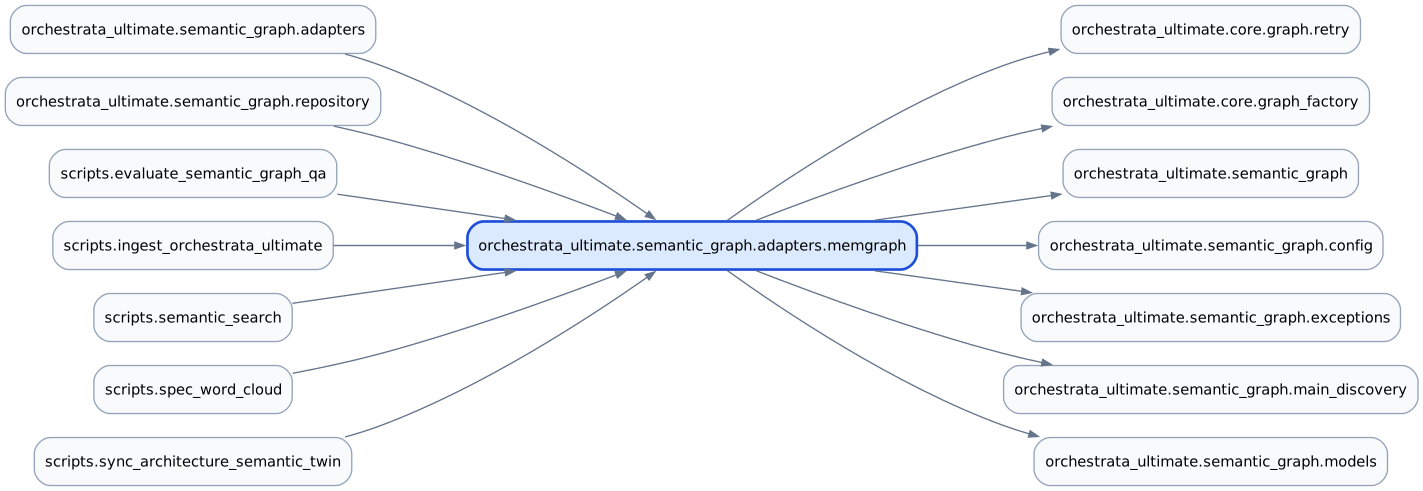
MemgraphSemanticGraph is the production implementation of the SemanticGraph protocol. It reads and writes the shared semantic/RAG graph, the memgraph database, and never the operational orchkg graph. The official Neo4j Bolt driver is used because Memgraph speaks Bolt; that is client naming only. The driver is synchronous and is run in worker threads to keep the async repository interface and avoid event-loop binding problems in tests. repository registers it as the memgraph backend, and the in-memory twin for tests is memory.
- Connection.
connectasks_resolve_urifor the current MAIN, which callsmain_discovery.resolve_mainfrom main_discovery with the adapter's own config fields and no caching, because a reconnect after failure is exactly when a cached MAIN would be stale. It opens the driver (explicitly unauthenticated unless a username or password is configured), verifies connectivity and calls_ensure_schemafor constraints and lookup indexes. It returnsFalseand logs a warning on failure. - Graph side.
upsert_entities,upsert_relationshipsandget_neighbors, written in batches ofwrite_batch_size. - Vector side.
add_chunkscreates the native vector index lazily, sized from the first chunk's embedding (_ensure_vector_index,_wait_for_vector_index, with checks of existing dimension and indexes), andsearch_similarqueries it through thevector_search.searchmodule. - Retrieval.
retrievetakes the nearest chunks and, for a graph depth above zero, expands a matching neighbourhood in one batched query into aGraphRAGContext.search_keyword,matching_module_names,chunk_prominenceandlink_chunks_to_modulessupply the keyword, module and prominence signals that ingestion fuses for hybrid search. - Maintenance.
clearremoves this project's chunk label and index in batches,clear_prefixedis the test-isolated cleanup,delete_chunksandchunks_with_id_prefixserve incremental updates, andfind_stale_chunk_nodeswithprune_stale_chunk_nodes(dry run unlessapplyis set) removes nodes under stale chunk labels.
Failures raise ConnectionError, QueryError or VectorSearchError from exceptions; a failed query triggers a reconnect.
At a glance
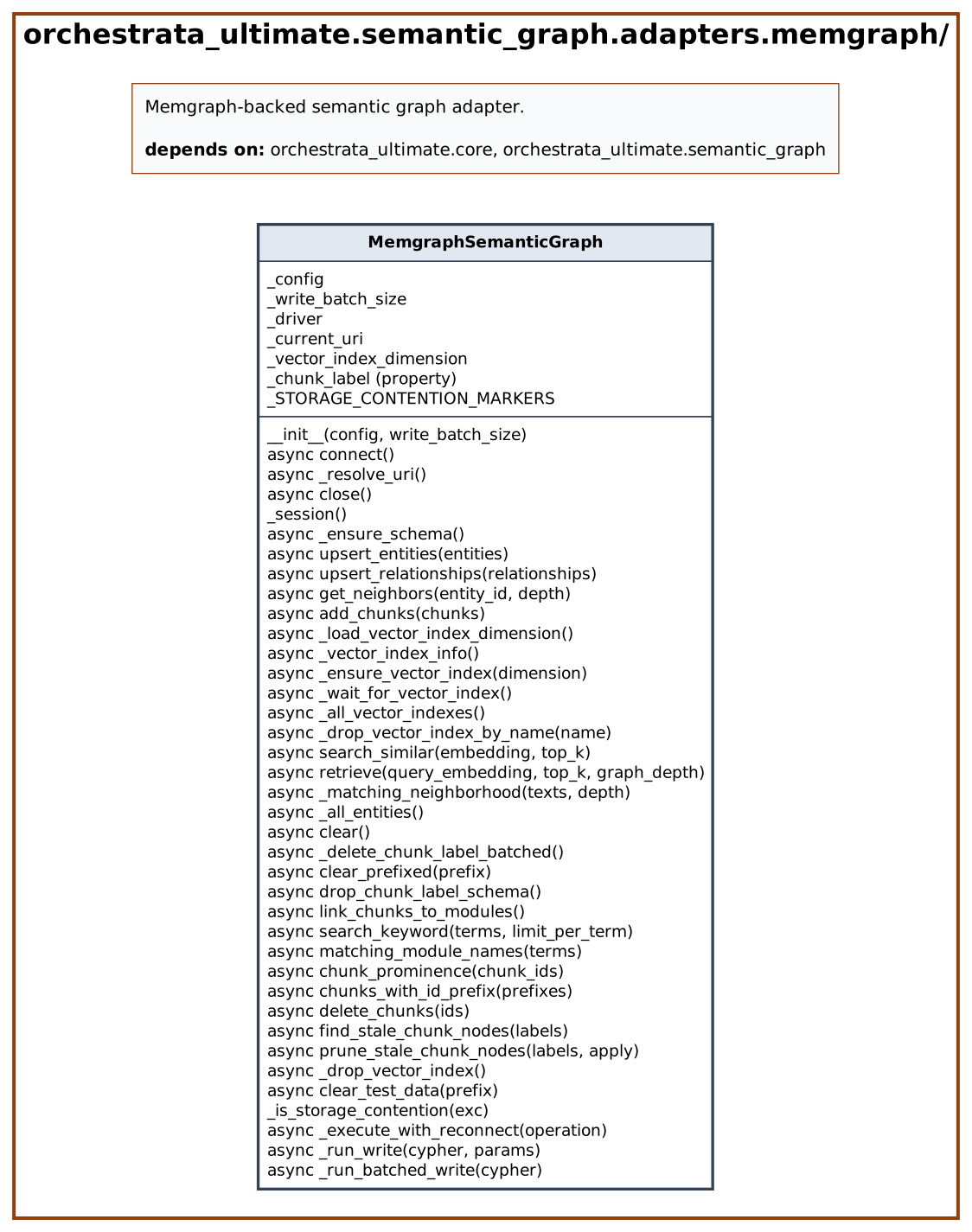
Class diagram
Dependency diagram
API
Constants
| Name | Type | Value |
|---|---|---|
STALE_CHUNK_LABELS |
tuple[str, ...] |
('SemanticChunk', 'QwenChunk', 'Chunk') |
Classes
MemgraphSemanticGraph
Line 56
Memgraph implementation of the SemanticGraph interface.
| Method | Signature | Summary |
|---|---|---|
__init__ |
__init__(config: SemanticGraphConfig | None = None, write_batch_size: int = WRITE_BATCH_SIZE) -> None |
|
connect |
async connect() -> bool |
Open the Bolt driver and verify connectivity. |
_resolve_uri |
async _resolve_uri() -> str | None |
Return a Bolt URI to connect to -- the current Memgraph MAIN. |
close |
async close() -> None |
Close the Bolt driver. |
_chunk_label property |
_chunk_label() -> str |
Return the configured node label for chunks. |
_session |
_session() -> Any |
Open a driver session, targeting config.database when set. |
_ensure_schema |
async _ensure_schema() -> None |
Create uniqueness constraints, lookup indexes, and detect the vector index. |
upsert_entities |
async upsert_entities(entities: list[Entity]) -> None |
|
upsert_relationships |
async upsert_relationships(relationships: list[Relationship]) -> None |
|
get_neighbors |
async get_neighbors(entity_id: str, depth: int = 1) -> tuple[list[Entity], list[Relationship]] |
|
add_chunks |
async add_chunks(chunks: list[Chunk]) -> None |
|
_load_vector_index_dimension |
async _load_vector_index_dimension() -> None |
Set _vector_index_dimension from an existing index, if any. |
_vector_index_info |
async _vector_index_info() -> dict[str, Any] | None |
Return metadata for the configured vector index, or None if absent. |
_ensure_vector_index |
async _ensure_vector_index(dimension: int) -> None |
Create the native vector index lazily if it does not yet exist. |
_wait_for_vector_index |
async _wait_for_vector_index() -> None |
Poll until the configured vector index is reported by Memgraph. |
_all_vector_indexes |
async _all_vector_indexes() -> list[dict[str, Any]] |
Return metadata for all vector indexes in the database. |
_drop_vector_index_by_name |
async _drop_vector_index_by_name(name: str) -> None |
Drop a vector index by its exact name. |
search_similar |
async search_similar(embedding: list[float], top_k: int = 5) -> list[Chunk] |
|
retrieve |
async retrieve(query_embedding: list[float], top_k: int = 5, graph_depth: int = 1) -> GraphRAGContext |
|
_matching_neighborhood |
async _matching_neighborhood(texts: list[str], depth: int) -> tuple[list[Entity], list[Relationship]] |
Retrieve's entity match + graph expansion as ONE batched query. |
_all_entities |
async _all_entities() -> list[Entity] |
Return all entities in the graph. |
clear |
async clear() -> None |
Clear THIS project's data: the vector index and its chunk-label nodes. |
_delete_chunk_label_batched |
async _delete_chunk_label_batched() -> int |
DETACH DELETE every chunk-label node, _write_batch_size per transaction (see WRITE_BATCH_SIZE). |
clear_prefixed |
async clear_prefixed(prefix: str) -> None |
Test-isolated cleanup: drop index, delete chunks by label, and delete only entities whose id starts with prefix. |
drop_chunk_label_schema |
async drop_chunk_label_schema() -> None |
Drop the per-chunk-label constraint and lookup indexes that _ensure_schema created for self._chunk_label. |
link_chunks_to_modules |
async link_chunks_to_modules() -> None |
Create Module nodes and BELONGS_TO edges from chunk metadata. |
search_keyword |
async search_keyword(terms: list[str], limit_per_term: int = 50) -> list[tuple[Chunk, int]] |
Return chunks whose content contains any of terms. |
matching_module_names |
async matching_module_names(terms: list[str]) -> set[str] |
Return lower-cased Module.name values that match any of terms. |
chunk_prominence |
async chunk_prominence(chunk_ids: list[str]) -> dict[str, float] |
Return chunk_id -> prominence for chunks linked to a prominent Entity. |
chunks_with_id_prefix |
async chunks_with_id_prefix(prefixes: list[str]) -> list[Chunk] |
Return chunks (of this adapter's configured label) whose id starts with any of prefixes. |
delete_chunks |
async delete_chunks(ids: list[str]) -> None |
Delete chunks (of this adapter's configured label) by exact id. |
find_stale_chunk_nodes |
async find_stale_chunk_nodes(labels: list[str] | None = None) -> list[dict[str, Any]] |
Return nodes with a stale chunk label that carry the orchestrata chunk-id shape (audit #3). |
prune_stale_chunk_nodes |
async prune_stale_chunk_nodes(labels: list[str] | None = None, apply: bool = False) -> int |
Report (or, with apply=True, delete) stale chunk nodes. |
_drop_vector_index |
async _drop_vector_index() -> None |
Drop the native vector index so the next test starts clean. |
clear_test_data |
async clear_test_data(prefix: str) -> None |
Remove nodes whose id starts with prefix (used by tests). |
_is_storage_contention classmethod |
_is_storage_contention(exc: Exception) -> bool |
True when exc is Memgraph's transient storage-access contention. |
_execute_with_reconnect |
async _execute_with_reconnect(operation: Callable[..., T], **args: Any, max_retries: int = 1, max_storage_retries: int = 12) -> T |
Run a sync operation in a thread with two independent retry classes. |
_run_write |
async _run_write(cypher: str, params: dict[str, Any] | None = None) -> None |
Run a write query in a thread. |
_run_batched_write |
async _run_batched_write(cypher: str) -> int |
Repeat a LIMIT $batch write, one transaction per pass, until a pass reports n == 0. cypher must bind $batch and return a single count(*) AS n row. |
Functions
| Function | Signature | Summary |
|---|---|---|
_node_to_entity |
_node_to_entity(node: Any) -> Entity |
Convert a Memgraph node to an Entity model. |
_node_to_chunk |
_node_to_chunk(node: Any) -> Chunk |
Convert a Memgraph node to a Chunk model. |
_rel_to_relationship |
_rel_to_relationship(rel: Any, source_id: str | None = None, target_id: str | None = None) -> Relationship |
Convert a Memgraph relationship to a Relationship model. |
_records_to_entities_relationships |
_records_to_entities_relationships(records: Any) -> tuple[list[Entity], list[Relationship]] |
Assemble deduplicated entities/relationships from expansion records. |
Source
"""Memgraph-backed semantic graph adapter.
Uses the official Neo4j Bolt driver because Memgraph speaks the Bolt protocol.
The synchronous driver is used internally and wrapped in threads to preserve the
async repository interface; this avoids event-loop binding issues in tests.
Vector search uses Memgraph's native HNSW vector index via the
``vector_search.search`` query module. The index is created lazily on the first
``add_chunks`` call using the dimension of the first chunk's embedding.
"""
from __future__ import annotations
import json
import logging
import time
from collections.abc import Callable
from typing import Any, TypeVar
import anyio
import anyio.to_thread
from orchestrata_ultimate.core.graph.retry import _PERMANENT_MARKERS
from orchestrata_ultimate.semantic_graph import main_discovery
from orchestrata_ultimate.semantic_graph.config import SemanticGraphConfig
from orchestrata_ultimate.semantic_graph.exceptions import (
ConnectionError,
QueryError,
VectorSearchError,
)
from orchestrata_ultimate.semantic_graph.models import (
Chunk,
Entity,
GraphRAGContext,
Relationship,
)
logger = logging.getLogger(__name__)
T = TypeVar("T")
# Stale chunk labels from earlier embedding backends (audit #3). ``Chunk`` is
# also used by the unrelated wiki graph, so any scan/prune over these labels
# MUST additionally scope by the orchestrata chunk-id shape — see
# MemgraphSemanticGraph.find_stale_chunk_nodes.
STALE_CHUNK_LABELS: tuple[str, ...] = ("SemanticChunk", "QwenChunk", "Chunk")
# Row cap for one bulk-write transaction (whole-label delete, chunk→Module
# linking). Prod's SYNC replica must apply every committed transaction inside
# the main's fixed 5 s replication RPC wait; one unbounded DETACH DELETE over
# every 1536-dim chunk took ~54 s to apply there and failed the 2026-10-19
# promote. Bulk writes therefore loop in transactions of at most this many rows.
WRITE_BATCH_SIZE = 500
class MemgraphSemanticGraph:
"""Memgraph implementation of the SemanticGraph interface."""
def __init__(
self,
config: SemanticGraphConfig | None = None,
write_batch_size: int = WRITE_BATCH_SIZE,
) -> None:
if write_batch_size < 1:
raise ValueError(f"write_batch_size must be >= 1, got {write_batch_size}")
self._config = config or SemanticGraphConfig.from_env()
self._write_batch_size = write_batch_size
self._driver: Any | None = None
self._current_uri: str | None = None
self._vector_index_dimension: int | None = None
async def connect(self) -> bool:
"""Open the Bolt driver and verify connectivity.
If an HA controller URL is configured, discover the current MAIN URI from
the controller before connecting.
"""
uri = await self._resolve_uri()
if uri is None:
logger.warning("No Memgraph URI available from controller or config")
return False
def _connect() -> Any:
from neo4j import basic_auth
from orchestrata_ultimate.core.graph_factory import NO_AUTH, create_graph
# Memgraph nodes normally run unauthenticated: NO_AUTH means
# "explicitly no auth", unlike None which would fall back to the
# NEO4J_USERNAME/NEO4J_PASSWORD env credentials.
auth = NO_AUTH
if self._config.username or self._config.password:
auth = basic_auth(self._config.username, self._config.password)
driver = create_graph(uri=uri, auth=auth)
driver.verify_connectivity()
return driver
driver: Any | None = None
try:
driver = await anyio.to_thread.run_sync(_connect)
self._driver = driver
self._current_uri = uri
await self._ensure_schema()
return True
except Exception as exc:
logger.warning("Memgraph connection failed: %s", exc)
if driver is not None:
try:
await anyio.to_thread.run_sync(driver.close)
except Exception as close_exc: # pragma: no cover - defensive cleanup
logger.debug(
"Failed to close failed Memgraph driver: %s", close_exc
)
self._driver = None
return False
async def _resolve_uri(self) -> str | None:
"""Return a Bolt URI to connect to -- the current Memgraph MAIN.
Delegates to :func:`main_discovery.resolve_main`, built from this
adapter's own config fields (not the process environment) so a
caller with a custom ``SemanticGraphConfig`` (e.g. a non-default env
key, or a config built directly in tests) is honored exactly.
Always resolves fresh (``cache=False``): ``connect()`` runs once at
startup and again -- via ``_execute_with_reconnect`` -- after a
connection failure, which is exactly when a stale cached MAIN would
be wrong (a restart failing MAIN over is the scenario this exists
to survive; see the ``main_discovery`` module docstring).
"""
env = {
"MEMGRAPH_HA_CONTROLLER_URL": self._config.ha_controller_url or "",
"MEMGRAPH_URIS": ",".join(self._config.uris),
"MEMGRAPH_URI": self._config.uri or "",
}
def _resolve() -> str:
return main_discovery.resolve_main(env, cache=False)
try:
return await anyio.to_thread.run_sync(_resolve)
except ConnectionError as exc:
logger.warning("Memgraph MAIN discovery failed: %s", exc)
return None
async def close(self) -> None:
"""Close the Bolt driver."""
if self._driver is not None:
await anyio.to_thread.run_sync(self._driver.close)
self._driver = None
@property
def _chunk_label(self) -> str:
"""Return the configured node label for chunks."""
return self._config.chunk_label
def _session(self) -> Any:
"""Open a driver session, targeting ``config.database`` when set.
Default (None) keeps the historic server-default-database behavior;
a configured database gives the caller its own index/label universe
on a multi-tenant cluster (test worker isolation, 2026-08-11).
"""
driver = self._driver
if driver is None:
raise ConnectionError(
"Memgraph driver is not connected — call connect() first"
)
if self._config.database:
return driver.session(database=self._config.database)
return driver.session()
async def _ensure_schema(self) -> None:
"""Create uniqueness constraints, lookup indexes, and detect the
vector index.
The explicit indexes are load-bearing: in Memgraph a uniqueness
constraint does NOT back lookups, and without a label(+property)
index every ``MATCH (e:Entity {id: ...})`` scans the whole graph —
~742K nodes on the shared cluster turned a seconds-long batched
UNWIND update into a >120s timeout (2026-07-08).
"""
label = self._chunk_label
statements = [
# Memgraph dialect, not Neo4j's: this adapter only ever talks to
# Memgraph, and "CREATE CONSTRAINT <name> IF NOT EXISTS FOR ...
# REQUIRE ..." is a parse error there — so both uniqueness
# constraints raised on every call and were swallowed by the
# debug-level except below. Neither has ever existed on the
# cluster. Memgraph constraints are unnamed and re-creation is a
# silent no-op (measured live 2026-07-26).
"CREATE CONSTRAINT ON (e:Entity) ASSERT e.id IS UNIQUE",
f"CREATE CONSTRAINT ON (c:{label}) ASSERT c.id IS UNIQUE",
# CREATE INDEX has no IF NOT EXISTS in Memgraph; duplicates raise
# and are absorbed by the try/except below.
"CREATE INDEX ON :Entity",
"CREATE INDEX ON :Entity(id)",
f"CREATE INDEX ON :{label}",
f"CREATE INDEX ON :{label}(id)",
# Module(name) exists for ONE reason: `link_chunks_to_modules`
# does `MERGE (m:Module {name: c.module})`, and MERGE matches on
# the exact property pattern it is given. Without this index that
# MERGE label-scans every Module once per chunk -- measured
# 2026-08-17 on prod at 7188 chunks x 789 modules, a single
# transaction that ran ~15 minutes and blocked a promotion.
#
# An INDEX, deliberately, not a constraint: the docstring on
# link_chunks_to_modules explains at length why Memgraph's Module
# identity is NOT unified with canonical Neo4j's `id` key, and
# that reasoning stands. This changes no MERGE semantics and
# declares no key -- it only stops the scan.
"CREATE INDEX ON :Module",
"CREATE INDEX ON :Module(name)",
]
for cypher in statements:
try:
await self._run_write(cypher)
except (
Exception
) as exc: # pragma: no cover - already-present constraint/index
logger.debug(
"Schema statement skipped (likely already present): %s", exc
)
await self._load_vector_index_dimension()
async def upsert_entities(self, entities: list[Entity]) -> None:
if not entities:
return
def _upsert(driver: Any, entity: Entity) -> None:
props = dict(entity.properties)
props.pop("id", None)
props.pop("labels", None)
with self._session() as session:
session.run(
"""
MERGE (e:Entity {id: $id})
SET e.labels = $labels, e += $props
""",
{
"id": entity.id,
"labels": json.dumps(entity.labels),
"props": props,
},
).consume()
for entity in entities:
await self._execute_with_reconnect(_upsert, entity)
async def upsert_relationships(self, relationships: list[Relationship]) -> None:
if not relationships:
return
def _upsert(driver: Any, rel: Relationship) -> None:
props = dict(rel.properties)
props.pop("id", None)
cypher = (
f"MATCH (a:Entity {{id: $source_id}}), (b:Entity {{id: $target_id}}) "
f"MERGE (a)-[r:{rel.type} {{id: $id}}]->(b) "
f"SET r += $props"
)
with self._session() as session:
session.run(
cypher,
{
"source_id": rel.source_id,
"target_id": rel.target_id,
"id": rel.id,
"props": props,
},
).consume()
for rel in relationships:
await self._execute_with_reconnect(_upsert, rel)
async def get_neighbors(
self, entity_id: str, depth: int = 1
) -> tuple[list[Entity], list[Relationship]]:
if not isinstance(depth, int):
raise QueryError("depth must be an integer between 1 and 10")
if depth < 1:
return ([], [])
if depth > 10:
raise QueryError("depth must be an integer between 1 and 10")
# Memgraph does not support parameterizing the upper bound of a
# variable-length pattern, so the depth literal is interpolated safely
# after the integer validation above. We use OPTIONAL MATCH so that the
# start entity is always returned even when it has no outgoing edges,
# matching the behaviour of the in-memory adapter. We also return
# ``start`` and ``end`` explicitly because Memgraph only populates node
# properties for nodes returned in the query, which we need to build
# relationship IDs.
cypher = (
f"MATCH (start:Entity {{id: $id}}) "
f"OPTIONAL MATCH (start)-[r*1..{depth}]->(end:Entity) "
f"RETURN DISTINCT start, end, r AS rels"
)
def _fetch(driver: Any) -> tuple[list[Entity], list[Relationship]]:
with self._session() as session:
result = session.run(cypher, {"id": entity_id})
return _records_to_entities_relationships(result)
return await self._execute_with_reconnect(_fetch)
async def add_chunks(self, chunks: list[Chunk]) -> None:
if not chunks:
return
first_embedding = next((c.embedding for c in chunks if c.embedding), None)
if first_embedding is not None:
await self._ensure_vector_index(len(first_embedding))
label = self._chunk_label
def _add(driver: Any, chunk: Chunk) -> None:
props = dict(chunk.metadata)
props.pop("id", None)
props.pop("content", None)
props.pop("embedding", None)
with self._session() as session:
session.run(
f"""
MERGE (c:{label} {{id: $id}})
SET c.content = $content,
c.embedding = $embedding,
c += $props
""",
{
"id": chunk.id,
"content": chunk.content,
"embedding": chunk.embedding,
"props": props,
},
).consume()
for chunk in chunks:
await self._execute_with_reconnect(_add, chunk)
async def _load_vector_index_dimension(self) -> None:
"""Set ``_vector_index_dimension`` from an existing index, if any."""
info = await self._vector_index_info()
if info is not None:
self._vector_index_dimension = info["dimension"]
async def _vector_index_info(self) -> dict[str, Any] | None:
"""Return metadata for the configured vector index, or None if absent."""
def _fetch(driver: Any) -> dict[str, Any] | None:
with self._session() as session:
result = session.run(
"CALL vector_search.show_index_info() YIELD index_name, dimension "
"WHERE index_name = $index_name "
"RETURN dimension",
{"index_name": self._config.vector_index_name},
)
record = result.single()
if record is None:
return None
return {"dimension": record["dimension"]}
return await self._execute_with_reconnect(_fetch)
async def _ensure_vector_index(self, dimension: int) -> None:
"""Create the native vector index lazily if it does not yet exist."""
if self._vector_index_dimension == dimension:
return
label = self._chunk_label
existing = await self._all_vector_indexes()
logger.debug("Existing vector indexes: %s", existing)
for index in existing:
if index["label"] == label and index["property"] == "embedding":
if index["dimension"] == dimension:
self._vector_index_dimension = dimension
return
raise QueryError(
f"Vector index {index['name']} has dimension {index['dimension']}, "
f"but chunks have dimension {dimension}. "
"Clear the graph or use a different chunk_label before changing embedders."
)
def _create(driver: Any) -> None:
cypher = (
"CREATE VECTOR INDEX "
f"{self._config.vector_index_name} ON :{label}(embedding) "
"WITH CONFIG {"
f"dimension: {dimension}, "
f"capacity: {self._config.vector_index_capacity}, "
f"metric: '{self._config.vector_index_metric}'"
"}"
)
with self._session() as session:
session.run(cypher).consume()
logger.info(
"Creating vector index %s with dimension %s",
self._config.vector_index_name,
dimension,
)
await self._execute_with_reconnect(_create, max_storage_retries=20)
await self._wait_for_vector_index()
self._vector_index_dimension = dimension
async def _wait_for_vector_index(self) -> None:
"""Poll until the configured vector index is reported by Memgraph.
Memgraph builds vector indexes asynchronously, so a freshly issued
``CREATE VECTOR INDEX`` may not be queryable immediately. Polling
prevents race conditions between index creation and search.
"""
deadline = time.monotonic() + self._config.vector_index_timeout
delay = 0.05
while time.monotonic() < deadline:
info = await self._vector_index_info()
if info is not None:
logger.debug("Vector index %s is ready", self._config.vector_index_name)
return
await anyio.sleep(delay)
delay = min(delay * 2, 0.5)
# Memgraph builds vector indexes synchronously in practice; this path
# only fires if index creation hangs.
raise QueryError( # pragma: no cover
f"Vector index {self._config.vector_index_name} was not ready within "
f"{self._config.vector_index_timeout}s"
)
async def _all_vector_indexes(self) -> list[dict[str, Any]]:
"""Return metadata for all vector indexes in the database."""
def _fetch(driver: Any) -> list[dict[str, Any]]:
with self._session() as session:
result = session.run(
"CALL vector_search.show_index_info() "
"YIELD index_name, label, property, dimension "
"RETURN index_name, label, property, dimension"
)
return [
{
"name": record["index_name"],
"label": record["label"].lstrip(":"),
"property": record["property"],
"dimension": record["dimension"],
}
for record in result
]
return await self._execute_with_reconnect(_fetch)
async def _drop_vector_index_by_name(self, name: str) -> None:
"""Drop a vector index by its exact name."""
def _drop(driver: Any) -> None:
with self._session() as session:
try:
session.run(f"DROP VECTOR INDEX {name}").consume()
except Exception as exc:
# Tolerate a genuinely-absent index only. Transient
# storage contention MUST propagate so
# _execute_with_reconnect backs off and retries —
# swallowing it here leaked 148 __TEST_ vector indexes
# onto the shared cluster (found 2026-07-12).
if self._is_storage_contention(exc):
raise
logger.debug("Vector index drop failed for %s: %s", name, exc)
await self._execute_with_reconnect(_drop, max_storage_retries=20)
self._vector_index_dimension = None
async def search_similar(
self, embedding: list[float], top_k: int = 5
) -> list[Chunk]:
if not embedding:
return []
if self._vector_index_dimension is None:
# No chunks have been added yet, so the index does not exist.
return []
if len(embedding) != self._vector_index_dimension:
raise VectorSearchError(
f"Query embedding has dimension {len(embedding)}, "
f"but the vector index {self._config.vector_index_name!r} "
f"has dimension {self._vector_index_dimension}. "
"Use an embedder that produces vectors matching the index's dimension."
)
cypher = (
"CALL vector_search.search($index_name, $top_k, $query) "
"YIELD node, similarity "
"RETURN node "
"ORDER BY similarity DESC"
)
def _search(driver: Any) -> list[Chunk]:
with self._session() as session:
current_top_k = top_k
while current_top_k >= 1:
try:
result = session.run(
cypher,
{
"index_name": self._config.vector_index_name,
"top_k": current_top_k,
"query": embedding,
},
)
return [_node_to_chunk(record["node"]) for record in result]
except Exception as exc:
# Defensive retry for a transient Memgraph bug where a
# deleted object is returned during vector search. This
# is impossible to trigger deterministically in tests.
error_message = str(exc).lower()
if (
"deleted object" not in error_message or current_top_k <= 1
): # pragma: no cover
raise
logger.warning( # pragma: no cover
"Vector search returned deleted object with top_k=%s, retrying with top_k=%s",
current_top_k,
current_top_k - 1,
)
current_top_k -= 1 # pragma: no cover
return [] # pragma: no cover
return await self._execute_with_reconnect(_search)
async def retrieve(
self,
query_embedding: list[float],
top_k: int = 5,
graph_depth: int = 1,
) -> GraphRAGContext:
chunks = await self.search_similar(query_embedding, top_k)
entities: dict[str, Entity] = {}
relationships: dict[str, Relationship] = {}
if graph_depth > 0 and chunks:
ents, rels = await self._matching_neighborhood(
[chunk.content for chunk in chunks], graph_depth
)
for e in ents:
entities[e.id] = e
for r in rels:
relationships[r.id] = r
return GraphRAGContext(
entities=list(entities.values()),
relationships=list(relationships.values()),
chunks=chunks,
)
async def _matching_neighborhood(
self, texts: list[str], depth: int
) -> tuple[list[Entity], list[Relationship]]:
"""Retrieve's entity match + graph expansion as ONE batched query.
Replaces the old per-entity fan-out — a full-graph ``_all_entities()``
fetch (0.90s) plus one ``get_neighbors`` Bolt round-trip PER matched
entity (measured 2026-08-12: 10,964 round-trips, 16.19s for a single
``retrieve(top_k=5, depth=1)`` on the real 13,747-entity graph). The
substring candidate heuristic is UNCHANGED — an entity matches when
its id or any of its string property values appears in a chunk's text
— but the scan is pushed server-side into the same query as the
variable-depth expansion, so the whole graph side of a retrieve costs
one round-trip.
The ``valueType`` guards matter: the shared graph holds imported
nodes with non-string ``id``/property values, and ``CONTAINS`` on a
non-string raises a server error (same lesson as ``clear_test_data``).
"""
if not isinstance(depth, int) or depth < 1 or depth > 10:
raise QueryError("depth must be an integer between 1 and 10")
# Depth literal interpolated for the same reason as get_neighbors:
# Memgraph cannot parameterize a variable-length pattern's bound,
# and the integer validation above keeps the interpolation safe.
cypher = (
"MATCH (start:Entity) "
"WHERE any(text IN $texts WHERE "
"(valueType(start.id) = 'STRING' AND text CONTAINS start.id) "
"OR any(k IN keys(start) "
"WHERE valueType(start[k]) = 'STRING' AND text CONTAINS start[k])) "
f"OPTIONAL MATCH (start)-[r*1..{depth}]->(end:Entity) "
"RETURN DISTINCT start, end, r AS rels"
)
def _fetch(driver: Any) -> tuple[list[Entity], list[Relationship]]:
with self._session() as session:
result = session.run(cypher, {"texts": texts})
return _records_to_entities_relationships(result)
return await self._execute_with_reconnect(_fetch)
async def _all_entities(self) -> list[Entity]:
"""Return all entities in the graph."""
def _fetch(driver: Any) -> list[Entity]:
with self._session() as session:
result = session.run("MATCH (e:Entity) RETURN e")
return [_node_to_entity(record["e"]) for record in result]
return await self._execute_with_reconnect(_fetch)
async def clear(self) -> None:
"""Clear THIS project's data: the vector index and its chunk-label
nodes. Deliberately does NOT touch ``:Entity`` nodes.
The Memgraph cluster is SHARED (knowledge-wiki's enhancement layer
stores ``Entity{Spec/Requirement/Story/CodeElement}`` + IMPLEMENTS
edges here). An earlier unscoped ``MATCH (e:Entity) DETACH DELETE e``
meant every production ingest run wiped the wiki project's entities
(found + ruled 2026-07-10). Entities are MERGE-by-id upserts, so
re-ingest overwrites in place without any delete; stale-orphan
pruning is a separate, deliberate, scoped operation
(``clear_prefixed`` / ``clear_test_data``).
"""
# Drop the vector index first so stale index entries do not leak into
# subsequent searches after the nodes are deleted.
await self._drop_vector_index()
await self._delete_chunk_label_batched()
async def _delete_chunk_label_batched(self) -> int:
"""DETACH DELETE every chunk-label node, ``_write_batch_size`` per
transaction (see ``WRITE_BATCH_SIZE``). Returns the rows deleted."""
return await self._run_batched_write(
f"MATCH (c:{self._chunk_label}) WITH c LIMIT $batch "
"DETACH DELETE c RETURN count(*) AS n"
)
async def clear_prefixed(self, prefix: str) -> None:
"""Test-isolated cleanup: drop index, delete chunks by label, and delete
only entities whose id starts with ``prefix``.
This avoids parallel test workers racing on a shared ``Entity`` label.
"""
await self._drop_vector_index()
await self._delete_chunk_label_batched()
await self._run_write(
"MATCH (e:Entity) WHERE e.id STARTS WITH $prefix DETACH DELETE e",
{"prefix": prefix},
)
async def drop_chunk_label_schema(self) -> None:
"""Drop the per-chunk-label constraint and lookup indexes that
``_ensure_schema`` created for ``self._chunk_label``.
Test-teardown counterpart to ``_ensure_schema``: ``clear_prefixed``
deletes NODES and the vector index but Memgraph keeps the (empty)
label's constraint + indexes forever, and boot recovery replays every
one of them — 3,379 leaked ``*__TEST_*`` labels (6,713 indexes +
3,323 constraints) cost the shared cluster ~17 minutes of pegged CPU
per data-node restart before the 2026-07-15 purge. Call this AFTER
the last ``clear_prefixed`` of a test, never before the test body
(the schema is load-bearing while the test runs). Deliberately never
touches the shared ``:Entity`` schema. A production label's schema is
recreated by the next ``connect()``, but there is no reason to call
this outside test teardown.
"""
label = self._chunk_label
statements = [
f"DROP CONSTRAINT ON (c:{label}) ASSERT c.id IS UNIQUE",
f"DROP INDEX ON :{label}(id)",
f"DROP INDEX ON :{label}",
]
for cypher in statements:
try:
await self._run_write(cypher)
except Exception as exc:
# Absent constraint/index is benign (mirrors _ensure_schema's
# duplicate-absorb). Contention that escapes _run_write has
# exhausted its retries — propagate so the leak is LOUD, not
# silent (see _drop_vector_index_by_name).
if self._is_storage_contention(exc):
raise
logger.debug("Schema drop skipped (likely absent): %s", exc)
async def link_chunks_to_modules(self) -> None:
"""Create Module nodes and BELONGS_TO edges from chunk metadata.
Chunks must have a ``module`` metadata key. The operation is idempotent.
NOT a MERGE-key/constraint-key mismatch (checked 2026-07-22, twin-bug
audit of ``canonical_schema.CANONICAL_MERGE_KEYS`` vs live MERGE
sites): ``Module.name`` here targets MEMGRAPH (this adapter's own
graph, the shared semantic/RAG store), not Neo4j. ``canonical_schema``
constraints are Neo4j-only DDL (``apply()`` takes a
``SyncGraphRepository`` over the OPERATIONAL graph); this adapter's
own ``_ensure_schema`` never creates a ``Module`` constraint on
Memgraph at all (only ``Entity``/the configured chunk label) --
canonical Neo4j's ``module_id`` constraint simply does not reach
here, so there is no divergent-key collision to fix. If Memgraph
Module identity is ever unified with the canonical `id` scheme, that
is a real design decision (a project-qualified id + a Memgraph-side
constraint), not a mechanical MERGE-key rename.
Bounded (2026-10-19): each transaction links at most
``_write_batch_size`` not-yet-linked chunks and the loop stops when a
pass links none, so a re-run over a linked corpus is one empty pass.
"""
await self._run_batched_write(f"""
MATCH (c:{self._chunk_label})
WHERE c.module IS NOT NULL AND NOT (c)-[:BELONGS_TO]->(:Module)
WITH c LIMIT $batch
MERGE (m:Module {{name: c.module}})
MERGE (c)-[:BELONGS_TO]->(m)
RETURN count(*) AS n
""")
async def search_keyword(
self, terms: list[str], limit_per_term: int = 50
) -> list[tuple[Chunk, int]]:
"""Return chunks whose content contains any of ``terms``.
One case-insensitive ``CONTAINS`` query is issued per term (capped at
``limit_per_term`` matches each) and results are unioned in Python,
deduplicated by chunk id, with a per-chunk count of how many distinct
terms matched (used as the keyword-ranking signal for fusion).
"""
if not terms:
return []
label = self._chunk_label
def _search(driver: Any) -> list[tuple[Chunk, int]]:
counts: dict[str, int] = {}
chunks: dict[str, Chunk] = {}
with self._session() as session:
for term in terms:
result = session.run(
f"""
MATCH (c:{label})
WHERE toLower(c.content) CONTAINS toLower($term)
RETURN c
LIMIT $limit
""",
{"term": term, "limit": limit_per_term},
)
for record in result:
chunk = _node_to_chunk(record["c"])
counts[chunk.id] = counts.get(chunk.id, 0) + 1
chunks[chunk.id] = chunk
return [(chunks[cid], counts[cid]) for cid in chunks]
return await self._execute_with_reconnect(_search)
async def matching_module_names(self, terms: list[str]) -> set[str]:
"""Return lower-cased ``Module.name`` values that match any of ``terms``."""
if not terms:
return set()
lowered_terms = [t.lower() for t in terms]
def _fetch(driver: Any) -> set[str]:
with self._session() as session:
result = session.run(
"MATCH (m:Module) WHERE toLower(m.name) IN $terms "
"RETURN toLower(m.name) AS name",
{"terms": lowered_terms},
)
return {record["name"] for record in result}
return await self._execute_with_reconnect(_fetch)
async def chunk_prominence(self, chunk_ids: list[str]) -> dict[str, float]:
"""Return ``chunk_id -> prominence`` for chunks linked to a prominent Entity.
Follows ``BELONGS_TO``/``MENTIONS`` edges from a chunk to an
``:Entity`` node carrying a numeric ``prominence`` property. When a
chunk links to more than one such entity, the maximum prominence wins.
"""
if not chunk_ids:
return {}
label = self._chunk_label
def _fetch(driver: Any) -> dict[str, float]:
prominences: dict[str, float] = {}
with self._session() as session:
result = session.run(
f"""
MATCH (c:{label})-[:BELONGS_TO|MENTIONS]->(e:Entity)
WHERE c.id IN $ids AND e.prominence IS NOT NULL
RETURN c.id AS cid, e.prominence AS prominence
""",
{"ids": chunk_ids},
)
for record in result:
cid = record["cid"]
prominence = float(record["prominence"])
if cid not in prominences or prominence > prominences[cid]:
prominences[cid] = prominence
return prominences
return await self._execute_with_reconnect(_fetch)
async def chunks_with_id_prefix(self, prefixes: list[str]) -> list[Chunk]:
"""Return chunks (of this adapter's configured label) whose id starts
with any of ``prefixes``.
Generic, label-scoped id-prefix scan -- used by
:class:`orchestrata_ultimate.semantic_graph.architecture_twin.ArchitectureTwin`
to find its own stale chunks without touching any other label or id
shape, but reusable by any caller that owns a dedicated chunk label
and wants to enumerate a subset of it by id prefix.
"""
if not prefixes:
return []
label = self._chunk_label
def _fetch(driver: Any) -> list[Chunk]:
with self._session() as session:
result = session.run(
f"""
MATCH (c:{label})
WHERE any(p IN $prefixes WHERE c.id STARTS WITH p)
RETURN c
""",
{"prefixes": prefixes},
)
return [_node_to_chunk(record["c"]) for record in result]
return await self._execute_with_reconnect(_fetch)
async def delete_chunks(self, ids: list[str]) -> None:
"""Delete chunks (of this adapter's configured label) by exact id."""
if not ids:
return
label = self._chunk_label
def _delete(driver: Any) -> None:
with self._session() as session:
session.run(
f"MATCH (c:{label}) WHERE c.id IN $ids DETACH DELETE c",
{"ids": ids},
).consume()
await self._execute_with_reconnect(_delete)
async def find_stale_chunk_nodes(
self, labels: list[str] | None = None
) -> list[dict[str, Any]]:
"""Return nodes with a stale chunk label that carry the orchestrata
chunk-id shape (audit #3).
``CodestralChunk`` is the canonical, fully-embedded chunk label.
Older ingestion runs left behind ``SemanticChunk``/``QwenChunk``/
``Chunk`` nodes. The bare ``Chunk`` label is ALSO used by the
unrelated wiki graph (``chunk_id`` property + ``DERIVED_FROM``->
``Page`` edges), so this scopes matches to nodes that have an
orchestrata-style ``id`` property, no ``chunk_id`` property, and no
outgoing ``DERIVED_FROM`` edge — never the wiki graph's nodes.
"""
labels = labels or list(STALE_CHUNK_LABELS)
def _fetch(driver: Any) -> list[dict[str, Any]]:
with self._session() as session:
found: list[dict[str, Any]] = [
{"id": record["id"], "label": label}
for label in labels
for record in session.run(f"""
MATCH (c:{label})
WHERE c.id IS NOT NULL
AND c.chunk_id IS NULL
AND NOT (c)-[:DERIVED_FROM]->()
RETURN c.id AS id
""")
]
return found
return await self._execute_with_reconnect(_fetch)
async def prune_stale_chunk_nodes(
self, labels: list[str] | None = None, apply: bool = False
) -> int:
"""Report (or, with ``apply=True``, delete) stale chunk nodes.
Returns the count of stale nodes found (dry-run) or deleted
(``apply=True``). Never touches wiki-graph ``Chunk`` nodes — see
:meth:`find_stale_chunk_nodes` for the exact scoping rule.
"""
labels = labels or list(STALE_CHUNK_LABELS)
stale = await self.find_stale_chunk_nodes(labels)
if not apply or not stale:
return len(stale)
def _delete(driver: Any) -> None:
with self._session() as session:
for label in labels:
session.run(f"""
MATCH (c:{label})
WHERE c.id IS NOT NULL
AND c.chunk_id IS NULL
AND NOT (c)-[:DERIVED_FROM]->()
DETACH DELETE c
""").consume()
await self._execute_with_reconnect(_delete)
return len(stale)
async def _drop_vector_index(self) -> None:
"""Drop the native vector index so the next test starts clean."""
def _drop(driver: Any) -> None:
with self._session() as session:
try:
session.run(
f"DROP VECTOR INDEX {self._config.vector_index_name}"
).consume()
except Exception as exc:
# See _drop_vector_index_by_name: contention must reach
# the retry wrapper; only absent-index errors are benign.
if self._is_storage_contention(exc):
raise
logger.debug("Vector index drop failed (may not exist): %s", exc)
await self._execute_with_reconnect(_drop, max_storage_retries=20)
self._vector_index_dimension = None
async def clear_test_data(self, prefix: str) -> None:
"""Remove nodes whose id starts with ``prefix`` (used by tests).
The ``CASE`` guard matters: the shared graph holds imported
operational nodes, and ``STARTS WITH`` raises a server error when it
meets a non-string ``id`` — one bad node poisons the whole sweep.
A plain ``valueType(...) = 'STRING' AND ...`` conjunct does NOT help:
Memgraph's planner gives no short-circuit guarantee (verified
2026-07-08); only ``CASE`` forces the type check to gate evaluation.
"""
await self._run_write(
"MATCH (n) WHERE CASE valueType(n.id) WHEN 'STRING' "
"THEN n.id STARTS WITH $prefix ELSE false END DETACH DELETE n",
{"prefix": prefix},
)
# Memgraph aborts any query that cannot acquire storage access within
# ``storage.access_timeout_sec``. On the shared HA cluster the periodic
# snapshots (and concurrent writers) transiently hold that access, so a
# write/read surfaces a RETRYABLE ``TransientError`` — "Cannot get unique/
# shared access to the storage. Try stopping other parallel queries. Note:
# Periodic snapshots also hold storage access." This is expected
# steady-state behaviour on the shared cluster, not a fault: the snapshot /
# competing writer is short-lived, so back off and retry the SAME driver.
_STORAGE_CONTENTION_MARKERS = (
"cannot get unique access to the storage",
"cannot get shared access to the storage",
"storage.access_timeout",
"try stopping other parallel queries",
)
@classmethod
def _is_storage_contention(cls, exc: Exception) -> bool:
"""True when *exc* is Memgraph's transient storage-access contention.
The permanent-marker guard MUST run BEFORE the type-name check:
Memgraph reports a nonexistent database (gql status 50N42, "Tried to
retrieve an unknown database") as a ``TransientError``, so the bare
``type name == "TransientError"`` disjunct below would otherwise burn
the whole storage-retry budget (~75s of backoff PER operation, and
``connect()`` to a nonexistent db never failed within 250s — measured
2026-08-12) on a failure no retry can ever clear. The marker list is
shared with ``core.graph.retry`` (``_PERMANENT_MARKERS``), not
duplicated here.
"""
message = str(exc).lower()
if any(marker.lower() in message for marker in _PERMANENT_MARKERS):
return False
return type(exc).__name__ == "TransientError" or any(
marker in message for marker in cls._STORAGE_CONTENTION_MARKERS
)
async def _execute_with_reconnect(
self,
operation: Callable[..., T],
*args: Any,
max_retries: int = 1,
max_storage_retries: int = 12,
) -> T:
"""Run a sync operation in a thread with two independent retry classes.
A *connection* error reconnects to the (possibly new) MAIN, bounded by
``max_retries``. A transient *storage-access-contention* error backs off
and retries the same driver, bounded by ``max_storage_retries`` — the
snapshot or competing writer that held storage access clears quickly.
"""
conn_attempts = 0
storage_attempts = 0
while True:
if self._driver is None:
connected = await self.connect()
if not connected:
raise ConnectionError("Unable to connect to Memgraph")
try:
return await anyio.to_thread.run_sync(operation, self._driver, *args)
except Exception as exc:
error_message = str(exc).lower()
is_storage_contention = self._is_storage_contention(exc)
if is_storage_contention and storage_attempts < max_storage_retries:
storage_attempts += 1
# exponential backoff capped at 10s: total window across
# 12 retries ~75s, comfortably outlasting a periodic
# snapshot's storage-access hold on the shared cluster.
backoff = min(0.25 * (2 ** (storage_attempts - 1)), 10.0)
logger.warning(
"Memgraph storage-access contention (attempt %d/%d), "
"backing off %.2fs: %s",
storage_attempts,
max_storage_retries,
backoff,
exc,
)
await anyio.sleep(backoff)
continue
# Failover reconnect is defensive code for transient network
# partitions; forcing a real connection failure mid-operation is
# not practical in unit tests.
is_connection_error = any( # pragma: no cover
marker in error_message
for marker in (
"connection refused",
"failed to establish connection",
"serviceunavailable",
"sessionexpired",
"broken pipe",
"connection reset",
)
)
if (
conn_attempts >= max_retries or not is_connection_error
): # pragma: no cover
raise
conn_attempts += 1
logger.warning( # pragma: no cover
"Memgraph operation failed, attempting failover reconnect: %s", exc
)
await self.close() # pragma: no cover
async def _run_write(
self, cypher: str, params: dict[str, Any] | None = None
) -> None:
"""Run a write query in a thread."""
def _write(driver: Any) -> None:
with self._session() as session:
# consume() so server-side failures raise here; an unconsumed
# write result is silently discarded on session close and the
# failure never surfaces (verified against Memgraph 2026-07-08).
session.run(cypher, params or {}).consume()
await self._execute_with_reconnect(_write)
async def _run_batched_write(self, cypher: str) -> int:
"""Repeat a ``LIMIT $batch`` write, one transaction per pass, until a
pass reports ``n == 0``. ``cypher`` must bind ``$batch`` and return a
single ``count(*) AS n`` row. Returns the total rows written."""
bound = {"batch": self._write_batch_size}
def _write(driver: Any) -> int:
with self._session() as session:
record = session.run(cypher, bound).single()
return int(record["n"]) if record is not None else 0
total = 0
while True:
written = await self._execute_with_reconnect(_write)
if written == 0:
return total
total += written
def _node_to_entity(node: Any) -> Entity:
"""Convert a Memgraph node to an Entity model."""
labels_raw = node.get("labels", "[]")
try:
labels = (
json.loads(labels_raw) if isinstance(labels_raw, str) else list(labels_raw)
)
except (
json.JSONDecodeError
): # pragma: no cover - defensive fallback for corrupt labels
labels = []
props = {k: v for k, v in dict(node).items() if k not in ("id", "labels")}
return Entity(id=node["id"], labels=labels, properties=props)
def _node_to_chunk(node: Any) -> Chunk:
"""Convert a Memgraph node to a Chunk model."""
props = dict(node)
embedding = props.pop("embedding", None)
content = props.pop("content", "")
node_id = props.pop("id", "")
return Chunk(id=node_id, content=content, embedding=embedding, metadata=props)
def _rel_to_relationship(
rel: Any, source_id: str | None = None, target_id: str | None = None
) -> Relationship:
"""Convert a Memgraph relationship to a Relationship model."""
props = dict(rel)
rel_id = props.pop("id", "")
rel_type = rel.type if hasattr(rel, "type") else props.pop("type", "")
# Memgraph's Bolt driver returns relationships without populated endpoint
# nodes in most queries, so callers pass explicit source/target IDs. This
# fallback is defensive and cannot be exercised with real Memgraph data.
if source_id is None and hasattr(rel, "start_node"): # pragma: no cover
source_id = rel.start_node.get("id", "")
if target_id is None and hasattr(rel, "end_node"): # pragma: no cover
target_id = rel.end_node.get("id", "")
return Relationship(
id=rel_id,
type=rel_type,
source_id=source_id or "",
target_id=target_id or "",
properties=props,
)
def _records_to_entities_relationships(
records: Any,
) -> tuple[list[Entity], list[Relationship]]:
"""Assemble deduplicated entities/relationships from expansion records.
Consumes the ``RETURN DISTINCT start, end, r AS rels`` record shape shared
by ``get_neighbors`` and ``_matching_neighborhood``.
"""
entities: dict[str, Entity] = {}
relationships: dict[str, Relationship] = {}
for record in records:
start_node = record["start"]
entities[start_node["id"]] = _node_to_entity(start_node)
end_node = record["end"]
if end_node is None:
continue
entities[end_node["id"]] = _node_to_entity(end_node)
rels = record["rels"] or []
for rel in rels:
rel_id = rel.get("id")
if rel_id and rel_id not in relationships:
relationships[rel_id] = _rel_to_relationship(
rel,
source_id=start_node["id"],
target_id=end_node["id"],
)
return (list(entities.values()), list(relationships.values()))