orchestrata_ultimate.refactor.codemod.workspace
Reference › orchestrata_ultimate › refactor › codemod › workspace
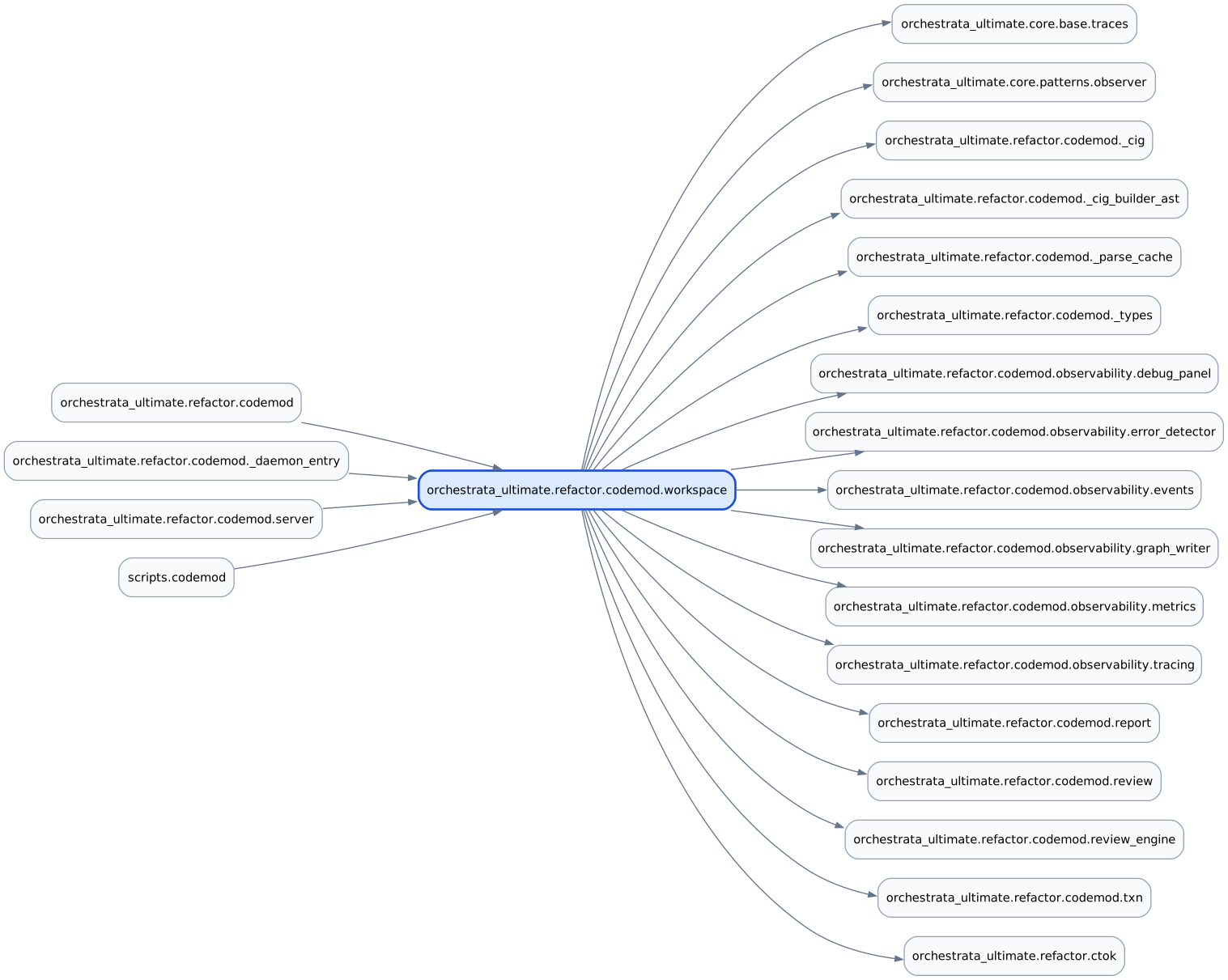
CodemodWorkspace is the main entry point of the codemod engine (SPEC-110). It loads a repository's Python files into memory, builds the code intelligence graph over them, runs transform passes over the in-memory trees, and commits the result to disk after review. The package facade, the daemon server, _daemon_entry and scripts.codemod use it. It imports the lossless layer from ctok, the graph, the transaction layer, the review engine and the observability modules. See the refactor package narrative for the packet history.
load(root, include, parallel, cache_dir, observers)folds each include root onto the repository (a root outside the repo is refused), collects the*.pyfiles in sorted order so node ids are deterministic, parses them toLosslessModuleobjects (optionally on a thread pool, and through a content-addressedParseCachewhencache_diris set), builds the graph, and emitsINDEX_BUILTandWORKSPACE_LOADED. Files that fail to parse are listed inunparsable.run(passes, observers)applies passes in order, so pass N sees the mutations of pass N-1, emittingPASS_STARTED,FILE_MUTATEDandPASS_COMPLETEDand merging the results into oneChangeSet. After each pass the import index is updated for the touched modules.commit(changes, reviews, dry_run, observers, review_engine, run_review_engine)runs the review engine on the mutated forest first. By default only findings the change introduced abort the commit (ADR-0073); legacy findings are reported in theCommitReport. A dry run produces the report without writing. A real commit writes throughtxn.commit_changes, and a failure emits rollback and abort events and re-raises.restore(originals)puts earlier trees back and updates the index, which the daemon uses after a dry run or a refused commit.- Queries:
dependencies,dependents,symbol_table,stats,forest,cig,modules.
Every operation stamps a single correlation id on its events; observers passed to a call apply to that call only, while subscribe attaches a workspace-wide observer. default_observers() returns the five standard observers, which the CLI attaches with --observe.
At a glance
| Source | src/orchestrata_ultimate/refactor/codemod/workspace.py |
| Lines of code | 866 |
| Classes | 3 |
| Functions | 8 |
| Imports (internal) | orchestrata_ultimate.core.base.traces, orchestrata_ultimate.core.patterns.observer, orchestrata_ultimate.refactor.codemod._cig, orchestrata_ultimate.refactor.codemod._cig_builder_ast, orchestrata_ultimate.refactor.codemod._parse_cache, orchestrata_ultimate.refactor.codemod._types, orchestrata_ultimate.refactor.codemod.observability.debug_panel, orchestrata_ultimate.refactor.codemod.observability.error_detector, orchestrata_ultimate.refactor.codemod.observability.events, orchestrata_ultimate.refactor.codemod.observability.graph_writer, orchestrata_ultimate.refactor.codemod.observability.metrics, orchestrata_ultimate.refactor.codemod.observability.tracing, orchestrata_ultimate.refactor.codemod.report, orchestrata_ultimate.refactor.codemod.review, orchestrata_ultimate.refactor.codemod.review_engine, orchestrata_ultimate.refactor.codemod.txn, orchestrata_ultimate.refactor.ctok |
| Imported by | orchestrata_ultimate.refactor.codemod, orchestrata_ultimate.refactor.codemod._daemon_entry, orchestrata_ultimate.refactor.codemod.server, scripts.codemod |
| Tests that import it | tests/refactor/codemod/_benchmark_helpers.py, tests/refactor/codemod/analysis/conftest.py, tests/refactor/codemod/analysis/test_abstraction.py, tests/refactor/codemod/analysis/test_blast_radius.py, tests/refactor/codemod/analysis/test_breaking_change.py, tests/refactor/codemod/analysis/test_complexity.py, tests/refactor/codemod/analysis/test_coupling.py, tests/refactor/codemod/analysis/test_dead_code.py, tests/refactor/codemod/analysis/test_read_only.py, tests/refactor/codemod/analysis/test_test_coverage.py, tests/refactor/codemod/conftest.py, tests/refactor/codemod/test_benchmark_load.py, tests/refactor/codemod/test_cig_builder_ast.py, tests/refactor/codemod/test_cli.py, tests/refactor/codemod/test_client_coverage.py, tests/refactor/codemod/test_code_intelligence_graph.py, tests/refactor/codemod/test_concurrency.py, tests/refactor/codemod/test_ipc_protocol.py, tests/refactor/codemod/test_observability.py, tests/refactor/codemod/test_observability_wiring.py, tests/refactor/codemod/test_parse_cache.py, tests/refactor/codemod/test_review_checks.py, tests/refactor/codemod/test_review_engine.py, tests/refactor/codemod/test_review_engine_commit_wiring.py, tests/refactor/codemod/test_server_coverage.py … and 4 more |
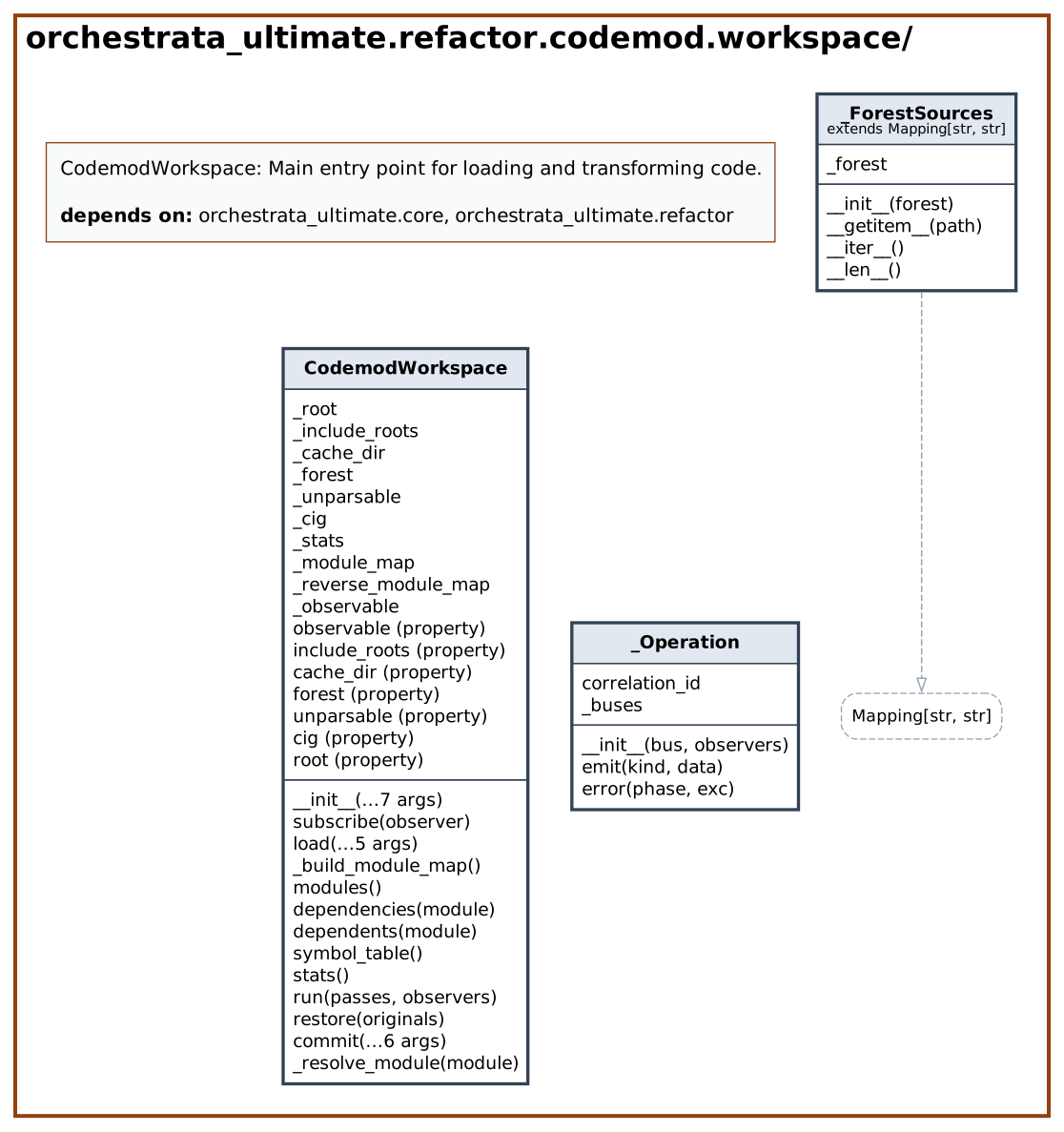
Class diagram
Dependency diagram
API
Classes
_Operation
Decorators: traces(spec='110', story='US-110-005', reqs=['REQ-110-025', 'REQ-110-027']) · Line 103
Emitter for ONE top-level operation (one run()/commit()/load).
| Method | Signature | Summary |
|---|---|---|
__init__ |
__init__(bus: SyncObservable[CodemodEvent] | None, observers: Sequence[Observer[CodemodEvent]] | None) -> None |
|
emit |
emit(kind: CodemodEventType, data: dict[str, Any]) -> None |
Deliver one event; a no-op when nobody is subscribed. |
error |
error(phase: str, exc: Exception, ****extra: Any) -> None |
Emit ERROR_DETECTED for an exception the caller re-raises. |
_ForestSources
Bases: Mapping[str, str] · Line 159
Source text of a forest's modules, decoded on access.
| Method | Signature | Summary |
|---|---|---|
__init__ |
__init__(forest: Mapping[str, LosslessModule]) -> None |
|
__getitem__ |
__getitem__(path: str) -> str |
|
__iter__ |
__iter__() -> Iterator[str] |
|
__len__ |
__len__() -> int |
CodemodWorkspace
Decorators: traces(spec='110', story='US-110-001', reqs=['REQ-110-001', 'REQ-110-002', 'REQ-110-003', 'REQ-110-004']) · Line 248
In-memory CST forest with Code Intelligence Graph.
| Method | Signature | Summary |
|---|---|---|
__init__ |
__init__(root: Path, forest: dict[str, LosslessModule], unparsable: tuple[tuple[str, str], ...], cig: CodeIntelligenceGraph, stats: WorkspaceStats, include_roots: tuple[str, ...] = (), cache_dir: str | Path | None = None) -> None |
Wire CodemodWorkspace's composed collaborators. |
observable property |
observable() -> SyncObservable[CodemodEvent] |
The workspace-owned event bus (REQ-110-025); no subscribers by default. |
subscribe |
subscribe(observer: Observer[CodemodEvent]) -> Callable[[], None] |
Subscribe observer to every operation on this workspace. |
load classmethod |
load(root: Path, include: tuple[str, ...] = ('src', 'scripts', 'tests'), parallel: bool = False, cache_dir: str | Path | None = None, observers: Sequence[Observer[CodemodEvent]] | None = None) -> CodemodWorkspace |
Parse all .py files under include roots into a lossless forest. |
_build_module_map |
_build_module_map() -> None |
Build bidirectional mapping between dotted names and paths. |
include_roots property |
include_roots() -> tuple[str, ...] |
Repo-relative directories the forest was loaded from. |
cache_dir property |
cache_dir() -> str | Path | None |
Parse-cache directory the forest was loaded with (None: uncached). |
forest property |
forest() -> Mapping[str, LosslessModule] |
Repo-relative path to LosslessModule mapping. |
unparsable property |
unparsable() -> tuple[tuple[str, str], ...] |
(path, error_message) for files that failed to parse. |
cig property |
cig() -> CodeIntelligenceGraph |
Code Intelligence Graph. |
root property |
root() -> Path |
Repository root directory. |
modules |
modules() -> Mapping[str, str] |
Bidirectional mapping: dotted name and repo-relative path. |
dependencies |
dependencies(module: str) -> frozenset[str] |
Modules this module imports (direct only). |
dependents |
dependents(module: str) -> frozenset[str] |
Modules that import this module (direct only). |
symbol_table |
symbol_table() -> Mapping[str, frozenset[str]] |
Module path to top-level defined names. |
stats |
stats() -> WorkspaceStats |
Workspace load statistics. |
run |
run(passes: Sequence, observers: Sequence[Observer[CodemodEvent]] | None = None) -> ChangeSet |
Apply transform passes sequentially over the forest. |
restore |
restore(originals: Mapping[str, LosslessModule]) -> None |
Put the load-time trees back into the forest. |
commit |
commit(changes: ChangeSet, reviews: Sequence | None = None, dry_run: bool = True, observers: Sequence[Observer[CodemodEvent]] | None = None, review_engine: InMemoryReviewEngine | None = None, run_review_engine: bool = True) -> CommitReport |
Review mutated forest, then write changes atomically. |
_resolve_module |
_resolve_module(module: str) -> str | None |
Resolve a module name to a repo-relative path. |
Functions
| Function | Signature | Summary |
|---|---|---|
default_observers traces |
default_observers() -> tuple[Observer[CodemodEvent], ...] |
The 5 built-in observers (REQ-110-026), freshly constructed. |
_compose_observable traces |
_compose_observable(observers: Sequence[Observer[CodemodEvent]] | None) -> SyncObservable[CodemodEvent] |
Compose a SyncObservable[CodemodEvent] holding observers. |
_parse_file traces |
_parse_file(path: Path) -> tuple[Path, LosslessModule | Exception, bytes | None] |
Parse a single Python file. |
_parse_file_cached |
_parse_file_cached(path: Path, cache: ParseCache) -> tuple[Path, LosslessModule | Exception, bytes | None] |
Parse a single Python file, going through the disk parse cache. |
_include_root |
_include_root(root: Path, subdir: str) -> str | None |
subdir as a repo-relative POSIX root without a trailing slash. |
_finding_payload traces |
_finding_payload(finding: Finding) -> dict[str, Any] |
The FINDING_EMITTED event payload of finding. |
_resolve_reviews traces |
_resolve_reviews(reviews: Sequence | None, review_engine: InMemoryReviewEngine | None, run_review_engine: bool) -> list |
The review passes commit runs, the in-memory engine first. |
_path_to_dotted |
_path_to_dotted(path: str) -> str |
Convert a repo-relative path to a dotted module name. |
Source
"""CodemodWorkspace: Main entry point for loading and transforming code.
Loads an entire Python codebase as a lossless module forest, builds the
Code Intelligence Graph, and provides methods for running transform
passes and committing changes atomically.
"""
from __future__ import annotations
import ast
import functools
import logging
import os
import time
import uuid
from collections.abc import Callable, Iterator, Mapping, Sequence
from concurrent.futures import ThreadPoolExecutor
from pathlib import Path
from typing import Any
import psutil
from orchestrata_ultimate.core.base.traces import traces
from orchestrata_ultimate.core.patterns.observer import SyncObservable
from orchestrata_ultimate.refactor.codemod._cig import CodeIntelligenceGraph
from orchestrata_ultimate.refactor.codemod._cig_builder_ast import build_cig_ast
from orchestrata_ultimate.refactor.codemod._parse_cache import ParseCache, cache_key
from orchestrata_ultimate.refactor.codemod._types import WorkspaceStats
from orchestrata_ultimate.refactor.codemod.observability.debug_panel import (
DebugPanelObserver,
)
from orchestrata_ultimate.refactor.codemod.observability.error_detector import (
ErrorDetector,
)
from orchestrata_ultimate.refactor.codemod.observability.events import (
CodemodEvent,
CodemodEventType,
Observer,
)
from orchestrata_ultimate.refactor.codemod.observability.graph_writer import (
GraphWriterObserver,
)
from orchestrata_ultimate.refactor.codemod.observability.metrics import (
MetricsObserver,
)
from orchestrata_ultimate.refactor.codemod.observability.tracing import (
TracingObserver,
)
from orchestrata_ultimate.refactor.codemod.report import (
ChangeSet,
CommitReport,
Finding,
)
from orchestrata_ultimate.refactor.codemod.review import PrologSemanticReview
from orchestrata_ultimate.refactor.codemod.review_engine import InMemoryReviewEngine
from orchestrata_ultimate.refactor.codemod.txn import commit_changes
from orchestrata_ultimate.refactor.ctok import LosslessModule
logger = logging.getLogger(__name__)
@traces(spec="110", story="US-110-005", reqs=["REQ-110-026"])
def default_observers() -> tuple[Observer[CodemodEvent], ...]:
"""The 5 built-in observers (REQ-110-026), freshly constructed.
Each observer is built with its own safe, no-live-infra-required
default (``TracingObserver`` logs via the stdlib ``logging`` module,
``MetricsObserver`` skips Prometheus registry registration when none
is given, ``ErrorDetector``/``GraphWriterObserver`` no-op without a
configured event bus/repository). Constructed fresh per call so
per-correlation state (span timers, error windows, file handles)
never leaks across unrelated ``run()``/``commit()`` invocations.
"""
return (
TracingObserver(),
MetricsObserver(),
DebugPanelObserver(),
ErrorDetector(),
GraphWriterObserver(),
)
@traces(spec="110", story="US-110-005", reqs=["REQ-110-025", "REQ-110-027"])
def _compose_observable(
observers: Sequence[Observer[CodemodEvent]] | None,
) -> SyncObservable[CodemodEvent]:
"""Compose a ``SyncObservable[CodemodEvent]`` holding ``observers``.
REQ-110-025: the workspace composes a ``SyncObservable[CodemodEvent]``
and emits events for its operations. REQ-110-027: the default observer
set is EMPTY (zero cost when nobody watches; no implicit Prometheus or
graph writes); ``observers`` subscribes the given set. Observer dispatch
failures are logged and swallowed by ``SyncObservable.emit`` itself
(ERR-110-011).
"""
observable: SyncObservable[CodemodEvent] = SyncObservable()
for observer in observers or ():
observable.subscribe(observer)
return observable
@traces(spec="110", story="US-110-005", reqs=["REQ-110-025", "REQ-110-027"])
class _Operation:
"""Emitter for ONE top-level operation (one ``run()``/``commit()``/load).
Owns the operation's ``correlation_id`` and fans every event out to the
workspace-owned bus plus a private bus holding the call's ``observers``
override. The private bus keeps a per-call override from receiving the
events of a concurrent operation on the same workspace; dropping it at
the end of the call is the unsubscribe.
"""
def __init__(
self,
bus: SyncObservable[CodemodEvent] | None,
observers: Sequence[Observer[CodemodEvent]] | None,
) -> None:
self.correlation_id = uuid.uuid4().hex
buses: list[SyncObservable[CodemodEvent]] = []
if bus is not None:
buses.append(bus)
if observers:
# An observer already subscribed on the workspace bus receives
# each event once, through that bus (REQ-110-027).
workspace_observers = bus.observers if bus is not None else ()
private = [
o for o in observers if not any(o is w for w in workspace_observers)
]
if private:
buses.append(_compose_observable(private))
self._buses = tuple(buses)
def emit(self, kind: CodemodEventType, data: dict[str, Any]) -> None:
"""Deliver one event; a no-op when nobody is subscribed."""
if not any(bus.observers for bus in self._buses):
return
event = CodemodEvent(
type=kind,
timestamp=time.time(),
data=data,
correlation_id=self.correlation_id,
)
for bus in self._buses:
bus.emit(event)
def error(self, phase: str, exc: Exception, **extra: Any) -> None:
"""Emit ``ERROR_DETECTED`` for an exception the caller re-raises."""
self.emit(
CodemodEventType.ERROR_DETECTED,
{
"phase": phase,
"error_type": type(exc).__name__,
"message": str(exc),
**extra,
},
)
class _ForestSources(Mapping[str, str]):
"""Source text of a forest's modules, decoded on access.
``build_cig_ast`` reads text only for a module it holds no tree for; the
forest holds every tree, so nothing is decoded on a normal load. An eager
``{path: decoded text}`` dict was a second full copy of the tree's source
(non-ASCII files widen to 2-4 bytes per character) live while the graph
is built (REQ-110-004).
"""
def __init__(self, forest: Mapping[str, LosslessModule]) -> None:
self._forest = forest
def __getitem__(self, path: str) -> str:
return self._forest[path].stream.source.decode("utf-8")
def __iter__(self) -> Iterator[str]:
return iter(self._forest)
def __len__(self) -> int:
return len(self._forest)
@traces(spec="110", story="US-110-001", reqs=["REQ-110-001", "REQ-110-002"])
def _parse_file(path: Path) -> tuple[Path, LosslessModule | Exception, bytes | None]:
"""Parse a single Python file.
Args:
path: Absolute path to the Python file.
Returns:
Tuple of (path, LosslessModule or Exception, source bytes or None).
"""
try:
data = path.read_bytes()
return (path, LosslessModule.parse(data), data)
except Exception as e:
logger.debug("Failed to parse %s: %s", path, e)
return (path, e, None)
def _parse_file_cached(
path: Path, cache: ParseCache
) -> tuple[Path, LosslessModule | Exception, bytes | None]:
"""Parse a single Python file, going through the disk parse cache."""
try:
data = path.read_bytes()
key = cache_key(data)
module = cache.get(key)
if module is not None:
return (path, module, data)
module = LosslessModule.parse(data)
cache.put(key, module)
return (path, module, data)
except Exception as e:
logger.debug("Failed to parse %s: %s", path, e)
return (path, e, None)
def _include_root(root: Path, subdir: str) -> str | None:
"""``subdir`` as a repo-relative POSIX root without a trailing slash.
Absolute, ``.`` and ``..`` forms are folded onto ``root`` first, so the
stored root matches the repo-relative paths of the forest. ``None`` means
the include is the repo root itself (no restriction). An include that
resolves outside ``root`` raises ``ValueError``, by its lexical form or,
through a symlink, by the path it actually reaches (``Path.resolve``).
"""
rel = os.path.relpath(
os.path.normpath(os.path.join(os.path.abspath(root), subdir)),
os.path.abspath(root),
).replace(os.sep, "/")
outside = ValueError(
f"include {subdir!r} resolves outside the repo root {str(root)!r}"
)
if rel == ".." or rel.startswith("../"):
raise outside
try:
(Path(root) / subdir).resolve().relative_to(Path(root).resolve())
except ValueError:
raise outside from None
return None if rel == "." else rel
@traces(
spec="110",
story="US-110-001",
reqs=["REQ-110-001", "REQ-110-002", "REQ-110-003", "REQ-110-004"],
)
class CodemodWorkspace:
"""In-memory CST forest with Code Intelligence Graph."""
def __init__(
self,
root: Path,
forest: dict[str, LosslessModule],
unparsable: tuple[tuple[str, str], ...],
cig: CodeIntelligenceGraph,
stats: WorkspaceStats,
include_roots: tuple[str, ...] = (),
cache_dir: str | Path | None = None,
) -> None:
"""Wire CodemodWorkspace's composed collaborators.
Args:
root: Repository root directory.
forest: Mapping of repo-relative paths to parsed LosslessModules.
unparsable: Tuple of (path, error_message) for failed parses.
cig: Code Intelligence Graph built from the forest.
stats: Workspace load statistics.
include_roots: Repo-relative roots the forest was loaded from
(empty when the workspace was not built by ``load``).
cache_dir: Parse-cache directory the load used, if any (a reload
reuses it).
"""
self._root = root
self._include_roots = include_roots
self._cache_dir = cache_dir
self._forest = forest
self._unparsable = unparsable
self._cig = cig
self._stats = stats
self._module_map: dict[str, str] = {}
self._reverse_module_map: dict[str, str] = {}
self._observable: SyncObservable[CodemodEvent] = SyncObservable()
self._build_module_map()
@property
@traces(spec="110", story="US-110-005", reqs=["REQ-110-025"])
def observable(self) -> SyncObservable[CodemodEvent]:
"""The workspace-owned event bus (REQ-110-025); no subscribers by default."""
return self._observable
@traces(spec="110", story="US-110-005", reqs=["REQ-110-027"])
def subscribe(self, observer: Observer[CodemodEvent]) -> Callable[[], None]:
"""Subscribe ``observer`` to every operation on this workspace.
Returns:
Zero-arg callable that unsubscribes ``observer``.
"""
return self._observable.subscribe(observer)
@traces(
spec="110",
story="US-110-001",
reqs=["REQ-110-001", "REQ-110-002", "REQ-110-003", "REQ-110-004"],
)
@classmethod
def load(
cls,
root: Path,
include: tuple[str, ...] = ("src", "scripts", "tests"),
parallel: bool = False,
cache_dir: str | Path | None = None,
observers: Sequence[Observer[CodemodEvent]] | None = None,
) -> CodemodWorkspace:
"""Parse all .py files under include roots into a lossless forest.
Emits ``INDEX_BUILT`` and ``WORKSPACE_LOADED`` (REQ-110-025) to
``observers`` (None means nobody; the workspace does not exist yet,
so only this call's override can watch its own load).
Args:
root: Repository root directory.
include: Tuple of directory names to include.
parallel: If True, use ThreadPoolExecutor for parallel parse
and parallel CIG extraction (serial replay preserves
identical output).
cache_dir: Optional directory for the content-addressed parse
cache. When set, unchanged files (by xxhash of bytes) are
unpickled instead of re-parsed (~7x faster per file).
Leave unset for cold-load benchmarks (REQ-110-003).
Returns:
CodemodWorkspace with populated forest and CIG.
"""
op = _Operation(None, observers)
load_started = time.monotonic()
process = psutil.Process()
rss_before = process.memory_info().rss
# Folded onto the root before any file is read: an include outside the
# repo is refused, and one entry naming the root itself lifts the
# restriction (an empty tuple means "no roots").
folded = [_include_root(root, subdir) for subdir in include]
include_roots = () if None in folded else tuple(r for r in folded if r)
files: list[Path] = []
for rel_root in folded:
subdir_path = root / rel_root if rel_root else root
if subdir_path.exists():
# Sorted: rglob order is filesystem-dependent, and node ids
# follow file order (deterministic across machines).
files.extend(sorted(subdir_path.rglob("*.py")))
start_time = time.monotonic()
parse_fn: Callable[
[Path], tuple[Path, LosslessModule | Exception, bytes | None]
]
if cache_dir is not None:
cache = ParseCache(cache_dir)
parse_fn = functools.partial(_parse_file_cached, cache=cache)
else:
parse_fn = _parse_file
if parallel:
max_workers = os.cpu_count() or 4
with ThreadPoolExecutor(max_workers=max_workers) as executor:
results = list(executor.map(parse_fn, files))
else:
results = [parse_fn(f) for f in files]
parse_time = time.monotonic() - start_time
forest: dict[str, LosslessModule] = {}
unparsable_list: list[tuple[str, str]] = []
for path, result, _data in results:
rel_path = str(path.relative_to(root))
if isinstance(result, LosslessModule):
forest[rel_path] = result
else:
unparsable_list.append((rel_path, str(result)))
op.error("parse", result, path=rel_path)
# build_cig_ast re-parses any module it is only given text for, but
# the forest already holds every module's ast.Module (parsed by
# LosslessModule.parse) — pass the trees through so each file is
# parsed exactly once. sources stays for the path set / fallback.
sources = _ForestSources(forest)
index_started = time.monotonic()
try:
cig = build_cig_ast(
sources,
parallel=parallel,
trees={rel_path: module.tree for rel_path, module in forest.items()},
)
except Exception as exc:
op.error("index", exc)
raise
op.emit(
CodemodEventType.INDEX_BUILT,
{
"module_count": len(forest),
"node_count": cig.node_count,
"elapsed_seconds": time.monotonic() - index_started,
},
)
rss_after = process.memory_info().rss
rss_delta = rss_after - rss_before
# stream.source is the raw bytes already in memory; m.code would
# RECONSTRUCT every module (a full re-serialization) just to count
# bytes — measured 2026-08-11 at ~5.4s of a full-tree serial load.
total_bytes = sum(len(m.stream.source) for m in forest.values())
stats = WorkspaceStats(
file_count=len(forest),
total_bytes=total_bytes,
rss_delta_bytes=rss_delta,
parse_time_seconds=parse_time,
unparsable_count=len(unparsable_list),
)
op.emit(
CodemodEventType.WORKSPACE_LOADED,
{
"module_count": len(forest),
"unparsable_count": len(unparsable_list),
"elapsed_seconds": time.monotonic() - load_started,
"cache_enabled": cache_dir is not None,
},
)
return cls(
root=root,
forest=forest,
unparsable=tuple(unparsable_list),
cig=cig,
stats=stats,
include_roots=include_roots,
cache_dir=cache_dir,
)
def _build_module_map(self) -> None:
"""Build bidirectional mapping between dotted names and paths."""
for path in self._forest:
dotted = _path_to_dotted(path)
self._module_map[dotted] = path
self._module_map[path] = dotted
@property
def include_roots(self) -> tuple[str, ...]:
"""Repo-relative directories the forest was loaded from."""
return self._include_roots
@property
def cache_dir(self) -> str | Path | None:
"""Parse-cache directory the forest was loaded with (None: uncached)."""
return self._cache_dir
@property
def forest(self) -> Mapping[str, LosslessModule]:
"""Repo-relative path to LosslessModule mapping."""
return self._forest
@property
def unparsable(self) -> tuple[tuple[str, str], ...]:
"""(path, error_message) for files that failed to parse."""
return self._unparsable
@property
def cig(self) -> CodeIntelligenceGraph:
"""Code Intelligence Graph."""
return self._cig
@property
def root(self) -> Path:
"""Repository root directory."""
return self._root
def modules(self) -> Mapping[str, str]:
"""Bidirectional mapping: dotted name and repo-relative path."""
return self._module_map
def dependencies(self, module: str) -> frozenset[str]:
"""Modules this module imports (direct only).
Args:
module: Dotted module name or repo-relative path.
Returns:
Set of module names/paths that this module imports.
"""
path = self._resolve_module(module)
if path is None:
return frozenset()
key = f"module:{path}"
if key not in self._cig.key_to_id:
return frozenset()
node_id = self._cig.resolve(key)
dep_ids = self._cig.dependencies(node_id)
result: set[str] = set()
for dep_id in dep_ids:
dep_node = self._cig.nodes.get(dep_id)
if dep_node and dep_node.node_type == "Module":
result.add(dep_node.path)
return frozenset(result)
def dependents(self, module: str) -> frozenset[str]:
"""Modules that import this module (direct only).
Args:
module: Dotted module name or repo-relative path.
Returns:
Set of module names/paths that import this module.
"""
path = self._resolve_module(module)
if path is None:
return frozenset()
key = f"module:{path}"
if key not in self._cig.key_to_id:
return frozenset()
node_id = self._cig.resolve(key)
dep_ids = self._cig.dependents(node_id)
result: set[str] = set()
for dep_id in dep_ids:
dep_node = self._cig.nodes.get(dep_id)
if dep_node and dep_node.node_type == "Module":
result.add(dep_node.path)
return frozenset(result)
def symbol_table(self) -> Mapping[str, frozenset[str]]:
"""Module path to top-level defined names.
Returns:
Mapping of module paths to sets of defined names
(classes, functions, module-level variables).
"""
table: dict[str, set[str]] = {}
for path, module in self._forest.items():
names: set[str] = set()
for stmt in module.tree.body:
if isinstance(
stmt, (ast.ClassDef, ast.FunctionDef, ast.AsyncFunctionDef)
):
names.add(stmt.name)
elif isinstance(stmt, ast.Assign):
for target in stmt.targets:
if isinstance(target, ast.Name):
names.add(target.id)
table[path] = names
return {k: frozenset(v) for k, v in table.items()}
@traces(spec="110", story="US-110-001", reqs=["REQ-110-004"])
def stats(self) -> WorkspaceStats:
"""Workspace load statistics."""
return self._stats
@traces(
spec="110",
story="US-110-003",
reqs=["REQ-110-008", "REQ-110-009", "REQ-110-025", "REQ-110-027"],
)
def run(
self,
passes: Sequence,
observers: Sequence[Observer[CodemodEvent]] | None = None,
) -> ChangeSet:
"""Apply transform passes sequentially over the forest.
Pass N sees pass N-1's mutations. Returns composed ChangeSet.
Emits ``PASS_STARTED``, one ``FILE_MUTATED`` per mutated file and
``PASS_COMPLETED`` around each pass (REQ-110-025), all sharing one
``correlation_id`` for this call.
Args:
passes: Sequence of TransformPass instances.
observers: Observers subscribed for the duration of this call
(REQ-110-027), in addition to those subscribed on the
workspace. ``None`` adds none; the default set is empty.
Returns:
ChangeSet with all mutations from all passes.
"""
op = _Operation(self._observable, observers)
composed = ChangeSet(entries=())
for pass_ in passes:
pass_name = getattr(pass_, "name", type(pass_).__name__)
pass_type = getattr(pass_, "pass_type", "transform")
op.emit(
CodemodEventType.PASS_STARTED,
{"pass_name": pass_name, "pass_type": pass_type},
)
pass_start = time.monotonic()
try:
result = pass_.apply(self)
except Exception as exc:
op.error("pass", exc, pass_name=pass_name)
raise
pass_duration = time.monotonic() - pass_start
composed = composed.merge(result)
for entry in result.entries:
self._forest[entry.path] = entry.mutated_tree
op.emit(
CodemodEventType.FILE_MUTATED,
{"path": entry.path, "pass_name": entry.pass_name},
)
op.emit(
CodemodEventType.PASS_COMPLETED,
{
"pass_name": pass_name,
"pass_type": pass_type,
"file_count": result.file_count,
"duration_seconds": pass_duration,
},
)
return composed
@traces(spec="110", story="US-110-013", reqs=["REQ-110-137"])
def restore(self, originals: Mapping[str, LosslessModule]) -> None:
"""Put the load-time trees back into the forest.
``run`` writes every mutated tree into the forest; a dry run (or a
commit that wrote nothing) leaves that forest ahead of the disk. A
daemon serving the forest calls this with the ``original_tree`` of
each path the run touched so the next client sees the disk state.
Args:
originals: Repo-relative path to the tree the path held before
the run mutated it.
"""
for path, tree in originals.items():
self._forest[path] = tree
@traces(
spec="110",
story="US-110-005",
reqs=[
"REQ-110-013",
"REQ-110-014",
"REQ-110-015",
"REQ-110-016",
"REQ-110-017",
"REQ-110-025",
"REQ-110-027",
"REQ-110-033",
"REQ-110-035",
],
)
def commit(
self,
changes: ChangeSet,
reviews: Sequence | None = None,
dry_run: bool = True,
observers: Sequence[Observer[CodemodEvent]] | None = None,
review_engine: InMemoryReviewEngine | None = None,
run_review_engine: bool = True,
) -> CommitReport:
"""Review mutated forest, then write changes atomically.
Emits ``REVIEW_STARTED``/``REVIEW_COMPLETED`` with one
``FINDING_EMITTED`` per finding, then ``COMMIT_STARTED`` followed by
``COMMIT_COMPLETED``; a review-gate refusal emits ``COMMIT_ABORTED``,
and a failed write emits ``ROLLBACK_TRIGGERED`` (from the
transaction), ``ERROR_DETECTED`` and ``COMMIT_ABORTED`` before the
exception propagates (REQ-110-025). All events of one call share one
``correlation_id``.
Args:
changes: ChangeSet from workspace.run().
reviews: Review passes to run before write.
dry_run: If True, produce diff and report without writing.
observers: Observers subscribed for the duration of this call
(REQ-110-027), in addition to those subscribed on the
workspace. ``None`` adds none; the default set is empty.
review_engine: The in-memory 40-check engine to run before the
``reviews`` (REQ-110-033/035). ``None`` with
``reviews=None`` builds ``InMemoryReviewEngine()``; an
explicit ``reviews`` list runs as given. By default an
error-severity finding aborts the commit only when the change
introduced it (ADR-0073); pass
``review_engine=InMemoryReviewEngine(baseline='absolute')``
for the unconditional abort.
run_review_engine: ``False`` skips the engine entirely.
Returns:
CommitReport with passes run, files written, findings, duration.
``legacy_findings`` holds what the default engine found already
present in the original trees (reported, never vetoing); each is
also emitted as ``FINDING_EMITTED`` with ``legacy: True``.
"""
op = _Operation(self._observable, observers)
correlation_id = op.correlation_id
start_time = time.monotonic()
all_findings: list[Finding] = []
legacy_findings: list[Finding] = []
active = _resolve_reviews(reviews, review_engine, run_review_engine)
if active:
op.emit(CodemodEventType.REVIEW_STARTED, {"review_count": len(active)})
for review in active:
try:
if isinstance(review, InMemoryReviewEngine):
outcome = review.review_detailed(self, changes)
findings = list(outcome.introduced)
legacy = list(outcome.legacy)
else:
findings = review.review(self, changes)
legacy = []
except Exception as exc:
op.error("review", exc, review_name=getattr(review, "name", ""))
op.emit(CodemodEventType.COMMIT_ABORTED, {"reason": "review_error"})
raise
all_findings.extend(findings)
legacy_findings.extend(legacy)
for finding in findings:
op.emit(CodemodEventType.FINDING_EMITTED, _finding_payload(finding))
for finding in legacy:
op.emit(
CodemodEventType.FINDING_EMITTED,
{**_finding_payload(finding), "legacy": True},
)
error_count = sum(1 for f in all_findings if f.severity == "error")
warning_count = sum(1 for f in all_findings if f.severity == "warning")
op.emit(
CodemodEventType.REVIEW_COMPLETED,
{
"finding_count": len(all_findings),
"error_count": error_count,
"warning_count": warning_count,
"legacy_count": len(legacy_findings),
},
)
error_findings = [f for f in all_findings if f.severity == "error"]
if error_findings:
op.emit(
CodemodEventType.COMMIT_ABORTED,
{"reason": "review_errors", "error_count": len(error_findings)},
)
duration = time.monotonic() - start_time
return CommitReport(
success=False,
files_written=(),
findings=tuple(all_findings),
duration_seconds=duration,
dry_run=dry_run,
passes_run=tuple(r.name for r in active),
correlation_id=correlation_id,
legacy_findings=tuple(legacy_findings),
)
op.emit(
CodemodEventType.COMMIT_STARTED,
{"file_count": changes.file_count, "dry_run": dry_run},
)
try:
files_written, _rolled_back = commit_changes(
self._root, changes, dry_run=dry_run, on_event=op.emit
)
except Exception as exc:
op.error("commit", exc)
op.emit(CodemodEventType.COMMIT_ABORTED, {"reason": "write_failed"})
raise
duration = time.monotonic() - start_time
op.emit(
CodemodEventType.COMMIT_COMPLETED,
{
"files_written": len(files_written),
"file_count": len(files_written),
"duration_seconds": duration,
"dry_run": dry_run,
"pass_count": len(active),
"finding_count": len(all_findings),
"status": "success",
},
)
return CommitReport(
success=True,
files_written=tuple(files_written),
findings=tuple(all_findings),
duration_seconds=duration,
dry_run=dry_run,
passes_run=tuple(r.name for r in active),
correlation_id=correlation_id,
legacy_findings=tuple(legacy_findings),
)
def _resolve_module(self, module: str) -> str | None:
"""Resolve a module name to a repo-relative path."""
if module in self._forest:
return module
if module in self._module_map:
mapped = self._module_map[module]
if mapped in self._forest:
return mapped
dotted = _path_to_dotted(module)
if dotted in self._module_map:
return self._module_map[dotted]
return None
@traces(spec="110", story="US-110-004", reqs=["REQ-110-033"])
def _finding_payload(finding: Finding) -> dict[str, Any]:
"""The ``FINDING_EMITTED`` event payload of ``finding``."""
return {
"severity": finding.severity,
"rule": finding.rule,
"path": finding.path,
"line": finding.line,
"message": finding.message,
}
@traces(spec="110", story="US-110-004", reqs=["REQ-110-033", "REQ-110-035"])
def _resolve_reviews(
reviews: Sequence | None,
review_engine: InMemoryReviewEngine | None,
run_review_engine: bool,
) -> list:
"""The review passes ``commit`` runs, the in-memory engine first.
An explicit ``review_engine`` always runs; with ``reviews=None`` and no
engine, the default ``InMemoryReviewEngine()`` is built. A caller list is
run as given and does not gain an engine. When the list already holds a
``PrologSemanticReview`` the engine skips its own phase 3 so the Prolog
pass does not run twice.
"""
passes = list(reviews) if reviews else []
if not run_review_engine:
return passes
engine = review_engine
if engine is None and reviews is None:
engine = InMemoryReviewEngine()
if engine is None:
return passes
if any(isinstance(r, PrologSemanticReview) for r in passes):
engine = engine.without_phase3()
return [engine, *passes]
def _path_to_dotted(path: str) -> str:
"""Convert a repo-relative path to a dotted module name.
Strips src/ prefix and .py suffix, converts / to dots.
"""
p = path
for prefix in ("src/", "scripts/", "tests/"):
if p.startswith(prefix):
p = p[len(prefix) :]
break
if p.endswith(".py"):
p = p[:-3]
if p.endswith("/__init__"):
p = p[:-9]
return p.replace("/", ".")