orchestrata_ultimate.llm.client
Reference › orchestrata_ultimate › llm › client
client is the async facade every volk uses to reach a language model; the base agent (base) and several code drivers import it. Volks call call_llm, call_reasoner or call_with_tools and never see which provider answers. Provider and model are resolved at call time from config by volk alias, and the request is routed through a process-wide ProviderManager from the providers package. Specification 028 is the main source of requirements. The curated narrative is llm.
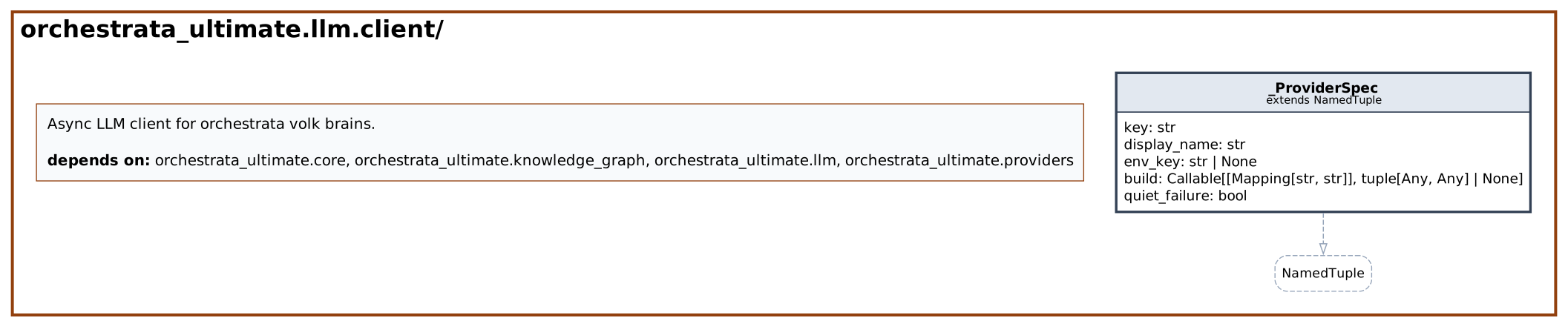
call_llmbuilds a system and user message pair, resolves the model withget_volk_modelunless one is passed, and sends it through_execute_with_retry. Agraph_contextstring is prepended to the user message, and the system prompt is extended to require a closing "Entities used" section. The reply is then checked by a graph-context validator, and the call is retried with a stricter prompt up to a bounded number of times if cited entities are missing.call_reasonerandcall_with_toolsfollow the same path for reasoning-tier calls and tool-calling turns; the latter takes a message list and tool schemas._get_provider_managerbuilds the singleton once.PROVIDER_CONFIGSis a table of_ProviderSpecentries, one per backend (Claude CLI, Anthropic, DeepSeek, OpenAI, OpenRouter, Ollama), each with a builder;_register_all_providersregisters those whose credentials are present in the environment, and the Claude CLI and Ollama need no key. Environment values come from the process environment and from.envfiles parsed by_load_dotenv._execute_with_retryretries with exponential backoff._should_stop_retryingstops on a non-transient error (_is_transient), atMAX_RETRIESattempts, or when a total time budget is spent;LLM_RETRY_TOTAL_BUDGET_SECONDSsets the budget (default 900) andLLM_RETRY_DELAY_SCALEscales the delays._compute_retry_delaypicks the delay, aware of rate-limit errors. After the retries it raisesLLMClientErrorfrom exceptions.- When
LLM_CASSETTE_DIRis set,_execute_with_retrybecomes a record and replay boundary instead of calling a provider, using _cassette: a hit is replayed,LLM_CASSETTE_SYNTH=1returns a synthetic reply,LLM_CASSETTE_RECORD=1records a real reply, and otherwise it raises. _capture_exchangeappends each request and response as a JSON line to the file named byORCHESTRATA_CONVERSATION_LOGwhen that variable is set, and does nothing otherwise; it never raises into the caller.
At a glance
| Source | src/orchestrata_ultimate/llm/client.py |
| Lines of code | 1077 |
| Classes | 1 |
| Functions | 27 |
| Imports (internal) | orchestrata_ultimate.core.base.traces, orchestrata_ultimate.core.logging, orchestrata_ultimate.core.protocols, orchestrata_ultimate.knowledge_graph.graph_context_validator, orchestrata_ultimate.llm._cassette, orchestrata_ultimate.llm.config, orchestrata_ultimate.llm.exceptions, orchestrata_ultimate.providers.adapters.anthropic_adapter, orchestrata_ultimate.providers.adapters.claude_cli_adapter, orchestrata_ultimate.providers.adapters.deepseek_adapter, orchestrata_ultimate.providers.adapters.ollama_adapter, orchestrata_ultimate.providers.adapters.openai_adapter, orchestrata_ultimate.providers.adapters.openrouter_adapter, orchestrata_ultimate.providers.provider_manager |
| Imported by | orchestrata_ultimate.agents.volks.base, orchestrata_ultimate.drivers.deepseek_coder_driver, orchestrata_ultimate.factory.assumptions.adjudicator, orchestrata_ultimate.factory.decision.authority, orchestrata_ultimate.harness.evaluators.llm_judge, orchestrata_ultimate.llm, orchestrata_ultimate.orchestrator.intent_normalizer, orchestrata_ultimate.refactor.agent, scripts.ask_openrouter, scripts.e2e_run, scripts.graph_query |
| Tests that import it | tests/agents/test_volk_tools_and_personas.py, tests/agents/volks/architect/conftest.py, tests/agents/volks/architect/test_volk.py, tests/agents/volks/codedirector/test_volk.py, tests/agents/volks/documentor/test_volk.py, tests/agents/volks/junior/test_volk_extended.py, tests/agents/volks/pm/test_volk_extended.py, tests/agents/volks/qa/test_llm_review.py, tests/agents/volks/qa/test_testgen.py, tests/agents/volks/qa/test_volk.py, tests/agents/volks/qa/test_volk_extended.py, tests/agents/volks/test_base_memory_fold.py, tests/agents/volks/test_base_tool_loop.py, tests/agents/volks/test_senior_dev.py, tests/drivers/test_deepseek_coder_driver.py, tests/generated_recovery/test_drivers_deepseek_coder_driver.py, tests/harness/test_evaluator_llm_judge.py, tests/knowledge_graph/test_graph_context_injection.py, tests/knowledge_graph/test_runtime_signals.py, tests/llm/test_cassette.py, tests/llm/test_client.py, tests/llm/test_client_claude_code_routing.py, tests/llm/test_client_extended.py, tests/llm/test_client_openai_registration.py, tests/llm/test_haiku_routing.py … and 6 more |
Class diagram
Dependency diagram
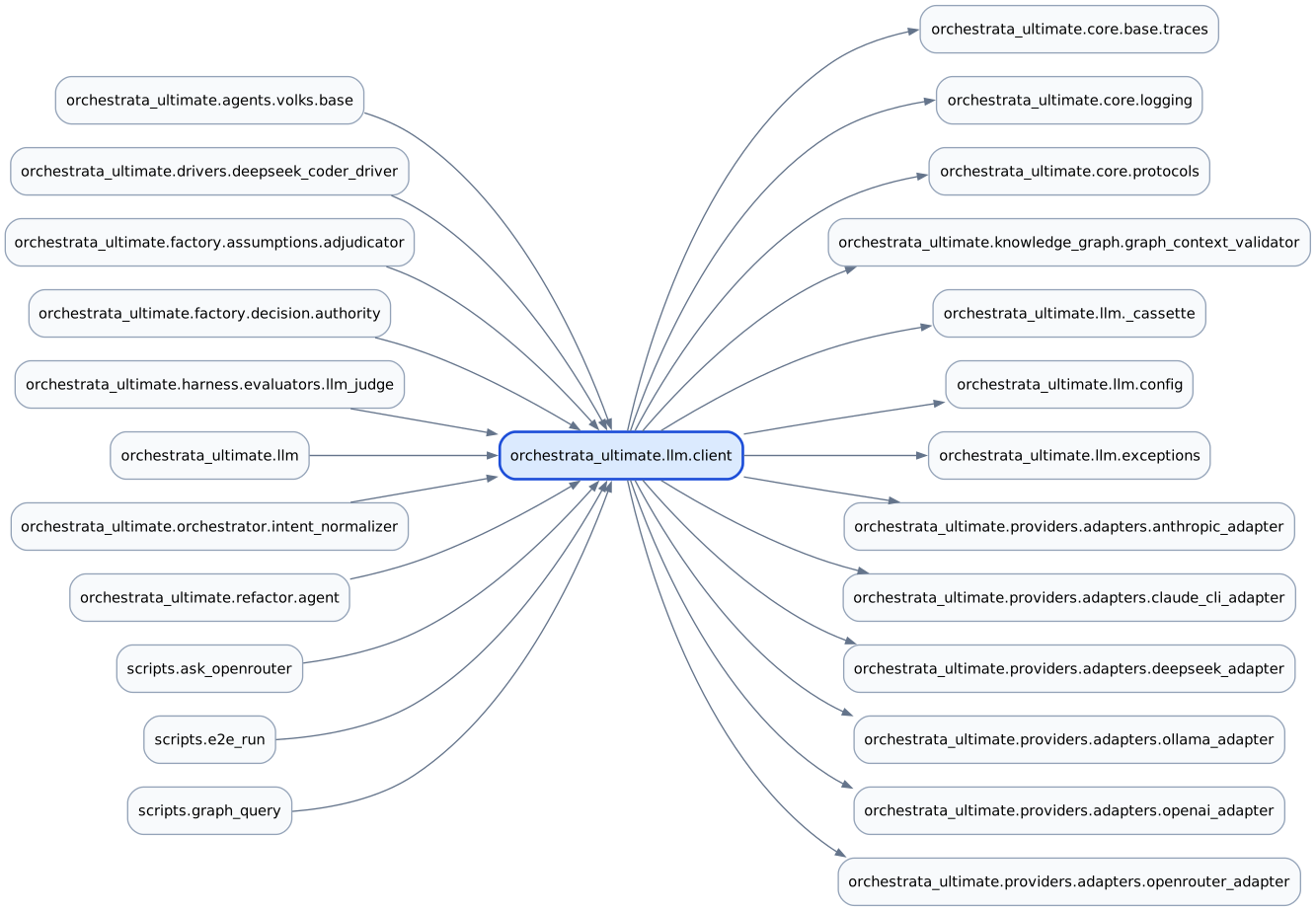
Truncated at 25 nodes: showing 13 of 14 imports and 11 of 11 importers.
API
Constants
| Name | Type | Value |
|---|---|---|
PROVIDER_CONFIGS |
tuple[_ProviderSpec, ...] |
(_ProviderSpec('claude', 'Claude CLI', None, _build_claude_cli, quiet_failure=T… |
Classes
_ProviderSpec
Bases: NamedTuple · Line 336
One data-driven entry in the provider-registration table.
| Attribute | Type | Default |
|---|---|---|
key |
str |
|
display_name |
str |
|
env_key |
str | None |
|
build |
Callable[[Mapping[str, str]], tuple[Any, Any] | None] |
|
quiet_failure |
bool |
False |
Functions
| Function | Signature | Summary |
|---|---|---|
_parse_dotenv_file |
_parse_dotenv_file(path: str) -> dict[str, str] |
Parse a .env file and return missing environment variables. |
_load_dotenv |
_load_dotenv() -> dict[str, str] |
Load environment variables from .env files. |
_build_claude_cli |
_build_claude_cli(env: Mapping[str, str]) -> tuple[Any, Any] | None |
Build the Claude CLI adapter (OAuth, no API key needed). |
_build_anthropic |
_build_anthropic(env: Mapping[str, str]) -> tuple[Any, Any] | None |
Build the Anthropic API adapter (key already confirmed present). |
_build_deepseek |
_build_deepseek(env: Mapping[str, str]) -> tuple[Any, Any] | None |
Build the DeepSeek adapter (key already confirmed present). |
_build_openai |
_build_openai(env: Mapping[str, str]) -> tuple[Any, Any] | None |
Build the OpenAI adapter (key already confirmed present). |
_build_openrouter |
_build_openrouter(env: Mapping[str, str]) -> tuple[Any, Any] | None |
Build the OpenRouter adapter (key already confirmed present). |
_build_ollama |
_build_ollama(env: Mapping[str, str]) -> tuple[Any, Any] | None |
Build the Ollama adapter for local inference (no key needed). |
_register_one |
_register_one(manager: ProviderManager, spec: _ProviderSpec, env: Mapping[str, str] | None = None) -> None |
Register a single provider per its table entry. |
_register_claude_cli |
_register_claude_cli(manager: ProviderManager, env: Mapping[str, str] | None = None) -> None |
Register Claude CLI adapter (OAuth, no API key needed). |
_register_anthropic |
_register_anthropic(manager: ProviderManager, env: Mapping[str, str] | None = None) -> None |
Register Anthropic API adapter if ANTHROPIC_API_KEY is set. |
_register_deepseek |
_register_deepseek(manager: ProviderManager, env: Mapping[str, str] | None = None) -> None |
Register DeepSeek adapter if DEEPSEEK_API_KEY is set. |
_register_openai |
_register_openai(manager: ProviderManager, env: Mapping[str, str] | None = None) -> None |
Register OpenAI adapter if OPENAI_API_KEY is set. |
_register_openrouter |
_register_openrouter(manager: ProviderManager, env: Mapping[str, str] | None = None) -> None |
Register OpenRouter adapter with latest Qwen 3.7, Kimi K2, Claude Opus 4.8. |
_register_ollama |
_register_ollama(manager: ProviderManager, env: Mapping[str, str] | None = None) -> None |
Register Ollama adapter for local inference (no key needed). |
_register_all_providers |
_register_all_providers(manager: ProviderManager, env: Mapping[str, str] | None = None) -> None |
Register every provider in PROVIDER_CONFIGS against manager. |
_register_adapters |
_register_adapters(manager: ProviderManager, env: Mapping[str, str] | None = None) -> None |
Register all available LLM provider adapters. |
_get_provider_manager traces, traces |
_get_provider_manager() -> ProviderManager |
Get or create the singleton ProviderManager. |
_is_transient traces, traces |
_is_transient(exc: Exception) -> bool |
Check if an exception represents a transient error. |
_is_rate_limit_error traces, traces |
_is_rate_limit_error(exc: Exception) -> bool |
Check if an exception is a rate-limit exhaustion signal. |
_execute_with_retry traces, traces |
async _execute_with_retry(request: ProviderRequest, label: str, env: Mapping[str, str] | None = None) -> ProviderResponse |
Execute a provider request with exponential backoff retry. |
_should_stop_retrying |
_should_stop_retrying(exc: Exception, attempt: int, elapsed: float, budget: float) -> bool |
Decide whether the retry loop stops after a failed attempt. |
_compute_retry_delay |
_compute_retry_delay(manager: ProviderManager, request: ProviderRequest, exc: Exception, attempt: int) -> int |
Choose the retry delay for a failed attempt. |
_capture_exchange |
_capture_exchange(request: ProviderRequest, result: ProviderResponse, label: str, attempt: int, env: Mapping[str, str] | None = None) -> None |
Append a full LLM request/response to ORCHESTRATA_CONVERSATION_LOG. |
call_llm traces |
async call_llm(system_prompt: str, user_message: str, model: str | None = None, temperature: float = 0.0, volk: str | None = None, graph_context: str | None = None, env: Mapping[str, str] | None = None) -> str |
Call the configured LLM provider and return the text response. |
call_reasoner traces, traces |
async call_reasoner(user_message: str, model: str | None = None, temperature: float = 1.0, volk: str | None = None, graph_context: str | None = None, env: Mapping[str, str] | None = None) -> str |
Call a reasoning-tier LLM model for deep analysis. |
call_with_tools |
async call_with_tools(messages: list[Message], tools: list[dict], model: str | None = None, temperature: float = 0.2, volk: str | None = None, tool_choice: str = 'auto', env: Mapping[str, str] | None = None) -> ProviderResponse |
Call the LLM with function/tool calling (SPEC-103 FR-005). |
Source
# mypy: ignore-errors
"""Async LLM client for orchestrata volk brains.
Provides call_llm() and call_reasoner() — the primary interface
all volks use to invoke LLM reasoning. Routes requests through
the production ProviderManager with per-volk provider/model
assignment from VolkConfig.
Usage:
from orchestrata_ultimate.llm.client import call_llm
response = await call_llm(
"You are a requirements analyst.",
"Analyze this intent: ...",
volk="U:BA",
)
"""
from __future__ import annotations
import asyncio
import logging
import threading
import time
from collections.abc import Callable, Mapping
from typing import TYPE_CHECKING, Any, NamedTuple
from orchestrata_ultimate.core.base.traces import traces
from orchestrata_ultimate.core.protocols import (
Message,
ProviderRequest,
ProviderResponse,
)
from orchestrata_ultimate.llm.config import (
get_volk_model,
)
from orchestrata_ultimate.llm.exceptions import (
LLMClientError,
LLMProviderUnavailableError,
)
if TYPE_CHECKING:
from orchestrata_ultimate.providers.provider_manager import ProviderManager
_logger = logging.getLogger(__name__)
# Retry configuration for transient errors. Delays must be generous enough to
# clear a provider's per-minute rate-limit window (HTTP 429): under a sustained
# implement/review loop, deepseek-v4-pro returns 429 in bursts, and a short
# backoff (the old 1+2+4+8 = 15s effective) exhausted retries and crashed the
# volk. Effective cumulative backoff here is 5+10+20+40+60 = 135s.
MAX_RETRIES = 6
RETRY_DELAYS = [5, 10, 20, 40, 60, 60]
# Canned, broadly-viable text returned by the synthetic-replay cassette mode
# (LLM_CASSETTE_SYNTH=1). Deliberately contains prose AND a fenced code block so
# it satisfies the common shape assertions (non-empty content, "contains code",
# "mentions a function") of LLM-routed tests without any real provider call.
# Policy 2026-08-04: "do not call the llm in the tests, just return any viable
# text and save the time."
# The text also carries the Architect volk's design-section markers
# (ARCHITECTURE:/REQUIREMENTS:/FILE_TREE:/API_SPEC:/CLASS_DIAGRAM:, parsed by
# architect_project._parse_design) with non-blank placeholder bodies, so a
# synth-served design response never trips the all-core-sections-blank guard.
# It must NOT contain "REQUIREMENTS_COMPLETE" — the Concierge intake volk
# branches on that token.
_SYNTHETIC_LLM_TEXT = (
"Here is a viable response.\n\n"
"```python\n"
"def solution():\n"
' """Placeholder implementation generated for offline test replay."""\n'
" return True\n"
"```\n\n"
"ARCHITECTURE:\n"
"Single-module placeholder architecture: one entry point delegating to a\n"
"pure function; no external services.\n\n"
"REQUIREMENTS:\n"
"- The response must be viable, deterministic, and produced offline.\n\n"
"FILE_TREE:\n"
"src/\n"
" solution.py\n\n"
"API_SPEC:\n"
"solution.py: def solution() -> bool — returns True.\n\n"
"CLASS_DIAGRAM:\n"
"classDiagram\n"
" class Solution\n\n"
"This placeholder satisfies the request."
)
_TRANSIENT_MARKERS = frozenset(
{
"500",
"502",
"503",
"429",
"Timeout",
"timed out",
"Connection refused",
"ConnectionReset",
"Connection reset",
"RemoteDisconnected",
"BrokenPipe",
}
)
_RATE_LIMIT_MARKERS = frozenset(
{
"RPM exhausted",
"TPM exhausted",
"rate limit exhausted",
"Too Many Requests",
}
)
# Lazy-initialized ProviderManager singleton
_provider_manager = None
_provider_manager_lock = threading.Lock()
def _parse_dotenv_file(path: str) -> dict[str, str]:
"""Parse a .env file and return missing environment variables.
Args:
path: Path to the .env file.
Returns:
Mapping of variable names to values that are not already
present in the process environment.
"""
import os
loaded: dict[str, str] = {}
with open(path) as f:
for line in f:
line = line.strip()
if not line or line.startswith("#") or "=" not in line:
continue
k, v = line.split("=", 1)
v = v.strip().strip('"').strip("'")
key = k.strip()
if v and key not in os.environ:
loaded[key] = v
return loaded
def _load_dotenv() -> dict[str, str]:
"""Load environment variables from .env files.
Returns:
Effective environment mapping: the current process environment
merged with any variables loaded from .env files. Values already
present in ``os.environ`` take precedence over .env entries.
"""
import os
merged: dict[str, str] = dict(os.environ)
for env_path in [".env", "/opt/orchestrata/.env"]:
if not os.path.exists(env_path):
continue
try:
merged.update(_parse_dotenv_file(env_path))
except Exception as exc:
_logger.debug("dotenv load: %s", exc)
return merged
def _build_claude_cli(env: Mapping[str, str]) -> tuple[Any, Any] | None:
"""Build the Claude CLI adapter (OAuth, no API key needed).
Primary adapter for container deployments where the Claude CLI
binary is available on PATH. Returns ``None`` (no registration,
no log) when the CLI binary isn't found on this host.
"""
from orchestrata_ultimate.core.protocols import ModelPricing, ProviderConfig
from orchestrata_ultimate.providers.adapters.claude_cli_adapter import (
ClaudeCLIAdapter,
)
_free = ModelPricing()
cfg = ProviderConfig(
models=["sonnet", "opus", "haiku"],
rate_limit_rpm=20,
timeout_seconds=600.0,
pricing={"sonnet": _free, "opus": _free, "haiku": _free},
)
cli_adapter = ClaudeCLIAdapter(timeout_seconds=cfg.timeout_seconds, config=cfg)
if not cli_adapter._claude_bin:
return None
return cli_adapter, cfg
def _build_anthropic(env: Mapping[str, str]) -> tuple[Any, Any] | None:
"""Build the Anthropic API adapter (key already confirmed present)."""
from orchestrata_ultimate.core.protocols import ModelPricing, ProviderConfig
from orchestrata_ultimate.providers.adapters.anthropic_adapter import (
AnthropicAdapter,
)
anthropic_key = env.get("ANTHROPIC_API_KEY", "")
_p = ModelPricing()
_haiku_pricing = ModelPricing(input_per_1m=1.00, output_per_1m=5.00)
cfg = ProviderConfig(
api_key=anthropic_key,
models=["claude-sonnet-4-6", "claude-opus-4-6", "claude-haiku-4-5"],
rate_limit_rpm=50,
timeout_seconds=120.0,
pricing={
"claude-sonnet-4-6": _p,
"claude-opus-4-6": _p,
"claude-haiku-4-5": _haiku_pricing,
},
)
return AnthropicAdapter(cfg), cfg
def _build_deepseek(env: Mapping[str, str]) -> tuple[Any, Any] | None:
"""Build the DeepSeek adapter (key already confirmed present)."""
from orchestrata_ultimate.core.protocols import ModelPricing, ProviderConfig
from orchestrata_ultimate.providers.adapters.deepseek_adapter import (
DeepSeekAdapter,
)
deepseek_key = env.get("DEEPSEEK_API_KEY", "")
_p = ModelPricing()
cfg = ProviderConfig(
api_key=deepseek_key,
base_url="https://api.deepseek.com/v1",
models=["deepseek-v4-pro", "deepseek-v4-flash"],
rate_limit_rpm=30,
timeout_seconds=180.0,
pricing={
"deepseek-v4-pro": _p,
"deepseek-v4-flash": _p,
},
)
return DeepSeekAdapter(cfg), cfg
def _build_openai(env: Mapping[str, str]) -> tuple[Any, Any] | None:
"""Build the OpenAI adapter (key already confirmed present)."""
from orchestrata_ultimate.core.protocols import ModelPricing, ProviderConfig
from orchestrata_ultimate.providers.adapters.openai_adapter import OpenAIAdapter
openai_key = env.get("OPENAI_API_KEY", "")
_p = ModelPricing()
models = ["gpt-4o", "gpt-4o-mini", "o1", "o3-mini"]
cfg = ProviderConfig(
api_key=openai_key,
base_url="https://api.openai.com/v1",
models=models,
rate_limit_rpm=500,
timeout_seconds=60.0,
pricing={m: _p for m in models},
)
return OpenAIAdapter(cfg), cfg
def _build_openrouter(env: Mapping[str, str]) -> tuple[Any, Any] | None:
"""Build the OpenRouter adapter (key already confirmed present).
OpenRouter routes a single API key to 339+ upstream models including
Anthropic (Claude Opus 4.8, Sonnet 4.6), Qwen (3.7-plus, 3.7-max, coder),
Kimi (k2.7-code, k2-thinking), DeepSeek, Meta, and Gemini 3.1.
"""
from orchestrata_ultimate.core.protocols import ModelPricing, ProviderConfig
from orchestrata_ultimate.providers.adapters.openrouter_adapter import (
OpenRouterAdapter,
)
openrouter_key = env.get("OPENROUTER_API_KEY", "")
_p = ModelPricing()
models = [
"anthropic/claude-sonnet-4-6",
"anthropic/claude-haiku-4-5-20251001",
"deepseek/deepseek-chat",
"deepseek/deepseek-reasoner",
"qwen/qwen3.7-plus",
"qwen/qwen3.7-max",
"qwen/qwen3-coder-plus",
"qwen/qwen3-coder",
"moonshotai/kimi-k2.7-code",
"moonshotai/kimi-k2-thinking",
"meta-llama/llama-3.3-70b-instruct",
"google/gemini-3.1-pro-preview",
"minimax/minimax-m3",
# openrouter-cheap profile tier (2026-07-13): real pricing below so
# the cost tracker reports true spend for the cheap-model spike.
"deepseek/deepseek-v4-flash",
"qwen/qwen3-coder-next",
]
pricing = {m: _p for m in models}
pricing["deepseek/deepseek-v4-flash"] = ModelPricing(
input_per_1m=0.077, output_per_1m=0.154, context_window=1_048_576
)
pricing["qwen/qwen3-coder-next"] = ModelPricing(
input_per_1m=0.11, output_per_1m=0.80, context_window=262_144
)
# openrouter-minimax orchestration tier (user-selected 2026-07-13 after
# the v4-flash reliability failures in the LRU-rebuild demo runs 3/4):
# MiniMax M3, catalog price 0.30/1.20 per 1M, 1M context.
pricing["minimax/minimax-m3"] = ModelPricing(
input_per_1m=0.30, output_per_1m=1.20, context_window=1_048_576
)
cfg = ProviderConfig(
api_key=openrouter_key,
base_url="https://openrouter.ai/api/v1",
models=models,
rate_limit_rpm=60,
timeout_seconds=180.0,
pricing=pricing,
)
return OpenRouterAdapter(cfg), cfg
def _build_ollama(env: Mapping[str, str]) -> tuple[Any, Any] | None:
"""Build the Ollama adapter for local inference (no key needed).
Raises ``KeyError`` (caught by the caller) when ``OLLAMA_BASE_URL``
isn't set, matching the original unconditional-attempt behavior.
"""
from orchestrata_ultimate.core.protocols import ModelPricing, ProviderConfig
from orchestrata_ultimate.providers.adapters.ollama_adapter import OllamaAdapter
ollama_url = env["OLLAMA_BASE_URL"]
_p = ModelPricing()
cfg = ProviderConfig(
base_url=ollama_url,
models=["qwen3:1.7b"],
rate_limit_rpm=120,
timeout_seconds=120.0,
pricing={"qwen3:1.7b": _p},
)
return OllamaAdapter(cfg), cfg
class _ProviderSpec(NamedTuple):
"""One data-driven entry in the provider-registration table.
Attributes:
key: Registry name passed to ``manager.register_provider``.
display_name: Human-readable name used in log messages.
env_key: Env var whose presence gates registration, or ``None``
when the provider is always attempted (its ``build`` may
still raise/return ``None`` to skip).
build: Builds ``(adapter, config)`` from the effective env, or
returns ``None`` to skip registration silently.
quiet_failure: When True, a build exception is logged at DEBUG
("... skipped") instead of WARNING ("... failed") — matches
the original claude_cli/ollama "best-effort, no key required"
adapters vs. the API-key-gated ones.
"""
key: str
display_name: str
env_key: str | None
build: Callable[[Mapping[str, str]], tuple[Any, Any] | None]
quiet_failure: bool = False
PROVIDER_CONFIGS: tuple[_ProviderSpec, ...] = (
_ProviderSpec("claude", "Claude CLI", None, _build_claude_cli, quiet_failure=True),
_ProviderSpec("anthropic", "Anthropic", "ANTHROPIC_API_KEY", _build_anthropic),
_ProviderSpec("deepseek", "DeepSeek", "DEEPSEEK_API_KEY", _build_deepseek),
_ProviderSpec("openai", "OpenAI", "OPENAI_API_KEY", _build_openai),
_ProviderSpec("openrouter", "OpenRouter", "OPENROUTER_API_KEY", _build_openrouter),
_ProviderSpec("ollama", "Ollama", None, _build_ollama, quiet_failure=True),
)
def _register_one(
manager: ProviderManager,
spec: _ProviderSpec,
env: Mapping[str, str] | None = None,
) -> None:
"""Register a single provider per its table entry.
Args:
manager: The ProviderManager to register the adapter with.
spec: The provider's table entry (build fn, env gate, logging).
env: Optional explicit environment mapping (defaults to
``os.environ``).
"""
import os
# NOTE: falls back to os.environ on any falsy env (None *or* {}) to
# preserve the original per-provider ``(env or os.environ)`` behavior.
effective_env = env or os.environ
if spec.env_key is not None and not effective_env.get(spec.env_key, ""):
return
try:
result = spec.build(effective_env)
except Exception as exc:
log = _logger.debug if spec.quiet_failure else _logger.warning
verb = "skipped" if spec.quiet_failure else "failed"
log("%s adapter %s: %s", spec.display_name, verb, exc)
return
if result is None:
return
adapter, cfg = result
manager.register_provider(spec.key, adapter, cfg)
_logger.info("Registered %s adapter", spec.display_name)
def _register_claude_cli(
manager: ProviderManager, env: Mapping[str, str] | None = None
) -> None:
"""Register Claude CLI adapter (OAuth, no API key needed)."""
_register_one(manager, PROVIDER_CONFIGS[0], env)
def _register_anthropic(
manager: ProviderManager, env: Mapping[str, str] | None = None
) -> None:
"""Register Anthropic API adapter if ANTHROPIC_API_KEY is set."""
_register_one(manager, PROVIDER_CONFIGS[1], env)
def _register_deepseek(
manager: ProviderManager, env: Mapping[str, str] | None = None
) -> None:
"""Register DeepSeek adapter if DEEPSEEK_API_KEY is set."""
_register_one(manager, PROVIDER_CONFIGS[2], env)
def _register_openai(
manager: ProviderManager, env: Mapping[str, str] | None = None
) -> None:
"""Register OpenAI adapter if OPENAI_API_KEY is set."""
_register_one(manager, PROVIDER_CONFIGS[3], env)
def _register_openrouter(
manager: ProviderManager, env: Mapping[str, str] | None = None
) -> None:
"""Register OpenRouter adapter with latest Qwen 3.7, Kimi K2, Claude Opus 4.8."""
_register_one(manager, PROVIDER_CONFIGS[4], env)
def _register_ollama(
manager: ProviderManager, env: Mapping[str, str] | None = None
) -> None:
"""Register Ollama adapter for local inference (no key needed)."""
_register_one(manager, PROVIDER_CONFIGS[5], env)
def _register_all_providers(
manager: ProviderManager,
env: Mapping[str, str] | None = None,
) -> None:
"""Register every provider in ``PROVIDER_CONFIGS`` against ``manager``.
Args:
manager: The ProviderManager to register adapters with.
env: The effective environment mapping (already resolved by the
caller — see :func:`_register_adapters`).
"""
for spec in PROVIDER_CONFIGS:
_register_one(manager, spec, env)
def _register_adapters(
manager: ProviderManager,
env: Mapping[str, str] | None = None,
) -> None:
"""Register all available LLM provider adapters.
Loads environment variables from .env files, then registers
each adapter that has credentials available.
Args:
manager: The ProviderManager to register adapters with.
env: Optional explicit environment mapping. When provided, it is
forwarded directly to each registration helper and no .env file
is loaded. When omitted, variables are loaded from .env files.
"""
effective_env = env if env is not None else _load_dotenv()
_register_all_providers(manager, effective_env)
@traces(spec="017", reqs=["REQ-017-014"])
@traces(spec="028", reqs=["REQ-028-050", "REQ-028-051", "REQ-028-052", "REQ-028-053"])
def _get_provider_manager() -> ProviderManager:
"""Get or create the singleton ProviderManager.
Registers all available adapters on first call.
Returns:
The ProviderManager instance.
Raises:
LLMProviderUnavailableError: If provider package unavailable.
"""
global _provider_manager
if _provider_manager is not None:
return _provider_manager
with _provider_manager_lock:
if _provider_manager is not None:
return _provider_manager
try:
from orchestrata_ultimate.providers.provider_manager import (
ProviderManager,
)
manager = ProviderManager()
_register_adapters(manager)
_provider_manager = manager
return _provider_manager
except ImportError as exc:
raise LLMProviderUnavailableError(
"orchestrata-provider package not installed"
) from exc
@traces(spec="017", reqs=["REQ-017-015"])
@traces(
spec="028",
reqs=["REQ-028-029", "REQ-028-030", "REQ-028-031", "REQ-028-032", "REQ-028-033"],
)
def _is_transient(exc: Exception) -> bool:
"""Check if an exception represents a transient error.
Args:
exc: The exception to check.
Returns:
True if the error is transient and should be retried.
"""
err_str = str(exc)
if err_str.startswith("No eligible provider found") and (
"unknown model/capabilities" in err_str
):
# This exact rejection reason (providers/router.py
# get_rejection_reasons) means NO registered provider serves the
# requested model/capabilities — a CONFIGURATION verdict retrying
# cannot change. Defensive pin only: this message matches no
# _TRANSIENT_MARKERS/_RATE_LIMIT_MARKERS entry today, so without
# this branch it is already non-retryable; the branch exists so a
# future marker addition cannot silently make a config verdict
# retryable. It is NOT the retry driver of the 2026-08-05 CXP
# accept-queue wedge (backlog 129/128) — that driver is still
# unidentified (backlog). Other "No eligible provider" rejections
# (RPM/TPM exhausted, breaker cooldown) stay retryable — their
# causes clear with time.
return False
return any(
marker in err_str for marker in _TRANSIENT_MARKERS
) or _is_rate_limit_error(exc)
@traces(spec="017", reqs=["REQ-017-015"])
@traces(
spec="028",
reqs=["REQ-028-034", "REQ-028-035", "REQ-028-036", "REQ-028-037", "REQ-028-038"],
)
def _is_rate_limit_error(exc: Exception) -> bool:
"""Check if an exception is a rate-limit exhaustion signal.
Detects both local router rejection (RPM/TPM exhausted) and upstream
HTTP 429 responses so retries can back off past the rate window.
"""
err_str = str(exc)
return any(marker in err_str for marker in _RATE_LIMIT_MARKERS)
@traces(spec="017", reqs=["REQ-017-016"])
@traces(
spec="028",
reqs=["REQ-028-034", "REQ-028-035", "REQ-028-036", "REQ-028-037", "REQ-028-038"],
)
async def _execute_with_retry(
request: ProviderRequest,
label: str,
env: Mapping[str, str] | None = None,
) -> ProviderResponse:
"""Execute a provider request with exponential backoff retry.
When ``LLM_CASSETTE_DIR`` is set (env or ``os.environ``), this is a
record/replay cassette boundary instead of a real provider call: a
cassette hit returns the captured ``ProviderResponse`` with no network
call and no retries; a miss either records a real response
(``LLM_CASSETTE_RECORD=1``) or fails loudly (replay-only — the test
suite's default mode, so a missing cassette is never silently skipped).
Empty/unset ``LLM_CASSETTE_DIR`` leaves production behavior untouched.
Args:
request: The ProviderRequest to execute.
label: Label for logging retry attempts.
env: Optional environment mapping (defaults to ``os.environ``).
Returns:
The ProviderResponse.
Raises:
LLMClientError: After all retries exhausted, or (cassette mode) when
no cassette exists for the request and recording is not enabled.
"""
import os # noqa: PLC0415
from orchestrata_ultimate.llm._cassette import CassetteStore # noqa: PLC0415
effective_env = env or os.environ
cassette_dir = effective_env.get("LLM_CASSETTE_DIR", "")
if cassette_dir:
import dataclasses # noqa: PLC0415
store = CassetteStore(cassette_dir)
cassette_key = store.key(request)
hit = store.load(cassette_key)
if hit is None:
# Provider-agnostic fallback (policy 2026-08-04): replay the Claude
# recording of THIS prompt for whatever model it routed to, presented
# under the requesting model's identity — "copy Claude's answer as if
# it were the other LLM's." Exact model-specific key wins when
# present; this only fires on an exact miss, so a genuine per-model
# cassette is never shadowed.
generic = store.load(store.content_key(request))
if generic is not None:
hit = dataclasses.replace(generic, model_used=request.model)
if hit is not None:
_capture_exchange(request, hit, label, 0, env=env)
return hit
if effective_env.get("LLM_CASSETTE_SYNTH") == "1":
# Synthetic replay (policy 2026-08-04: "do not call the llm in the
# tests, just return any viable text"). On a cassette miss, return a
# canned, broadly-viable ProviderResponse under the requesting
# model's identity instead of placing a real call OR raising — so an
# LLM-routed test completes instantly with plausible text and never
# touches a provider. Opt-in via env (the test fixtures set it); the
# strict default lane leaves it unset and still fails loud on a miss.
synthetic = ProviderResponse(
content=_SYNTHETIC_LLM_TEXT,
model_used=request.model or "synthetic",
provider_used="synthetic",
)
_capture_exchange(request, synthetic, label, 0, env=env)
return synthetic
if effective_env.get("LLM_CASSETTE_RECORD") == "1":
manager = _get_provider_manager()
result = await manager.execute(request)
_capture_exchange(request, result, label, 0, env=env)
# Save the exact (model-specific) cassette AND a provider-agnostic
# copy, so a single Claude recording serves every model that later
# sends the same prompt.
store.save(cassette_key, result)
store.save(store.content_key(request), result)
return result
raise LLMClientError(
f"no LLM cassette for key {cassette_key} (model={request.model}); "
"re-record locally with LLM_CASSETTE_RECORD=1"
)
manager = _get_provider_manager()
last_exc = None
# Retry backoff is real wall-clock. LLM_RETRY_DELAY_SCALE compresses it
# (default 1.0 = production timing per RETRY_DELAYS) so retry-path tests
# exercise the FULL retry/backoff logic — same retry count, same branches,
# same sleep call — without sleeping real seconds. Production is untouched.
retry_delay_scale = float(effective_env.get("LLM_RETRY_DELAY_SCALE", "1"))
# Total-elapsed budget across ALL attempts (2026-08-05 kernel wedge root
# cause): claude_cli_adapter's per-attempt failure "Claude CLI timed out
# after 600s" contains the transient marker "timed out", so the attempt
# counter alone allowed 6 × 600s + 135s backoff ≈ 62 min of one pinned
# kernel handler per volk call — the handler pool exhausted and the CXP
# accept queue wedged at backlog 129/128. Fast transients (connection
# refused, 5xx) still get all MAX_RETRIES attempts — they fit inside the
# budget in seconds; only slow-failure modes lose their multiplier.
retry_budget = float(effective_env.get("LLM_RETRY_TOTAL_BUDGET_SECONDS", "900"))
started = time.monotonic()
attempts_made = 0
for attempt in range(MAX_RETRIES):
attempts_made = attempt + 1
try:
result = await manager.execute(request)
_capture_exchange(request, result, label, attempt, env=env)
return result
except Exception as exc:
last_exc = exc
elapsed = time.monotonic() - started
if _should_stop_retrying(exc, attempt, elapsed, retry_budget):
break
delay = _compute_retry_delay(manager, request, exc, attempt)
_logger.warning(
"%s attempt %d failed: %s — retrying in %ds",
label,
attempt + 1,
exc,
delay,
)
await asyncio.sleep(delay * retry_delay_scale)
raise LLMClientError(
f"{label} failed after {attempts_made} attempt(s): {last_exc}"
) from last_exc
def _should_stop_retrying(
exc: Exception, attempt: int, elapsed: float, budget: float
) -> bool:
"""Decide whether the retry loop stops after a failed attempt.
Stops on: a non-transient error (retrying cannot change the outcome),
the attempt counter reaching ``MAX_RETRIES``, or total elapsed time
reaching ``budget`` — the last one bounds handler occupancy when each
attempt is itself slow (the 62-minute wedge scenario above).
"""
return not _is_transient(exc) or attempt >= MAX_RETRIES - 1 or elapsed >= budget
def _compute_retry_delay(
manager: ProviderManager,
request: ProviderRequest,
exc: Exception,
attempt: int,
) -> int:
"""Choose the retry delay for a failed attempt.
For rate-limit failures this waits long enough to clear the local
sliding-window remainder rather than burning retries inside the same
minute. Falls back to the default exponential backoff for other
transient errors.
"""
if not _is_rate_limit_error(exc):
return RETRY_DELAYS[attempt]
window_remainder = manager.get_rate_limit_backoff(request)
if window_remainder <= 0.0:
# Upstream 429 with no local window metadata — wait a full window.
return 60
# Wait past the remainder; a 1s buffer is enough to clear the window.
return max(int(window_remainder) + 1, 1)
def _capture_exchange(
request: ProviderRequest,
result: ProviderResponse,
label: str,
attempt: int,
env: Mapping[str, str] | None = None,
) -> None:
"""Append a full LLM request/response to ``ORCHESTRATA_CONVERSATION_LOG``.
Real-time provenance for volk conversations: every provider round-trip
(including validation retries) is captured as one flushed JSONL line when
the env var is set, and is a no-op otherwise (so production never logs
prompt/response content by default — SPEC-100 FR-009). Never raises into
the caller: capture must never break a real LLM call.
"""
import os # noqa: PLC0415
path = (env or os.environ).get("ORCHESTRATA_CONVERSATION_LOG", "")
if not path:
return
try:
import json # noqa: PLC0415
from datetime import UTC, datetime # noqa: PLC0415
try:
from orchestrata_ultimate.core.logging import ( # noqa: PLC0415
correlation_id,
session_id,
volk_id,
)
cid, sid, vid = (
correlation_id.get(""),
session_id.get(""),
volk_id.get(""),
)
except Exception:
cid = sid = vid = ""
entry = {
"ts": datetime.now(UTC).isoformat(),
"label": label,
"attempt": attempt + 1,
"correlation_id": cid,
"session_id": sid,
"volk": getattr(request, "volk_id", None) or vid,
"model": getattr(request, "model", None),
"messages": [
{"role": m.role, "content": m.content}
for m in getattr(request, "messages", [])
],
"response": getattr(result, "content", None),
"usage": str(getattr(result, "usage", None)),
# Diagnostic provenance (run-3 forensics 2026-07-13: a mid-
# sentence 227-char architect answer was undiagnosable without
# finish_reason/upstream — the adapter returns both in metadata
# but they were dropped here). tool_calls as a count: the raw
# entries repeat the arguments already visible in the next
# request's messages.
"finish_reason": (getattr(result, "metadata", None) or {}).get(
"finish_reason", ""
),
"upstream_model": (getattr(result, "metadata", None) or {}).get(
"upstream_model", ""
),
"tool_call_count": len(getattr(result, "tool_calls", None) or []),
}
with open(path, "a", encoding="utf-8") as fh:
fh.write(json.dumps(entry, default=str) + "\n")
fh.flush()
except Exception:
pass
@traces(
spec="028",
reqs=[
"REQ-028-003",
"REQ-028-005",
"REQ-028-006",
"REQ-028-040",
"REQ-028-042",
"REQ-028-043",
"REQ-028-049",
],
)
async def call_llm(
system_prompt: str,
user_message: str,
model: str | None = None,
temperature: float = 0.0,
volk: str | None = None,
graph_context: str | None = None,
env: Mapping[str, str] | None = None,
) -> str:
"""Call the configured LLM provider and return the text response.
Routes through ProviderManager with per-volk provider/model
assignment. Retries transient errors with exponential backoff.
If graph_context is provided, it is prepended to the user message
so the LLM processes it as part of the prompt — not optional, not
a tool the LLM can choose to ignore. The data is in the tokens.
Args:
system_prompt: System prompt for the LLM.
user_message: User message / query.
model: Explicit model override (optional).
temperature: Sampling temperature (0.0 = deterministic).
volk: Volk alias for provider/model routing (e.g. "U:Cx").
graph_context: Pre-formatted knowledge graph context to inject
into the prompt. When set, prepended to user_message.
env: Optional environment mapping (defaults to ``os.environ``).
Returns:
The LLM response text.
Raises:
LLMClientError: If the call fails after all retries.
LLMProviderUnavailableError: If no provider is available.
"""
volk_model = model
if not model:
# Resolve from per-volk config. NOTE: get_volk_model() (and the
# underlying VolkConfig) has no "default" fallback for an
# unconfigured/None volk — it raises LLMConfigError. Callers that
# omit both `model` and `volk` will see that LLMConfigError instead
# of the LLMClientError/LLMProviderUnavailableError documented above;
# always pass a `volk` registered in configs/spike-profiles.yaml
# (see SPEC-028 REQ-028-021/028 for the intended "default" sentinel,
# which is not yet implemented in llm/config.py).
volk_model = get_volk_model(volk)
# Inject graph context directly into the prompt tokens.
# The LLM has no choice — it processes this data because it's
# in the message, not in a side-channel it can ignore.
effective_message = user_message
if graph_context:
effective_message = graph_context + "\n\n---\n\n" + user_message
# Phase 0: graph-context responses must cite the entities they used.
# Volk calls already get this via compose_persona(); add it here for
# direct call_llm() callers so validation has something to enforce.
if "## Entities used" not in system_prompt:
system_prompt = (
f"{system_prompt}\n\n"
"You MUST end your response with a '## Entities used' section "
"listing every class, function, requirement, decision, and "
"artifact you acted on from the provided context."
)
request = ProviderRequest(
messages=[
Message(role="system", content=system_prompt),
Message(role="user", content=effective_message),
],
model=volk_model,
parameters={"temperature": temperature},
volk_id=volk,
)
label = f"call_llm(volk={volk})"
start = time.monotonic()
response = await _execute_with_retry(request, label, env=env)
elapsed_ms = (time.monotonic() - start) * 1000
_logger.debug(
"%s completed in %.0fms (model=%s, tokens=%s)",
label,
elapsed_ms,
response.model_used if hasattr(response, "model_used") else "?",
getattr(response, "usage", None),
)
# Post-response validation: enforce graph context compliance.
# If graph_context was injected and contains entities, validate
# that the response references them. Retry if it doesn't.
if graph_context:
try:
from orchestrata_ultimate.knowledge_graph.graph_context_validator import (
MAX_VALIDATION_RETRIES,
GraphContextValidator,
)
validator = GraphContextValidator(graph_context)
if validator.has_entities:
result = validator.validate(response.content)
if not result.passed:
_logger.warning(
"%s graph context validation FAILED: "
"%d/%d public entities referenced (%.0f%%, "
"required: 100%%). Retrying.",
label,
result.public_referenced,
result.public_count,
result.compliance_ratio * 100,
)
# Retry with forced entity list. Seed with the original
# response so the "retries exhausted" return below is safe even
# when MAX_VALIDATION_RETRIES == 0 (loop body never runs).
retry_response = response
for retry in range(MAX_VALIDATION_RETRIES):
retry_prompt = validator.build_retry_prompt(
effective_message, result
)
retry_request = ProviderRequest(
messages=[
Message(role="system", content=system_prompt),
Message(role="user", content=retry_prompt),
],
model=volk_model,
parameters={"temperature": temperature},
volk_id=volk,
)
retry_response = await _execute_with_retry(
retry_request, f"{label}_retry{retry + 1}", env=env
)
result = validator.validate(retry_response.content)
if result.passed:
_logger.info(
"%s graph context validation PASSED on retry %d",
label,
retry + 1,
)
return retry_response.content
_logger.warning(
"%s retry %d still failed: %d/%d public entities (%.0f%%)",
label,
retry + 1,
result.public_referenced,
result.public_count,
result.compliance_ratio * 100,
)
# All retries exhausted — return last response with warning
_logger.error(
"%s graph context validation FAILED after %d retries. "
"Proceeding with non-compliant response.",
label,
MAX_VALIDATION_RETRIES,
)
return retry_response.content
except ImportError:
pass # knowledge package not installed — skip validation
return response.content
@traces(spec="017", reqs=["REQ-017-018"])
@traces(
spec="028",
reqs=["REQ-028-011", "REQ-028-012", "REQ-028-013", "REQ-028-014", "REQ-028-015"],
)
async def call_reasoner(
user_message: str,
model: str | None = None,
temperature: float = 1.0,
volk: str | None = None,
graph_context: str | None = None,
env: Mapping[str, str] | None = None,
) -> str:
"""Call a reasoning-tier LLM model for deep analysis.
Used by the Architect volk (U:Ar) for architectural reasoning.
Routes to the reasoning model variant for the configured provider.
Args:
user_message: The reasoning prompt.
model: Explicit model override (optional).
temperature: Sampling temperature (default 1.0 for creativity).
volk: Volk alias (defaults to reasoning tier).
graph_context: Pre-formatted knowledge graph context to inject.
env: Optional environment mapping (defaults to ``os.environ``).
Returns:
The reasoning model response text.
Raises:
LLMClientError: If the call fails after all retries.
"""
system_prompt = "You are a deep reasoning architect. Think step by step."
reasoning_model = model
if not reasoning_model:
if volk:
reasoning_model = get_volk_model(volk)
else:
reasoning_model = get_volk_model("U:Ar")
return await call_llm(
system_prompt,
user_message,
model=reasoning_model,
temperature=temperature,
volk=volk or "U:Ar",
graph_context=graph_context,
env=env,
)
async def call_with_tools(
messages: list[Message],
tools: list[dict],
model: str | None = None,
temperature: float = 0.2,
volk: str | None = None,
tool_choice: str = "auto",
env: Mapping[str, str] | None = None,
) -> ProviderResponse:
"""Call the LLM with function/tool calling (SPEC-103 FR-005).
Unlike :func:`call_llm`, this takes a full message list (so the caller can
carry assistant tool_calls and tool-result turns) and returns the whole
:class:`ProviderResponse` so the caller can read ``.tool_calls`` as well as
``.content``. ``tools`` and ``tool_choice`` are placed in the request
parameters so the adapter forwards them to the provider via ``**parameters``.
Args:
messages: Conversation so far (system/user/assistant/tool messages).
tools: OpenAI/DeepSeek-compatible function schemas.
model: Explicit model override; defaults to the volk's model.
temperature: Sampling temperature (low for deterministic refactors).
volk: Volk alias for provider/model routing.
tool_choice: "auto" (default), "none", or a forced tool.
env: Optional environment mapping (defaults to ``os.environ``).
Returns:
The ProviderResponse, carrying ``content`` and ``tool_calls``.
Raises:
LLMClientError: If the call fails after all retries.
"""
resolved = model
if not resolved:
resolved = get_volk_model(volk)
request = ProviderRequest(
messages=messages,
model=resolved,
parameters={
"temperature": temperature,
"tools": tools,
"tool_choice": tool_choice,
},
tools=tools,
tool_choice=tool_choice,
volk_id=volk,
)
return await _execute_with_retry(request, f"call_with_tools(volk={volk})", env=env)