orchestrata_ultimate.knowledge_graph.kg_design
Reference › orchestrata_ultimate › knowledge_graph › kg_design
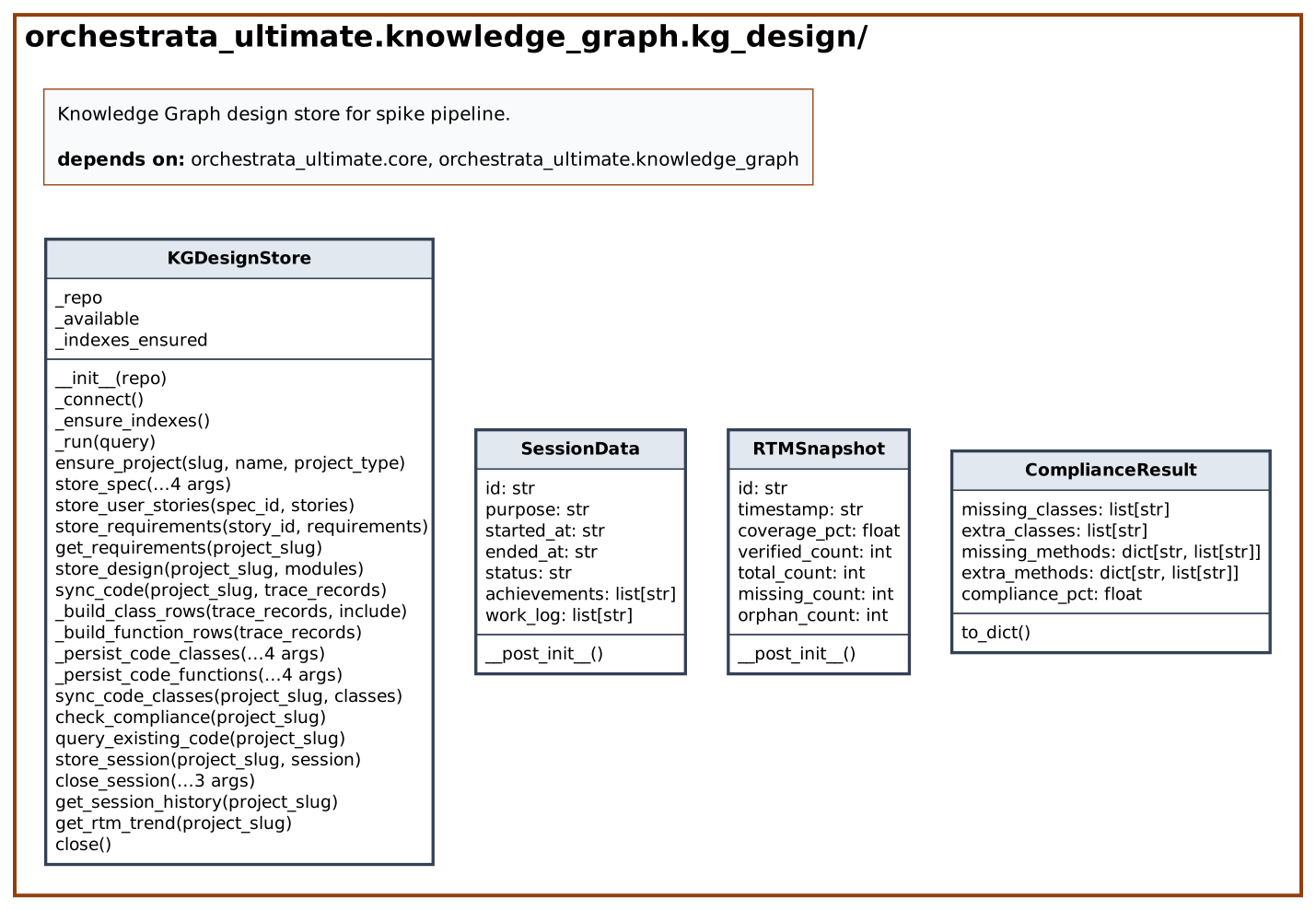
KGDesignStore is the graph-backed store for design and traceability data in the spike pipeline: specs, user stories, requirements, design modules and classes, code nodes and sessions, all in the operational graph (orchkg on orchgraph). The analyst, compliance and other volks import it. It works on a synchronous graph repository, supplied or created by _connect, and _ensure_indexes creates lookup indexes. All operations are non-fatal: _run wraps each Cypher call so that when the graph is unavailable the methods return empty results and log.
Write methods are ensure_project, store_spec (a Spec linked to a Project), store_user_stories, store_requirements, store_design (DesignModule and DesignClass nodes), sync_code and sync_code_classes (code traces become CodeClass and CodeFunction nodes through the _build_* and _persist_* helpers), store_session and close_session. Read methods are get_requirements, query_existing_code for the refactoring case, get_session_history and get_rtm_trend, the coverage trend across sessions. check_compliance compares the design classes with the code classes and returns a ComplianceResult. The dataclasses SessionData and RTMSnapshot carry session lifecycle and requirements-traceability-matrix coverage over time. The dialect is taken from resolve_kg_dialect.
At a glance
| Source | src/orchestrata_ultimate/knowledge_graph/kg_design.py |
| Lines of code | 924 |
| Classes | 4 |
| Functions | 1 |
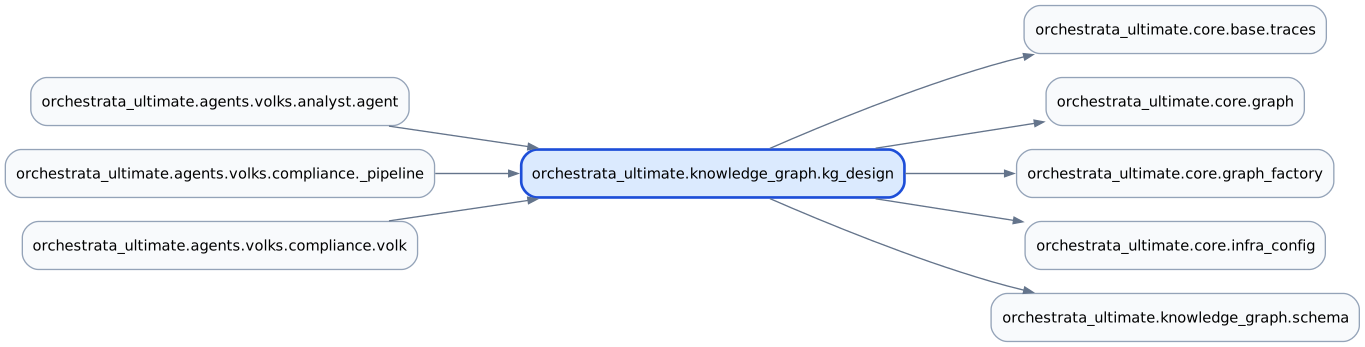
| Imports (internal) | orchestrata_ultimate.core.base.traces, orchestrata_ultimate.core.graph, orchestrata_ultimate.core.graph_factory, orchestrata_ultimate.core.infra_config, orchestrata_ultimate.knowledge_graph.schema |
| Imported by | orchestrata_ultimate.agents.volks.analyst.agent, orchestrata_ultimate.agents.volks.compliance._pipeline, orchestrata_ultimate.agents.volks.compliance.volk |
| Tests that import it | tests/agents/volks/compliance/test_pipeline.py, tests/agents/volks/compliance/test_volk.py, tests/knowledge_graph/test_kg_design.py, tests/knowledge_graph/test_kg_design_coverage.py, tests/knowledge_graph/test_kg_design_extended.py, tests/knowledge_graph/test_knowledge_signatures.py |
Class diagram
Dependency diagram
API
Classes
SessionData (dataclass)
Decorators: dataclass · Line 33
Session lifecycle data.
| Attribute | Type | Default |
|---|---|---|
id |
str |
|
purpose |
str |
'' |
started_at |
str |
'' |
ended_at |
str |
'' |
status |
str |
'ACTIVE' |
achievements |
list[str] |
field(default_factory=list) |
work_log |
list[str] |
field(default_factory=list) |
| Method | Signature | Summary |
|---|---|---|
__post_init__ |
__post_init__() -> None |
RTMSnapshot (dataclass)
Decorators: dataclass · Line 50
RTM snapshot for tracking coverage over time.
| Attribute | Type | Default |
|---|---|---|
id |
str |
|
timestamp |
str |
'' |
coverage_pct |
float |
0.0 |
verified_count |
int |
0 |
total_count |
int |
0 |
missing_count |
int |
0 |
orphan_count |
int |
0 |
| Method | Signature | Summary |
|---|---|---|
__post_init__ |
__post_init__() -> None |
ComplianceResult (dataclass)
Decorators: dataclass · Line 94
Result of design vs code compliance check.
| Attribute | Type | Default |
|---|---|---|
missing_classes |
list[str] |
field(default_factory=list) |
extra_classes |
list[str] |
field(default_factory=list) |
missing_methods |
dict[str, list[str]] |
field(default_factory=dict) |
extra_methods |
dict[str, list[str]] |
field(default_factory=dict) |
compliance_pct |
float |
0.0 |
| Method | Signature | Summary |
|---|---|---|
to_dict |
to_dict() -> dict[str, Any] |
KGDesignStore
Line 113
Graph-backed store for design and traceability data.
| Method | Signature | Summary |
|---|---|---|
__init__ |
__init__(repo: SyncGraphRepository | None = None) -> None |
Initialize the design store. |
_connect |
_connect() -> None |
|
_ensure_indexes |
_ensure_indexes() -> None |
Create indexes for efficient querying. |
_run |
_run(query: str, *, write: bool = True, ****params: Any) -> list[dict] |
Execute a Cypher query and return results. |
ensure_project |
ensure_project(slug: str, name: str, project_type: str = '') -> None |
Create or update a Project node. |
store_spec |
store_spec(project_slug: str, spec_id: str, title: str, content: str = '') -> str |
Store a Spec node linked to a Project. |
store_user_stories |
store_user_stories(spec_id: str, stories: list[dict[str, Any]]) -> dict[str, str] |
Store UserStory nodes linked to a Spec. |
store_requirements |
store_requirements(story_id: str, requirements: list[dict[str, Any]]) -> None |
Store Requirement nodes linked to a UserStory. |
get_requirements |
get_requirements(project_slug: str) -> list[dict[str, str]] |
Get all requirements for a project. |
store_design |
store_design(project_slug: str, modules: list[dict[str, Any]]) -> None |
Store DesignModule and DesignClass nodes. |
sync_code |
sync_code(project_slug: str, trace_records: list[dict[str, Any]]) -> None |
Sync code traces to CodeClass/CodeFunction nodes. |
_build_class_rows staticmethod |
_build_class_rows(trace_records: list[dict[str, Any]], include: Any) -> tuple[list[dict[str, Any]], list[dict[str, Any]]] |
Build CodeClass node rows and their TRACES_TO requirement rows. |
_build_function_rows staticmethod |
_build_function_rows(trace_records: list[dict[str, Any]]) -> tuple[list[dict[str, Any]], list[dict[str, Any]]] |
Build CodeFunction node rows (methods) and their requirement rows. |
_persist_code_classes |
_persist_code_classes(project_slug: str, ts: str, class_rows: list[dict[str, Any]], class_req_rows: list[dict[str, Any]]) -> None |
Write CodeClass nodes and their TRACES_TO requirement edges. |
_persist_code_functions |
_persist_code_functions(project_slug: str, ts: str, func_rows: list[dict[str, Any]], func_req_rows: list[dict[str, Any]]) -> None |
Write CodeFunction nodes and their TRACES_TO requirement edges. |
sync_code_classes |
sync_code_classes(project_slug: str, classes: list[dict[str, Any]]) -> None |
Sync code classes with their methods for compliance. |
check_compliance |
check_compliance(project_slug: str) -> ComplianceResult |
Compare DesignClass nodes against CodeClass nodes. |
query_existing_code |
query_existing_code(project_slug: str) -> dict[str, Any] |
Query KG for existing code in a project (refactoring case). |
store_session |
store_session(project_slug: str, session: SessionData) -> None |
Store a Session node linked to a Project. |
close_session |
close_session(session_id: str, achievements: list[str], rtm_snapshot: RTMSnapshot | None = None) -> None |
Close a session and optionally link an RTM snapshot. |
get_session_history |
get_session_history(project_slug: str) -> list[dict[str, Any]] |
Get all sessions for a project. |
get_rtm_trend |
get_rtm_trend(project_slug: str) -> list[dict[str, Any]] |
Get RTM coverage trend across sessions. |
close |
close() -> None |
Close the repository. |
Functions
| Function | Signature | Summary |
|---|---|---|
_require_project_slug |
_require_project_slug(project_slug: str, caller: str) -> None |
Guard every project-scoped WRITE against an empty/whitespace slug. |
Source
# mypy: ignore-errors
"""Knowledge Graph design store for spike pipeline.
Reads/writes specs, user stories, requirements, design nodes, code nodes,
and session data to the graph. Provides compliance queries comparing design
vs implementation.
Non-fatal: all Neo4j operations are wrapped in try/except. If Neo4j is
unavailable, operations return empty results and log warnings/errors.
"""
from __future__ import annotations
import json
import logging
from dataclasses import dataclass, field
from datetime import UTC, datetime
from typing import TYPE_CHECKING, Any
from orchestrata_ultimate.core.base.traces import traces
from orchestrata_ultimate.core.graph import BoltSyncRepository, GraphRepositoryConfig
from orchestrata_ultimate.core.graph_factory import resolve_kg_dialect
from orchestrata_ultimate.core.infra_config import GRAPH_PASSWORD, GRAPH_URI, GRAPH_USER
from orchestrata_ultimate.knowledge_graph.schema import to_memgraph_ddl
if TYPE_CHECKING:
from orchestrata_ultimate.core.graph import SyncGraphRepository
_logger = logging.getLogger(__name__)
@dataclass
class SessionData:
"""Session lifecycle data."""
id: str
purpose: str = ""
started_at: str = ""
ended_at: str = ""
status: str = "ACTIVE"
achievements: list[str] = field(default_factory=list)
work_log: list[str] = field(default_factory=list)
def __post_init__(self) -> None:
if not self.started_at:
self.started_at = datetime.now(UTC).isoformat()
@dataclass
class RTMSnapshot:
"""RTM snapshot for tracking coverage over time."""
id: str
timestamp: str = ""
coverage_pct: float = 0.0
verified_count: int = 0
total_count: int = 0
missing_count: int = 0
orphan_count: int = 0
def __post_init__(self) -> None:
if not self.timestamp:
self.timestamp = datetime.now(UTC).isoformat()
def _require_project_slug(project_slug: str, caller: str) -> None:
"""Guard every project-scoped WRITE against an empty/whitespace slug.
2026-07 audit: callers that slugified free-text (a task summary /
intent) instead of resolving the canonical project id produced an
empty-string slug and a truncated-to-50-chars slug, each MERGEing its
own throwaway ``:Project`` hub that thousands of CodeClass/CodeFunction
``DEFINES`` edges then anchored onto. Fail fast instead: never write an
anonymous Project hub. Callers must resolve a real slug via
``knowledge_graph.project_resolver`` (falling back to the ``"unscoped"``
sentinel — never ``""`` — when no project directory is known).
Args:
project_slug: The slug the caller is about to write under.
caller: Method name, for the error message.
Raises:
ValueError: If ``project_slug`` is empty or whitespace-only.
"""
if not project_slug or not project_slug.strip():
raise ValueError(
f"KGDesignStore.{caller}: project_slug must be a non-empty, "
"non-whitespace string -- refusing to write an anonymous "
"Project hub node."
)
@dataclass
class ComplianceResult:
"""Result of design vs code compliance check."""
missing_classes: list[str] = field(default_factory=list)
extra_classes: list[str] = field(default_factory=list)
missing_methods: dict[str, list[str]] = field(default_factory=dict)
extra_methods: dict[str, list[str]] = field(default_factory=dict)
compliance_pct: float = 0.0
def to_dict(self) -> dict[str, Any]:
return {
"missing_classes": self.missing_classes,
"extra_classes": self.extra_classes,
"missing_methods": self.missing_methods,
"extra_methods": self.extra_methods,
"compliance_pct": self.compliance_pct,
}
class KGDesignStore:
"""Graph-backed store for design and traceability data.
All operations are non-fatal. If the graph is unavailable, methods
return empty results and log warnings/errors.
"""
def __init__(self, repo: SyncGraphRepository | None = None) -> None:
"""Initialize the design store.
Ownership (backlog #163 phase 4): when ``repo`` is None, the store
builds and owns its own repository lazily via ``_connect()`` (on
first ``_run()`` call) — ``close()`` on it really closes the
underlying driver. When a ``repo`` is injected, ownership belongs to
whoever built *that* repo (shared repos no-op on ``close()``); this
class no longer tracks its own ``_owns_driver`` flag.
"""
self._repo: SyncGraphRepository | None = repo
self._available = False
self._indexes_ensured = False
if repo is not None:
try:
repo.verify_connectivity()
self._available = True
self._ensure_indexes()
except Exception as e:
self._available = False
_logger.error(
"shared driver unavailable (%s) -- design store disabled", e
)
def _connect(self) -> None:
if self._repo is not None:
return
try:
repo = BoltSyncRepository(
GraphRepositoryConfig(uri=GRAPH_URI, auth=(GRAPH_USER, GRAPH_PASSWORD))
)
self._repo = repo
repo.verify_connectivity()
self._available = True
self._ensure_indexes()
_logger.info("graph connected: %s", GRAPH_URI)
except Exception as e:
self._available = False
_logger.error("graph unavailable (%s) -- design store disabled", e)
@traces(spec="008", story="US-001", reqs=["REQ-008-037"])
def _ensure_indexes(self) -> None:
"""Create indexes for efficient querying."""
repo = self._repo
if not self._available or self._indexes_ensured or repo is None:
return
# Project.slug and Session.session_id are canonical UNIQUE keys
# (canonical_schema CANONICAL_MERGE_KEYS): their constraints provide
# backing indexes for free, and a plain index created here FIRST
# permanently blocks constraint creation (Neo.ClientError.Schema.
# IndexAlreadyExists — hit in the 2026-07-12 suite runs). Never
# index a canonical key here.
indexes = [
# Wave 6: Spec/UserStory/Requirement keys are canonical `id`
# (backed by uniqueness constraints), so plain indexes on the old
# `spec_id`/`story_id`/`req_id` properties are removed.
# DesignModule/DesignClass now key on project-qualified `id`, so
# their name indexes are also retired.
"CREATE INDEX IF NOT EXISTS FOR (c:CodeClass) ON (c.name)",
"CREATE INDEX IF NOT EXISTS FOR (c:CodeFunction) ON (c.name)",
"CREATE INDEX IF NOT EXISTS FOR (r:RTMSnapshot) ON (r.snapshot_id)",
]
# gate-ok: a missing index degrades query SPEED, not correctness; the failing statement is logged and re-applying is idempotent on the next connect
try:
for idx in indexes:
# Rendered for the live engine, then run via execute_autocommit
# rather than execute_write: the statements above are Neo4j
# dialect, and orchgraph/Memgraph both spells them differently
# ("CREATE INDEX ON :L(p)") and refuses index DDL inside a
# managed/explicit transaction ("Index manipulation is not
# allowed in multicommand transactions" — measured live
# 2026-07-26). Neo4j accepts DDL either way, so this is the
# portable form for both engines.
stmt = idx
if resolve_kg_dialect() == "memgraph":
translated = to_memgraph_ddl(idx)
if translated is None:
continue
stmt = translated
try:
repo.execute_autocommit(stmt)
except Exception as exc:
# The Memgraph dialect has no IF NOT EXISTS grammar, so
# re-application surfaces as "already exists" — exactly the
# no-op the Neo4j dialect gets for free.
if "already exists" not in str(exc).lower():
raise
self._indexes_ensured = True
except Exception as e:
_logger.warning("index creation error: %s", e)
def _run(self, query: str, *, write: bool = True, **params: Any) -> list[dict]:
"""Execute a Cypher query and return results.
Args:
query: The Cypher query string.
write: Whether to route through a managed write transaction
(default) or a managed read transaction. Most callers write
(MERGE/SET); the handful of pure lookups pass ``write=False``.
**params: Cypher query parameters.
"""
if not self._available and self._repo is None:
self._connect()
if not self._available:
return []
repo = self._repo
if repo is None:
return []
try:
if write:
return repo.execute_write(query, params)
return repo.execute_read(query, params)
except Exception as e:
_logger.error("query error: %s", e)
return []
# -- Project Operations ----------------------------------------
def ensure_project(self, slug: str, name: str, project_type: str = "") -> None:
"""Create or update a Project node."""
_require_project_slug(slug, "ensure_project")
self._run(
"MERGE (p:Project {slug: $slug}) "
"SET p.name = $name, "
" p.project_type = $type, "
" p.updated_at = $ts",
slug=slug,
name=name,
type=project_type,
ts=datetime.now(UTC).isoformat(),
)
# -- Spec Operations ---------------------------------------------
def store_spec(
self,
project_slug: str,
spec_id: str,
title: str,
content: str = "",
) -> str:
"""Store a Spec node linked to a Project.
``id`` is project-qualified (``"{project_slug}:{spec_id}"``): a bare
``spec_id`` (e.g. ``"001"``, this class's own default) recurs across
analyst runs/projects, so it is unsound as a global MERGE key in a
multi-project graph (2026-07-12 multi-project ruling). The bare
``spec_id`` is kept as a plain property for display/lookup. Label is
``Spec`` (canonical_schema LABEL_SPEC), not the prior ``Specification``
— this class was the only reader/writer of that label, so it converges
onto the canon rather than keeping its own synonym.
Returns:
The project-qualified Spec id, to pass forward into
``store_user_stories``.
Session-254 root-connectivity ruling: the ``Project`` hub used to be
``MATCH``ed rather than ``MERGE``d here, so when no ``:Project``
existed yet for ``project_slug`` the match failed OPEN -- the ``MERGE
(p)-[:HAS_SPEC]->(s)`` line never ran, and the Spec (plus every
UserStory/Requirement ``store_user_stories``/``store_requirements``
hang off it) was minted as an unreachable island (183 live nodes
found by ``scripts/check_kg_connectivity.py``). ``MERGE`` is safe here
specifically because ``_require_project_slug`` above already fails
closed on an empty/whitespace slug -- every other hub writer in the
repo (``cold_store.py``, ``session_manager.py``, ``gateway/audit.py``)
follows the same MERGE-the-hub pattern.
"""
_require_project_slug(project_slug, "store_spec")
qid = f"{project_slug}:{spec_id}"
self._run(
"MERGE (s:Spec {id: $id}) "
"SET s.spec_id = $spec_id, "
" s.project_slug = $slug, "
" s.title = $title, "
" s.content = $content, "
" s.updated_at = $ts "
"WITH s "
"MERGE (p:Project {slug: $slug}) "
"MERGE (p)-[:HAS_SPEC]->(s)",
id=qid,
spec_id=spec_id,
title=title,
content=content,
slug=project_slug,
ts=datetime.now(UTC).isoformat(),
)
return qid
# -- User Story Operations -------------------------------------
def store_user_stories(
self,
spec_id: str,
stories: list[dict[str, Any]],
) -> dict[str, str]:
"""Store UserStory nodes linked to a Spec.
Args:
spec_id: The project-qualified Spec id returned by
``store_spec`` (NOT the bare spec number).
stories: List of dicts with keys:
id, title, as_a, i_want, so_that,
acceptance_criteria (list of strings).
Returns:
Mapping of each story's bare ``id`` to its project-qualified
UserStory id (``"{spec_id}:{story id}"``), to pass forward into
``store_requirements``. Empty when ``stories`` is empty.
"""
if not stories:
return {}
rows = [
{
"id": f"{spec_id}:{s['id']}",
"story_id": s["id"],
"title": s.get("title", ""),
"as_a": s.get("as_a", ""),
"i_want": s.get("i_want", ""),
"so_that": s.get("so_that", ""),
"criteria": json.dumps(s.get("acceptance_criteria", [])),
}
for s in stories
]
ts = datetime.now(UTC).isoformat()
self._run(
"MATCH (sp:Spec {id: $spec_id}) "
"UNWIND $rows AS row "
"MERGE (u:UserStory {id: row.id}) "
"SET u.story_id = row.story_id, "
" u.title = row.title, "
" u.as_a = row.as_a, "
" u.i_want = row.i_want, "
" u.so_that = row.so_that, "
" u.acceptance_criteria = row.criteria, "
" u.updated_at = $ts "
"MERGE (sp)-[:HAS_STORY]->(u)",
spec_id=spec_id,
rows=rows,
ts=ts,
)
return {row["story_id"]: row["id"] for row in rows}
# -- Requirement Operations ------------------------------------
def store_requirements(
self,
story_id: str,
requirements: list[dict[str, Any]],
) -> None:
"""Store Requirement nodes linked to a UserStory.
Args:
story_id: The project-qualified UserStory id returned by
``store_user_stories`` (NOT the bare story id).
requirements: List of dicts with keys:
id, description, priority, category.
Note:
``id`` is project-qualified (``"{story_id}:{req id}"``). The bare
``req_id`` is kept as a plain property — ``_persist_code_classes``/
``_persist_code_functions`` below still MATCH Requirement by that
bare ``req_id`` (a separate, @traces-decorator-sourced identity
space not reconciled by this wave; W3 reconciliation ledger).
"""
if not requirements:
return
rows = [
{
"id": f"{story_id}:{r['id']}",
"req_id": r["id"],
"desc": r.get("description", ""),
"priority": r.get("priority", "NORMAL"),
"category": r.get("category", ""),
}
for r in requirements
]
ts = datetime.now(UTC).isoformat()
self._run(
"MATCH (u:UserStory {id: $story_id}) "
"UNWIND $rows AS row "
"MERGE (r:Requirement {id: row.id}) "
"SET r.req_id = row.req_id, "
" r.description = row.desc, "
" r.priority = row.priority, "
" r.category = row.category, "
" r.updated_at = $ts "
"MERGE (u)-[:HAS_REQUIREMENT]->(r)",
story_id=story_id,
rows=rows,
ts=ts,
)
def get_requirements(self, project_slug: str) -> list[dict[str, str]]:
"""Get all requirements for a project.
Returns:
List of dicts with req_id, description, story_id, spec_id (all
the bare/display ids, not the internal qualified ``id``).
"""
results = self._run(
"MATCH (p:Project {slug: $slug})-[:HAS_SPEC]->"
"(s:Spec)-[:HAS_STORY]->"
"(u:UserStory)-[:HAS_REQUIREMENT]->"
"(r:Requirement) "
"RETURN r.req_id AS req_id, "
" r.description AS description, "
" u.story_id AS story_id, "
" s.spec_id AS spec_id "
"ORDER BY r.req_id",
write=False,
slug=project_slug,
)
return results
# -- Design Operations -----------------------------------------
def store_design(
self,
project_slug: str,
modules: list[dict[str, Any]],
) -> None:
"""Store DesignModule and DesignClass nodes.
Args:
project_slug: Project slug.
modules: List of module dicts with keys:
name, description, dependencies,
classes: [{name, methods, attributes, responsibilities}]
"""
if not modules:
return
_require_project_slug(project_slug, "store_design")
mod_rows = [
{
"id": f"{project_slug}:{m['name']}",
"name": m["name"],
"desc": m.get("description", ""),
"deps": json.dumps(m.get("dependencies", [])),
}
for m in modules
]
cls_rows = [
{
"id": f"{project_slug}:{module['name']}:{cls['name']}",
"name": cls["name"],
"methods": json.dumps(cls.get("methods", [])),
"attrs": json.dumps(cls.get("attributes", [])),
"resp": cls.get("responsibilities", ""),
"mod_id": f"{project_slug}:{module['name']}",
}
for module in modules
for cls in module.get("classes", [])
]
ts = datetime.now(UTC).isoformat()
if mod_rows:
self._run(
"MATCH (p:Project {slug: $slug}) "
"UNWIND $rows AS row "
"MERGE (m:DesignModule {id: row.id}) "
"SET m.name = row.name, "
" m.description = row.desc, "
" m.dependencies = row.deps, "
" m.updated_at = $ts "
"MERGE (p)-[:HAS_MODULE]->(m)",
slug=project_slug,
rows=mod_rows,
ts=ts,
)
if cls_rows:
self._run(
"UNWIND $rows AS row "
"MERGE (c:DesignClass {id: row.id}) "
"SET c.name = row.name, "
" c.methods = row.methods, "
" c.attributes = row.attrs, "
" c.responsibilities = row.resp, "
" c.updated_at = $ts "
"WITH c, row "
"MATCH (m:DesignModule {id: row.mod_id}) "
"MERGE (m)-[:CONTAINS_CLASS]->(c)",
rows=cls_rows,
ts=ts,
)
# -- Code Sync Operations --------------------------------------
def sync_code(
self,
project_slug: str,
trace_records: list[dict[str, Any]],
) -> None:
"""Sync code traces to CodeClass/CodeFunction nodes.
Creates nodes for each traced class/function and links them
to requirements via TRACES_TO relationships.
Args:
project_slug: Project slug.
trace_records: List of TraceInfo.to_dict() dicts.
"""
if not trace_records:
return
_require_project_slug(project_slug, "sync_code")
ts = datetime.now(UTC).isoformat()
# Batch 1: CodeClass nodes (non-method)
class_rows, class_req_rows = self._build_class_rows(
trace_records,
include=lambda t: bool(t.get("class_name") and not t.get("method")),
)
self._persist_code_classes(project_slug, ts, class_rows, class_req_rows)
# Batch 2: CodeFunction nodes (methods)
func_rows, func_req_rows = self._build_function_rows(trace_records)
self._persist_code_functions(project_slug, ts, func_rows, func_req_rows)
# Batch 3: CodeClass nodes for class-bearing methods (class_name + method)
class_only_rows, class_only_req_rows = self._build_class_rows(
trace_records,
include=lambda t: bool(t.get("class_name") and t.get("method")),
)
self._persist_code_classes(
project_slug, ts, class_only_rows, class_only_req_rows
)
@staticmethod
def _build_class_rows(
trace_records: list[dict[str, Any]],
include: Any,
) -> tuple[list[dict[str, Any]], list[dict[str, Any]]]:
"""Build CodeClass node rows and their TRACES_TO requirement rows.
Args:
trace_records: Trace dicts to scan.
include: Predicate deciding whether a trace contributes a class row.
"""
class_rows: list[dict[str, Any]] = []
req_rows: list[dict[str, Any]] = []
for trace in trace_records:
if not include(trace):
continue
class_rows.append(
{
"name": trace["class_name"],
"fp": trace.get("file_path", ""),
"ln": trace.get("line_number", 0),
"mod": trace.get("module", ""),
}
)
req_rows.extend(
{"name": trace["class_name"], "req_id": req_id}
for req_id in trace.get("reqs", [])
)
return class_rows, req_rows
@staticmethod
def _build_function_rows(
trace_records: list[dict[str, Any]],
) -> tuple[list[dict[str, Any]], list[dict[str, Any]]]:
"""Build CodeFunction node rows (methods) and their requirement rows."""
func_rows: list[dict[str, Any]] = []
req_rows: list[dict[str, Any]] = []
for trace in trace_records:
if not trace.get("method"):
continue
class_name = trace.get("class_name", "")
func_name = trace["method"]
full_name = f"{class_name}.{func_name}" if class_name else func_name
func_rows.append(
{
"name": full_name,
"fp": trace.get("file_path", ""),
"ln": trace.get("line_number", 0),
"cls": class_name,
"mod": trace.get("module", ""),
}
)
req_rows.extend(
{"name": full_name, "req_id": req_id}
for req_id in trace.get("reqs", [])
)
return func_rows, req_rows
def _persist_code_classes(
self,
project_slug: str,
ts: str,
class_rows: list[dict[str, Any]],
class_req_rows: list[dict[str, Any]],
) -> None:
"""Write CodeClass nodes and their TRACES_TO requirement edges."""
if class_rows:
self._run(
"MATCH (p:Project {slug: $slug}) "
"UNWIND $rows AS row "
"MERGE (c:CodeClass {name: row.name, project: $slug}) "
"SET c.file_path = row.fp, "
" c.line_number = row.ln, "
" c.module = row.mod, "
" c.updated_at = $ts "
"MERGE (p)-[:DEFINES]->(c)",
slug=project_slug,
rows=class_rows,
ts=ts,
)
if class_req_rows:
self._run(
"UNWIND $rows AS row "
"MATCH (c:CodeClass {name: row.name, project: $slug}) "
"MATCH (r:Requirement {req_id: row.req_id}) "
"MERGE (c)-[:TRACES_TO]->(r)",
slug=project_slug,
rows=class_req_rows,
)
def _persist_code_functions(
self,
project_slug: str,
ts: str,
func_rows: list[dict[str, Any]],
func_req_rows: list[dict[str, Any]],
) -> None:
"""Write CodeFunction nodes and their TRACES_TO requirement edges."""
if func_rows:
self._run(
"MATCH (p:Project {slug: $slug}) "
"UNWIND $rows AS row "
"MERGE (f:CodeFunction {name: row.name, project: $slug}) "
"SET f.file_path = row.fp, "
" f.line_number = row.ln, "
" f.class_name = row.cls, "
" f.module = row.mod, "
" f.updated_at = $ts "
"MERGE (p)-[:DEFINES]->(f)",
slug=project_slug,
rows=func_rows,
ts=ts,
)
if func_req_rows:
self._run(
"UNWIND $rows AS row "
"MATCH (f:CodeFunction {name: row.name, project: $slug}) "
"MATCH (r:Requirement {req_id: row.req_id}) "
"MERGE (f)-[:TRACES_TO]->(r)",
slug=project_slug,
rows=func_req_rows,
)
def sync_code_classes(
self,
project_slug: str,
classes: list[dict[str, Any]],
) -> None:
"""Sync code classes with their methods for compliance.
Args:
project_slug: Project slug.
classes: List of dicts with name, methods, file_path.
"""
_require_project_slug(project_slug, "sync_code_classes")
for cls in classes:
methods = json.dumps(cls.get("methods", []))
self._run(
"MERGE (c:CodeClass {name: $name, "
" project: $slug}) "
"SET c.methods = $methods, "
" c.file_path = $fp, "
" c.updated_at = $ts",
name=cls["name"],
slug=project_slug,
methods=methods,
fp=cls.get("file_path", ""),
ts=datetime.now(UTC).isoformat(),
)
# -- Compliance Checking ---------------------------------------
def check_compliance(self, project_slug: str) -> ComplianceResult:
"""Compare DesignClass nodes against CodeClass nodes.
Returns:
ComplianceResult with missing/extra classes and methods.
"""
design_classes = self._run(
"MATCH (p:Project {slug: $slug})-[:HAS_MODULE]->"
"(:DesignModule)-[:CONTAINS_CLASS]->"
"(d:DesignClass) "
"RETURN d.name AS name, d.methods AS methods",
write=False,
slug=project_slug,
)
code_classes = self._run(
"MATCH (c:CodeClass {project: $slug}) "
"RETURN c.name AS name, c.methods AS methods",
write=False,
slug=project_slug,
)
design_names = {d["name"] for d in design_classes}
code_names = {c["name"] for c in code_classes}
missing_classes = sorted(design_names - code_names)
extra_classes = sorted(code_names - design_names)
design_methods: dict[str, list[str]] = {}
for d in design_classes:
methods_raw = d.get("methods", "[]")
if isinstance(methods_raw, str):
methods_raw = json.loads(methods_raw)
design_methods[d["name"]] = methods_raw
code_methods: dict[str, list[str]] = {}
for c in code_classes:
methods_raw = c.get("methods", "[]")
if isinstance(methods_raw, str):
methods_raw = json.loads(methods_raw)
code_methods[c["name"]] = methods_raw
missing_methods: dict[str, list[str]] = {}
extra_methods_dict: dict[str, list[str]] = {}
for cls_name in design_names & code_names:
d_set = set(design_methods.get(cls_name, []))
c_set = set(code_methods.get(cls_name, []))
missing = sorted(d_set - c_set)
extra = sorted(c_set - d_set)
if missing:
missing_methods[cls_name] = missing
if extra:
extra_methods_dict[cls_name] = extra
total_designed = len(design_names)
implemented = len(design_names & code_names)
compliance_pct = (
round(implemented / total_designed * 100, 1)
if total_designed > 0
else 100.0
)
return ComplianceResult(
missing_classes=missing_classes,
extra_classes=extra_classes,
missing_methods=missing_methods,
extra_methods=extra_methods_dict,
compliance_pct=compliance_pct,
)
# -- Query Operations ------------------------------------------
def query_existing_code(self, project_slug: str) -> dict[str, Any]:
"""Query KG for existing code in a project (refactoring case).
Returns:
Dict with classes, functions, modules lists.
"""
classes = self._run(
"MATCH (c:CodeClass {project: $slug}) "
"RETURN c.name AS name, c.file_path AS file_path, "
" c.methods AS methods",
write=False,
slug=project_slug,
)
functions = self._run(
"MATCH (f:CodeFunction {project: $slug}) "
"RETURN f.name AS name, f.file_path AS file_path, "
" f.class_name AS class_name",
write=False,
slug=project_slug,
)
modules = self._run(
"MATCH (p:Project {slug: $slug})-[:HAS_MODULE]->"
"(m:DesignModule) "
"RETURN m.name AS name, m.description AS description",
write=False,
slug=project_slug,
)
return {
"classes": classes,
"functions": functions,
"modules": modules,
}
# -- Session Operations ----------------------------------------
def store_session(self, project_slug: str, session: SessionData) -> None:
"""Store a Session node linked to a Project.
Session-254 root-connectivity ruling: found while fixing the
identical ``store_spec`` defect above -- this writer also ``MATCH``ed
(rather than ``MERGE``d) the Project hub, so it fails open exactly
the same way whenever no ``:Project`` exists yet for ``project_slug``,
despite ``plans/hub-link-plan.md`` §4.6 having (incorrectly) listed
this method as one of the five already-anchored Session writers.
``_require_project_slug`` above makes ``MERGE`` safe here too.
"""
_require_project_slug(project_slug, "store_session")
self._run(
"MERGE (s:Session {session_id: $sid}) "
"SET s.purpose = $purpose, "
" s.started_at = $started, "
" s.status = $status, "
" s.updated_at = $ts "
"WITH s "
"MERGE (p:Project {slug: $slug}) "
"MERGE (p)-[:HAS_SESSION]->(s)",
sid=session.id,
purpose=session.purpose,
started=session.started_at,
status=session.status,
slug=project_slug,
ts=datetime.now(UTC).isoformat(),
)
def close_session(
self,
session_id: str,
achievements: list[str],
rtm_snapshot: RTMSnapshot | None = None,
) -> None:
"""Close a session and optionally link an RTM snapshot."""
self._run(
"MATCH (s:Session {session_id: $sid}) "
"SET s.ended_at = $ts, "
" s.status = 'COMPLETED', "
" s.achievements = $achievements",
sid=session_id,
ts=datetime.now(UTC).isoformat(),
achievements=json.dumps(achievements),
)
if rtm_snapshot:
self._run(
"MERGE (r:RTMSnapshot "
" {snapshot_id: $snap_id}) "
"SET r.timestamp = $ts, "
" r.coverage_pct = $cov, "
" r.verified_count = $verified, "
" r.total_count = $total, "
" r.missing_count = $missing, "
" r.orphan_count = $orphan "
"WITH r "
"MATCH (s:Session {session_id: $sid}) "
"MERGE (s)-[:PRODUCED_RTM]->(r)",
snap_id=rtm_snapshot.id,
ts=rtm_snapshot.timestamp,
cov=rtm_snapshot.coverage_pct,
verified=rtm_snapshot.verified_count,
total=rtm_snapshot.total_count,
missing=rtm_snapshot.missing_count,
orphan=rtm_snapshot.orphan_count,
sid=session_id,
)
def get_session_history(self, project_slug: str) -> list[dict[str, Any]]:
"""Get all sessions for a project."""
return self._run(
"MATCH (p:Project {slug: $slug})-[:HAS_SESSION]->"
"(s:Session) "
"RETURN s.session_id AS session_id, "
" s.purpose AS purpose, "
" s.started_at AS started_at, "
" s.ended_at AS ended_at, "
" s.status AS status, "
" s.achievements AS achievements "
"ORDER BY s.started_at",
write=False,
slug=project_slug,
)
def get_rtm_trend(self, project_slug: str) -> list[dict[str, Any]]:
"""Get RTM coverage trend across sessions.
Returns:
List of dicts with timestamp, coverage_pct, verified,
total for each session.
"""
return self._run(
"MATCH (p:Project {slug: $slug})-[:HAS_SESSION]->"
"(s:Session)-[:PRODUCED_RTM]->(r:RTMSnapshot) "
"RETURN r.timestamp AS timestamp, "
" r.coverage_pct AS coverage_pct, "
" r.verified_count AS verified, "
" r.total_count AS total "
"ORDER BY r.timestamp",
write=False,
slug=project_slug,
)
# -- Cleanup ---------------------------------------------------
def close(self) -> None:
"""Close the repository.
A no-op when ``self._repo`` wraps a driver it does not own (shared
semantics live on the repository itself — see ``__init__``).
"""
if self._repo is not None:
self._repo.close()
self._repo = None
self._available = False