orchestrata_ultimate.di.container
Reference › orchestrata_ultimate › di › container
The whole dependency-injection system of orchestrata, described in the di narrative. Its only project imports are the IComponent interface and ComponentScope enum from core.protocols, and the @traces decorator; the in-tree consumer is the gateway server, which uses DIContainer in its composition root.
ComponentRegistrationis the record stored per interface: the implementation class, the scope (default singleton), a config dictionary, an explicit dependency list and an optional factory callable.ResolutionContextis created for each resolution pass. Itsresolvingstack detects circular dependencies, itscacheholds singleton instances, andcontext_idisolates request-scoped components.DIContainerregisters withregister(a class or factory) andregister_instance, both guarded byallow_override;_validate_registrationchecks each registration.resolve(interface, context_id)is a coroutine that descends through_resolve_with_context,_create_instance,_resolve_dependenciesand_resolve_param, usinginspecton the constructor (_extract_dependencies) to inject dependencies recursively. Scopes are singleton (cached), transient (rebuilt on every resolve) and request (cached per context id).set_contextandget_contextcarry keyed values,has,get_all_registrationsandget_registry_infointrospect, andshutdownstops components in reverse dependency order.ContainerBuilderis the fluent, configuration-driven path:with_config,with_component,with_instance,with_context, thenbuild.ContainerRegistrypublishes containers by name in a class-level dictionary (register,get,has) andshutdown_alltears them all down.
At a glance
| Source | src/orchestrata_ultimate/di/container.py |
| Lines of code | 897 |
| Classes | 5 |
| Functions | 0 |
| Imports (internal) | orchestrata_ultimate.core.base.traces, orchestrata_ultimate.core.protocols |
| Imported by | orchestrata_ultimate.di, orchestrata_ultimate.gateway.server |
| Tests that import it | tests/di/test_container_extended.py, tests/gateway/test_memory_engine_wiring.py, tests/test_di.py |
Class diagram
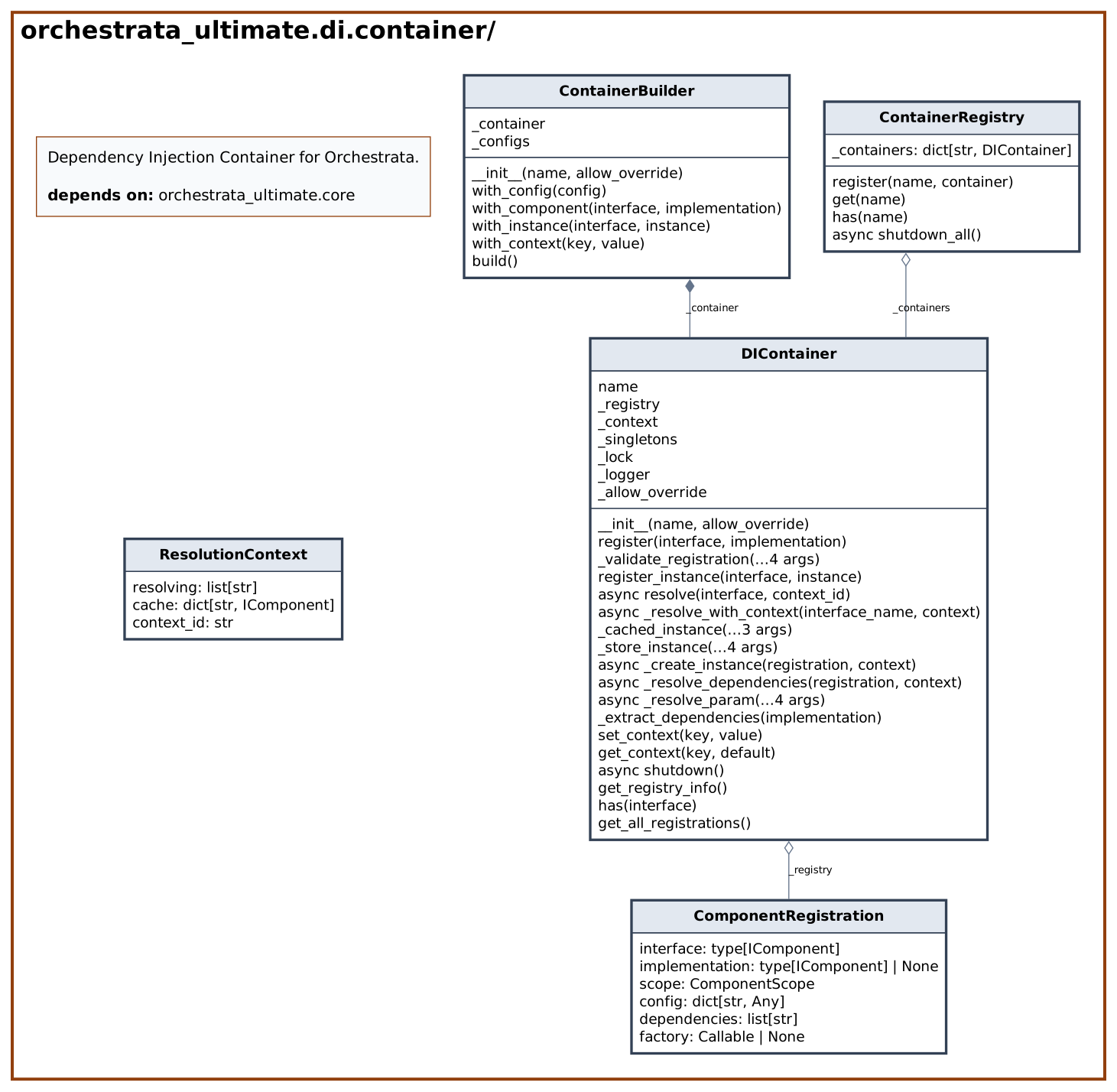
Dependency diagram

API
Classes
ComponentRegistration (dataclass)
Decorators: dataclass · Line 31
Registration information for a component
| Attribute | Type | Default |
|---|---|---|
interface |
type[IComponent] |
|
implementation |
type[IComponent] | None |
None |
scope |
ComponentScope |
ComponentScope.SINGLETON |
config |
dict[str, Any] |
field(default_factory=dict) |
dependencies |
list[str] |
field(default_factory=list) |
factory |
Callable | None |
None |
ResolutionContext (dataclass)
Decorators: traces(spec='024', story='Resolution', reqs=['REQ-024-025', 'REQ-024-030']), dataclass · Line 48
Context for dependency resolution
| Attribute | Type | Default |
|---|---|---|
resolving |
list[str] |
field(default_factory=list) |
cache |
dict[str, IComponent] |
field(default_factory=dict) |
context_id |
str |
'' |
DIContainer
Line 65
Dependency injection container for Orchestrata components.
| Method | Signature | Summary |
|---|---|---|
__init__ |
__init__(name: str = 'default', allow_override: bool = False) -> None |
Initialize DI container. |
register |
register(interface: type[T], implementation: type[T] | None = None, *, scope: ComponentScope = ComponentScope.SINGLETON, config: dict[str, Any] | None = None, factory: Callable[..., T] | None = None, dependencies: list[str] | None = None) -> DIContainer |
Register a component implementation. |
_validate_registration |
_validate_registration(interface_name: str, interface: type, implementation: type | None, factory: Callable | None) -> None |
Validate that the registration arguments are consistent. |
register_instance |
register_instance(interface: type[T], instance: T) -> DIContainer |
Register an existing instance. |
resolve |
async resolve(interface: type[T], context_id: str | None = None) -> T |
Resolve component instance. |
_resolve_with_context |
async _resolve_with_context(interface_name: str, context: ResolutionContext) -> IComponent |
Resolve component with context. |
_cached_instance |
_cached_instance(interface_name: str, registration: ComponentRegistration, context: ResolutionContext) -> IComponent | None |
Return a cached instance for SINGLETON/REQUEST scopes, else None. |
_store_instance |
_store_instance(interface_name: str, registration: ComponentRegistration, context: ResolutionContext, instance: IComponent) -> None |
Cache a freshly created instance according to its scope (REQ-024-017). |
_create_instance |
async _create_instance(registration: ComponentRegistration, context: ResolutionContext) -> Any |
Instantiate a component from its registration. |
_resolve_dependencies |
async _resolve_dependencies(registration: ComponentRegistration, context: ResolutionContext) -> dict[str, Any] |
Resolve constructor dependencies by inspecting signature. |
_resolve_param |
async _resolve_param(param_name: str, param: inspect.Parameter, registration: ComponentRegistration, context: ResolutionContext) -> Any |
Resolve a single constructor parameter. |
_extract_dependencies |
_extract_dependencies(implementation: type[IComponent]) -> list[str] |
Extract dependency interfaces from constructor. |
set_context |
set_context(key: str, value: Any) -> None |
Set context value for dependency resolution. |
get_context |
get_context(key: str, default: Any = None) -> Any |
Get context value. |
shutdown |
async shutdown() -> None |
Shutdown all components in reverse dependency order. |
get_registry_info |
get_registry_info() -> dict[str, Any] |
Get information about registered components. |
has |
has(interface: type[T]) -> bool |
Check if interface has a registration. |
get_all_registrations |
get_all_registrations() -> dict[str, ComponentRegistration] |
Get raw registration mapping. |
ContainerBuilder
Line 685
Fluent builder for configuring DI containers.
| Method | Signature | Summary |
|---|---|---|
__init__ |
__init__(name: str = 'default', allow_override: bool = False) -> None |
Initialize container builder. |
with_config |
with_config(config: dict[str, Any]) -> ContainerBuilder |
Add configuration to container. |
with_component |
with_component(interface: type[T], implementation: type[T] | None = None, *, scope: ComponentScope = ComponentScope.SINGLETON, config_key: str | None = None, factory: Callable[..., T] | None = None, dependencies: list[str] | None = None) -> ContainerBuilder |
Register a component. |
with_instance |
with_instance(interface: type[T], instance: T) -> ContainerBuilder |
Register an existing instance. |
with_context |
with_context(key: str, value: Any) -> ContainerBuilder |
Add context value. |
build |
build() -> DIContainer |
Build the configured container. |
ContainerRegistry
Decorators: traces(spec='024', story='Container Registry', reqs=['REQ-024-045']) · Line 838
Global registry for DI containers.
| Attribute | Type | Default |
|---|---|---|
_containers |
dict[str, DIContainer] |
{} |
| Method | Signature | Summary |
|---|---|---|
register classmethod |
register(name: str, container: DIContainer) -> None |
Register a container. |
get classmethod |
get(name: str = 'default') -> DIContainer |
Get container by name. |
has classmethod |
has(name: str) -> bool |
Check if container is registered. |
shutdown_all classmethod |
async shutdown_all() -> None |
Shutdown all registered containers. |
Source
# mypy: ignore-errors
"""
Dependency Injection Container for Orchestrata.
Provides a flexible, type-safe dependency injection system
that supports multiple scopes and configuration-driven assembly.
"""
from __future__ import annotations
import inspect
import logging
import threading
from collections.abc import Callable
from copy import copy
from dataclasses import dataclass, field
from typing import Any, TypeVar, cast
from orchestrata_ultimate.core.base.traces import traces
from orchestrata_ultimate.core.protocols import ComponentScope, IComponent
# Type variables
T = TypeVar("T", bound=IComponent)
# ============================================================================
# Data Classes
# ============================================================================
@dataclass
class ComponentRegistration:
"""Registration information for a component"""
interface: type[IComponent]
implementation: type[IComponent] | None = None
scope: ComponentScope = ComponentScope.SINGLETON
config: dict[str, Any] = field(default_factory=dict)
dependencies: list[str] = field(default_factory=list)
factory: Callable | None = None
@traces(
spec="024",
story="Resolution",
reqs=["REQ-024-025", "REQ-024-030"],
)
@dataclass
class ResolutionContext:
"""Context for dependency resolution"""
resolving: list[str] = field(
default_factory=list
) # Stack of interfaces being resolved
cache: dict[str, IComponent] = field(
default_factory=dict
) # Cache for singleton instances
context_id: str = "" # For REQUEST scope isolation
# ============================================================================
# Dependency Injection Container
# ============================================================================
class DIContainer:
"""
Dependency injection container for Orchestrata components.
Supports:
- Interface-based registration
- Multiple scopes (singleton, transient, request)
- Constructor injection
- Configuration-driven assembly
- Circular dependency detection
"""
def __init__(self, name: str = "default", allow_override: bool = False) -> None:
"""
Initialize DI container.
Args:
name: Container name for logging
allow_override: If True, allows re-registering same interface
"""
self.name = name
self._registry: dict[str, ComponentRegistration] = {}
self._context: dict[str, Any] = {}
self._singletons: dict[str, IComponent] = {} # Separate cache for singletons
self._lock = threading.Lock()
self._logger = logging.getLogger(f"di.container.{name}")
self._allow_override = allow_override
# Register self as a service
self._context["di_container"] = self
@traces(
spec="024",
story="Core Registration",
reqs=[
"REQ-024-001",
"REQ-024-002",
"REQ-024-003",
"REQ-024-004",
"REQ-024-007",
"REQ-024-008",
"REQ-024-009",
"REQ-024-010",
"REQ-024-051",
],
)
def register(
self,
interface: type[T],
implementation: type[T] | None = None,
*,
scope: ComponentScope = ComponentScope.SINGLETON,
config: dict[str, Any] | None = None,
factory: Callable[..., T] | None = None,
dependencies: list[str] | None = None,
) -> DIContainer:
"""
Register a component implementation.
Args:
interface: Interface class
implementation: Implementation class (optional if using factory)
scope: Component scope (SINGLETON, TRANSIENT, REQUEST)
config: Component configuration dict
factory: Factory function for creating instances
dependencies: Explicit dependency override list
Returns:
Self for method chaining
Raises:
ValueError: If neither implementation nor factory provided
ValueError: If duplicate interface registration without allow_override
"""
interface_name = interface.__name__
# Check for duplicate registration (REQ-024-010)
with self._lock:
if interface_name in self._registry and not self._allow_override:
raise ValueError(f"Interface {interface_name} already registered")
self._validate_registration(interface_name, interface, implementation, factory)
# Shallow copy config to prevent mutation issues (REQ-024-007)
config_copy = copy(config) if config else {}
# Use explicit dependencies or extract from constructor
dependencies_list = (
dependencies
if dependencies is not None
else (self._extract_dependencies(implementation) if implementation else [])
)
registration = ComponentRegistration(
interface=interface,
implementation=implementation,
scope=scope,
config=config_copy,
dependencies=dependencies_list,
factory=factory,
)
with self._lock:
self._registry[interface_name] = registration
self._logger.debug(
f"Registered {interface_name} -> "
f"{implementation.__name__ if implementation else 'factory'}"
)
return self # REQ-024-009: Return self for chaining
@traces(
spec="024",
story="Core Registration",
reqs=["REQ-024-005", "REQ-024-006"],
)
def _validate_registration(
self,
interface_name: str,
interface: type,
implementation: type | None,
factory: Callable | None,
) -> None:
"""Validate that the registration arguments are consistent.
Args:
interface_name: String name of the interface (for messages).
interface: The interface type.
implementation: The implementation type, if provided.
factory: The factory callable, if provided.
Raises:
ValueError: If neither implementation nor factory is provided,
or if implementation does not implement interface.
"""
if implementation is None and factory is None:
raise ValueError(
f"Must provide either implementation or factory for {interface_name}"
)
if implementation is not None and not issubclass(implementation, interface):
raise ValueError(
f"{implementation.__name__} must implement {interface_name}"
)
@traces(
spec="024",
story="Instance Registration",
reqs=[
"REQ-024-036",
"REQ-024-037",
"REQ-024-039",
],
)
def register_instance(self, interface: type[T], instance: T) -> DIContainer:
"""
Register an existing instance.
Args:
interface: Interface class
instance: Component instance
Returns:
Self for method chaining
Raises:
ValueError: If instance does not implement interface
"""
interface_name = interface.__name__
if not isinstance(instance, interface):
raise ValueError(f"Instance must implement {interface_name}")
# Create a factory that returns the instance
@traces(spec="024", story="Instance Registration", reqs=["REQ-024-038"])
def factory() -> T:
return instance
self.register(
interface=interface, factory=factory, scope=ComponentScope.SINGLETON
)
return self # REQ-024-040: Return self for chaining
@traces(
spec="024",
story="Resolution",
reqs=["REQ-024-011", "REQ-024-012", "REQ-024-023", "REQ-024-052"],
)
async def resolve(self, interface: type[T], context_id: str | None = None) -> T:
"""
Resolve component instance.
Args:
interface: Interface to resolve
context_id: Context ID for REQUEST scope isolation
Returns:
Component instance
Raises:
ValueError: If interface not registered
RuntimeError: If circular dependency detected
"""
# `interface_name` is typed `Any` (not `str`): `.__name__` is
# normally a plain string, but the REQ-024-023 generic-stripping
# check below intentionally probes it (not `interface` itself) for
# `__origin__`, since some dynamic/generic-alias types return a
# name-like object carrying its own `__origin__` rather than a bare
# str (see test_resolve_with_generic_alias_type).
interface_name: Any = interface.__name__
# Handle generic type parameters (REQ-024-023)
# For now, strip generic parameters and use base type
if hasattr(interface_name, "__origin__"):
actual_interface = interface_name.__origin__
interface_name = actual_interface.__name__
# Snapshot registry under lock; resolution itself is lock-free
with self._lock:
if interface_name not in self._registry:
raise ValueError(f"Interface {interface_name} not registered")
# Create context with ID for REQUEST scope (REQ-024-015, REQ-024-025)
context = ResolutionContext()
if context_id:
context.context_id = context_id
# Use context_id-based cache for REQUEST scope
cache_key = f"{interface_name}:{context_id}"
if cache_key in self._context:
return self._context[cache_key]
else:
context.context_id = "default"
cache_key = interface_name
try:
instance = await self._resolve_with_context(interface_name, context)
# The string-keyed internal registry can't carry the TypeVar
# binding through `_resolve_with_context`'s `IComponent` return
# type; the caller's `interface: type[T]` is what guarantees the
# resolved instance is actually a `T` (assuming a correctly
# populated registry).
return cast(T, instance)
except KeyError:
raise ValueError(f"Interface {interface_name} not registered")
except RecursionError:
raise RuntimeError(
f"Circular dependency detected: {' -> '.join(context.resolving)}"
)
@traces(
spec="024",
story="Resolution",
reqs=[
"REQ-024-014",
"REQ-024-016",
"REQ-024-026",
"REQ-024-027",
"REQ-024-028",
"REQ-024-029",
"REQ-024-030",
],
)
async def _resolve_with_context(
self, interface_name: str, context: ResolutionContext
) -> IComponent:
"""
Resolve component with context.
Args:
interface_name: Interface name to resolve
context: Resolution context
Returns:
Component instance
"""
# Circular dependency detection (REQ-024-026, REQ-024-027, REQ-024-028)
if interface_name in context.resolving:
cycle = " -> ".join(context.resolving) + f" -> {interface_name}"
raise RecursionError(f"Circular dependency: {cycle}")
# Check cache/singletons (REQ-024-013, REQ-024-015)
registration = self._registry[interface_name]
cached = self._cached_instance(interface_name, registration, context)
if cached is not None:
return cached
# For TRANSIENT (REQ-024-014): Always create new instance (no caching)
context.resolving.append(interface_name)
try:
instance = await self._create_instance(registration, context)
# Call initialize() for IComponent instances (REQ-024-016)
if isinstance(instance, IComponent):
await instance.initialize(registration.config)
self._store_instance(interface_name, registration, context, instance)
return instance
finally:
# Unwind resolving stack (REQ-024-030)
context.resolving.pop()
@traces(spec="024", story="Resolution", reqs=["REQ-024-013", "REQ-024-015"])
def _cached_instance(
self,
interface_name: str,
registration: ComponentRegistration,
context: ResolutionContext,
) -> IComponent | None:
"""Return a cached instance for SINGLETON/REQUEST scopes, else None."""
# For SINGLETON (REQ-024-013): global singleton cache
if registration.scope == ComponentScope.SINGLETON:
return self._singletons.get(interface_name)
# For REQUEST scope (REQ-024-015): context-specific cache
if registration.scope == ComponentScope.REQUEST:
cache_key = f"{interface_name}:{context.context_id}"
return context.cache.get(cache_key)
return None
@traces(spec="024", story="Resolution", reqs=["REQ-024-017", "REQ-024-053"])
def _store_instance(
self,
interface_name: str,
registration: ComponentRegistration,
context: ResolutionContext,
instance: IComponent,
) -> None:
"""Cache a freshly created instance according to its scope (REQ-024-017)."""
if registration.scope == ComponentScope.SINGLETON:
# Double-checked locking pattern (REQ-024-053)
if interface_name not in self._singletons:
with self._lock:
if interface_name not in self._singletons:
self._singletons[interface_name] = instance
elif registration.scope == ComponentScope.REQUEST:
cache_key = f"{interface_name}:{context.context_id}"
context.cache[cache_key] = instance
@traces(
spec="024",
story="Resolution",
reqs=["REQ-024-020", "REQ-024-021", "REQ-024-024"],
)
async def _create_instance(
self,
registration: ComponentRegistration,
context: ResolutionContext,
) -> Any:
"""Instantiate a component from its registration.
Uses the factory if present, otherwise resolves constructor
dependencies and calls the implementation class.
Args:
registration: Component registration.
context: Current resolution context.
Returns:
New component instance (not yet initialized).
Raises:
Exceptions from factory or initialization propagate (REQ-024-024)
"""
# Use factory if registered (REQ-024-020)
if registration.factory is not None:
# Pass config to factory if it accepts it (REQ-024-021)
sig = inspect.signature(registration.factory)
if "config" in sig.parameters or "kwargs" in sig.parameters:
return registration.factory(config=registration.config)
return registration.factory()
dependencies = await self._resolve_dependencies(registration, context)
if registration.implementation is None:
# Unreachable via the public API: register()'s own validation
# (_validate_registration) already requires implementation or
# factory. This guards direct/programmatic construction of an
# invalid ComponentRegistration (e.g. in tests) and narrows the
# type for the call below.
raise ValueError(
f"No implementation or factory for {registration.interface.__name__}"
)
return registration.implementation(**dependencies)
@traces(spec="024", story="Resolution", reqs=["REQ-024-018"])
async def _resolve_dependencies(
self, registration: ComponentRegistration, context: ResolutionContext
) -> dict[str, Any]:
"""
Resolve constructor dependencies by inspecting signature.
Args:
registration: Component registration
context: Resolution context
Returns:
Dictionary of resolved dependencies
"""
dependencies: dict[str, Any] = {}
if registration.implementation is None:
return dependencies
constructor = registration.implementation.__init__
signature = inspect.signature(constructor)
for param_name, param in signature.parameters.items():
if param_name == "self":
continue
dependencies[param_name] = await self._resolve_param(
param_name, param, registration, context
)
return dependencies
@traces(spec="024", story="Resolution", reqs=["REQ-024-019"])
async def _resolve_param(
self,
param_name: str,
param: inspect.Parameter,
registration: ComponentRegistration,
context: ResolutionContext,
) -> Any:
"""Resolve a single constructor parameter.
Skips parameters without type annotations or with built-in types.
Args:
param_name: Name of the parameter.
param: The inspect.Parameter object.
registration: The component registration being constructed.
context: Current resolution context.
Returns:
Resolved value for the parameter.
Raises:
ValueError: If the parameter cannot be resolved.
"""
param_type = param.annotation
# Skip untyped parameters or use context default (REQ-024-019)
if param_type == inspect.Parameter.empty:
if param_name in self._context:
return self._context[param_name]
if param.default != inspect.Parameter.empty:
return param.default
raise ValueError(f"Cannot resolve untyped parameter: {param_name}")
# Resolve IComponent interfaces recursively
if inspect.isclass(param_type) and issubclass(param_type, IComponent):
return await self._resolve_with_context(param_type.__name__, context)
# Use context values or defaults
if param_name in self._context:
return self._context[param_name]
if param.default != inspect.Parameter.empty:
return param.default
# Try config values
config_key = f"{registration.interface.__name__.lower()}.{param_name}"
if config_key in registration.config:
return registration.config[config_key]
raise ValueError(f"Cannot resolve parameter: {param_name}")
def _extract_dependencies(self, implementation: type[IComponent]) -> list[str]:
"""
Extract dependency interfaces from constructor.
Args:
implementation: Implementation class
Returns:
List of dependency interface names
"""
dependencies = []
constructor = implementation.__init__
signature = inspect.signature(constructor)
for param_name, param in signature.parameters.items():
if param_name == "self":
continue
param_type = param.annotation
if (
param_type != inspect.Parameter.empty
and inspect.isclass(param_type)
and issubclass(param_type, IComponent)
):
dependencies.append(param_type.__name__)
return dependencies
@traces(spec="024", story="Introspection", reqs=["REQ-024-049"])
def set_context(self, key: str, value: Any) -> None:
"""
Set context value for dependency resolution.
Args:
key: Context key
value: Context value
"""
self._context[key] = value
@traces(spec="024", story="Introspection", reqs=["REQ-024-050"])
def get_context(self, key: str, default: Any = None) -> Any:
"""
Get context value.
Args:
key: Context key
default: Default value if key not found
Returns:
Context value
"""
return self._context.get(key, default)
async def shutdown(self) -> None:
"""Shutdown all components in reverse dependency order.
Stops both context-tracked components (e.g. values stashed via
``set_context``) and SINGLETON-scope components resolved through
``resolve()`` — those live in ``self._singletons``, a separate cache
from ``self._context`` (defect found during D4 audit: this method
used to iterate only ``self._context``, so a singleton resolved via
the normal ``resolve()`` path never had ``stop()`` called; only
components manually stashed into ``self._context`` were reached).
"""
self._logger.info("Shutting down DI container")
stopped_ids: set[int] = set()
# Shutdown context-tracked components (original behavior, unchanged).
for interface_name, instance in list(self._context.items()):
if isinstance(instance, IComponent):
stopped_ids.add(id(instance))
try:
await instance.stop()
except Exception as e:
self._logger.error(f"Error stopping {interface_name}: {e}")
# Shutdown SINGLETON-scope components resolved via resolve(), in
# reverse (most-recently-resolved first). Skip anything already
# stopped above to avoid calling stop() twice on the same instance.
for interface_name, instance in reversed(list(self._singletons.items())):
if id(instance) in stopped_ids:
continue
if isinstance(instance, IComponent):
try:
await instance.stop()
except Exception as e:
self._logger.error(f"Error stopping {interface_name}: {e}")
self._context.clear()
self._singletons.clear()
@traces(spec="024", story="Introspection", reqs=["REQ-024-046"])
def get_registry_info(self) -> dict[str, Any]:
"""
Get information about registered components.
Returns:
Dictionary with registry information
"""
info = {
"name": self.name,
"registered_components": len(self._registry),
"components": {},
}
for interface_name, registration in self._registry.items():
info["components"][interface_name] = {
"implementation": (
registration.implementation.__name__
if registration.implementation
else "factory"
),
"scope": registration.scope.value,
"dependencies": registration.dependencies,
"has_config": bool(registration.config),
}
return info
@traces(spec="024", story="Introspection", reqs=["REQ-024-047"])
def has(self, interface: type[T]) -> bool:
"""
Check if interface has a registration.
Args:
interface: Interface to check
Returns:
True if registered, False otherwise
"""
interface_name = interface.__name__
with self._lock:
return interface_name in self._registry
@traces(spec="024", story="Introspection", reqs=["REQ-024-048"])
def get_all_registrations(self) -> dict[str, ComponentRegistration]:
"""
Get raw registration mapping.
Returns:
Dictionary of interface names to ComponentRegistration
"""
with self._lock:
return self._registry.copy()
# ============================================================================
# Container Builder
# ============================================================================
class ContainerBuilder:
"""
Fluent builder for configuring DI containers.
"""
def __init__(self, name: str = "default", allow_override: bool = False) -> None:
"""
Initialize container builder.
Args:
name: Container name
allow_override: If True, allows re-registering same interface
"""
self._container = DIContainer(name, allow_override=allow_override)
self._configs: dict[str, dict[str, Any]] = {}
def with_config(self, config: dict[str, Any]) -> ContainerBuilder:
"""
Add configuration to container.
Args:
config: Configuration dictionary
Returns:
Self for chaining
"""
self._configs.update(config)
return self
@traces(spec="024", story="Container Builder", reqs=["REQ-024-031"])
def with_component(
self,
interface: type[T],
implementation: type[T] | None = None,
*,
scope: ComponentScope = ComponentScope.SINGLETON,
config_key: str | None = None,
factory: Callable[..., T] | None = None,
dependencies: list[str] | None = None,
) -> ContainerBuilder:
"""
Register a component.
Args:
interface: Interface class
implementation: Implementation class
scope: Component scope
config_key: Key in config for component-specific config
factory: Factory function
dependencies: Explicit dependency list
Returns:
Self for chaining
"""
# Get component config
config = {}
if config_key and config_key in self._configs:
config = self._configs[config_key]
elif interface.__name__.lower() in self._configs:
config = self._configs[interface.__name__.lower()]
self._container.register(
interface=interface,
implementation=implementation,
scope=scope,
config=config,
factory=factory,
dependencies=dependencies,
)
return self
def with_instance(self, interface: type[T], instance: T) -> ContainerBuilder:
"""
Register an existing instance.
Args:
interface: Interface class
instance: Component instance
Returns:
Self for chaining
"""
self._container.register_instance(interface, instance)
return self
def with_context(self, key: str, value: Any) -> ContainerBuilder:
"""
Add context value.
Args:
key: Context key
value: Context value
Returns:
Self for chaining
"""
self._container.set_context(key, value)
return self
@traces(
spec="024",
story="Container Builder",
reqs=["REQ-024-032", "REQ-024-034", "REQ-024-035"],
)
def build(self) -> DIContainer:
"""
Build the configured container.
Validates registrations and returns the container this builder has
been assembling.
Note: this returns the SAME ``DIContainer`` instance the builder has
been mutating since ``__init__`` (not an independent copy) — further
``with_*`` calls on this builder after ``build()`` still mutate the
container already handed to the caller. (REQ-024-035 originally
promised an "independent" container; this comment was corrected to
match actual behavior during the D4 audit rather than changing the
long-standing return-same-instance contract multiple call sites
depend on.)
Returns:
The configured DI container (same object across repeat build() calls)
Raises:
ValueError: If registrations are invalid
"""
# Validate registrations (REQ-024-034)
for interface_name, registration in self._container._registry.items():
if registration.implementation is None and registration.factory is None:
raise ValueError(
f"Invalid registration for {interface_name}: no implementation or factory"
)
if registration.implementation is not None and not issubclass(
registration.implementation, registration.interface
):
raise ValueError(
f"Invalid registration for {interface_name}: implementation doesn't implement interface"
)
return self._container
# ============================================================================
# Global Container Registry
# ============================================================================
@traces(
spec="024",
story="Container Registry",
reqs=["REQ-024-045"],
)
class ContainerRegistry:
"""
Global registry for DI containers.
Allows accessing containers by name from anywhere in the application.
"""
_containers: dict[str, DIContainer] = {}
@classmethod
@traces(spec="024", story="Container Registry", reqs=["REQ-024-041"])
def register(cls, name: str, container: DIContainer) -> None:
"""
Register a container.
Args:
name: Container name
container: DI container
"""
cls._containers[name] = container
@classmethod
@traces(spec="024", story="Container Registry", reqs=["REQ-024-042"])
def get(cls, name: str = "default") -> DIContainer:
"""
Get container by name.
Args:
name: Container name
Returns:
DI container
Raises:
KeyError: If container not found
"""
if name not in cls._containers:
raise KeyError(f"Container '{name}' not registered")
return cls._containers[name]
@classmethod
@traces(spec="024", story="Container Registry", reqs=["REQ-024-043"])
def has(cls, name: str) -> bool:
"""
Check if container is registered.
Args:
name: Container name
Returns:
True if registered, False otherwise
"""
return name in cls._containers
@classmethod
async def shutdown_all(cls) -> None:
"""Shutdown all registered containers."""
for container in cls._containers.values():
await container.shutdown()
cls._containers.clear()