orchestrata_ultimate.core.config.manager
Reference › orchestrata_ultimate › core › config › manager
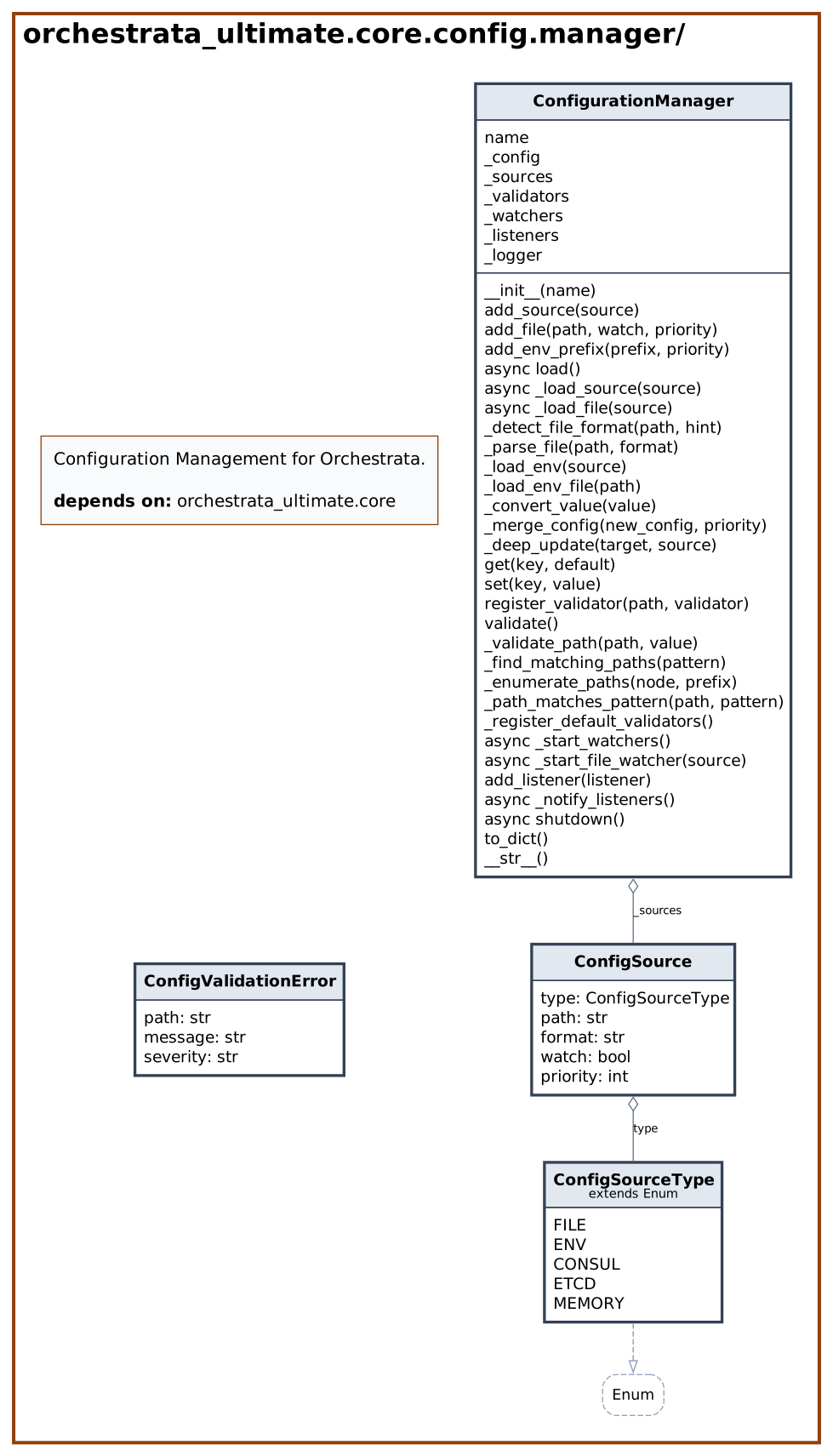
A layered configuration manager. ConfigurationManager collects ConfigSource records (type, path, format, watch flag, priority) and merges them into one nested dictionary. Source types are FILE, ENV, CONSUL, ETCD and MEMORY; the listing shows file and environment loading, and files can be JSON, YAML or .env (detected from the extension or content, _detect_file_format). add_file and add_env_prefix are the convenience entry points. create_configuration(config_files, env_prefix, watch_files) builds a manager with the prefix ORCHESTRATA_ by default.
load is asynchronous. Sources are ordered by priority, and _merge_config deep-merges each into the result so that the first, highest-priority source wins for scalar values while nested dictionaries are merged recursively. Environment variables with the prefix are turned into nested keys: the prefix is removed, the name is lower-cased and a double underscore separates levels; _convert_value converts the string to a number, boolean or string by its content. get and set read and write dotted paths.
Validation uses validators registered for path patterns with register_validator; validate returns a list of ConfigValidationError (path, message, severity). Defaults check that *.port is an integer from 1 to 65535, *.timeout is a non-negative integer and *.host is a non-empty string. Files marked to watch are followed with watchfiles, and listeners added with add_listener are notified when the configuration changes; shutdown stops the watchers. The module carries @traces annotations for SPEC-001 story US-009. See the core narrative.
At a glance
| Source | src/orchestrata_ultimate/core/config/manager.py |
| Lines of code | 817 |
| Classes | 4 |
| Functions | 1 |
| Imports (internal) | orchestrata_ultimate.core.base.traces |
| Imported by | orchestrata_ultimate.core.config |
| Tests that import it | tests/core/test_config_manager.py, tests/core/test_config_manager_extended.py, tests/generated_core/test_config_manager_generated.py |
Class diagram
Dependency diagram

API
Classes
ConfigSourceType (enum)
Bases: Enum · Line 31
Types of configuration sources
| Member | Value |
|---|---|
FILE |
'file' |
ENV |
'environment' |
CONSUL |
'consul' |
ETCD |
'etcd' |
MEMORY |
'memory' |
ConfigSource (dataclass)
Decorators: traces(spec='001', story='US-009', reqs=['REQ-001-US-009-006']), dataclass · Line 43
Configuration source
| Attribute | Type | Default |
|---|---|---|
type |
ConfigSourceType |
|
path |
str |
|
format |
str |
'auto' |
watch |
bool |
False |
priority |
int |
0 |
ConfigValidationError (dataclass)
Decorators: traces(spec='001', story='US-009', reqs=['REQ-001-US-009-004']), dataclass · Line 55
Configuration validation error
| Attribute | Type | Default |
|---|---|---|
path |
str |
|
message |
str |
|
severity |
str |
'error' |
ConfigurationManager
Decorators: traces(spec='001', story='US-009', reqs=['REQ-001-US-009-001', 'REQ-001-US-009-002', 'REQ-001-US-009-004', 'REQ-001-US-… · Line 81
Unified configuration management system.
| Method | Signature | Summary |
|---|---|---|
__init__ |
__init__(name: str = 'default') -> None |
Initialize configuration manager. |
add_source |
add_source(source: ConfigSource) -> None |
Add configuration source. |
add_file |
add_file(path: str, watch: bool = False, priority: int = 0) -> None |
Add configuration file. |
add_env_prefix |
add_env_prefix(prefix: str, priority: int = 10) -> None |
Add environment variables with prefix. |
load |
async load() -> None |
Load configuration from all sources. |
_load_source |
async _load_source(source: ConfigSource) -> dict[str, Any] |
Load configuration from source. |
_load_file |
async _load_file(source: ConfigSource) -> dict[str, Any] |
Load configuration from file. |
_detect_file_format |
_detect_file_format(path: Path, hint: str) -> str |
Determine the config file format from extension or content. |
_parse_file |
_parse_file(path: Path, format: str) -> dict[str, Any] |
Parse a config file according to its format. |
_load_env |
_load_env(source: ConfigSource) -> dict[str, Any] |
Load configuration from environment variables. |
_load_env_file |
_load_env_file(path: Path) -> dict[str, Any] |
Load configuration from .env file. |
_convert_value |
_convert_value(value: str) -> Any |
Convert string value to appropriate type. |
_merge_config |
_merge_config(new_config: dict[str, Any], priority: int) -> None |
Merge configuration with priority. |
_deep_update |
_deep_update(target: dict[str, Any], source: dict[str, Any]) -> None |
Deep update dictionary. |
get |
get(key: str, default: Any = None) -> Any |
Get configuration value. |
set |
set(key: str, value: Any) -> None |
Set configuration value. |
register_validator |
register_validator(path: str, validator: Callable) -> None |
Register configuration validator. |
validate |
validate() -> list[ConfigValidationError] |
Validate entire configuration. |
_validate_path |
_validate_path(path: str, value: Any) -> list[ConfigValidationError] |
Validate specific path. |
_find_matching_paths |
_find_matching_paths(pattern: str) -> list[str] |
Find configuration paths matching pattern. |
_enumerate_paths |
_enumerate_paths(node: dict[str, Any], prefix: str = '') -> list[str] |
Recursively enumerate all dot-separated leaf paths in a config dict. |
_path_matches_pattern |
_path_matches_pattern(path: str, pattern: str) -> bool |
Check if path matches pattern. |
_register_default_validators |
_register_default_validators() -> None |
Register default validators. |
_start_watchers |
async _start_watchers() -> None |
Start file watchers for config sources. |
_start_file_watcher |
async _start_file_watcher(source: ConfigSource) -> None |
Start file watcher for config file. |
add_listener |
add_listener(listener: Callable) -> None |
Add configuration change listener. |
_notify_listeners |
async _notify_listeners() -> None |
Notify all listeners of configuration changes. |
shutdown |
async shutdown() -> None |
Shutdown configuration manager. |
to_dict |
to_dict() -> dict[str, Any] |
Get configuration as dictionary. |
__str__ |
__str__() -> str |
String representation of configuration. |
Functions
| Function | Signature | Summary |
|---|---|---|
create_configuration traces |
create_configuration(config_files: list[str] | None = None, env_prefix: str = 'ORCHESTRATA_', watch_files: bool = False) -> ConfigurationManager |
Create and configure a configuration manager. |
Source
# mypy: ignore-errors
"""
Configuration Management for Orchestrata.
Provides a unified configuration system that supports multiple sources,
validation, and dynamic updates.
"""
import asyncio
import inspect
import json
import logging
import os
import re
from collections.abc import Callable
from dataclasses import dataclass
from enum import Enum
from pathlib import Path
from typing import Any
import yaml
from watchfiles import Change, awatch
from orchestrata_ultimate.core.base.traces import traces
# ============================================================================
# Data Classes
# ============================================================================
class ConfigSourceType(Enum):
"""Types of configuration sources"""
FILE = "file"
ENV = "environment"
CONSUL = "consul"
ETCD = "etcd"
MEMORY = "memory"
@traces(spec="001", story="US-009", reqs=["REQ-001-US-009-006"])
@dataclass
class ConfigSource:
"""Configuration source"""
type: ConfigSourceType
path: str
format: str = "auto" # "json", "yaml", "env", "auto"
watch: bool = False
priority: int = 0 # Higher priority overrides lower
@traces(spec="001", story="US-009", reqs=["REQ-001-US-009-004"])
@dataclass
class ConfigValidationError:
"""Configuration validation error"""
path: str
message: str
severity: str = "error" # "error", "warning", "info"
# ============================================================================
# Configuration Manager
# ============================================================================
@traces(
spec="001",
story="US-009",
reqs=[
"REQ-001-US-009-001", # loads config from YAML files (add_file/_load_file)
"REQ-001-US-009-002", # loads config from env vars (add_env_prefix/_load_env)
"REQ-001-US-009-004", # validates configuration schema (register_validator/validate)
"REQ-001-US-009-006", # priority-based source merging (env > file > defaults)
"REQ-001-US-009-011", # reloads config without restart via file watchers
"REQ-001-US-009-015", # notifies registered listeners of configuration changes
"REQ-001-US-009-021", # exposes the current configuration (get/to_dict)
],
)
class ConfigurationManager:
"""
Unified configuration management system.
Features:
- Multiple configuration sources (files, environment, remote)
- Priority-based merging
- Validation with schemas
- Dynamic updates with watchers
- Type conversion and interpolation
"""
def __init__(self, name: str = "default") -> None:
"""
Initialize configuration manager.
Args:
name: Manager name for logging
"""
self.name = name
self._config: dict[str, Any] = {}
self._sources: list[ConfigSource] = []
self._validators: dict[str, Callable] = {}
self._watchers: dict[str, asyncio.Task] = {}
self._listeners: list[Callable] = []
self._logger = logging.getLogger(f"config.{name}")
# Default validators
self._register_default_validators()
@traces(spec="001", story="US-009", reqs=["REQ-001-US-009-006"])
def add_source(self, source: ConfigSource) -> None:
"""
Add configuration source.
Args:
source: Configuration source
"""
self._sources.append(source)
self._sources.sort(key=lambda s: s.priority, reverse=True)
self._logger.debug(f"Added config source: {source.type.value}://{source.path}")
@traces(spec="001", story="US-009", reqs=["REQ-001-US-009-001"])
def add_file(self, path: str, watch: bool = False, priority: int = 0) -> None:
"""
Add configuration file.
Args:
path: File path
watch: Whether to watch for changes
priority: Source priority
"""
# Determine format from extension
format = "auto"
if path.endswith(".json"):
format = "json"
elif path.endswith(".yaml") or path.endswith(".yml"):
format = "yaml"
elif path.endswith(".env"):
format = "env"
source = ConfigSource(
type=ConfigSourceType.FILE,
path=path,
format=format,
watch=watch,
priority=priority,
)
self.add_source(source)
@traces(spec="001", story="US-009", reqs=["REQ-001-US-009-002"])
def add_env_prefix(self, prefix: str, priority: int = 10) -> None:
"""
Add environment variables with prefix.
Args:
prefix: Environment variable prefix
priority: Source priority
"""
source = ConfigSource(
type=ConfigSourceType.ENV,
path=prefix,
format="env",
watch=False,
priority=priority,
)
self.add_source(source)
@traces(
spec="001", story="US-009", reqs=["REQ-001-US-009-007", "REQ-001-US-009-008"]
)
async def load(self) -> None:
"""
Load configuration from all sources.
"""
self._logger.info("Loading configuration")
# Clear existing config
self._config.clear()
# Load from each source
for source in self._sources:
try:
config = await self._load_source(source)
self._merge_config(config, source.priority)
self._logger.debug(
f"Loaded config from {source.type.value}://{source.path}"
)
except Exception as e:
self._logger.error(
f"Failed to load config from {source.type.value}://{source.path}: {e}"
)
# Validate
errors = self.validate()
if errors:
for error in errors:
if error.severity == "error":
self._logger.error(
f"Config validation error at {error.path}: {error.message}"
)
elif error.severity == "warning":
self._logger.warning(
f"Config validation warning at {error.path}: {error.message}"
)
# Start watchers
await self._start_watchers()
# Notify listeners
await self._notify_listeners()
@traces(
spec="001", story="US-009", reqs=["REQ-001-US-009-001", "REQ-001-US-009-002"]
)
async def _load_source(self, source: ConfigSource) -> dict[str, Any]:
"""
Load configuration from source.
Args:
source: Configuration source
Returns:
Configuration dictionary
"""
if source.type == ConfigSourceType.FILE:
return await self._load_file(source)
elif source.type == ConfigSourceType.ENV:
return self._load_env(source)
elif source.type == ConfigSourceType.MEMORY:
return (
json.loads(source.path) if isinstance(source.path, str) else source.path
)
else:
raise ValueError(f"Unsupported config source type: {source.type}")
@traces(spec="001", story="US-009", reqs=["REQ-001-US-009-001"])
async def _load_file(self, source: ConfigSource) -> dict[str, Any]:
"""
Load configuration from file.
Args:
source: File source
Returns:
Configuration dictionary
"""
path = Path(source.path)
if not path.exists():
self._logger.warning(f"Config file not found: {path}")
return {}
format = self._detect_file_format(path, source.format)
return self._parse_file(path, format)
@traces(spec="001", story="US-009", reqs=["REQ-001-US-009-001"])
def _detect_file_format(self, path: Path, hint: str) -> str:
"""Determine the config file format from extension or content.
Args:
path: File path.
hint: Format hint from the source (may be "auto").
Returns:
Resolved format string.
"""
if hint != "auto":
return hint
if path.suffix in [".json"]:
return "json"
elif path.suffix in [".yaml", ".yml"]:
return "yaml"
elif path.suffix in [".env"]:
return "env"
# Detect from content
content = path.read_text()
return "json" if content.strip().startswith("{") else "yaml"
@traces(spec="001", story="US-009", reqs=["REQ-001-US-009-001"])
def _parse_file(self, path: Path, format: str) -> dict[str, Any]:
"""Parse a config file according to its format.
Args:
path: File path.
format: Format string ("json", "yaml", or "env").
Returns:
Configuration dictionary.
"""
if format == "json":
with open(path) as f:
return json.load(f)
elif format == "yaml":
with open(path) as f:
return yaml.safe_load(f)
elif format == "env":
return self._load_env_file(path)
else:
raise ValueError(f"Unsupported config format: {format}")
@traces(spec="001", story="US-009", reqs=["REQ-001-US-009-002"])
def _load_env(self, source: ConfigSource) -> dict[str, Any]:
"""
Load configuration from environment variables.
Args:
source: Environment source
Returns:
Configuration dictionary
"""
config = {}
prefix = source.path
for key, value in os.environ.items():
if key.startswith(prefix):
# Convert key to nested dict path
config_key = key[len(prefix) :].lstrip("_")
parts = config_key.lower().split("__")
# Build nested structure
current = config
for i, part in enumerate(parts):
if i == len(parts) - 1:
# Convert value based on content
current[part] = self._convert_value(value)
else:
if part not in current:
current[part] = {}
current = current[part]
return config
@traces(spec="001", story="US-009", reqs=["REQ-001-US-009-002"])
def _load_env_file(self, path: Path) -> dict[str, Any]:
"""
Load configuration from .env file.
Args:
path: .env file path
Returns:
Configuration dictionary
"""
config = {}
with open(path) as f:
for line in f:
line = line.strip()
if not line or line.startswith("#"):
continue
if "=" in line:
key, value = line.split("=", 1)
key = key.strip()
value = value.strip().strip('"').strip("'")
# Convert to nested dict
parts = key.lower().split("__")
current = config
for i, part in enumerate(parts):
if i == len(parts) - 1:
current[part] = self._convert_value(value)
else:
if part not in current:
current[part] = {}
current = current[part]
return config
@traces(spec="001", story="US-009", reqs=["REQ-001-US-009-002"])
def _convert_value(self, value: str) -> Any:
"""
Convert string value to appropriate type.
Args:
value: String value
Returns:
Converted value
"""
# Try to convert to bool
if value.lower() in ["true", "yes", "on", "1"]:
return True
elif value.lower() in ["false", "no", "off", "0"]:
return False
# Try to convert to int
try:
return int(value)
except ValueError as exc:
logging.getLogger(__name__).debug("int parse: %s", exc)
# Try to convert to float
try:
return float(value)
except ValueError as exc:
logging.getLogger(__name__).debug("float parse: %s", exc)
# Try to convert to list
if "," in value:
return [self._convert_value(v.strip()) for v in value.split(",")]
# Return as string
return value
@traces(spec="001", story="US-009", reqs=["REQ-001-US-009-006"])
def _merge_config(self, new_config: dict[str, Any], priority: int) -> None:
"""
Merge configuration with priority.
Sources are sorted descending by priority before loading (see add_source),
so each subsequent call to _merge_config applies a lower-priority source.
_deep_update overwrites existing keys, meaning the first (highest-priority)
source wins for scalar values while nested dicts are merged recursively.
This gives correct priority semantics without needing to track priority
per-key at merge time.
Args:
new_config: New configuration to merge
priority: Priority of this config (informational; ordering is enforced
at source-load time by sorting self._sources before iteration)
"""
self._deep_update(self._config, new_config)
@traces(spec="001", story="US-009", reqs=["REQ-001-US-009-006"])
def _deep_update(self, target: dict[str, Any], source: dict[str, Any]) -> None:
"""
Deep update dictionary.
Args:
target: Target dictionary
source: Source dictionary
"""
for key, value in source.items():
if (
key in target
and isinstance(target[key], dict)
and isinstance(value, dict)
):
self._deep_update(target[key], value)
else:
target[key] = value
@traces(spec="001", story="US-009", reqs=["REQ-001-US-009-024"])
def get(self, key: str, default: Any = None) -> Any:
"""
Get configuration value.
Args:
key: Dot-separated key path
default: Default value if key not found
Returns:
Configuration value
"""
parts = key.split(".")
current = self._config
for part in parts:
if isinstance(current, dict) and part in current:
current = current[part]
else:
return default
return current
@traces(
spec="001", story="US-009", reqs=["REQ-001-US-009-012", "REQ-001-US-009-013"]
)
def set(self, key: str, value: Any) -> None:
"""
Set configuration value.
Args:
key: Dot-separated key path
value: Value to set
"""
parts = key.split(".")
current = self._config
# Navigate to parent
for part in parts[:-1]:
if part not in current or not isinstance(current[part], dict):
current[part] = {}
current = current[part]
# Set value
last_part = parts[-1]
current[last_part] = value
# Validate
errors = self._validate_path(key, value)
for error in errors:
self._logger.warning(f"Config validation: {error.message}")
# Notify listeners
try:
loop = asyncio.get_running_loop()
loop.create_task(self._notify_listeners())
except RuntimeError:
pass
@traces(spec="001", story="US-009", reqs=["REQ-001-US-009-004"])
def register_validator(self, path: str, validator: Callable) -> None:
"""
Register configuration validator.
Args:
path: Path pattern to validate (supports * wildcard)
validator: Validator function that takes (path, value) and returns list of errors
"""
self._validators[path] = validator
@traces(spec="001", story="US-009", reqs=["REQ-001-US-009-004"])
def validate(self) -> list[ConfigValidationError]:
"""
Validate entire configuration.
Returns:
List of validation errors
"""
errors = []
for path_pattern, validator in self._validators.items():
# Find matching paths
matching_paths = self._find_matching_paths(path_pattern)
for path in matching_paths:
value = self.get(path)
if value is not None:
validator_errors = validator(path, value)
if validator_errors:
if isinstance(validator_errors, str):
errors.append(
ConfigValidationError(
path=path, message=validator_errors
)
)
else:
for error in validator_errors:
if isinstance(error, str):
errors.append(
ConfigValidationError(path=path, message=error)
)
else:
errors.append(error)
return errors
@traces(spec="001", story="US-009", reqs=["REQ-001-US-009-013"])
def _validate_path(self, path: str, value: Any) -> list[ConfigValidationError]:
"""
Validate specific path.
Args:
path: Configuration path
value: Configuration value
Returns:
List of validation errors
"""
errors = []
for path_pattern, validator in self._validators.items():
if self._path_matches_pattern(path, path_pattern):
validator_errors = validator(path, value)
if validator_errors:
if isinstance(validator_errors, str):
errors.append(
ConfigValidationError(path=path, message=validator_errors)
)
else:
for error in validator_errors:
if isinstance(error, str):
errors.append(
ConfigValidationError(path=path, message=error)
)
else:
errors.append(error)
return errors
@traces(spec="001", story="US-009", reqs=["REQ-001-US-009-004"])
def _find_matching_paths(self, pattern: str) -> list[str]:
"""
Find configuration paths matching pattern.
For exact patterns (no wildcards) the lookup is O(1) via get().
For wildcard patterns, all leaf paths in the config tree are enumerated
and matched against the compiled regex produced by _path_matches_pattern.
Limitation: each * matches exactly one path segment (non-greedy).
A pattern like "*.port" matches "redis.port" but not "a.b.port".
Use "*.*.port" for two-level nesting.
Args:
pattern: Path pattern with * wildcards (each * matches one segment)
Returns:
List of matching dot-separated config paths
"""
if "*" not in pattern:
return [pattern] if self.get(pattern) is not None else []
all_paths = self._enumerate_paths(self._config)
return [p for p in all_paths if self._path_matches_pattern(p, pattern)]
@traces(spec="001", story="US-009", reqs=["REQ-001-US-009-004"])
def _enumerate_paths(self, node: dict[str, Any], prefix: str = "") -> list[str]:
"""Recursively enumerate all dot-separated leaf paths in a config dict.
Args:
node: Current dict node.
prefix: Dot-separated prefix accumulated so far.
Returns:
List of full dot-separated paths to every leaf value.
"""
paths: list[str] = []
for key, value in node.items():
full_key = f"{prefix}.{key}" if prefix else key
if isinstance(value, dict):
paths.extend(self._enumerate_paths(value, full_key))
else:
paths.append(full_key)
return paths
@traces(spec="001", story="US-009", reqs=["REQ-001-US-009-004"])
def _path_matches_pattern(self, path: str, pattern: str) -> bool:
"""
Check if path matches pattern.
Args:
path: Configuration path
pattern: Pattern with * wildcards
Returns:
True if path matches pattern
"""
# Simple wildcard matching
if "*" not in pattern:
return path == pattern
# Convert to regex
regex_pattern = "^" + pattern.replace(".", "\\.").replace("*", "[^.]+") + "$"
return bool(re.match(regex_pattern, path))
@traces(spec="001", story="US-009", reqs=["REQ-001-US-009-004"])
def _register_default_validators(self) -> None:
"""Register default validators."""
@traces(spec="001", story="US-009", reqs=["REQ-001-US-009-004"])
def validate_port(path: str, value: Any) -> str | None:
if not isinstance(value, int):
return f"{path} must be an integer"
if value < 1 or value > 65535:
return f"{path} must be between 1 and 65535"
return None
@traces(spec="001", story="US-009", reqs=["REQ-001-US-009-004"])
def validate_positive_int(path: str, value: Any) -> str | None:
if not isinstance(value, int):
return f"{path} must be an integer"
if value < 0:
return f"{path} must be positive"
return None
@traces(spec="001", story="US-009", reqs=["REQ-001-US-009-004"])
def validate_string(path: str, value: Any) -> str | None:
if not isinstance(value, str):
return f"{path} must be a string"
if not value.strip():
return f"{path} cannot be empty"
return None
self.register_validator("*.port", validate_port)
self.register_validator("*.timeout", validate_positive_int)
self.register_validator("*.host", validate_string)
@traces(spec="001", story="US-009", reqs=["REQ-001-US-009-011"])
async def _start_watchers(self) -> None:
"""Start file watchers for config sources."""
for source in self._sources:
if source.type == ConfigSourceType.FILE and source.watch:
await self._start_file_watcher(source)
@traces(spec="001", story="US-009", reqs=["REQ-001-US-009-011"])
async def _start_file_watcher(self, source: ConfigSource) -> None:
"""
Start file watcher for config file.
Args:
source: File source to watch
"""
path = Path(source.path)
if not path.exists():
return
@traces(spec="001", story="US-009", reqs=["REQ-001-US-009-011"])
async def watch_file() -> None:
async for changes in awatch(
path.parent, watch_filter=lambda _, p: p == str(path)
):
for change_type, _ in changes:
if change_type in [Change.added, Change.modified]:
self._logger.info(f"Config file changed: {path}")
await self.load()
break
task = asyncio.create_task(watch_file())
self._watchers[source.path] = task
@traces(spec="001", story="US-009", reqs=["REQ-001-US-009-015"])
def add_listener(self, listener: Callable) -> None:
"""
Add configuration change listener.
Args:
listener: Callback function that takes (config_manager)
"""
self._listeners.append(listener)
@traces(spec="001", story="US-009", reqs=["REQ-001-US-009-015"])
async def _notify_listeners(self) -> None:
"""Notify all listeners of configuration changes."""
for listener in self._listeners:
try:
if inspect.iscoroutinefunction(listener):
await listener(self)
else:
listener(self)
except Exception as e:
self._logger.error(f"Error in config listener: {e}")
async def shutdown(self) -> None:
"""Shutdown configuration manager."""
# Cancel watchers
for task in self._watchers.values():
task.cancel()
# Wait for tasks to complete
if self._watchers:
await asyncio.gather(*self._watchers.values(), return_exceptions=True)
self._watchers.clear()
self._listeners.clear()
self._logger.info("Configuration manager shutdown")
@traces(spec="001", story="US-009", reqs=["REQ-001-US-009-021"])
def to_dict(self) -> dict[str, Any]:
"""
Get configuration as dictionary.
Returns:
Configuration dictionary
"""
return self._config.copy()
@traces(spec="001", story="US-009", reqs=["REQ-001-US-009-026"])
def __str__(self) -> str:
"""String representation of configuration."""
return json.dumps(self._config, indent=2, default=str)
# ============================================================================
# Configuration Factory
# ============================================================================
@traces(
spec="001",
story="US-009",
reqs=["REQ-001-US-009-001", "REQ-001-US-009-002", "REQ-001-US-009-006"],
)
def create_configuration(
config_files: list[str] | None = None,
env_prefix: str = "ORCHESTRATA_",
watch_files: bool = False,
) -> ConfigurationManager:
"""
Create and configure a configuration manager.
Args:
config_files: List of config file paths
env_prefix: Environment variable prefix
watch_files: Whether to watch config files for changes
Returns:
Configured configuration manager
"""
config = ConfigurationManager()
# Add default config files
default_files = [
"/etc/orchestrata/config.yaml",
"~/.orchestrata/config.yaml",
"./config.yaml",
"./config/config.yaml",
]
files_to_try = (config_files or []) + default_files
for file_path in files_to_try:
expanded_path = os.path.expanduser(file_path)
if os.path.exists(expanded_path):
config.add_file(expanded_path, watch=watch_files, priority=5)
# Add environment variables
config.add_env_prefix(env_prefix, priority=10)
return config