orchestrata_ultimate.core.base.error
Reference › orchestrata_ultimate › core › base › error
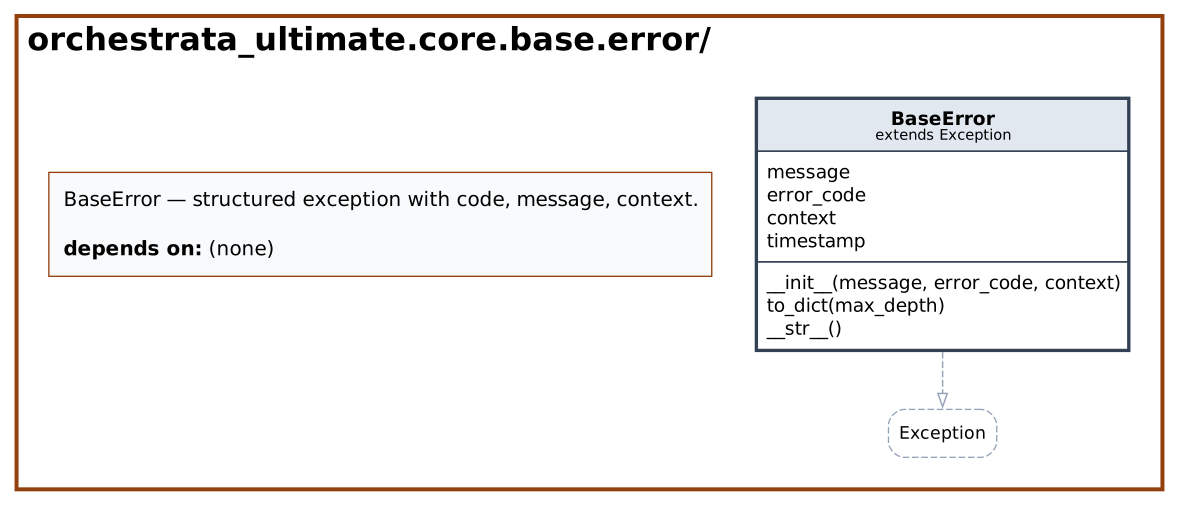
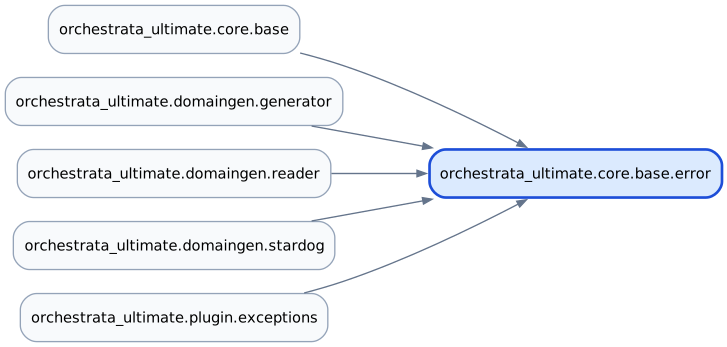
BaseError is the root of the project's custom exceptions, imported by the domaingen generator, reader and Stardog modules and by the plugin exceptions. It extends Exception with structured data: a human-readable message, a machine-readable error_code (for example PKG_CAT_SPECIFIC), a mutable context dictionary and a UTC timestamp. to_dict serialises the error, including the chain of __cause__ exceptions, with a max_depth of 10 so that a cyclic chain terminates.
At a glance
| Source | src/orchestrata_ultimate/core/base/error.py |
| Lines of code | 66 |
| Classes | 1 |
| Functions | 0 |
| Imports (internal) | none |
| Imported by | orchestrata_ultimate.core.base, orchestrata_ultimate.domaingen.generator, orchestrata_ultimate.domaingen.reader, orchestrata_ultimate.domaingen.stardog, orchestrata_ultimate.plugin.exceptions |
| Tests that import it | tests/core/base/test_error.py, tests/core/test_base_error.py, tests/generated_core/test_base_error_generated.py, tests/generated_recovery/test_core_base_error.py |
Class diagram
Dependency diagram
API
Classes
BaseError
Bases: Exception · Line 7
Base class for all custom exceptions.
| Method | Signature | Summary |
|---|---|---|
__init__ |
__init__(message: str = '', error_code: str | None = None, context: dict[str, Any] | None = None) -> None |
Initialize with message, optional code and context. |
to_dict |
to_dict(max_depth: int = 10) -> dict[str, Any] |
Serialize error to dictionary, including cause chain. |
__str__ |
__str__() -> str |
String representation with code prefix if present. |
Source
"""BaseError — structured exception with code, message, context."""

from datetime import UTC, datetime
from typing import Any


class BaseError(Exception):
    """Base class for all custom exceptions.

    Provides structured error information: code, message, context
    dict, timestamp, and exception chain serialization.

    Attributes:
        error_code: Machine-readable code (e.g., "PKG_CAT_SPECIFIC").
        message: Human-readable description.
        context: Mutable dict of additional context.
        timestamp: When the error occurred (UTC).
    """

    def __init__(
        self,
        message: str = "",
        error_code: str | None = None,
        context: dict[str, Any] | None = None,
    ) -> None:
        """Initialize with message, optional code and context.

        Args:
            message: Error description.
            error_code: Machine-readable error code.
            context: Additional context dict.
        """
        super().__init__(message)
        self.message = message
        self.error_code = error_code
        self.context = context or {}
        self.timestamp = datetime.now(UTC)

    def to_dict(self, max_depth: int = 10) -> dict[str, Any]:
        """Serialize error to dictionary, including __cause__ chain.

        Args:
            max_depth: Maximum chain depth to prevent cycles.

        Returns:
            Dict with error_code, message, context, timestamp,
            and optional cause chain.
        """
        result: dict[str, Any] = {
            "error_code": self.error_code,
            "message": self.message,
            "context": self.context,
            "timestamp": self.timestamp.isoformat(),
        }
        if self.__cause__ and max_depth > 0:
            if isinstance(self.__cause__, BaseError):
                result["cause"] = self.__cause__.to_dict(max_depth=max_depth - 1)
            else:
                result["cause"] = str(self.__cause__)
        return result

    def __str__(self) -> str:
        """String representation with code prefix if present."""
        if self.error_code:
            return f"[{self.error_code}] {self.message}"
        return self.message