orchestrata_tools.test_generator.jinja_gen
Reference › orchestrata_tools › test_generator › jinja_gen
JinjaTestGenerator is a template-driven test generator: deterministic and configurable, with the AST used for @traces extraction, branch detection and method introspection and Jinja2 used to render the output. It supports branch-aware generation for full path coverage. It is re-exported by the package, and its tests are tests/test_orchestrata_tools_jinja_gen.py, tests/test_enum_test_gen_value_agnostic.py and tests/test_orchestrata_tools_testgen_param_strategy.py. The non-template equivalent is enhanced_generator.
generate_module takes classes, the source module and the test module and returns a complete module. _build_context assembles the Jinja context from the classes and a traces map; _method_contexts adds per-method branch data. Branches come from _extract_branches, which reads the cached source file (_get_source), finds the method node (_find_method_node) and walks it (_walk_branches), recording BranchInfo entries with a name, condition and branch type; _format_branches converts them for the template. set_template replaces the default template at run time. Parameter values come from the shared strategy in testgen.types, with a table that also maps NoneType to None. JinjaGenConfig holds the settings.
At a glance
| Source | src/orchestrata_tools/test_generator/jinja_gen.py |
| Lines of code | 586 |
| Classes | 3 |
| Functions | 0 |
| Imports (internal) | orchestrata_tools.models.ast_models, orchestrata_tools.test_generator.testgen.types |
| Imported by | orchestrata_tools.test_generator |
| Tests that import it | tests/test_enum_test_gen_value_agnostic.py, tests/test_orchestrata_tools_jinja_gen.py, tests/test_orchestrata_tools_testgen_param_strategy.py |
Class diagram
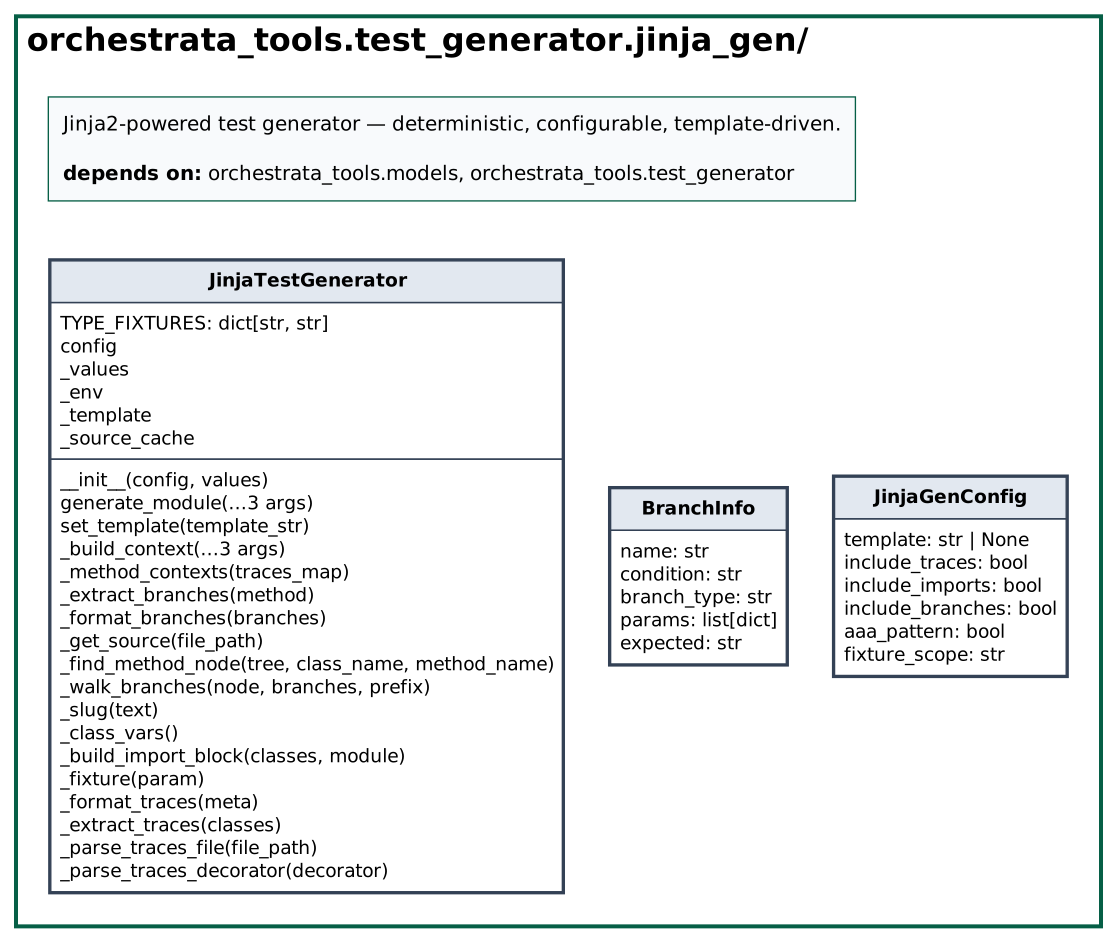
Dependency diagram

API
Classes
BranchInfo (dataclass)
Decorators: dataclass · Line 37
A code branch found in a method body.
| Attribute | Type | Default |
|---|---|---|
name |
str |
|
condition |
str |
|
branch_type |
str |
|
params |
list[dict] |
field(default_factory=list) |
expected |
str |
'' |
JinjaGenConfig (dataclass)
Decorators: dataclass · Line 164
Configuration for Jinja2-based test generation.
| Attribute | Type | Default |
|---|---|---|
template |
str | None |
None |
include_traces |
bool |
True |
include_imports |
bool |
True |
include_branches |
bool |
True |
aaa_pattern |
bool |
True |
fixture_scope |
str |
'function' |
JinjaTestGenerator
Line 178
Generate pytest modules using Jinja2 templates + AST introspection.
| Attribute | Type | Default |
|---|---|---|
TYPE_FIXTURES |
dict[str, str] |
JINJA_LITERAL_FIXTURES |
| Method | Signature | Summary |
|---|---|---|
__init__ |
__init__(config: JinjaGenConfig | None = None, values: ParamValueStrategy | None = None) |
|
generate_module |
generate_module(classes: list[ClassInfo], source_module: str, test_module: str) -> str |
Generate a complete test module with branch coverage. |
set_template |
set_template(template_str: str) -> None |
Override the default template at runtime. |
_build_context |
_build_context(classes: list[ClassInfo], source_module: str, traces_map: dict[str, dict]) -> dict |
Build Jinja2 template context. |
_method_contexts |
_method_contexts(traces_map: dict[str, dict]) -> list[dict] |
Build method contexts including branch information. |
_extract_branches |
_extract_branches(method: MethodInfo) -> list[dict] |
Extract branch points from a method's AST body. |
_format_branches |
_format_branches(branches: list[BranchInfo]) -> list[dict] |
Convert BranchInfo to template-ready dicts. |
_get_source |
_get_source(file_path: str) -> str |
Get cached source for a file. |
_find_method_node |
_find_method_node(tree: py_ast.AST, class_name: str, method_name: str) -> py_ast.AST | None |
Find a method's AST node within its class. |
_walk_branches |
_walk_branches(node: py_ast.AST, branches: list[BranchInfo], prefix: str) -> None |
Walk an AST node and its children to find branch points. |
_slug staticmethod |
_slug(text: str) -> str |
Convert a string to a safe identifier slug. |
_class_vars |
_class_vars() -> list[dict] |
|
_build_import_block |
_build_import_block(classes: list[ClassInfo], module: str) -> str |
|
_fixture |
_fixture(param: ParamInfo) -> str |
|
_format_traces |
_format_traces(meta: dict) -> str | None |
|
_extract_traces |
_extract_traces(classes: list[ClassInfo]) -> dict[str, dict] |
|
_parse_traces_file |
_parse_traces_file(file_path: str) -> dict[str, dict] |
|
_parse_traces_decorator |
_parse_traces_decorator(decorator: py_ast.expr) -> dict | None |
Source
"""Jinja2-powered test generator — deterministic, configurable, template-driven.
Uses AST for @traces extraction, branch detection, and method introspection.
Jinja2 for output rendering. Supports branch-aware test generation for full
path coverage.
Usage:
from orchestrata_tools.test_generator.jinja_gen import JinjaTestGenerator
gen = JinjaTestGenerator()
code = gen.generate_module(classes, "my.module", "test_my_module")
"""
from __future__ import annotations
import ast as py_ast
from dataclasses import dataclass, field
from pathlib import Path
from typing import TYPE_CHECKING
from jinja2 import BaseLoader, Environment
from orchestrata_tools.test_generator.testgen.types import (
JINJA_LITERAL_FIXTURES,
ParamValueStrategy,
default_param_strategy,
fixture_args,
)
if TYPE_CHECKING:
from orchestrata_tools.models.ast_models import ClassInfo, MethodInfo, ParamInfo
# ── Branch info ───────────────────────────────────────────────────────
@dataclass
class BranchInfo:
"""A code branch found in a method body."""
name: str # e.g. "when_path_exists", "when_path_none"
condition: str # The condition expression as text
branch_type: str # "if_true", "if_false", "except", "else", "loop_empty"
params: list[dict] = field(default_factory=list) # Parameter overrides
expected: str = "" # Expected behavior description
# ── Default Jinja2 template ───────────────────────────────────────────
DEFAULT_TEST_TEMPLATE = '''\
"""Tests for {{ source_module }}.
Test Standards (AGENTS.md § Test Standards):
T1-T9 enforced. No mocking, stubs, fakes, skips, monkeypatch.
Function-scope fixtures only. test_id for DB ops. Parallel-safe.
"""
from __future__ import annotations
import pytest
from datetime import UTC, datetime
from pathlib import Path
from uuid import uuid4
{% if import_block %}
{{ import_block }}
{% endif %}
{% if has_traces %}
from orchestrata_ultimate.core.base.traces import traces
{% endif %}
{% for cls in classes %}
{% if cls.traces_deco %}
{{ cls.traces_deco }}
{% endif %}
class Test{{ cls.name }}:
{% if cls.is_enum %}
{% for var in cls.vars %}
def test_{{ var.name }}_is_valid(self) -> None:
"""Test {{ cls.name }}.{{ var.name }} is a valid enum value."""
assert {{ cls.name }}.{{ var.name }} in {{ cls.name }}
assert {{ cls.name }}.{{ var.name }}.name == "{{ var.name }}"
{% endfor %}
{% else %}
@pytest.fixture
def obj(self) -> {{ cls.name }}:
return {{ cls.name }}()
{% for method in cls.methods %}
{# ── base test ── #}
{% if method.traces_deco %}
{{ method.traces_deco }}
{% endif %}
{% if method.is_async %}
@pytest.mark.asyncio
async def test_{{ method.name }}(self, obj: {{ cls.name }}{{ method.fixture_args }}) -> None:
{% else %}
def test_{{ method.name }}(self, obj: {{ cls.name }}{{ method.fixture_args }}) -> None:
{% endif %}
"""Test {{ cls.name }}.{{ method.name }}()."""
# Arrange
{% for p in method.params %}
{{ p.name }} = {{ p.fixture }}
{% endfor %}
# Act
{% if method.has_return %}
result = {% if method.is_async %}await {% endif %}obj.{{ method.name }}({{ method.call_args }})
{% else %}
{% if method.is_async %}await {% endif %}obj.{{ method.name }}({{ method.call_args }})
{% endif %}
# Assert
{% if method.has_return %}
assert result is not None
{% else %}
# Verify side effects or state changes
{% endif %}
{# ── branch tests ── #}
{% for branch in method.branches %}
{% if method.is_async %}
@pytest.mark.asyncio
async def test_{{ method.name }}_{{ branch.name }}(self, obj: {{ cls.name }}{{ method.fixture_args }}) -> None:
{% else %}
def test_{{ method.name }}_{{ branch.name }}(self, obj: {{ cls.name }}{{ method.fixture_args }}) -> None:
{% endif %}
"""Test {{ cls.name }}.{{ method.name }}() — branch: {{ branch.branch_type }} {{ branch.condition }}."""
# Arrange
{% for p in branch.params %}
{{ p.name }} = {{ p.fixture }}
{% endfor %}
{% for p in method.params %}
{% if p.name not in branch.param_names %}
{{ p.name }} = {{ p.fixture }}
{% endif %}
{% endfor %}
# Act
{% if method.has_return %}
result = {% if method.is_async %}await {% endif %}obj.{{ method.name }}({{ method.call_args }})
{% else %}
{% if method.is_async %}await {% endif %}obj.{{ method.name }}({{ method.call_args }})
{% endif %}
# Assert — {{ branch.expected }}
{% if method.has_return %}
assert result is not None
{% else %}
# {{ branch.expected }}
{% endif %}
{% endfor %}
{% endfor %}
{% endif %}
{% endfor %}
'''
# ── Configuration ─────────────────────────────────────────────────────
@dataclass
class JinjaGenConfig:
"""Configuration for Jinja2-based test generation."""
template: str | None = None
include_traces: bool = True
include_imports: bool = True
include_branches: bool = True # Generate branch-specific tests
aaa_pattern: bool = True
fixture_scope: str = "function"
# ── Generator ─────────────────────────────────────────────────────────
class JinjaTestGenerator:
"""Generate pytest modules using Jinja2 templates + AST introspection.
Features:
- @traces decorator extraction and propagation
- Branch detection (if/else, try/except, match/case, loops)
- Async method support
- Enum value testing
- AAA pattern
- Configurable via JinjaGenConfig
"""
#: One source of truth: the literal table lives in ``testgen.types``.
TYPE_FIXTURES: dict[str, str] = JINJA_LITERAL_FIXTURES
def __init__(
self,
config: JinjaGenConfig | None = None,
values: ParamValueStrategy | None = None,
):
self.config = config or JinjaGenConfig()
# WI-TESTGEN (task 575): path-like ``str`` params -> ``tmp_path``.
self._values = values or default_param_strategy(
self.TYPE_FIXTURES, "None # TODO: provide fixture for {name} ({ann})"
)
self._env = Environment(loader=BaseLoader())
self._env.filters["indent"] = lambda s, _n=0: str(s) # No-op indent
self._template = self._env.from_string(
self.config.template or DEFAULT_TEST_TEMPLATE
)
self._source_cache: dict[str, str] = {}
# ── Public API ─────────────────────────────────────────────────
def generate_module(
self, classes: list[ClassInfo], source_module: str, test_module: str
) -> str:
"""Generate a complete test module with branch coverage."""
traces_map = self._extract_traces(classes)
ctx = self._build_context(classes, source_module, traces_map)
return self._template.render(**ctx)
def set_template(self, template_str: str) -> None:
"""Override the default template at runtime."""
self._template = self._env.from_string(template_str)
# ── Context building ──────────────────────────────────────────
def _build_context(
self, classes: list[ClassInfo], source_module: str, traces_map: dict[str, dict]
) -> dict:
"""Build Jinja2 template context."""
has_traces = bool(traces_map)
import_block = self._build_import_block(classes, source_module)
cls_ctx = []
for cls in classes:
if cls.name.startswith("_"):
continue
is_enum = cls.is_enum or (
not cls.methods
and cls.class_vars
and all(
hasattr(v, "name") if hasattr(v, "name") else False
for v in (cls.class_vars or [])
)
)
class_traces = traces_map.get(cls.name, {})
cls_ctx.append(
{
"name": cls.name,
"is_enum": is_enum,
"traces_deco": self._format_traces(class_traces),
"vars": self._class_vars(cls),
"methods": self._method_contexts(cls, traces_map),
}
)
return {
"source_module": source_module,
"has_traces": has_traces,
"import_block": import_block,
"classes": cls_ctx,
}
def _method_contexts(
self, cls: ClassInfo, traces_map: dict[str, dict]
) -> list[dict]:
"""Build method contexts including branch information."""
methods = []
for m in cls.methods:
if m.name.startswith("_") and m.name != "__init__":
continue
params = [p for p in m.parameters if p.name not in ("self", "cls")]
method_traces = traces_map.get(m.name, {})
method_params = [
{"name": p.name, "fixture": self._fixture(p)} for p in params[:5]
]
call_args = ", ".join(f"{p.name}={p.name}" for p in params)
# Extract branches if enabled
branches: list[dict] = []
if self.config.include_branches:
branches = self._extract_branches(cls, m)
methods.append(
{
"name": m.name,
"is_async": m.is_async,
"has_return": bool(m.return_type and m.return_type != "None"),
"traces_deco": self._format_traces(method_traces),
"params": method_params,
"fixture_args": "".join(
f", {name}"
for name in fixture_args(p["fixture"] for p in method_params)
),
"call_args": call_args,
"branches": branches,
}
)
return methods
# ── Branch extraction ─────────────────────────────────────────
def _extract_branches(self, cls: ClassInfo, method: MethodInfo) -> list[dict]:
"""Extract branch points from a method's AST body.
Walks the method's AST looking for if/else, try/except, match/case,
and for/while structures. For each branch, generates parameter
overrides that would exercise that path.
"""
source = self._get_source(
getattr(cls, "file_path", "") if hasattr(cls, "file_path") else ""
)
if not source:
return []
try:
tree = py_ast.parse(source)
except Exception:
return []
# Find the method node
method_node = self._find_method_node(tree, cls.name, method.name)
if not method_node:
return []
branches: list[BranchInfo] = []
self._walk_branches(method_node, branches, prefix=method.name)
return self._format_branches(branches)
def _format_branches(self, branches: list[BranchInfo]) -> list[dict]:
"""Convert BranchInfo to template-ready dicts."""
return [
{
"name": b.name,
"condition": b.condition[:60],
"branch_type": b.branch_type,
"expected": b.expected or "Verify branch behavior",
"params": b.params,
"param_names": {p["name"] for p in b.params} if b.params else set(),
}
for b in branches
]
def _get_source(self, file_path: str) -> str:
"""Get cached source for a file."""
if file_path not in self._source_cache:
try:
self._source_cache[file_path] = Path(file_path).read_text()
except Exception:
return ""
return self._source_cache[file_path]
def _find_method_node(
self, tree: py_ast.AST, class_name: str, method_name: str
) -> py_ast.AST | None:
"""Find a method's AST node within its class."""
for node in py_ast.walk(tree):
if isinstance(node, py_ast.ClassDef) and node.name == class_name:
for item in node.body:
if isinstance(item, (py_ast.FunctionDef, py_ast.AsyncFunctionDef)):
if item.name == method_name:
return item
return None
def _walk_branches(
self, node: py_ast.AST, branches: list[BranchInfo], prefix: str
) -> None:
"""Walk an AST node and its children to find branch points."""
# If statement
if isinstance(node, py_ast.If):
cond_text = (
py_ast.unparse(node.test) if hasattr(node, "test") else "condition"
)
# True branch
branches.append(
BranchInfo(
name=f"{prefix}_when_{self._slug(cond_text)}_true",
condition=cond_text,
branch_type="if_true",
expected=f"Condition '{cond_text}' is truthy",
)
)
# False branch (elif or else)
if node.orelse:
branches.append(
BranchInfo(
name=f"{prefix}_when_{self._slug(cond_text)}_false",
condition=f"not ({cond_text})",
branch_type="if_false",
expected=f"Condition '{cond_text}' is falsy",
)
)
# Walk children (declared as AST so the `child` name can be
# reused below for py_ast.walk()/iter_child_nodes(), which
# yield the broader AST type rather than the stmt subtype).
child: py_ast.AST
for child in [*node.body, *node.orelse]:
self._walk_branches(child, branches, prefix)
# Try/except
elif isinstance(node, py_ast.Try):
branches.append(
BranchInfo(
name=f"{prefix}_try_succeeds",
condition="no exception",
branch_type="try",
expected="No exception is raised",
)
)
for handler in node.handlers:
exc_name = py_ast.unparse(handler.type) if handler.type else "Exception"
branches.append(
BranchInfo(
name=f"{prefix}_raises_{self._slug(exc_name)}",
condition=exc_name,
branch_type="except",
params=[
{"name": "self", "fixture": "self"},
{"name": "obj", "fixture": "obj"},
],
expected=f"Raises {exc_name}",
)
)
for child in py_ast.walk(node):
if child is not node:
self._walk_branches(child, branches, prefix)
# For / While loops
elif isinstance(node, (py_ast.For, py_ast.While)):
branches.append(
BranchInfo(
name=f"{prefix}_iterates",
condition=(
"has items"
if isinstance(node, py_ast.For)
else "condition true"
),
branch_type="loop_body",
expected="Loop body executes",
)
)
branches.append(
BranchInfo(
name=f"{prefix}_empty",
condition=(
"no items"
if isinstance(node, py_ast.For)
else "condition false"
),
branch_type="loop_empty",
expected="Loop body does not execute",
)
)
# Match/case (Python 3.10+)
elif isinstance(node, py_ast.Match):
for i, case in enumerate(node.cases):
pat = (
py_ast.unparse(case.pattern)
if hasattr(case, "pattern")
else f"case_{i}"
)
branches.append(
BranchInfo(
name=f"{prefix}_matches_{self._slug(pat)}",
condition=f"match {pat}",
branch_type="match_case",
expected=f"Matches pattern: {pat}",
)
)
# Walk children for nested branches
for child in py_ast.iter_child_nodes(node):
self._walk_branches(child, branches, prefix)
@staticmethod
def _slug(text: str) -> str:
"""Convert a string to a safe identifier slug."""
import re
text = re.sub(r"[^a-zA-Z0-9_\s]", "", text[:40])
text = re.sub(r"\s+", "_", text.strip())
return text[:30].lower() or "condition"
# ── Enum + class var helpers ─────────────────────────────────
def _class_vars(self, cls: ClassInfo) -> list[dict]:
vars_list = []
for v in cls.class_vars or []:
name = getattr(v, "name", "") if hasattr(v, "name") else str(v)
if name and not name.startswith("_"):
vars_list.append({"name": name})
return vars_list
# ── Import block ──────────────────────────────────────────────
def _build_import_block(self, classes: list[ClassInfo], module: str) -> str:
names = [c.name for c in classes if not c.name.startswith("_")]
if not names:
return ""
if len(names) == 1:
return f"from orchestrata_ultimate.{module} import {names[0]}"
lines = [f"from orchestrata_ultimate.{module} import ("]
for name in names:
lines.append(f" {name},")
lines.append(")")
return "\n".join(lines)
# ── Fixtures ──────────────────────────────────────────────────
def _fixture(self, param: ParamInfo) -> str:
default = getattr(param, "default", None)
if default is not None:
return str(default)
return self._values.value_for(param)
# ── @traces formatting ────────────────────────────────────────
def _format_traces(self, meta: dict) -> str | None:
if not meta or not self.config.include_traces:
return None
return (
f'@traces(spec="{meta.get("spec", "???")}", '
f'story="{meta.get("story", "???")}", '
f'reqs=["{meta.get("reqs", "REQ-???-???")}"])'
)
# ── AST @traces extraction ────────────────────────────────────
def _extract_traces(self, classes: list[ClassInfo]) -> dict[str, dict]:
result: dict[str, dict] = {}
seen: set[str] = set()
for cls in classes:
fp = getattr(cls, "file_path", "") if hasattr(cls, "file_path") else ""
if not fp or fp in seen:
continue
seen.add(fp)
try:
result.update(self._parse_traces_file(fp))
except Exception:
pass
return result
def _parse_traces_file(self, file_path: str) -> dict[str, dict]:
result: dict[str, dict] = {}
try:
with open(file_path) as f:
tree = py_ast.parse(f.read())
except Exception:
return result
for node in py_ast.walk(tree):
if not isinstance(
node,
(
py_ast.ClassDef,
py_ast.FunctionDef,
py_ast.AsyncFunctionDef,
),
):
continue
for dec in node.decorator_list:
meta = self._parse_traces_decorator(dec)
if meta:
result[node.name] = meta
return result
def _parse_traces_decorator(self, decorator: py_ast.expr) -> dict | None:
if (
not isinstance(decorator, py_ast.Call)
or not isinstance(decorator.func, py_ast.Name)
or decorator.func.id != "traces"
):
return None
meta: dict[str, str] = {}
for kw in decorator.keywords:
if kw.arg == "spec" and isinstance(kw.value, py_ast.Constant):
meta["spec"] = str(kw.value.value)
elif kw.arg == "story" and isinstance(kw.value, py_ast.Constant):
meta["story"] = str(kw.value.value)
elif kw.arg == "reqs" and isinstance(kw.value, py_ast.List):
reqs = [
str(e.value)
for e in kw.value.elts
if isinstance(e, py_ast.Constant)
]
meta["reqs"] = ", ".join(reqs[:3])
return meta if meta else None