orchestrata_tools.diagram.diagram_to_code
Reference › orchestrata_tools › diagram › diagram_to_code
This module is the reverse direction of the diagram pipeline: it reads a Mermaid classDiagram and generates Python code skeletons from it. It is a port of DiagramToCode from the old diagram_generator.py script and is used by the round-trip verifier and the spec compliance audit. It is imported by the package __init__ and diagram; tests/test_diagram_to_code_roundtrip.py and tests/test_orchestrata_tools_diagram_to_code.py cover it. The forward direction is class_diagram.
ParsedClass describes one class read from a diagram: its name, stereotypes, decorators, variables (as ClassVarInfo), methods (as FunctionInfo), bases, implemented interfaces, and relationship lists for compositions, aggregations, dependencies and associations. It reuses the models in ast_models.
DiagramToCode has three methods. parse turns diagram text into a list of ParsedClass. generate_code renders the classes as Python source, either as one module named by module_name or, with per_module=True, as a dictionary of module name to source; imports can be omitted. write_modules writes per-module files into an output directory and returns the file contents keyed by path.
At a glance
| Source | src/orchestrata_tools/diagram/diagram_to_code.py |
| Lines of code | 735 |
| Classes | 2 |
| Functions | 0 |
| Imports (internal) | orchestrata_tools.models.ast_models |
| Imported by | orchestrata_tools, orchestrata_tools.diagram |
| Tests that import it | tests/test_diagram_to_code_roundtrip.py, tests/test_orchestrata_tools_diagram_to_code.py |
Class diagram
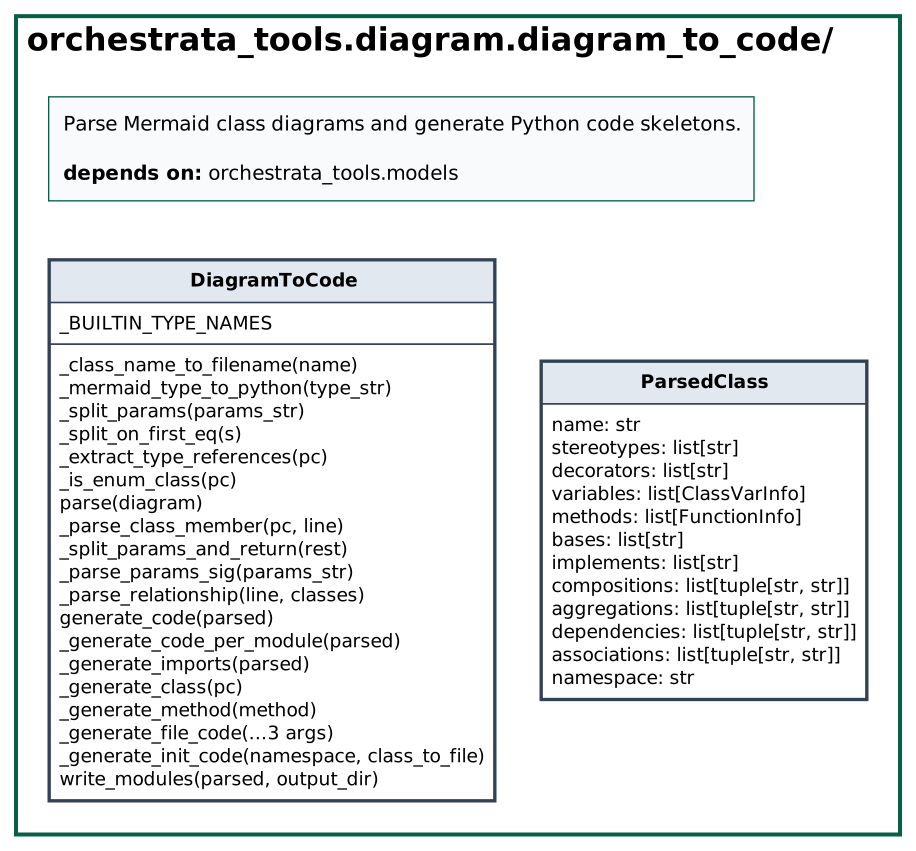
Dependency diagram

API
Classes
ParsedClass (dataclass)
Decorators: dataclass · Line 29
A class parsed from a Mermaid classDiagram.
| Attribute | Type | Default |
|---|---|---|
name |
str |
|
stereotypes |
list[str] |
field(default_factory=list) |
decorators |
list[str] |
field(default_factory=list) |
variables |
list[ClassVarInfo] |
field(default_factory=list) |
methods |
list[FunctionInfo] |
field(default_factory=list) |
bases |
list[str] |
field(default_factory=list) |
implements |
list[str] |
field(default_factory=list) |
compositions |
list[tuple[str, str]] |
field(default_factory=list) |
aggregations |
list[tuple[str, str]] |
field(default_factory=list) |
dependencies |
list[tuple[str, str]] |
field(default_factory=list) |
associations |
list[tuple[str, str]] |
field(default_factory=list) |
namespace |
str |
'' |
DiagramToCode
Line 49
Parse Mermaid class diagrams and generate Python code skeletons.
| Method | Signature | Summary |
|---|---|---|
_class_name_to_filename staticmethod |
_class_name_to_filename(name: str) -> str |
|
_mermaid_type_to_python staticmethod |
_mermaid_type_to_python(type_str: str) -> str |
|
_split_params staticmethod |
_split_params(params_str: str) -> list[str] |
|
_split_on_first_eq staticmethod |
_split_on_first_eq(s: str) -> list[str] |
|
_extract_type_references |
_extract_type_references(pc: ParsedClass) -> set[str] |
|
_is_enum_class |
_is_enum_class(pc: ParsedClass) -> bool |
|
parse |
parse(diagram: str) -> list[ParsedClass] |
|
_parse_class_member |
_parse_class_member(pc: ParsedClass, line: str) -> None |
|
_split_params_and_return |
_split_params_and_return(rest: str) -> tuple[str, str | None] |
|
_parse_params_sig |
_parse_params_sig(params_str: str) -> list[ParamInfo] |
|
_parse_relationship |
_parse_relationship(line: str, classes: dict[str, ParsedClass]) -> None |
|
generate_code |
generate_code(parsed: list[ParsedClass], *, module_name: str = 'scaffold', include_imports: bool = True, per_module: bool = False) -> str | dict[str, str] |
|
_generate_code_per_module |
_generate_code_per_module(parsed: list[ParsedClass], *, include_imports: bool = True) -> dict[str, str] |
|
_generate_imports |
_generate_imports(parsed: list[ParsedClass]) -> list[str] |
|
_generate_class |
_generate_class(pc: ParsedClass) -> list[str] |
|
_generate_method |
_generate_method(method: FunctionInfo) -> list[str] |
|
_generate_file_code |
_generate_file_code(classes: list[ParsedClass], namespace: str, class_to_file: dict[str, str]) -> str |
|
_generate_init_code |
_generate_init_code(namespace: str, class_to_file: dict[str, str]) -> str |
|
write_modules |
write_modules(parsed: list[ParsedClass], output_dir: str) -> dict[str, str] |
Source
"""Parse Mermaid class diagrams and generate Python code skeletons.
Reverse direction of the diagram pipeline: turns ``classDiagram`` blocks
into structured ``ParsedClass`` objects, then generates Python modules from them.
Used by the round-trip verifier and spec compliance auditor
(``generate_comprehensive_audit.py``).
Port of ``DiagramToCode`` from ``scripts/diagram_generator.py``.
"""
from __future__ import annotations
import os
import re
from collections import OrderedDict
from dataclasses import dataclass, field
from orchestrata_tools.models.ast_models import (
ClassVarInfo,
FunctionInfo,
ParamInfo,
)
# ── ParsedClass ───────────────────────────────────────────────────────
@dataclass
class ParsedClass:
"""A class parsed from a Mermaid classDiagram."""
name: str
stereotypes: list[str] = field(default_factory=list)
decorators: list[str] = field(default_factory=list)
variables: list[ClassVarInfo] = field(default_factory=list)
methods: list[FunctionInfo] = field(default_factory=list)
bases: list[str] = field(default_factory=list)
implements: list[str] = field(default_factory=list)
compositions: list[tuple[str, str]] = field(default_factory=list)
aggregations: list[tuple[str, str]] = field(default_factory=list)
dependencies: list[tuple[str, str]] = field(default_factory=list)
associations: list[tuple[str, str]] = field(default_factory=list)
namespace: str = ""
# ── DiagramToCode ─────────────────────────────────────────────────────
class DiagramToCode:
"""Parse Mermaid class diagrams and generate Python code skeletons."""
_BUILTIN_TYPE_NAMES = frozenset(
{
"str",
"int",
"float",
"bool",
"bytes",
"None",
"Any",
"Callable",
"Type",
"ClassVar",
"Optional",
"List",
"Dict",
"Set",
"Tuple",
"list",
"dict",
"set",
"tuple",
"frozenset",
"datetime",
"Path",
"UUID",
"uuid4",
"timedelta",
"object",
"type",
"Exception",
}
)
# ── helpers ────────────────────────────────────────────────────
@staticmethod
def _class_name_to_filename(name: str) -> str:
s = re.sub(r"([A-Z]+)([A-Z][a-z])", r"\1_\2", name)
s = re.sub(r"([a-z\d])([A-Z])", r"\1_\2", s)
return s.lower()
@staticmethod
def _mermaid_type_to_python(type_str: str) -> str:
if not type_str:
return type_str
result = []
tilde_count = 0
for char in type_str:
if char == "~":
if tilde_count % 2 == 0:
result.append("[")
else:
result.append("]")
tilde_count += 1
else:
result.append(char)
return "".join(result)
@staticmethod
def _split_params(params_str: str) -> list[str]:
parts = []
depth = 0
current = []
for ch in params_str:
if ch in ("(", "[", "{"):
depth += 1
current.append(ch)
elif ch in (")", "]", "}"):
depth -= 1
current.append(ch)
elif ch == "," and depth == 0:
parts.append("".join(current))
current = []
else:
current.append(ch)
if current:
parts.append("".join(current))
return parts
@staticmethod
def _split_on_first_eq(s: str) -> list[str]:
depth = 0
for i, ch in enumerate(s):
if ch in ("(", "[", "{"):
depth += 1
elif ch in (")", "]", "}"):
depth -= 1
elif ch == "=" and depth == 0:
return [s[:i], s[i + 1 :]]
return [s]
def _extract_type_references(self, pc: ParsedClass) -> set[str]:
raw: list[str] = []
for var in pc.variables:
if var.type_annotation:
raw.append(var.type_annotation)
for method in pc.methods:
for p in method.parameters:
if p.type_annotation:
raw.append(p.type_annotation)
if method.return_type:
raw.append(method.return_type)
refs: set[str] = set()
for ann in raw:
for token in re.findall(r"\b([A-Z][A-Za-z0-9_]*)\b", ann):
if token not in self._BUILTIN_TYPE_NAMES:
refs.add(token)
refs.discard(pc.name)
return refs
def _is_enum_class(self, pc: ParsedClass) -> bool:
return any("enum" in s.lower() for s in pc.stereotypes + pc.decorators)
# ── parsing ────────────────────────────────────────────────────
def parse(self, diagram: str) -> list[ParsedClass]:
lines = diagram.splitlines()
classes: dict[str, ParsedClass] = {}
class_order: list[str] = []
current_class: str | None = None
in_class_body = False
current_namespace: str | None = None
for line in lines:
stripped = line.strip()
if stripped.startswith("classDiagram") or stripped.startswith(
"classDiagram-direction"
):
continue
ns_match = re.match(r"namespace\s+([\w.]+)\s*\{", stripped)
if ns_match:
current_namespace = ns_match.group(1)
continue
class_match = re.match(r"class\s+(\w+)(?:\s*<<(.+?)>>)?\s*\{", stripped)
if class_match:
cname = class_match.group(1)
stereo = class_match.group(2)
pc = ParsedClass(name=cname, namespace=current_namespace or "")
if stereo:
pc.stereotypes = [s.strip() for s in stereo.split(",")]
current_class = cname
in_class_body = True
classes[cname] = pc
class_order.append(cname)
continue
if stripped == "}" and in_class_body:
in_class_body = False
current_class = None
continue
if stripped == "}" and current_namespace and not in_class_body:
current_namespace = None
continue
if in_class_body and current_class:
self._parse_class_member(classes[current_class], stripped)
continue
if not in_class_body:
self._parse_relationship(stripped, classes)
return [classes[n] for n in class_order if n in classes]
def _parse_class_member(self, pc: ParsedClass, line: str) -> None:
if line == "---":
return
decorator_match = re.match(r"<<(.+?)>>", line)
if decorator_match:
pc.decorators.append(decorator_match.group(1))
return
method_match = re.match(
r"(?:\{(.+?)\}\s*)?([+#-]?\s*)(async\s+)?(\w+)\(",
line,
)
if method_match:
decos_str = method_match.group(1) or ""
is_async = bool(method_match.group(3))
name = method_match.group(4)
rest = line[method_match.end() :]
params_str, return_type = self._split_params_and_return(rest)
if return_type:
return_type = self._mermaid_type_to_python(return_type)
# Strip leading "->" if the parser already captured it
return_type = re.sub(r"^\s*->\s*", "", return_type)
decorators = (
[d.strip().lstrip("@") for d in decos_str.split() if d.strip()]
if decos_str
else []
)
parameters = self._parse_params_sig(params_str)
is_classmethod = "classmethod" in decorators
is_staticmethod = "staticmethod" in decorators
is_property = "property" in decorators
is_abstract = "abstractmethod" in decorators
fi = FunctionInfo(
name=name,
qualified_name=f"{pc.name}.{name}",
module_path="",
file_path="",
line=0,
is_async=is_async,
decorators=decorators,
parameters=parameters,
return_type=return_type,
)
# Attach extra metadata via a private dict for code generation
fi._extra = { # type: ignore[attr-defined]
"is_method": not is_staticmethod,
"is_classmethod": is_classmethod,
"is_staticmethod": is_staticmethod,
"is_property": is_property,
"is_abstract": is_abstract,
"class_name": pc.name,
}
pc.methods.append(fi)
return
var_match = re.match(
r"([#$+-]?\s*)(\w+)(?::\s*(.+?))?(?:\s*=\s*(.+))?$",
line,
)
if var_match:
vname = var_match.group(2)
annotation = var_match.group(3)
if annotation:
annotation = self._mermaid_type_to_python(annotation)
default = var_match.group(4)
cvi = ClassVarInfo(
name=vname,
type_annotation=annotation,
default=default,
)
pc.variables.append(cvi)
def _split_params_and_return(self, rest: str) -> tuple[str, str | None]:
depth = 0
close_idx = -1
for i, ch in enumerate(rest):
if ch == "(":
depth += 1
elif ch == ")":
if depth == 0:
close_idx = i
break
depth -= 1
if close_idx == -1:
return rest, None
params_str = rest[:close_idx]
after = rest[close_idx + 1 :].strip()
return_type = None
if after.startswith(":"):
return_type = after[1:].strip() or None
elif after:
return_type = after.strip() or None
return params_str, return_type
def _parse_params_sig(self, params_str: str) -> list[ParamInfo]:
if not params_str.strip():
return []
params = []
for p in self._split_params(params_str):
p = p.strip()
if not p:
continue
kind = "positional"
default = None
if "=" in p:
parts = self._split_on_first_eq(p)
p = parts[0].strip()
default = parts[1].strip()
if ":" in p:
parts = p.split(":", 1)
name = parts[0].strip()
type_ann = self._mermaid_type_to_python(parts[1].strip())
else:
name = p
type_ann = None
if name.startswith("*"):
if name.startswith("**"):
name = name[2:]
kind = "kwargs"
else:
name = name[1:]
kind = "varargs"
params.append(
ParamInfo(
name=name,
type_annotation=type_ann,
default=default,
kind=kind,
)
)
return params
def _parse_relationship(self, line: str, classes: dict[str, ParsedClass]) -> None:
rel_patterns = [
(r'(\w+)\s+<\|--\s+(\w+)(?:\s+"(.+?)")?', "inheritance"),
(r'(\w+)\s+\.\.\|>\s+(\w+)(?:\s+"(.+?)")?', "implementation"),
(r'(\w+)\s+\*--\s+(\w+)(?:\s+"(.+?)")?', "composition"),
(r'(\w+)\s+o--\s+(\w+)(?:\s+"(.+?)")?', "aggregation"),
(r'(\w+)\s+\.\.>\s+(\w+)(?:\s+"(.+?)")?', "dependency"),
(r'(\w+)\s+-->\s+(\w+)(?:\s+"(.+?)")?', "association"),
(r'(\w+)\s+--\s+(\w+)(?:\s+"(.+?)")?', "dir_association"),
]
for pattern, rel_type in rel_patterns:
match = re.match(pattern, line)
if match:
from_class = match.group(1)
to_class = match.group(2)
label = match.group(3) or ""
if from_class not in classes:
classes[from_class] = ParsedClass(name=from_class)
if to_class not in classes:
classes[to_class] = ParsedClass(name=to_class)
if rel_type == "inheritance":
classes[to_class].bases.append(from_class)
elif rel_type == "implementation":
classes[to_class].implements.append(from_class)
elif rel_type == "composition":
classes[from_class].compositions.append((to_class, label))
elif rel_type == "aggregation":
classes[from_class].aggregations.append((to_class, label))
elif rel_type == "dependency":
classes[from_class].dependencies.append((to_class, label))
elif rel_type == "association":
classes[from_class].associations.append((to_class, label))
break
# ── code generation ────────────────────────────────────────────
def generate_code(
self,
parsed: list[ParsedClass],
*,
module_name: str = "scaffold",
include_imports: bool = True,
per_module: bool = False,
) -> str | dict[str, str]:
if per_module:
return self._generate_code_per_module(
parsed, include_imports=include_imports
)
lines = [
f'"""Generated from Mermaid diagram — {module_name} module."""',
"",
]
if include_imports:
import_lines = self._generate_imports(parsed)
if import_lines:
lines.extend(import_lines)
lines.append("")
for pc in parsed:
lines.extend(self._generate_class(pc))
lines.append("")
return "\n".join(lines)
def _generate_code_per_module(
self, parsed: list[ParsedClass], *, include_imports: bool = True
) -> dict[str, str]:
groups: OrderedDict[str, list[ParsedClass]] = OrderedDict()
for pc in parsed:
ns = pc.namespace or ""
groups.setdefault(ns, []).append(pc)
result: dict[str, str] = {}
for ns, group in groups.items():
module_path = ns.replace(".", "/") if ns else "scaffold"
lines = [
f'"""Generated from Mermaid diagram — {ns or "scaffold"} module."""',
"",
]
if include_imports:
il = self._generate_imports(group)
if il:
lines.extend(il)
lines.append("")
for pc in group:
lines.extend(self._generate_class(pc))
lines.append("")
result[module_path] = "\n".join(lines)
return result
def _generate_imports(self, parsed: list[ParsedClass]) -> list[str]:
imports = set()
for pc in parsed:
if any("enum" in s.lower() for s in pc.stereotypes + pc.decorators):
imports.add("from enum import Enum")
if any("dataclass" in s for s in pc.stereotypes + pc.decorators):
imports.add("from dataclasses import dataclass, field")
if any("pydantic" in s for s in pc.stereotypes + pc.decorators):
imports.add("from pydantic import BaseModel")
if any("abstract" in s.lower() for s in pc.stereotypes + pc.decorators):
imports.add("from abc import ABC, abstractmethod")
if pc.implements:
imports.add("from typing import Protocol")
for method in pc.methods:
if method.is_async:
imports.add("import asyncio")
for p in method.parameters:
if p.type_annotation:
for t in (
"Optional",
"List",
"Dict",
"Set",
"Tuple",
"Callable",
"Any",
):
if t in (p.type_annotation or ""):
imports.add(f"from typing import {t}")
if method.return_type:
for t in (
"Optional",
"List",
"Dict",
"Set",
"Tuple",
"Callable",
"Any",
):
if t in (method.return_type or ""):
imports.add(f"from typing import {t}")
for var in pc.variables:
if var.type_annotation and "ClassVar" in var.type_annotation:
imports.add("from typing import ClassVar")
stdlib_type_imports = {
"datetime": "from datetime import datetime",
"Path": "from pathlib import Path",
"UUID": "from uuid import UUID",
"uuid4": "from uuid import uuid4",
"timedelta": "from datetime import timedelta",
}
all_annotations: list[str] = []
for pc in parsed:
for var in pc.variables:
if var.type_annotation:
all_annotations.append(var.type_annotation)
for method in pc.methods:
for p in method.parameters:
if p.type_annotation:
all_annotations.append(p.type_annotation)
if method.return_type:
all_annotations.append(method.return_type)
combined = " ".join(all_annotations)
for type_name, import_line in stdlib_type_imports.items():
if type_name in combined:
imports.add(import_line)
return sorted(imports)
def _generate_class(self, pc: ParsedClass) -> list[str]:
lines = []
is_enum = self._is_enum_class(pc)
base_class_stereotypes = {"enum", "pydantic", "abstract"}
for dec in pc.decorators:
if dec.lower() in base_class_stereotypes:
continue
lines.append(f"@{dec}")
bases = list(pc.bases)
if pc.implements:
bases.extend(pc.implements)
if is_enum and "Enum" not in bases:
bases.append("Enum")
if (
any("pydantic" in s.lower() for s in pc.stereotypes + pc.decorators)
and "BaseModel" not in bases
):
bases.append("BaseModel")
if (
any("abstract" in s.lower() for s in pc.stereotypes + pc.decorators)
and "ABC" not in bases
):
bases.append("ABC")
bases_str = f"({', '.join(bases)})" if bases else ""
lines.append(f"class {pc.name}{bases_str}:")
has_body = False
display_stereotypes = [s for s in pc.stereotypes if s.lower() != "enum"]
doc_parts = []
if display_stereotypes:
doc_parts.append(f"Stereotypes: {', '.join(display_stereotypes)}")
if pc.compositions:
doc_parts.append(f"Composes: {', '.join(t for t, _ in pc.compositions)}")
if pc.aggregations:
doc_parts.append(f"Aggregates: {', '.join(t for t, _ in pc.aggregations)}")
if pc.dependencies:
doc_parts.append(f"Depends on: {', '.join(t for t, _ in pc.dependencies)}")
if doc_parts:
lines.append(f' """{"; ".join(doc_parts)}"""')
has_body = True
if is_enum:
for var in pc.variables:
lines.append(f' {var.name} = "{var.name}"')
has_body = True
else:
for var in pc.variables:
ann = f": {var.type_annotation}" if var.type_annotation else ""
default = f" = {var.default}" if var.default else ""
lines.append(f" {var.name}{ann}{default}")
has_body = True
for method in pc.methods:
lines.extend(self._generate_method(method))
has_body = True
if not has_body:
lines.append(" pass")
return lines
def _generate_method(self, method: FunctionInfo) -> list[str]:
extra = getattr(method, "_extra", {})
lines = [f" @{dec}" for dec in method.decorators]
async_kw = "async " if method.is_async else ""
params = []
is_method = extra.get("is_method", False)
is_classmethod = extra.get("is_classmethod", False)
is_staticmethod = extra.get("is_staticmethod", False)
if is_classmethod:
params.append("cls")
elif is_method and not is_staticmethod:
params.append("self")
for p in method.parameters:
p_str = p.name
if p.type_annotation:
p_str += f": {p.type_annotation}"
if p.default:
p_str += f" = {p.default}"
params.append(p_str)
params_str = ", ".join(params)
returns = f" -> {method.return_type}" if method.return_type else ""
lines.append(f" {async_kw}def {method.name}({params_str}){returns}:")
lines.append(" ...")
return lines
def _generate_file_code(
self,
classes: list[ParsedClass],
namespace: str,
class_to_file: dict[str, str],
) -> str:
lines: list[str] = ["from __future__ import annotations", ""]
import_lines = self._generate_imports(classes)
if import_lines:
lines.extend(import_lines)
lines.append("")
local_class_names = {pc.name for pc in classes}
needed_imports: dict[str, set[str]] = {}
for pc in classes:
refs = self._extract_type_references(pc)
for ref_name in refs:
if ref_name in class_to_file and ref_name not in local_class_names:
needed_imports.setdefault(class_to_file[ref_name], set()).add(
ref_name
)
for target_file in sorted(needed_imports):
names = ", ".join(sorted(needed_imports[target_file]))
lines.append(f"from {namespace}.{target_file} import {names}")
if needed_imports:
lines.append("")
for pc in classes:
lines.extend(self._generate_class(pc))
lines.append("")
return "\n".join(lines)
def _generate_init_code(self, namespace: str, class_to_file: dict[str, str]) -> str:
lines: list[str] = [
f'"""{namespace.split(".")[-1]} package."""',
"",
]
file_to_classes: dict[str, list[str]] = {}
for cls_name, file_stem in sorted(class_to_file.items()):
file_to_classes.setdefault(file_stem, []).append(cls_name)
for file_stem in sorted(file_to_classes):
names = ", ".join(sorted(file_to_classes[file_stem]))
lines.append(f"from {namespace}.{file_stem} import {names}")
lines.append("")
all_names = sorted(class_to_file.keys())
all_str = ", ".join(f'"{n}"' for n in all_names)
lines.append(f"__all__ = [{all_str}]")
lines.append("")
return "\n".join(lines)
def write_modules(
self, parsed: list[ParsedClass], output_dir: str
) -> dict[str, str]:
groups: OrderedDict[str, list[ParsedClass]] = OrderedDict()
for pc in parsed:
ns = pc.namespace or ""
groups.setdefault(ns, []).append(pc)
written: dict[str, str] = {}
all_intermediate_dirs: set[str] = set()
for ns, group in groups.items():
dir_path_rel = ns.replace(".", "/") if ns else "scaffold"
full_dir = os.path.join(output_dir, dir_path_rel)
os.makedirs(full_dir, exist_ok=True)
parts = dir_path_rel.split("/")
for i in range(1, len(parts)):
parent = os.path.join(output_dir, *parts[:i])
all_intermediate_dirs.add(parent)
enums = [pc for pc in group if self._is_enum_class(pc)]
non_enums = [pc for pc in group if not self._is_enum_class(pc)]
class_to_file: dict[str, str] = {}
for pc in enums:
class_to_file[pc.name] = "types"
for pc in non_enums:
class_to_file[pc.name] = self._class_name_to_filename(pc.name)
if enums:
code = self._generate_file_code(enums, ns, class_to_file)
fpath = os.path.join(full_dir, "types.py")
with open(fpath, "w", encoding="utf-8") as f:
f.write(code)
written[fpath] = code
for pc in non_enums:
file_stem = class_to_file[pc.name]
code = self._generate_file_code([pc], ns, class_to_file)
fpath = os.path.join(full_dir, f"{file_stem}.py")
with open(fpath, "w", encoding="utf-8") as f:
f.write(code)
written[fpath] = code
init_code = self._generate_init_code(ns, class_to_file)
init_path = os.path.join(full_dir, "__init__.py")
with open(init_path, "w", encoding="utf-8") as f:
f.write(init_code)
written[init_path] = init_code
for dir_path in sorted(all_intermediate_dirs):
os.makedirs(dir_path, exist_ok=True)
init_path = os.path.join(dir_path, "__init__.py")
if init_path not in written:
pkg_name = os.path.basename(dir_path)
with open(init_path, "w", encoding="utf-8") as f:
f.write(f'"""{pkg_name} package."""\n')
written[init_path] = f'"""{pkg_name} package."""\n'
return written