scripts.test-review
Reference › scripts › test-review
scripts/test-review.py is the test file reviewer: it checks test files against the orchestrata-ultimate test standards and reports findings with severity ERROR, WARNING or INFO. A human or a review gate runs it; it has no internal imports. See audit_test_purity, test_isolation_audit and gate_parallel_safety for related checks.
find_test_files expands the paths given, and TestFileChecker.check_file parses each file with ast and runs a set of rule methods, each recording issues in a TestReport. The rules cover imports (including banned libraries and relative imports), fixtures, skips, mocking, monkeypatch, os.environ use, try-except-pass, module-level mutable state, hard-coded ports, xdist use, test-id usage, anyio marks and async tests, graph-write and Redis-write isolation, teardown of per-test DDL and chunk-label schema, bare driver sessions, and environment-key drift against registries built from the repository. A # gate-ok: comment exempts a line and the next. String literals and comments are blanked first (_strip_strings_and_comments), and code samples that carry Cypher as an inner literal are recognised so they are not flagged.
Options: positional paths, --output or -o (report file), --stdout, --min-severity (default WARNING) and --worklist-baseline (a JSON file whose rows are downgraded to INFO as named, non-blocking debt, while new findings keep their severity). With no test files it exits 0. Otherwise it exits 1 when any ERROR was found.
At a glance
| Source | scripts/test-review.py |
| Lines of code | 1769 |
| Classes | 4 |
| Functions | 10 |
| Imports (internal) | none |
| Imported by | none |
| Tests that import it | none |
Class diagram
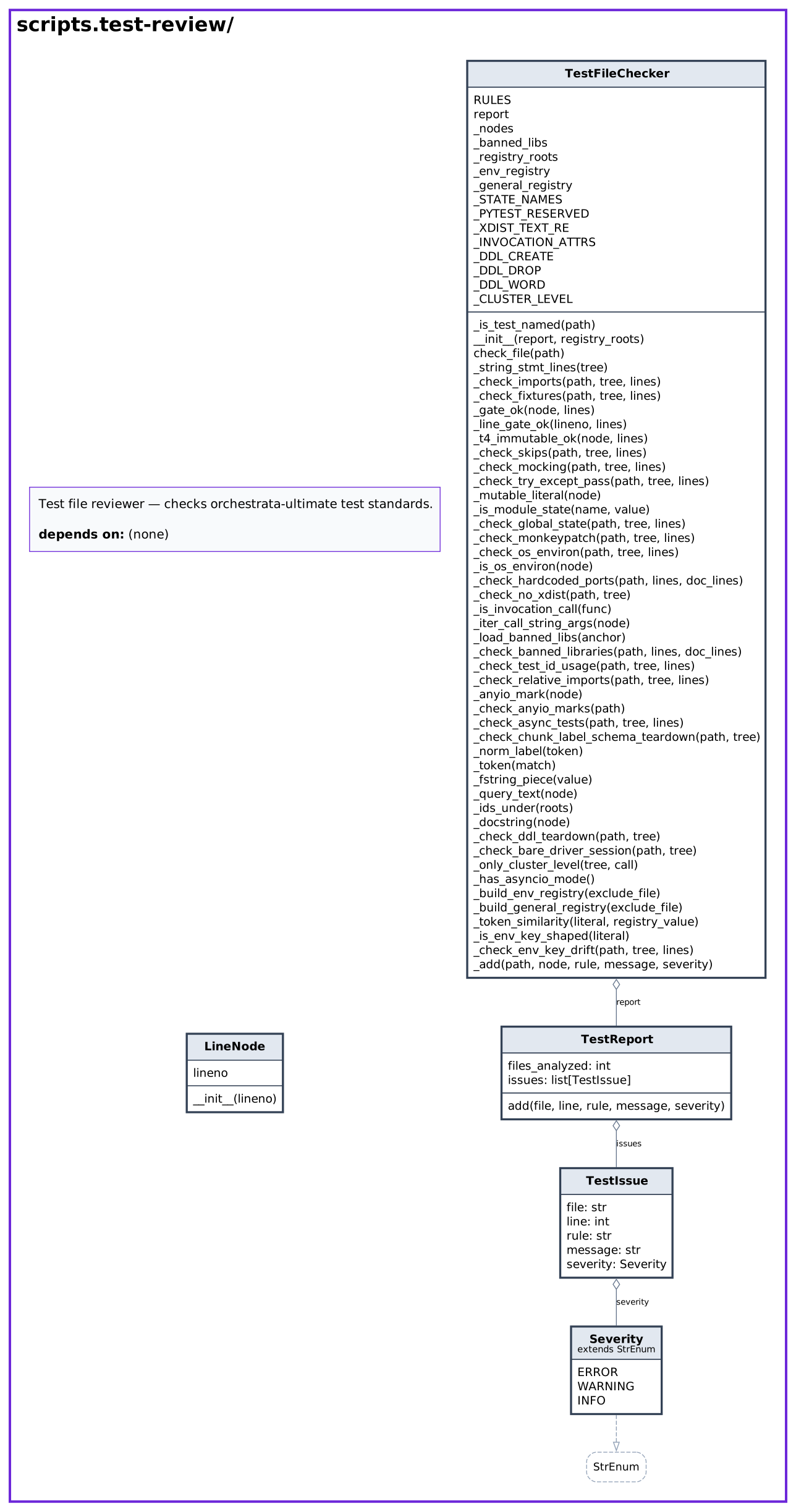
Dependency diagram
No internal imports and no importers.
API
Constants
| Name | Type | Value |
|---|---|---|
_SEVERITY_RANK |
dict[Severity, int] |
{Severity.ERROR: 3, Severity.WARNING: 2, Severity.INFO: 1} |
Classes
Severity (enum)
Bases: StrEnum · Line 178
| Member | Value |
|---|---|
ERROR |
'ERROR' |
WARNING |
'WARNING' |
INFO |
'INFO' |
TestIssue (dataclass)
Decorators: dataclass · Line 185
| Attribute | Type | Default |
|---|---|---|
file |
str |
|
line |
int |
|
rule |
str |
|
message |
str |
|
severity |
Severity |
TestReport (dataclass)
Decorators: dataclass · Line 194
| Attribute | Type | Default |
|---|---|---|
files_analyzed |
int |
0 |
issues |
list[TestIssue] |
field(default_factory=list) |
| Method | Signature | Summary |
|---|---|---|
add |
add(file: str, line: int, rule: str, message: str, severity: Severity) -> None |
TestFileChecker
Line 221
AST-based checker for test file compliance.
| Method | Signature | Summary |
|---|---|---|
_is_test_named staticmethod |
_is_test_named(path: Path) -> bool |
True when path is test-named (test_*.py or *_test.py). |
__init__ |
__init__(report: TestReport, registry_roots: list[Path] | None = None) -> None |
|
check_file |
check_file(path: Path) -> None |
|
_string_stmt_lines |
_string_stmt_lines(tree: ast.AST) -> set[int] |
Line numbers spanned by bare string-literal statements — i.e. module/ class/function docstrings and standalone string blocks. |
_check_imports |
_check_imports(path: Path, tree: ast.AST, lines: list[str]) -> None |
|
_check_fixtures |
_check_fixtures(path: Path, tree: ast.AST, lines: list[str]) -> None |
|
_gate_ok staticmethod |
_gate_ok(node: ast.FunctionDef | ast.AsyncFunctionDef, lines: list[str]) -> bool |
True when a reasoned # gate-ok: <why> sits above the decorator. |
_line_gate_ok staticmethod |
_line_gate_ok(lineno: int, lines: list[str]) -> bool |
Reasoned # gate-ok: <why> on the 1-based lineno or the line above — the adjacency rule test_isolation_audit.py::_is_waived uses, so per-line waivers are portable between the two gates. |
_t4_immutable_ok staticmethod |
_t4_immutable_ok(node: ast.FunctionDef | ast.AsyncFunctionDef, lines: list[str]) -> bool |
The module-scope opt-in: annotation comment + return-only body. |
_check_skips |
_check_skips(path: Path, tree: ast.AST, lines: list[str]) -> None |
|
_check_mocking |
_check_mocking(path: Path, tree: ast.AST, lines: list[str]) -> None |
|
_check_try_except_pass |
_check_try_except_pass(path: Path, tree: ast.AST, lines: list[str]) -> None |
|
_mutable_literal staticmethod |
_mutable_literal(node: ast.AST) -> bool |
ATOM — the expression constructs a mutable container. |
_is_module_state classmethod |
_is_module_state(name: str, value: ast.AST) -> bool |
FACT — a module-level binding that is STATE rather than a constant. |
_check_global_state |
_check_global_state(path: Path, tree: ast.Module, lines: list[str]) -> None |
T9 — no module-level mutable state. |
_check_monkeypatch |
_check_monkeypatch(path: Path, tree: ast.AST, lines: list[str]) -> None |
AST-based: only a real monkeypatch.<attr> access on a Name literally bound to monkeypatch counts. |
_check_os_environ |
_check_os_environ(path: Path, tree: ast.AST, lines: list[str]) -> None |
AST-based: only a real os.environ[...] subscript — an ast.Subscript node whose value is the attribute access os.environ — counts. |
_is_os_environ staticmethod |
_is_os_environ(node: ast.AST) -> bool |
|
_check_hardcoded_ports |
_check_hardcoded_ports(path: Path, lines: list[str], doc_lines: set[int]) -> None |
|
_check_no_xdist |
_check_no_xdist(path: Path, tree: ast.AST) -> None |
AST-based: only string arguments to an actual process invocation (subprocess.run/Popen/call/..., os.system, or pytest.main) count. |
_is_invocation_call classmethod |
_is_invocation_call(func: ast.expr) -> bool |
|
_iter_call_string_args staticmethod |
_iter_call_string_args(node: ast.Call) -> list[str] |
|
_load_banned_libs |
_load_banned_libs(anchor: Path) -> list[str] |
Find and parse .claude/banned-libraries.txt by walking up from a test file (works whether test-review runs in-repo or globally-installed). |
_check_banned_libraries |
_check_banned_libraries(path: Path, lines: list[str], doc_lines: set[int]) -> None |
|
_check_test_id_usage |
_check_test_id_usage(path: Path, tree: ast.AST, lines: list[str]) -> None |
T10 — a module that WRITES to Redis/Memgraph must namespace by test_id. |
_check_relative_imports |
_check_relative_imports(path: Path, tree: ast.AST, lines: list[str]) -> None |
|
_anyio_mark staticmethod |
_anyio_mark(node: ast.AST) -> ast.AST | None |
Return the pytest.mark.anyio decorator on node, or None. |
_check_anyio_marks |
_check_anyio_marks(path: Path) -> None |
T20 — no @pytest.mark.anyio while asyncio_mode is configured. |
_check_async_tests |
_check_async_tests(path: Path, tree: ast.AST, lines: list[str]) -> None |
|
_check_chunk_label_schema_teardown |
_check_chunk_label_schema_teardown(path: Path, tree: ast.AST) -> None |
T17 — a per-test Memgraph chunk_label must drop its schema. |
_norm_label staticmethod |
_norm_label(token: str) -> str |
Label token, comparable between a CREATE and its DROP. |
_token classmethod |
_token(match: re.Match[str]) -> str |
Normalised label from a DDL match, whichever alternative fired. |
_fstring_piece staticmethod |
_fstring_piece(value: ast.AST) -> str |
One f-string segment as text, an interpolation as {name}. |
_query_text classmethod |
_query_text(node: ast.AST) -> str | None |
Literal text of a string node, f-string placeholders preserved. |
_ids_under staticmethod |
_ids_under(roots: Iterable[ast.AST]) -> frozenset[int] |
Identity of every node in the subtrees rooted at roots. |
_docstring staticmethod |
_docstring(node: ast.AST) -> ast.Constant | None |
The node's docstring constant, when it has one. |
_check_ddl_teardown |
_check_ddl_teardown(path: Path, tree: ast.AST) -> None |
T19 — DDL a test CREATEs, the test must DROP. |
_check_bare_driver_session |
_check_bare_driver_session(path: Path, tree: ast.AST) -> None |
T18 — a raw <x>.driver.session() reads the WRONG database. |
_only_cluster_level |
_only_cluster_level(tree: ast.AST, call: ast.Call) -> bool |
True when the with-block around call runs cluster-level DDL only. |
_has_asyncio_mode |
_has_asyncio_mode() -> bool |
Check if project has asyncio_mode = 'auto' in pytest config. |
_build_env_registry |
_build_env_registry(exclude_file: Path | None = None) -> dict[str, tuple[str, str, int]] |
Build the registry of declared env key constants. |
_build_general_registry |
_build_general_registry(exclude_file: Path | None = None) -> dict[str, tuple[str, str, int]] |
Build the GENERAL constants registry (T17-GEN): every module-level UPPER_CASE string-constant assignment EXCEPT the *_ENV names (which the landed T21 tier owns). |
_token_similarity |
_token_similarity(literal: str, registry_value: str) -> tuple[bool, int] |
Check if literal shares >=2 consecutive tokens with registry_value. |
_is_env_key_shaped staticmethod |
_is_env_key_shaped(literal: str) -> bool |
True when literal is env-key-shaped: contains '_' and all cased chars are uppercase. |
_check_env_key_drift |
_check_env_key_drift(path: Path, tree: ast.AST, lines: list[str]) -> None |
T21 — detect env key drift/fabrication by comparing literals to declared constants. |
_add |
_add(path: Path, node: ast.AST, rule: str, message: str, severity: Severity = Severity.ERROR) -> None |
Functions
| Function | Signature | Summary |
|---|---|---|
_strip_strings_and_comments |
_strip_strings_and_comments(lines: list[str]) -> list[str] |
Return lines with every string literal and comment blanked out. |
_is_code_sample |
_is_code_sample(text: str) -> bool |
True when text is Python source carrying Cypher as an inner literal. |
_gate_ok_lines |
_gate_ok_lines(lines: list[str]) -> set[int] |
Lines covered by a # gate-ok: declaration (the marker and the next). |
_has_graph_writes |
_has_graph_writes(code: list[str], tree: ast.AST, raw: list[str]) -> bool |
True when the module both calls the driver and carries write Cypher. |
_executes_cypher_write |
_executes_cypher_write(call: ast.Call, exempt: set[int]) -> bool |
True when write-Cypher is passed INTO call and call runs it. |
_has_redis_writes |
_has_redis_writes(code: list[str]) -> bool |
|
find_test_files |
find_test_files(paths: list[str]) -> list[Path] |
|
output_text |
output_text(report: TestReport, min_severity: Severity, output_file: str | None = None) -> None |
|
_apply_worklist_baseline |
_apply_worklist_baseline(report: TestReport, baseline_path: str) -> None |
Downgrade baseline rows (T21 exact-key WARNINGs named at dispatch time) to INFO — named debt, non-blocking. |
main |
main() -> int |
Source
Permalink: https://gitlab.com/MSamy/orchestrata-ultimate-architecture/-/blob/a4cbc2bdf/scripts/test-review.py
#!/usr/bin/env python3
"""Test file reviewer — checks orchestrata-ultimate test standards.
Usage:
python test-review.py tests/test_foo.py
python test-review.py --format text --stdout tests/test_foo.py
python test-review.py end2end/harness/
"""
from __future__ import annotations
import argparse
import ast
import re
import sys
from collections.abc import Iterable
from dataclasses import dataclass, field
from enum import StrEnum
from pathlib import Path
def _strip_strings_and_comments(lines: list[str]) -> list[str]:
"""Return *lines* with every string literal and comment blanked out.
Line-regex rules that scan raw source cannot tell a real call from the
same text quoted inside a docstring or inside test DATA — modules that
assert on code samples carry things like ``"return redis.Redis(host='x')"``
as a plain string. Blanking those regions first keeps the rules matching
code only. Tokenizing preserves line numbering: each token's span is
replaced in place with spaces.
Falls back to the original lines when the source does not tokenize (a
syntax error is reported by other rules, not swallowed here).
"""
import io
import tokenize
blanked = list(lines)
try:
tokens = list(tokenize.generate_tokens(io.StringIO("\n".join(lines)).readline))
except tokenize.TokenError, IndentationError, SyntaxError:
return blanked
for tok in tokens:
if tok.type not in (tokenize.STRING, tokenize.COMMENT):
continue
(srow, scol), (erow, ecol) = tok.start, tok.end
for row in range(srow, erow + 1):
idx = row - 1
if idx >= len(blanked):
break
line = blanked[idx]
start = scol if row == srow else 0
end = ecol if row == erow else len(line)
blanked[idx] = line[:start] + " " * (end - start) + line[end:]
return blanked
# A Cypher WRITE is a clause applied to something, not the bare keyword.
# Matching the word alone (the form until 2026-08-06) fired on `'CREATE'` used
# as a plain operation-name value in test expectations, and on docstring prose
# such as "Fix: Use MERGE or DELETE existing node first" — the artifact-vs-
# description confusion again, in a rule that then reported the module as
# writing to the graph. CREATE/MERGE must be followed by a node/edge pattern;
# SET/DELETE/REMOVE by an identifier.
# Case-SENSITIVE on purpose: Cypher clauses are written uppercase in this
# codebase, and matching case-insensitively turns every ordinary Python
# `create(...)` / `.set(...)` call into a graph write (measured: T10 went
# 12 -> 31 findings the moment IGNORECASE was added).
_CYPHER_WRITE = re.compile(
r"\b(CREATE|MERGE)\s*\("
r"|\b(SET|DELETE|REMOVE)\s+[\w`]"
r"|\bDROP\s+(INDEX|CONSTRAINT)\b"
)
# Calls that RECORD Cypher rather than execute it. A write-Cypher string handed
# to one of these is fixture DATA (written to a temp file for the tool under
# test to scan, or shelled out), never a graph write.
_CYPHER_DATA_SINKS = frozenset(
{"write_text", "write_bytes", "write", "writelines", "dump", "dumps"}
)
# A string that is itself PYTHON SOURCE is a code sample handed to a checker,
# not a query. tests/scripts/test_code_review_tool.py feeds the reviewer whole
# function bodies like ``def test_wipe():\n session.run("MATCH (n) DETACH
# DELETE n")`` -- the Cypher there is quoted INSIDE the sample and never runs.
_PY_SOURCE_MARKERS = re.compile(r"^\s*(?:def |class |import |from \w+ import )", re.M)
def _is_code_sample(text: str) -> bool:
"""True when ``text`` is Python source carrying Cypher as an inner literal."""
return "\n" in text and bool(_PY_SOURCE_MARKERS.search(text))
# Generic verbs (set/delete/expire) need a redis-ish receiver — a bare
# `.set(...)` matches far too much. The rest are distinctive enough to match any
# receiver, and every one of them mutates.
_REDIS_WRITE = re.compile(
r"\bredis\w*\.(set|delete|expire|rename|incr|decr)\("
r"|\.(setex|psetex|getset|setnx|msetnx|mset|hset|hsetnx|hdel"
r"|hincrby|lpush|rpush|lpop|rpop|linsert|lset|ltrim|sadd|srem"
r"|spop|zadd|zrem|zincrby|pexpire|persist|flushdb|flushall"
r"|xadd|xtrim|xdel)\(",
re.I,
)
def _gate_ok_lines(lines: list[str]) -> set[int]:
"""Lines covered by a ``# gate-ok:`` declaration (the marker and the next).
The project's established way of saying "this Cypher is DATA, not a query
anyone runs". Six gates honour it; this one did not, so a module whose
fixtures are Cypher STRINGS the tooling scans was reported as writing to
the graph.
"""
marked = {n for n, line in enumerate(lines, start=1) if "gate-ok:" in line}
return marked | {n + 1 for n in marked}
def _has_graph_writes(code: list[str], tree: ast.AST, raw: list[str]) -> bool:
"""True when the module both calls the driver and carries write Cypher.
Requiring both keeps read-only query modules out: the call alone says
nothing about whether anything is mutated.
``code`` is the comment/string-blanked source used for the call scan;
``raw`` is the original, because the ``# gate-ok:`` markers live in
comments and are blanked out of ``code`` by construction.
"""
exempt = _gate_ok_lines(raw)
return any(
_executes_cypher_write(call, exempt)
for call in ast.walk(tree)
if isinstance(call, ast.Call)
)
def _executes_cypher_write(call: ast.Call, exempt: set[int]) -> bool:
"""True when write-Cypher is passed INTO ``call`` and ``call`` runs it.
Keyed on where the Cypher GOES, not on what the receiver is named. Two
earlier forms both failed on this codebase:
* matching a bare ``.run(`` classed ``subprocess.run(...)`` as a driver call,
so a module whose Cypher is fixture text (test_graph_test_preflight.py)
read as writing to the graph;
* allow-listing driver method names missed project helpers -- ``session.run``
reached through ``def w(cypher)`` (test_requirement_resolution.py) and
``syncer._run("MERGE ...")`` (kg_sync/test_stage_session.py) are real
writes under names no allow-list predicts.
Passing Cypher to a call means something executes it, unless the callee is a
known data sink or a subprocess spawn.
"""
func = call.func
name = func.attr if isinstance(func, ast.Attribute) else getattr(func, "id", "")
if name in _CYPHER_DATA_SINKS:
return False
if (
isinstance(func, ast.Attribute)
and getattr(func.value, "id", "") == "subprocess"
):
return False
return any(
isinstance(node, ast.Constant)
and isinstance(node.value, str)
and _CYPHER_WRITE.search(node.value)
and not _is_code_sample(node.value)
and getattr(node, "lineno", 0) not in exempt
for arg in [*call.args, *(kw.value for kw in call.keywords)]
for node in ast.walk(arg)
)
def _has_redis_writes(code: list[str]) -> bool:
return any(_REDIS_WRITE.search(line) for line in code)
class Severity(StrEnum):
ERROR = "ERROR"
WARNING = "WARNING"
INFO = "INFO"
@dataclass
class TestIssue:
file: str
line: int
rule: str
message: str
severity: Severity
@dataclass
class TestReport:
files_analyzed: int = 0
issues: list[TestIssue] = field(default_factory=list)
def add(
self, file: str, line: int, rule: str, message: str, severity: Severity
) -> None:
self.issues.append(TestIssue(file, line, rule, message, severity))
def find_test_files(paths: list[str]) -> list[Path]:
files: list[Path] = []
for p in paths:
path = Path(p)
if path.is_file() and path.suffix == ".py":
# Always include explicit .py files (for T21 env-key rule)
files.append(path)
elif path.is_dir():
# Directories only include test-named files (T1-T20 scoping)
files.extend(
f
for f in path.rglob("*.py")
if f.name.startswith("test_") or f.name.endswith("_test.py")
)
return sorted(set(files))
class TestFileChecker:
"""AST-based checker for test file compliance."""
RULES = {
"T1": "No mocking — no unittest.mock, MagicMock, AsyncMock, Mock, patch",
"T2": "No stubs or fakes — no FakeX, StubX, DummyX classes",
"T3": "No try/except/pass blocks",
"T4": "Function-scope fixtures only — module scope solely for annotated IMMUTABLE precomputed results ('# T4-immutable-module-scope:'), class/session never",
"T5": "No os.environ mutations",
"T6": "No hardcoded ports",
"T7": "No pytest.mark.skip or skipif",
"T8": "No monkeypatch usage",
"T9": "No global mutable state at module level",
"T10": "Use test_id fixture for DB/graph (Memgraph) ops",
"T11": "Use isolation fixture for file/DB resources",
"T12": "No bare os.environ['X'] reads — use os.environ.get()",
"T13": "No relative imports",
"T14": "Async tests need pytest.mark.asyncio or asyncio_mode",
"T15": "No pytest-xdist (-n/--numprocesses/--dist) — it deadlocks this suite; use the threadpool runner",
"T16": "No banned-library imports — see .claude/banned-libraries.txt",
"T17": "A uuid-scoped Memgraph chunk_label must drop its schema in teardown — clear() leaves the constraint + indexes behind forever",
"T18": "Verify through the store/repo's own session() — a bare `.driver.session()` reads the cluster default database, not the one under test",
"T19": "DDL a test CREATEs, the test must DROP — node sweeps delete nodes only, so a constraint/index outlives the run forever and is replayed at boot recovery",
"T21": "Env key drift/fabrication — compare string literals against declared constants (names ending in _ENV); flag similar-but-not-equal keys (ERROR) and exact literals outside declaring module (WARNING)",
}
@staticmethod
def _is_test_named(path: Path) -> bool:
"""True when path is test-named (test_*.py or *_test.py).
This predicate matches find_test_files' directory-scanning logic and
determines which files are subject to T1-T20 rules. The T21 env-key
rule runs on ALL explicit .py files regardless of naming.
"""
return path.name.startswith("test_") or path.name.endswith("_test.py")
def __init__(
self, report: TestReport, registry_roots: list[Path] | None = None
) -> None:
self.report = report
# Nodes of the file under check — populated once per file by
# check_file() and read by every rule (see the note there).
self._nodes: list[ast.AST] = []
# Banned distribution names (.claude/banned-libraries.txt), discovered
# lazily from the first test file's repo. None = not yet loaded.
self._banned_libs: list[str] | None = None
# Registry of declared env key constants, built once per review run.
# If registry_roots is None, use the default src/orchestrata_ultimate + scripts.
self._registry_roots = registry_roots
self._env_registry: dict[str, tuple[str, str, int]] | None = None
self._general_registry: dict[str, tuple[str, str, int]] | None = None
def check_file(self, path: Path) -> None:
self.report.files_analyzed += 1
source = path.read_text(encoding="utf-8")
lines = source.splitlines()
try:
tree = ast.parse(source)
except SyntaxError as exc:
self.report.add(
str(path),
exc.lineno or 1,
"SYNTAX",
f"SyntaxError: {exc.msg}",
Severity.ERROR,
)
return
# ONE walk per file, shared by every check. Each check used to call
# ast.walk(tree) itself — 17 full traversals of the same tree, on
# every one of ~1550 test modules. Measured 2026-08-06: 36.07s wall /
# 35.69s CPU over tests/ before this cache.
self._nodes = list(ast.walk(tree))
# T1-T20 rules are gated behind test-name scoping (same predicate as
# find_test_files for directory scanning). T21 (env-key rule) runs on
# ALL explicit .py files regardless of naming.
if self._is_test_named(path):
self._check_imports(path, tree, lines)
self._check_fixtures(path, tree, lines)
self._check_skips(path, tree, lines)
self._check_mocking(path, tree, lines)
self._check_try_except_pass(path, tree, lines)
doc_lines = self._string_stmt_lines(tree)
self._check_global_state(path, tree, lines)
self._check_monkeypatch(path, tree, lines)
self._check_os_environ(path, tree, lines)
self._check_hardcoded_ports(path, lines, doc_lines)
self._check_no_xdist(path, tree)
self._check_banned_libraries(path, lines, doc_lines)
self._check_test_id_usage(path, tree, lines)
self._check_relative_imports(path, tree, lines)
self._check_async_tests(path, tree, lines)
self._check_anyio_marks(path)
self._check_chunk_label_schema_teardown(path, tree)
self._check_ddl_teardown(path, tree)
self._check_bare_driver_session(path, tree)
self._check_env_key_drift(path, tree, lines)
# ------------------------------------------------------------------
# Individual checks
# ------------------------------------------------------------------
def _string_stmt_lines(self, tree: ast.AST) -> set[int]:
"""Line numbers spanned by bare string-literal statements — i.e. module/
class/function docstrings and standalone string blocks. Trigger words
(monkeypatch, ``-n auto``) inside these are documentation, not code, so
the text-based checks skip them. Assignments/calls that embed a string
(e.g. ``cmd = "pytest -n auto"``) are NOT bare Expr statements and remain
checked, so real usage is still caught.
"""
out: set[int] = set()
for node in self._nodes:
if (
isinstance(node, ast.Expr)
and isinstance(node.value, ast.Constant)
and isinstance(node.value.value, str)
):
end = getattr(node, "end_lineno", node.lineno) or node.lineno
out.update(range(node.lineno, end + 1))
return out
def _check_imports(self, path: Path, tree: ast.AST, lines: list[str]) -> None:
for node in self._nodes:
if isinstance(node, ast.Import):
for alias in node.names:
name = alias.name
if name in ("unittest.mock", "mock"):
self._add(
path,
node,
"T1",
f"Import of '{name}' is forbidden (no mocking)",
)
elif isinstance(node, ast.ImportFrom):
module = node.module or ""
if "unittest.mock" in module or "mock" in module.split("."):
self._add(
path,
node,
"T1",
f"Import from '{module}' is forbidden (no mocking)",
)
names = [a.name for a in node.names]
for n in names:
if n in ("MagicMock", "AsyncMock", "Mock", "patch", "mocker"):
self._add(
path,
node,
"T1",
f"Import of '{n}' is forbidden (no mocking)",
)
def _check_fixtures(self, path: Path, tree: ast.AST, lines: list[str]) -> None:
# T4 harmonized with the CLAUDE.md Key Rule wording ("no module/class
# scope for MUTABLE state"): scope='module' is allowed ONLY for an
# immutable precomputed result, opted in explicitly with a
# '# T4-immutable-module-scope: <why>' comment directly above the
# decorator AND a return-only body (no yield — a teardown implies a
# lifecycle, which implies state). class/session scope stay forbidden
# unconditionally.
for node in self._nodes:
if not isinstance(node, ast.FunctionDef | ast.AsyncFunctionDef):
continue
for dec in node.decorator_list:
if not isinstance(dec, ast.Call):
continue
func = dec.func
name = (
func.attr
if isinstance(func, ast.Attribute)
else getattr(func, "id", "")
)
if name != "fixture":
continue
for kw in dec.keywords:
if kw.arg == "scope" and isinstance(kw.value, ast.Constant):
# ast.Constant.value is Any, so a bytes literal
# (scope=b"session") would render as "b'session'" in
# the message below. Only a str scope is meaningful to
# pytest; anything else cannot name a forbidden scope.
if not isinstance(kw.value.value, str):
continue
scope: str = kw.value.value
if scope == "session" and self._gate_ok(node, lines):
# Session-scoped CONNECTION infra (the conftest
# neo4j_driver precedent) carries no mutable test
# state and is what makes the shared-index test
# files affordable. gate_parallel_safety.py already
# accepts a reasoned '# gate-ok:' waiver on exactly
# these lines; honouring the SAME marker here keeps
# one waiver vocabulary across both reviewers
# instead of one tool contradicting the other.
continue
if scope in ("class", "session"):
self._add(
path,
node,
"T4",
f"Fixture with scope='{scope}' is forbidden — use function scope only"
+ (
" (session-scoped CONNECTION infra may opt out with a reasoned '# gate-ok: <why>' comment directly above the decorator)"
if scope == "session"
else ""
),
)
elif scope == "module" and not self._t4_immutable_ok(
node, lines
):
self._add(
path,
node,
"T4",
"Fixture with scope='module' is forbidden — use function scope, or opt in an IMMUTABLE precomputed result with '# T4-immutable-module-scope: <why>' directly above the decorator (return-only, no yield)",
)
@staticmethod
def _gate_ok(
node: ast.FunctionDef | ast.AsyncFunctionDef, lines: list[str]
) -> bool:
"""True when a reasoned ``# gate-ok: <why>`` sits above the decorator.
Same marker and same "a reason is mandatory, a bare marker does not
waive" rule as ``scripts/gate_parallel_safety.py`` (``_WAIVER_RE``), so
one annotation satisfies both reviewers rather than each tool inventing
its own vocabulary.
"""
first_line = min([d.lineno for d in node.decorator_list] + [node.lineno])
for offset in (2, 3): # the line above the decorator, and the one above that
if first_line >= offset:
if re.search(r"#\s*gate-ok:\s*\S", lines[first_line - offset]):
return True
return False
@staticmethod
def _line_gate_ok(lineno: int, lines: list[str]) -> bool:
"""Reasoned ``# gate-ok: <why>`` on the 1-based *lineno* or the line
above — the adjacency rule ``test_isolation_audit.py::_is_waived``
uses, so per-line waivers are portable between the two gates.
"""
for idx in (lineno - 1, lineno - 2):
if 0 <= idx < len(lines) and re.search(r"#\s*gate-ok:\s*\S", lines[idx]):
return True
return False
@staticmethod
def _t4_immutable_ok(
node: ast.FunctionDef | ast.AsyncFunctionDef, lines: list[str]
) -> bool:
"""The module-scope opt-in: annotation comment + return-only body."""
first_line = min([d.lineno for d in node.decorator_list] + [node.lineno])
above = lines[first_line - 2] if first_line >= 2 else ""
if "T4-immutable-module-scope:" not in above:
return False
return not any(isinstance(n, ast.Yield | ast.YieldFrom) for n in ast.walk(node))
def _check_skips(self, path: Path, tree: ast.AST, lines: list[str]) -> None:
for node in self._nodes:
if isinstance(node, ast.Attribute):
if node.attr in ("skip", "skipif"):
self._add(
path, node, "T7", f"Use of pytest.mark.{node.attr} is forbidden"
)
def _check_mocking(self, path: Path, tree: ast.AST, lines: list[str]) -> None:
for node in self._nodes:
if isinstance(node, ast.Name):
if node.id in ("MagicMock", "AsyncMock", "Mock"):
self._add(
path,
node,
"T1",
f"Use of '{node.id}' is forbidden (no mocking)",
)
elif isinstance(node, ast.ClassDef):
if any(node.name.startswith(p) for p in ("Fake", "Stub", "Dummy")):
self._add(
path,
node,
"T2",
f"Class '{node.name}' appears to be a stub/fake (no stubs/fakes)",
)
def _check_try_except_pass(
self, path: Path, tree: ast.AST, lines: list[str]
) -> None:
for node in self._nodes:
if isinstance(node, ast.Try):
for handler in node.handlers:
if len(handler.body) == 1 and isinstance(handler.body[0], ast.Pass):
self._add(
path, handler, "T3", "try/except/pass block is forbidden"
)
# Names that are shared mutable state whatever they are bound to.
_STATE_NAMES = frozenset({"_cache", "_state", "_registry", "_instances"})
# Names RESERVED BY PYTEST at module level — pytest's own documented API,
# not state this suite owns. ``pytestmark`` is read by the collector at
# import time to apply markers to every test in the module; nothing
# mutates it, and nothing carries data between tests through it. The
# mutable-container heuristic below could not tell pytest's protocol from
# a suite-authored list and flagged all 62 modules that use the idiom —
# a rule with no model of the framework it reviews.
_PYTEST_RESERVED = frozenset(
{"pytestmark", "collect_ignore", "collect_ignore_glob"}
)
@staticmethod
def _mutable_literal(node: ast.AST) -> bool:
"""ATOM — the expression constructs a mutable container."""
if isinstance(node, (ast.List, ast.Dict, ast.Set, ast.ListComp, ast.DictComp)):
return True
return (
isinstance(node, ast.Call)
and isinstance(node.func, ast.Name)
and node.func.id in ("list", "dict", "set", "defaultdict", "Counter")
)
@classmethod
def _is_module_state(cls, name: str, value: ast.AST) -> bool:
"""FACT — a module-level binding that is STATE rather than a constant.
Two ways to qualify: a known shared-state name, or a mutable container
bound to a non-UPPER_CASE name. The name list alone caught exactly four
spellings and missed every other module-level mutable — UPPER_CASE is
the project's constant convention, so anything else holding a mutable
container is state.
"""
if name in cls._PYTEST_RESERVED:
return False
return name in cls._STATE_NAMES or (
not name.isupper() and cls._mutable_literal(value)
)
def _check_global_state(
self, path: Path, tree: ast.Module, lines: list[str]
) -> None:
"""T9 — no module-level mutable state."""
bindings = (
(node, target.id)
for node in tree.body
if isinstance(node, ast.Assign)
for target in node.targets
if isinstance(target, ast.Name)
)
for node, name in bindings:
if self._is_module_state(name, node.value):
self._add(
path,
node,
"T9",
f"Module-level mutable state '{name}' is forbidden",
)
def _check_monkeypatch(self, path: Path, tree: ast.AST, lines: list[str]) -> None:
"""AST-based: only a real ``monkeypatch.<attr>`` access on a Name
literally bound to ``monkeypatch`` counts. A line-based/regex scan
(the prior implementation) false-positived on any line merely
*containing* the substring "monkeypatch" — e.g. an identifier like
a fixture named ``monkeypatch_free_chdir`` (declaring it does NOT
use monkeypatch), or a string literal used as test data for a
meta-test of a pattern-detector (e.g. ``lines = ["monkeypatch.setenv(...)\\n"]``
fed into ``verification.review.checks_safety`` or this very tool's
own test suite). Walking ``ast.Attribute`` nodes only matches actual
attribute access in real code, never substrings or string contents.
"""
for node in self._nodes:
if not isinstance(node, ast.Attribute):
continue
if not (
isinstance(node.value, ast.Name) and node.value.id == "monkeypatch"
):
continue
# monkeypatch.setenv/delenv is allowed in tests per AGENTS.md.
if node.attr in ("setenv", "delenv"):
continue
self._add(
path,
node,
"T8",
"Use of monkeypatch is forbidden (only monkeypatch.setenv/delenv allowed)",
)
def _check_os_environ(self, path: Path, tree: ast.AST, lines: list[str]) -> None:
"""AST-based: only a real ``os.environ[...]`` subscript — an
``ast.Subscript`` node whose value is the attribute access
``os.environ`` — counts. A text/regex scan over raw lines (the prior
implementation) false-positived on any line merely *containing* the
substring, including inert string-literal fixture data belonging to
OTHER tools' tests — e.g. Python source text fed to
``verification.review.checks_safety.check_env_access`` via
``ast.parse(source)``, which is not real code in THIS file, just a
string constant. Walking ``ast.Subscript`` nodes only matches genuine
subscript syntax; a string can never masquerade as one.
A T5 mutation accepts a reasoned ``# gate-ok: <why>`` on the flagged
line or the line above — the SAME waiver channel (marker, mandatory
reason, adjacency rule) as ``test_isolation_audit.py``'s
OS_ENVIRON_MUTATION check, so one annotation satisfies both gates.
Two gates disagreeing about the same save/restore seam is worse than
either being absent (see the T4 cross-reference note above).
"""
for node in self._nodes:
if not isinstance(node, ast.Subscript):
continue
if not self._is_os_environ(node.value):
continue
if isinstance(node.ctx, ast.Store | ast.Del):
if self._line_gate_ok(node.lineno, lines):
continue
self._add(path, node, "T5", "Mutation of os.environ[...] is forbidden")
else:
self._add(
path,
node,
"T12",
"Use os.environ.get(...) instead of os.environ[...]",
severity=Severity.WARNING,
)
@staticmethod
def _is_os_environ(node: ast.AST) -> bool:
return (
isinstance(node, ast.Attribute)
and node.attr == "environ"
and isinstance(node.value, ast.Name)
and node.value.id == "os"
)
def _check_hardcoded_ports(
self, path: Path, lines: list[str], doc_lines: set[int]
) -> None:
for i, line in enumerate(lines, 1):
if i in doc_lines or line.lstrip().startswith("#"):
continue
if re.search(r"port\s*=\s*5\d{4}", line):
self.report.add(
str(path),
i,
"T6",
"Hardcoded port detected — use dynamic allocation",
Severity.ERROR,
)
# SHOWSTOPPER: pytest-xdist (-n / --numprocesses / --dist) deadlocks this
# suite (~78% stall). Use the threadpool runner instead
# (scripts/run_tests_threadpool.py / core.threading.test_executor).
_XDIST_TEXT_RE = re.compile(
r"--dist\b|--numprocesses\b|pytest-xdist|(?<![\w-])-n[ =]*(auto|\d)"
)
# Callables that actually spawn/execute a command — the only place an
# xdist CLI flag could ever really run pytest in xdist mode.
_INVOCATION_ATTRS = {
"run",
"call",
"check_call",
"check_output",
"Popen",
"system",
"popen",
}
def _check_no_xdist(self, path: Path, tree: ast.AST) -> None:
"""AST-based: only string arguments to an actual process invocation
(``subprocess.run``/``Popen``/``call``/..., ``os.system``, or
``pytest.main``) count. A text/regex scan over raw lines (the prior
implementation) false-positived on inert string-literal fixture data
belonging to OTHER tools' tests — e.g. a fake ``.gitlab-ci.yml`` body
("head -n 100", "--dist-dir=dist") written via ``write_text`` for
scripts/validate_ci.py's own gate tests, which is YAML text, never
actually invoked as a command here. Restricting to real invocation
call sites means a string can never masquerade as a genuine one.
"""
for node in self._nodes:
if not isinstance(node, ast.Call) or not self._is_invocation_call(
node.func
):
continue
command = " ".join(self._iter_call_string_args(node))
if not command or "ORCHESTRATA_WORKER_SLOT" in command:
continue
if self._XDIST_TEXT_RE.search(command):
self._add(
path,
node,
"T15",
"pytest-xdist (-n/--numprocesses/--dist) is forbidden — it deadlocks this "
"suite (~78%); use scripts/run_tests_threadpool.py (core.threading.test_executor)",
)
@classmethod
def _is_invocation_call(cls, func: ast.expr) -> bool:
if isinstance(func, ast.Attribute):
if func.attr in cls._INVOCATION_ATTRS:
return True
return (
func.attr == "main"
and isinstance(func.value, ast.Name)
and func.value.id == "pytest"
)
if isinstance(func, ast.Name):
return func.id in cls._INVOCATION_ATTRS
return False
@staticmethod
def _iter_call_string_args(node: ast.Call) -> list[str]:
out: list[str] = []
def collect(n: ast.AST) -> None:
if isinstance(n, ast.Constant) and isinstance(n.value, str):
out.append(n.value)
elif isinstance(n, ast.List | ast.Tuple):
for elt in n.elts:
collect(elt)
for arg in node.args:
collect(arg)
for kw in node.keywords:
if kw.value is not None:
collect(kw.value)
return out
def _load_banned_libs(self, anchor: Path) -> list[str]:
"""Find and parse .claude/banned-libraries.txt by walking up from a test
file (works whether test-review runs in-repo or globally-installed).
Cached after the first lookup."""
if self._banned_libs is not None:
return self._banned_libs
self._banned_libs = []
for parent in [anchor.resolve(), *anchor.resolve().parents]:
candidate = parent / ".claude" / "banned-libraries.txt"
if candidate.exists():
self._banned_libs = [
ln.strip()
for ln in candidate.read_text(encoding="utf-8").splitlines()
if ln.strip() and not ln.strip().startswith("#")
]
break
return self._banned_libs
def _check_banned_libraries(
self, path: Path, lines: list[str], doc_lines: set[int]
) -> None:
# A test file must not import a banned library. Derives the import module
# from each banned distribution name (pytest-xdist -> xdist). xdist's
# command flags are already covered by T15; this catches the import.
banned = self._load_banned_libs(path)
if not banned:
return
import_names = {b.removeprefix("pytest-").replace("-", "_"): b for b in banned}
pattern = re.compile(
r"^\s*(?:import|from)\s+("
+ "|".join(re.escape(n) for n in import_names)
+ r")\b"
)
# Scan with string literals and comments blanked (same treatment as
# T10 below): an ``import xdist`` inside a payload string is test DATA
# that never runs — gate-test fixtures carry banned source as strings.
code = _strip_strings_and_comments(lines)
for i, line in enumerate(code, 1):
if i in doc_lines or line.lstrip().startswith("#"):
continue
m = pattern.match(line)
if m:
dist = import_names[m.group(1)]
self.report.add(
str(path),
i,
"T16",
f"banned library '{dist}' imported — see "
".claude/banned-libraries.txt",
Severity.ERROR,
)
def _check_test_id_usage(self, path: Path, tree: ast.AST, lines: list[str]) -> None:
"""T10 — a module that WRITES to Redis/Memgraph must namespace by test_id.
The point of ``test_id`` is collision-freedom between parallel workers
sharing one real database, so only WRITES can violate it. Reads have
nothing to namespace, and three things used to be flagged that cannot
collide with anything:
- read-only Cypher (``session.run("RETURN 1 AS ok")``);
- ``.pipeline(`` on any receiver — this project's own ``PipelineRunner``
and volk pipelines match it far more often than redis-py does;
- ``redis.Redis(`` appearing inside a docstring or a string literal
that IS the test data (modules that assert on code samples).
The scan therefore runs over source with strings and comments blanked
out, and requires an actual write: a redis write command, or a Cypher
write clause in one of the module's string constants.
"""
code = _strip_strings_and_comments(lines)
writes = _has_graph_writes(code, tree, lines) or _has_redis_writes(code)
# `test_id` is one way to namespace; a per-test `uuid4()` prefix is the
# other, and it buys the same collision-freedom. Checking only for the
# fixture NAME flagged modules that already isolate correctly.
has_namespacing = any(
"test_id" in line or re.search(r"\buuid\d?\(|\buuid\.uuid\d\(", line)
for line in code
)
has_conftest = path.name == "conftest.py"
if writes and not has_namespacing and not has_conftest:
self.report.add(
str(path),
1,
"T10",
"File WRITES to Redis/Memgraph without namespacing — use the "
"test_id fixture or a per-test uuid4() prefix",
Severity.WARNING,
)
def _check_relative_imports(
self, path: Path, tree: ast.AST, lines: list[str]
) -> None:
for node in self._nodes:
if isinstance(node, ast.ImportFrom):
if node.level > 0:
self._add(
path,
node,
"T13",
"Relative import is forbidden — use absolute imports",
)
@staticmethod
def _anyio_mark(node: ast.AST) -> ast.AST | None:
"""Return the `pytest.mark.anyio` decorator on *node*, or None.
Matches both the bare form (`@pytest.mark.anyio`) and the called form
(`@pytest.mark.anyio(...)`), on functions and on classes.
"""
decorators = getattr(node, "decorator_list", [])
for dec in decorators:
target = dec.func if isinstance(dec, ast.Call) else dec
if isinstance(target, ast.Attribute) and target.attr == "anyio":
inner = target.value
if isinstance(inner, ast.Attribute) and inner.attr == "mark":
return dec
return None
def _check_anyio_marks(self, path: Path) -> None:
"""T20 — no `@pytest.mark.anyio` while asyncio_mode is configured.
Under `asyncio_mode = auto`, pytest-asyncio already owns every async
test and async fixture. Adding the anyio mark puts two plugins in the
same regime, and they do not agree about which event loop a FIXTURE
runs on versus the TEST that consumes it. That split is what broke
tests/gateway/handlers/test_projects.py on Python 3.14.6t (backlog
P2.14); 55 further files carried the same latent shape and were
de-marked. This rule is why they stay de-marked.
"""
if not self._has_asyncio_mode():
return
for node in self._nodes:
if not isinstance(
node, ast.AsyncFunctionDef | ast.FunctionDef | ast.ClassDef
):
continue
dec = self._anyio_mark(node)
if dec is not None:
self._add(
path,
dec,
"T20",
"@pytest.mark.anyio is forbidden — asyncio_mode is configured, so "
"pytest-asyncio owns async tests and fixtures; running both plugins "
"splits the fixture loop from the test loop (P2.14). Delete the mark.",
)
def _check_async_tests(self, path: Path, tree: ast.AST, lines: list[str]) -> None:
# Check project-wide asyncio_mode config
has_asyncio_mode = self._has_asyncio_mode()
for node in self._nodes:
if isinstance(node, ast.AsyncFunctionDef):
if node.name.startswith("test_"):
# Check if decorated with pytest.mark.asyncio
has_marker = any(
isinstance(d, ast.Call)
and isinstance(d.func, ast.Attribute)
and d.func.attr == "asyncio"
for d in node.decorator_list
)
if not has_marker and not has_asyncio_mode:
self._add(
path,
node,
"T14",
f"Async test '{node.name}' needs @pytest.mark.asyncio or asyncio_mode in config",
)
def _check_chunk_label_schema_teardown(self, path: Path, tree: ast.AST) -> None:
"""T17 — a per-test Memgraph ``chunk_label`` must drop its schema.
``connect()`` creates a uniqueness constraint and two lookup indexes
for whatever ``chunk_label`` names. ``clear()``/``clear_prefixed()``
delete NODES only; the schema survives, and Memgraph replays every
entry at boot recovery. When the label carries the ``test_id`` uuid
that is unbounded growth: 3,379 leaked ``*__TEST_*`` labels (6,713
indexes + 3,323 constraints guarding 9 nodes) cost the shared cluster
~17 minutes of pegged CPU per data-node restart in the 2026-07-15
incident, and two fixtures had regrown the same leak by 2026-07-26.
Fixed per-WORKER labels (``f"TestChunk{worker_slot}"``) are bounded by
the worker count and deliberately keep their schema so the warm-run
``connect()`` short-circuit stays effective — this rule only fires on
labels interpolating ``test_id``.
"""
for node in self._nodes:
if not isinstance(node, (ast.FunctionDef, ast.AsyncFunctionDef)):
continue
uuid_scoped_label: ast.AST | None = None
for sub in ast.walk(node):
if not isinstance(sub, ast.keyword) or sub.arg != "chunk_label":
continue
if not isinstance(sub.value, ast.JoinedStr):
continue
names = {
v.value.id
for v in sub.value.values
if isinstance(v, ast.FormattedValue)
and isinstance(v.value, ast.Name)
}
if "test_id" in names:
uuid_scoped_label = sub.value
break
if uuid_scoped_label is None:
continue
# Only functions that OWN the graph's lifecycle can drop its
# schema. A pure config factory (builds a SemanticGraphConfig and
# returns it) has no teardown to put the drop in -- its consumers
# do, and they are checked on their own. Ownership evidence: the
# function yields the resource, or calls a lifecycle method on it.
attrs = {
sub.attr for sub in ast.walk(node) if isinstance(sub, ast.Attribute)
}
owns_lifecycle = bool(
attrs & {"clear", "clear_prefixed", "close", "connect"}
) or any(
isinstance(sub, (ast.Yield, ast.YieldFrom)) for sub in ast.walk(node)
)
if not owns_lifecycle:
continue
drops = "drop_chunk_label_schema" in attrs
if not drops:
self._add(
path,
node,
"T17",
f"'{node.name}' builds a uuid-scoped chunk_label but never calls "
"drop_chunk_label_schema() — its constraint + 2 indexes leak on "
"every run and Memgraph replays them at boot recovery",
)
# Cypher DDL as it appears inside a test's query strings. The label token
# is captured VERBATIM: for an interpolated label the capture is the
# placeholder itself (``{label}``), which is precisely what lets a CREATE
# pair with its DROP without resolving the expression.
_DDL_CREATE = re.compile(
r"CREATE\s+CONSTRAINT\s+ON\s*\(\s*\w+\s*:\s*(?P<label>[^)\s]+)"
r"|CREATE\s+(?:\w+\s+)?INDEX\s+ON\s*:\s*(?P<ilabel>[^(\s]+)",
re.IGNORECASE,
)
_DDL_DROP = re.compile(
r"DROP\s+CONSTRAINT\s+ON\s*\(\s*\w+\s*:\s*(?P<label>[^)\s]+)"
r"|DROP\s+(?:\w+\s+)?INDEX\s+ON\s*:\s*(?P<ilabel>[^(\s]+)",
re.IGNORECASE,
)
# Cheap prefilter: only strings mentioning CREATE or DROP can carry DDL.
_DDL_WORD = re.compile(r"CREATE|DROP", re.IGNORECASE)
@staticmethod
def _norm_label(token: str) -> str:
"""Label token, comparable between a CREATE and its DROP."""
return token.strip().strip("`").strip()
@classmethod
def _token(cls, match: re.Match[str]) -> str:
"""Normalised label from a DDL match, whichever alternative fired."""
return cls._norm_label(match.group("label") or match.group("ilabel") or "")
@staticmethod
def _fstring_piece(value: ast.AST) -> str:
"""One f-string segment as text, an interpolation as ``{name}``."""
if isinstance(value, ast.Constant) and isinstance(value.value, str):
return value.value
if not isinstance(value, ast.FormattedValue):
return ""
inner = value.value
if isinstance(inner, ast.Name):
return "{" + inner.id + "}"
if isinstance(inner, ast.Attribute):
return "{" + inner.attr + "}"
return "{?}"
@classmethod
def _query_text(cls, node: ast.AST) -> str | None:
"""Literal text of a string node, f-string placeholders preserved.
An interpolated label survives as ``{name}`` rather than being lost,
so ``f"...ON (n:{label})..."`` and its DROP produce the same token.
"""
if isinstance(node, ast.Constant) and isinstance(node.value, str):
return node.value
if isinstance(node, ast.JoinedStr):
return "".join(map(cls._fstring_piece, node.values))
return None
@staticmethod
def _ids_under(roots: Iterable[ast.AST]) -> frozenset[int]:
"""Identity of every node in the subtrees rooted at ``roots``."""
return frozenset(id(sub) for root in roots for sub in ast.walk(root))
@staticmethod
def _docstring(node: ast.AST) -> ast.Constant | None:
"""The node's docstring constant, when it has one."""
body = getattr(node, "body", None)
if not isinstance(body, list) or not body:
return None
first = body[0]
if (
isinstance(first, ast.Expr)
and isinstance(first.value, ast.Constant)
and isinstance(first.value.value, str)
):
return first.value
return None
def _check_ddl_teardown(self, path: Path, tree: ast.AST) -> None:
"""T19 — DDL a test CREATEs, the test must DROP.
``CREATE CONSTRAINT`` / ``CREATE INDEX`` on a per-test label is
permanent: node sweeps delete NODES only, the schema survives, and
Memgraph replays every entry at boot recovery. T17 covers exactly one
shape of this — the ``chunk_label=`` keyword — and structurally cannot
see raw Cypher, which is how every other site writes it.
Measured 2026-08-06: 57 leaked constraints across 7 databases on the
test cluster, from five fixtures issuing raw ``CREATE CONSTRAINT`` with
no drop. ``sweep_test_pollution.py`` contains no ``DROP CONSTRAINT`` at
all, so nothing in the project could ever have cleaned them.
Pairing is by label TOKEN, so an interpolated label pairs through its
placeholder. DDL that a test merely ASSERTS ABOUT — a generator's
expected output compared against a literal — is not executed DDL and
is excluded; counting it would repeat the artifact-vs-description
confusion this project has now measured eight times.
"""
# Strings that DESCRIBE DDL rather than run it. Two shapes:
# operands of an assert/comparison (a generator's expected output),
# and docstrings — a fixture that documents the DDL it measured
# ("CREATE INDEX ON :<label>(id) (2,514ms) ...") is prose, not a
# statement. Missing the docstring case produced a false positive on
# tests/semantic_graph/test_memgraph_adapter.py the first time this
# rule ran: the ninth instance in one day of a scanner with no model
# of which input is the artifact and which is prose about it
# (concepts/gates-must-separate-artifact-from-description).
nodes = list(self._nodes)
described = self._ids_under(
n for n in nodes if isinstance(n, (ast.Assert, ast.Compare))
) | frozenset(map(id, filter(None, (self._docstring(n) for n in nodes))))
# An f-string's own literal pieces are Constants too; scoring them
# separately would split "CREATE CONSTRAINT ON (n:" from its label.
joined = [n for n in nodes if isinstance(n, ast.JoinedStr)]
inner = self._ids_under(joined) - frozenset(map(id, joined))
# DDL only counts when it reaches an execution seam. A test-review
# corpus is Python source stored as DATA — this rule's own test file
# embeds "CREATE CONSTRAINT ..." in string constants it writes to a
# temp file — and a string that is never handed to a call executes
# nothing.
executed = self._ids_under(n for n in nodes if isinstance(n, ast.Call))
texts = [
(n, text)
for n, text in ((n, self._query_text(n)) for n in nodes)
if text and id(n) not in inner and self._DDL_WORD.search(text)
]
dropped = frozenset(
self._token(m) for _, text in texts for m in self._DDL_DROP.finditer(text)
)
created: dict[str, ast.AST] = {}
for node, text in texts:
if id(node) in described or id(node) not in executed:
continue
created.update(
{
self._token(m): node
for m in self._DDL_CREATE.finditer(text)
if self._token(m) not in created
}
)
# A DROP whose label is COMPUTED can drop anything, so it satisfies
# every create in the file. The idiom is a teardown loop —
# ``for label in (A, B): run(f"DROP CONSTRAINT ON (n:{label}) ...")``
# — which creates by literal and drops by loop variable, so literal
# pairing would flag correct teardown as a leak.
wildcard_drop = any("{" in token for token in dropped)
leaked = (
{}
if wildcard_drop
else {
label: node for label, node in created.items() if label not in dropped
}
)
for label, node in sorted(leaked.items()):
self._add(
path,
node,
"T19",
f"creates DDL on ':{label}' and never drops it — the schema "
"outlives the test forever (node sweeps delete nodes only) and "
"Memgraph replays it at every boot recovery; drop it in teardown",
)
def _check_bare_driver_session(self, path: Path, tree: ast.AST) -> None:
"""T18 — a raw ``<x>.driver.session()`` reads the WRONG database.
Since the 2026-07-26 orchgraph cutover the operational KG and the
shared semantic/RAG graph are two DATABASES on one cluster, so the
URI no longer picks between them — the ``database=`` argument does.
Stores and repositories thread it on every call; reaching past them
to ``.driver.session()`` does not, so the session lands on the
cluster default.
This is a FALSE-GREEN shape, not a style nit: five sync/promotion
test modules were verifying an empty database and passing anyway
(measured 2026-07-26). Use the object's own ``session()`` —
``store.session()``, ``repo.session()`` — which binds the database
the code under test actually writes to.
"""
kg_operational = any(
isinstance(n, ast.Name) and n.id in ("NEO4J_URI", "resolve_kg_database")
for n in self._nodes
)
for node in self._nodes:
if not isinstance(node, ast.Call):
continue
func = node.func
# Shape: <anything>.driver.session(...)
if not isinstance(func, ast.Attribute) or func.attr != "session":
continue
# Two shapes reach a raw driver: `<obj>.driver.session()` and a
# bare driver held directly (`neo4j_cleanup_driver.session()`) —
# the second is how a fixture verifying the wrong database
# slipped past the first sweep.
#
# The bare-name shape is only flagged in modules that target the
# OPERATIONAL KG (`kg_operational` below). Semantic-graph tests
# use the same driver class against the cluster DEFAULT database,
# which is correct for them — flagging those turned 0 findings
# into 352.
receiver = func.value
if isinstance(receiver, ast.Attribute):
if receiver.attr != "driver":
continue
elif isinstance(receiver, ast.Name):
if not receiver.id.endswith("driver") or not kg_operational:
continue
else:
continue
# `database=` supplied explicitly is the caller doing it right.
if any(kw.arg == "database" for kw in node.keywords):
continue
# A session running only CLUSTER-level statements has no database
# to bind: `SHOW DATABASES` enumerates the cluster, and there is
# no store or repository whose session() could scope it. Measured
# 2026-08-06 on tests/core/test_worker_database_mapping.py, where
# the raw driver is deliberate and correct.
if self._only_cluster_level(tree, node):
continue
self._add(
path,
node,
"T18",
"bare `.driver.session()` reads the cluster default database, "
"not the one under test — use the store/repo's own session()",
)
# Statements that address the CLUSTER, not a database within it. A
# session running only these has nothing to scope: `database=` on a
# `SHOW DATABASES` call would name one of the very things being listed.
_CLUSTER_LEVEL = re.compile(
r"^\s*(SHOW\s+(DATABASES|VERSION|REPLICATION\s+ROLE|STORAGE\s+INFO)"
r"|CREATE\s+DATABASE|DROP\s+DATABASE|USE\s+DATABASE)\b",
re.IGNORECASE,
)
def _only_cluster_level(self, tree: ast.AST, call: ast.Call) -> bool:
"""True when the ``with``-block around ``call`` runs cluster-level DDL only.
Conservative by construction: a block that runs even one ordinary
query, or whose statements cannot be read statically, is NOT exempt —
so the false-green shape T18 exists to catch stays caught.
"""
blocks = [
node
for node in self._nodes
if isinstance(node, (ast.With, ast.AsyncWith))
and any(item.context_expr is call for item in node.items)
]
if not blocks:
return False
runs = [
sub
for stmt in blocks[0].body
for sub in ast.walk(stmt)
if isinstance(sub, ast.Call)
and isinstance(sub.func, ast.Attribute)
and sub.func.attr == "run"
]
# A query with no readable literal cannot be proven cluster-level.
texts = [self._query_text(r.args[0]) if r.args else None for r in runs]
return (
bool(texts)
and all(t is not None for t in texts)
and all(self._CLUSTER_LEVEL.match(t) for t in texts if t)
)
def _has_asyncio_mode(self) -> bool:
"""Check if project has asyncio_mode = 'auto' in pytest config."""
project_root = Path("/home/mohamed/workspace/orchestrata-ultimate-architecture")
for config_file in ("pyproject.toml", "pytest.ini", "setup.cfg"):
p = project_root / config_file
if p.exists():
text = p.read_text()
if "asyncio_mode" in text:
return True
return False
# ------------------------------------------------------------------
# T21 — env key drift/fabrication detection
# ------------------------------------------------------------------
def _build_env_registry(
self, exclude_file: Path | None = None
) -> dict[str, tuple[str, str, int]]:
"""Build the registry of declared env key constants.
Walks all .py files under registry_roots (default: src/orchestrata_ultimate + scripts),
collecting module-level assignments where target ends with '_ENV' and value is a string Constant.
Excludes the file being reviewed (if provided) to avoid self-tripping when the file
being checked also declares constants.
Returns: dict mapping constant_value -> (constant_name, declaring_module, lineno)
Cache built once per checker instance per review run.
"""
if self._env_registry is not None:
return self._env_registry
roots = (
self._registry_roots
if self._registry_roots
else [
Path(__file__).resolve().parents[1] / "src" / "orchestrata_ultimate",
Path(__file__).resolve().parents[1] / "scripts",
]
)
registry: dict[str, tuple[str, str, int]] = {}
module_paths: list[Path] = []
for root in roots:
if not root.exists():
continue
module_paths.extend(root.rglob("*.py"))
for path in module_paths:
# Skip the file being reviewed
if exclude_file and path == exclude_file:
continue
try:
source = path.read_text(encoding="utf-8")
tree = ast.parse(source)
except SyntaxError:
continue
# Only check module-level assignments (in the body of the Module node)
for node in tree.body:
if not isinstance(node, ast.Assign):
continue
for target in node.targets:
if not isinstance(target, ast.Name):
continue
name = target.id
if not name.endswith("_ENV"):
continue
if not isinstance(node.value, ast.Constant) or not isinstance(
node.value.value, str
):
continue
value = node.value.value
registry[value] = (name, str(path), node.lineno)
self._env_registry = registry
return registry
def _build_general_registry(
self, exclude_file: Path | None = None
) -> dict[str, tuple[str, str, int]]:
"""Build the GENERAL constants registry (T17-GEN): every module-level
UPPER_CASE string-constant assignment EXCEPT the ``*_ENV`` names (which
the landed T21 tier owns). The general tier is exact-match WARNING only —
the measured >=2-token drift over all UPPER_CASE values is ~100% FP, so
no drift ERROR is emitted here (T17 Stage A ruling)."""
if self._general_registry is not None:
return self._general_registry
roots = (
self._registry_roots
if self._registry_roots
else [
Path(__file__).resolve().parents[1] / "src" / "orchestrata_ultimate",
Path(__file__).resolve().parents[1] / "scripts",
]
)
registry: dict[str, tuple[str, str, int]] = {}
for root in roots:
if not root.exists():
continue
for path in root.rglob("*.py"):
if exclude_file and path == exclude_file:
continue
try:
tree = ast.parse(path.read_text(encoding="utf-8"))
except SyntaxError:
continue
for node in tree.body:
if not isinstance(node, ast.Assign):
continue
for target in node.targets:
if not isinstance(target, ast.Name):
continue
name = target.id
if name.endswith("_ENV") or not name.isupper():
continue
if not isinstance(node.value, ast.Constant) or not isinstance(
node.value.value, str
):
continue
registry[node.value.value] = (name, str(path), node.lineno)
self._general_registry = registry
return registry
def _token_similarity(self, literal: str, registry_value: str) -> tuple[bool, int]:
"""Check if literal shares >=2 consecutive tokens with registry_value.
Tokenize by splitting on '_', drop empties, compare token runs.
Returns (similar, max_consecutive_tokens) where similar means >=2 consecutive shared tokens.
Case-insensitive comparison.
"""
if literal == registry_value:
return (False, 0) # Exact match is not drift
def tokenize(s: str) -> list[str]:
return [t for t in s.lower().split("_") if t]
literal_tokens = tokenize(literal)
registry_tokens = tokenize(registry_value)
if not literal_tokens or not registry_tokens:
return (False, 0)
# Find max consecutive matching run
max_consecutive = 0
for i, lt in enumerate(literal_tokens):
for j, rt in enumerate(registry_tokens):
consecutive = 0
li, ri = i, j
while (
li < len(literal_tokens)
and ri < len(registry_tokens)
and literal_tokens[li] == registry_tokens[ri]
):
consecutive += 1
li += 1
ri += 1
max_consecutive = max(max_consecutive, consecutive)
return (max_consecutive >= 2, max_consecutive)
@staticmethod
def _is_env_key_shaped(literal: str) -> bool:
"""True when literal is env-key-shaped: contains '_' and all cased chars are uppercase.
Env keys follow UPPER_SNAKE_CASE by universal convention. This shape gate filters
out lowercase/mixed-case literals (JSON field names, dict payload keys) that share
tokens with env constants but are NOT env keys.
Example: "head_commit" → False (lowercase), "ORCH_HEAD_COMMIT" → True (uppercase)
"""
if "_" not in literal:
return False
# Every cased character must be uppercase
for c in literal:
if c.isalpha() and not c.isupper():
return False
return True
def _check_env_key_drift(self, path: Path, tree: ast.AST, lines: list[str]) -> None:
"""T21 — detect env key drift/fabrication by comparing literals to declared constants.
Two levels:
- T21 ERROR: literal shares >=2 consecutive tokens with a registry value
but is != it (e.g. "ORCH_TEST_DEADLINE" vs "ORCHESTRATA_TEST_DEADLINE")
- T21 WARNING: literal exactly matches a registry value used outside its
declaring module → should import the constant instead
SHAPE GATE: a literal enters T21 comparison ONLY if it is env-key-shaped
(contains '_' AND every cased character is uppercase). This filters out
lowercase/mixed-case literals like JSON field names ("head_commit") that
share tokens with env constants but are not env key literals.
Non-goals (do NOT flag): infra keys with NO declared constant; comments/
docstrings; f-strings' dynamic parts. Self-exemption via path exemption.
The rule applies to ANY .py file passed on the CLI (T1-T20 keep their
current test-named scoping unchanged).
"""
# Build registry excluding the file being reviewed
registry = self._build_env_registry(exclude_file=path)
# Skip the rule's own test file to avoid false positives from fixture code
# (concatenated fixture literals and the self-exemption pattern).
# D6: self-exemption via documented path exemption - the test file
# contains fixture string literals that would otherwise trigger T21.
if "tests/scripts/test_test_review_tool.py" in str(path):
return
# D8: self-exemption for the review tool itself — it uses env key literals
# in string checks (not os.environ accesses) and importing the constants
# would be circular (the tool checks the constants it uses).
if "scripts/test-review.py" in str(path):
return
# Track which module declared each constant for exact-match warnings
# Maps literal value -> (constant_name, declaring_module)
constant_to_module: dict[str, tuple[str, str]] = {}
for value, (name, module, _) in registry.items():
constant_to_module[value] = (name, module)
# T17-GEN general tier: exact-match WARNING only (no drift — the >=2-token
# drift over all UPPER_CASE values is ~100% FP). Separate map so the
# landed *_ENV tier semantics stay byte-stable.
general_registry = self._build_general_registry(exclude_file=path)
general_constant_to_module: dict[str, tuple[str, str]] = {}
for value, (name, module, _) in general_registry.items():
general_constant_to_module[value] = (name, module)
# Collect docstring node IDs to exclude
docstring_ids = set()
for node in ast.walk(tree):
if isinstance(
node, (ast.FunctionDef, ast.AsyncFunctionDef, ast.ClassDef, ast.Module)
):
docstring = self._docstring(node)
if docstring is not None:
docstring_ids.add(id(docstring))
# Collect ALL string literals in code position (excluding docstrings)
# This matches the brief's "ast.walk over ast.Constant where value is str"
string_literals: list[tuple[str, int]] = []
for node in ast.walk(tree):
if isinstance(node, ast.Constant) and isinstance(node.value, str):
# Skip empty strings and docstrings
if node.value and id(node) not in docstring_ids:
string_literals.append((node.value, node.lineno))
# Remove duplicates while preserving line order
seen: set[str] = set()
unique_literals: list[tuple[str, int]] = []
for lit, lineno in string_literals:
if lit not in seen:
seen.add(lit)
unique_literals.append((lit, lineno))
# Check each literal
for literal, lineno in unique_literals:
# SHAPE GATE: skip literals that are not env-key-shaped
if not self._is_env_key_shaped(literal):
continue
# Skip literals ending in '_ENV' (constant NAME-shaped strings, not key values)
if literal.endswith("_ENV"):
continue
# Skip infra keys that have no declared constant (RUL-003 style inline literals)
# A literal is "infra" if it doesn't match any registry value and doesn't
# share >=2 tokens with any registry value
# D11: exact match PRECEDES drift. If literal exactly equals ANY registry value,
# it's an exact-match issue (WARNING), NOT a drift issue (ERROR).
has_match = False
exact_match_value = None # The registry value that matches exactly, if any
best_match = (
None # (reg_value, max_consecutive_tokens) for similar-but-not-equal
)
for reg_value in registry:
if literal == reg_value:
has_match = True
exact_match_value = reg_value # Record exact match
# Keep checking for drift against other entries? No - exact match wins.
# Per D11: exact match PRECEDES drift. Stop checking similarity.
break
similar, max_consecutive = self._token_similarity(literal, reg_value)
if similar:
has_match = True
if best_match is None or max_consecutive > best_match[1]:
best_match = (reg_value, max_consecutive)
# Create a simple node-like object for reporting line numbers
class LineNode:
def __init__(self, lineno):
self.lineno = lineno
line_node = LineNode(lineno)
# T17-GEN general tier: exact-match WARNING (retyped constant value),
# no drift — the >=2-token drift over all UPPER_CASE values is ~100% FP.
# Runs for every shape-gated literal, independent of the *_ENV match
# (a general constant's value is not an env key, so it has no *_ENV
# entry to match against).
if literal in general_constant_to_module:
gen_name, gen_module = general_constant_to_module[literal]
if gen_module != str(path):
self._add(
path,
line_node,
"T21",
f"T21 retyped constant '{literal}' has a declared "
f"constant NAME='{gen_name}' at {gen_module} — import it "
f"instead of retyping",
Severity.WARNING,
)
if not has_match:
# No registry match at all - this is an infra key, skip it
continue
# D11: exact match PRECEDES drift. If literal exactly equals ANY registry value,
# it's an exact-match issue (WARNING), NOT a drift issue (ERROR).
# Check exact match first.
has_drift_issue = False
if exact_match_value is not None:
# Exact match found - issue WARNING (unless self-declaration)
# (drift check skipped - exact match wins)
pass
elif best_match is not None:
# Drift issue (similar but not equal)
reg_value, _ = best_match
const_name, const_module, _ = registry[reg_value]
has_drift_issue = True
self._add(
path,
line_node,
"T21",
f"T21 possible fabricated/drifted env key '{literal}' — "
f"declared constant NAME='{const_name}' at {const_module}:{_}",
Severity.ERROR,
)
else:
# Fallback: iterate through registry (shouldn't happen given has_match=True)
for reg_value, (const_name, const_module, _) in registry.items():
similar, _ = self._token_similarity(literal, reg_value)
if similar:
self._add(
path,
line_node,
"T21",
f"T21 possible fabricated/drifted env key '{literal}' — "
f"declared constant NAME='{const_name}' at {const_module}:{_}",
Severity.ERROR,
)
break # One error per literal is enough
# Check for exact match outside declaring module
# Skip if the literal was already flagged as drift (same literal can't be both)
# OR if the literal is declared in this file (self-declaration)
if has_drift_issue:
# Already flagged as drift, skip exact match warning
pass
else:
# Check for self-declaration
is_self_declaration = False
for node in tree.body:
if isinstance(node, ast.Assign):
for target in node.targets:
if isinstance(target, ast.Name):
if target.id.endswith("_ENV"):
if isinstance(
node.value, ast.Constant
) and isinstance(node.value.value, str):
if node.value.value == literal:
is_self_declaration = True
break
if is_self_declaration:
break
if not is_self_declaration and literal in constant_to_module:
const_name, declaring_module = constant_to_module[literal]
if declaring_module != str(path):
self._add(
path,
line_node,
"T21",
f"T21 env key '{literal}' has a declared constant NAME='{const_name}' at {declaring_module} — "
f"import it instead of retyping",
Severity.WARNING,
)
# ------------------------------------------------------------------
# Helpers
# ------------------------------------------------------------------
def _add(
self,
path: Path,
node: ast.AST,
rule: str,
message: str,
severity: Severity = Severity.ERROR,
) -> None:
self.report.add(str(path), getattr(node, "lineno", 1), rule, message, severity)
# Severity rank, most severe first — used to filter by --min-severity. Severity
# names do NOT sort correctly alphabetically (e.g. "INFO" < "WARNING" would
# wrongly include INFO issues when min-severity=WARNING), so filtering must use
# this explicit rank rather than comparing Severity.value strings.
_SEVERITY_RANK: dict[Severity, int] = {
Severity.ERROR: 3,
Severity.WARNING: 2,
Severity.INFO: 1,
}
def output_text(
report: TestReport, min_severity: Severity, output_file: str | None = None
) -> None:
out = sys.stdout if output_file is None else open(output_file, "w")
min_rank = _SEVERITY_RANK[min_severity]
filtered = [i for i in report.issues if _SEVERITY_RANK[i.severity] >= min_rank]
print("=" * 80, file=out)
print("TEST REVIEW REPORT", file=out)
print("=" * 80, file=out)
print(f"\nFiles Analyzed: {report.files_analyzed}", file=out)
print(f"Total Issues: {len(filtered)}\n", file=out)
if not filtered:
print("✅ All test files comply with standards.", file=out)
else:
by_severity: dict[Severity, list[TestIssue]] = {s: [] for s in Severity}
for i in filtered:
by_severity[i.severity].append(i)
for sev in (Severity.ERROR, Severity.WARNING, Severity.INFO):
items = by_severity[sev]
if items:
print(f"\n{sev.value} ({len(items)}):", file=out)
for item in items:
print(
f" {item.file}:{item.line} [{item.rule}] {item.message}",
file=out,
)
if output_file:
out.close()
def _apply_worklist_baseline(report: TestReport, baseline_path: str) -> None:
"""Downgrade baseline rows (T21 exact-key WARNINGs named at dispatch time) to
INFO — named debt, non-blocking. New findings keep their severity. A
missing/unparsable baseline is a no-op (the baseline is advisory, not a
correctness gate)."""
import json
try:
data = json.loads(Path(baseline_path).read_text(encoding="utf-8"))
except OSError, json.JSONDecodeError:
return
baseline = {(Path(r["file"]).name, r["line"]) for r in data.get("rows", [])}
for issue in report.issues:
if issue.rule != "T21" or issue.severity != Severity.WARNING:
continue
if (Path(issue.file).name, issue.line) in baseline:
issue.severity = Severity.INFO
def main() -> int:
parser = argparse.ArgumentParser(
description="Test file reviewer for orchestrata-ultimate"
)
parser.add_argument("paths", nargs="+", help="Test files or directories to review")
parser.add_argument("--output", "-o", help="Output file for report")
parser.add_argument("--stdout", action="store_true", help="Print report to stdout")
parser.add_argument(
"--min-severity", choices=["ERROR", "WARNING", "INFO"], default="WARNING"
)
parser.add_argument(
"--worklist-baseline",
help="Worklist-baseline JSON (T21-ROUTING): baseline rows downgrade to "
"INFO (named debt, non-blocking); new findings keep their severity.",
)
args = parser.parse_args()
files = find_test_files(args.paths)
if not files:
print("No test files found.", file=sys.stderr)
return 0
report = TestReport()
checker = TestFileChecker(report)
for f in files:
checker.check_file(f)
if args.worklist_baseline:
_apply_worklist_baseline(report, args.worklist_baseline)
min_sev = Severity(args.min_severity)
output_text(report, min_sev, None if args.stdout else args.output)
if args.stdout and args.output:
output_text(report, min_sev, args.output)
error_count = sum(1 for i in report.issues if i.severity == Severity.ERROR)
return 1 if error_count > 0 else 0
if __name__ == "__main__":
sys.exit(main())