scripts.check_incus_not_docker
Reference › scripts › check_incus_not_docker
The Incus-not-Docker gate, the mechanism for ruling RUL-004: containers run on Incus (LXD), not Docker. tests/scripts/test_check_incus_not_docker.py imports it.
Invocation: main takes --repo-root (default the repository root), --json and --ruling, which prints the ratified ruling text and exits 0. Otherwise run_check returns an exit code and a report, printed as text or JSON.
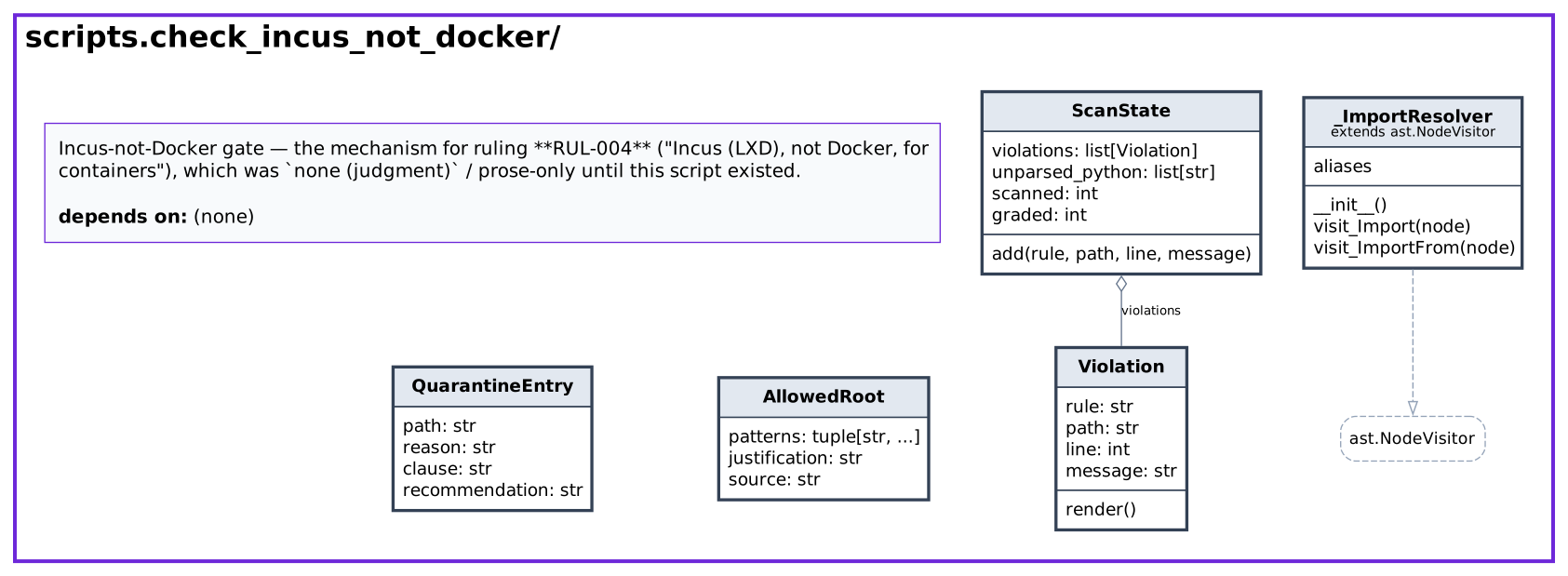
The scan covers the whole repository file by file (iter_scanned_files), restricted to the content scope. Allowed roots (AllowedRoot) and quarantined entries (QuarantineEntry) are the declared exceptions, and a few detection-predicate files are exempt because they must name Docker to detect it. Shell files are scanned line by line after comments and noise are stripped (scan_shell_file, find_shell_invocations); only invocations in an execution position count, so an echoed or quoted mention is not flagged. Python files are parsed: _ImportResolver resolves import aliases, and scan_python_file flags subprocess and shell calls that run Docker, including through shell strings. Config files (scan_config_file) and newly introduced files (scan_file_introduction) get their own rules. Every hit is recorded in a ScanState with rule, path, line and message, and becomes a Violation.
At a glance
| Source | scripts/check_incus_not_docker.py |
| Lines of code | 1117 |
| Classes | 5 |
| Functions | 27 |
| Imports (internal) | none |
| Imported by | none |
| Tests that import it | tests/scripts/test_check_incus_not_docker.py |
Class diagram
Dependency diagram
No internal imports and no importers.
API
Constants
| Name | Type | Value |
|---|---|---|
ENFORCED_ROOTS |
tuple[str, ...] |
('src', 'scripts', 'tests', 'deploy', 'env', 'infra') |
ENFORCED_FILES |
tuple[str, ...] |
('conftest.py', 'pyproject.toml', '.env.example') |
PRUNED_DIR_NAMES |
frozenset[str] |
frozenset({'__pycache__', 'node_modules', 'vendor', 'dist-janus', 'htmlcov', 's… |
ALLOWED_ROOTS |
tuple[AllowedRoot, ...] |
(AllowedRoot(patterns=('docker/',), justification='service-topology REFERENCE o… |
QUARANTINE |
tuple[QuarantineEntry, ...] |
(QuarantineEntry(path='rtm/scripts/setup_test_infrastructure.sh', reason='froze… |
DETECTION_PREDICATE_EXEMPT_PREFIXES |
tuple[tuple[str, str], ...] |
(('src/orchestrata_tools/', 'generic toolkit that DESCRIBES foreign projects (e… |
_DOCKER_PROBE_RES |
tuple[tuple[re.Pattern[str], str], ...] |
((re.compile('\\bcommand\\s+-v\\s+docker(?:-compose)?\\b'), 'probes for the doc… |
_CONFIG_MARKER_RES |
tuple[tuple[re.Pattern[str], str], ...] |
((re.compile('\\bDOCKER_HOST\\s*='), 'declares DOCKER_HOST — a Docker daemon en… |
_NEEDLES |
tuple[str, ...] |
('docker', 'compose.y') |
Classes
AllowedRoot (dataclass)
Decorators: dataclass(frozen=True) · Line 153
One allowlist entry — and the repo document that ratifies it.
| Attribute | Type | Default |
|---|---|---|
patterns |
tuple[str, ...] |
|
justification |
str |
|
source |
str |
QuarantineEntry (dataclass)
Decorators: dataclass(frozen=True) · Line 229
A live in-tree instance of the forbidden behaviour that is NOT excused.
| Attribute | Type | Default |
|---|---|---|
path |
str |
|
reason |
str |
|
clause |
str |
|
recommendation |
str |
Violation (dataclass)
Decorators: dataclass · Line 433
| Attribute | Type | Default |
|---|---|---|
rule |
str |
|
path |
str |
|
line |
int |
|
message |
str |
| Method | Signature | Summary |
|---|---|---|
render |
render() -> str |
ScanState (dataclass)
Decorators: dataclass · Line 455
| Attribute | Type | Default |
|---|---|---|
violations |
list[Violation] |
field(default_factory=list) |
unparsed_python |
list[str] |
field(default_factory=list) |
scanned |
int |
0 |
graded |
int |
0 |
| Method | Signature | Summary |
|---|---|---|
add |
add(rule: str, path: str, line: int, message: str) -> None |
_ImportResolver
Bases: ast.NodeVisitor · Line 696
Map local names to canonical dotted names (sp -> subprocess).
| Method | Signature | Summary |
|---|---|---|
__init__ |
__init__() -> None |
|
visit_Import |
visit_Import(node: ast.Import) -> None |
|
visit_ImportFrom |
visit_ImportFrom(node: ast.ImportFrom) -> None |
Functions
| Function | Signature | Summary |
|---|---|---|
_has_docker_needle |
_has_docker_needle(text: str) -> bool |
|
_matches_pattern |
_matches_pattern(rel: str, pattern: str) -> bool |
|
allowlist_entry_for |
allowlist_entry_for(rel: str) -> AllowedRoot | None |
Return the allowlist entry covering rel, or None. |
_in_content_scope |
_in_content_scope(rel: str) -> bool |
True when the file's CONTENT is graded (rules A, B, C). |
_detection_predicate_exemption |
_detection_predicate_exemption(rel: str) -> str | None |
|
iter_scanned_files |
iter_scanned_files(repo_root: Path) -> list[tuple[Path, str]] |
Enforced roots (recursive, pruned) plus repo-root top-level files. |
_read_text |
_read_text(path: Path) -> str | None |
|
strip_shell_comment |
strip_shell_comment(line: str) -> str |
Drop an unquoted # comment, preserving the code before it. |
strip_shell_noise |
strip_shell_noise(text: str) -> list[str] |
Return the lines of text with comments and here-doc BODIES blanked. |
_is_execution_position |
_is_execution_position(prefix: str) -> bool |
|
_is_echoed |
_is_echoed(prefix: str) -> bool |
True when the docker text is an argument of a leading echo/printf. |
find_shell_invocations |
find_shell_invocations(line: str) -> list[tuple[str, str]] |
Return (binary, subcommand) pairs invoked on this (stripped) line. |
_systemd_argv0 |
_systemd_argv0(value: str) -> str | None |
|
scan_shell_file |
scan_shell_file(rel: str, text: str, state: ScanState) -> None |
|
_dotted_name |
_dotted_name(node: ast.expr) -> str | None |
|
_canonical_call_name |
_canonical_call_name(node: ast.Call, aliases: dict[str, str]) -> str | None |
|
_const_str |
_const_str(node: ast.expr) -> str | None |
|
_argv_strings |
_argv_strings(node: ast.Call, canonical: str) -> tuple[list[str | None], bool] |
Return (argv-ish strings, resolved) for a subprocess-executing call. |
_shell_string_hit |
_shell_string_hit(text: str) -> tuple[str, str] | None |
|
_is_shell_exec |
_is_shell_exec(canonical: str, node: ast.Call, argv: list[str | None]) -> bool |
True when this call hands its string(s) to a shell for interpretation. |
scan_python_file |
scan_python_file(rel: str, text: str, state: ScanState) -> None |
|
_is_rule_c_target |
_is_rule_c_target(rel: str) -> bool |
|
scan_config_file |
scan_config_file(rel: str, text: str, state: ScanState) -> None |
|
scan_file_introduction |
scan_file_introduction(rel: str, state: ScanState) -> None |
|
run_check |
run_check(repo_root: Path) -> tuple[int, dict] |
Scan repo_root; return (exit_code, report). |
_print_text_report |
_print_text_report(report: dict) -> None |
|
main |
main(argv: list[str] | None = None) -> int |
Source
#!/usr/bin/env python3
"""Incus-not-Docker gate — the mechanism for ruling **RUL-004** ("Incus (LXD),
not Docker, for containers"), which was `none (judgment)` / prose-only until
this script existed.
See ``~/workspace/knowledge-wiki/rulings/RUL-004-incus-not-docker.md`` for the
ruling text, and ``RULING_TEXT`` below for the verbatim ratified design this
gate implements (also emitted by ``--ruling`` and by ``--json``).
**Shape: a SCOPE-based introduction ratchet, not a repo-wide grep.** The repo
deliberately carries six Docker-bearing path trees (topology reference, dev
stand-in backend, GitLab appliance nesting, CI substrate, frozen handover
artifacts, documentation). A naive scan is red at birth and gets reverted
within a day. This gate instead defines the LIVE SURFACE that determines how
orchestrata actually runs, and fails only when a Docker RUNTIME DEPENDENCY is
introduced there.
Four rules, all restricted to the enforced scope:
A shell / systemd / provisioning invocation (``*.sh``, ``*.bash``,
``*.service``, ``*.timer``, ``*.socket``) — comments and here-doc
bodies stripped FIRST, then docker in an execution position,
``ExecStart=``-family with docker as argv[0], or a docker dependency
probe (``command -v docker``, ``apt-get install docker.io``, ...).
``incus exec c -- docker compose up`` is NOT an escape: an in-scope
file shelling docker through incus still FAILS.
B Python, AST-POSITION based (never a regex over source text) — a
``docker`` string in a subprocess-EXECUTING position, ``import
docker`` (the PyPI Docker SDK), or a docker detection predicate used
to branch orchestrata's own provisioning.
C config / env — ``DOCKER_HOST=``, ``/var/run/docker.sock``, a
``docker.io/`` image reference, or a ``docker`` distribution
requirement, in an in-scope env file, ``deploy/**``,
``pyproject.toml``, ``.env.example``, or Terraform under ``infra/``.
D file introduction — a new ``Dockerfile*`` / ``docker-compose*.y*ml`` /
``compose.y*ml`` anywhere outside the allowlisted ``docker/`` and
``infra/docker/``.
Rule B is AST-position based precisely because raw text is not good enough:
measured over the enforced scope of this checkout, a naive regex returns 3
hits, 3 of them false positives (a comment, a docstring, and a prose string
literal in ``scripts/gen_level0.py``) and 0 true positives. The designed
rules return 0. That 3-to-0 delta is the whole value of the AST design, and
those three sites are regression-locked in the gate's own test module.
The allowlist protects FILES, never INVOCATIONS FROM LIVE CODE: if
``deploy/install.sh`` or ``scripts/start_test_services.py`` calls ``docker
compose -f docker/docker-compose.yml up``, the CALLER is in scope and the
gate fires. That seam is what stops the allowlist from becoming an evasion
route.
QUARANTINE is reported, never excused: ``rtm/scripts/*_test_infrastructure.sh``
are a live in-tree instance of the exact behaviour RUL-004 forbids (``docker
run -d`` for redis-test / neo4j-test / rabbitmq-test). They are dead code, so
they are not a blocking failure — but silently allowlisting them is the
false-confidence failure this gate exists to prevent, so every run prints
them as a non-blocking QUARANTINE line.
Known, deliberate gaps (stated rather than hidden):
* a Docker deployment path added ENTIRELY inside an allowlisted tree with
no in-scope caller is not detected — bounded by the caller seam above;
* dot-directories (``.github/``, ``.harness/``) are pruned from the walk;
they are not part of orchestrata's deployment path;
* ``src/orchestrata_tools/`` is EXEMPT from rule B's detection-predicate
clause (it analyses foreign projects for a living, which may legitimately
be Docker projects) — it stays fully covered for subprocess-argv and for
``import docker``.
Exit 0 clean. Exit 1 on any violation, one ``RUL-004: <path>:<line> — ...``
line per finding. Quarantine lines never affect the exit code.
Usage:
python scripts/check_incus_not_docker.py [--repo-root PATH] [--json]
[--ruling]
"""
from __future__ import annotations
import argparse
import ast
import json
import os
import re
import sys
from dataclasses import asdict, dataclass, field
from pathlib import Path
REPO_ROOT = Path(__file__).resolve().parent.parent
RULE_ID = "RUL-004"
#: The ratified design this gate implements, verbatim. Emitted by ``--ruling``
#: and by ``--json`` so the mechanism always carries the reasoning it enforces.
RULING_TEXT = """RUL-004 — Incus (LXD), not Docker, for containers. Currently `none (judgment)`; prose-only. It IS mechanizable as a scoped introduction-ratchet gate, and the enforcement bullet should become:
- gate scripts/check_incus_not_docker.py RUL-004
- banned-deps docker
The gate is a SCOPE-based ratchet, not a repo-wide grep. The repo deliberately carries six Docker-bearing path trees (measured, sourced below); a naive scan is red at birth and would be reverted within a day. The design instead defines the LIVE SURFACE that determines how orchestrata actually runs, and fails only when a Docker RUNTIME DEPENDENCY is introduced there.
ENFORCED SCOPE (in scope — a docker runtime dep here is a FAIL):
src/ scripts/ tests/ deploy/ env/ infra/ (minus infra/docker/) conftest.py pyproject.toml .env.example
OUT OF SCOPE (allowlist, each with its source of authority — encoded as a literal ALLOWED_ROOTS table in the script, each entry carrying its justification string, printed in --json output so the excuse is auditable):
- `docker/` — service-topology REFERENCE only. Source: plans/implementation-status-and-plan.md:31 "Containers = Incus, not Docker. docker-compose.yml is the topology reference only". Already gated separately by scripts/validate_ci.py Gate 8 (env vars, no hardcoded IPs).
- `infra/docker/infra-compose.yml` + `claude-env/` — the ratified DEVELOPMENT STAND-IN backend for a machine with no Incus. Source: docs/environment-replication.md:47-55 ("--backend incus|docker", "Development stand-in. No Raft HA") and claude-env/README.md:10-12.
- `incus/gitlab/*.sh`, `incus/launch.sh` — Docker nested INSIDE an Incus container to run the third-party GitLab CE appliance. Incus remains the container runtime; docker is appliance packaging. Same nesting shown canonically in docker/REFERENCE.md (`incus exec orchestrata-docker -- docker compose ...`).
- `.gitlab-ci.yml` — builds the CI RUNNER image (docker:dind, `docker build -f docker/Dockerfile.ci`). GitLab shared runners are docker-executor; this is CI substrate, not orchestrata's deployment path.
- `rtm/` — frozen handover artifact tree.
- All `*.md`, `docs/`, `plans/`, `specs/` anywhere — documentation.
The allowlist protects FILES, never INVOCATIONS FROM LIVE CODE: if `deploy/install.sh` or `scripts/start_test_services.py` calls `docker compose -f docker/docker-compose.yml up`, the CALLER is in scope and the gate fires. That seam is what stops the allowlist from becoming an evasion route.
QUARANTINE (reported, not excused): `rtm/scripts/setup_test_infrastructure.sh` runs `docker run -d` for redis-test / neo4j-test / rabbitmq-test and `docker exec ... cypher-shell` (lines 50-51, 72-137, 551-617), and `rtm/scripts/check_test_infrastructure.sh:28` the same. That is EXACTLY the "test-isolation targeting Docker" RUL-004 names. It is dead — nothing invokes it; the only reference is prose in plans/tools_useful_to_plan.md:540-567. Silently allowlisting it is the false-confidence failure this task exists to prevent, so the script carries it as an explicit QUARANTINE entry (path + reason "frozen handover artifact, invoked by no runner" + the ruling clause it violates) printed on every run as a non-blocking QUARANTINE line. Visible, not invisible. Recommendation to surface separately: delete rtm/scripts/{setup,check}_test_infrastructure.sh — the live equivalent is scripts/start_test_services.py against the Incus test fleet."""
# --------------------------------------------------------------------------
# Scope
# --------------------------------------------------------------------------
#: Path roots whose content determines how orchestrata actually runs.
ENFORCED_ROOTS: tuple[str, ...] = (
"src",
"scripts",
"tests",
"deploy",
"env",
"infra",
)
#: Individual in-scope files that live at the repository root.
ENFORCED_FILES: tuple[str, ...] = (
"conftest.py",
"pyproject.toml",
".env.example",
)
#: Directory names never walked: VCS/build/venv/cache/vendor noise, plus every
#: dot-directory (``.git``, ``.venv``, ``.harness`` worktree copies, ...).
PRUNED_DIR_NAMES: frozenset[str] = frozenset(
{
"__pycache__",
"node_modules",
"vendor",
"dist-janus",
"htmlcov",
"site-packages",
}
)
@dataclass(frozen=True)
class AllowedRoot:
"""One allowlist entry — and the repo document that ratifies it.
An allowlist entry with no citation is how a gate quietly becomes a
no-op, so ``justification`` and ``source`` are required fields and are
printed by ``--json``.
"""
patterns: tuple[str, ...]
justification: str
source: str
ALLOWED_ROOTS: tuple[AllowedRoot, ...] = (
AllowedRoot(
patterns=("docker/",),
justification=(
"service-topology REFERENCE only; not a deployment path. Already "
"gated separately by scripts/validate_ci.py Gate 8 (env vars, no "
"hardcoded IPs)."
),
source=(
"plans/implementation-status-and-plan.md:31 — 'Containers = Incus, "
"not Docker. docker-compose.yml is the topology reference only'"
),
),
AllowedRoot(
patterns=("infra/docker/", "claude-env/"),
justification=(
"ratified DEVELOPMENT STAND-IN backend for a machine with no "
"Incus; not the deployment path (no Raft HA)."
),
source=(
"docs/environment-replication.md:47-55 ('--backend incus|docker', "
"'Development stand-in. No Raft HA') and claude-env/README.md:10-12"
),
),
AllowedRoot(
patterns=("incus/",),
justification=(
"Docker nested INSIDE an Incus container to run the third-party "
"GitLab CE appliance. Incus remains the container runtime; docker "
"is appliance packaging."
),
source=(
"docker/REFERENCE.md — canonical nesting "
"'incus exec orchestrata-docker -- docker compose ...'"
),
),
AllowedRoot(
patterns=(".gitlab-ci.yml",),
justification=(
"builds the CI RUNNER image (docker:dind, "
"'docker build -f docker/Dockerfile.ci'). GitLab shared runners "
"are docker-executor; CI substrate, not orchestrata's deployment "
"path."
),
source=".gitlab-ci.yml build stage",
),
AllowedRoot(
patterns=("rtm/",),
justification=(
"frozen handover artifact tree — see the QUARANTINE table, which "
"reports (rather than excuses) its Docker test-isolation scripts."
),
source="rtm/ handover snapshot",
),
AllowedRoot(
patterns=("docs/", "plans/", "specs/", "*.md", "*.markdown", "*.rst"),
justification="documentation — prose about Docker is not a runtime dep.",
source="RUL-004 design, out-of-scope table",
),
)
@dataclass(frozen=True)
class QuarantineEntry:
"""A live in-tree instance of the forbidden behaviour that is NOT excused.
Reported on every run as a non-blocking line so it stays visible instead
of disappearing into the allowlist.
"""
path: str
reason: str
clause: str
recommendation: str
QUARANTINE: tuple[QuarantineEntry, ...] = (
QuarantineEntry(
path="rtm/scripts/setup_test_infrastructure.sh",
reason="frozen handover artifact, invoked by no runner",
clause=(
"'actual deployment and test-isolation should target Incus' — this "
"script runs 'docker run -d' for redis-test / neo4j-test / "
"rabbitmq-test and 'docker exec ... cypher-shell'"
),
recommendation=(
"delete it; the live equivalent is scripts/start_test_services.py "
"against the Incus test fleet"
),
),
QuarantineEntry(
path="rtm/scripts/check_test_infrastructure.sh",
reason="frozen handover artifact, invoked by no runner",
clause=(
"'actual deployment and test-isolation should target Incus' — line "
"28 probes the test graph with 'docker exec neo4j-test cypher-shell'"
),
recommendation=(
"delete it; the live equivalent is scripts/start_test_services.py "
"against the Incus test fleet"
),
),
)
#: Rule B detection-predicate exemption: this package's CONTRACT is describing
#: arbitrary foreign projects, which may legitimately be Docker projects. It
#: stays fully covered for subprocess-argv invocation and for ``import docker``.
DETECTION_PREDICATE_EXEMPT_PREFIXES: tuple[tuple[str, str], ...] = (
(
"src/orchestrata_tools/",
"generic toolkit that DESCRIBES foreign projects (env_collector probes "
"for a Dockerfile by design); exempt from the detection-predicate "
"clause only",
),
)
# --------------------------------------------------------------------------
# Patterns
# --------------------------------------------------------------------------
_DOCKER_SUBCOMMANDS = (
"compose",
"run",
"exec",
"ps",
"build",
"push",
"pull",
"up",
"down",
"start",
"stop",
"rm",
"kill",
"login",
"logs",
"restart",
"network",
"volume",
"image",
"images",
"info",
"inspect",
"cp",
"tag",
"save",
"load",
)
#: ``docker`` / ``docker-compose`` (optionally as an absolute path) followed by
#: a real subcommand. The lookbehind stops ``orchestrata-docker`` and
#: ``docker/Dockerfile.ci`` from matching.
_DOCKER_CMD_RE = re.compile(
r"(?<![\w.-])(?P<path>/[\w./-]*/)?(?P<bin>docker(?:-compose)?)\s+"
r"(?:compose\s+)?(?P<sub>" + "|".join(_DOCKER_SUBCOMMANDS) + r")(?![\w-])"
)
#: Text that may legitimately precede a command word. ``--`` is included on
#: purpose: ``incus exec c -- docker compose up`` must FAIL, not pass.
#:
#: A QUOTE is deliberately NOT an execution position here, and neither is
#: ``=``. Treating them as one made every search pattern and string comparison
#: read as an invocation — measured 2026-08-05, ``grep -q "docker run"``,
#: ``grep -rn 'docker run' src/``, ``[ "$CMD" = "docker run" ]``,
#: ``jq '... == "docker run"'`` and the bare assignment
#: ``LEGACY_CMD="docker run redis"`` all reported "shell invocation of
#: docker", and those idioms already appear in 11 of the 25 in-scope shell
#: files. A quote only opens a COMMAND when a shell was asked to interpret the
#: string, which _SHELL_DASH_C_RE below recognises.
_EXEC_PREFIX_RE = re.compile(
r"(?:^|[;&|(){}`]|\$\(|&&|\|\||--|"
r"\b(?:sudo|exec|env|nohup|time|then|do|else|eval|xargs)\b)\s*$"
)
#: ``bash -c "docker run ..."`` / ``sudo sh -lc 'docker compose up'`` — the one
#: shape where an opening quote really does begin a command.
_SHELL_DASH_C_RE = re.compile(
r"\b(?:sh|bash|zsh|dash|ksh|env)\b[^\"']*\s-[a-z]*c[a-z]*\s*[\"']\s*$"
)
_COMMAND_SEPARATOR_RE = re.compile(r"[;&|]|&&|\|\|")
_HEREDOC_RE = re.compile(r"<<-?\s*(?P<q>['\"]?)(?P<term>[A-Za-z_][\w-]*)(?P=q)")
_SYSTEMD_EXEC_RE = re.compile(
r"^\s*(?P<key>Exec(?:Start|StartPre|StartPost|Stop|StopPost|Reload|Condition))"
r"\s*=\s*(?P<value>.*)$"
)
_DOCKER_PROBE_RES: tuple[tuple[re.Pattern[str], str], ...] = (
(
re.compile(r"\bcommand\s+-v\s+docker(?:-compose)?\b"),
"probes for the docker binary (command -v docker)",
),
(
re.compile(r"\bwhich\s+docker(?:-compose)?\b"),
"probes for the docker binary (which docker)",
),
(
re.compile(
r"\b(?:apt|apt-get|dnf|yum|apk|zypper)\s+(?:-\S+\s+)*"
r"(?:install|add)\b[^;&|]*\b(?:docker|docker\.io|docker-ce|"
r"docker-compose)\b"
),
"installs the docker package as a dependency",
),
(
re.compile(r"\bpacman\s+-S\S*\b[^;&|]*\bdocker\b"),
"installs the docker package as a dependency",
),
)
_DOCKER_BINARIES = frozenset({"docker", "docker-compose"})
_DOCKER_FILENAME_RE = re.compile(
r"^(?:Dockerfile(?:[.\-].*)?|docker-compose(?:[.\-].*)?\.ya?ml|compose\.ya?ml)$",
re.IGNORECASE,
)
_DOCKER_FILENAME_CONSTANTS = frozenset(
{
"Dockerfile",
"dockerfile",
"docker-compose.yml",
"docker-compose.yaml",
"compose.yml",
"compose.yaml",
}
)
_CONFIG_MARKER_RES: tuple[tuple[re.Pattern[str], str], ...] = (
(
re.compile(r"\bDOCKER_HOST\s*="),
"declares DOCKER_HOST — a Docker daemon endpoint",
),
(
re.compile(r"(?:unix://)?/var/run/docker\.sock"),
"references the Docker daemon socket",
),
(
re.compile(r"\bdocker\.io/[\w./-]+"),
"pins a docker.io/ image reference",
),
)
#: A ``docker`` distribution requirement in pyproject.toml (also blocked at
#: write time by .claude/hooks/no-banned-deps.sh via banned-libraries.txt).
_PYPROJECT_DOCKER_DEP_RE = re.compile(
r"^\s*[\"']?(?P<name>docker|docker-compose|docker-py)\s*"
r"(?:[<>=!~\[][^\"']*)?[\"']?\s*,?\s*$",
re.IGNORECASE,
)
_SHELL_SUFFIXES = frozenset({".sh", ".bash", ".service", ".timer", ".socket"})
_ECHO_COMMANDS = frozenset({"echo", "printf", ":", "#"})
_INFRA_TERRAFORM_SUFFIXES = frozenset({".tf", ".tfvars", ".tftpl"})
# --------------------------------------------------------------------------
# Findings
# --------------------------------------------------------------------------
@dataclass
class Violation:
rule: str
path: str
line: int
message: str
def render(self) -> str:
return f"{RULE_ID}: {self.path}:{self.line} — {self.message}"
#: Substrings without which no rule A/B/C pattern can match. ``compose.y`` is
#: listed separately because ``compose.yml`` / ``compose.yaml`` (the
#: unprefixed Compose v2 filenames) do not contain the word "docker".
_NEEDLES: tuple[str, ...] = ("docker", "compose.y")
def _has_docker_needle(text: str) -> bool:
lowered = text.lower()
return any(needle in lowered for needle in _NEEDLES)
@dataclass
class ScanState:
violations: list[Violation] = field(default_factory=list)
unparsed_python: list[str] = field(default_factory=list)
scanned: int = 0
graded: int = 0
def add(self, rule: str, path: str, line: int, message: str) -> None:
for existing in self.violations:
if existing.path == path and existing.line == line:
return
self.violations.append(Violation(rule, path, line, message))
# --------------------------------------------------------------------------
# Scope helpers
# --------------------------------------------------------------------------
def _matches_pattern(rel: str, pattern: str) -> bool:
if pattern.endswith("/"):
return rel == pattern[:-1] or rel.startswith(pattern)
if pattern.startswith("*."):
return rel.endswith(pattern[1:])
return rel == pattern
def allowlist_entry_for(rel: str) -> AllowedRoot | None:
"""Return the allowlist entry covering ``rel``, or ``None``."""
for entry in ALLOWED_ROOTS:
for pattern in entry.patterns:
if _matches_pattern(rel, pattern):
return entry
return None
def _in_content_scope(rel: str) -> bool:
"""True when the file's CONTENT is graded (rules A, B, C)."""
if allowlist_entry_for(rel) is not None:
return False
if rel in ENFORCED_FILES:
return True
return rel.split("/", 1)[0] in ENFORCED_ROOTS
def _detection_predicate_exemption(rel: str) -> str | None:
for prefix, reason in DETECTION_PREDICATE_EXEMPT_PREFIXES:
if rel.startswith(prefix):
return reason
return None
def iter_scanned_files(repo_root: Path) -> list[tuple[Path, str]]:
"""Enforced roots (recursive, pruned) plus repo-root top-level files.
Top-level files are included so that a newly introduced ``./Dockerfile``
or ``./docker-compose.yml`` is caught by rule D even though only
``conftest.py`` / ``pyproject.toml`` / ``.env.example`` are graded for
content there.
"""
found: list[tuple[Path, str]] = []
for entry in sorted(repo_root.iterdir()) if repo_root.is_dir() else []:
if entry.is_file():
found.append((entry, entry.name))
for root_name in ENFORCED_ROOTS:
root_dir = repo_root / root_name
if not root_dir.is_dir():
continue
for dirpath, dirnames, filenames in os.walk(root_dir):
dirnames[:] = sorted(
d
for d in dirnames
if not d.startswith(".") and d not in PRUNED_DIR_NAMES
)
for filename in sorted(filenames):
abs_path = Path(dirpath) / filename
rel = abs_path.relative_to(repo_root).as_posix()
found.append((abs_path, rel))
return found
def _read_text(path: Path) -> str | None:
try:
return path.read_text(encoding="utf-8")
except OSError, UnicodeDecodeError:
return None
# --------------------------------------------------------------------------
# Rule A — shell / systemd / provisioning invocation
# --------------------------------------------------------------------------
def strip_shell_comment(line: str) -> str:
"""Drop an unquoted ``#`` comment, preserving the code before it."""
quote: str | None = None
for index, char in enumerate(line):
if quote is not None:
if char == quote:
quote = None
continue
if char in ("'", '"'):
quote = char
continue
if char == "#" and (index == 0 or line[index - 1].isspace()):
return line[:index]
return line
def strip_shell_noise(text: str) -> list[str]:
"""Return the lines of ``text`` with comments and here-doc BODIES blanked.
Line numbering is preserved (blanked lines become empty strings) so a
finding still cites the real line number.
"""
out: list[str] = []
terminator: str | None = None
for line in text.splitlines():
if terminator is not None:
if line.strip() == terminator:
terminator = None
out.append("")
continue
stripped = strip_shell_comment(line)
match = _HEREDOC_RE.search(stripped)
if match:
terminator = match.group("term")
out.append(stripped)
return out
def _is_execution_position(prefix: str) -> bool:
if _EXEC_PREFIX_RE.search(prefix):
return True
# An opening quote counts only when a shell was handed the string:
# ``bash -c "docker run"``. Everything else quoting the words is a search
# pattern, a comparison, or an assignment — not an invocation.
return bool(_SHELL_DASH_C_RE.search(prefix))
def _is_echoed(prefix: str) -> bool:
"""True when the docker text is an argument of a leading echo/printf.
Only applies when no command separator intervenes — ``echo hi && docker
run x`` is still an invocation.
"""
if _COMMAND_SEPARATOR_RE.search(prefix):
return False
tokens = prefix.split()
return bool(tokens) and tokens[0] in _ECHO_COMMANDS
def find_shell_invocations(line: str) -> list[tuple[str, str]]:
"""Return ``(binary, subcommand)`` pairs invoked on this (stripped) line."""
hits: list[tuple[str, str]] = []
for match in _DOCKER_CMD_RE.finditer(line):
prefix = line[: match.start()]
if _is_echoed(prefix):
continue
if not _is_execution_position(prefix):
continue
binary = (match.group("path") or "") + match.group("bin")
hits.append((binary, match.group("sub")))
return hits
def _systemd_argv0(value: str) -> str | None:
cleaned = value.lstrip("-+@!:").strip()
if not cleaned:
return None
return cleaned.split()[0]
def scan_shell_file(rel: str, text: str, state: ScanState) -> None:
for lineno, line in enumerate(strip_shell_noise(text), start=1):
if not line.strip():
continue
systemd = _SYSTEMD_EXEC_RE.match(line)
if systemd:
argv0 = _systemd_argv0(systemd.group("value"))
if argv0 and Path(argv0).name in _DOCKER_BINARIES:
state.add(
"A",
rel,
lineno,
f"systemd {systemd.group('key')} invokes docker "
f"({argv0}); Incus is the container runtime "
f"(see INFRASTRUCTURE.md, deploy/orchestrata-test/)",
)
continue
for binary, subcommand in find_shell_invocations(line):
state.add(
"A",
rel,
lineno,
f"shell invocation of {binary} ({subcommand}); orchestrata "
f"runs on Incus (LXD) — see INFRASTRUCTURE.md and "
f"scripts/start_test_services.py",
)
for pattern, description in _DOCKER_PROBE_RES:
if pattern.search(line):
state.add("A", rel, lineno, f"{description}; Incus is the runtime")
break
# --------------------------------------------------------------------------
# Rule B — Python, AST position based
# --------------------------------------------------------------------------
_EXEC_FUNCS = frozenset(
{
"subprocess.run",
"subprocess.Popen",
"subprocess.call",
"subprocess.check_call",
"subprocess.check_output",
"os.system",
"os.popen",
"os.execv",
"os.execvp",
"os.execvpe",
"asyncio.create_subprocess_exec",
"asyncio.create_subprocess_shell",
}
)
_VARIADIC_EXEC_FUNCS = frozenset(
{
"asyncio.create_subprocess_exec",
"os.execvp",
"os.execv",
"os.execvpe",
}
)
class _ImportResolver(ast.NodeVisitor):
"""Map local names to canonical dotted names (``sp`` -> ``subprocess``)."""
def __init__(self) -> None:
self.aliases: dict[str, str] = {}
def visit_Import(self, node: ast.Import) -> None:
for alias in node.names:
local = alias.asname or alias.name.split(".")[0]
canonical = alias.name if alias.asname else alias.name.split(".")[0]
self.aliases[local] = canonical
self.generic_visit(node)
def visit_ImportFrom(self, node: ast.ImportFrom) -> None:
module = node.module or ""
for alias in node.names:
local = alias.asname or alias.name
self.aliases[local] = f"{module}.{alias.name}" if module else alias.name
self.generic_visit(node)
def _dotted_name(node: ast.expr) -> str | None:
parts: list[str] = []
current: ast.expr = node
while isinstance(current, ast.Attribute):
parts.append(current.attr)
current = current.value
if not isinstance(current, ast.Name):
return None
parts.append(current.id)
return ".".join(reversed(parts))
def _canonical_call_name(node: ast.Call, aliases: dict[str, str]) -> str | None:
dotted = _dotted_name(node.func)
if dotted is None:
return None
head, _, tail = dotted.partition(".")
resolved = aliases.get(head)
if resolved is None:
return dotted
return f"{resolved}.{tail}" if tail else resolved
def _const_str(node: ast.expr) -> str | None:
if isinstance(node, ast.Constant) and isinstance(node.value, str):
return node.value
return None
def _argv_strings(node: ast.Call, canonical: str) -> tuple[list[str | None], bool]:
"""Return (argv-ish strings, resolved) for a subprocess-executing call."""
if canonical in _VARIADIC_EXEC_FUNCS:
return [_const_str(arg) for arg in node.args], bool(node.args)
target: ast.expr | None = node.args[0] if node.args else None
if target is None:
for keyword in node.keywords:
if keyword.arg in ("args", "cmd", "command"):
target = keyword.value
break
if target is None:
return [], False
if isinstance(target, (ast.List, ast.Tuple)):
return [_const_str(el) for el in target.elts], True
literal = _const_str(target)
if literal is not None:
return [literal], True
return [], False
def _shell_string_hit(text: str) -> tuple[str, str] | None:
for line in strip_shell_noise(text):
hits = find_shell_invocations(line)
if hits:
return hits[0]
return None
#: Binaries that INTERPRET their argument as a shell command line.
_SHELL_BINARIES = frozenset({"sh", "bash", "zsh", "dash", "ksh", "fish"})
#: Exec functions whose command argument is always shell-interpreted.
_SHELL_EXEC_FUNCS = frozenset(
{"os.system", "os.popen", "asyncio.create_subprocess_shell"}
)
def _is_shell_exec(canonical: str, node: ast.Call, argv: list[str | None]) -> bool:
"""True when this call hands its string(s) to a shell for interpretation.
Three ways that happens: the function is inherently shell-based
(``os.system``), ``shell=True`` is passed, or argv[0] is a shell binary
(``["bash", "-lc", "docker run ..."]``). Anything else receives its
arguments verbatim, so a docker-shaped string in there is data — a search
pattern, a message, a config value — not a command.
"""
if canonical in _SHELL_EXEC_FUNCS:
return True
for keyword in node.keywords:
if keyword.arg == "shell":
value = keyword.value
if isinstance(value, ast.Constant) and value.value is True:
return True
argv0 = argv[0] if argv else None
if argv0 and Path(argv0).name in _SHELL_BINARIES:
return True
return False
def scan_python_file(rel: str, text: str, state: ScanState) -> None:
try:
tree = ast.parse(text, filename=rel)
except SyntaxError:
state.unparsed_python.append(rel)
return
resolver = _ImportResolver()
resolver.visit(tree)
aliases = resolver.aliases
predicate_exemption = _detection_predicate_exemption(rel)
for node in ast.walk(tree):
if isinstance(node, ast.Import):
for alias in node.names:
root = alias.name.split(".")[0]
if root == "docker":
state.add(
"B",
rel,
node.lineno,
f"imports the PyPI Docker SDK ({alias.name}); "
f"orchestrata drives Incus, not Docker",
)
continue
if isinstance(node, ast.ImportFrom):
module = node.module or ""
if module == "docker" or module.startswith("docker."):
state.add(
"B",
rel,
node.lineno,
f"imports the PyPI Docker SDK (from {module}); "
f"orchestrata drives Incus, not Docker",
)
continue
if not isinstance(node, ast.Call):
continue
# Detection predicate FIRST: ``(root / "Dockerfile").exists()`` has a
# BinOp receiver, so it has no resolvable dotted name at all — testing
# it after the ``canonical is None`` guard below would make it dead.
if (
predicate_exemption is None
and isinstance(node.func, ast.Attribute)
and node.func.attr == "exists"
and isinstance(node.func.value, ast.BinOp)
and isinstance(node.func.value.op, ast.Div)
):
probe = _const_str(node.func.value.right)
if probe in _DOCKER_FILENAME_CONSTANTS:
state.add(
"B",
rel,
node.lineno,
f"branches on the presence of {probe!r}; orchestrata's own "
f"provisioning is Incus-based",
)
continue
canonical = _canonical_call_name(node, aliases)
if canonical is None:
continue
if canonical in _EXEC_FUNCS:
argv, _resolved = _argv_strings(node, canonical)
argv0 = argv[0] if argv else None
if argv0 and Path(argv0).name in _DOCKER_BINARIES:
state.add(
"B",
rel,
node.lineno,
f"{canonical} executes docker (argv[0]={argv0!r}); "
f"test isolation and deployment target Incus "
f"(scripts/start_test_services.py, harness IncusIsolation)",
)
continue
# Only scan argv STRINGS as shell commands when a shell is
# actually going to interpret them. Applying the shell grammar to
# every argv element makes a search PATTERN byte-indistinguishable
# from a command: measured 2026-08-05,
# ``subprocess.run(["grep", "-rn", "docker run", root])`` — a
# companion audit that ENFORCES this very ruling — reported
# "subprocess.run runs a shell command invoking docker (run)".
# 327 such calls exist in 93 in-scope Python files, including four
# sibling ruling gates.
if _is_shell_exec(canonical, node, argv):
for element in argv:
if element is None:
continue
hit = _shell_string_hit(element)
if hit is not None:
state.add(
"B",
rel,
node.lineno,
f"{canonical} runs a shell command invoking "
f"{hit[0]} ({hit[1]}); orchestrata runs on Incus",
)
break
continue
if predicate_exemption is not None:
continue
if canonical == "shutil.which":
probe = _const_str(node.args[0]) if node.args else None
if probe in _DOCKER_BINARIES:
state.add(
"B",
rel,
node.lineno,
f"probes for the docker binary (shutil.which({probe!r})) "
f"to branch provisioning; the runtime is Incus",
)
continue
# --------------------------------------------------------------------------
# Rule C — config / env
# --------------------------------------------------------------------------
def _is_rule_c_target(rel: str) -> bool:
if rel in ("pyproject.toml", ".env.example"):
return True
if rel.startswith("deploy/"):
return True
if rel.startswith("env/") and rel.endswith(".env"):
return True
if rel.startswith("infra/"):
return Path(rel).suffix in _INFRA_TERRAFORM_SUFFIXES
return False
def scan_config_file(rel: str, text: str, state: ScanState) -> None:
in_dependency_block = rel == "pyproject.toml"
for lineno, raw in enumerate(text.splitlines(), start=1):
line = raw.split("#", 1)[0] if raw.lstrip().startswith("#") else raw
if not line.strip():
continue
for pattern, description in _CONFIG_MARKER_RES:
if pattern.search(line):
state.add(
"C",
rel,
lineno,
f"{description}; infra endpoints are Incus containers "
f"(env/{{dev,test,prod}}.env)",
)
break
if in_dependency_block and _PYPROJECT_DOCKER_DEP_RE.match(line):
state.add(
"C",
rel,
lineno,
"declares a docker distribution dependency; 'docker' is a "
"banned library (.claude/banned-libraries.txt)",
)
# --------------------------------------------------------------------------
# Rule D — file introduction
# --------------------------------------------------------------------------
def scan_file_introduction(rel: str, state: ScanState) -> None:
name = Path(rel).name
if _DOCKER_FILENAME_RE.match(name):
state.add(
"D",
rel,
1,
f"introduces {name} outside the allowlisted docker/ and "
f"infra/docker/ trees; docker-compose is the topology REFERENCE, "
f"not the deployment path",
)
# --------------------------------------------------------------------------
# Driver
# --------------------------------------------------------------------------
def run_check(repo_root: Path) -> tuple[int, dict]:
"""Scan ``repo_root``; return ``(exit_code, report)``."""
repo_root = repo_root.resolve()
state = ScanState()
for abs_path, rel in iter_scanned_files(repo_root):
if allowlist_entry_for(rel) is not None:
continue
scan_file_introduction(rel, state)
if not _in_content_scope(rel):
continue
suffix = Path(rel).suffix
if (
suffix not in _SHELL_SUFFIXES
and suffix != ".py"
and not _is_rule_c_target(rel)
):
continue
text = _read_text(abs_path)
if text is None:
continue
state.scanned += 1
# Necessary-condition prefilter, NOT a detection rule: every pattern in
# rules A/B/C contains one of these needles somewhere in the file
# (``DOCKER_HOST``, ``docker.sock``, ``docker.io/``, ``import docker``,
# ``shutil.which("docker")``, ``Dockerfile``, ``compose.yml``...), so a
# file without one cannot produce a finding. Skipping the AST parse for
# the other ~2760 in-scope files takes the whole-tree scan from ~13.7s
# to well under a second, which is what makes this affordable as a
# BLOCKING gate. Rule D is filename-based and already ran above.
if not _has_docker_needle(text):
continue
state.graded += 1
if suffix in _SHELL_SUFFIXES:
scan_shell_file(rel, text, state)
elif suffix == ".py":
scan_python_file(rel, text, state)
if _is_rule_c_target(rel):
scan_config_file(rel, text, state)
quarantined = [
asdict(entry) for entry in QUARANTINE if (repo_root / entry.path).exists()
]
report = {
"rule_id": RULE_ID,
"repo_root": str(repo_root),
"status": "fail" if state.violations else "pass",
"files_scanned": state.scanned,
"files_graded": state.graded,
"enforced_scope": {
"roots": list(ENFORCED_ROOTS),
"files": list(ENFORCED_FILES),
},
"allowlist": [asdict(entry) for entry in ALLOWED_ROOTS],
"exemptions": [
{"prefix": prefix, "clause": "rule B detection predicate", "reason": reason}
for prefix, reason in DETECTION_PREDICATE_EXEMPT_PREFIXES
],
"quarantine": quarantined,
"unparsed_python": state.unparsed_python,
"violations": [asdict(v) for v in state.violations],
"ruling": RULING_TEXT,
}
return (1 if state.violations else 0), report
def _print_text_report(report: dict) -> None:
for entry in report["quarantine"]:
print(
f"QUARANTINE {entry['path']} — {entry['reason']}; violates "
f"{entry['clause']}. Recommendation: {entry['recommendation']}",
flush=True,
)
if report["status"] == "pass":
print(
f"[incus-not-docker] OK — {RULE_ID} satisfied "
f"({report['files_scanned']} in-scope files scanned, "
f"{report['files_graded']} carrying a docker token graded)",
flush=True,
)
return
print(
f"[incus-not-docker] FAIL — {len(report['violations'])} violation(s):",
flush=True,
)
for raw in report["violations"]:
print(f" {Violation(**raw).render()}", flush=True)
def main(argv: list[str] | None = None) -> int:
parser = argparse.ArgumentParser(
description="RUL-004 gate — Incus (LXD), not Docker, for containers."
)
parser.add_argument(
"--repo-root", default=None, help="Directory to gate (default: repo root)"
)
parser.add_argument("--json", action="store_true", help="Machine-readable output")
parser.add_argument(
"--ruling", action="store_true", help="Print the ratified ruling and exit 0"
)
args = parser.parse_args(argv)
if args.ruling:
print(RULING_TEXT)
return 0
repo_root = Path(args.repo_root).resolve() if args.repo_root else REPO_ROOT
exit_code, report = run_check(repo_root)
if args.json:
print(json.dumps(report, indent=2, default=str))
else:
_print_text_report(report)
return exit_code
if __name__ == "__main__":
sys.exit(main())