scripts.check_env_contract
Reference › scripts › check_env_contract
The env-contract gate, the mechanized half of ruling RUL-019. It statically analyses the source tree to check how program entrypoints load their environment configuration. tests/scripts/test_check_env_contract.py imports it; a gate or a human runs it.
Invocation: main takes --repo-root (default this checkout), --max-depth and --json. --max-depth is the import-closure depth searched for an infrastructure trigger; the default is 1, meaning the entrypoint and what it imports directly, and -1 means unlimited. The exit code is 0 when clean, 1 for violations and 2 when the tree cannot be analysed (AnalysisError).
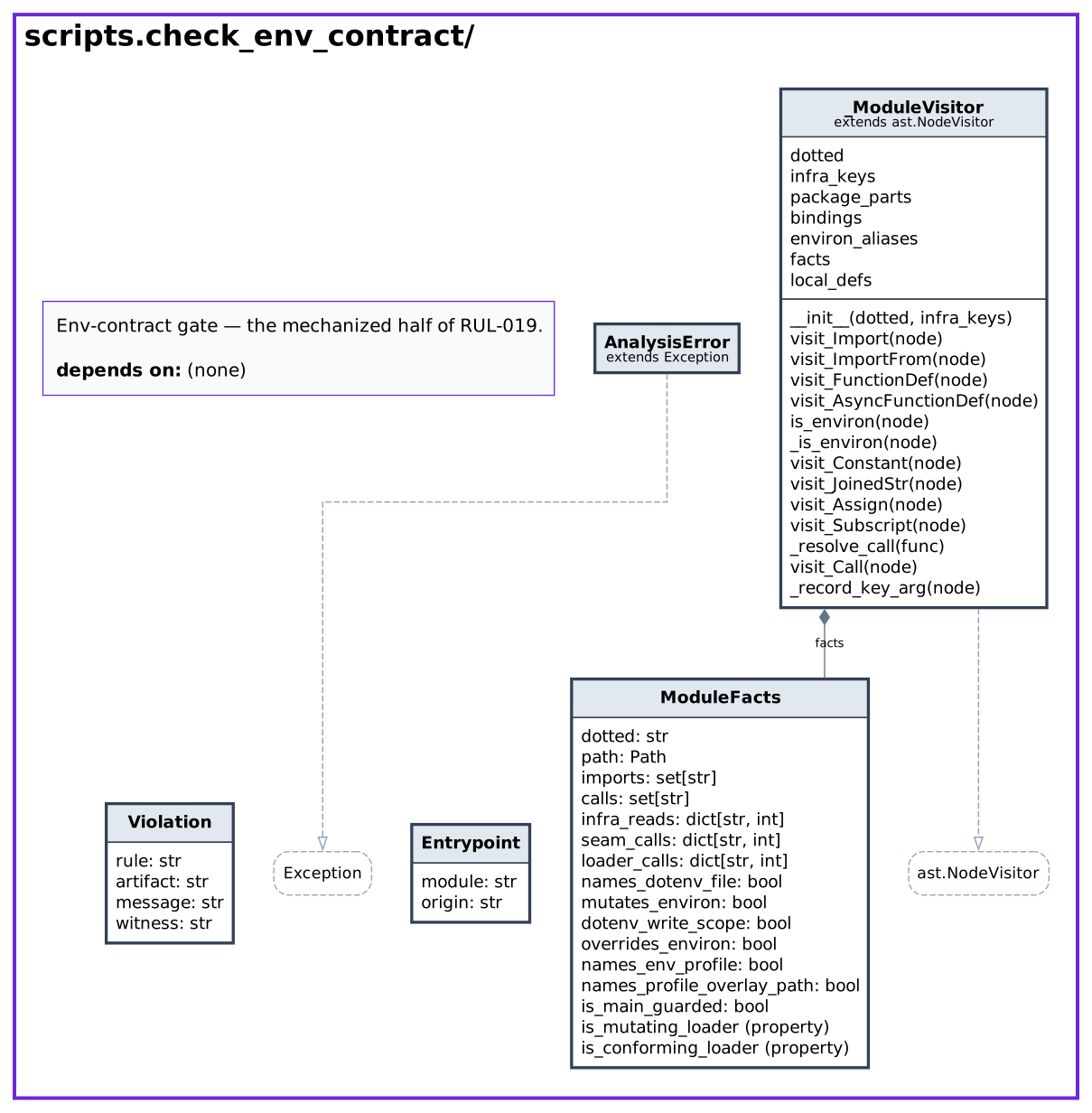
The analysis has three layers. First, module_map lists the modules and load_infra_keys reads the set of infrastructure variable names. A _ModuleVisitor walks each module's syntax tree and records, as ModuleFacts, which names it reads from the environment, whether it loads a dotenv file and whether it writes to the environment; a module is then classed as a mutating loader or a conforming loader. Second, import_edges builds the module import graph and collect_entrypoints gathers entrypoints from the project's script table, the deployment unit files (execstart_commands) and modules with a main guard. Third, closure_with_witness computes what each entrypoint reaches within the depth limit, with a witness path, and check_rule_a and the later rule checks produce a Violation for each breach. Only variable names are handled; values are never read.
At a glance
| Source | scripts/check_env_contract.py |
| Lines of code | 1068 |
| Classes | 5 |
| Functions | 24 |
| Imports (internal) | none |
| Imported by | none |
| Tests that import it | tests/scripts/test_check_env_contract.py |
Class diagram
Dependency diagram
No internal imports and no importers.
API
Constants
| Name | Type | Value |
|---|---|---|
RESOLVER_SEAMS |
frozenset[str] |
frozenset({'orchestrata_ultimate.cxp.endpoint_config.require_port', 'orchestrat… |
REGISTERED_LOADERS |
frozenset[str] |
frozenset({'orchestrata_ultimate.core.env_bootstrap.load_env_contract'}) |
Classes
AnalysisError
Bases: Exception · Line 166
The tree cannot be analysed at all — exit 2, never a silent pass.
Violation (dataclass)
Decorators: dataclass · Line 171
One finding. witness carries the import path that proves it, so a false positive is diagnosable in one read instead of being argued about.
| Attribute | Type | Default |
|---|---|---|
rule |
str |
|
artifact |
str |
|
message |
str |
|
witness |
str |
'' |
ModuleFacts (dataclass)
Decorators: dataclass · Line 182
Everything the gate needs from one src/ module, extracted once.
| Attribute | Type | Default |
|---|---|---|
dotted |
str |
|
path |
Path |
|
imports |
set[str] |
field(default_factory=set) |
calls |
set[str] |
field(default_factory=set) |
infra_reads |
dict[str, int] |
field(default_factory=dict) |
seam_calls |
dict[str, int] |
field(default_factory=dict) |
loader_calls |
dict[str, int] |
field(default_factory=dict) |
names_dotenv_file |
bool |
False |
mutates_environ |
bool |
False |
dotenv_write_scope |
bool |
False |
overrides_environ |
bool |
False |
names_env_profile |
bool |
False |
names_profile_overlay_path |
bool |
False |
is_main_guarded |
bool |
False |
| Method | Signature | Summary |
|---|---|---|
is_mutating_loader property |
is_mutating_loader() -> bool |
A hand-rolled .env loader: ONE SCOPE both names a .env file and writes into os.environ. |
is_conforming_loader property |
is_conforming_loader() -> bool |
The full RUL-019 two-phase contract: a mutating loader that is profile-aware AND applies the overlay with override (a bare os.environ[k] = v write, not only setdefault). |
Entrypoint (dataclass)
Decorators: dataclass · Line 235
One member of the E1/E2/E3 entrypoint universe, with its provenance.
| Attribute | Type | Default |
|---|---|---|
module |
str |
|
origin |
str |
_ModuleVisitor
Bases: ast.NodeVisitor · Line 338
Collects import edges, resolved call targets, and env facts.
| Method | Signature | Summary |
|---|---|---|
__init__ |
__init__(dotted: str, infra_keys: frozenset[str]) -> None |
|
visit_Import |
visit_Import(node: ast.Import) -> None |
|
visit_ImportFrom |
visit_ImportFrom(node: ast.ImportFrom) -> None |
|
visit_FunctionDef |
visit_FunctionDef(node: ast.FunctionDef) -> None |
|
visit_AsyncFunctionDef |
visit_AsyncFunctionDef(node: ast.AsyncFunctionDef) -> None |
|
is_environ |
is_environ(node: ast.expr) -> bool |
Public alias — the scope-correlation pass reuses this resolution. |
_is_environ |
_is_environ(node: ast.expr) -> bool |
|
visit_Constant |
visit_Constant(node: ast.Constant) -> None |
|
visit_JoinedStr |
visit_JoinedStr(node: ast.JoinedStr) -> None |
|
visit_Assign |
visit_Assign(node: ast.Assign) -> None |
|
visit_Subscript |
visit_Subscript(node: ast.Subscript) -> None |
|
_resolve_call |
_resolve_call(func: ast.expr) -> str | None |
|
visit_Call |
visit_Call(node: ast.Call) -> None |
|
_record_key_arg |
_record_key_arg(node: ast.Call) -> None |
Functions
| Function | Signature | Summary |
|---|---|---|
module_map |
module_map(src_root: Path) -> dict[str, Path] |
dotted name -> file for every .py under src_root. |
load_infra_keys |
load_infra_keys(src_root: Path) -> frozenset[str] |
Parse INFRA_ENDPOINT_KEYS out of core/infra_env_rule.py. |
_dotted_of |
_dotted_of(node: ast.expr) -> str | None |
a.b.c for a Name/Attribute chain, else None. |
_resolve_relative |
_resolve_relative(module: str | None, level: int, package_parts: list[str]) -> str |
|
_has_main_guard |
_has_main_guard(tree: ast.Module) -> bool |
|
_is_dotenv_const |
_is_dotenv_const(node: ast.AST) -> bool |
|
_writes_environ |
_writes_environ(node: ast.AST, visitor: _ModuleVisitor) -> bool |
os.environ[k] = v / os.environ.setdefault(...) / .update(...). |
_scope_bodies |
_scope_bodies(tree: ast.AST) -> list[list[ast.stmt]] |
Every scope that could hold a loader: each function body, plus the module's own top-level statements (walked WITHOUT descending into function or class bodies, which are separate scopes). |
_names_dotenv_and_writes |
_names_dotenv_and_writes(tree: ast.AST, visitor: _ModuleVisitor) -> bool |
True when ONE scope both names a .env file and writes os.environ. |
analyse_modules |
analyse_modules(modules: dict[str, Path], infra_keys: frozenset[str]) -> dict[str, ModuleFacts] |
Extract :class:ModuleFacts for every module. |
import_edges |
import_edges(facts: dict[str, ModuleFacts], modules: dict[str, Path]) -> dict[str, set[str]] |
Intra-package STATIC import edges only. |
entrypoints_from_pyproject |
entrypoints_from_pyproject(repo_root: Path, modules: dict[str, Path]) -> list[Entrypoint] |
E1: [project.scripts] / [project.gui-scripts] targets that resolve to a module under src/. |
execstart_commands |
execstart_commands(repo_root: Path) -> list[tuple[str, str]] |
(unit_rel_path, command) for every ExecStart= under deploy/. |
entrypoints_from_deploy |
entrypoints_from_deploy(repo_root: Path, modules: dict[str, Path], src_root: Path) -> tuple[list[Entrypoint], int] |
E2: ExecStart= targets under deploy/, plus the count resolved (reported so a silent parse regression is visible, never inferred). |
entrypoints_from_main_guards |
entrypoints_from_main_guards(facts: dict[str, ModuleFacts]) -> list[Entrypoint] |
E3: src/ modules carrying a top-level __main__ guard. |
collect_entrypoints |
collect_entrypoints(repo_root: Path, src_root: Path, modules: dict[str, Path], facts: dict[str, ModuleFacts]) -> tuple[dict[str, list[str]], int] |
module -> [origins] for the union of E1/E2/E3, plus the count of ExecStart targets resolved (printed so a silent parse regression is visible). |
closure_with_witness |
closure_with_witness(root: str, edges: dict[str, set[str]]) -> tuple[dict[str, int], dict[str, str | None]] |
BFS over static import edges. |
_witness_path |
_witness_path(target: str, parent: dict[str, str | None]) -> str |
|
check_rule_a |
check_rule_a(facts: dict[str, ModuleFacts], repo_root: Path) -> list[Violation] |
At most ONE mutating dotenv loader in src/, and it must be conforming (profile-aware, override-applying). |
_first_trigger |
_first_trigger(depth: dict[str, int], facts: dict[str, ModuleFacts], max_depth: int) -> tuple[str, str, str] | None |
(kind, detail, via_module) for the shallowest trigger within max_depth (-1 = unlimited), or None. |
check_rule_b |
check_rule_b(universe: dict[str, list[str]], facts: dict[str, ModuleFacts], edges: dict[str, set[str]], repo_root: Path, max_depth: int) -> tuple[list[Violation], list[dict], list[dict]] |
Every in-scope entrypoint's closure must reach a registered loader. |
run_check |
run_check(repo_root: Path, max_depth: int = 1) -> tuple[int, dict] |
Injection seam: tests pass a throwaway tmp_path repo root — this never touches the live checkout implicitly. |
_print_text_report |
_print_text_report(report: dict) -> None |
|
main |
main(argv: list[str] | None = None) -> int |
CLI entry point. 0 clean, 1 violations, 2 unanalysable tree. |
Source
#!/usr/bin/env python3
"""Env-contract gate — the mechanized half of RUL-019.
Ruling text, verbatim (this is the ``gate scripts/check_env_contract.py
RUL-019`` mechanism declared by
``~/workspace/knowledge-wiki/rulings/RUL-019-pydantic-dotenv-config-pattern.md``):
RUL-019 — Config modules use Pydantic BaseSettings, and env files must be auto-loaded by every entrypoint via _load_dotenv() (secrets-only .env, then the active ORCHESTRATA_ENV_PROFILE overlay env/{dev,test,prod}.env with override=True) — never left to direnv or manual sourcing. Currently declared `none (judgment)`, i.e. prose only.
MEASURED STATE (why this is mechanizable and worth mechanizing):
- There is NO canonical two-phase loader in src/. The only correct implementations of the ruling's contract live OUTSIDE the package: scripts/start_test_services.py::_load_dotenv (lines 95-127, .env setdefault then env/<profile>.env with override) and tests/conftest.py (lines 263/277).
- src/ carries three DIVERGENT copies, none of which does the profile overlay: gateway/cli.py::_load_dotenv (.env only, setdefault), kernel/cli_client.py::load_dotenv (explicitly "mirrors gateway.cli._load_dotenv"), llm/client.py::_load_dotenv (returns a mapping, never mutates os.environ).
- Two production entrypoints reach a REQUIRED raising infra seam and load nothing: agents/runtime_main.py (CXP_GRPC_PORT via cxp.endpoint_config.cxp_grpc_port) and knowledge_graph/server.py (KG_GRPC_PORT via cxp.endpoint_config.require_port). Both are launched by systemd ExecStart under deploy/ and survive only on EnvironmentFile= injection.
- Verified empirically, not theoretically: `env -i .venv/bin/python -m orchestrata_ultimate.agents.runtime_main` → rc=1, CXPConfigError "…define one in .env." The process names .env in its own failure message and never reads it.
RULING: mechanizable as a gate. The ruling is NOT "config modules should look like infra_config.py" (unfalsifiable, correctly judgment-only). It IS "every process that needs the infra contract must load the infra contract" — that is a reachability question over an enumerable entrypoint set, and it has a real answer today: two failures.
WHAT THIS GATE CHECKS — two rules. Rule B is the ruling; Rule A is what stops
Rule B being satisfiable by a stub.
ENTRYPOINT UNIVERSE (enumerable, deterministic; never "the file is called
cli.py"):
E1 ``[project.scripts]`` targets in ``pyproject.toml`` that resolve to a
module under ``src/``.
E2 ``ExecStart=`` lines under ``deploy/`` invoking ``python -m <mod>`` or
a path under ``src/``. Backslash line-continuations are joined before
matching (``deploy/systemd/*.service`` wraps every ExecStart) — a
line-wise regex would silently miss the kernel unit entirely, and a
missed entrypoint is a FALSE NEGATIVE, the worse direction here.
E3 ``src/**/*.py`` carrying a top-level ``if __name__ == "__main__":``.
IN-SCOPE FILTER: an entrypoint is in scope iff its transitive intra-package
import closure reaches a *read* of one of ``core.infra_env_rule
.INFRA_ENDPOINT_KEYS`` (the RUL-003 set — parsed out of that module, never
re-listed here, so the two rules can never drift) or a *call* to one of the
raising resolver seams in :data:`RESOLVER_SEAMS`. Everything else — the
infra-free CLIs, ``session/examples/*``, ``session/hooks/*`` — is silent.
RULE B — COVERAGE (the ruling): every in-scope entrypoint's closure must reach
a call to a REGISTERED env loader (:data:`REGISTERED_LOADERS` — an explicit
short list, never a name heuristic). Reachability, not unconditional
execution: ``gateway/cli.py`` guards its call with ``if env is None:`` for the
hermetic-test seam, and that legitimately counts.
RULE A — LOADER CONFORMANCE / NO DUPLICATES: at most ONE module under ``src/``
may define a MUTATING dotenv loader — defined precisely as a module that both
names a file whose basename is ``.env`` AND writes into ``os.environ``
(subscript assign / ``setdefault`` / ``update`` / ``pop`` / ``clear``). That
one module must statically reference ``ORCHESTRATA_ENV_PROFILE``, an ``env/``
profile path, and apply the profile with OVERRIDE (a bare ``os.environ[k] = v``
write, not only ``setdefault``). A second such module is a violation and must
import the canonical one.
DELIBERATELY NOT FLAGGED: non-mutating ``.env`` READERS (``llm/client.py``
``_load_dotenv`` returns a merged mapping; ``harness/history.py``
``_read_dotenv_graph_vars`` likewise) — the mutation predicate is exactly what
keeps them out. Non-entrypoint modules that read infra keys (``gateway/
server.py`` reads ``CXP_GRPC_PORT`` but is not a process; it is reached via
``gateway/cli.py``, which loads) — the analysis is transitive-from-entrypoint,
never per-file. ``scripts/*.py`` — operator tooling, out of scope entirely.
NOT MECHANIZED: the "config modules use Pydantic BaseSettings" clause. It has
no falsifiable subject — there is no enumerable set of "config modules"
distinct from "modules that read configuration", so a gate for it would either
flag every module touching ``os.environ`` (noise) or merely re-assert that
``core/infra_config.py`` exists (vacuous). That clause stays a second
``none (judgment)`` bullet on the ruling page, so the page states exactly which
half is covered.
CLOSURE DEPTH — why the trigger search is bounded (``--max-depth``, default 1),
measured, not assumed. Import reachability is a PROXY for "this process reads
the infra contract at startup", and at unlimited depth the proxy decouples from
the truth it stands for. Measured on this tree: unbounded, the gate reports 16
violations; 14 of them trace to ONE trigger site,
``core/graph/adapters/bolt_async.py:88``, where ``resolve_kg_database()`` is
called inside ``_session_kwargs`` — a method that runs only when a graph
session is actually opened. Importing the adapter reads nothing. Those 14
include ``session/examples/basic_usage.py``, which is not a process anybody
runs against infra. A gate that fires there gets switched off, and a
switched-off gate enforces nothing — the exact RUL-023 failure this exercise
exists to prevent.
At depth 1 the trigger must appear in the entrypoint module itself or in a
module it names in its OWN import statements — the process's declared startup
surface. That keeps the two real findings (``agents/runtime_main.py`` and
``knowledge_graph/server.py`` both call the seam in their own module) and
``gateway/cli.py`` (whose directly-imported ``gateway/server.py`` reads
``CXP_GRPC_PORT``).
The bound errs toward FALSE NEGATIVES: an entrypoint that delegates its infra
read two or more hops down is not flagged. That is deliberate and it is
VISIBLE, never silently dropped — every run reports ``deep_scope_only``, the
entrypoints that would be in scope at unlimited depth, with the witness path
to each trigger. Raise the bound with ``--max-depth`` (``-1`` = unlimited) to
audit that region.
Trigger search is depth-bounded; LOADER search is not. Scoping narrowly and
crediting coverage broadly both bias away from false alarms, which is the only
direction a gate survives in.
SCOPE LIMIT, STATED: this gate proves an entrypoint REACHES a conforming
loader; it does not prove the loader RAN before the first infra read
(ordering). An ordering proof needs runtime evidence. Do not claim ordering
coverage.
Exit 0 clean, 1 on any violation, 2 when the tree cannot be analysed at all
(no ``src/``, unparseable ``infra_env_rule.py``).
Usage:
python scripts/check_env_contract.py [--repo-root PATH] [--max-depth N] [--json]
"""
from __future__ import annotations
import argparse
import ast
import json
import re
import sys
import tomllib
from collections import deque
from dataclasses import asdict, dataclass, field
from pathlib import Path
REPO_ROOT = Path(__file__).resolve().parent.parent
RULE_ID = "RUL-019"
#: The raising resolver seams. A call to any of these means the caller depends
#: on a REQUIRED infra key being present in the environment — the seam raises
#: rather than defaulting (RUL-003), so an unloaded process dies at startup.
RESOLVER_SEAMS: frozenset[str] = frozenset(
{
"orchestrata_ultimate.cxp.endpoint_config.require_port",
"orchestrata_ultimate.cxp.endpoint_config.cxp_grpc_port",
"orchestrata_ultimate.core.graph_factory.resolve_uri",
"orchestrata_ultimate.core.graph_factory.resolve_kg_database",
"orchestrata_ultimate.core.redis_factory.resolve_redis_host",
"orchestrata_ultimate.core.redis_factory.resolve_redis_port",
}
)
#: The env-contract loaders an in-scope entrypoint may reach. EXPLICIT — never
#: a name heuristic ("anything called ``*load_dotenv*``"), because the whole
#: point of Rule A is that hand-rolled look-alikes are the defect. Keep this
#: list in the same commit as any new loader; Rule A's one-canonical-loader
#: constraint is what keeps it from growing.
REGISTERED_LOADERS: frozenset[str] = frozenset(
{
# THE single canonical two-phase loader. The two migration entries that
# used to sit beside it (``gateway.cli._load_dotenv`` and
# ``kernel.cli_client.load_dotenv``) were hand-rolled ``.env``-only
# walk-ups that never applied the ``env/<profile>.env`` overlay; both
# now delegate here and are reached transitively, so the allowlist is
# back to the one name Rule A intends.
"orchestrata_ultimate.core.env_bootstrap.load_env_contract",
}
)
_ENVIRON_MUTATORS = frozenset({"setdefault", "update", "pop", "clear", "popitem"})
_EXECSTART_RE = re.compile(r"^ExecStart\s*=\s*(.*)$", re.MULTILINE)
_CONTINUATION_RE = re.compile(r"\\\s*\n\s*")
class AnalysisError(Exception):
"""The tree cannot be analysed at all — exit 2, never a silent pass."""
@dataclass
class Violation:
"""One finding. *witness* carries the import path that proves it, so a
false positive is diagnosable in one read instead of being argued about."""
rule: str # "A" or "B"
artifact: str # repo-relative path
message: str
witness: str = ""
@dataclass
class ModuleFacts:
"""Everything the gate needs from one ``src/`` module, extracted once."""
dotted: str
path: Path
imports: set[str] = field(default_factory=set)
calls: set[str] = field(default_factory=set)
infra_reads: dict[str, int] = field(default_factory=dict) # key -> lineno
seam_calls: dict[str, int] = field(default_factory=dict) # seam -> lineno
loader_calls: dict[str, int] = field(default_factory=dict) # loader -> lineno
names_dotenv_file: bool = False
mutates_environ: bool = False
#: A single SCOPE both names a ``.env`` file and writes ``os.environ``.
#: Module-wide co-occurrence is NOT enough — see ``_names_dotenv_and_writes``.
dotenv_write_scope: bool = False
overrides_environ: bool = False
names_env_profile: bool = False
names_profile_overlay_path: bool = False
is_main_guarded: bool = False
@property
def is_mutating_loader(self) -> bool:
"""A hand-rolled ``.env`` loader: ONE SCOPE both names a ``.env`` file
and writes into ``os.environ``. Non-mutating readers
(``llm/client.py``) are deliberately excluded — they serve a different
job (returning a mapping to a caller) and are not a second source of
truth for the process environment.
The scope correlation is load-bearing. Module-wide co-occurrence of
the two facts is not evidence of anything: measured 2026-08-05, adding
the project-mandated free-threading guard
``os.environ.setdefault("OPENBLAS_NUM_THREADS", "1")`` to
``core/infra_config.py`` — whose only ``.env`` mention is pydantic's
``env_file=".env"`` in a class body — reported it as a rogue loader
and told the author to "fold this onto" the canonical env loader.
Eight live modules name a ``.env`` path; each was one unrelated
``os.environ`` write away from the same false accusation."""
return self.dotenv_write_scope
@property
def is_conforming_loader(self) -> bool:
"""The full RUL-019 two-phase contract: a mutating loader that is
profile-aware AND applies the overlay with override (a bare
``os.environ[k] = v`` write, not only ``setdefault``)."""
return (
self.is_mutating_loader
and self.names_env_profile
and self.names_profile_overlay_path
and self.overrides_environ
)
@dataclass
class Entrypoint:
"""One member of the E1/E2/E3 entrypoint universe, with its provenance."""
module: str
origin: str # human-readable provenance, e.g. "deploy/x.service ExecStart"
# --------------------------------------------------------------------------
# module map
# --------------------------------------------------------------------------
def module_map(src_root: Path) -> dict[str, Path]:
"""``dotted name -> file`` for every ``.py`` under *src_root*.
``pkg/__init__.py`` maps to the bare package name so ``from pkg import x``
resolves an edge onto the package marker as well as the submodule.
"""
out: dict[str, Path] = {}
for path in sorted(src_root.rglob("*.py")):
rel = path.relative_to(src_root)
parts = list(rel.parts)
if parts[-1] == "__init__.py":
parts = parts[:-1]
if not parts:
continue
else:
parts[-1] = parts[-1][: -len(".py")]
out[".".join(parts)] = path
return out
def load_infra_keys(src_root: Path) -> frozenset[str]:
"""Parse ``INFRA_ENDPOINT_KEYS`` out of ``core/infra_env_rule.py``.
Parsed statically rather than imported: the gate must work against a
throwaway fixture tree that is not installed, and against a checkout whose
package may not be importable. Reusing that already-canonical set (the
RUL-003 keys) instead of re-listing it here is what stops RUL-003 and
RUL-019 drifting apart.
"""
path = src_root / "orchestrata_ultimate" / "core" / "infra_env_rule.py"
if not path.exists():
raise AnalysisError(f"missing canonical key set: {path}")
try:
tree = ast.parse(path.read_text(encoding="utf-8"))
except SyntaxError as exc:
raise AnalysisError(f"cannot parse {path}: {exc}") from exc
for node in tree.body:
target = None
value = None
if isinstance(node, ast.AnnAssign) and isinstance(node.target, ast.Name):
target, value = node.target.id, node.value
elif isinstance(node, ast.Assign) and len(node.targets) == 1:
if isinstance(node.targets[0], ast.Name):
target, value = node.targets[0].id, node.value
if target != "INFRA_ENDPOINT_KEYS" or value is None:
continue
payload: ast.expr = value
if (
isinstance(value, ast.Call)
and isinstance(value.func, ast.Name)
and value.func.id == "frozenset"
and value.args
):
payload = value.args[0]
try:
keys = ast.literal_eval(payload)
except ValueError as exc:
raise AnalysisError(f"INFRA_ENDPOINT_KEYS is not a literal: {exc}") from exc
return frozenset(str(k) for k in keys)
raise AnalysisError(f"INFRA_ENDPOINT_KEYS not found in {path}")
# --------------------------------------------------------------------------
# per-module static analysis
# --------------------------------------------------------------------------
def _dotted_of(node: ast.expr) -> str | None:
"""``a.b.c`` for a Name/Attribute chain, else ``None``."""
parts: list[str] = []
cur: ast.expr = node
while isinstance(cur, ast.Attribute):
parts.append(cur.attr)
cur = cur.value
if not isinstance(cur, ast.Name):
return None
parts.append(cur.id)
return ".".join(reversed(parts))
def _resolve_relative(module: str | None, level: int, package_parts: list[str]) -> str:
base = (
package_parts[: len(package_parts) - (level - 1)]
if level > 1
else list(package_parts)
)
if module:
base = base + module.split(".")
return ".".join(base)
class _ModuleVisitor(ast.NodeVisitor):
"""Collects import edges, resolved call targets, and env facts.
Call targets are resolved through the module's own IMPORT BINDINGS (and
its top-level ``def``s), never by bare name matching — a local helper that
happens to be called ``require_port`` must not read as the CXP seam.
"""
def __init__(self, dotted: str, infra_keys: frozenset[str]) -> None:
self.dotted = dotted
self.infra_keys = infra_keys
self.package_parts = dotted.split(".")[:-1]
self.bindings: dict[str, str] = {}
self.environ_aliases: set[str] = set()
self.facts = ModuleFacts(dotted=dotted, path=Path())
self.local_defs: set[str] = set()
# -- imports ---------------------------------------------------------
def visit_Import(self, node: ast.Import) -> None:
for alias in node.names:
local = alias.asname or alias.name.split(".")[0]
target = alias.name if alias.asname else alias.name.split(".")[0]
self.bindings[local] = target
self.facts.imports.add(alias.name)
self.generic_visit(node)
def visit_ImportFrom(self, node: ast.ImportFrom) -> None:
module = (
_resolve_relative(node.module, node.level, self.package_parts)
if node.level
else (node.module or "")
)
if module:
self.facts.imports.add(module)
for alias in node.names:
local = alias.asname or alias.name
if module == "os" and alias.name == "environ":
self.environ_aliases.add(local)
qualified = f"{module}.{alias.name}" if module else alias.name
self.bindings[local] = qualified
self.facts.imports.add(qualified)
self.generic_visit(node)
# -- defs ------------------------------------------------------------
def visit_FunctionDef(self, node: ast.FunctionDef) -> None:
self.local_defs.add(node.name)
self.generic_visit(node)
def visit_AsyncFunctionDef(self, node: ast.AsyncFunctionDef) -> None:
self.local_defs.add(node.name)
self.generic_visit(node)
# -- env facts -------------------------------------------------------
def is_environ(self, node: ast.expr) -> bool:
"""Public alias — the scope-correlation pass reuses this resolution."""
return self._is_environ(node)
def _is_environ(self, node: ast.expr) -> bool:
dotted = _dotted_of(node)
if dotted in ("os.environ", "environ"):
return dotted == "os.environ" or "environ" in self.environ_aliases
return False
def visit_Constant(self, node: ast.Constant) -> None:
if isinstance(node.value, str):
value = node.value
if value == ".env" or value.endswith("/.env"):
self.facts.names_dotenv_file = True
if value == "ORCHESTRATA_ENV_PROFILE":
self.facts.names_env_profile = True
if value == "env" or "env/" in value:
self.facts.names_profile_overlay_path = True
self.generic_visit(node)
def visit_JoinedStr(self, node: ast.JoinedStr) -> None:
# f"{profile}.env" — the profile-overlay filename never appears as a
# plain constant, so the overlay check must see through f-strings.
tail = node.values[-1] if node.values else None
if isinstance(tail, ast.Constant) and isinstance(tail.value, str):
if tail.value.endswith(".env"):
self.facts.names_profile_overlay_path = True
self.generic_visit(node)
def visit_Assign(self, node: ast.Assign) -> None:
for target in node.targets:
if isinstance(target, ast.Subscript) and self._is_environ(target.value):
self.facts.mutates_environ = True
# A bare subscript write is the OVERRIDE form; setdefault is
# the only-if-unset form. The distinction is the whole
# difference between the base .env tier and the profile tier.
self.facts.overrides_environ = True
self.generic_visit(node)
def visit_Subscript(self, node: ast.Subscript) -> None:
if self._is_environ(node.value) and isinstance(node.slice, ast.Constant):
key = node.slice.value
if isinstance(key, str) and key in self.infra_keys:
self.facts.infra_reads.setdefault(key, node.lineno)
self.generic_visit(node)
# -- calls -----------------------------------------------------------
def _resolve_call(self, func: ast.expr) -> str | None:
if isinstance(func, ast.Name):
if func.id in self.bindings:
return self.bindings[func.id]
if func.id in self.local_defs:
return f"{self.dotted}.{func.id}"
return None
dotted = _dotted_of(func)
if dotted is None:
return None
head, _, rest = dotted.partition(".")
if head in self.bindings and rest:
return f"{self.bindings[head]}.{rest}"
return None
def visit_Call(self, node: ast.Call) -> None:
resolved = self._resolve_call(node.func)
if resolved:
self.facts.calls.add(resolved)
if resolved in RESOLVER_SEAMS:
self.facts.seam_calls.setdefault(resolved, node.lineno)
if resolved in REGISTERED_LOADERS:
self.facts.loader_calls.setdefault(resolved, node.lineno)
# os.environ.setdefault(...) / .update(...) — mutation, not a read.
if isinstance(node.func, ast.Attribute):
if node.func.attr in _ENVIRON_MUTATORS and self._is_environ(
node.func.value
):
self.facts.mutates_environ = True
if node.func.attr in ("get", "setdefault") and self._is_environ(
node.func.value
):
self._record_key_arg(node)
# A key STRING is an infra READ only when something RESOLVES it: an
# os.environ lookup (above) or a raising resolver seam such as
# require_port("KG_GRPC_PORT"). Recording it for ANY call whose first
# argument merely equals a key name turns pure help text into an infra
# dependency — measured 2026-08-05, a one-line
# ``_key_help("REDIS_HOST")`` returning an f-string pulled
# ``postman.cli`` into scope and failed it for "reads required infra
# key REDIS_HOST ... depends on systemd EnvironmentFile= injection".
# The two genuine findings are seam calls, so they are unaffected.
if resolved in RESOLVER_SEAMS:
self._record_key_arg(node)
self.generic_visit(node)
def _record_key_arg(self, node: ast.Call) -> None:
if not node.args:
return
first = node.args[0]
if isinstance(first, ast.Constant) and isinstance(first.value, str):
if first.value in self.infra_keys:
self.facts.infra_reads.setdefault(first.value, node.lineno)
def _has_main_guard(tree: ast.Module) -> bool:
for node in tree.body:
if not isinstance(node, ast.If):
continue
test = node.test
if (
isinstance(test, ast.Compare)
and isinstance(test.left, ast.Name)
and test.left.id == "__name__"
and len(test.comparators) == 1
and isinstance(test.comparators[0], ast.Constant)
and test.comparators[0].value == "__main__"
):
return True
return False
def _is_dotenv_const(node: ast.AST) -> bool:
return (
isinstance(node, ast.Constant)
and isinstance(node.value, str)
and (node.value == ".env" or node.value.endswith("/.env"))
)
def _writes_environ(node: ast.AST, visitor: _ModuleVisitor) -> bool:
"""``os.environ[k] = v`` / ``os.environ.setdefault(...)`` / ``.update(...)``."""
if isinstance(node, ast.Assign):
return any(
isinstance(t, ast.Subscript) and visitor.is_environ(t.value)
for t in node.targets
)
if isinstance(node, ast.Call) and isinstance(node.func, ast.Attribute):
return node.func.attr in _ENVIRON_MUTATORS and visitor.is_environ(
node.func.value
)
return False
def _scope_bodies(tree: ast.AST) -> list[list[ast.stmt]]:
"""Every scope that could hold a loader: each function body, plus the
module's own top-level statements (walked WITHOUT descending into function
or class bodies, which are separate scopes)."""
scopes: list[list[ast.stmt]] = []
for node in ast.walk(tree):
if isinstance(node, (ast.FunctionDef, ast.AsyncFunctionDef)):
scopes.append(node.body)
if isinstance(tree, ast.Module):
top: list[ast.stmt] = []
stack: list[ast.stmt] = list(tree.body)
while stack:
stmt = stack.pop()
if isinstance(stmt, (ast.FunctionDef, ast.AsyncFunctionDef, ast.ClassDef)):
continue
top.append(stmt)
for child in ast.iter_child_nodes(stmt):
if isinstance(child, ast.stmt):
stack.append(child)
scopes.append(top)
return scopes
def _names_dotenv_and_writes(tree: ast.AST, visitor: _ModuleVisitor) -> bool:
"""True when ONE scope both names a ``.env`` file and writes ``os.environ``.
Requiring co-occurrence within a single scope is what separates a real
hand-rolled loader (``def _load_dotenv(): ... os.environ.setdefault(k, v)``)
from a module that merely happens to do both somewhere — e.g. a pydantic
``env_file=".env"`` declaration in a class body alongside an unrelated
``os.environ.setdefault("OPENBLAS_NUM_THREADS", "1")`` at module level.
"""
for body in _scope_bodies(tree):
names_dotenv = False
writes = False
for stmt in body:
for node in ast.walk(stmt):
if _is_dotenv_const(node):
names_dotenv = True
elif _writes_environ(node, visitor):
writes = True
if names_dotenv and writes:
return True
return False
def analyse_modules(
modules: dict[str, Path], infra_keys: frozenset[str]
) -> dict[str, ModuleFacts]:
"""Extract :class:`ModuleFacts` for every module. A module that fails to
parse yields EMPTY facts rather than aborting the run — one broken file
must not blind the gate to the rest of the tree."""
out: dict[str, ModuleFacts] = {}
for dotted, path in modules.items():
try:
tree = ast.parse(path.read_text(encoding="utf-8", errors="replace"))
except SyntaxError:
out[dotted] = ModuleFacts(dotted=dotted, path=path)
continue
visitor = _ModuleVisitor(dotted, infra_keys)
visitor.visit(tree)
facts = visitor.facts
facts.path = path
facts.is_main_guarded = _has_main_guard(tree)
facts.dotenv_write_scope = _names_dotenv_and_writes(tree, visitor)
out[dotted] = facts
return out
def import_edges(
facts: dict[str, ModuleFacts], modules: dict[str, Path]
) -> dict[str, set[str]]:
"""Intra-package STATIC import edges only.
No speculative call-graph resolution: an edge exists because an ``import``
statement names a module that exists under ``src/``. A dotted name that
resolves to a symbol inside a module (``pkg.mod.func``) folds onto its
longest existing module prefix.
"""
edges: dict[str, set[str]] = {}
for dotted, mf in facts.items():
targets: set[str] = set()
for raw in mf.imports:
parts = raw.split(".")
for i in range(len(parts), 0, -1):
candidate = ".".join(parts[:i])
if candidate in modules and candidate != dotted:
targets.add(candidate)
break
edges[dotted] = targets
return edges
# --------------------------------------------------------------------------
# entrypoint universe
# --------------------------------------------------------------------------
def entrypoints_from_pyproject(
repo_root: Path, modules: dict[str, Path]
) -> list[Entrypoint]:
"""E1: ``[project.scripts]`` / ``[project.gui-scripts]`` targets that
resolve to a module under ``src/``."""
path = repo_root / "pyproject.toml"
if not path.exists():
return []
try:
data = tomllib.loads(path.read_text(encoding="utf-8"))
except tomllib.TOMLDecodeError:
return []
out: list[Entrypoint] = []
for table in ("scripts", "gui-scripts"):
entries = data.get("project", {}).get(table) or {}
for name, target in sorted(entries.items()):
module = str(target).split(":")[0]
if module in modules:
out.append(
Entrypoint(module, f"pyproject.toml [project.{table}] {name}")
)
return out
def execstart_commands(repo_root: Path) -> list[tuple[str, str]]:
"""``(unit_rel_path, command)`` for every ``ExecStart=`` under ``deploy/``.
Backslash line-continuations are joined FIRST. ``deploy/systemd/*.service``
wraps every ExecStart across two lines; a line-wise regex would resolve
zero targets there and report a clean tree — a false negative.
"""
deploy = repo_root / "deploy"
if not deploy.is_dir():
return []
return [
(str(path.relative_to(repo_root)), match.group(1).strip())
for path in sorted(deploy.rglob("*"))
if path.is_file() and path.suffix in (".service", ".timer", ".socket")
for match in _EXECSTART_RE.finditer(
_CONTINUATION_RE.sub(
" ", path.read_text(encoding="utf-8", errors="replace")
)
)
]
def entrypoints_from_deploy(
repo_root: Path, modules: dict[str, Path], src_root: Path
) -> tuple[list[Entrypoint], int]:
"""E2: ``ExecStart=`` targets under ``deploy/``, plus the count resolved
(reported so a silent parse regression is visible, never inferred)."""
out: list[Entrypoint] = []
resolved = 0
for unit, command in execstart_commands(repo_root):
tokens = command.replace("=", " ").split()
module: str | None = None
for i, token in enumerate(tokens):
if token == "-m" and i + 1 < len(tokens):
candidate = tokens[i + 1]
if candidate in modules:
module = candidate
break
if token.endswith(".py"):
candidate_path = Path(token)
try:
rel = candidate_path.resolve().relative_to(src_root.resolve())
except ValueError, OSError:
continue
parts = list(rel.parts)
parts[-1] = parts[-1][: -len(".py")]
candidate = ".".join(parts)
if candidate in modules:
module = candidate
break
if module:
resolved += 1
out.append(Entrypoint(module, f"{unit} ExecStart"))
return out, resolved
def entrypoints_from_main_guards(facts: dict[str, ModuleFacts]) -> list[Entrypoint]:
"""E3: ``src/`` modules carrying a top-level ``__main__`` guard."""
return [
Entrypoint(dotted, "__main__ guard")
for dotted, mf in sorted(facts.items())
if mf.is_main_guarded
]
def collect_entrypoints(
repo_root: Path,
src_root: Path,
modules: dict[str, Path],
facts: dict[str, ModuleFacts],
) -> tuple[dict[str, list[str]], int]:
"""``module -> [origins]`` for the union of E1/E2/E3, plus the count of
ExecStart targets resolved (printed so a silent parse regression is
visible)."""
deploy_eps, resolved = entrypoints_from_deploy(repo_root, modules, src_root)
universe: dict[str, list[str]] = {}
for ep in (
entrypoints_from_pyproject(repo_root, modules)
+ deploy_eps
+ entrypoints_from_main_guards(facts)
):
universe.setdefault(ep.module, []).append(ep.origin)
return universe, resolved
# --------------------------------------------------------------------------
# closure + rules
# --------------------------------------------------------------------------
def closure_with_witness(
root: str, edges: dict[str, set[str]]
) -> tuple[dict[str, int], dict[str, str | None]]:
"""BFS over static import edges.
Returns ``{module: depth}`` (breadth-first, so ``depth`` is the SHORTEST
import distance from *root*) and a parent map, so every finding can print
the exact witness path instead of asserting reachability the reader has to
take on faith.
"""
depth: dict[str, int] = {root: 0}
parent: dict[str, str | None] = {root: None}
queue = deque([root])
while queue:
current = queue.popleft()
for nxt in sorted(edges.get(current, ())):
if nxt not in depth:
depth[nxt] = depth[current] + 1
parent[nxt] = current
queue.append(nxt)
return depth, parent
def _witness_path(target: str, parent: dict[str, str | None]) -> str:
chain = [target]
cur = parent.get(target)
while cur is not None:
chain.append(cur)
cur = parent.get(cur)
return " -> ".join(reversed(chain))
def check_rule_a(facts: dict[str, ModuleFacts], repo_root: Path) -> list[Violation]:
"""At most ONE mutating dotenv loader in ``src/``, and it must be
conforming (profile-aware, override-applying)."""
loaders = [mf for mf in facts.values() if mf.is_mutating_loader]
if not loaders:
return []
conforming = [mf for mf in loaders if mf.is_conforming_loader]
violations: list[Violation] = []
def rel(mf: ModuleFacts) -> str:
try:
return str(mf.path.relative_to(repo_root))
except ValueError:
return str(mf.path)
if len(conforming) == 1:
canonical = conforming[0]
for mf in sorted(loaders, key=lambda m: m.dotted):
if mf is canonical:
continue
violations.append(
Violation(
"A",
rel(mf),
f"{mf.dotted} is a second hand-rolled mutating .env loader "
f"(names a .env file and writes os.environ); the canonical "
f"loader is {canonical.dotted} — import it instead of "
f"re-implementing the env contract",
)
)
return violations
if len(conforming) > 1:
return [
Violation(
"A",
rel(mf),
f"{mf.dotted} is one of {len(conforming)} conforming env "
f"loaders — exactly ONE module under src/ may own the env "
f"contract",
)
for mf in sorted(conforming, key=lambda m: m.dotted)
]
# Zero conforming: every mutating loader is a non-conforming duplicate of
# a contract that does not exist yet.
for mf in sorted(loaders, key=lambda m: m.dotted):
missing = []
if not mf.names_env_profile:
missing.append("ORCHESTRATA_ENV_PROFILE")
if not mf.names_profile_overlay_path:
missing.append("env/<profile>.env overlay path")
if not mf.overrides_environ:
missing.append("override write (os.environ[k] = v)")
violations.append(
Violation(
"A",
rel(mf),
f"{mf.dotted} writes os.environ from a .env file but does not "
f"implement the RUL-019 two-phase contract — missing: "
f"{', '.join(missing)}. Exactly ONE canonical loader may exist; "
f"fold this onto it",
)
)
return violations
def _first_trigger(
depth: dict[str, int],
facts: dict[str, ModuleFacts],
max_depth: int,
) -> tuple[str, str, str] | None:
"""``(kind, detail, via_module)`` for the shallowest trigger within
*max_depth* (``-1`` = unlimited), or ``None``.
Shallowest first, so the witness path printed for a finding is the
shortest one — the version a reader can actually check.
"""
candidates = sorted(depth, key=lambda name: (depth[name], name))
for name in candidates:
if max_depth >= 0 and depth[name] > max_depth:
break
other = facts.get(name)
if other is None:
continue
for seam, lineno in sorted(other.seam_calls.items()):
return ("seam", f"{seam} (line {lineno})", name)
for key, lineno in sorted(other.infra_reads.items()):
return ("key", f"{key} (line {lineno})", name)
return None
def check_rule_b(
universe: dict[str, list[str]],
facts: dict[str, ModuleFacts],
edges: dict[str, set[str]],
repo_root: Path,
max_depth: int,
) -> tuple[list[Violation], list[dict], list[dict]]:
"""Every in-scope entrypoint's closure must reach a registered loader.
Returns ``(violations, in_scope, deep_scope_only)``. The third list is the
region the depth bound discards — entrypoints that WOULD be in scope at
unlimited depth. It is reported on every run so the bound's false-negative
surface stays visible instead of becoming an invisible exemption.
"""
violations: list[Violation] = []
scoped: list[dict] = []
deep_only: list[dict] = []
for module in sorted(universe):
mf = facts.get(module)
if mf is None:
continue
depth, parent = closure_with_witness(module, edges)
trigger = _first_trigger(depth, facts, max_depth)
if trigger is None:
deep_trigger = _first_trigger(depth, facts, -1)
if deep_trigger is not None:
kind, detail, via = deep_trigger
deep_only.append(
{
"module": module,
"origins": universe[module],
"trigger": {"kind": kind, "detail": detail, "via": via},
"depth": depth[via],
"witness": _witness_path(via, parent),
}
)
continue
# Loader search is deliberately UNBOUNDED — see the module docstring.
loader: tuple[str, str] | None = None
for name in sorted(depth, key=lambda n: (depth[n], n)):
other = facts.get(name)
if other is None or not other.loader_calls:
continue
loader = (sorted(other.loader_calls)[0], name)
break
kind, detail, via = trigger
scoped.append(
{
"module": module,
"origins": universe[module],
"trigger": {"kind": kind, "detail": detail, "via": via},
"loader": ({"call": loader[0], "via": loader[1]} if loader else None),
}
)
if loader is not None:
continue
try:
artifact = str(facts[module].path.relative_to(repo_root))
except ValueError:
artifact = str(facts[module].path)
subject = (
f"calls required infra seam {detail}"
if kind == "seam"
else f"reads required infra key {detail}"
)
origins = "; ".join(universe[module])
violations.append(
Violation(
"B",
artifact,
f"entrypoint {module} ({origins}) {subject}, but its import "
f"closure never reaches the env-contract loader — it depends on "
f"systemd EnvironmentFile= injection and cannot start from a "
f"bare shell",
witness=_witness_path(via, parent),
)
)
return violations, scoped, deep_only
# --------------------------------------------------------------------------
# driver
# --------------------------------------------------------------------------
def run_check(repo_root: Path, max_depth: int = 1) -> tuple[int, dict]:
"""Injection seam: tests pass a throwaway tmp_path repo root — this never
touches the live checkout implicitly."""
src_root = repo_root / "src"
if not src_root.is_dir():
raise AnalysisError(f"no src/ directory under {repo_root}")
modules = module_map(src_root)
if not modules:
raise AnalysisError(f"no python modules under {src_root}")
infra_keys = load_infra_keys(src_root)
facts = analyse_modules(modules, infra_keys)
edges = import_edges(facts, modules)
universe, execstart_resolved = collect_entrypoints(
repo_root, src_root, modules, facts
)
violations = check_rule_a(facts, repo_root)
rule_b, scoped, deep_only = check_rule_b(
universe, facts, edges, repo_root, max_depth
)
violations.extend(rule_b)
report = {
"status": "pass" if not violations else "fail",
"rule_id": RULE_ID,
"repo_root": str(repo_root),
"max_depth": max_depth,
"infra_keys": sorted(infra_keys),
"modules": len(modules),
"entrypoints": len(universe),
"execstart_targets_resolved": execstart_resolved,
"in_scope": scoped,
"deep_scope_only": deep_only,
"mutating_loaders": sorted(
mf.dotted for mf in facts.values() if mf.is_mutating_loader
),
"violations": [asdict(v) for v in violations],
}
return (0 if not violations else 1), report
def _print_text_report(report: dict) -> None:
print(
f"[env-contract] {report['modules']} module(s), "
f"{report['entrypoints']} entrypoint(s), "
f"{len(report['in_scope'])} in scope at depth "
f"{report['max_depth']}, "
f"{report['execstart_targets_resolved']} ExecStart target(s) resolved",
flush=True,
)
if report["deep_scope_only"]:
print(
f"[env-contract] note: {len(report['deep_scope_only'])} further "
f"entrypoint(s) would be in scope at unlimited depth — not graded "
f"here (see --max-depth): "
+ ", ".join(d["module"] for d in report["deep_scope_only"]),
flush=True,
)
if report["status"] == "pass":
print(f"[env-contract] OK — {RULE_ID} satisfied", flush=True)
return
print(
f"[env-contract] FAIL — {len(report['violations'])} violation(s):",
flush=True,
)
for v in report["violations"]:
print(
f" {RULE_ID} [rule {v['rule']}] {v['artifact']}: {v['message']}",
flush=True,
)
if v["witness"]:
print(f" witness: {v['witness']}", flush=True)
def main(argv: list[str] | None = None) -> int:
"""CLI entry point. 0 clean, 1 violations, 2 unanalysable tree."""
parser = argparse.ArgumentParser(description="RUL-019 env-contract gate")
parser.add_argument(
"--repo-root",
default=None,
help="Tree to analyse (default: this checkout's root)",
)
parser.add_argument(
"--max-depth",
type=int,
default=1,
help=(
"Import-closure depth searched for an infra trigger (default 1: "
"the entrypoint and what it imports directly; -1 = unlimited). "
"See the module docstring for the measurement behind the default."
),
)
parser.add_argument("--json", action="store_true", help="Machine-readable output")
args = parser.parse_args(argv)
root = Path(args.repo_root).expanduser().resolve() if args.repo_root else REPO_ROOT
try:
exit_code, report = run_check(root, max_depth=args.max_depth)
except AnalysisError as exc:
print(f"[env-contract] ERROR — {exc}", file=sys.stderr, flush=True)
return 2
if args.json:
print(json.dumps(report, indent=2, default=str))
else:
_print_text_report(report)
return exit_code
if __name__ == "__main__":
sys.exit(main())