scripts.benchmark_code_intel
Reference › scripts › benchmark_code_intel
Measures the Step 3.4 code-intelligence service-level objectives against the live graph cluster. A human or a scheduled check runs it; tests/scripts/test_benchmark_code_intel.py imports it.
Invocation: main builds its parser in _build_parser and accepts a target URI, a database name, an iteration count (--iterations) and --json FILE for a machine-readable report. resolve_target_uri picks the endpoint from the environment unless one is given explicitly. It prints the target, runs every SLO, prints a table and a count such as "n/m SLOs met", and finishes with RESULT: PASS (exit 0) or RESULT: FAIL (exit 1).
Each SLO is a query template with a latency budget. sample_ids draws real node ids from the graph and params_for fills a template's parameters. measure runs the query the requested number of times and returns a Measurement whose observed_ms, within_budget and passed say whether the budget held. explain fetches the query plan and plan_scans fails a measurement when the plan scans instead of using an index, so a fast result on a small graph does not hide a bad plan. report_payload assembles the JSON report. The benchmark only reads the graph.
At a glance
| Source | scripts/benchmark_code_intel.py |
| Lines of code | 426 |
| Classes | 2 |
| Functions | 10 |
| Imports (internal) | none |
| Imported by | none |
| Tests that import it | tests/scripts/test_benchmark_code_intel.py |
Class diagram
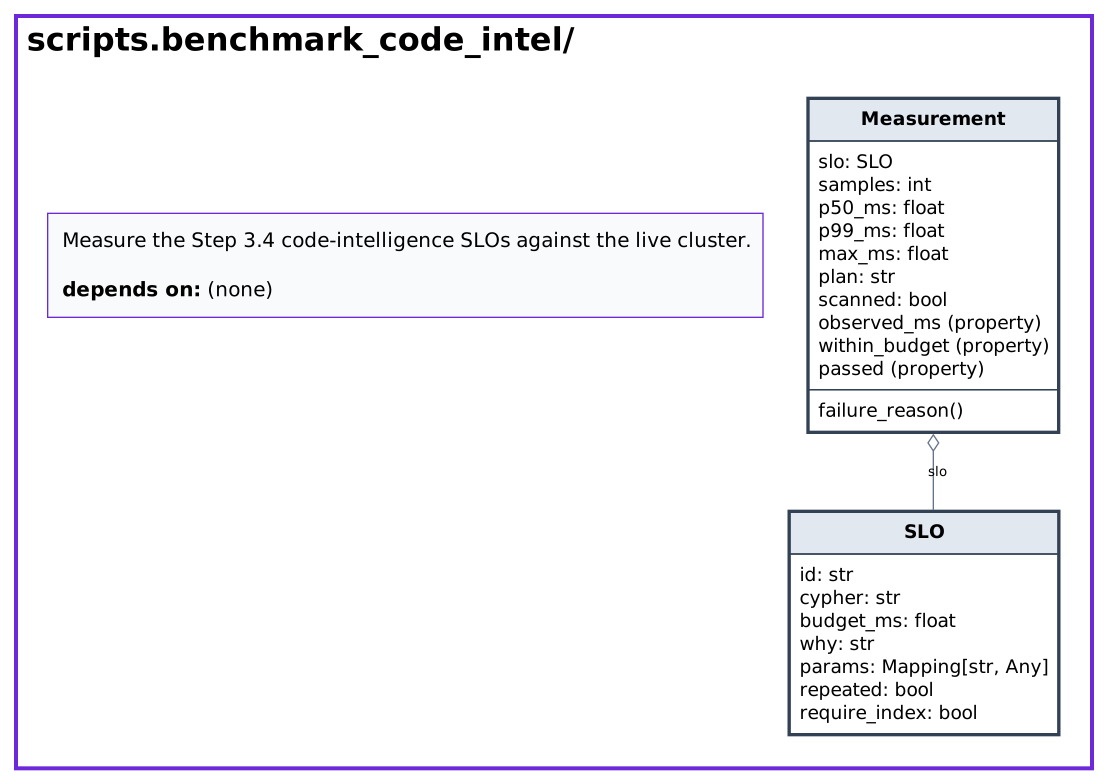
Dependency diagram
No internal imports and no importers.
API
Constants
| Name | Type | Value |
|---|---|---|
SLO_TEMPLATES |
tuple[SLO, ...] |
(SLO(id='indexed_symbol_lookup_class', cypher='MATCH (c:Class {id: $id}) RETURN… |
Classes
SLO (dataclass)
Decorators: dataclass(frozen=True) · Line 57
One measured service-level objective.
| Attribute | Type | Default |
|---|---|---|
id |
str |
|
cypher |
str |
|
budget_ms |
float |
|
why |
str |
|
params |
Mapping[str, Any] |
field(default_factory=dict) |
repeated |
bool |
True |
require_index |
bool |
True |
Measurement (dataclass)
Decorators: dataclass · Line 154
What one SLO actually cost, and whether it met its budget.
| Attribute | Type | Default |
|---|---|---|
slo |
SLO |
|
samples |
int |
|
p50_ms |
float |
|
p99_ms |
float |
|
max_ms |
float |
|
plan |
str |
|
scanned |
bool |
| Method | Signature | Summary |
|---|---|---|
observed_ms property |
observed_ms() -> float |
The number compared against the budget. |
within_budget property |
within_budget() -> bool |
|
passed property |
passed() -> bool |
|
failure_reason |
failure_reason() -> str |
Functions
| Function | Signature | Summary |
|---|---|---|
plan_scans |
plan_scans(plan_rows: Sequence[str]) -> bool |
Whether a query plan reads more rows than an index lookup would. |
explain |
explain(session: Any, cypher: str, params: Mapping[str, Any]) -> list[str] |
Return the query plan as a list of operator lines. |
measure |
measure(session: Any, slo: SLO, params: Mapping[str, Any], iterations: int) -> Measurement |
Time one SLO and capture its plan. |
sample_ids |
sample_ids(session: Any) -> dict[str, str] |
Read one real canonical id per code label from the graph. |
params_for |
params_for(slo: SLO, ids: Mapping[str, str]) -> dict[str, Any] |
Bind each SLO to a real id sampled from the graph. |
resolve_target_uri |
resolve_target_uri(env: Mapping[str, str], explicit: str | None) -> str |
Address of the graph to measure, from .env at call time (RUL-003). |
_build_parser |
_build_parser() -> argparse.ArgumentParser |
|
print_measurements |
print_measurements(measurements: Sequence[Measurement]) -> None |
Print one line per SLO, then the reason for every miss. |
report_payload |
report_payload(endpoints: Mapping[str, str], measurements: Sequence[Measurement]) -> dict[str, Any] |
Assemble the machine-readable SLO report. |
main |
main(argv: list[str] | None = None, env: Mapping[str, str] | None = None) -> int |
Measure every SLO; return 0 only when all of them are met. |
Source
"""Measure the Step 3.4 code-intelligence SLOs against the live cluster.

The SLOs are ratified in ``plans/neo4j-to-orchgraph-migration-plan.md``
Step 3.4 and are *measured*, never asserted:

    | SLO                                        | Target      |
    |--------------------------------------------|-------------|
    | Indexed symbol lookup (canonical id)       | p99 < 1 ms  |
    | 2-hop neighborhood (callers/callees/inh.)  | p99 < 1 ms  |
    | Full code-node predicate scan              | < 50 ms     |
    | Whole-graph MAGE analytical pass           | < 1 s       |

The file-save -> graph SLO (< 5 s) belongs to the live-sync service and is
measured by ``scripts/ast_live_sync.py --measure`` / its integration test,
not here: it is an end-to-end pipeline latency, not a query latency.

**Plan gate.** A latency number alone cannot distinguish "fast because it
used an index" from "fast because the graph is small today". Every latency
SLO therefore also EXPLAINs its query and fails if the plan contains a
whole-label/whole-graph scan where an index applies. That gate is what
caught ``Method.id`` planning ``ScanAll`` over 5,561 nodes: Method is out of
canonical_schema.py's canon, so it gets no CONSTRAINT and therefore none of
the implicit indexes every other code label receives.

Honest physics (quoted from the plan): sub-ms is PER indexed lookup / k-hop
on the in-memory engine; a query touching every node is tens of ms;
whole-codebase analytics are the MAGE sub-second class. No SLO here claims
sub-ms full scans.

Exits non-zero on any miss, so it can gate the Phase 4.3 suite evidence.

Usage::

    python scripts/benchmark_code_intel.py
    python scripts/benchmark_code_intel.py --iterations 500 --json reports/slo.json
"""

from __future__ import annotations

import argparse
import json
import os
import statistics
import sys
import time
from collections.abc import Mapping, Sequence
from dataclasses import dataclass, field
from typing import Any

# Plan operators that mean "this query read more than the index would have".
# Memgraph spells them ScanAll / ScanAllByLabel; anything ScanAllByLabelProperties
# or narrower is an index hit.
_SCAN_OPERATORS = ("ScanAll (", "ScanAllByLabel (")


@dataclass(frozen=True)
class SLO:
    """One measured service-level objective.

    ``budget_ms`` is compared against ``p99`` for repeated queries and
    against the single measured duration for one-shot analytical passes.
    """

    id: str
    cypher: str
    budget_ms: float
    why: str
    params: Mapping[str, Any] = field(default_factory=dict)
    # One-shot passes (a whole-graph MAGE algorithm) are measured once: a p99
    # over repeated runs would measure Memgraph's result cache, not the pass.
    repeated: bool = True
    # Scans are legitimate for the deliberate full-scan SLO.
    require_index: bool = True


# Canonical ids are project-qualified (ruling 2). These are read from the
# graph at runtime rather than hardcoded, so the benchmark cannot silently
# measure a lookup that matches nothing.
SLO_TEMPLATES: tuple[SLO, ...] = (
    SLO(
        id="indexed_symbol_lookup_class",
        cypher="MATCH (c:Class {id: $id}) RETURN c.qualified_name AS n",
        budget_ms=1.0,
        why="the review path resolves a symbol by canonical id on every hop",
    ),
    SLO(
        id="indexed_symbol_lookup_method",
        cypher="MATCH (m:Method {id: $id}) RETURN m.qualified_name AS n",
        budget_ms=1.0,
        why="Method is the largest code label (5.5K) and had no id index",
    ),
    SLO(
        id="indexed_symbol_lookup_function",
        cypher="MATCH (f:Function {id: $id}) RETURN f.qualified_name AS n",
        budget_ms=1.0,
        why="function lookup by canonical id",
    ),
    SLO(
        id="two_hop_callers_callees",
        cypher=(
            "MATCH (f:Function {id: $id})-[:CALLS*1..2]->(callee) "
            "RETURN count(DISTINCT callee) AS n"
        ),
        budget_ms=1.0,
        why="'what does changing this break' is a 2-hop call traversal",
    ),
    SLO(
        id="two_hop_inheritance",
        cypher=(
            "MATCH (c:Class {id: $id})-[:INHERITS*1..2]->(base) "
            "RETURN count(DISTINCT base) AS n"
        ),
        budget_ms=1.0,
        why="review needs the ancestor chain of a changed class",
    ),
    SLO(
        id="module_defines_neighborhood",
        cypher=(
            "MATCH (m:Module {id: $id})-[:DEFINES]->(sym) " "RETURN count(sym) AS n"
        ),
        budget_ms=1.0,
        why="a file-save review pulls everything the changed module defines",
    ),
    SLO(
        id="full_code_node_predicate_scan",
        cypher="MATCH (m:Method) WHERE m.is_async RETURN count(m) AS n",
        budget_ms=50.0,
        why="a predicate over every method — deliberately unindexed, tens of ms",
        require_index=False,
    ),
    SLO(
        id="mage_whole_graph_pagerank",
        cypher="CALL pagerank.get() YIELD node, rank RETURN count(node) AS n",
        budget_ms=1000.0,
        why="whole-graph analytical pass is the MAGE sub-second class",
        repeated=False,
        require_index=False,
    ),
    SLO(
        id="mage_whole_graph_wcc",
        cypher=(
            "CALL weakly_connected_components.get() "
            "YIELD node, component_id RETURN count(DISTINCT component_id) AS n"
        ),
        budget_ms=1000.0,
        why="connectivity over the whole graph — the root-invariant check",
        repeated=False,
        require_index=False,
    ),
)


@dataclass
class Measurement:
    """What one SLO actually cost, and whether it met its budget."""

    slo: SLO
    samples: int
    p50_ms: float
    p99_ms: float
    max_ms: float
    plan: str
    scanned: bool

    @property
    def observed_ms(self) -> float:
        """The number compared against the budget."""
        return self.p99_ms if self.slo.repeated else self.max_ms

    @property
    def within_budget(self) -> bool:
        return self.observed_ms < self.slo.budget_ms

    @property
    def passed(self) -> bool:
        return self.within_budget and not (self.slo.require_index and self.scanned)

    def failure_reason(self) -> str:
        reasons = []
        if not self.within_budget:
            reasons.append(
                f"{self.observed_ms:.3f} ms >= {self.slo.budget_ms:.3f} ms budget"
            )
        if self.slo.require_index and self.scanned:
            reasons.append(f"plan scans where an index applies: {self.plan}")
        return "; ".join(reasons)


def plan_scans(plan_rows: Sequence[str]) -> bool:
    """Whether a query plan reads more rows than an index lookup would.

    ``ScanAllByLabelProperties`` (and narrower) is an index hit; bare
    ``ScanAll`` / ``ScanAllByLabel`` mean the engine walked the label or the
    whole graph. Prefix matching is deliberate -- ``ScanAllByLabel (`` must
    not match ``ScanAllByLabelProperties (``.
    """
    return any(op in row for row in plan_rows for op in _SCAN_OPERATORS)


def explain(session: Any, cypher: str, params: Mapping[str, Any]) -> list[str]:
    """Return the query plan as a list of operator lines."""
    rows = session.run(f"EXPLAIN {cypher}", dict(params))
    return [str(next(iter(row.values()))).strip() for row in rows]


def measure(
    session: Any, slo: SLO, params: Mapping[str, Any], iterations: int
) -> Measurement:
    """Time one SLO and capture its plan.

    A warm-up run precedes timing: the first execution of any query pays
    plan-compilation cost that no production caller pays on the hot path, and
    including it would report a parse-time regression as a graph regression.
    """
    merged = {**slo.params, **params}
    # MAGE procedures cannot be EXPLAINed on all builds; a plan we cannot read
    # is reported as "no plan", never as a silent pass of the index gate.
    try:
        plan_rows = explain(session, slo.cypher, merged)
    except Exception:
        plan_rows = []
    scanned = plan_scans(plan_rows) if plan_rows else False

    session.run(slo.cypher, dict(merged)).consume()  # warm-up

    runs = iterations if slo.repeated else 1
    durations: list[float] = []
    for _ in range(runs):
        started = time.perf_counter()
        session.run(slo.cypher, dict(merged)).consume()
        durations.append((time.perf_counter() - started) * 1000.0)

    durations.sort()
    # A p99 needs enough samples that the 99th percentile is not simply "the
    # worst sample". At n=200 it lands on the 2nd-worst, so ONE server-side
    # hiccup (GC pause, snapshot write) is reported as an SLO breach: measured
    # 2026-07-26, indexed_symbol_lookup_method "missed" at 3.135 ms p99 with a
    # 13.884 ms single-sample max while its p50 (0.348 ms) was identical to
    # the Class and Function lookups. At n=1000 the same SLO measured 0.720 ms.
    # Hence the 1000 default -- reporting noise as a regression is the failure
    # mode this harness exists to prevent.
    p99 = (
        statistics.quantiles(durations, n=100)[98]
        if len(durations) >= 100
        else durations[-1]
    )
    return Measurement(
        slo=slo,
        samples=len(durations),
        p50_ms=statistics.median(durations),
        p99_ms=p99,
        max_ms=durations[-1],
        plan=" | ".join(plan_rows) or "(no plan available)",
        scanned=scanned,
    )


def sample_ids(session: Any) -> dict[str, str]:
    """Read one real canonical id per code label from the graph.

    Hardcoding ids would let the benchmark keep "passing" while measuring
    lookups that match nothing -- the fastest possible query and a
    meaningless one.
    """
    wanted = {
        "class_id": "MATCH (c:Class) RETURN c.id AS id LIMIT 1",
        "method_id": "MATCH (m:Method) RETURN m.id AS id LIMIT 1",
        "function_id": "MATCH (f:Function) RETURN f.id AS id LIMIT 1",
        "module_id": "MATCH (m:Module) RETURN m.id AS id LIMIT 1",
        # A Function that actually calls something, so the 2-hop SLO
        # traverses edges instead of measuring an empty expansion.
        "calling_function_id": (
            "MATCH (f:Function)-[:CALLS]->() RETURN f.id AS id LIMIT 1"
        ),
        "inheriting_class_id": (
            "MATCH (c:Class)-[:INHERITS]->() RETURN c.id AS id LIMIT 1"
        ),
    }
    found: dict[str, str] = {}
    for key, cypher in wanted.items():
        row = session.run(cypher).single()
        if row is None or row["id"] is None:
            raise SystemExit(
                f"cannot benchmark: no node available for {key!r} "
                f"({cypher}). Run the Step 3.3 re-derive first."
            )
        found[key] = row["id"]
    return found


def params_for(slo: SLO, ids: Mapping[str, str]) -> dict[str, Any]:
    """Bind each SLO to a real id sampled from the graph."""
    by_slo = {
        "indexed_symbol_lookup_class": ids["class_id"],
        "indexed_symbol_lookup_method": ids["method_id"],
        "indexed_symbol_lookup_function": ids["function_id"],
        "two_hop_callers_callees": ids["calling_function_id"],
        "two_hop_inheritance": ids["inheriting_class_id"],
        "module_defines_neighborhood": ids["module_id"],
    }
    node_id = by_slo.get(slo.id)
    return {"id": node_id} if node_id is not None else {}


def resolve_target_uri(env: Mapping[str, str], explicit: str | None) -> str:
    """Address of the graph to measure, from .env at call time (RUL-003).

    Prefers ``KG_ROUTING_URI`` and falls back to ``MEMGRAPH_URI`` so this
    harness keeps working across the Phase 4.2 cutover without an edit:
    ``KG_ROUTING_URI`` is empty in ``.env`` today and is the key the cutover
    fills in, while ``MEMGRAPH_URI`` is the orchgraph routing address now.
    Hardcoding either would make the benchmark measure the wrong graph on one
    side of the flip.
    """
    if explicit:
        return explicit
    for key in ("KG_ROUTING_URI", "MEMGRAPH_URI"):
        value = env.get(key, "").strip()
        # An unsubstituted .env template leaves CHANGEME_* sentinels behind —
        # those are NOT endpoints (they crash the driver's URI parser with an
        # empty scheme far from the cause); treat them as unset, matching
        # conftest's ADR-0053 sentinel guard.
        if value and not value.startswith("CHANGEME_"):
            return value
    raise SystemExit(
        "neither KG_ROUTING_URI nor MEMGRAPH_URI is set, and no --uri was passed"
    )


def _build_parser() -> argparse.ArgumentParser:
    parser = argparse.ArgumentParser(description=__doc__)
    parser.add_argument(
        "--uri", default=None, help="default: $KG_ROUTING_URI, else $MEMGRAPH_URI"
    )
    parser.add_argument("--database", default="orchkg")
    parser.add_argument(
        "--iterations",
        type=int,
        default=1000,
        help="samples per repeated SLO (default: 1000)",
    )
    parser.add_argument("--json", default=None, help="write a report to this path")
    return parser


def print_measurements(measurements: Sequence[Measurement]) -> None:
    """Print one line per SLO, then the reason for every miss."""
    for m in measurements:
        mark = "OK  " if m.passed else "MISS"
        stat = "p99" if m.slo.repeated else "max"
        print(
            f"  [{mark}] {m.slo.id:<34} {stat}={m.observed_ms:8.3f} ms "
            f"budget={m.slo.budget_ms:8.3f} ms  n={m.samples}"
        )
    for m in measurements:
        if not m.passed:
            print(f"\n  MISS {m.slo.id}: {m.failure_reason()}")
            print(f"       why this SLO exists: {m.slo.why}")


def report_payload(
    endpoints: Mapping[str, str], measurements: Sequence[Measurement]
) -> dict[str, Any]:
    """Assemble the machine-readable SLO report."""
    return {
        **endpoints,
        "total": len(measurements),
        "passed": sum(1 for m in measurements if m.passed),
        "results": [
            {
                "id": m.slo.id,
                "why": m.slo.why,
                "budget_ms": m.slo.budget_ms,
                "observed_ms": m.observed_ms,
                "p50_ms": m.p50_ms,
                "p99_ms": m.p99_ms,
                "max_ms": m.max_ms,
                "samples": m.samples,
                "plan": m.plan,
                "scanned": m.scanned,
                "passed": m.passed,
                "failure_reason": "" if m.passed else m.failure_reason(),
            }
            for m in measurements
        ],
    }


def main(argv: list[str] | None = None, env: Mapping[str, str] | None = None) -> int:
    """Measure every SLO; return 0 only when all of them are met."""
    args = _build_parser().parse_args(argv)
    environ = env if env is not None else os.environ

    from neo4j import GraphDatabase

    uri = resolve_target_uri(environ, args.uri)
    print(f"target : {uri} db={args.database}")
    print(f"SLOs   : {len(SLO_TEMPLATES)} · {args.iterations} iterations each\n")

    driver = GraphDatabase.driver(uri, auth=None)
    try:
        with driver.session(database=args.database) as session:
            ids = sample_ids(session)
            measurements = [
                measure(session, slo, params_for(slo, ids), args.iterations)
                for slo in SLO_TEMPLATES
            ]
    finally:
        driver.close()

    print_measurements(measurements)
    missed = [m for m in measurements if not m.passed]
    print(f"\n{len(measurements) - len(missed)}/{len(measurements)} SLOs met")

    if args.json:
        payload = report_payload({"uri": uri, "database": args.database}, measurements)
        with open(args.json, "w", encoding="utf-8") as handle:
            json.dump(payload, handle, indent=2)
        print(f"report: {args.json}")

    print("RESULT: PASS" if not missed else "RESULT: FAIL")
    return 0 if not missed else 1


if __name__ == "__main__":
    sys.exit(main())